Stephen King properties sure has been heating up around Hollywood of late. For the past month or so we’ve had almost weekly news about Ron Howard’s plans for King’s massive book series, The Dark Tower. Today news that the role of Roland Deschain, the Gunslinger, has been offered to Spanish-actor Javier Bardem shows that the planned film adaptation of The Dark Tower is moving forward.
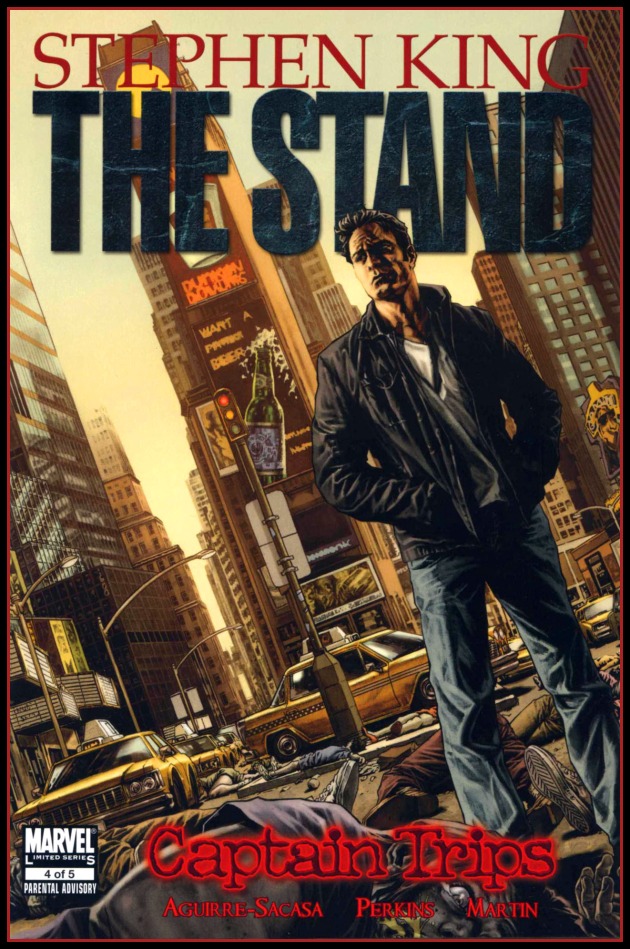
Now, according to The Hollywood Reporter blog Heat Vision, Warner Brothers and CBS Films are planning to co-produce the film adaptation of another Stephen King property and one many of his fans consider as their favorite. I consider myself one of those fans and I’m actually quite excited that these two studios are looking to adapt the epic, apocalyptic novel The Stand.
The novel already was adapted into a mini-series by Mick Garris in 1994, but that adaptation didn’t satisfy the book’s fans as its producers were hoping for. This planned film adaptation looks to give The Stand a grand stage to be shown to its old and new fans. While trying to adapt a novel that is over 1200 pages long might seem daunting the same was said about trying to adapt a novel that was three times it’s length and that one succeeded beyond anyone’s expectations. If Peter Jackson can take The Lord of the Rings and create an epic masterpiece out of such a dense piece of literature I think King’s The Stand should make just as good a transition.
Here’s to hoping that this particular apocalyptic project gets on the fast track and doesn’t get bogged down in development hell the way another apocalypse-themed film project has found itself in: Max Brook’s zombie epic novel, World War Z.
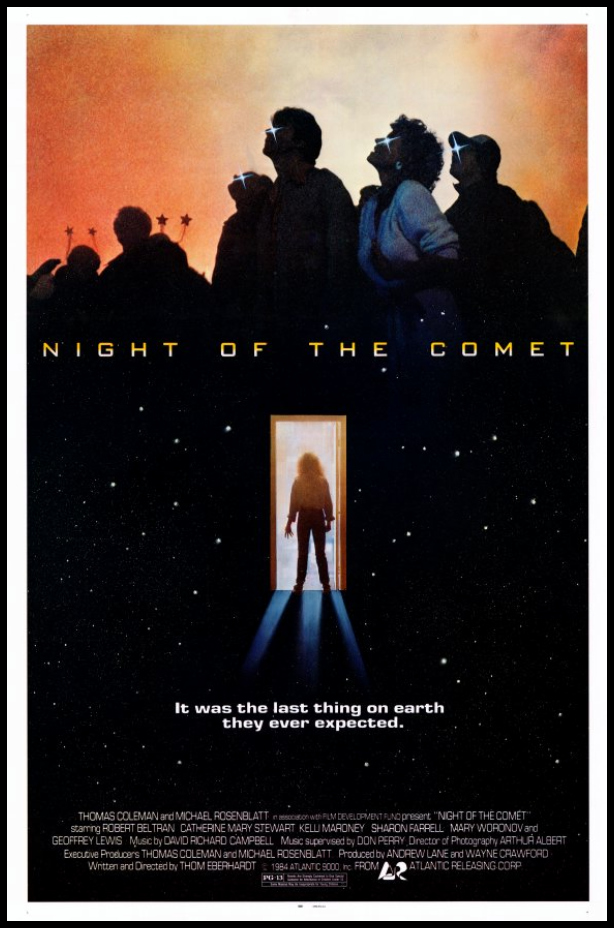
Night of the Comet took advantage of the return of Halley’s Comet hype which ran through nation and pretty much most of the world throughout most of 1984 and into 1985. Hollywood being the opportunist industry that it was (and still is) were quick to produce and release a movie about the return of Halley’s Comet over the planet as soon as possible. The 1980’s was a good decade for the low to mid-budgeted horror and sci-fi movies which had a quick death at the box-office but which gained success and cult status in the many displays racks of the tens of thousands of video rental places. 1984’s Night of the Comet was one of these films and it typifies the cheesiness that was 1980’s scifi horror.
The film opens up with everyone partying the arrival of Halley’s Comet which could be seen in the night sky every 75-76 years. This time around the planet will pass through the comet’s tail which has only happened once and that was 65 million years in the past. People are out on the streets as night falls celebrating the Comet’s arrival and we meet two of the main characters in the film in the form of Regina (80’s genre icon Catherine Mary Stewart) and Samantha (Kelli Maroney). Two sisters who truly epitomizes the mall and valley culture of 1980’s Southern California, Regina and Samantha are not enjoying the night of the comet as Regina ends up working the night shift at the local theater she works at and Samantha is stuck at home with her stepmother and all the partygoers attending her stepmom’s party. In the span of a few sequences both Regina and Samantha end up locking themselves up somewhere quiet and safe to get away from the party going on around them.
While they stew in their own little, steel-lined hideaways the comet makes its pass over the planet with everyone who can see looking up to take a peek of the returning comet. What happens next sets up the rest of the movie. The comet seem to have turned anyone not protected behind heavy steel structures into red dust and those only half-protected end up turning into zombie-like creatures. Luckily for the two sisters they were inside such heavy steel structures when the comet did its pass over and were well-protected. The rest of the movie deals with Regina and Samantha dealing with the possibility that they may be the last people on the planet (though this soon get shotdown with the arrival of Commander Chakotay of Star Trek Voyager…I mean Robert Beltran) and trying to keep themselves from being eaten by the zombie survivors and being tested upon by shady, secret government scientists.
Night of the Comet won’t win any awards even from horror and science-fiction groups, but it will entertain to a point. For those who grew up during the 80’s the movie will bring back fond, if painful memories of just how cheesy that decade was in terms of pop culture. Catherine Mary Stewart as Regina would be seen in more cheesy horror flicks of the era. In fact, she pretty much became the PG-13 version of 80’s Scream Queen Linnea Quigley. Where Ms. Quigley wasn’t against gratuitious nudity and sex in the movies she was in, Ms. Stewart was very chaste and very girl next door in her roles.
Would I recommend this movie to people? Yes, I would but buying the dvd might be more for the hardcore horror and scifi completist since one can easily see Night of the Comet on regular and cable TV. In the end, the movie is a fun romp back through time to a weird and different era. The movie is not great, but it’s not bad either.
Before I talk about this trailer, allow me to share a few facts: my family used to live in Fouke, Arkansas! I’ve been down to Boggy Creek! I never saw the famous Fouke Monster but I went out looking for him a few times! Anyway, this is the trailer for The Legend of Boggy Creek, which is a documentary about an apeman that supposedly lives in the area (though, according to Wikipedia, he hasn’t been spotted since ’98 so maybe he drowned or moved to Missouri). This film is somewhat infamous because it features reenactments of various monster sightings, some of which star people who actually lived in Fouke at the time and who play themselves (and a few of them later sued once the film came out). It was also the first film directed by Charles B. Pierce, who directed a lot of independent films in Arkansas and North Texas, including the classic The Town That Dreaded Sundown. Sadly, Pierce passed away last year at the age of 71.
This is one of those trailers that I discovered while randomly searching Youtube and, I have to be honest, my first thought was that it was a parody trailer. But no, after researching the manner, I can say that Mean Mother is a real movie. It was apparently yet another one of the cinematic offerings of the late Al Adamson.
This Italian film is one of the countless Omen/Exorcist rip-offs that came out in the 70s. Actually, The Night Child is an indirect rip-off of those two films as it’s actually a rip-off of a previous Italian version of the Exorcist, Beyond The Door. What I especially love about this trailer is the “Keeping telling yourself, she’s only a child,” line which is obviously meant to recall the “Keep telling yourself, it’s only a movie…” tagline from Last House On The Left.
“Meet today’s women…beautiful, liberated, and ready for action! They’re the young nurses and they’re growing up fast!” I love the narrator of this trailer. I’ve heard his voice in several exploitation trailers from the early 70s and he just has a way of delivering the sleaziest lines in the most cheerful, harmless way. I’d love to know who he was and if he’s still with us.
Oh. My. God. Okay, I saw this movie a few years ago and I was watching it by myself at 3 in the morning with all the lights off while there was a thunderstorm going on outside and there was this howling wind that kept on making all the windows shake. I got so scared, it’s not even funny. This is a remake of the silent classic. It stars Klaus Kinski, Bruno Ganz, and Isabelle Adjani and was directed by the one and only Werner Herzog.
“Why don’t you come along and see me this week? And bring your girlfriend…” This trailer was specifically designed to promote this film in Australia. Needless to say, that’s not actually Sylvia Kristel providing the voice over.
It has been over ten years since one of the masters of horror has released a full-length feature film. Sure, John Carpenter has filmed episodes for two seasons of Showtime’s horror anthology, Masters of Horror. But it seemed like the bad experience he had in filming his last feature-length, 2001’s Ghosts of Mars, might have soured him in doing anything for the big-screen.
That was then and this is now 2011 and Carpenter looks to make his return to the big-screen with the horror film, The Ward. It will star one of the industry’s rising stars in Amber Heard with veteran performers both young (Danielle Panabaker, Lyndsy Fonseca) and old (Jared Harris) backing her up.
The Ward was first show in this past 2010 Toronto International Film Festival and the reaction to the film was generally positive with most saying this was a good return for one of the horror genre’s most admired and beloved filmmakers.
The film looks to be set in a 1960’s mental institution with Heard’s character the center of attention. Mysterious happenings involving the staff, current patients and the presence of a ghost seem to be the main plot of the film.
Will Carpenter’s bag of filmmaking skills remain as it was before he left feature-length filmmaking a decade ago or will he show that he’s learned a few new tricks to add to his considerable skillset? The film certainly seem to echo some of the Japanese-style gothic and ghost story films which still remains a staple of Japanese horror cinema. In the end, I’m just glad to see one of the masters of horror back in the driver’s seat. Time for him to show some of the young horror filmmakers nowadays how to do it.
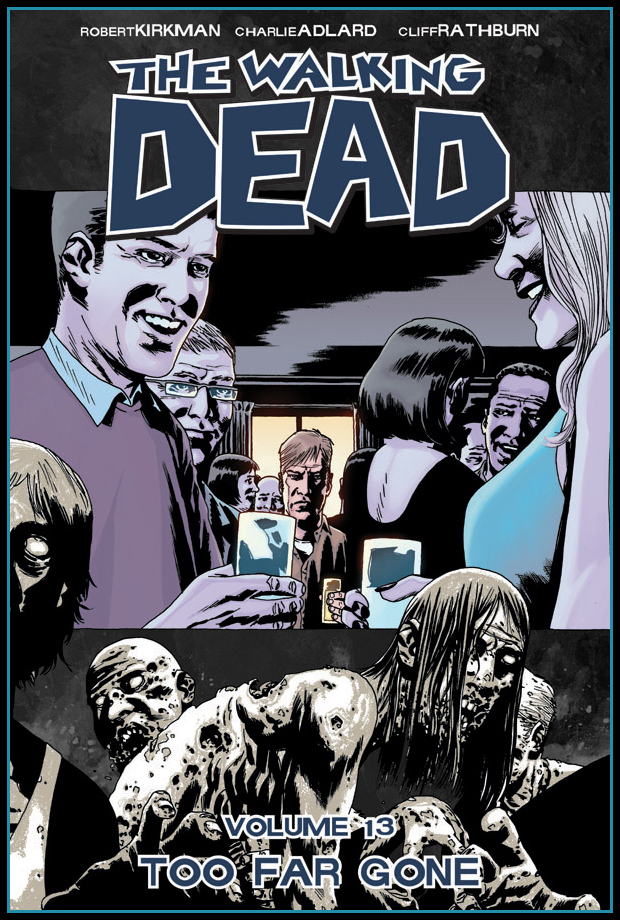
It’s been almost a month since the final episode of the first season for the tv series adaptation of this comic book aired on AMC. The Frank Darabont and Gale Anne Hurd produced series became a major hit not just for the channel but also for everyone involved. While the adaptation deviated from the comic’s path at times in the end it helped established the post-apocalyptic world creator Robert Kirkman had been working five years to create. This is a world that is still on-going and, just weeks earlier, released the thirteenth volume of collected issues 73 thru to 78.
The 13th volume is aptly titled, Too Far Gone, as it continues where the previous trade paperback left off and that’s Rick and his group of survivors trying to settle in the safe, walled community in Alexandria, VA. This wasn’t the respite Rick and his group were hoping for, but it is as close to one as they’ll get as their original destination of Washington, DC resembles much of everything else they’ve seen and that’s unsafe devastation.
As Rick gradually gets used to going back as a lawman for the community everyone else do their part in doing the new jobs handpicked for them by the community’s leader Douglas. Through the first half of the volume we see through the point of view of certain character that this safe haven they’ve joined has it’s fair share of secrets and that not everything was as stable as they’ve been led to believe. While some of the revelations the reader will read as the volume unfolds doesn’t bring back images of Woodbury and The Governor, they do show that the underbelly of the Alexandria community is just as rotten but in other ways.
The title of the volume is in regards to Rick as a character and to a small degree the rest of his group. Here they are in a safe place with other survivors who just want to try and get back to living life the way it used to be. The paranoia and mistrust Rick has built within himself after the long journey from his hospital bed to this place has begun to chip away at not just his sanity but his humanity as well. He hasn’t turned the corner to become another Governor, but his actions in regards to trying to safeguard their new found safety does show that Rick and some in his group do not trust all the smiles and well-wishes thrown their way.
Rick knows that as safe as they all might seem now it doesn’t take much for all of it to come crashing down. It’s this looming threat that forces Rick to behave in ways which does have people question if he’s lost it and has he become a danger not just to their new benefactors but to his own people as well. The answer to this question wasn’t clear and remains, like all of Kirkman’s answer to certain moral question throughout the series, ambiguous and left up to the reader to decide if what Rick has done for the safety of his son and the others keep him in the role of hero or villain.
The volume ends in relatively safe conditions, but clues of an ominous consequence at the solution to some of the community’s outside problems may just bring a much bigger one in the next volume.
For those who are fans of the comic book the last two volumes has been slower affairs with quick bursts of action and horror. Like volume 6 and 7 previously, this relative calm before the storm may just bring about another major change to the roster of characters we’ve been following since the battle at the prison. Will we see another major kill-off of characters? Only Kirkman can answer that and it will be another 4-5 months before the next volume hits the streets. It will be a long wait indeed.
I will admit that I’m not the biggest fan of Kevin Smith as a filmmaker though I don’t dislike or even loathe the man the way some film bloggers seem to. He’s definitely much more talented than Uwe Boll despite what some people may say. I just think that Kevin Smith had ended up listening too much to his own press about how he was the indie darling of the 90’s. He lived too much in his past glories and stagnated as a creative artist.
His last few films were either bombs financially and/or critically. Smith just tried too much to replicate what he had done in the past when he should’ve been trying to expand his horizons and attempt new things. To say that his Cop Out was awful would be an understatement. One of the worst films of recent memory, but for some reason actors still want to work with the guy.
It’s a good thing that good actors still want to work with him because his upcoming film, a horror film at that and a straight out one, in 2011 looks to be Smith reinventing himself beyond his “Jay and Silent Bob” era.
Red State looks like it’s just plain horror and the teaser trailer doesn’t seem to show any black humor or any humor at all that seem to be part and parcel of any Kevin Smith production. The teaser has a fundamentalist eerie vibe to it and with Michael Parks in what looks to be a Fred Phelps of Westboro Baptist Church infamy has definitely peaked my interest.
If Neil Gaiman, who has already seen the finished product (or close to being finished), was shaken by the experience but in a good way then my optimism for this film may not result in another Kevin Smith disappointmen. One can only hope.
I went to see Harry Potter and the Deathly Hallows, Part One earlier today and, before the film started, I saw the trailer for the upcoming Red Riding Hood. The trailer itself gives off a definite Twilight vibe, which isn’t surprising since both films were directed by Catherine Hardwicke and, regardless of what we may think of them, the Twilight films have made a lot of money. So, it makes sense that the trailer would be designed to bring in as many Twilight fans as possible…
Still, I’m looking forward (though admittedly, with a certain amount of caution) to Red Riding Hood. Why? Well, first off, Gary Oldman’s in it and Gary Oldman would have made Twilight a lot better as well. Plus, both of the leads are pretty to look at. (And, it should be noted, if Amanda Seyfried could give a good performance in a terrible film like Chloe than she can probably give a good performance in anything.) And finally — Catherine Hardwicke made her debut with Thirteen back in 2003 and I love that film so much that I can even forgive her for a hundred Twilights.
So, we’ve finally reached the season finale of a very short inaugural season of Frank Darabont’s tv adaptation of Robert Kirkman’s critically-acclaimed and very popular comic book series, The Walking Dead. AMC ordered an initial 6-episode for this season which made setting up the world for the non-fans of the comic book a top priority. This could be seen in the first five episodes as each one explained the rules of this new post-apocalyptic world and how it has changed how people have now begun to behave.
The tv series has stayed mostly loyal to its comic book source, but some divergence from the source material has caused some grumblings amongst the comic book’s legions of fans. It doesn’t matter to them that the comic book’s creator has been ok with the changes and actually an active participant with said changes. These changes have been somewhat minor in the show’s five episodes but as episode five rolled to an end we got a major departure to the source material. Rick has taken his band of survivors back to Atlanta where the CDC (Center for Disease Control) is headquartered at. This never happened in the comic book and it’s inclusion to the story has driven many a fan of the source material batshit crazy.
They ask why make the changes, both minor and major, to a story that was already full of story-arcs, subplots aplenty and enough characters down the line that new ones weren’t needed. I can’t blame them for asking such questions for I, too, are a major fan of the comics right from the very beginning. But these changes is exactly why the story being told by this tv adaptation look and seem fresh to me. The end of the last episode was such a major departure that I can now honestly say that I have no idea what Darabont and Kirkman have in store for Season Two. It’s that element of the unknown and the surprise of not knowing what’s around the corner why I don’t rail against these changes. If I wanted a page-by-page, panel-by-panel adaptation then I’d rather just bring out the comics and re-read them for the umpteenth time.
Now we get to the season finale and whether the major change will actually improve or just ruin the series.
I must say that I was guarded in my optimism about this major departure and the inclusion of the CDC. What I’ve liked about some of the best zombie stories ever put on film or on paper is that the zombie apocalypse never truly gets a definite explanation as to how it began or what caused it in the first place. This season finale episode titled “TS-19” seemed like Darabont’s attempt to try and explain the cause of the zombies and who or what let it loose in the first place. Very bad zombie stories try to over-explain and end up tripping over themselves in the process and thus ruining the experience.
With “TS-19” we get Dr. Edmund Jenner (Noah Emmerich), last surviving researcher in the CDC, give a brief explanation as to the process of when a person goes from living to dead to reanimated corpse. While the fancy computer-enhanced imagery seemed to explain much it really doesn’t. It just scientifically showed what everyone already knew. They still don’t know if it’s a viral or bacterial disease or if it’s even a disease at all. Even Jenner doesn’t discount Jacqui (one of those new characters added in that fans of the comics railed against) mentioning that it could be the wrath of God. The sequence even answers viewers’ question about how long it takes for a recently dead to return back as a “walker”. The answer to that is that they don’t know.
This episode highlighted how ineffectual the very institutions people depended on for help, security and safety when the zombie apocalypse finally hit critical stage. We see this in the show’s cold start prologue as we go back in time to see the final moments at the King’s County Hospital where a comatose Rick Grimes was being kept at for observations. Shane, his partner and best friend, sees the brutal solution the military has for those either infected but alive and/or unwilling to vacate the hospital as it began to be overrun by the “walkers”.
This sequence answered questions about why the military was so inefficient. It’s also a damning condemnation about the rigidity of such a major governmental institution unable to adapt to an ever-changing situation where the enemy didn’t sleep, didn’t stop to rest or wasn’t afraid about being fired on. This was an enemy that was conducting the true meaning of “total war” on a people who were already on the ends of their last rope. The fact that their solution only swelled the ranks of those they fought just showed how doomed the world is when something this apocalyptic occurs without warning and without a means to fully understand and combat.
Even Jenner doesn’t know what made the zombie apocalypse begin and the source of what scientists thought was something they could find a cure for. This ambiguity needed to be shown to stop question from the audience about the “why’s” and “how’s” and instead get the series back onto the road where survival and holding onto their humanity remains their ultimate struggle.
This episode does get them back onto that lonely road with some deciding to stay as the facility began a countdown towards a final decontamination. We get also get a nice scene between Jeffrey DeMunn’s Dale and Laurie Holden’s Andrea that should make fans of the comics happy. The same goes for showing just how ineffectual Rick has been as their leader as every decision he has made has put the group in danger. It shows Rick’s intractable belief in doing the right things and holding on to the vestiges of civilized behavior could be just a front to give his wife and son hope that things will be better. This episode shows Rick that what’s better is to stay for that final decontamination instead of going back on the road where only death and suffering will await him and his group. Jenner’s comment that was heard was like a prophetic announcement that Rick will regret going back out.
So, we finally end Season One of The Walking Dead and have a very long wait (hopefully AMC make the decision to air Season Two not on October but at least a month sooner, if not a couple of months.) til the series picks up again with the convoy of survivors headed to parts unknown. Parts unknown not just for the characters in the series but for fans of the comic book as well. Here’s to hoping that while Darabont and Kirkman uses the comic book as the main path for the series moving forward that they also deviate from it from time to time if there’s a good story to tell on those small paths and tributaries.
Extras
* “Dude, you are such a buzzkill.” – Glenn finally gets backhis witty ways as he reacts to Shane’s questioning of Jenner during a celebratory dinner.
* “Man, I’m going to get shitfaced drunk, AGAIN.” – Daryl’s reaction to Jenner’s news that there may be no one left anywhere.
* I found it quite ironic that of all the people to hold out the longest as the rest of the world gave up it would be the French.
* There was quite the Lost In Translation moment towards the end as Jenner whispers something into Rick’s ear before the group bolted to escape. Theories on what already has odds on Lori’s physical situation after the tests Jenner gave the group.
* As a military nut I smiled at the use of the acronym H.I.T. to literally mean a hit of a high-impulse thermobaric high explosive. That’s what I call a hit.
* Scene as Rick tries to plead with Jenner to let them go one can see Daryl still axing away at the blast doors.
* “The world runs on fossil fuel. How stupid is that!” – Jenner pointing out that places still doing research to find a solution failed because the power grids which run on fuel stopped due to lack of it.
* “This is what takes us down. This is our extinction event.” – Jenner finally voicing what everyone in the show has been avoiding and should give a clue as to the true meaning of the show’s title.
* The episode ends with a Bob Dylan song, Tomorrow Is a Long Time, that was very appropriate.
Season One of The Walking Dead is just days away from concluding. The show has been a runaway hit for AMC. It’s ratings since the pilot premiered on Halloween night has tripled the numbers posted by AMC’s other critically-acclaimed hits like Mad Men and Breaking Bad. It’s showrunner in Frank Darabont with veteran Hollywood producer Gale Anne Hurd the show had the firepower to allow a basic cable network to take a chance on a tv series based on a long-running comic book series about survivors in a post-zombie apocalypse world.
With Season 2 already approved for a 13-episode pick-up the only question now is whether the show will be able to take the foundations laid by Darabont and his writers this first season and continue to improve on the product. This question may have just taken on a certain significance as Deadlinehas reported that Frank Darabont has fired all the writers of this first season and plans on writing the second season by himself with freelance writers being brought in to work on each episode’s scripts.
For a show that has garnered great reviews from critics and fans alike, not to mention ratings that it’s sister shows on the network could only wish for, this change in how the upcoming season would be written might just put the shadow of worry over it’s growing legion of fans.
For some, this news might seem like a panic move designed to placate the vocal minority of blog reviewers who have pointed out how the show’s writing didn’t pass muster after a powerful pilot episode. How the series’ first season seem to have a Jekyll and Hyde tone to it. One episode being great then the next just so-so. Could the negative criticism (some justified and others just criticism for criticism’s sake) have reached the heads of AMC and the show’s producers and a decision for a change was made off the cuff.
This report, if confirmed by Darabont and the network as true, does mean Darabont becomes the sole writer for the show with hired freelancers doctoring finished scripts then it could be a blessing for the show moving forward. There will now be a singular voice that will dictate how the show goes forward. Some will think this may just ruin the quality of the show not having a staff of established writers on-board like the first season had, but it’s those very same writers who the show’s detractors have been blaming for the show’s missed opportunity to create a brave new show on tv.
Also, it’s not such a rare thing to have a show written by one individual and for a series that’s really one long story with some very complicated subplots thrown. Having that one writer could keep things from getting too confusing. It could also solve the up and down nature of the episode quality.
AMC, hasn’t stated that the show will not have a staff of writers. There’s a chance that Darabont will hire both freelance and series writers to help smooth the transition from Season One to Season Two. The good thing is that the network and the producers pretty much have 11 months to decide on exactly how to proceed.
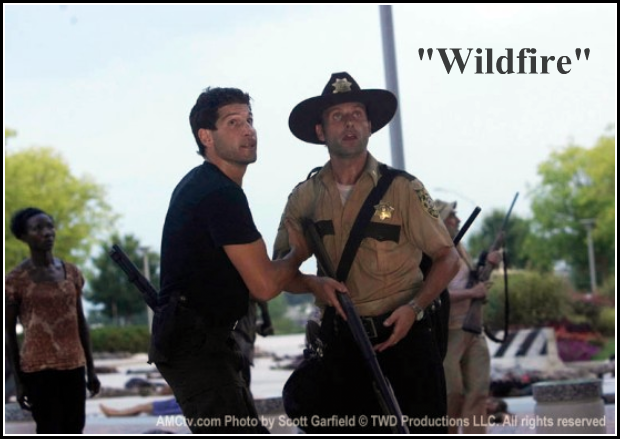
We’ve now come to the penultimate episode of The Walking Dead‘s first season. If there’s been one thing about this tv adaptation — of the Robert Kirkman comic book series which it’s based on — has proven it’s that the show is willing to go off the reservation when it comes to following the source material. The show has made some interesting storytelling and character choices right from the start. Scenes which occur later in the comic book have been moved up and combined with others. New characters, both recurring and disposable ones, have been introduced to the original numbers from the book.
Some of these changes have been welcomed by old fans of the book, but there’s a vocal minority who don’t see why there’s a need for such changes and additions. To new fans whose experience with this franchise has been just through the show the changes don’t mean a thing. They’re coming into this fresh and with open eyes. For long-time fans this need to watch this show with open eyes instead of clutching at the strict canonical material that are the books it would be a hard time going. I’m one of those who have been reading the books since the beginning and for the most part I’ve accepted these changes. Even the major departure introduced to end this episode I find quite interesting and with guarded optimism that it will lead to a surprising season finale and set-up season two properly.
We begin the show the very morning after the zombie attack on the camp which ended the previous episode. The survivors are cleaning up the bodies of both the “walkers” put down and those people they lost. The scenes showing how both Carol deals with her abusive husband’s corpse and how Andrea deals with her younger sister Amy were quite powerful in their own way. In one scene, we see an abused and beaten down wife taking out her anger and relief on the source of her problems with a pickaxe. In another, we see an older sister remembering past regrets of never being there for her much younger sister despite promises to do so. The scene with Andrea goes against much of what most zombie survival aficionados would do, but it brings to light just how much the Andrea loved her sister and even if it means seeing her come to a semblance of life just one more time to say her goodbyes she would do it. Knowing what she would need to do in the end just made her tearful final goodbye that more powerful.
The third farewell doesn’t happen until 3/4’s of the way into the episode (though we do see Morales and his family go their own way. Going to miss him going for the fences with that baseball bat) and involves Jim. An injury incurred from the fight during the night leaves him and the group with a problem that gets resolved in one of the more poignant scenes in this series, so far. As Morgan Jones from the pilot episode instructed Rick the “walkers” and their bites are a death sentence. The two competing leaders of the group in Rick and Shane want to solve their Jim problem using different methods. Rick wants to take the group to the one place he thinks could still help Jim and that’s the CDC near Atlanta. While Shane, with enthusiastic support from Daryl, wants to put Jim down before he becomes a dangerous liability.
In a scene reminiscent of a similar one from Romero’s original Dawn of the Dead, Jim makes the final and ultimate decision about his life. The goodbyes made by everyone to Jim after he’s made his decision to be left behind was very heartbreaking. Jim might have been a secondary support character but the last couple episodes have fleshed out his character enough that we care what happens to this man who has lost everything and thinks his predicament will reunite him with those he has lost.
The growing schism between best friends Rick and Shane gets a few more nails added to it as we see Shane gradually losing his command of the group. The group looks to be gravitating towards Rick as their leader now and even the wildcard in Daryl seem to look to Rick for the answers. The scene between the two as they patrol the woods near the camp definitely widens the gulf between the two even if Rick looks to be unaware of what’s really going on with Shane. The sudden appearance of ever stalwart and ever watchful Dale sure thinks something is amiss.
It’s the final ten minutes of the show where we finally know why the episode was titled “WildFire”. In another departure, one that would be called huge by fans of the comic books, we see the lone surviving researcher within the CDC sending video reports on what’s being called “Wildfire” and how research on the so-called “disease” has remained useless with no answer in sight.
The whole entire sequence reminds me of the early parts of Stephen King’s own apocalyptic epic novel, The Stand, as scientists desperately try to stem the tide of the approaching apocalypse to no avail. It’s little subtle references to other apocalyptic stories and tales like this which keeps some of the changes and departures from the source material bearable and, at times, even welcome.
It’s this major departure that will send some long-time fans of the comic book apoplectic. The vocal minority will definitely get even louder as to why Darabont and the writers are messing with the timeline and the stories in the original comic book. As one of those fans I should be screaming just as loudly, but the zombie and apocalyptic genre fan in me actually like how this show has gone off the beaten path of the original source material.
If they had stayed word-for-word and panel-for-panel true to the comic book then there’s no surprises to be experience. Knowing how everything unfolds right from the start could get boring even if it is about something read and re-read with love. There’s still no guarantee that the final pay-off of this particular major detour from the comic book will end in a good way, but the possibility of not knowing how this story-arc will end this first season is both exciting and tense-inducing. It could succeed in the best way, but also fail in an epic one. Either way the path now is not set in stone and everything moving forward will be undiscovered country.
Extras
* Quote of the night: “I think tomorrow I’m gonna blow my brains out, I haven’t decided. But tonight, I’m getting drunk!” – nameless CDC researcher.
* For once Glenn doesn’t have a witty quip or remark which just highlights the somber mood of this episode.
* There’s still no news on the whereabouts of one Merle Dixon though he gets name-dropped a couple times.
* A sneaking suspicion that Merle will not appear again this season, but may in the next or later ones.
* Bear McCreary’s score and choices of music for the episode the best in the series, so far to date. Especially, the use of John Murphy’s Adagio in D Minor from the sci-fi drama Sunshine which was recently used in Kick-Ass.


 Through the Shattered Lens