This film called Rubber has been on the periphery of my radar for quite some time now. I’ve first heard of it when word trickled out of the After Dark Film Festival in 2010 where it was shown. From what I’ve heard of it the film wasn’t well-received when it was shown at 2010’s Cannes Film Festival. I wouldn’t be surprised if it wasn’t seen in a positive light over there. This film seems to be not the usual fare to get the applause and accolades.
Rubber seems to have gotten a more positive response outside of Cannes. This is especially true with the genre festival circuits.
From the looks of the trailer and synopsis of it on wiki I will hazard a guess and say that the tire is alive and looks to go on some sort of killing spree. The scene in the beginning of the trailer reminded me of the short film Treevenge! especially when the tire watched as a pile of rubber tires were being burned.
The film has been called a horror comedy and the trailer definitely gives it a dark comedy look to it. It comes out from Magnet Releases this April Fools Day.
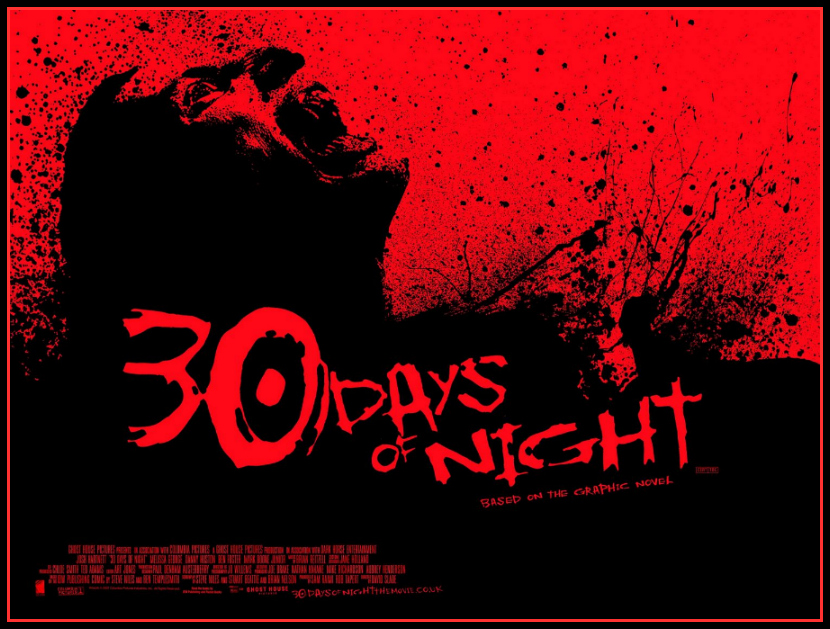
30 Days of Night is pretty much a siege movie with heavy elements of horror and gore. Siege movies always succeed and fail depending on whether the tension and dread built up from the beginning of the film suspends the audience’s disbelief. Siege films like The Thing and Romero’s Living Dead trilogy works well because right from the get-go we see the tension build not just on the location the cast are put in but within the besieged survivors as well. Survival becomes that much more difficult due to human frailties and an inability to work together bringing the whole group down. The monsters outside are bad enough, but sometimes it’s the survivors themselves who must share the blame.
David Slade’s (director of the excellent Hard Candy) movie does a very good job of bringing the initial tension and dread the comic brought to life in its first chapter. The story takes place in Barrow, Alaska which happens to be located within the Arctic Circle. This location allows it a very peculiar yearly event of having pitch-black night which lasts for a period of an entire month. The movie begins just as the town of Barrow prepares for this month-long prolonged night. Most of the town decide to move down south for the month where the night doesn’t last as long, but enough stay in Barrow to give it a semblance of life and activity.
The build-up of the characters in 30 Days of Night marks one of the weaknesses in the film. There’s barely much characterization in distinguishing one Barrow, Alaskan from another. The lack in character development from all the characters whether human or vampire doesn’t invest the film with anyone we want to see make it out through the night and into dawn. Even Danny Huston, a very underrated and overly capable actor in past films fails to elevate his lead vampire character Marlowe beyond it’s genre trappings. Known only as The Stranger in the credits, Ben Foster’s Renfield-like character edges between caricature and genuine creepiness in his performance. Foster knows he’s in a genre movie and has fun with the character. He’s the only one to truly take on his character and roll with it.
I now get to the subject of the vampires themselves. Most vampire movies seem enamored in portraying the vampire as some sort of seductive, fashion-obsessed, or in the case of the Anne Rice-type anachronistic in their dress, with an unnatural immortality they either live as hedonistically as possible or bemoan their cursed existence. Then there’s the more recent trend that Twilight has brought into the vampire mythology and it’s not good. There’s never been a true portrayal of the vampire as a pure, hunger-driven monster with an appetite to match their status as one of folklore and legend’s top-tier boogeymen. Slade goes for speed and agility in his vampires instead of hypnotizing and mesmerizing their victims. The vampires in this movie owes much to the frenetic and over-amped infecteds of 28 Days Later.
The attack itself and the subsequent siege worked well enough in the early going. There were some great overhead shots of the town’s people losing it’s fight during the initial feeding frenzy as the camera shoots the scene high overhead. The only thing Slade had a misstep in terms of the siege itself was after those first couple of nights. The rest of the 30 days didn’t seem to show enough desperation on the faces and bodies of the last few survivors. Really, the only way the audience even knew a couple weeks have passed were the caption telling them how many days into the month-long night has passed. I think with some better editing and a better sense of structure in the middle section of the movie to show time actually progressing the movie would’ve been better on so many levels.
All in all, 30 Days of Night was just good enough to be a fun watch. The premise itself was original and put a new spin on the vampire genre that has rarely been tapped. The performances were pretty average with no one bringing the whole film down with a misstep performance or raising the bar with a great one. The final product had a chance to be something great, but just ends up being a good and original take on the vampire story with elements of Night of the Living Dead.
(Hi! This is actually a review that I wrote a while ago for an anthology of B-movie reviews that a “friend” of mine was planning on self-publishing. Much like this site, the book would be made up of different reviewers giving each film their own individual spin. We were going to call it Dinner and a Cannibal Movie. I came up with that title, by the way. Unfortunately, the project was eventually abandoned but not before I’d written a handful of reviews. Here’s one of the shorter ones, for Umberto Lenzi’s Black Demons. Oh, and be warned: Because of the nature of the project it was written for, this review is full of spoilers.)
My ex-roommate Kim and I have a long-standing argument concerning this film. I claim that it’s an Umberto Lenzi zombie film that was made in 1991, long after Italian zombie cinema had run its course. It is also my contention that we saw this movie in October of 2004. Admittedly, we were performing our own private pagan ritual during most of the film’s 90-minute running time but we still paid enough attention to not be impressed by it. Kim, on the other hand, argues that we never watched Black Demons and that, furthermore, there is no such film as Black Demons. I suspect that a combination of her own rather prodigious liberal guilt and the film’s own utter banality has led her to repress the memory of it in much the same way as the protagonist of a Dario Argento thriller will often forget a key detail of a murder he has witnessed.
Black Demons tells the story of five young people who find themselves on the bad end of some black magic. For reasons that are never really made all that clear (largely because the entire cast has a bad habit of mumbling their dialogue), English Kevin is in Brazil with his American girlfriend, Jessica. Tagging along with them is Jessica’s half-brother, a morose young man who is recovering from a nervous breakdown and who has the rather unfortunate name of Dick. Along with having a vaguely incestuous relationship with Jessica (whether this was intentional on Lenzi’s part or just a case of bad acting is up for debate), Dick is also fascinated by black magic and has a tendency to wander off by himself a lot. This leads to a lot of scenes of Kevin and Jessica repeatedly shouting, “Dick! Dick!” as they search for him. This provided both me and Kim a lot of giggly amusement if nothing else.
Anyway, Dick attends a black magic ceremony that he records on audio tape and then proceeds to obsessively listen to whenever the movie needs an excuse to bring on a few zombies. The morning after the ceremony, our threesome’s jeep breaks down out in the middle of nowhere. Luckily, two hikers – Jose and his girlfriend, Sonya – come along and invite everyone to spend the night at Jose’s villa. As luck would have it, there’s a big cemetery located right behind the villa and idiot Dick decides to play his little audio tape right in the middle of it.
(I think Kim may have exclaimed, “God, what a dick,” at this point but she denies it along with the movie itself.)
Needless to say, this causes six zombies to rise from their graves and the usual hilarity follows. It turns out that these zombies were, in life, African slaves who rebelled against their white masters and were put to death as a result. Their eyes were plucked out as they died, though this doesn’t seem to keep them from being able to see once they come back to life. It turns out that the mission of these six black zombies is to kill six white people to even the score. Unfortunately, most of this is explained by Jose who has such an incredibly thick accent that it is next to impossible to understand a word he says. Therefore, the plot may actually be a bit more complex than I realize.
Though, I doubt it.
As Kim and I immediately realized, the zombies need to kill six white people. Yet there are only five white people in the film. Whether this was a case of lazy writing or maybe an actor walked off the film at the last minute, I do not know. However, Lenzi ingeniously handles this problem by killing an anonymous, never-seen white guy offscreen and then having our heroes hear about it on the radio. Still, you have to wonder why these zombies, seeking vengeance for being slaves in their past life, would only feel the need to kill six white people. Sure, it works out in the sense that there are six zombies and this way they only have to kill one person apiece. But still, it seems like they’re letting the white race off a little bit easily here. Indeed, if the solution to all of the world’s racial strife is simply to kill off the five, uninteresting losers in this film, then I have to side with the zombies on this one.
Unfortunately, Kevin and Jessica aren’t willing to sacrifice themselves for world harmony and insist on surviving until the end of the movie. Kevin eventually figures out that the zombies can be stopped by a well-thrown Molotov cocktail. How exactly he figured this out isn’t really clear. Perhaps he saw it in another, better zombie film. (Like Lucio Fulci’s Zombie 2, for instance. Unfortunately, beyond the Molotovs, the bad acting of the female lead, and a grisly fetish for showing eyeballs getting damaged, these two films have little in common.) Kevin’s plan works though not before the tragic ends of Sonya, Jose, the phantom sixth white guy, and yes, even Dick. Leaving behind a bunch of smoldering slaves, Jessica and Kevin flee the villa for a world still torn apart with racial strife and anger. Thanks a lot, guys!
Almost all good horror is to be found in subtext. Such as, Dracula may be pretty intimidating with his fangs and his blood drinking and all, but it’s as a symbol of unbridled lust and secret fantasies that he’s been able to become and remain an icon for over a century. And while Frankenstein might be frightening to look at, his true power comes from being a sign of what happens when man attempts to play God. In an admittedly less literary vein, what else is a truly scary slasher but proof positive over how little control we truly have over our own future? Strictly on paper, Black Demons should be a film awash in powerful subtext. After all, these zombies wouldn’t even exist if they hadn’t been enslaved and treated like property by the ancestors of the film’s heroes. In a world that is still struggling (and failing) to deal with the legacy of racism, a film in which a bunch of slaves come back to life and seek vengeance on only whites should have quite a bit to say. Perhaps if Black Demons had been directed by Fulci or Deodato, it would have done just that. However, this film was directed by Umberto Lenzi which means that it ends with Kevin assuring Jessica that their nightmare is over with the camera ominously (and, quite frankly, obscenely) pans over to a bunch of black children playing on the side of the road, basically equating those living children with a bunch of bloodthirsty, vengeful zombies on the basis of the color of their skin. Whether Lenzi realized what he was doing or not, this one camera movement manages to be a hundred times more offensive than anything found in Cannibal Apocalypse.
The zombie fps survival game that seem to be blowing up the interwebs with it’s “official announcement” trailer was a title that was initially talked about several years ago when Valve’s Left 4 Dead first came out and become a massive hit. Zombies were back in force in gaming (not that it really left) and every no-name studio was announcing a zombie title to try and take advantage of the sudden craze for the walking dead in games.
Techland was one such studio and their title was to be called, Dead Island. It was to be a first-person shooter for the Xbox 360 and PC. Set in an unnamed resort island, the game was received by the gaming community who followed such news with some interest. That interest soon waned when nothing new and concrete about the game came out in the last couple years. It’s now 2011 and, after a couple brief tidbits about the title in 2010, it looks like the game is going to be a reality (fingers crossed).
The trailer has been getting major praises since IGN first premiered it. People were soon hyped to see the game become a reality. Those who still were guarded with their reactions still thought the trailer was well-done and, some even said, it was artfully done. One thing that seem to have everyone in agreement is how heartbreaking the trailer ends up being once the whole sequence plays out. It’s true what some have said. Children always seem to be taboo as zombie chow in films and most games (novels have been more ahead of the game when it comes to children becoming zombie food) and it looks like Techland decided no one will be safe in this game.
I, for one, have been one of those who have been following this title since it was first talked about years back and if this announcement trailer really means the game will be made then my faith in the title has been rewarded.
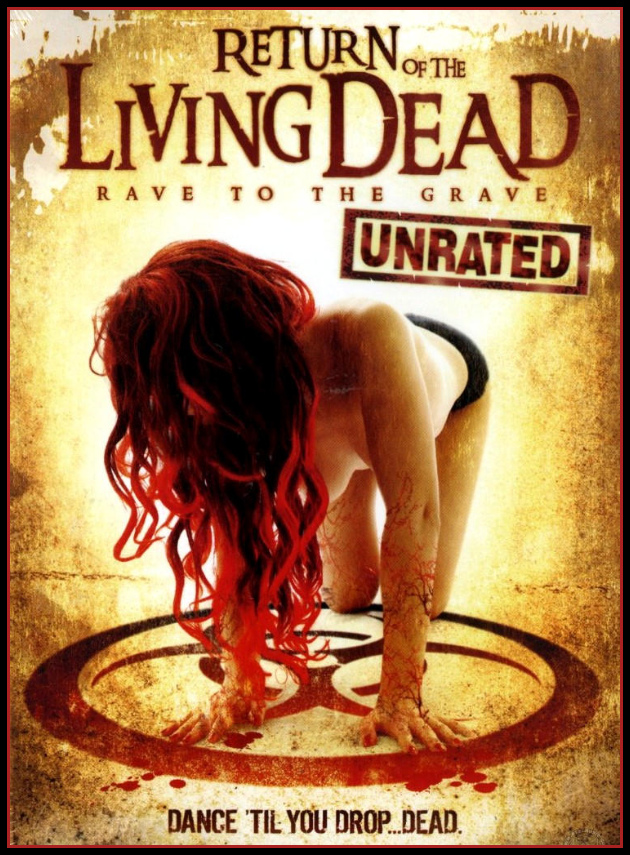
There’s not much to say about Return of the Living Dead 5: Rave to the Grave other than it’s actually worse than the movie before it. Return of the Living Dead 4: Necropolis was really bad and not in the so bad it’s funny. What had been a cult horror franchise which had fun with the zombie genre in addition to putting some genuine scares in people, these last two Return of the Living Dead films should pretty much kill the franchise just when the zombie revival is still going on strong.
Ellory Elkayem does directing duty for this fifth installment. He also directed the fourth film. I had thought that not everything should be laid at Elkayem’s feet when it came to who to blame for the lackluster and awful film that was Necropolis, but after sitting through Rave to the Grave I have to say that whatever good will Ellory Elkayem built up with his funny take on the giant creature feature, Eight-Legged Freaks, has been wasted with his back-to-back filming of Necropolis and Rave to the Grave. Elkayem films both films one after the other and I am going to assume this was more to save on the budget than any sort of continuity with the actors hired to play recurring roles. If saving money was the main reason then it sure didn’t look like it. Except for a few hero-zombie (zombies given more screentime than most thus given a better make-up effect) scenes the film clearly shows it’s ultra low-budget pedrigree. I don’t have problems with low-budget horror movies as long as there’s a sense of energy and enjoyment by those making it, but neither Necropolis and Rave to the Grave showed any one of the two.
Rave to the Grave occurs one year after the events of Necropolis and the teenage survivors of that film have now graduated and attending college. The film never really makes it clear if they’re in back in the U.S. attending college or still in Eastern Europe where the previous film was set. Either way the survivors from the previous film seem to have moved on quite well from their horrific experiences in Necropolis. The fact that they don’t seem to recognize the newly found containment barrel marked with the label of 2-4-5 Trioxin just adds to the weird and huge plot hole between film four and five. One would think that these kids would have it etched forver in their minds that containment barrel with 2-4-5- Trioxin equals horror. Instead they naively investigate and research the barrel with one of their friends realizing he could turn the chemical leaking from the barrel into a new form of rave drug whose extreme hallucinogenic effects also hide a side-effect which basically turns anyone who partakes of the drug into a zombie.
The rest of the movie deals with the survivors finally realizing the crisis they’ve unleashed and instead of calling for police or military help decide to go to the same outdoor rave party where everyone is taking the drug to try and find the person who made the drug Z and stop him from taking them. Like I said earlier, the film really has major plot holes and most of the time doesn’t make much sense. What we get in the end is an excuse to have a huge set piece where the survivors get to shoot as many zombies as possible while at the same time allow for the random raver to suddenly become a zombie out of the blue. There’s also a subplot of a couple of bumbling Men-in-Black type agents whose job it is to recover the Trioxin barrel while remaining inconspicuous. The secret organization they belong to must be global since I could barely understand their lines with the heavy Russian accent used by both “actors”.
My disappointment in what could’ve been a nice follow-up to the first three Return of the Living Dead movies was compounded by the sheer Z-movie level of Rave to the Grave after the awful work that was Necropolis. For those wanting to see a good b-level zombie movie that’s bad but enjoyable at the same time should check out House of the Dead 2. Yes, the sequel to Uwe Boll’s rancid and awful House of the Dead ended up being better than the original and way more entertaining than Return of the Living Dead 5: Rave to the Grave. I wouldn’t even accept this film as a free dvd if someone gave it to me. In fact, I may end up punching that person as a reflex action.
I remember watching the original Return of the Living Dead in 1985. That zombie movie played on the premise that Night of the Living Dead actually happened. It was a great twist and interesting idea. The zombies in that film weren’t shambling and dumb like the one’s in Romero’s film. Instead these zombies were pretty quick and could talk and formulate plans and traps. Also these zombies couldn’t be killed by destroying the brain. It was the birth of the superzombies and it made for a fun experience. One thing it also had was a nice dose of comedy mixed in with the horror.
A few years later they had a sequel to Return of the Living Dead that was a good second helping. Nothing to write home about but it was a fun gory flick. Then came a second sequel which dropped the comedy and instead tried to be Romeo and Juliet meets brain-eating zombies. Other than the usual gore and bloodsplatter this second sequel was an utter failure. It took over 10 years for someone to try making a couple more sequels, but sure enough someone found a way to do it. They even found a good enough director in Ellory Elkayem (he directed the fun, campy giant spider monster flick Eight-Legged Freaks). There was talk that this third sequel will return the ROTLD franchise back to its roots of horror mixed with comedy. I was stoked about the news. Then when it came time to see Return of the Living Dead 4: Necropolis, I found out that it was going to go direct-to-cable. This usually means bad news all around about the overall quality of the finished film, but I was still going to give it a chance.
I finally saw its premiere on Sci-Fi channel in 2005 and all my low expectations weren’t even reached by the what I saw on the TV. The movie starts off well enough and right from the get-go they don’t hide the fact that the film is taking place in some Eastern European country. Peter Coyote the — only actor with any sort of talent — makes his appearance in this scene and there’s not even any attempt to make his character abit mysterious of whether he’s a good guy or a bad guy. Coyote’s scientist role in the film screams evil mad scientist. The rest of the cast seemed like it was randomly picked from a college campus and from the streets of Romania. The dialogue was bad enough but having them read out loud by amateurs just made it all worse.
The whole premise of the film outside of reintroducing newcomers to the zombifying effects of Trioxin seemed like the writers were trying to emulate Resident Evil instead of Return of the Living Dead. There’s the mega-corporation which deals with everything known to man and also research and develops illegal biowarfare technology like zombies armed with hi-tech weapons. Resident Evil did this better (thats not saying much) so it goes without saying that ROTLD4: Necropolis just didn’t know what it wanted to be. There wasn’t any of the comedy that made the first two films in the franchise so fun to watch. It looked as if they tried to make a serious zombie movie and instead it turned out to be seriously bad.
Even the zombies themselves ended up being inconsistent with the zombies from the first two films. Some seemed smart enough but most were of the Romero kind which goes against everything that is ROTLD. Their feeding habits even changed from eating nothing but brains but to eating other parts of the body. Then the filmmakers made it so they’re not indestructible anymore. Shooting these zombies in the head will drop them like a sack of bricks.
There really wasn’t anything fun about this sequel. Zombie movies are suppose to be dumb, gory fun but instead Return of the Living Dead 4: Necropolis just ends up being dumb, horrible and awful. I had alot of hope in Ellory Elkayem as an up-and-coming genre director, but cranking out this film after making such a fun one in Eight-Legged Freaks is a mystery and saddening. I wouldn’t recommend this film as a rental on dvd. Just go rent the original trilogy of films in the series and leave this one alone.
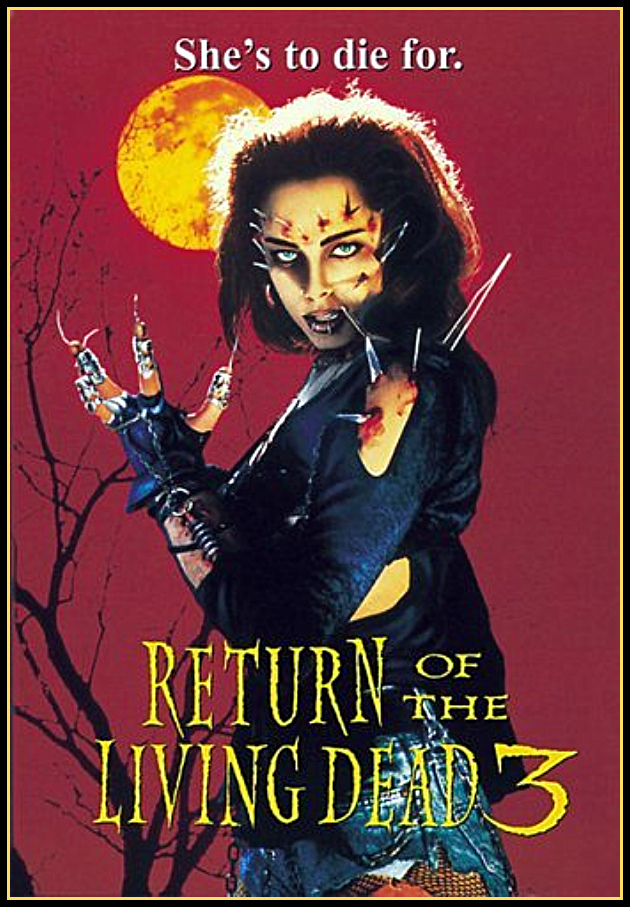
In 1993 horror fans were greeted with the release of Return of the Living Dead 3. This third film in the Return of the Living Dead series produced by John Russo ends up being a very good zombie movie and actually has genuine horror that the second film lacked. What ROTLDIII, its writers and directors seem to have left behind was the comedy side of the series which made them cult-classics to begin with.
Taking up directing duty this time around was genre-veteran Brian Yuzna (Beyond Re-Animator) who films this third entry purely on a horror standpoint. This film is serious horror from start to finish. This time around the military is still trying to find a way to use 2-4-5 Trioxin as a way to create zombie soldiers, but ones that could be easily controlled by them. To say that this project hasn’t met with success is an understatement. But it’s the story of the son of the military project director and his girlfriend who dominate the film’s plot. As portrayed by J. Trevor Edmond and Melinda Clarke, these two star-crossed lovers find themselves enmeshed with the dark secret of the project being held in secret. Son soon uses the Trioxin gas to try and ressurect his girlfriend who gets killed early on during an accident. What he gets instead is an undead girlfriend whose hunger for live brains (for some reason the zombies in this ROTLD sequel also feed on other bodily parts) can only be controlled when she causes herself bodily pain through extreme forms of piercing. The rest of the film deals with the father trying to save his son not just from himself and his undead girlfriend but from the hordes of escaped zombies in the facility.
The horror in the film was actually pretty good and this was helped a lot by the gore effects work which surpasses anything the first two films in the series had. The acting was decent enough with Melinda Clarke as the zombified girlfriend putting on a sexy, albeit creepy performance. If it wasn’t for the brain and flesh-eating she sure would’ve made for quite a poster girl for teenage boys.
In the end, Return of the Living Dead 3 continues the series admirably. Despite not having much humor and comedy in the film, this third film in the series more than makes up for it with high levels of gore and a definite sense of horror the first two didn’t much have not to mention a bit of romance which seemed to work.
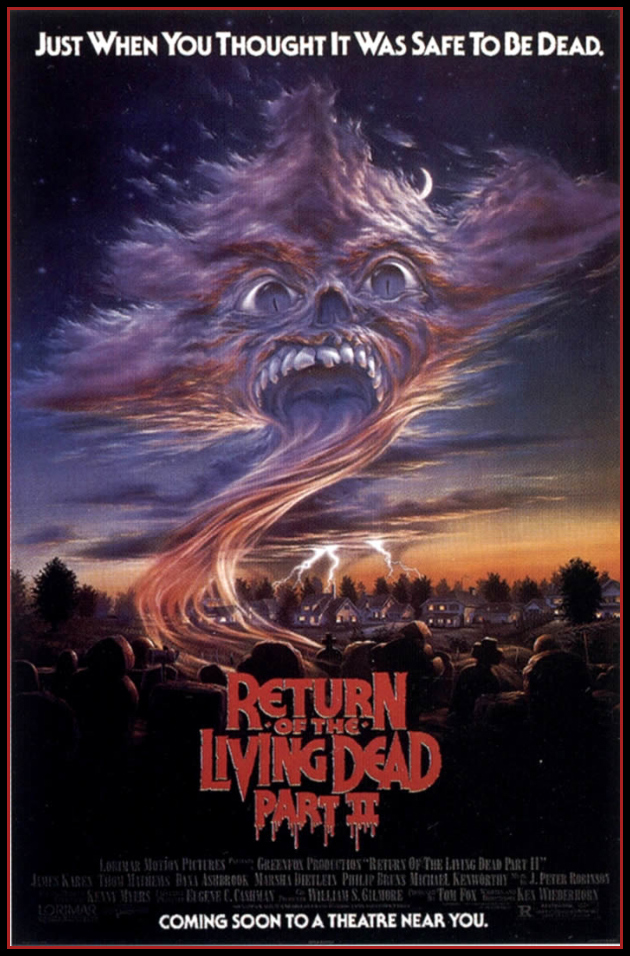
1988 saw the release of Return of the Living Dead Part II. This film is a sort of sequel/reboot of the first film in that the story and even some of the characters bear too much of a similarity to the original film. Ken Weiderhorn both writes and directs this “sequel” and it shows. The film reuses alot of what made the first film a cult-classic amongst horror fans. Weiderhorn seems to be of the philosophy that if something ain’t broke then don’t fix it. What this does is make the film feel like a deja vu and maybe that was his intent since two of the main characters in the film say pretty much the same thing. Despite all this the film itself is pretty good and stays true to the original, albeit with abit more humor and better effects work.
Reprising similar roles they had in the first film are James Karen as Ed and Thom Mathews as Joey. Both work as in the post-burial industry and moonlight stealing valuables from the privates crypts and mausoleum in the cemetery they’re working in. Their characters act and almost have similar lines from Karen and Mathews’ characters of Frank and Freddy in the first film. Karen as Ed goes over-the-top once the 2-4-5 Trioxin gas is let loose and the dead bodies in the cemetery begin to come back to life seeking live brains. It’s these two characters who really keep the film from spiraling down to awful status. Even though their characters are similar to the original film, Karen and Mathews still bring a dose of great comedic timing and horror to the situation.
This time around the town has been safely evacuated by the military except for a few people who lived on the newly-built suburban housing area in the outskirt of town. It’s these survivors who must try and find a way to defeat the zombies and at the same time convince the military blockading the town that they’re not infected. There’s more action and comedy in this sequel. I think the comedy part of the film got way too much attention, but as I said earlier, Weiderhorn seems to think that if it worked in the original then it should work with more in this film. The effects work looks a bit better and probably due to an increase in the budget.
In the end, Return of the Living Dead Part II never brought anything new to the original it was following-up. The film pretty much reuses the same characters and situations. Weiderhorn does this to good effect and the finished product was an entertaining enough horror-comedy. Who knows how this sequel would’ve turned out if Russo had written it and O’Bannon back directing.
Return of the Living Dead has to go down as one of the funniest and inventive take on the zombie subgenre that began after the release of George A. Romero’s Night of the Living Dead. Due to a dispute between Romero and John Russo (co-producer of the original NOTLD), the sequels to Night of the Living Dead that were produced and directed by Romero dropped the “Living Dead” part in their titles. Russo retained the rights to create sequels using those words while Romero just kept the word “Dead” in the follow-up films to Night. It took Russo awhile, but he finally got to use those naming rights with 1985’s Return of the Living Dead.
Even though there were some acrimony between Romero and Russo, the screenplay for Return of the Living Dead makes several complimentary nods to Night of the Living Dead. The film’s premise was what if Romero’s first film was actually based on a true event and that the government and the military covered it up before people got a wind of it. The film takes that simple premise and creates an action-packed horror-comedy that still stands the test of time.
Unlike Romero’s films, Return of the Living Dead actually gives an explanation as to what causes the dead to return to life with a singular purpose of attacking the living. The cause of all this undead mayhem was due to a bioweapon nerve toxin called 2-4-5 Trioxin which was originally designed by the military to defoliate marijuana crops. To say that the side-effects of the gas had some interesting effects was an understatement. The zombies created by Trioxin do attack the living but they’re also much more livelier and smarter (retaining agility, strength and mental capacity of their previous life) than the traditional Romero-zombies. They also do not feed on just humans. They also feed on other animals. The last major difference between the Romero-zombies and the Trioxin-zombies was that the latter only wanted to feed on live brains to end the pain of being dead. These differences made for a much faster-paced horror movie. As much as I consider the Romero zombie films as the best out there, I hold a special place in my horror-fan heart for these Trioxin dudes.
The story by John Russo would be turned into a screenplay and directed by Dan O’Bannon also made Return of the Living Dead behave more as a horror-comedy than just a straight-up horror. The dialogue between the characters were full of great one-liners that would’ve sounded cheesy if not for the great and game performances from the cast. Clu Gulager as Burt Wilson (owner of the medical supplies warehouse where the lost canister of Trioxin was being stored in) did a great job being incredulous at the events happening around him. His back and forth with his friend Ernie (played with Peter Lorre eyes by Don Calfa), the local mortuary’s gun-toting mortician, keep the film lively and hilarious in-between scenes of horror.
The scene stealers in the film must go to a bumbling pair of Burt’s employees who inadvertently release the toxic and reanimating gas from the warehouse’s inventory of Trioxin canister. James Karen as the worldly and cynical Frank was a riot from start to end. His over-the-top performance had me in stitches. He played Frank with such a manic, panicky style that it was difficult not to get caught up in his hysterics. To balance out Frank’s Hardy with his more subdued, but no less panicked Laurel, was Thom Mathews as Freddy. Mathews would later appear in other horror movies in the decade and even reprise a similar role in this film’s sequel. His performance as the straight man to Karen’s fool was also very good. His slow decline into becoming one of the zombies after the initial inhalation of the Trioxin gas in the film’s introduction was funny and sad. Of all the zombies in the film he gets the brunt of the slapstick sequences, especially once he starts hunting his girlfriend for her brains. His professing of his love for her and at the same time wanting her to give up her brain was hilarious, if not creepy as well.
Another thing that Return of the Living Dead had that made it different from Romero’s zombie movies were the scenes of gratuitious nudity throughout the film. A majority of the nude scenes were courtesy of scream queen Linnea Quigley as the punk rock Trash whose morbid obsession with all things death made her an early victim for the zombies and later on as one of their leaders. I know that kids my age at that time replayed over and over the scene of her strip-tease down to nothing atop a graveyard headstone. Even now many fans of the film consider that sequence as one of their favorite.
Return of the Living Dead still counts as one of the best zombie movies out there and preceded the UK’s Shaun of the Dead by two decades as a great horror-comedy. There was a sequel a few years later to capitalize on the popularity of the first film. It tried to capture the hilarity and horror of the first one but did not measure up in the end.
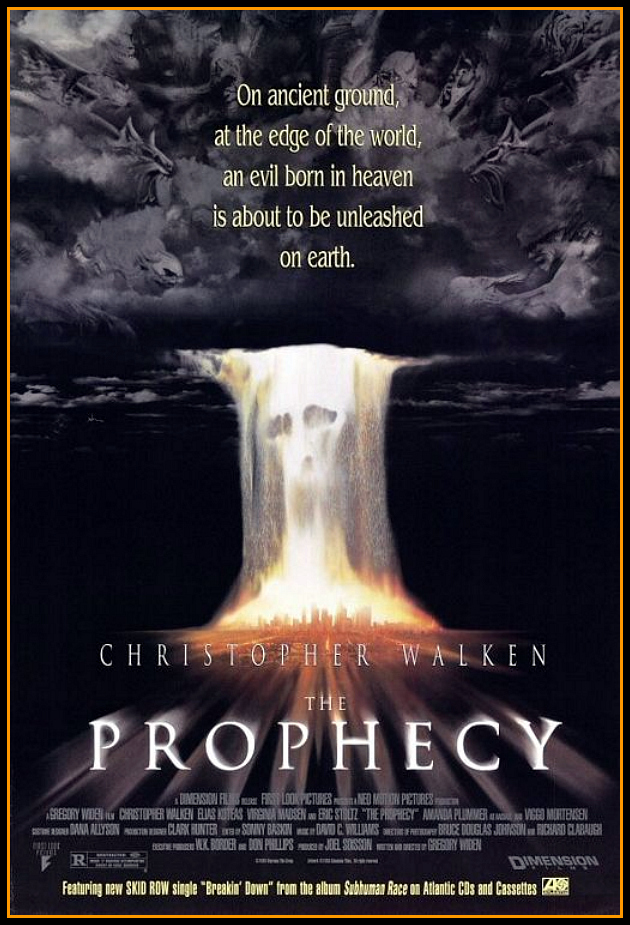
I first found out about this little cult film starring the very awesome Christopher Walken around 1993 or so when I was at the local Waldenbooks (yes there used to be bookstores not named Barnes & Noble or Borders back in the day) looking at the latest issue of Fangoria. Inside the magazine they were doing a brief feature on an upcoming horror film tentatively called God’s Army. All I saw was that it was to star Christopher Walken and it had gore and angels in it. That alone peaked my interest and I was looking forward to seeing it in the theaters. Almost two years passed and nothing about it was ever heard again until I visited the video rental place near my house and saw a VHS tape (yeah, those big videocassette thingies) with the title of The Prophecy and starring Christopher Walken.
This was the film I was so hyped to seeing in the theaters. The title had changed from it’s earlier (and much cooler) one of God’s Army. It would seem that it’s film distributor had little to no faith in the box-office potential of the film and just delayed it’s release to the point that when it did come out no one knew about it barely anyone saw it. It was a real damn shame since filmmaker Gregory Widen made such a good film that was able to mash-up horror, angels and a detective story all in one without creating a mess of things.
The Prophecy was about the war in heaven we were never taught about in Sunday school. We all know about the war in heaven where Lucifer and the rebel angels who followed him tried to overthrow God. That didn’t go over so well for Lucifer and he and his band of fallen angels were cast out into Hell by God and his right-hand man the Archangel Michael. This film talks about the second war in heaven soon thereafter which no one outside those who wrote little-known apocryphal texts about it (and being apocryphal they never were included in the Bible). This war now had a new group of angels led by the Archangel Gabriel rebelling against God for choosing humans (talking monkeys as these new rebels called them) above all living creatures including the angels themselves for God’s love. This war was now in a state of stalemate after countless millenia, but a prophecy about a soul so dark and evil was to be the tipping point for either side. This particular soul was to be found on Earth and whoever acquires it would break the stalemate and finally bring this second war to an end.
With this in mind we have Walken as the Archangel Gabriel coming down to Earth to look for this soul so he can finally win the war for his side (which also means the end of mankind). It’s the angel Simon (played by Eric Stoltz) who comes down to stop him from getting this soul or, at the very least, hide it from Gabriel. With these two factions of angels vying to acquire this soul we have a Detective Thomas Daggett smack in the middle of the case investigating all the weird happenings and deaths surrounding the battle between these two factions. The dead bodies of angels begin to appear on morgue slabs looking like eyeless, hermaphroditic specimens and angelic script found in crime scenes brings Daggett back to his time studying to be a priest before images of angels warring amongst themselves breaks him down and he quits the seminary to become a cop instead.
It would come down to these three factions racing against time to acquire this dark soul.
The film is not as gory as it’s feature in Fangoria made it out to be, but it is quite violent and bloody that I understand why it got the horror label attached to it. It’s more a dark fantasy thriller more than horror. It’s rare in today’s film that we see angels portrayed as the bloodthirsty beings that the really are. The film even points out this oft-ignored detail of God’s messengers. Angels are always the ones God sends to punish or send a very serious message to his chosen beings that is Man. The Prophecy shows this aspect of angels in full light and how their attitudes about humanity might lead some of them to hate God for raising Man above even them.
Christopher Walker does a great job conveying Gabriel’s hate and contempt for humans. His Gabriel is like one of those pundits always on tv (both liberal and consevative) who are so into their sides’ message that they never see the other side as anything but the enemy. One could almost say that Walken’s Gabriel is like then apocalypse-hungry version of Glenn Beck and Keith Olbermann in one body. This is not to say that Walken goes over-the-top with his performance. In fact, he’s quite subdued in how he uses those many tics and voice mannerisms a whole cottage industry has grown around in.
Walken’s portrayal of Gabriel infuses what could’ve become a one-note villain with lots of layers and complexities that the rest of the cast were able to play off from. His character would be terrifying one moment then smoothly switch over to being funny and charming then back to terror. It’s due to his great performance that the other cast members like Stoltz as the weary, loyal angel Simon and Koteas as the fallen religious cop Daggett were able to bring their own performance to another level. This is quite a feat since the dialogue in the film was a mixed bag of horror cliches and interesting Biblical-speak about secret wars, apocryphal books and prophecies. The film even has a nice appearance of the first fallen angel himself and none other than Viggo Mortensen plays Lucifer.
The Prophecy does have a feeling that it was always one misstep away from becoming an awful film. This had happened with 2010’s Legion and did that film about angels and the apocalypse turn out to be a huge steaming pile of shit-turd. But while Dimension Film saw the film fall over on the side of bad for myself and those who have come to admire and love this cult classic the film stayed balance between good and bad. Widen’s film never went over to the side of becoming a truly great film, but it also never fell on the side that Legion ended up on. What Prophecy ended up becoming was a film that was almost grindhouse in nature, but even then it still looked too good with too many good performances to be given that label. The fact that it contains one of Christopher Walken’s best performances speaks well of a film that many critics during it’s early days had dismissed as just another bad horror film.
In the end, this film became just one of the many little-gems that got lost in film studio money politics. I definitely would recommend this cult film to people who haven’t seen it, but I would tell them to stop at just this film and not even go near the four sequels which came after it.


 Through the Shattered Lens