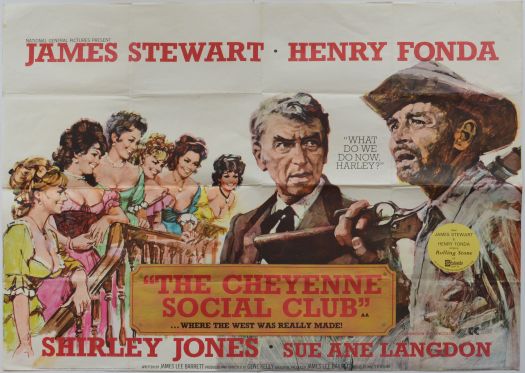
THE CHEYENNE SOCIAL CLUB isn’t a great movie, but it’s not a bad one, either. It couldn’t be; not with all that talent in front of and behind the cameras. You’ve got two legendary leads, James Stewart and Henry Fonda , Oscar winner Shirley Jones, Gene Kelly in the director’s chair, and John Wayne’s favorite cinematographer William Clothier . Still, the film, while amusing, should’ve been so much better.
The story’s fairy simple: two old Texas cowhands, John O’Hanlon (Stewart) and Harley Sullivan (Fonda) are plying their trade when John receives a letter. Seems John’s brother has died and left him an inheritance – The Cheyenne Social Club in Cheyenne, Wyoming. John and his old pal head north, and it turns out The Cheyenne Social Club is a cathouse, run by Madame Jenny (Jones), and she and the girls warmly greet the perplexed duo. Uptight John, who’s always wanted to…
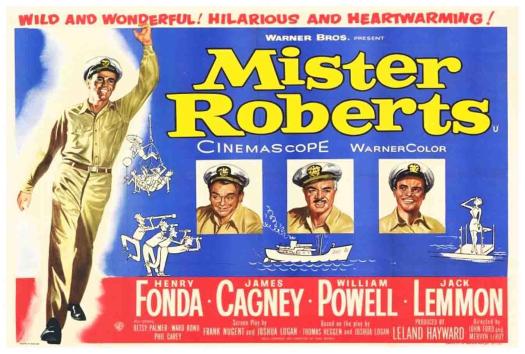
I grew up a “Navy brat”, often accompanying my dad to bases in Newport, RI. and Bethesda, MD. I’d hang out at the Enlisted Men’s Club he ran, watching Bugs Bunny and Road Runner cartoons with the sailors while dad did the books. I remember going aboard ship plenty of times, and saw one of my first movies with the crew on Family Night (the Cary Grant/Doris Day flick THAT TOUCH OF MINK). So naturally, I have a soft spot for nautical tales, and one of my favorites has always been MISTER ROBERTS.
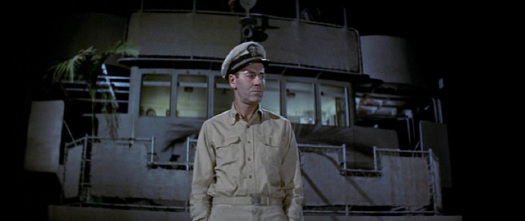
The film marked Henry Fonda’s return to the screen after an eight year absence. Fonda had starred in the original Broadway production to great acclaim, and his performance is imbued with his own experiences during WWII. Douglas Roberts is a lieutenant (j.g.) assigned to the cargo ship Reluctant in the South Pacific, run by the vain…
(With the Oscars scheduled to be awarded on March 4th, I have decided to review at least one Oscar-nominated film a day. These films could be nominees or they could be winners. They could be from this year’s Oscars or they could be a previous year’s nominee! We’ll see how things play out. Today, I take a look at the 1981 best picture nominee, On Golden Pond!)
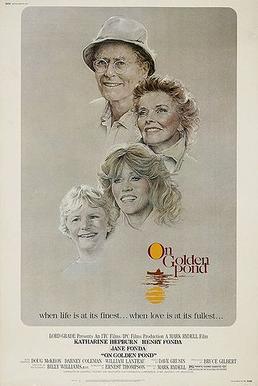
On Golden Pond takes place in a cottage that’s located on a lake called Golden Pond. Hence, the title. As far as title’s go, it’s not a bad one. It’s a film about an elderly couple who spends every summer in that cottage. They’re in their golden years so I guess it makes sense that they would feel an affinity for Golden Pond.
That said, I think that an even better title for the film would be Everything Annoys Norman.
Norman Thayer, Jr. (Henry Fonda) is a cantankerous old man. He’s 79 and not particularly looking forward to celebrating his 80th birthday. He’s a retired college professor. His wife claims that the last time Norma was really happy was when Franklin Roosevelt was elected president. Norman likes to fish and still brags about the time he caught a legendary trout named Walter.
What Norman doesn’t like is having to deal with the world. When he stops to get gas, he loudly complains that, “in his day,” gas only cost eighty-five cents. When he’s told that there’s another “middle-aged” couple on the lake, he says that, unless he’s going to live to be 150, he’s not middle-aged. He gets frustrated because his memory isn’t as good as it used to be. When he goes out for a walk in the woods, he forgets where the path is and he has to return to the house. Sometimes, he calls people by the wrong name. At one point, he struggles to use a landline phone. (I can only imagine how annoyed Norman would be if he was alive today.) Norman doesn’t like to deal with anyone other than his wife.
Ethel (Katharine Hepburn) is Norman’s wife. She loves him. When she hears Norman referred to as being “a son of a bitch,” she replies, “That son of a bitch is my husband.” Ethel is used to Norman and his ways. As she puts it, she understands that he’s like a “lion” who has to roar just to remind himself that he still can. Ethel is … well, basically, she’s Katharine Hepburn.
Ethel has invited their daughter, Chelsea (Jane Fonda), to celebrate Norman’s birthday with them. Norman and Chelsea have a strained relationship. It’s implied that Norman was an emotionally distant and overly critical father and that Chelsea has never been able to forgive him. When she shows up with her new boyfriend, Bill Ray (Dabney Coleman) and his 13 year-old son, Billy Ray (Doug McKeon), Norman barely bothers to acknowledge her. With Bill and Chelsea planning on vacation in Europe, they ask if Billy can stay at the cottage with Norman and Ethel. Ethel agrees. Norman acquiesces.
On Golden Pond is a film that I wanted to like more than I actually did. After all, the film features two classic actors, Henry Fonda and Katharine Hepburn, appearing in their only film together. (Both Henry Fonda and Hepburn won Oscars for their work here.) Henry Fonda gives a good performance as a strong-willed man who is struggling to deal with his own mortality. As for Hepburn, it’s not a great performance, largely because Ethel is a thinly written role, but she’s Katharine Hepburn so it doesn’t matter. But almost everything about the film — from the tasteful music to the pretty but not overwhelming cinematography — feels more like something you’d expect to find in a television production instead of a feature film. On Golden Pond was based on a play and, with almost all of the action set in that cottage, it really doesn’t escape its theatrical origins. That said, it’s a sweet movie. The love between Norman and Ethel feels real. If nothing else, the film gave the great Henry Fonda his only Oscar.
On Golden Pond was nominated for Best Picture but lost to Chariots of Fire.
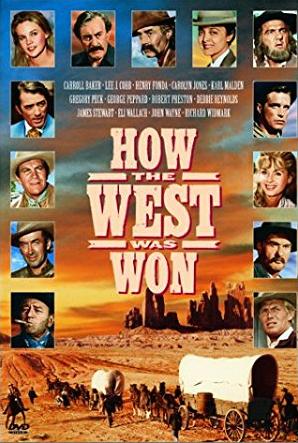
(With the Oscars scheduled to be awarded on March 4th, I have decided to review at least one Oscar-nominated film a day. These films could be nominees or they could be winners. They could be from this year’s Oscars or they could be a previous year’s nominee! We’ll see how things play out. Today, I take a look at the 1963 best picture nominee, How The West Was Won!)
How was the west won?
According to this film, the west was won by the brave men and women who set out in search of a better life. Some of them were mountain men. Some of them worked for the railroads. Some of them rode in wagons. Some of them gambled. Some of them sang songs. Some shot guns. Some died in the Civil War. The thing they all had in common was that they won the west and everyone had a familiar face. How The West Was Won is the history of the west, told through the eyes of a collection of character actors and aging stars from Hollywood’s Golden Age.
In many ways, How The West Was Won was the Avatar of the early 60s. It was a big, long, epic film that was designed to make viewers feel as if they were in the middle of the action. Avatar used 3D while How The West Was Won used Cinerama. Each scene was shot with three synchronized cameras and, when the film was projected onto a curved Cinerama screen, it was meant to create a truly immersive experience. The film is full of tracking shots and, while watching it on TCM last night, I tried to imagine what it must have been like to see it in 1963 and to feel as if I was plunging straight into the world of the old west. The film’s visuals were undoubtedly diminished by being viewed on a flat screen and yet, there were still a few breath-taking shots of the western landscape.
The other thing that How The West Was Won had in common with Avatarwas a predictable storyline and some truly unfortunate dialogue. I can understand why How The West Was Won was awarded two technical Oscars (for editing and sound) but, somehow, it also picked up the award for Best Writing, Screenplay or Story. How The West Was Won is made up of five different parts, each one of which feels like a condensed version of a typical western B-movie. There’s the mountain man helping the settlers get down the river story. There’s the Civil War story. There’s the railroad story and the outlaw story and, of course, the gold rush story. None of it’s particularly original and the film is so poorly paced that some sections of the film feel rushed while others seem to go on forever.
Some of the film’s uneven consistency was undoubtedly due to the fact that it was directed by four different directors. Henry Hathaway handled three sections while John Ford took care of the Civil War, George Marshall deal with the coming of the railroad, and an uncredited Richard Thorpe apparently shot a bunch of minor connecting scenes.
And yet, it’s hard not to like How The West Was Won. Like a lot of the epic Hollywood films of the late 50s and early 60s, it has its own goofy charm. The film is just so eager to please and remind the audience that they’re watching a story that could only be told on the big screen. Every minute of the film feels like a raised middle finger to the threat of television. “You’re not going to see this on your little idiot box!” the film seems to shout at every moment. “Think you’re going to get Cinerama on NBC!? THINK AGAIN!”
Then there’s the huge cast. As opposed to Avatar, the cast of How The West Was Won is actually fun to watch. Admittedly, a lot of them are either miscast or appear to simply be taking advantage of a quick payday but still, it’s interesting to see just how many iconic actors wander through this film.
For instance, the film starts and, within minutes, you’re like, “Hey! That’s Jimmy Stewart playing a mountain man who is only supposed to be in his 20s!”
There’s Debbie Reynolds as a showgirl who inherits a gold claim!
Is that Gregory Peck as a cynical gambler? And there’s Henry Fonda as a world-weary buffalo hunter! And Richard Widmark as a tyrannical railroad employee and Lee J. Cobb as a town marshal and Eli Wallach as an outlaw!
See that stern-faced settler over there? It’s Karl Malden!
What’s that? The Civil War’s broken out? Don’t worry, General John Wayne is here to save the day. And there’s George Peppard fighting for the Union and Russ Tamblyn fighting for the Confederacy! And there’s Agnes Moorehead and Thelma Ritter and Robert Preston and … wait a minute? Is that Spencer Tracy providing narration?
When Eli Wallach’s gang shows up, keep an eye out for a 36 year-old Harry Dean Stanton. And, earlier, when Walter Brennan’s family of river pirates menaces Karl Malden, be sure to look for an evil-looking pirate who, for about twenty seconds, stares straight at the camera. When you see him, be sure to say, “Hey, it’s Lee Van Cleef!”
How The West Was Won is a big, long, thoroughly silly movie but, if you’re a fan of classic film stars, it’s worth watching. It was a huge box office success and picked up 8 Oscar nominations. It lost best picture to Tom Jones.
(By the way, in my ideal fantasy world, From Russia With Love secured a 1963 U.S. release, as opposed to having to wait until 1964, and became the first spy thriller to win the Oscar for Best Picture.)
(With the Oscars scheduled to be awarded on March 4th, I have decided to review at least one Oscar-nominated film a day. These films could be nominees or they could be winners. They could be from this year’s Oscars or they could be a previous year’s nominee! We’ll see how things play out. Today, I take a look at the 1940 best picture nominee, The Grapes of Wrath!)
How dark can one mainstream Hollywood film from 1940 possibly be?
Watch The Grapes of Wrath to find out.
Based on the novel by John Steinbeck and directed by John Ford, The Grapes of Wrath tells the story of the Joad family and their efforts to neither get sent to prison nor starve to death during the Great Depression. When they lose their farm in Oklahoma, they head for California. Pa Joad (Russell Simpson) has a flyer that says someone is looking for men and women to work as pickers out west. The 12 members of the Joad Family load all of their possessions into a dilapidated old truck and they hit the road. It quickly becomes apparent that they’re not the only family basing all of their hopes on the vague promises offered up by that flyer. No matter how much Pa may claim different, it’s obvious that California is not going to be the promised land and that not all the members of the family are going to survive the trip.
Tom Joad (Henry Fonda) is the oldest of the Joad sons. He’s just been released from prison and he’s killed in the past. Having been in prison during the start of the Great Depression, Tom doesn’t realize how bad things truly are until he arrives home and sees someone he grew up with using a tractor to knock down a house. (It’s just business, of course. The owners of the house can’t pay their bills so the house gets destroyed.) The film’s story is largely told through Tom’s eyes and Henry Fonda gives a sympathetic performance, one the gets the audience to empathize with and relate to a character who is a total outsider.
As for the rest of the Joad Family, Ma (Jane Darwell) is the glue who holds them together and who refuses to allow them to surrender to despair. (And yet even Ma is forced to make some tough choices when the starving children of one work camp ask her to share her family’s meal with them.) Rosasharan (Dorris Bowdon) is pregnant while Grandpa (Charley Grapewin) is too sickly for the trip but doesn’t have anywhere else to go. And then there’s Casy (John Carradine), the former preacher turned labor organizer. Casy is not blood-related but he soon becomes a member of the family.
The Joads have a healthy distrust of the police and other authority figures and that turns out to be a good thing because there aren’t many good cops to be found between Oklahoma and California. Instead, the police merely serve to protect the rich from the poor. Whenever the workers talk about forming a union and demanding more than 5 cents per box for their hard work, the police are there to break heads and arrest any troublemakers on trumped up charges. Whenever a town decides that they don’t want any “Okies” entering the town and “stealing” jobs, the police are there to block the roads.
The Grapes of Wrath provides a portrait of the rough edges of America, the places and the people who were being ignored in 1940 and who are still too often ignored today. John Ford may not be the first director that comes to mind when you think of “film noir” but that’s exactly what The Grapes of Wrath feels like. During the night scenes, desperate faces emerge from the darkness while menacing figures lurk in the shadows. When the sun does rise, the black-and-white images are so harsh that you almost wish the moon would return. The same western landscape that Ford celebrated in his westerns emerges as a wasteland in The Grapes of Wrath. The American frontier is full of distrust, anger, greed, and ultimately starvation. (Reportedly, the film was often shown in the Soviet Union as a portrait of the failure of America and capitalism. However, it was discovered that Soviet citizens were amazed that, in America, even a family as poor as the Joads could still afford a car. The Grapes of Wrath was promptly banned after that.) John Ford is often thought of as being a sentimental director but there’s little beauty or hope to be found in the images of The Grapes of Wrath. (Just compare the way The Grapes of Wrath treats poverty to the way Ford portrayed it in How Green Was My Valley.) Instead, the film’s only hint of optimism comes from the unbreakable familial bond that holds the Joads together.
As dark as it may be, the film is nowhere near as pessimistic as the original novel. The novel ends with a stillborn baby and a stranger starving to death in a barn. The film doesn’t go quite that far and, in fact, offers up some deus ex machina in the form of a sympathetic government bureaucrat. (Apparently, authority figures weren’t bad as long as they worked for the federal government.) That the book is darker than the movie is not surprising. John Steinbeck was a socialist while John Ford was a Republican with a weakness for FDR. That said, even though the film does end on a more hopeful note than the novel, you still never quite buy that things are ever going to get better for anyone in the movie. You want things to get better but, deep down, you know it’s not going to happen. Tom says that he’s going to fight for a better world and Fonda’s delivers the line with such passion that you want him to succeed even if you know he probably won’t. Ma Joad says the people will never be defeated and, again, you briefly believe her even if there’s not much evidence to back her up.
Even when viewed today, The Grapes of Wrath is still a powerful film and I can only guess what it must have been like to see the film in 1940, when the Great Depression was still going on and people like the Joads were still making the journey to California. Not surprisingly, it was nominated for best picture of 1940, though it lost to Alfred Hitchcock’s Rebecca.
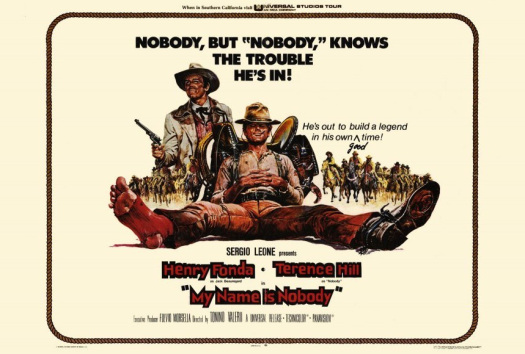
Sergio Leone wasn’t quite done with the Western genre after DUCK, YOU SUCKER. MY NAME IS NOBODY is based on “an idea by Sergio Leone”, and though Leone’s former Assistant Director Tonino Valerii is given full credit, the Maestro reportedly directed a couple of scenes as well as some second-unit action in the film. Whatever the case, the film puts a comic spin on Spaghetti Westerns in general and Leone’s movies in particular, with the comedic talents of star Terence Hill standing in sharp contrast to the old school Hollywood hero Henry Fonda .
Hill was the brightest star on the Italian horizon, having starred in Giuseppe Colizzi’s GOD FORGIVES… I DON’T, ACE HIGH, and BOOT HILL alongside burly Bud Spencer, adding elements of humor as they went along . But with 1970’S THEY CALL ME TRINITY, the duo went full-bore into comedy territory, giving the Spaghetti genre a…
When I hear the word “Runyonesque”, I think about racetrack touts, colorful Broadway denizens, dames with hearts of gold, and the like. If you want to make a Runyonesque movie, what better way than to have author Damon Runyon himself produce it, as RKO did for 1942’s THE BIG STREET. All the elements are there, the jargon, the characters, but the film suffers from abrupt shifts in tone from comedy to drama, and a totally unpleasant role for Lucille Ball . The result is an uneven movie with a real downer of an ending.
Based on Runyon’s short story “Little Pinks”, it follows the unrequited love of bus boy Augustus “Little Pinks” Pinkerton for torch singing gold digger Gloria Lyons, dubbed “Her Highness” by Pinks. Henry Fonda plays Pinks as lovestruck, spineless sad sack, dubbing Lucy Her Highness, even though she’s thoroughly rotten to him. When she’s smacked by her gangster boyfriend Case Ables ( Barton MacLane )…
The Longest Day is a pain-staking and meticulous recreation of invasion of Normandy, much of it filmed on location. It was reportedly something of a dream project for the head of the 20th Century Fox, Darryl F. Zanuck. Zanuck set out to make both the ultimate tribute to the Allied forces and the greatest war movie ever. Based on a best seller, The Longest Day has five credited screenwriters and three credited directors. (Ken Annakin was credited with “British and French exteriors,” Andrew Marton did “American exteriors,” and the German scenes were credited to Bernhard Wicki. Oddly, Gerd Oswald was not credited for his work on the parachuting scenes, even though those were some of the strongest scenes in the film.) Even though he was not credited as either a screenwriter or a director, it is generally agreed that the film ultimately reflected the vision of Darryl F. Zanuck. Zanuck not only rewrote the script but he also directed a few scenes as well. The film had a budget of 7.75 million dollars, which was a huge amount in 1962. (Until Steven Spielberg’s Schindler’s List, The Longest Day was the most expensive black-and-white film ever made.) Not only did the film tell an epic story, but it also had an epic length. Clocking in at 3 hours, The Longest Day was also one of the longest movies to ever be nominated for best picture.
The Longest Day also had an epic cast. Zanuck assembled an all-star cast for his recreation of D-Day. If you’re like me and you love watching old movies on TCM, you’ll see a lot of familiar faces go rushing by during the course of The Longest Day. American generals were played by actors like Robert Mitchum, Robert Ryan, Henry Fonda, and John Wayne. Peter Lawford, then the brother-in-law of the President of the United States, had a memorable role as the Scottish Lord Lovat, who marched through D-Day to the sounds of bagpipes. When the Allied troops storm the beach, everyone from Roddy McDowall to Sal Mineo to Robert Wagner to singer Paul Anka can be seen dodging bullets. Sean Connery pops up, speaking in his Scottish accent and providing comic relief. When a group of paratroopers parachute into an occupied village, comedian Red Buttons ends up hanging from the steeple of a church. When Richard Beymer (who is currently playing Ben Horne on Twin Peaks) gets separated from his squad, he stumbles across Richard Burton. Among those representing the French are Arletty and Christian Marquand. (Ironically, after World War II, Arletty was convicted of collaborating with the Germans and spent 18 months under house arrest. Her crime was having a romantic relationship with a German soldier. It is said that, in response to the charges, Arletty said, “My heart is French but my ass is international.”) Meanwhile, among the Germans, one can find three future Bond villains: Gert Frobe, Curt Jurgens, and Walter Gotell.
It’s a big film and, to be honest, it’s too big. It’s hard to keep track of everyone and, even though the battle scenes are probably about an intense as one could get away with in 1962 (though it’s nowhere near as effective as the famous opening of Saving Private Ryan, I still felt bad when Jeffrey Hunter and Eddie Albert were gunned down), their effectiveness is compromised by the film’s all-star approach. Often times, the action threatens to come to a halt so that everyone can get their close-up. Unfortunately, most of those famous faces don’t really get much of a chance to make an impression. Even as the battle rages, you keep getting distracted by questions like, “Was that guy famous or was he just an extra?”
Among the big stars, most of them play to their personas. John Wayne, for instance, may have been cast as General Benjamin Vandervoort but there’s never any doubt that he’s playing John Wayne. When he tells his troops to “send them to Hell,” it’s not Vandervoort giving orders. It’s John Wayne representing America. Henry Fonda may be identified as being General Theodore Roosevelt II but, ultimately, you react to him because he’s Henry Fonda, a symbol of middle-American decency. Neither Wayne nor Fonda gives a bad performance but you never forget that you’re watching Fonda and Wayne.
Throughout this huge film, there are bits and pieces that work so well that you wish the film had just concentrated on them as opposed to trying to tell every single story that occurred during D-Day. I liked Robert Mitchum as a tough but caring general who, in the midst of battle, gives a speech that inspires his troops to keep fighting. The scenes of Peter Lawford marching with a bagpiper at his side were nicely surreal. Finally, there’s Richard Beymer, wandering around the French countryside and going through the entire day without firing his gun once. Beymer gets the best line of the film when he says, “I wonder if we won.” It’s such a modest line but it’s probably the most powerful line in the film. I wish The Longest Day had more scenes like that.
The Longest Day was nominated for best picture of 1962 but it lost to an even longer film, Lawrence of Arabia.
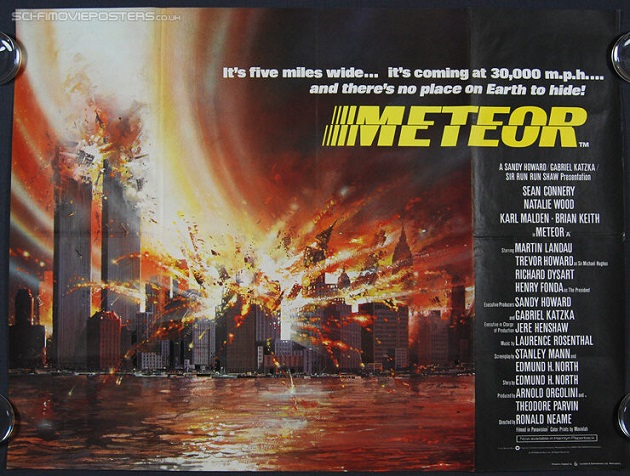
American-International Pictures had gotten pretty fancy-schmancy by the late 70’s. The studio was leaving their exploitation roots behind and branching out to bigger budgeted films like FORCE TEN FROM NAVARONE, LOVE AT FIRST BITE, and THE AMITYVILLE HORROR, with bigger name stars for marquee allure. Toward the end of 1979 they released METEOR, a $16 million dollar, star-studded, special-effects laden, sci-fi/ disaster film spectacle that bombed at the box-office and contributed to the company’s demise.
Coming at the tail end of the disaster cycle, METEOR is formulaic as hell. Take a group of well-known stars (Sean Connery, Natalie Wood , Karl Malden , Brian Keith , Martin Landau, Henry Fonda ), give them a disastrous menace to combat (in this case a five-mile wide meteor hurtling toward Earth), add some conflict (US/USSR Cold War relations), and some scenes of destruction, and voila! instant disaster movie! Unfortunately, by 1979 audiences had already grown tired…
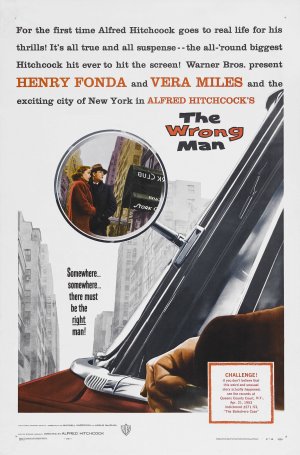
Since today is Alfred Hitchcock’s birthday, I figured why not take a few minutes to recommend one of his films that you may not have seen. First released in 1956 but still painfully relevant today, The Wrong Man is one of Hitchcock’s best but it’s also one of his most underrated.
The Wrong Man deals with a common Hitchcock theme — i.e., an innocent man has been accused of a crime and, despite all of his efforts, cannot seem to convince anyone of his innocence. The difference between The Wrong Man and something like Saboteur or Frenzy is that The Wrong Man is based on a true story.
Manny Ballestro (Henry Fonda) is a struggling musician. He makes $85 a week, playing in a small jazz club. But even though he may not be rich, he’s happy. He loves his job. He loves making music. Even more importantly, he loves his wife, Rose (Vera Miles). But Rose needs to have her wisdom teeth removed and it’s going to cost $300. (As a sign of how much things have changed, I would have been relieved if it had only cost me $300 to get my wisdom teeth taken out.) Desperate for money, Manny tries to borrow money on his wife’s life insurance plan. What Manny doesn’t know is that the insurance office has been held up twice by a man who bears a vague resemblance to him. A clerk calls the police and Manny soon finds himself being taken down to the police station.
Two detectives say that they need Manny’s help but they don’t tell him why. But Manny knows he’s innocent of any crime and he believes that the police are on his side and he agrees to help. When they tell him to walk into a liquor store, he does so. When they take him to a deli, he goes in there as well. When they demand to know why he was trying to borrow money on his wife’s life insurance, he tells them. When they ask him about his financial difficulties, he tells them about that as well. Why shouldn’t he? He’s innocent and the police are just doing their job, right? And when the cops finally ask him to copy down a few words that were used in the note that the robber slipped the clerk at the insurance company, Manny does so. And when they then ask him to take part in a line-up, he does that as well…
And when Manny is arrested and charged with a crime … well, that’s when he finally understands that the system is not on his side. His wife manages to hire a reputable attorney, Frank O’Connor (Anthony Quayle), to defend him but it quickly becomes obvious that the world has already decided that Manny is guilty. When Manny and his wife try to track down some people who could provide Manny with an alibi, they discover that two of them are dead and one of them cannot be found. For once, in a Hitchcock film, it’s not a case of conspiracy. Instead, it’s just bad luck.
And, through it all, Rose continues to blame herself. In fact, she is so wracked with guilt that she has a nervous breakdown.
It all leads to an amazingly disheartening courtroom scene. As quickly becomes obvious, the judge has little interest in what’s happening in his court. Even worse, the jury is unconcerned with the evidence. Most of them are just annoyed at the inconvenience and punishing Manny seems like the perfect way to release their own frustrations…
It’s a bleak picture of the American justice system. Watching The Wrong Man today, it’s tempting to say that the film is just a reflection of society in the 1950s and that things have changed today. But really, have they? True, the police may now be required to read someone their rights when they’re arrested. A suspect can now ask for a lawyer. We’ve got laws against entrapment and all the rest. But that doesn’t matter. We still live in a society where people are still widely presumed to be guilty, even after they’ve been found innocent in a court of law. We still live in a society where the wrong man can have his life ruined because of one mistake.
The Wrong Man doesn’t get as much attention as some of Hitchcock’s other films. In many ways, it’s an atypical example of his work. Hitchcock was notorious for his dark sense of humor and his habit of waving away most plot points as just being mere “macguffins.” With the exception of two scenes, both of which are meant to depict Manny’s mental state, The Wrong Man is filmed in a documentary style, one that occasionally seems more like Sidney Lumet than Alfred Hitchcock. There’s next to no humor, nor are there any big or flamboyant twists. In short, The Wrong Man finds the director of Psycho, Vertigo, and Rear Window at his most sincere. It takes some getting used to.
But, once you do get used to it, The Wrong Man emerges as a powerful and bleak portrait of two innocent people at the mercy of a soulless system. It’s a must see so be sure to see it!