Retro Television Review: Darke of the Night 1.1 “Who’s Been Sitting In My Chair?”


Welcome to Retro Television Reviews, a feature where we review some of our favorite and least favorite shows of the past!  This Thursday, I will be reviewing Darke of the Night, which aired its only episode on the DuMont Network in 1955.  The show can be found on YouTube!
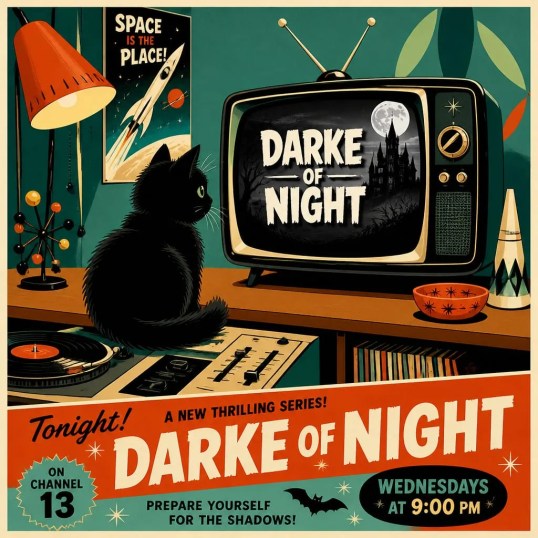
This week’s pilot originally aired as a part of the Studio 57 anthology show.

Episode 1.1 “Who’s Been Sitting In My Chair?”

(Dir by David Butler, originally aired on September 10th, 1955)

Johnny Darke (Jack Carson) is the hippest and coolest DJ in all of New York City .… or, at least, he’s as hip and cool as anyone could have been in 1955. All through the night, he spins records and talks to “the ghosts” who are listening. His station manager (Joseph Kearns) tells him that his sponsor doesn’t like it when Johnny talks about ghosts, but no one tells Johnny Darke what to do.

Johnny knows that a woman has been entering his apartment while he’s at the studio, but he doesn’t know why. (What I don’t know is why Johnny doesn’t just lock his door.) Johnny suspects that the woman is Margaret Canady (Jocelyn Brando), who lived in the apartment before Johnny moved in. Margaret’s boyfriend, Vincent Marsh (H.M. Wynant), is on death row for murder, but as Johnny learns about the case, he sees it as a story about two people who love each other as opposed to a woman who fell in love with a killer.

When Vincent breaks out of prison, he steals a guard’s gun and tells the guard that he’s going to use it to kill Margaret. (That was nice of him.) The police come down to the radio station and ask Johnny if he knows where to find Margaret. Johnny says that Margaret is probably at his apartment. After the police leave (and, strangely, do not immediately head over to Johnny’s apartment), Johnny calls his place and Margaret answers the phone. Apparently, Margaret’s not very good at secretly breaking into places.

When Johnny hears Vincent arrive over the phone, he hops over to his microphone and gives a cryptic message to “the ghost in the big brown chair” that the ghost who has just arrived is not in love with her. Then Johnny goes to his apartment and talks Vincent down.

This was a pilot for a series that would have featured Johnny Darke getting involved in the lives of his listeners. Jack Carson is likable as Johnny, which almost makes up for the fact that the story itself makes absolutely no sense. Why doesn’t Johnny just lock up his apartment before he heads to work? The implication is that Margaret is sneaking into the apartment to wait for Vincent to return, but there’s also a scene where it’s revealed that she’s secretly living with the building’s landlady. That scene is never followed up on. As I already mentioned, the biggest plot hole is that the police don’t immediately head over to Johnny’s apartment when they hear that Margaret is there. If they’re so determined to catch Vincent and they know that Vincent is planning on killing Margaret, why does it take them so long to actually go to the apartment? It seems like that should have been their priority.

Interestingly enough, the pilot ends with Jack Carson stepping out of character and offering up some statistics on the value of records purchased in 1957 ($4,000,000 worth) and the number of radio stations in the country. Carson explains that DJs are everywhere and every DJ has a million stories that could be adapted for Darke of the Night. He then brings on two actual DJs, Peter Potter and Al Jarvis. Both Potter and Jarvis endorse the idea of a weekly television series about a DJ.

It’s odd but, in its way, kind of touching. Jack Carson just seems so earnest and sincere about his desire to star as a radio DJ! Unfortunately, it didn’t happen for him. The pilot aired as part of the Studio 57 anthology series and that was that. Carson may not have gotten to play a DJ on a weekly basis, but two years later he co-starred in Cat on a Hot Tin Roof with Paul Newman and Elizabeth Taylor. Carson passed away in 1963 at the far too young age of 52, but he’ll live forever wherever classic movies are appreciated.

ALFRED HITCHCOCK PRESENTS (TV Series) – S1, E20: “And So Died Riabouchinska,” starring Claude Rains and Charles Bronson!


I’ve never been a rabid consumer of horror films, but I do love Alfred Hitchcock. And when you consider that Charles Bronson was featured three times in his TV series, ALFRED HITCHCOCK PRESENTS, you know I’m all in. Bronson first appeared in the season 1 episode, “And So Died Riabouchinska” which starred the Invisible Man himself, Claude Rains! I thought it would be fun to revisit this early episode from the classic TV series. 

When a juggler named Ockman is found dead in the basement of a vaudeville theater, Detective Krovitch (Charles Bronson), a no-nonsense police investigator, is on the case. The prime suspect quickly emerges to be John Fabian (Claude Rains), a ventriloquist whose act revolves around his beautiful female dummy, Riabouchinska, who we find out is modeled after a long, lost love. As Krovitch interrogates Fabian and all of those around him, including his embittered wife Alyce (Wynne Miller), and her lover, the shady manager Douglas, it becomes clear that the ventriloquist has a dark and dangerous past. We discover a Fabian who is lost in a world of obsession, self delusion and even perversion, a world that the now deceased Ockman was threatening to expose.  Without giving too much away, this episode blends psychological horror with police procedural and spits out an episode that still resonates loudly on the freaky-meter!

Adapted by Mel Dinelli from Ray Bradbury’s short story, “And So Died Riabouchinska” is an exceptional entry in Season 1 of the ALFRED HITCHCOCK PRESENTS TV series. Claude Rains is incredible as Fabian. It’s a thespian tour-de-force, with Rains creating a role that’s creepy, pathetic, and oddly relatable all at the same time. I haven’t seen many of Rains’ most notable works, but based on his performance here, I do know that he’s amazing. Charles Bronson, whose strong screen presence was as obvious as the nose on his face, even this early in his career, goes toe to toe with Rains (and Riabouchinska) and helps ground the episode in something resembling the real world. It’s not a showy role for the legendary tough guy, but he conveys the toughness and authority that would go on to define his career. Performances aside, the episode is truly set apart with an emotional storyline that plumbs the depths of the human psyche in a way that seems daring for 1956 television. There are parts of this episode that will definitely make you squirm in your seat! 

Overall, in my opinion, “And So Died Riabouchinska” is an essential episode of the ALFRED HITCHCOCK PRESENTS series. It’s a lot of fun seeing Hitchcock introduce the show at the beginning and wrap it up at the end, but the best part is the fact that the story that takes place in-between is creepy, clever, and compulsively re-watchable.

30 Days of Noir #3: Footsteps in the Night (dir by Jean Yarbough)


The 1957 film Footsteps in the Night opens in a small motel apartment in Los Angeles.

Jazz blares from a record player.  Playing cards are spread across a table.  A cigarette burns in an ashtray while a stack of poker chips sits undisturbed nearby.  When the apartment’s resident, Henry Johnson (Douglas Dick) steps into the room, he nearly stumbles over the dead body that’s lying in the middle of the floor.

Henry looks down at the body.  Is he shocked?  Is he scared?  Is he regretful?  Is he guilty?  It’s impossible to tell from his somewhat perturbed but mostly blank facial expression.  He takes in the scene and then promptly turns out the lights.

The dead man is Henry’s neighbor, Fred Horner (Robert Shaye).  When the police arrive, Detectives Andy Doyle (Bill Elliott) and Mike Duncan (Don Haggerty) immediately deduce that someone murdered Fred in the middle of a poker game.  Since everyone says that Henry was not only a degenerate gambler but that he also frequently got into arguments with Fred, Henry becomes the number one suspect.  Not helping Henry’s case is the fact that he’s disappeared and his girlfriend, Mary Raiken (Eleanore Train), won’t reveal where he’s hiding.

It seems like an open-and-shut case but Doyle has his doubts.  The case against Henry is almost too perfect and Doyle wonders if maybe they’re overlooking something.  As Doyle and Duncan continue to investigate, they discover that Fred Horner was an angry and misanthropic man.  They also discover that there’s a salesman named Bradbury (James Flavin) who is staying at an adjacent hotel and who bears a strong resemblance to the dead man….

Clocking in at just 62 minutes, Footsteps in the Night is a fast-paced police procedural with elements of film noir tossed in for good measure.  While I was doing some research for this review, I discovered that Footsteps in the Night was actually the fifth and final film in which Bill Elliott played Detective Andy Doyle.  Before taking on the role of Doyle, Elliott appeared in several westerns and he plays Doyle much like an ideal frontier sheriff.  He’s a no-nonsense lawman who solves cases with common sense and doesn’t have much time for wild speculation.  Dan Haggerty backs him up as the equally no-nonsense Mike Duncan.  As opposed to the modern tendency to celebrate cops who “break the rules,” Footsteps in the Night emphasizes the professional, by-the-book attitude of Doyle and Duncan.  If you were ever murdered, Duncan and Doyle are the type of cops that you would want assigned to the case.

As for their number one suspect, Henry may claim to have just been an innocent bystander but his gambling addiction makes him less than trustworthy in the eyes of many cops.  It’s only when Doyle and Duncan start to dig into the case that they discover just how cruelly Fred manipulated Henry’s addiction.  In the best tradition of many murder mysteries, Footsteps in the Night not only leaves you wondering who the murderer may have been but also whether or not the victim may have gotten what he deserved.

Footsteps in the Night is a good police procedural.  I look forward to watching and reviewing the other four films in which Bill Elliott played Detective Doyle as well.

Lisa Reviews An Oscar Nominee: The Grapes of Wrath (dir by John Ford)


(With the Oscars scheduled to be awarded on March 4th, I have decided to review at least one Oscar-nominated film a day.  These films could be nominees or they could be winners.  They could be from this year’s Oscars or they could be a previous year’s nominee!  We’ll see how things play out.  Today, I take a look at the 1940 best picture nominee, The Grapes of Wrath!)

How dark can one mainstream Hollywood film from 1940 possibly be?

Watch The Grapes of Wrath to find out.

Based on the novel by John Steinbeck and directed by John Ford, The Grapes of Wrath tells the story of the Joad family and their efforts to neither get sent to prison nor starve to death during the Great Depression.  When they lose their farm in Oklahoma, they head for California.  Pa Joad (Russell Simpson) has a flyer that says someone is looking for men and women to work as pickers out west.  The 12 members of the Joad Family load all of their possessions into a dilapidated old truck and they hit the road.  It quickly becomes apparent that they’re not the only family basing all of their hopes on the vague promises offered up by that flyer.  No matter how much Pa may claim different, it’s obvious that California is not going to be the promised land and that not all the members of the family are going to survive the trip.

Tom Joad (Henry Fonda) is the oldest of the Joad sons.  He’s just been released from prison and he’s killed in the past.  Having been in prison during the start of the Great Depression, Tom doesn’t realize how bad things truly are until he arrives home and sees someone he grew up with using a tractor to knock down a house.  (It’s just business, of course.  The owners of the house can’t pay their bills so the house gets destroyed.)  The film’s story is largely told through Tom’s eyes and Henry Fonda gives a sympathetic performance, one the gets the audience to empathize with and relate to a character who is a total outsider.

As for the rest of the Joad Family, Ma (Jane Darwell) is the glue who holds them together and who refuses to allow them to surrender to despair.  (And yet even Ma is forced to make some tough choices when the starving children of one work camp ask her to share her family’s meal with them.)  Rosasharan (Dorris Bowdon) is pregnant while Grandpa (Charley Grapewin) is too sickly for the trip but doesn’t have anywhere else to go.  And then there’s Casy (John Carradine), the former preacher turned labor organizer.  Casy is not blood-related but he soon becomes a member of the family.

The Joads have a healthy distrust of the police and other authority figures and that turns out to be a good thing because there aren’t many good cops to be found between Oklahoma and California.  Instead, the police merely serve to protect the rich from the poor.  Whenever the workers talk about forming a union and demanding more than 5 cents per box for their hard work, the police are there to break heads and arrest any troublemakers on trumped up charges.  Whenever a town decides that they don’t want any “Okies” entering the town and “stealing” jobs, the police are there to block the roads.

The Grapes of Wrath provides a portrait of the rough edges of America, the places and the people who were being ignored in 1940 and who are still too often ignored today.  John Ford may not be the first director that comes to mind when you think of “film noir” but that’s exactly what The Grapes of Wrath feels like.  During the night scenes, desperate faces emerge from the darkness while menacing figures lurk in the shadows.  When the sun does rise, the black-and-white images are so harsh that you almost wish the moon would return.  The same western landscape that Ford celebrated in his westerns emerges as a wasteland in The Grapes of Wrath.  The American frontier is full of distrust, anger, greed, and ultimately starvation.  (Reportedly, the film was often shown in the Soviet Union as a portrait of the failure of America and capitalism.  However, it was discovered that Soviet citizens were amazed that, in America, even a family as poor as the Joads could still afford a car.  The Grapes of Wrath was promptly banned after that.)  John Ford is often thought of as being a sentimental director but there’s little beauty or hope to be found in the images of The Grapes of Wrath.  (Just compare the way The Grapes of Wrath treats poverty to the way Ford portrayed it in How Green Was My Valley.)  Instead, the film’s only hint of optimism comes from the unbreakable familial bond that holds the Joads together.

As dark as it may be, the film is nowhere near as pessimistic as the original novel.  The novel ends with a stillborn baby and a stranger starving to death in a barn.  The film doesn’t go quite that far and, in fact, offers up some deus ex machina in the form of a sympathetic government bureaucrat.  (Apparently, authority figures weren’t bad as long as they worked for the federal government.)  That the book is darker than the movie is not surprising.  John Steinbeck was a socialist while John Ford was a Republican with a weakness for FDR.  That said, even though the film does end on a more hopeful note than the novel, you still never quite buy that things are ever going to get better for anyone in the movie.  You want things to get better but, deep down, you know it’s not going to happen.  Tom says that he’s going to fight for a better world and Fonda’s delivers the line with such passion that you want him to succeed even if you know he probably won’t.  Ma Joad says the people will never be defeated and, again, you briefly believe her even if there’s not much evidence to back her up.

Even when viewed today, The Grapes of Wrath is still a powerful film and I can only guess what it must have been like to see the film in 1940, when the Great Depression was still going on and people like the Joads were still making the journey to California.  Not surprisingly, it was nominated for best picture of 1940, though it lost to Alfred Hitchcock’s Rebecca.