Film Review: The Hindenburg (dir by Robert Wise)


80 years ago, on May 6th, 1937, the Hindenburg, a German airship, exploded in the air over New Jersey.  The disaster was not only covered live by radio reporter Herbert Morrison (whose cry of “Oh the humanity!” continues to be parodied to this day) but it was also one of the first disasters to be recorded on film.  Looking at the footage of the Hindenburg exploding into flame and sinking to the ground, a mere skeleton of what it once was, it’s hard to believe that only 36 people died in the disaster.  The majority of those who died were crew members, most of whom lost their lives while helping passengers off of the airship.  (Fortunately, the Hindenburg was close enough to the ground that many of the passengers were able to escape by simply jumping.)

Not surprisingly, there was a lot of speculation about what led to the Hindenburg (which has successfully completed 63 flights before the disaster) exploding.  The most commonly accepted explanation was that it was simply an act of God, the result of either lightning or improperly stored helium.  Apparently, there was no official evidence found to suggest that sabotage was involved but, even back in 1937, people loved conspiracy theories.

And really, it’s not totally implausible to think that the Hindenburg was sabotaged.  The Hindenburg was making its first trans-Atlantic flight and it was viewed as being a symbol of Nazi Germany.  One of the ship’s passengers, Captain Ernest Lehman, was coming to the U.S. in order to lobby Congress to give Germany helium for their airships.  With Hitler regularly bragging about the superiority of German industry, the theory was that an anti-Nazi crewman or passengers planted a bomb on the Hindenburg.  Since no individual or group ever stepped forward to claim responsibility, the theory continues that the saboteur must have perished in the disaster.

At the very least, that’s the theory put forward by a film that I watched earlier today, the 1975 disaster movie, The Hindenburg.

A mix of historical speculation and disaster film melodrama, The Hindenburg stars George C. Scott as Col. Franz Ritter, a veteran of the German air force who is assigned to travel on the Hindenburg and protect it from saboteurs.  Ritter is a Nazi but, the film argues, he’s a reluctant and disillusioned Nazi.  Just a few weeks before the launch of the airship, his teenage son was killed while vandalizing a synagogue.  Ritter is a patriot who no longer recognizes his country and George C. Scott actually does a pretty good job portraying him.  (You do have to wonder why a seasoned veteran of the German air force would have a gruff, slightly mid-Atlantic accent but oh well.  It’s a 70s disaster film.  These things happen.)

Ritter is assigned to work with Martin Vogel (Roy Thinnes), a member of the Gestapo who is working undercover as the Hindenburg’s photographer.  Tt soon becomes obvious that he is as much a fanatic as Ritter is reluctant.  Vogel is a sadist, convinced that every Jewish passenger is secretly a saboteur.  Thinnes is chilling in the role.  What makes him especially frightening is not just his prejudice but his casual assumption that everyone feels the same way that he does.

And yet, as good as Scott and Thinnes are, the rest of the cast is rather disappointing.  The Hindenburg features a large ensemble of actors, all playing characters who are dealing with their own privates dramas while hoping not to burn to death during the final 15 minutes of the film.  Unfortunately, even by the standards of a typical 70s disaster film, the passengers are thinly drawn.  I liked Burgess Meredith and Rene Auberjonois as two con artists but that was mostly because Meredith and Auberjonois are so charming that they’re fun to watch even if they don’t have anything to do.  Anne Bancroft has one or two good scenes as a German baroness and Robert Clary does well as a vaudeville performer who comes under suspicion because of his anti-Nazi leanings.  Otherwise, the passengers are forgettable.  Whether they die in the inferno and manage to make it to the ground, your main reaction will probably be to look at them and say, “Who was that again?”

Anyway, despite all of Ritter and Vogel’s sleuthing, it’s not much of mystery because it’s pretty easy to figure out that the saboteur is a crewman named Boerth (William Atherton).  Having seen Real GeniusDie Hard and the original Ghostbusters, I found it odd to see William Atherton playing a sympathetic character.  Atherton did okay in the role but his attempt at a German accent mostly served to remind me that absolutely no one else in the film was trying to sound German.

Anyway, the main problem with The Hindenburg is that it takes forever for the airship to actually explode.  The film tries to create some suspense over whether Ritter will keep the bomb from exploding but we already know that he’s not going to.  (Let’s be honest.  If you didn’t already know about the Hindenburg disaster, you probably wouldn’t be watching the movie in the first place.)  The film probably would have worked better if it had started with the Hindenburg exploding and then had an investigator working backwards, trying to figure out who the saboteur was.

However, the scenes of the explosion almost make up for everything that came before.  When that bomb goes off, the entire film suddenly switches to black-and-white.  That may sound like a cheap or even sensationalistic trick but it actually works quite well.  It also allows the scenes of passengers and crewmen trying to escape to be seamlessly integrated with actual footage of the Hindenburg bursting into flame and crashing to the ground.  The real-life footage is still shocking, especially if you’re scared of fire.  Watching the real-life inferno, I was again shocked to realize that only 36 people died in the disaster.

In the end, The Hindenburg is flawed but watchable.  George C. Scott was always at his most watchable when playing a character disappointed with humanity and the real-life footage of the Hindenburg disaster is morbidly fascinating.

Oh, the humanity indeed!

Film Review: Guardians of the Galaxy Vol. 2 (dir by James Gunn)


(MINOR SPOILERS!  SPECIFICALLY, THE IDENTITY OF THIS FILM’S MAIN VILLAIN WILL BE REVEALED)

The Guardians of the Galaxy are back!

And this time, they’ve brought some new friends with them, friends with names like Kurt Russell, Sylvester Stallone, and … David Hasselhoff?

That’s right.  David Hasselhoff is now a part of the Marvel Cinematic Universe and somehow, it feels totally appropriate.  For all the words that have been written comparing Guardians of the Galaxy to the Star Wars franchise, it’s true ancestor is the 1978 Italian film, Starcrash.  (Perhaps not coincidentally, Starcrash was Hasselhoff’s film debut.)  Watch the trailer below and just try to tell me that you can’t imagine Chris Pratt and Zoe Saldana in the lead roles.

But enough about my obsession with Italian exploitation films.  I know the question that you want answered.  Is Guardians of the Galaxy Vol. 2 as good as the first one?

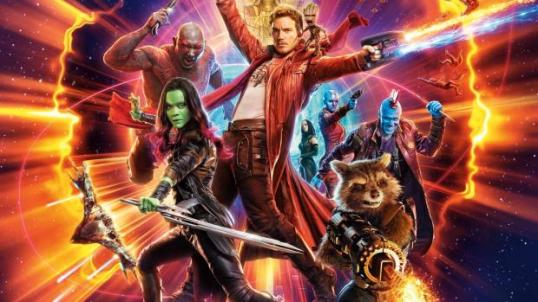
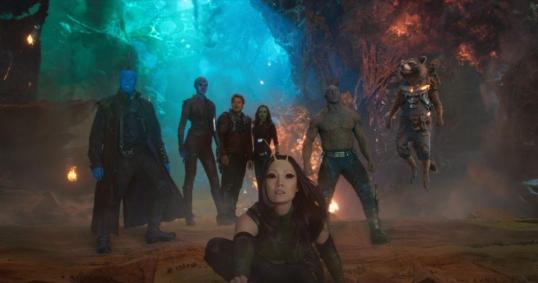
Well, it depends on how you look at it.  Guardians of the Galaxy Volume 2 is an absolute blast, a wonderfully entertaining film that mixes subversive comedy with sci-fi action.  Everyone from the first film — Chris Pratt, Zoe Saldana, Dave Bautista, Karen Gillan, Michael Rooker, and the voices of Bradley Cooper and Vin Diesel — is back and they’ve still got the same winning chemistry that made the first film so much fun.  Everyone is still committed to their roles, delivering even the strangest of dialogue with undeniable flair.  Nobody’s gotten bored with saving the universe yet.  The new additions to the cast are all well selected.  Kurt Russell totally disproves the assumption that MCU villains are never as interesting as their heroic opponents but, then again, it helps that he’s playing a character who has a memorable and odd backstory.  Once again, director James Gunn combines crowd-pleasing moments with his own sharp sense of humor.  If the pompous tone of Man of Steel and Batman v Superman made you sick, Guardians of the Galaxy Volume 2 is the perfect antidote.

Unfortunately, Volume 2 doesn’t provide the same thrill of discovery as the first film.  It’s easy to forget that, before the first film came out, a lot of people were predicting that Guardians of the Galaxy would be the first MCU film to flop at the box office.  The conventional wisdom was that, as opposed to a character like Captain America, no one, outside of a few comic book readers, knew who the Guardians of the Galaxy were.  Chris Pratt was just the goofy guy from Parks and Recreation.  A talking raccoon?  A walking tree?  It was all way too weird, the naysayers proclaimed, to appeal to a mainstream audience.

However, James Gunn proved them wrong.  Guardians of the Galaxy was not only the most successful MCU film to that date but it was also my pick for the best film of 2014.  I can still remember watching it for the first time and immediately falling in love with both the film’s skewered sensibility and Chris Pratt’s funny but soulful performance.  As opposed to a lot of films that were nominated for and won Oscars that year, Guardians of the Galaxy actually holds up after repeat viewings.

(Seriously, has anyone tried to rewatch Birdman lately?)

Going into the sequel, everyone now knows who the Guardians are and Chris Pratt is now a beloved film star.  Volume 2 has a lot to live up to and, for the most part, it succeeds.  It’s a tremendous amount of fun and, at the same time, it has a heart.  (The heart at the center of the Guardian of the Galaxy films is perhaps the biggest heart in the MCU.)

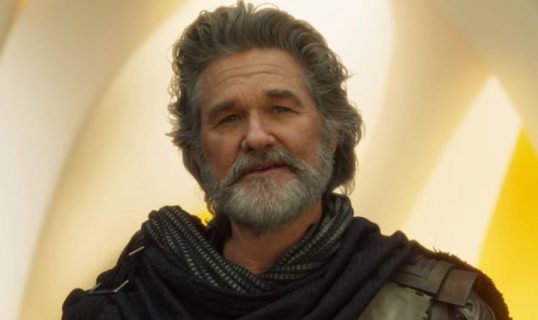
What is the film about?  Much like the first film, it’s about family.  After years of telling everyone that his father was David Hasselhoff, Peter Quill (Chris Pratt) finally meets his real father (Kurt Russell), a God-like figure named Ego.  Charismatic, cheerful, and just a little bit odd, Ego seems like the perfect father figure but he has some secrets of his own.  Russell gives a wonderful performance, making Ego one of the few MCU villains to be as interesting as the heroes.

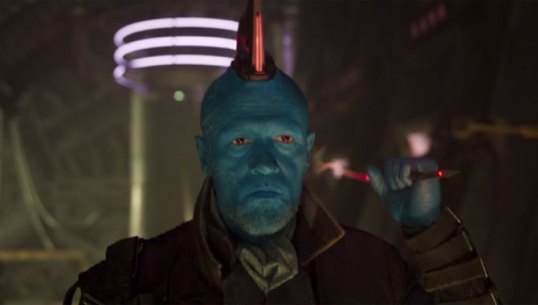
While Peter is bonding with his dad, he is also being pursued by his adoptive father, the blue-skinned space pirate named Yondu (Michael Rooker).  Yondu has been rejected by both his adopted son and the rest of his adopted family.  The other space pirates are no longer loyal to him.  His former boss (Sylvester Stallone) wants nothing to do with him.  As silly as it all may sound, it’s also unexpectedly poignant, thanks to Michael Rooker’s performance.  Rooker has appeared in several of Gunn’s films.  He’s almost the Cary Grant to Gunn’s Alfred Hitchcock.  Rooker gives one of the best performances of his careeer in the role of Yondu.  It’s tempting to be dismissive of Yondu, with his blue-skin and his Alabama accent, but Rooker makes him one of the most compelling characters to ever be found in an MCU film.

Meanwhile, Rocket Raccoon (voiced again by Bradley Cooper) has become a surrogate father figure to Groot (voice by Vin Diesel), who is still just a baby tree.  (Groot, a living tree, was reduced to just a twig at the end of the first film.  Fortunately, Rocket planted the twig and, in another few movies, we’ll hopefully have a fully grown Groot.)  Yes, Baby Groot does get to dance, again.  At one point, one of the film’s villains forbids any of his henchmen from attacking Baby Groot because he’s just too adorable to destroy.  And he’s right!  After this movie, everyone will want a Baby Groot of their own.

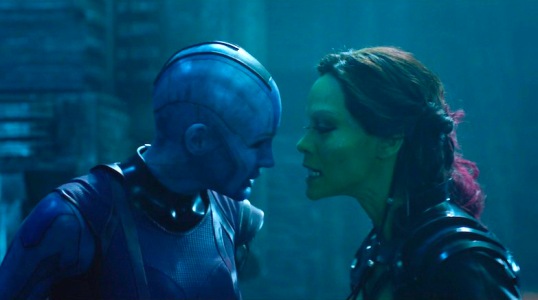
Gamora (Zoe Saldana) has been reunited with her sister, Nebula (Karen Gilliam) and, once again, they spend most of the movie trying to kill each other.  I have three older sisters so I related to their relationship.

And finally, Drax (Dave Bautista) is still mourning his family.  Fortunately, he gets to spend some quality time with Ego’s odd assistant, an empath named Mantis (Pom Klementieff).  Drax and Mantis both have no idea how social interaction is supposed to work and their scenes together are definitely a highlight of the film.  Bautista and Klementieff share a really likable chemistry.  Bautista is one of those actors who can make you laugh just be giving the camera a quizzical look.  Drax may not be as a complicated as the other Guardians but that simplicity often makes him as interesting as his more complex compatriots.

The film’s not only about family.  It’s also a strike against elitism and a celebration for freedom.  Over the course of two films, the Guardians have battled against both an actual god and a fanatic who claimed to speak for God.  At a time when so many movie heroes are tools of authoritarianism, the Guardians of the Galaxy stand for freedom.  In many ways, Peter Quill is as much of a symbol for liberty as Captain America.  Captain America makes his point with a shield while Peter Quill makes his case by dancing.

As might be expected from an MCU film, Guardians of the Galaxy Volume 2 is full of thrilling visuals, exciting battles, and quotable one liners.  Even if it never reaches the heights of the first one, it’s a blast of a film and, as Arleigh told me it would, the finale brought tears to my mismatched eyes.  See it and have a good time.

Also, be sure to stick around through the entire end credits.  Along with a lot of clues about what might happen in the future of the MCU, there’s also one final Groot joke that made me laugh out loud.

Enjoy!


The TSL’s Grindhouse: Giallo in Venice (dir by Mario Landi)


(I know this is a boring poster but it’s literally one of the few Giallo in Venice graphics that I can post without running the risk of getting the site in trouble.)

So, I finally saw the infamous (and, in many countries, banned) 1979 film, Giallo in Venice.

Back when I first decided to learn about the history of Italian horror, Giallo in Venice was a title that I frequently came across in the course of my research.  Everyone — and I do mean everyone — seemed to agree on three points: 1) it was one of the most graphic and mean-spirited Italian thrillers of all time, 2) it had never been released on DVD or Blu-ray in the United States and, as such, it was not the easiest film to see, and 3) the film was really, really bad.

Now, I have to admit that I probably wouldn’t have had any desire to see Giallo in Venice if not for the fact that I repeatedly read that it would be next to impossible for me to do so.  I hate being told what I can and cannot do.  Don’t get me wrong.  Everything that I read about Giallo in Venice was overwhelmingly negative.  Critics, some of whom I actually respected, were nearly unanimous in their dismissal of the film.  Unlike my hope that I’ll someday see fully restored versions of Greed and London After Midnight, seeing Giallo in Venice was never a number one priority for me.  Instead, it was just something that I kept in the back of my mind.  If I ever had a chance to watch Giallo in Venice, I told myself, I would just so I could say that I had seen it.

Last week,I got that chance.  I discovered that Giallo in Venice had not only been uploaded on YouTube but it was also the uncut version.   (I’m not going to include a link because of the film’s graphic content.  I don’t want to get either this site or the people who uploaded the video in trouble.  If you go to YouTube and search for “Giallo in Venice,” it should be one of the first videos to come up.) The only problem was that, along with being copied from a faded VHS tape, it was the Russian language version.  Basically, whenever any of the film’s characters spoke, you would first hear the line in the original Italian and then a rather angry man would shout the same the line in Russian.  Unfortunately, I know very little Italian and absolutely no Russian.

Needless to say, this led to a rather odd viewing experience.  If Giallo in Venice had been directed by a visual stylist like Lucio Fulci, Dario Argento, Mario Bava, or even Ruggero Deodato, it might not have been a problem.  Those four directors are all rightly renowned for their ability to create mood and atmosphere.  (And, for that matter, the best giallo films are often more concerned with visuals than dialogue.)  Unfortunately, Giallo in Venice was directed by Mario Landi, an veteran television director whose style can best be described as “turn on the camera at the start of the scene, turn it off at the end.”

(Landi also directed Patrick Still Lives, which is a smidgen more interesting than Giallo in Venice.)

As for the film’s plot — well, it’s hard for me to say for sure.  Not to overemphasize this point but, quite literally, I COULD NOT UNDERSTAND A WORD THAT ANYONE WAS SAYING.

The film opens in Venice, with a man being stabbed to death while a woman drowns in a canal.  Inspector De Paul (Jeff Blynn) is assigned to solve the murders.  He has poofy hair that wouldn’t be out of place in a stage production of Boogie Nights and, for some reason, Inspector De Paul is constantly eating hard-boiled eggs.  In just about every scene in which he appears, he is eating an egg.  Though it was hard to judge his overall performance (though the Russian seemed to enjoy repeating De Paul’s dialogue), Jeff Blynn really got into eating those eggs.  It got rather sickening to watch after a while.  As far as I could tell, De Paul’s investigation amounted to talking to one witness and then talking to the dead woman’s roommate.

The roommate, incidentally, is played by Mariangela Giordano, who also appeared in Patrick Still Lives, Burial Ground, and Michele Soavi’s The Sect.  Any fan of Italian horror will not only recognize Giordano but will also immediately know that her Giallo in Venice character is destined meet an unlucky end.  Patrick Still Lives, Burial Ground, and Giallo in Venice were all produced by Giordano’s then-boyfriend and, in all three films, she played a character who was graphically and gruesomely killed onscreen.  In Patrick Still Lives, she was skewered by a fireplace poker.  In Burial Ground, she made the mistake of trying to breastfeed her zombiefied son.  And in Giallo in Venice, one of her legs is slowly sawed off.  Seriously, if my boyfriend insisted that I suffer a terrible death in every film that he produced, it would probably be an issue.  Just saying.

Anyway, while Inspector De Paul is investigating the murder, this young couple keeps popping up.  They’re young, rich, and fifty shades of fucked up.  Fabio (Gianni Dei) has apparently been rendered impotent by all the cocaine that he’s been snorting and the only way he can get off is by forcing Flavia (Leonara Favi) to play out all of his kinky fantasies.  I found myself wondering why the film kept switching back and forth, between the not-quite-loving couple and the murder investigation.  Was Fabio the murderer?  Then, suddenly, I realized that Fabio and Flavia were the same couple who were murdered at the start of the film.  The Fabio and Flavia scenes were flashbacks.  I’m assuming that my confusion was due to the Russian dialogue but it says something about Landi’s visual style that it was impossible to tell, just from watching, that the Flavia/Fabio scenes were meant to be flashbacks.

(As far as I can — and again, dialogue problems — the flashbacks weren’t triggered by anyone saying, “I remember one time…” or anything like that.  Add to that, most of the flashbacks only featured Fabio and Flavia so, logically, there’s no way anyone could have been telling Inspector De Paul what happened.  Instead, the flashbacks just felt like random scenes that were sprinkled in between the violence and the eating.)

Giallo in Venice is a mix of egg eating, sex, and sadism.  The graphic murders are probably what Giallo in Venice is best known for, though I have to admit that I found the constant egg eating to be almost as disgusting.  As for the film’s gore, it was just as graphic and extreme as I had previously read.  But, with the exception of what happens to poor Mariangela Giordano, the violence has no impact on the viewer.  Since Landi directs with no discernible style, there’s nothing behind the murders beyond the fact that, when you title a movie Giallo in Venice, you’re obligated to include a few deaths.  It’s violence for the sake of violence and therefore, rather boring.  Admittedly, I’m sure it was rather shocking in 1979 but, today, audiences are more used to that sort of thing.  After all, everyone’s seen that tutorial on how to be a zombie for Halloween.

While watching Giallo in Venice, it was hard not to compare it to Lucio Fulci’s The New York Ripper.  Both films are deeply unpleasant but, due to Fulci’s energetic and, at times, subversive direction, there’s at least always something going on underneath the blood-drenched surface of The New York Ripper.  You can debate whether or not he succeeded but it can’t be denied that Fulci was going for something more than just sadism when he made The New York Ripper.  (If you doubt me, read Stephen Thrower’s analysis in Beyond Terror: The Films of Lucio Fulci.)  Landi’s style, in Giallo in Venice, is so flat that there’s not only nothing going on underneath but the surface itself seems to be pretty barren too.

To give credit where credit is due, I did appreciate just how ugly Landi managed to make Venice look.  I’ve been to Venice and I absolutely love it.  I would never believe that a director could make Venice look like a dump but Mario Landi managed to do it.  I don’t know if that was intentional on his part but it actually worked for the film.  Since all of the characters actually lived in Venice, it made sense that they wouldn’t be standing around and admiring the city’s natural beauty.  Instead, they all live and operate in the parts of Venice that tourists don’t see.

Finally, Landi did manage to get one interesting shot, when the reflection of one of the victims is seen in the killer’s sunglasses.  Unfortunately, Landi was so impressed by that shot that he kept using it over and over again until, eventually, it became far less interesting.

One final note: Giallo in Venice had a very odd score.  It sounded like it was being played by a cocktail lounge jazz quartet.  The music, itself, was actually rather boring but it was so totally out-of-place that it became oddly charming.  I found myself craving a drink with a little umbrella in it.

Anyway, that’s Giallo in Venice.  It’s not good, it’s not memorable, but at least I can now say that I’ve seen it.

Here’s The Trailer For The Big Sick


Back in January and February, I was looking forward to seeing The Big Sick.  Then I spent March and April listening to people insist that 1) The Big Sick is the greatest comedy ever and 2) if you don’t see and love The Big Sick, then you’ll somehow be responsible for the end of the world.  Nothing turns me off quicker than excessive and oppressive hype.

That said, I still hope the movie’s good because I will definitely be seeing it.

Film Review: Twin Peaks: Fire Walk With Me (dir by David Lynch)


“It was a dream!  We live in a dream!”

— Phillip Jeffries (David Bowie) in Twin Peaks: Fire Walk With Me (1992)

Even among fans of the show, Twin Peaks: Fire Walk With Me is controversial.

If you read Reflections: An Oral History of Twin Peaks, you’ll discover that many members of the television show’s cast either didn’t want to be involved in the film or didn’t care much for it when it came out.  Fearful of being typecast, Kyle MacLachlan only agreed to play Dale Cooper on the condition that his role be greatly reduced.  (Was it that fear of being typecast as clean-cut Dale Cooper that led to MacLachlan later appearing in films like Showgirls?)  Neither Lara Flynn Boyle nor Sherilyn Fenn could work the film into their schedules.

When Twin Peaks: Fire Walk With Me premiered at Cannes, it was reportedly booed by the same critics who previously applauded Lynch’s Wild at Heart and who, years later, would again applaud Mulholland Drive.  When it was released in the United States, the film was savaged by critics and a notorious box office flop.  Quentin Tarantino, previously a fan of Lynch’s, has been very outspoken about his hatred of Twin Peaks: Fire Walk With Me.  When I first told people that we would be looking back at Twin Peaks for this site, quite a few replied with, “Even the movie?”

And yet, there are many people, like me, who consider Twin Peaks: Fire Walk With Me to be one of David Lynch’s most haunting films.

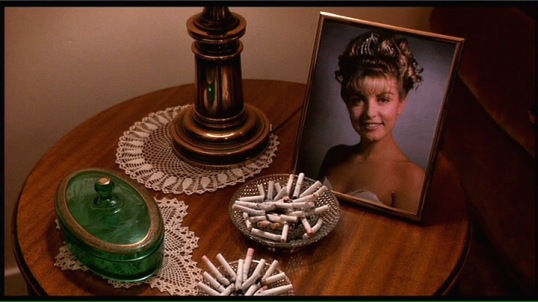
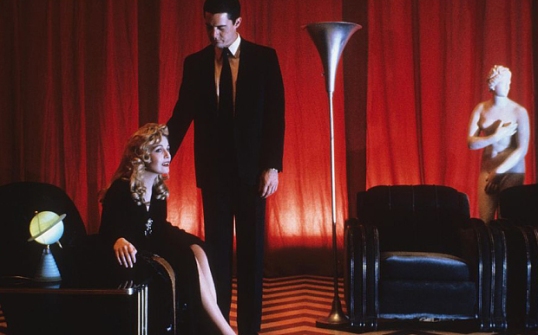
It’s also one of his most straight forward.  Twin Peaks: Fire Walk With Me is a prequel, dealing with the events leading up to the death of Laura Palmer.  Going into the film, the viewer already knows that Laura Palmer (Sheryl Lee) is full of secrets.  They know that she is using drugs.  They know that she is dating Bobby (Dana Ashbrook), while secretly seeing James (James Marshall).  They know about her diary and her relationship with the reclusive Harold (Lenny Von Dohlen).  They know that she is a friend to innocent Donna Hayward (Moria Kelly, somewhat awkwardly taking the place of Lara Flynn Boyle).  Even more importantly, they know that she has spent the last six years of her life being abused by BOB (Frank Silva) and that BOB is her father, Leland Palmer (Ray Wise).  The viewer starts the story knowing how it is going to end.

Things do get off to a somewhat shaky start with a nearly 20-minute prologue that basically plays like a prequel to the prequel.  Theresa Banks, who was mentioned in the show’s pilot, has been murdered and FBI director Gordon Cole (David Lynch) assigns agents Chester Desmond (Chris Isaak) and Sam Stanley (Kiefer Sutherland) to investigate.  Chester and Sam’s investigation basically amounts to a quick reenactment of the first season of Twin Peaks, with the agents discovering that Theresa was involved in drugs and prostitution.  When Chester vanishes, Dale Cooper is sent to investigate.  Harry Dean Stanton shows up as the manager of a trailer park and David Bowie has an odd cameo as a Southern-accented FBI agent who has just returned from the Black Lodge but otherwise, the start of the film almost feels like a satire of Lynch’s style.

But then, finally, we hear the familiar theme music and the “Welcome to Twin Peaks” sign appears.

“And the angel’s wouldn’t help you. Because they’ve all gone away.”

— Laura Palmer (Sheryl Lee), Twin Peaks: Fire Walk With Me (1992)

A year has passed since Theresa Banks was murdered.  The rest of the film deals with the final few days of the life of doomed homecoming queen Laura Palmer.  Laura smiles in public but cries in private.  She is full of secrets that she feels that she has to hide from a town that has literally idolized her.  She has visions of terrifying men creeping through her life and each day, she doesn’t know whether it will be BOB or her father waiting for her at home.  She knows that the world considers her to be beautiful but she also know that, within human nature, there is a desire to both conquer and destroy beauty.  When she sleeps, she has disturbing dreams that she cannot understand but that she knows are important.  At a time when everyone says she should be happy to alive, all she can think about is death.  Everywhere she goes, the male gaze follows and everything that should be liberating just feels her leaving more trapped.  For all the complaints that Twin Peaks: Fire Walk With Me is somehow too strange to be understood, it’s not a strange film at all.  This is David Lynch at his most straight forward.  Anyone who thinks that Laura’s story is incomprehensible has never been a 17 year-old girl.

This is the bleakest of all of David Lynch’s films.  There is none of broad humor or intentional camp that distinguished the TV show.  After the show’s occasionally cartoonish second season, the film served as a trip into the heart of the darkness that was always beating right underneath the surface of Twin Peaks.  It’s interesting how few of the show’s regulars actually show up in Twin Peaks: Fire Walk With Me.  None of the characters who represented goodness are present.  There’s no Doc Hayward.  No Sheriff Truman.  No Deputies Andy or Hawk.  No Pete Martell.  No Bookhouse Boys.  Scenes were filmed for some of them but they didn’t make it into the final cut because their tone did not fit with the story that Lynch was seeking to tell.  The Hornes, Dr. Jacoby, Josie, none of them are present either.

Instead, there’s just Larua and her father.  As much as they try to deny it, Laura knows that she is going to die and Leland knows that he is going to kill her.  Killer BOB and the denziens of the Black Lodge may be scary but what’s truly terrifying is the sight of a girl living in fear of her own father.  Is Leland possessed by BOB or is BOB simply his way of excusing his own actions?  If not for Leland’s sickness, would BOB even exist?  When Laura shouts, “Who are you!?” at the spirit of BOB, she speaks for every victim of abuse who is still struggling to understand why it happened.  For all the talk of the Black Lodge and all the surreal moments, the horror of this film is very much the horror of reality.  Leland’s abuse of Laura is not terrifying because Leland is possessed by BOB.  It’s terrifying because Leland is her father

David Lynch directs the film as if it where a living nightmare.  This is especially evident in scenes like the one where, at the dinner table, Leland switches from being kindly to abusive while Laura recoils in fear and her mother (Grace Zabriskie) begs Leland to stop.  It’s a hard scene to watch and yet, it’s a scene that is so brilliantly acted and directed that you can’t look away.  As brilliant as Ray Wise and Grace Zabriskie are, it’s Sheryl Lee who (rightly) dominates the scene and the rest of the film, giving a bravely vulnerable and emotionally raw performance.  In Reflections, Sheryl Lee speaks candidly about the difficulty of letting go of Laura after filming had been completed.  She became Laura and gave a performance that anchors this absolutely terrifying film.

“Mr. Lynch’s taste for brain-dead grotesque has lost its novelty.”

— Janet Maslin

“It’s not the worst movie ever made; it just seems to be”

— Vincent Canby

If you need proof that critics routinely don’t know what they’re talking about, just go read some of the original reviews of Twin Peaks: Fire Walk With Me.

And yet, having just rewatched the show and now the movie, I can understand why critics and audiences were baffled by this film.  This is not Twin Peaks the TV show.  There is no light to be found here.  There is no comic relief.  (Even Bobby Briggs, who had become something of a goofy anti-hero by the time the series ended, is seen here shooting a man in the head.)  There is no exit and there is no hope.  In the end, the film’s only comfort comes from knowing that Laura was able to save one person before dying.  It’s not easy to watch but, at the same time, it’s almost impossible to look away.  The film ends on Laura’s spirit smiling and, for the first time, the smile feels real.  Even if she’s now trapped in the Black Lodge, she’s still free from her father.

Since this was a prequel, it didn’t offer up any answers to the questions that were left up in the air by the show’s 2nd season finale.  Fortunately, those questions will be answered (or, then again, they may not be) when the third season premieres on Showtime on May 21st.

Previous Entries in The TSL’s Look At Twin Peaks:

  1. Twin Peaks: In the Beginning by Jedadiah Leland
  2. TV Review: Twin Peaks 1.1 — The Pilot (dir by David Lynch) by Lisa Marie Bowman
  3. TV Review: Twin Peaks 1.2 — Traces To Nowhere (directed by Duwayne Dunham) by Jedadiah Leland
  4. TV Review: Twin Peaks 1.3 — Zen, or the Skill To Catch A Killer (dir by David Lynch) by Lisa Marie Bowman
  5. TV Review: Twin Peaks 1.4 “Rest in Pain” (dir by Tina Rathbone) by Leonard Wilson
  6. TV Review: Twin Peaks 1.5 “The One-Armed Man” (directed by Tim Hunter) by Jedadiah Leland
  7. TV Review: Twin Peaks 1.6 “Cooper’s Dreams” (directed by Lesli Linka Glatter) by Lisa Marie Bowman
  8. TV Review: Twin Peaks 1.7 “Realization Time” (directed by Caleb Deschanel) by Lisa Marie Bowman
  9. TV Review: Twin Peaks 1.8 “The Last Evening” (directed by Mark Frost) by Leonard Wilson
  10. TV Review: Twin Peaks 2.1 “May the Giant Be With You” (dir by David Lynch) by Leonard Wilson
  11. TV Review: Twin Peaks 2.2 “Coma” (directed by David Lynch) by Jedadiah Leland
  12. TV Review: Twin Peaks 2.3 “The Man Behind The Glass” (directed by Lesli Linka Glatter) by Jedadiah Leland
  13. TV Review: Twin Peaks 2.4 “Laura’s Secret Diary” (dir by Todd Holland) by Lisa Marie Bowman
  14. TV Review: Twin Peaks 2.5 “The Orchid’s Curse” (dir by Graeme Clifford) by Lisa Marie Bowman
  15. TV Review: Twin Peaks 2.6 “Demons” (dir by Lesli Linka Glatter) by Leonard Wilson
  16. TV Review: Twin Peaks 2.7 “Lonely Souls” (directed by David Lynch) by Jedadiah Leland
  17. TV Review: Twin Peaks 2.8 “Drive With A Dead Girl” (dir by Caleb Deschanel) by Lisa Marie Bowman
  18. TV Review: Twin Peaks 2.9 “Arbitrary Law” (dir by Tim Hunter) by Lisa Marie Bowman
  19. TV Review: Twin Peaks 2.10 “Dispute Between Brothers” (directed by Tina Rathbone) by Jedadiah Leland
  20. TV Review: Twin Peaks 2.11 “Masked Ball” (directed by Duwayne Dunham) by Leonard Wilson
  21. TV Review: Twin Peaks 2.12 “The Black Widow” (directed by Caleb Deschanel) by Leonard Wilson
  22. TV Review: Twin Peaks 2.13 “Checkmate” (directed by Todd Holland) by Jedadiah Leland
  23. TV Review: Twin Peaks 2.14 “Double Play” (directed by Uli Edel) by Jedadiah Leland
  24. TV Review: Twin Peaks 2.15 “Slaves and Masters” (directed by Diane Keaton) by Lisa Marie Bowman
  25. TV Review: Twin Peaks 2.16 “The Condemned Woman” (directed by Lesli Linka Glatter) by Leonard Wilson
  26. TV Review: Twin Peaks 2.17 “Wounds and Scars” (directed by James Foley) by Lisa Marie Bowman
  27. TV Review: Twin Peaks 2.18 “On The Wings of Love” (directed by Duwayne Dunham) by Jedadiah Leland
  28. TV Review: Twin Peaks 2.19 “Variations on Relations” (directed by Jonathan Sanger) by Lisa Marie Bowman
  29. TV Review: Twin Peaks 2.20 “The Path to the Black Lodge” (directed by Stephen Gyllenhaal) by Lisa Marie Bowman
  30. TV Review: Twin Peaks 2.21 “Miss Twin Peaks” (directed by Tim Hunter) by Leonard Wilson
  31. TV Review: Twin Peaks 22.2 “Beyond Life and Death” (directed by David Lynch) by Lisa Marie Bowman

Film Review: Queen of the Desert (dir by Werner Herzog)


Last night, I finally saw the latest Werner Herzog film to be released in the United States, Queen of the Desert.

Queen of the Desert has actually been around … well, I was going to say forever but actually, I first started to hear about it in 2014.  It premiered (to less-than-enthusiastic reviews) at the Berlin International Film Festival in February of 2015 and was released in Germany later that same year.  Originally, it was going to get a wide release in America but then IFC acquired the distribution rights and ended up sitting on it for two years.  (During that time, Herzog went on to direct another film, Salt and Fire.)  Only last month did Queen of the Desert finally get a very limited theatrical and VOD release here in the United States.

Despite all of the bad things that I had heard, I was still looking forward to seeing Queen of the Desert.  Why not?  Werner Herzog is one of my favorite directors.  The star of Queen of the Desert, Nicole Kidman, is one of my favorite actresses.  Of course, there was also the Franco factor.  I knew that Queen of the Desert featured James Franco in a small role and, if you’ve been reading this site for a while, y’all know how I feel about James Franco.

Having now watched it, I can say that Queen of the Desert is not the disaster that so many have been insisting.  That doesn’t mean that it’s a great film or even a good film.  It’s a very middle-of-the-road film, one that is too well-made to really be a disaster but, at the same time, is never as memorable as it should be.

Queen of the Desert tells the story of Gertrude Bell (Nicole Kidman), who abandoned a safely comfortable but restrictive life in turn-of-the-century Britain so that she could explore the world.  In the film, Gertrude falls in love twice and, following the unhappy (and tragic) conclusions of those affairs, she always returns to the Middle East, where surviving the harshness of the desert and exploring the ruins of past civilizations brings her peace and gives her life a greater meaning.

That’s a theme that should be familiar to anyone who has watched any of Herzog’s documentaries or feature films.  The problem is that, as told in this film, there’s no real spark to the story or to Gertrude as a character.  Herzog’s best work has often dealt with people driven to the point of madness by their obsessions.  Think about Nicolas Cage in Bad Lieutenant: Port of Call New Orleans.  Think about Timothy Treadwell, obsessively living with the grizzlies until one them ate him in Grizzly Man.  Consider the introverted eccentrics who explored The Cave of Forgotten Dreams or even Christian Bale’s refusal to allow himself to be broken in the POW film, Rescue Dawn.  Think about Klaus Kinski in just about every film he ever made with Herzog.  For that matter, just think about Werner Herzog himself is Les Blank’s documentary, The Burden of Dreams.  Nicole Kidman would seem like an ideal choice for Gertrude and she does a good job with the role but, as written, Gertrude never has that touch of madness.  Unlike Aguirre, she’s not looking to conquer nature.  Unlike Fitzcarraldo, she’s not trying to bring “civilization” to the isolated spot in the world.  Unlike Timothy Treadwell, she’s not even trying to literally become one with nature.  Instead, she’s just someone who deals with heartache by going on a trip.  I do that every time I spend the weekend up at Lake Texoma.

(The real-life Gertrude Bell died, under somewhat mysterious circumstances, of an overdose of sleeping pills.  Whether it was suicide or an accidental overdose is not known.  In the film, the circumstances of her death — which seem very Herzogian, to be honest — are glossed over by an end title card that simply informs us that she died in 1926.)

As I said earlier, Queen of the Desert is disappointing but it’s not terrible.  Visually, it’s quite stunning and the scenes of the sand blowing in the desert are often a hundred times more interesting than the film’s storyline.  Whenever Herzog is letting his camera focus on the desert or glide over the ruins of an ancient palace, you can understand why Herzog wanted to make this film.  But, unfortunately, the film keeps returning to a story that’s about as middling as an old soap opera.

Nicole Kidman does a good job as Gertrude but she runs into the same problem that she ran into with Grace of Monaco.  She’s stuck with a script that repeatedly tells us that the lead character is fascinating without ever really giving her a chance to prove it.  (Before I get any angry comments, I know that Grace Kelly was fascinating and I’m sure that Gertrude Bell was too.  I’m merely talking about the way that they were portrayed in their biopics.)  As the men in her life, James Franco and Robert Pattinson are both ideal but Damian Lewis is a bit on the dull side.

All in all, this is not one of Werner Herzog’s best but, with all that said, I’ll still follow him anywhere that he chooses to go.

A Blast From The Past: Make Mine Freedom


Hi there!

Well, it’s May 1st!  Not only is it International Worker’s Day but, here in the United States, it is also Loyalty Day!

What are you supposed to do on Loyalty Day?  To be honest, I’m not really sure.  I actually didn’t even know there was such a thing as Loyalty Day until about two years ago.  I guess I’ll spend this Loyalty Day as I spent previous Loyalty Days, ironically commenting on the fact that it’s Loyalty Day.

So, with all that in mind, here’s a rather odd blast from the past (1948, to be exact) called Make Mine Freedom.  It’s a cartoon about why America rules and the rest of the world sucks.  Woo hoo!  Praise the Lord and pass the ammunition!  USA!  USA! USA!

As for the cartoon itself, it’s charmingly odd and will be best enjoyed by people who have a sense of humor about their ideology.  (Good luck finding anyone like that in 2017.  Those of us who think that both the left and the right are worthy of ridicule are becoming an endangered species.)  This cartoon was produced by Arkansas’s Harding College and, online, there seems to be some debate over who actually directed it.  Some sources claim that this was one of the first projects on which Joseph Barbera and William Hanna ever worked.  Others insist that this film should be properly credited to either Fritz Freling or Fred Moore.

Well, whoever directed it, did a good job of exposing that mean old Dr. Utopia…

Enjoy Make Mine Freedom and happy May Day!


What Lisa Watched Last Night #162: Manny Dearest (dir by Chad Krowchuk)


Last night, as thunder rumbled outside and the skies were lit up by lighting, I curled up on the couch and I watched the latest Lifetime original film, Manny Dearest!

Why Was I Watching It?

A Canadian film called Manny Dearest?  As soon as I saw the title, I assumed that it had to be a sequel to Degrassi: The Next Generation, one that would follow Manny Santos as she searched for love and success in Hollywood.

(Before you say that was a silly assumption on my part, just consider the number of Degrassi actors who regularly appear on the Lifetime network.)

Anyway, it turned out that I was wrong but I was already live-tweeting the movie so I kept watching.

What Was It About?

Karen (Ashely Scott) needs someone to help watch her two sons.  Alex (Mitch Ryan) is a male nanny, otherwise known as a manny.  Now, if this was a Hallmark film, Karen and Alex would fall in love and Alex would end up dumping her fiancée, a recovering alcoholic named Greg (Woody Jeffreys).  But, since this is a Lifetime film, Alex turns out to be just a little crazy.  Not only does he become obsessed with Karen and plot to get Greg out of the picture but he also teaches Karen’s sons some questionable lessons about how to deal with bullies.

What Worked?

This was actually one of the better Lifetime films that I’ve seen this year.  Yes, it was obvious that Alex was going to turn out to be crazy but that’s Lifetime.  When you sit down to watch a Lifetime movie, you know that the nanny is always going to turn out to be crazy.  It would have been a betrayal of the audience to not have Alex turn out to be just a little insane.

Mitch Ryan did an excellent job playing Alex.  Even though he was crazy and a murderer and he regularly drugged other people, Alex was still strangely likable.  Last night, the majority of twitter was Team Alex.  We especially enjoyed it when he scared the Hell out of a bully who was giving Karen’s son a hard time.  Take that, bully!  Add to that, Alex cooked, he did the dishes, he cleaned the house, and, whenever he showed up at the house at 3 in the morning, he was very careful about not waking anyone up.

My favorite character was Cori (Jordan Largy), a single mother who took one look at Alex and decided that she liked what she saw.  The thing I liked about Cori is that she always said exactly what was on her mind and she didn’t let anything hold her back.  Cori was the type of person who, when she brought her daughters over to play with Karen’s sons, greeted Alex by saying, “We thought we’d come by for a quickie.”

At this point, it’s a bit of a cliché for me to praise a Lifetime film for taking place in a nice house but, seriously, Karen had a really nice house.

What Did Not Work?

I guess some people would say that it was a problem that the villain was a hundred times more likable than the people he was menacing but not me.  This is was a fun and entertaining Lifetime movie.  As far as I’m concerned, it all worked.

“Oh my God!  Just like me!” Moments

At one point, when Alex tells Cori that he’s not interested, Cori responds with, “Your loss.”  I once said the same thing while breaking up with someone and I felt good about myself for a whole month afterward.

Lessons Learned

I like to think that, between watching Degrassi and Lifetime films like this one, I’ve learned a good deal about Canada.  For me, the most Canadian moment of Manny Dearest came when the police approached Alex and, despite having guns, did not open fire on him.  Restraint, it’s very Canadian.

Love you, Canada!

Movie Preview: American Exorcism


First off, let me say, I get a lot of movie screeners. Most just don’t fit my style of reviewing. When I saw this one in my inbox I knew it was right up my ally.

Let’s get the technical out of the way and then we can talk about the movie.

American ExorcismWriter and Director: Tripp Weathers

Cast:

Braxton Davis: (The Bay) as Will

Michael Filipowich  (24) as Damon

Jessica Morris: (Lucifer) (One Life To Live) as Janelle

Distributed by:

Uncork’d Entertainment

Produced by:

Thriller Films in association with Master Key Productions.

Plot:

Damon Richter thought he left the world of possessions, exorcisms, and evil behind until an old friend arrives with frightening information about his estranged daughter knowing that only his otherworldly skills can save her.

Preview:

Early on we meet Damon (Filipowich) A loving and caring father with some serious past. He uses his possession to fight the possessions of others. Caught in a battle between his family and his possession, he has a choice to make between his family or…..

10 years later; Damon is forced with the same choice again…

Review:

Actually, this is a completely different spin on the classic “Exorcism” story that we all know. Yes, it has some of the same elements, however (without giving spoilers) it is different. And, if you are willing to suspend belief, this is actually a fairly good horror movie.

Complaints:

The CGI left a lot to be desired. I get the budget, but still (no pun intended) it could have been a lot better. Although, as I have watched it twice now, it does add a certain nuance to it.

Overall:

If you are into horror and/or supernatural it is definitely worth the watch!

The trailer for American Exorcism can be found here:


American Exorcism will be available on VOD May 2nd and on DVD August 1st

Jonathan Demme, RIP


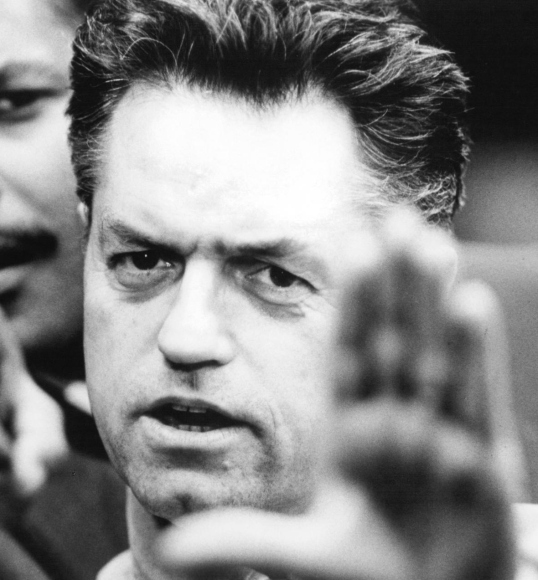
I just saw, on twitter, that Jonathan Demme died today in New York City.  He was 73 years old.

It’s ironic that Jonathan Demme’s best known film was the dark and harsh Silence of the Lambs because Demme was actually one of the most humanistic directors out there.  Starting with his work for Roger Corman in the early 70s, Demme worked in all genres.  He did gangster movies, action films, quirky comedies, socially conscious documentaries, and serious prestige dramas.  His directorial debut, Caged Heat, features one of Barbara Steele’s best performances and is considered to be the standard by which all other women in prison films are judged.  His concert film, Stop Making Sense, is widely considered to be the best concert film ever made.  His work on Silence of the Lambs continues to influence the horror genre to this day and Philadelphia was the first studio picture to be made about AIDS.  Even his remake of The Manchurian Candidate was better than the typical remake.  No matter what genre he was working in, the thing that remained a constant was Demme’s own interest in the human condition.  His films felt alive in a way that few directors have ever been able to duplicate.  His influence is obvious in the work of everyone from Wes Anderson to Paul Thomas Anderson to Alexander Payne.

Demme may be best known for The Silence of the Lambs but my favorite of his films will always be Rachel Getting Married.

Jonathan Demme, RIP.