The TSL’s Grindhouse: Bucktown (dir by Arthur Marks)


Welcome to the town of Buchanan!

It’s a small Southern town, popularly known as Bucktown.  It’s a town where you can literally get anything, as long as you know who to pay off.  Upon arriving, don’t be surprised if a little kid approaches you and asks you what you’re looking for.  He can get it for you.  That kid had connections!

The population of Buchanan is almost entirely African-American but all of the cops are white.  Under the leadership of the redneck police chief (Art Lund), the cops have turned Buchanan into their own private kingdom.  If you want to do anything in Buchanan, you have to be ready to pay the cops for protection.  Refuse and you’ll get arrested.  Continue to refuse and you’ll probably end up getting shot.

Obviously, someone needs to clean up Buchanan?  But who!?

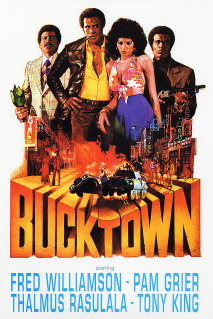
How about Duke Johnson (Fred Williamson)?  Duke’s brother owned the hottest nightclub in Bucktown, Club Alabama.  Or, at least he did until he announced he wasn’t going to pay anymore protection and he ended up getting gunned down by the cops.  When Duke arrives in town, he thinks that he’s just going to stay long enough to attend the funeral and sell his brother’s bar.  However, when Duke find out that he has to wait 60 days until he can sell the bar, he decides to stick around.  Not only does he move in with his brother’s former lover, Aretha (Pam Grier), but also reopens the Club Alabama.

Soon, the cops are coming around and demanding their share.  However, they quickly discover that no one tells Duke Johnson what to do.  Like all good action heroes, Duke has friends all over the country.  He places a call to Roy (Thalmus Rasulala) and soon, Roy, TJ (Tony King), and Hambone (Carl Weathers) show up in Bucktown.  They quickly wipe out the corrupt police force.  The local citizens are so happy that they make Roy the new police chief and his men the new police force.

Unfortunately, that turns out to be a mistake.  Apparently, giving some totally random dude complete and total authority to enforce the law in whatever he sees fit isn’t always the best way to handle things.  Roy and his men quickly become just as corrupt as the old redneck policemen.  The only thing protecting Duke is his friendship with Roy but even that is endangered when T.J. decides that he wants Aretha for himself.  T.J. decides to turn Roy and Duke against each other.  It all eventually leads to an epic fist fight, with the winner earning the right to remain in Bucktown…

(Of course, you may be wondering why anyone would want to remain in Bucktown as the place is kind of a dump, regardless of who’s in charge.)

Released in 1975, Bucktown is a pretty basic action film but I liked it because it appealed to all of my anti-authoritarian impulses.  There have been so many movies about what it takes to clean up a town but there haven’t been many made about what actually happens after all of the corrupt cops and greedy businessmen have been kicked out.  Thalmus Rusulala was great as the charismatic but dangerous Roy and Tony King, a favorite of Italian exploitation fans everywhere, was an effective villain.  Pam Grier doesn’t get to do much but she does the best with what she’s provided.  Of course, the entire film is dominated by Fred Williamson, who may not have been a great actor but who had an undeniable screen presence.  Williamson struts through the film like the hero of stylish Spaghetti western.

Bucktown is an entertaining 70s action film.  Though it doesn’t deeply explore any of the issues that it raises, it still deserves some credit for raising them.  If nothing else, it’s a film that shows why Fred Williamson retains a cult following to this day.

Insomnia File #32: Smooth Talk (dir by Joyce Chopra)


What’s an Insomnia File? You know how some times you just can’t get any sleep and, at about three in the morning, you’ll find yourself watching whatever you can find on cable? This feature is all about those insomnia-inspired discoveries!

If you were having trouble getting to sleep around one in the morning last night, you could have turned over to This TV and watched Smooth Talk, a disturbingly creepy coming-of-age film from 1985.

Connie Wyatt (played by Laura Dern in one of her first film roles) is fifteen years old and ready to discover the word.  It’s the summer and, for Connie and her friends, that means going to the mall, trying to capture the attention of the cute boys who go to their school, and lying to her parents about where she goes at night.  (She tells them that she and her friends have been going to the same movie, night-after-night.)  She likes it when the boys in the mall smile at her but not when the stranger honk their car horn at her whenever she walking at night.  Connie thinks of herself as being an independent adult, even though she’s not sure what that means.

Connie does know that she doesn’t want to be like her mother (Mary Kay Place).  Her mother, who claims that she was once a great beauty herself, complains that all Connie does is indulge in “trashy daydreams.”  Her mother tells Connie to be careful about who she flirts with and constantly demands that Connie stay home and help to paint the house.

Connie also doesn’t want to be like her older sister, June (Elizabeth Berridge).  June is obviously her mother’s favorite.  June never sneaks out.  June never rebels.  Whenever Connie and her mother argue, June always take their mother’s side.

In fact, the only member of her family that Connie’s close with is her father (Levon Helm).  Her father is always cheerful and always in a good mood.  Somehow, the constant tension in the house never seems to get to him and he never seems to be worried about anything.  He’s nice but he’s hardly an authority figure.

And then there’s an older man (Treat Wiliams).  When we first see him, he’s sitting outside of a diner and casually watching all of the teenage girls as they walk by.  (We all know the type.)  When he sees Connie and her friends, he looks over at Connie and tells her, “I’m watching you.”  Later, when Connie is alone at her house, the man pulls up in front of her house and starts to talk to her.

His name, he explains, is Arnold Friend.  “A. Friend,” he puts it.  That’s what he wants to be to her.  When she asks how old he is, he says that he’s 18, though he’s clearly closer to 30.  He’s handsome and he’s charming but there’s something off about him.  He shows Connie his car.  “Arnold Friend” is written on the side.  “33, 19, 17,” is written on the back.  Written next to a dent: “A woman driver did this.” Sitting in the car is a friend of Arnold’s, a man who hides his face behind a portable radio.

“He’s strange,” Arnold explains with a sly smile, before suggesting that Connie get in the car with them…

Smooth Talk is based on a short story by Joyce Carol Oates and, oh my God, is it ever creepy!  The first half of the movie plays out like a typical coming-of-age teen film but then Arnold shows up in that car and the film turns into a nightmare.  I spent almost the entire movie cringing, mostly because I once was Connie Wyatt, the only real difference being that I was even younger when I decided that I understood how the world worked better than my parents and I started rebelling.  As I watched the movie, I found myself wondering what I would have done if Arnold Friend had pulled up in front of my house.  Would I have gotten in the car or what I would have run back into the house, locked the door, and called the police?  I’d like to think I would have done the smart thing but … no.  Doing the smart thing would have meant admitting that the adults were right and there were situations that I couldn’t control or even really understand.

Laura Dern was 18 years old when she played 15 year-old Connie and she gave an amazing and naturalistic performance.  When Treat Williams first appeared as Arnold, I thought that he was overacting but, as the film progressed, I came to see that he was actually perfectly cast and giving exactly the type of performance that the movie’s story needed.  Arnold Friend, who speaks in outdated slang and always seems to be trying just a little bit too hard, has to be a slightly ridiculous figure because otherwise, no one would drop their guard enough to get into his car.  As I watched the movie, I realized that it was a mistake to think of Arnold as being a human being.  Instead, he’s a nightmare come to life.

Smooth Talk was a deeply unsettling film about growing up in an increasingly dangerous world.  It’s right up there with Out of The Blue, Christiane F, and Blue Velvet among nightmarish coming-of-age stories.

Previous Insomnia Files:

  1. Story of Mankind
  2. Stag
  3. Love Is A Gun
  4. Nina Takes A Lover
  5. Black Ice
  6. Frogs For Snakes
  7. Fair Game
  8. From The Hip
  9. Born Killers
  10. Eye For An Eye
  11. Summer Catch
  12. Beyond the Law
  13. Spring Broke
  14. Promise
  15. George Wallace
  16. Kill The Messenger
  17. The Suburbans
  18. Only The Strong
  19. Great Expectations
  20. Casual Sex?
  21. Truth
  22. Insomina
  23. Death Do Us Part
  24. A Star is Born
  25. The Winning Season
  26. Rabbit Run
  27. Remember My Name
  28. The Arrangement
  29. Day of the Animals
  30. Still of The Night
  31. Arsenal

The TSL’s Grindhouse: Death Journey (dir by Fred Williamson)


Imagine being caught up in the following situation.

You’re the district attorney of Manhattan.  You’ve got a chance to convict the city’s most powerful mob boss on some pretty serious charges.  In fact, you’ve got three eye witnesses who are willing to testify against him.  Sounds pretty good so far, right?

But wait a minute!  One of your eyewitnesses just died.  Oh well.  You’ve still got two left and surely, the police can protect two… oh wait.  Hold on.  Okay, you know that second witness that you had?  Well, he just got blown up or something.  Now, you’ve only got one witness left.  He’s a weaselly little mob accountant named Finley (Bernard Kirby).  He’s really not a bad guy, once you get past all of the Hawaiian shirts and his obsession with candy.  The only problem is that Finley is in California and you’re in New York.  How are you going to get Finley across the country without him getting blown up by the mob?

Well, let’s see.  You could ask the government for help but when was the last time government managed to do anything without screwing it up.  You could reach out to the FBI or something like that.  Maybe Finley could go into witness protection.  I mean, it’s worked for a countless number of other mob associates…

But no.  There’s no way Finley could survive in witness protection.  He’d probably give himself away as soon as someone offered him a candy bar.  Seriously, Finley is really obsessed with chocolate.

No, what you’re going to do is you’re going to call up Jesse Crowder (Fred Williamson).  Crowder used to be a cop but now he’s a private eye.  He’s a lot like Shaft, except he doesn’t ever get political.  There’s really nothing that Jesse Crowder can’t do.  He’s a marksman.  He’s a fighter.  He’s a lover.  When we first see him, he’s doing kung fu in slow motion.  If you really needed proof that Jesse Crowder is the ultimate badass, consider this: he smokes cigars.  You read that correctly.

Now, you may be asking yourself: why would the Manhattan district attorney know a Los Angeles private eye?  Because everyone knows Jesse Crowder, that’s why.

Anyway, Jesse agrees to take the case.  He’ll escort Finley to New York, on the condition that he get paid $25,000 upon arrival.  Of course, if he has to kill a lot of people, Jesse expects to be paid $50,000.

Needless to say, Jesse does end up having to kill a lot of people.  It’s not really his fault, of course.  They just keep popping up and getting in his way.  Jesse tries all sorts of ways to get Finley to New York.  He tries to drive him.  He tries to take the train.  No matter what he does, the mob shows up.  Is it possible that the mob had someone inside the district attorney’s office?

Fred Williamson not only starred in 1976’s Death Journey but he directed it as well.  Though it’s obvious that Williamson didn’t have much of a budget to work with, he still did a fairly good job with Death Journey.  Certainly, his direction here feels stronger than it did in Mean Johnny Barrows.  In its own undeniably dumb way, Death Journey‘s a fun action movie.  Williamson may not have been a great actor but he had a strong screen presence and it’s impossible not to be amused by the fact that, no matter what he does or where he goes, somewhat inevitably pops out of the shadows and tries to kill him.  With the exception of that opening kung fu sequence that goes on forever, Death Journey is a fast-paced action film.  The film only last 74 minutes so, right when you start to wonder if Williamson’s ever going to show any personality beyond being a cocky badass, the movie ends.

If you’re a fan of low-budget 70s action films, you’ll probably enjoy Death Journey.  If you don’t enjoy it, just make sure Jesse Crowder doesn’t find out.  After all, he knows karate.

An Olympic Film Review: Goldengirl (dir by Joseph Sargent)


The 1979 film Goldengirl is a film that I had wanted to see ever since I first came across this trailer on one of the 42nd Street Forever compilation DVDs:

Wow, I wondered.  What was Goldengirl’s secret and why was she ordering James Coburn to kiss her feet?  For that matter, why did James Coburn have a haircut that made him look exactly like this old lady who used to live next door to my grandma in Fort Smith?  What did it all have to do with the villain from The Spy Who Loved Me and just how drunk was Robert Culp when he shot his scenes?  Even more importantly, why did Goldengirl keep running into that wall?  That looked painful!

I did some research.  (That’s a fancy way of saying that I looked the movie up on Wikipedia.)  I discovered that Goldengirl was made in 1979.  It was originally meant to be a television miniseries that would not only air during the 1980 Summer Olympics but which would feature Goldengirl competing at those Olympics!  However, during production, it was decided to just use the material for a feature film instead. (Hmmmm, I thought, behind-the-scenes drama!  Intriguing!)  The film was released in June of ’79 and, despite one rave review from Vincent Canby in the New York Times, the film failed at the box office.  Add to that, the U.S. ultimately boycotted the 1980 summer games, which made Goldengirl‘s Olympic-set climax a bit awkward.

I also discovered that Goldengirl is nearly impossible to see.  It’s never been released on DVD or Blu-ray or any digital or streaming service.  So, I resigned myself to the fact that I’d probably never see Goldengirl and, the more I thought about it, the more I realized that I really didn’t care that much.

However, for the past few days, I have been absolutely obsessed with the Winter Olympics.  Even though it was a Summer Olympic movie, I decided to go on YouTube and see if anyone had uploaded Goldengirl since I last checked.

And guess what?

They had!

Now, here’s the problem.  The two guys who uploaded Goldengirl also talked over the entire movie.  Don’t get me wrong.  The movie looked about as good as a VHS copy of a movie from 1979 is ever going to look.  And I could still follow Goldengirl‘s story, even if I sometimes had to really strain to hear the dialogue over the two guys “commenting” on it.  Still, it meant that I had to put a bit more effort into watching this movie than it perhaps deserved.  It was kinda hard not to resent that.

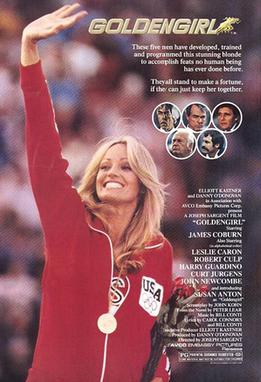
Anyway, I have finally seen Goldengirl and I can now tell you that it’s a pretty lousy movie.  Goldengirl is Goldine (Susan Anton).  Her father is a German scientist who used to work for the Nazis.  When he came to the United States, he decided to prove that his theories of eugenics were correct by adopting a daughter and breeding her to be the world’s greatest athlete.  Working with a psychiatrist named Dr. Lee (Leslie Caron, for some reason), they have not only turned Goldine into the world’s greatest athlete but they’ve also turned her into a bright, smiling media personality.  (Dr. Lee has trained Goldine, through the use of a vibrator, to always give the right answer when she’s asked a question.)  Now, they just need Goldine to win three gold medals at the Summer Olympics and for PR agent Jack Dryden (James Coburn) to make Goldine into a star.  Dryden is the only person who really cares about Goldine as something other than an experiment or a way to make money.

Goldine spends almost the entire movie running.  There’s one running montage that seems to go on forever.  Susan Anton was a model when she was cast as Goldine.  She’s got the right look to be a celebrity but she’s never convincing as an Olympic-class athlete.  Whenever Goldine competes, we either get a close-up of Anton running in slow-motion with no other runners around her or else a long-shot that’s designed to keep us from noticing that Anton isn’t really on the track.

Really, that’s entire film.  On the basis of the trailer, I was expecting that Goldengirl would turn out to be a robot or something like that.  Instead, it just turns out that her stepfather has spent years injecting her with vitamins and hormones and now, as a result, she has diabetes.  Seriously, that’s it.  She gets pretty mad when she finds out that her handlers have put her health at risk just so she could win a race.  But then she goes ahead and runs the race anyway so I guess it was all for the best.  Seriously, that’s the entire freaking movie.  It doesn’t help that Anton’s acting is amateurish and the rest of the cast seems bored.  Only Curt Jurgens really makes much of an impression, mostly because he’s too sinister not to be memorable.

The trailer is better than the movie.  That’s the secret of Goldengirl.

Lisa Reviews An Oscar Winner: You Can’t Take It With You (dir by Frank Capra)


(With the Oscars scheduled to be awarded on March 4th, I have decided to review at least one Oscar-nominated film a day.  These films could be nominees or they could be winners.  They could be from this year’s Oscars or they could be a previous year’s nominee!  We’ll see how things play out.  Today, I take a look at the 1938 best picture winner, You Can’t Take It With You!)

“You can’t take it with you.”

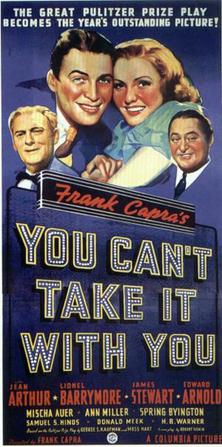
If there’s any one belief that defines the worldview of Martin Vanderhof (Lionel Barrymore), it’s this.  It doesn’t matter how much money you make in your life.  It doesn’t matter how successful you are at business or anything else.  The fact of the matter is that, when your time is up, you won’t be able to take any of that stuff with you.  Instead, Grandpa Vanderhof (as he’s called by his large family) believes that the most important thing to do during your lifetime is to make friends and pursue what you’re truly interested in.

Vanderhof has another belief, one that particularly appealed to be me.  He has never paid income tax.  He doesn’t see the point of giving money to the government when he doesn’t feel that they’ll make good use of it.  When an outraged IRS agent (Charles Lane) stops by Vanderhof’s sprawling house and demands that Vanderhof pay his taxes, Vanderhof refuses.  When the IRS man argues that the income tax is necessary to pay for the Presidency, the Congress, and the Supreme Court, Vanderhof offers to give him five dollars.  “Hell yeah!” I shouted at the TV.  With an attitude like that, Vanderhof should have moved down here to Texas.  We would have elected him governor.

Grandpa Vanderhof is the head of a large and cheerfully eccentric family, all of whom live together under the same roof.  Penny (Spring Byington) writes novels because, years ago, a typewriter was accidentally delivered to the house.  Her husband, Paul (Samuel S. Hinds), has a basement full of fireworks.  Essie (Ann Miller) loves to dance and spends almost the entire movie twirling from room to room.  Her husband, Ed (Dub Taylor), is a xylophone player.

Of course, it’s not just family living in the Vanderhof House.  There’s also Potap Kolenkhov (Mischa Auer), a Russian who is “teaching” Essie how to dance.  There’s Rheba the maid (Lillian Yarbo) and Donald (Eddie Anderson) the handyman.  Actually, the house appears to be open to just about anyone who wants to stay.

And then there’s Penny’s daughter, Alice (Jean Arthur).  Alice is the most “normal” member of the family.  She has just become engaged to Tony Kirby (James Stewart) and she is still trying to figure out how to introduce Tony’s stuffy parents (Edward Arnold and Mary Forbes) to her eccentric family.  What she and Tony don’t know is that Mr. Kirby is currently trying to buy up all the houses that are near a competitor’s factory.  Only one homeowner has refused to sell.  The name of that homeowner?  Martin “Grandpa” Vanderhof.

It all leads, of course, to one chaotic dinner party, one lively night in jail, and a huge fireworks display.  It also leads to true love, which is nice.  Jimmy Stewart and Jean Arthur are even more adorable here than they were in Mr. Smith Goes To Washington.

Based on a Pulitzer-winning play by George S. Kaufman, You Can’t Take It With You was the second comedy to win the Oscar for Best Picture.  The first comedy to win was 1934’s It Happened One Night.  It’s probably not coincidence that both of these films were directed by Frank Capra.

Seen today, You Can’t Take It With You seems a bit slight for an Oscar winner.  Grandpa Vanerhof is a lovable eccentric.  Tony’s father is a stuffy businessman.  Hmmm … I wonder whose philosophy is going to be victorious at the end of the movie?  Still, predictability aside, it’s a delightfully enjoyable film.  While it never quite escape its stage origins, it features wonderful performances from all the usual members of the Capra stock company.  James Stewart and Jean Arthur are a charming couple while Lionel Barrymore gives a performance that is so warmly likable that it’s hard to imagine that, just 9 years later, he would be so perfectly cast as the heartless Mr. Potter in It’s A Wonderful Life.  Of course, my favorite member of the member was Essie, mostly because I also like to dance from room to room.  While it’s hard to justify awarding it Best Picture over The Adventures of Robin Hood and Grand Illusion, You Can’t Take It With You is still a wonderfully fun movie.

It’ll make you smile and laugh.  Who can’t appreciate that?


New Orleans Film Review: Bad Lieutenant: Port Of Call New Orleans (dir by Werner Herzog)


“Do you think fish dream?”

— Terrence McDonagh (Nicolas Cage) in Bad Lieutenant: Port of Call New Orleans (2009)

Happy Mardi Gras!

Since today is not only Fat Tuesday but also rapidly coming to a close, I think it’s time for me to share one final New Orleans film review.  Admittedly, though this film takes place and was filmed in New Orleans, it doesn’t feature any Mardi Gras scenes.  However, it does feature a lead performance that is perhaps as bizarre as anything that you’re likely to see in the French Quarter tonight.  Of course, I’m talking about Werner Herzog’s 2009 film, Bad Lieutenant: Port Of Call New Orleans.

Whenever I mention this movie to anyone, it only takes a few minutes before they get around to saying, “What was the deal with the iguanas?”  Everyone remembers the two iguanas who would randomly show up throughout the movie.  At one point, they were sitting in a coffee table while Lt. Terrence McDonagh (Nicholas Cage) and Sgt. Stevie Pruit (Val Kilmer) were watching a house across the street.  When McDonagh demanded to know why the iguanas were on his coffee table, Pruit replied, “There ain’t no iguanas.”  McDonagh looked down at them and grinned.  This was followed by several hand-held close-ups of the iguanas, looking around inquisitively while McDonagh kept giving them the side eye.

The iguanas show up a second time, after McDonagh has tricked one gangster into killing another gangster.  “Shoot him again,” McDonagh demands, “his soul’s still dancing!”  Herzog pans over to show us that, indeed, the man’s soul is still dancing next to his corpse.  After the soul gets shot down, an iguana wanders across the floor.

What do the iguanas represent?  Some people think that they actually are meant to be hallucinations.  As the result of a back injury that he received saving a prisoner during Hurricane Katrina, McDonagh has permanent back problems and this has led to him getting hooked on drugs.  The perpetually high McDonagh sees and does a lot of bizarre things over the course of this movie.  Perhaps the iguanas are just a part of his addiction.

Myself, I think the iguanas represent the fact that, no matter what McDonagh and anyone else in New Orleans does over the course of the film, the randomness of nature is going win out in the end.  After all, Bad Lieutenant: Port of Call New Orleans opens with Katrina, which is perhaps the ultimate example of how helpless modern society is in the face of nature’s whims.  The film takes places in neighborhoods that have yet to recover from the flooding.  Every corner of the film is full of physical, emotional, and mental debris.  McDonagh pops pills and snorts cocaine in an attempt to maintain some semblance of control but ultimately, the iguanas are going to show up regardless of how much control he thinks he has.  Just as how Klaus Kinski, at the end of Aguirre, The Wrath Of God, couldn’t keep the monkeys off of his raft, Terrence McDonagh can’t keep the iguanas off of his coffee table.

Bad Lieutenant: Port of Call New Orleans apparently started life as a reboot of Abel Ferrara’s 1992 film, Bad Lieutenant.  The script (which was credited to William M. Finkelstein) is full of moments that mirror scenes from Ferrara’s film.  Once again, the protagonist is a corrupt police lieutenant who spends almost the entire film fucked up on drugs and whose only friend is a prostitute.  Again, there’s a disturbing scene in which the lieutenant harasses a young woman in a parking lot.  Again, the lieutenant has gambling debts and again, the lieutenant has to solve a horrifying crime.

While promoting his film, Herzog always said that 1) he had never seen Bad Lieutenant and 2) he didn’t even know who Abel Ferrara was.  Judging from the way Herzog directs the film, which is the complete opposite of the approach that Ferrara took to similar material, I’m inclined to believe Herzog.  Whereas Ferrara’s film was a grim and humorless plunge into the depths of Hell, Herzog takes an almost satirical approach to the story.  The running joke throughout Herzog’s film is that the bad lieutenant gets results precisely because he is so thoroughly messed up and incompetent.  The final part of Herzog’s film features so many sudden twists and turns that it’s hard not to conclude that Herzog is poking fun at how American crime films always have to wrap everything up within the final fifteen minutes, regardless of how messy or convoluted their plots may be.  Whereas Ferrara’s film featured Harvey Keitel naked and bellowing in soul-searing pain, Herzog gives us Nicolas Cage grinning, laughing, and apparently having a ball.

This has got to be one of Nicolas Cage’s wildest performances.  He yells.  He bulges his eyes.  He grins maniacally at the strangest moments.  He interrogates a suspect while taking hits off a joint.  Because his character has a bad back, Cage moves stiffly, carrying himself almost as if he were a living Golem.  McDonagh may have his demons but, at the same time, he also seems to be having a blast every time we see him.  Wisely, Herzog also allows the character some quieter moments.  When the lieutenant talks about how he used to imagine there was pirate treasure buried in his back yard or when he and an ex-con sit in front of a gigantic fish tank, Cage gets a chance to show that there actually is something going on underneath all of McDonagh’s bluster.  This not only one of Cage’s most over the top performances but also one of his best.

Herzog not only gets the best out of Cage but also the best out of New Orleans.  He may not make New Orleans look beautiful but he still captures the atmosphere that has made New Orleans one of the most legendary cities in the world.  Cage, Herzog, and New Orleans make for a great combination.

Scenes that I Love: Peter Fonda and Dennis Hopper Do Mardi Gras and Drop Acid in Easy Rider!


Today, a lot of people have traveled to New Orleans to celebrate Mardi Gras.  Here’s hoping that they have a better time in the city than Billy (Dennis Hopper) and Wyatt (Peter Fonda) had in the 1969 film, Easy Rider.

The scenes below, featuring Hopper, Fonda, Karen Black, and the legendary Toni Basil were actually filmed at Mardi Gras in 1968.  These were among the first scenes that Hopper (making his directorial debut) shot for the film and reportedly, filming was so chaotic that they were also nearly the last scenes to be filmed.  As those who have seen Easy Rider know, Billy and Wyatt spend the entire movie trying to get to New Orleans so that they can visit a famous brothel.  Once they get there, they discover that absolutely nothing lives up to the legend.  The brothel is a sleazy mess.  Mardi Gras is full of bad vibes.  Wyatt has an amazingly bad LSD trip.  (Hopper convinced Fonda to really drop acid before filming the scene, which led some harrowing footage.)  After they leave New Orleans, Fonda and Hopper cross the border into Texas and promptly end up getting blown away by two rednecks in a pickup truck.

Welcome to the sixties!

In the scene below, we get actual footage of 1968’s Mardi Gras.  Just watch all the celebrants who stop to stare at the  camera.

And here is the infamous cemetery scene.  Fonda resisted doing it and the end result is not easy to watch but it’s also one of the most powerful moments in the entire film:

Film Review: Mean Johnny Barrows (dir by Fred Williamson)


“Dedicated to the veteran who traded his place on the front line for a place on the unemployment line. Peace is Hell.”

— the end credits of Mean Johnny Barrows (1976)

“He’s not that mean.”

— Me, while watch Mean Johnny Barrows

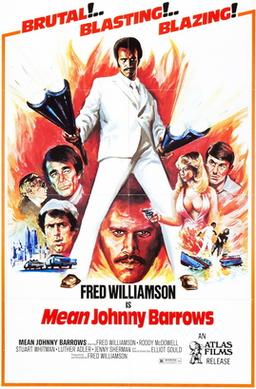
Who is Johnny Barrows?  As played by blaxploitation star Fred Williamson, Johnny Barrows is a former football great who later served in Vietnam and won several silver stars.  As a soldier, he killed an untold number of people but he is always quick to explain that he wouldn’t do the same thing as a civilian.  Even after the war ended, Johnny remained in the army, teaching new recruits.  He was good at his job but, one day, a racist officer decided to play a stupid trick on Johnny.  During a training exercise, that officer put a live landmine out on the training grounds.  After defusing the mine, Johnny promptly punched the officer.  The result?  A dishonorable discharge and the lesson that peace is Hell.

Johnny returns to Los Angeles and discovers that the country he fought for isn’t willing to fight for him.  Because of his dishonorable discharge, Johnny can’t find a good job.  Because he can’t find a job, he can’t afford a place to live.  Johnny stays on the streets.  His only friend is a self-described philosophy professor (Elliott Gould, in an amusing cameo) who teaches Johnny all about soup kitchens.

When Johnny steps into an Italian restaurant and asks for food, he is shocked to discover that the owner, Mario Racconi (Stuart Whitman), knows who he is.  Mario says that he played against Johnny in a high school football game.  (Perhaps Johnny’s shock is due to the fact that Mario appears to be at least ten years older than him.)  Mario gives Johnny something to eat and even offers him a job.  Realizing that the work is mob-related, Johnny says that he’s not interested.  He’s not going to break the law…

And here’s where we run into a problem with the film’s title.  The film is entitled Mean Johnny Barrows but, so far, he’s been almost painfully nice.  Then again, Mild Johnny Barrows doesn’t have much of a ring to it.

Anyway, Johnny does try to stay out of trouble.  He even manages to land a demeaning job cleaning the toilets at a gas station.  But his boss (R.G. Armstrong) is a real jerk and Johnny has his dignity, no matter how much the world wants to take it away from him.  Finally, Johnny agrees to work with the Racconi Family.  Not only does he become friends with Mario but he also falls for Mario’s girlfriend, Nancy (Jenny Sherman).

Unfortunately, not all Mafia families are as kind-hearted and generous as the Racconi Family.  The Da Vinci family wants to flood Los Angles with drugs.  It’s all the master plan of Tony Da Vinci (Roddy McDowall).  Tony is eager to prove himself to his father and what better way to do that than to smuggle heroin?  Tony also loves flowers because … well, why not?  Anyway, when the Racconis object to Tony’s scheme, a mob war erupts.  Nearly all of the Racconis are killed.  It looks like it’s time for Johnny Barrows to put on his white suit, pick up a gun, and get vengeance for his surrogate family.

There are some pretty obvious problems with Mean Johnny Barrows, not the least of which is the casting of Roddy McDowall — perhaps the least Italian actor in the history of cinema — as a ruthless mafioso.  After having starred in several successful blaxploitation films, Fred Williamson made his directorial debut with Mean Johnny Barrows.  Williamson’s inexperience as director shines through almost every minute of Mean Johnny Barrows.  Though he does well with the action scenes, there are other parts of the film where Williamson doesn’t even seem to be sure where he should point the camera.  With almost every role miscast, the performances are pretty inconsistent but Williamson gives a good performance (it’s obvious that he understood his strengths and weaknesses as an actor) and Elliott Gould is an entertaining oddity as the Professor.

If anything saves the film, it’s that Williamson’s anger at the way America treats its veterans feels sincere.  The heart of the film is in the first half, which details Johnny’s struggle to simply survive from one day to the next.  Even if Williamson’s direction is often shaky, the film’s rage is so authentic that you do get caught up in Johnny’s story.  The film ends on a properly down note, suggesting that, for men like Johnny Barrows, there is no hope to be found in America.

To quote the film’s theme song: Peace is Hell.

An Olympic Film Review: Downhill Racer (dir by Michael Ritchie)


For the past few days, like all good people, I have been totally obsessed with the Winter Olympics!  Last week, I asked my friends to suggest some Winter Olympic-themed movies that I could watch and review.  More than a few of them immediately recommended that I check out a film called Downhill Racer.

First released in 1969, Downhill Racer tells the story of David Chappellet (a very young and very handsome Robert Redford).  When we first meet David, he’s just arrived in Switzerland.  An alternate to the U.S. ski team, David has been summoned by Coach Eugene Claire (Gene Hackman) to replace an injured skier.  From the minute that David arrives, it’s obvious that he’s not interested in being anyone’s friend.  He’s upset that he was an alternate.  He’s upset that he’s going to be skiing so late in the competition.  He’s upset about … well, almost everything.  Unlike the rest of his teammates, he’s a loner and he rarely has much to say.  He cares about one thing: winning championships and being recognized as the best.  David is not a particularly likable character.  However, the fact that he doesn’t seem to care what anyone thinks about him is one of the things that makes him compelling.  Add to that, David quickly proves himself to be one of the best.  He may be arrogant but, more often than not, he can back up his pride.

Why is David so driven?  We get some clues when David returns to his hometown in Idaho.  Even though everyone in the town knows him and he doesn’t have any trouble convincing a former girlfriend to go off with him, David still seems out-of-place.  When he visits his father, the taciturn man is not impressed by David’s success.  As his father puts it, the world is full of champions.  Why should David deserve any more praise than anyone else?

Standing in contrast to the reservered David is Coach Claire.  Whereas David is reserved, Claire is passionate.  Whereas David is an unapologetic loner, Claire is willing to fight for every member of his team.  Whereas David reacts to a crash by refusing to accept that he made a mistake, Coach Claire is always brutally honest.  David couldn’t be a champion without Claire’s help but, in the end, the Coach is destined to remain in the background while David signs lucrative sponsorship deals and becomes a hero to television viewers everywhere.

It’s a familiar story, though perhaps it wasn’t as familiar in 1969 as it is today.  Today, we’ve grown accustomed to the idea that celebrities can be jerks and that “heroes” are often just manufactured idols.  (Downhill Racer has a good deal of fun with the shallowness of the media’s coverage of David Chappellett’s career.)  That said, familiar or not, there’s a good deal of authenticity to be found in the performances of both Redford and Hackman.  It takes a bit of courage to play a character who is as narcissistic and arrogant as David Chappellett but, even more so, it takes talent to make that character compelling.  As for Hackman, he’s the ideal coach.  He knows both how to get the best out of Chappellett but also when to call him out on his crap.  From the minute we meet the Coach, we knows that he cares but we also know that he’s seen a lot of David Chappelletts come and go over the years.

Of course, the main reason to watch Downhill Racer is because of the racing scenes, many of which were filmed as a point-of-view shot, putting you in the skis as the frozen landscape flies past you.  They are amazing to watch.  I’ve never been skiing, which is probably a good thing when you consider that I’m a bit accident-prone.  But the skiing sequences in Downhill Racer left me breathless, shaken, and exhilarated.

Downhill Racer is definitely one to watch, during the Olympics or any other time.

Lisa Reviews An Oscar Nominee: Dodsworth (dir by William Wyler)


(With the Oscars scheduled to be awarded on March 4th, I have decided to review at least one Oscar-nominated film a day.  These films could be nominees or they could be winners.  They could be from this year’s Oscars or they could be a previous year’s nominee!  We’ll see how things play out.  Today, I take a look at the 1936 best picture nominee, Dodsworth!)

Dodsworth is the type of film that makes me thankful for both TCM and my own obsession with Oscar history.

Based on a Sidney Howard-penned stage adaptation of a Sinclair Lewis novel, Dodsworth tells the story of an American couple abroad and how their travels change them as both individuals and as a couple.  Sam Dodsworth (Walter Huston) is a wealthy man living in the middle of the United States.  20 years ago, he founded Dodsworth Motors and now, he’s finally reached the point where he can sell his company and retire.  Sam doesn’t have any big plans, not yet anyway.  Mostly, he just wants to visit Europe with his wife, Fran (Ruth Chatterton).  They’ve never been.

Walter Huston is perfectly cast as Sam Dodsworth.  When we first meet Sam, we’re not really sure whether we’re going to like him or not.  He seems to be a decent human being but he also seems to be rather resistant to change.  He’s a self-made man.  He’s smart but he’s not well-educated.  He’s honest but he’s stubborn.  He’s rich but he’s hardly sophisticated.  He says that he wants to experience new things but we can’t help but wonder how he’s going to react when he actually has the opportunity.

The cracks in Sam and Fran’s marriage become obvious as soon as they board a luxury liner heading for England.  Sam meets another traveler, Edith (Mary Astor).  Edith is divorced and lives in Italy, two things that make her very exotic to a proud product of middle America like Sam Dodsworth.  Edith and Sam immediately hit it off but there’s no way that Sam would ever consider having an affair.  Meanwhile, Fran finds herself attracted to a series of different Europeans, played by David Niven, Paul Lukas, and Gregory Gaye.  While Fran loves Europe, Sam finds himself yearning to return to the small town world that he knows best.

For a film that was released 82 years ago, Dodsworth remains a remarkably watchable and involving film.  Along with featuring brilliant lead performances from Walter Huston, Ruth Chatterton, and Mary Astor, Dodsworth touches on universal themes that remains as relevant as today as when the film was first released.  Though neither Sam nor Fran would probably recognize the term, their trip to Europe leads to an existential crisis that will be familiar to anyone who has ever looked at their life and wondered, “Is this all there is?”  At the start of the film, both characters believe that they’ve found perfection in their marriage, their family, and their money.  By the end of the movie, both of them realize just how wrong they were.

If not for my love of Oscar history, I never would have seen Dodsworth listed among the films nominated for best picture of 1936.  And, if not for TCM, I wouldn’t have had the opportunity to DVR Dodsworth this morning and then watch it earlier tonight.  That’s why it pays to know your history and to take chances on films of which you previously may not have heard.

Dodsworth was nominated for 7 Academy Awards but it only won the Oscar for Best Art Direction.  It lost Best Picture to a far less memorable film, The Great Ziegfield.