Here’s The Teaser Trailer For The Predator!


Despite featuring Jacob Tremblay, this is apparently not a sequel to The Book of Henry

To be honest, the trailer is kind of bleh.  Then again, it really doesn’t have to be anything spectacular.  Most people who see this film are going to see it because of The Predator name, as opposed to anything that may or may not be in the trailer.  Predator is a bit like Alien and The Terminator.  There’s always going to be, at the very least, a curiosity factor whenever a new chapter in the franchise comes out.

That said, the film is directed by Shane Black, who is a freaking genius, and the script was co-written by Fred “Night of the Creeps” Dekker.  So, I’ll give it a look.

Cleaning Out The DVR: The Hoodlum Priest (dir by Irvin Kershner)


(I recorded The Hoodlum Priest off of TCM on January 6th of this year.)

“I’m not trying to change the world.  I’m just trying to keep the world from changing me.”

— Anti-Death Penalty Activist in The Hoodlum Priest (1961)

The Hoodlum Priest tells the story of two men who have far more in common than may first seem apparent.

Billy Lee Jackson (Keir Dullea) has spent the last few months in prison and seems to be destined to return as soon as possible.  Though he was convicted of armed robbery, the truth was that Billy was little more than a mugger and a petty thief.  It only takes one look at him to see that his tough exterior is largely an act.  Billy is angry, bitter, and often scared but tough he definitely isn’t.  As soon as Billy’s released back onto the streets of St. Louis, he teams up with his friend, Pico (Don Joslyn), and the two of them plot to crack a safe.

Father Charles Dismas Clark (Don Murray) is a Jesuit who has dedicated his life to trying to rehabilitate ex-cons like Billy.  As Father Clark explains it, he is the son of coal miners, a descendant of the original Molly Maguires.  He knows what it means to be on the fringes of society.  As opposed to his colleagues, Father Clark speaks the language of the streets.  (Of course, we’re talking about the streets of 1961 here, which means that Father Clark spends a lot of time saying stuff, “Hey, I ain’t no square!”)  Father Clark’s dream is to open up a halfway house, a place where those released from prison can stay as they try to reintegrate into society.   Helping Father Clark is a famed attorney named Louis Rosen (Larry Gates).  Opposing him and suggesting that Clark is as much a hoodlum as those he claims to be helping is a supercilious journalist named George Hale (Logan Ramsey).

At first, it appears that Billy could be one of Father Clark’s greatest success stories.  After convincing Billy and Pico to abandon their criminal plans, Father Clark arranges for Billy to get a job.  Billy even begins a rather unlikely romance with a wealthy socialite named Ellen (Cindi Wood).  However, no matter how hard Billy tries to resist, the temptation to return to his old ways remains.  While Father Clark struggles to convince people to support his halfway house, Billy finds himself drawn back into a life of crime…

The Hoodlum Priest was based on a true story.  The real Father Clark personally approached Don Murray and told him the story behind the founding of Dismas House.  Murray felt so strongly about Clark’s story that he not only starred in and produced The Hoodlum Priest but also wrote the screenplay.  (The script was credited to Don Deer, which was Murray’s nickname when he was a high school track star.)

That this film was a passion project for Murray is obvious in the intensity of his performance.  As played by Murray, Father Clark is hardly an intellectual.  Instead, he’s frequently as emotional and, at times, as angry as the people that he’s trying to help.  When Billy fails to show proper gratitude after Father Clark rescues him from being sent back to jail, Clark refuses to excuse the snub.  Clark may be sincere but he’s not going to let anyone push him around.  Director Irvin Kershner and cinematography Haskell Wexler bring a gritty realism to the film’s visuals, which keeps the film from getting overwhelmed by its own sincerity.

The Hoodlum Priest is a well-done piece of social commentary, one that features a still relevant message about the struggle of ex-cons to reintegrate into society.  Don Murray brings the same righteous authority to this film that he would later bring to Twin Peaks: The Return.  This is a good one to keep an eye out for on TCM.

Lisa Reviews Avengers: Infinity War (dir by Joe and Anthony Russo)


(Warning: There are spoilers in this review.  They’re not necessarily huge spoilers but they’re there.  Read at your own risk.)

Avengers: Infinity War is a lot of things.  It’s big, it’s thrilling, it’s emotional, it’s colorful, it’s loud, it’s flamboyant, and, clocking in at two and a half hours, it’s occasionally a bit exhausting.  It’s overwhelming but it’s never boring.  It’s a nearly perfect example of pure cinema, where the story is less about what happens and more how it’s told. It’s a tribute to not just the Marvel Cinematic Universe but also to the audiences who have been flocking to each movie since Iron Man was first released way back in 2008.  Avengers: Infinity War is a pop art masterpiece, one that provides the first part of a climax to a saga that’s been unfolding for ten years.

In the days leading up to the release of Avengers: Infinity War, the main selling point was the assumption that this movie would feature every single character that’s been introduced as a citizen of the MCU so far.  Though the film comes close to including everyone, there are still a few characters who are notable for their absence.  Ant-Man and the Wasp are nowhere to be seen.  None of the Marvel Television characters show up, which is a shame because I’m sure Jessica Jones would have had some choice words about the potential end of the universe.  Two familiar SHIELD agents make a brief appearance, though you have to wonder where they were when New York and Wakanda were being invaded.

That said, all of the big heroes show up.  Tony Stark (Robert Downey, Jr.) flies into space with Dr. Strange (Benedict Cumberbatch) and Spider-Man (Tom Holland).  Thor (Chris Hemsworth) teams up with Rocket Racoon and Groot (voiced by Bradley Cooper and Vin Diesel, respectively).  When Wakanda is attacked, Black Panther (Chadwick Boseman), Captain America (Chris Evans), The Falcon (Anthony Mackie), White Wolf (Sebastian Stan), the Hulk (Mark Ruffalo), Rhodey (Don Cheadle), and Natasha (Scarlett Johansson) are all present to defend it.  Meanwhile, Vision (Paul Bettany) and Wanda (Elizabeth Olsen) continue to pursue their odd relationship while Peter Quill (Chris Pratt) and Gamora (Zoe Saldana) search for Gamora’s father, Thanos (Josh Brolin).

It’s a packed film and the fact that it works as well as it does is a testament to the power of perfect casting and movie star charisma.  At this point, we feel as if we know these characters.  We know that Tony Stark is going to be haunted by what happened the last time Thanos’s minions involved New York.  We know that Spider-Man is going to be desperate to prove that he belongs with the adults, just as we know that Dr. Strange isn’t going to be particularly impressed with anyone he meets.  Needless to say, some characters get more screen time than others.  Despite a good deal of the film taking place in Wakanda, Black Panther largely stays in the background.  I personally wish that both Natasha and Captain America had been given a bit more to do.  Considering just how talented both Anthony Mackie and Don Cheadle are, it’s a shame that neither one of them ever gets to do much in these films.  At the same time, Infinity Wars allows both Elizabeth Olsen and Paul Bettany to come into their own and Chris Hemsworth again shows that he may be the most underrated star in the MCU.  I’ve read a lot of criticism of certain actions taken by Peter Quill towards the end of the film but actually, it’s exactly what you would expect his character to do in the situation and, up until that moment, Chris Pratt is a welcome presence.  It’s important to have someone around who appreciates good music and who can make you laugh, especially considering that Thanos is planning to wipe out 50% of the universe’s population…

Oh yes, Thanos.  After spending years lurking in the background, Thanos finally steps forward in Infinity War.  In fact, it can be argued that Avengers: Infinity War is actually much more of a Thanos film than an Avengers film.  While our heroes are continually spending the film trying to catch up to Thanos and reacting to his latest action, Thanos is always one step ahead.  Thanos is the one who steers the narrative and, for once, you really do believe that an MCU villain views the heroes as being mere distractions.  Thanos is the one on a quest and the film follows him through every step of his search.  In fact, the film’s most emotional moments belong to Thanos.  For all the death and destruction to be found in the film’s surprisingly dark narrative, Thanos is the only character to ever shed a tear.  Like all great villains, Thanos doesn’t view himself as being evil.  Instead, Thanos speaks very sincerely of his desire to bring balance to the universe.  The scary thing about Thanos isn’t that he claims that he’s being merciful when he slaughters millions of beings.  The scary thing about Thanos is that believes it.

Thanos, you see, is a bit of an intergalactic environmentalist.  As he explains it, the universe only has a finite number of resources.  By killing half of the universe’s population, he is ensuring that the other half will be able to survive in peace and harmony.  Most people would call Thanos’s actions genocidal but Thanos would probably say that he’s merely making the difficult decisions that others don’t have the courage or intelligence to make.  It may all sound rather far-fetched and melodramatic until you consider that, just last week, bureaucrats and doctors in the UK decided it would be better to starve a sick infant to death rather than allow his parents to take him to be treated in another country.  With his mix of narcissism and absolutely belief in his own moral certitude, Thanos is a far more familiar villain than a lot of viewers might want to admit.  As opposed to the forgettable villains who have appeared in so many MCU films, Thanos is a compelling and complicated figure.  It’s interesting to note that two of the best performances of the year so far were given by actors appearing as villains in MCU films, Michael B. Jordan in Black Panther and Josh Brolin in this one.

As befits the film’s subject matter, Infinity War is a sprawling film, one that skips from world to world.  The visuals are frequently spectacular, as are the many battles.  From the opening attack on New York to the final battles in Wakanda and in space, the action is non-stop and thrilling.  (It helps that, as opposed to some of the previous MCU films, it’s always clear who is fighting who and why they’re fighting.)  For me, though, the most memorable scenes are the scenes where Thanos looks and considers the worlds that he’s destroyed.  There’s a scene where an exhausted Thanos rests on a placid planet and it’s one of the strongest images in the history of the MCU.

I’ve been told that I shouldn’t worry too much about all of the characters who are killed over the course of Infinity War.  From what I’ve been told, it’s apparently something of a tradition in Marvel comics to kill off a bunch of recognizable characters and then have them come back to life an issue or two later.  And the fact that the sequel to Infinity War has already been filmed and is set to released next year leads me to suspect that nothing’s permanent.  I mean, if all of these people are really dead, there aren’t going to be many heroes left to make any more movies about.  That said, I still got far more emotional than I probably should have at some of the unexpected demises.  Especially … well, no.  I won’t say the name.  But seriously, it was upsetting.

2018 is shaping up to be the year of Marvel.  So far, Marvel has released two of the best films of the year.  To be honest, a film as huge as Infinity War shouldn’t have worked and yet, it does.  It’s a masterpiece of pop art.*

* For a totally different response to Avengers: Infinity War, check out Ryan’s review by clicking here!

Here’s The Latest Trailer (and the pre-trailer teaser) for Ant-Man and The Wasp!


Hi, everyone!

So, Jeff & I just saw Avengers: Infinity War!  I’ll be working on my review tonight but while I’m writing, feel free to watch the latest trailer for this year’s third Marvel film, Ant-Man and The Wasp!  2018 is truly shaping up to be the year of Marvel so it’ll be interesting to see if people get as excited about Ant-Man and The Wasp as they have about Black Panther and Avengers: Infinity War.

To be honest, the combination of Black Panther and Infinity War have set the bar very high.  Obviously, the film isn’t going to have the cultural cachet of Black Panther.  Nor does it look like it’s going to be quite as colorful as Infinity War.  Instead, this looks very much like a back-to-basics super hero film, one that will make good use of Paul Rudd’s charisma.  Hopefully, he and Evangeline Lilly will have a bit more chemistry in this film than they did in the first Ant-Man.

The video below starts with the “Where was Ant-Man during Infinity War?” teaser that was released yesterday and then it continues on to the trailer, which was released earlier today.

A Blast From The Past: Patriotism


Flag (Erin Nicole Bowman, 2010)

Today is Loyalty Day!

If you haven’t ever heard of Loyalty Day before … well, then you’re probably a subversive or something.  Loyalty Day has been a real holiday since 1955.  That was when President Dwight D. Eisenhower proclaimed May 1st to be Loyalty Day.  (I’m going to guess that this was done largely to provide an alternative to International Workers Day or Communist New Year or whatever May Day was known as back then.)  The official statutory definition reads as follows:

(a) Designation.— May 1 is Loyalty Day.(b) Purpose.— Loyalty Day is a special day for the reaffirmation of loyalty to the United States and for the recognition of the heritage of American freedom.(c) Proclamation.— The President is requested to issue a proclamation—

(1) calling on United States Government officials to display the flag of the United States on all Government buildings on Loyalty Day; and
(2) inviting the people of the United States to observe Loyalty Day with appropriate ceremonies in schools and other suitable places.

So, in honor of Loyalty Day, here’s a short film from 1972.  It’s called Patriotism and it was apparently made to teach school children what it meant to be a patriot.  Apparently, it means working as a crossing guard and wearing a vaguely fascist-looking vest while doing so.  It also means keeping an eye out for weeds and trash in your neighborhood.  My favorite part of this film is when the kid spots the turned over garbage can and gets a look of disgust on his face.  You can just tell he’s thinking, “Those goddamn hippies.”

(For the record, that’s what I always think whenever I can’t find a pen at work.)

Personally, I agree that making a good neighborhood is the first step in making a good country so I definitely applaud the kids for taking the time to clean their neighborhood up.  Still, I have to wonder: where are the adults?  How many grown ups walked past the overturned trash can and just ignored it?  Perhaps all the adults in the neighborhood were so disillusioned by George McGovern dumping Tom Eagleton as his running mate that they just gave up on life.  Who knows?  1972 was apparently a pretty traumatic year for some people.  Myself, I just find it amusing that there was a politician named McGovern.  That’s like a seminarian named McClergy.

Speaking of adults, this short film was hosted by actor Bob Crane, who would be murdered six years later and whose life would serve as the basis for a rather depressing movie called Auto Focus.

Anyway, in the immortal words of Team America: World Police, “America!  Fuck yeah!”  Let’s make this the best Loyalty Day ever!


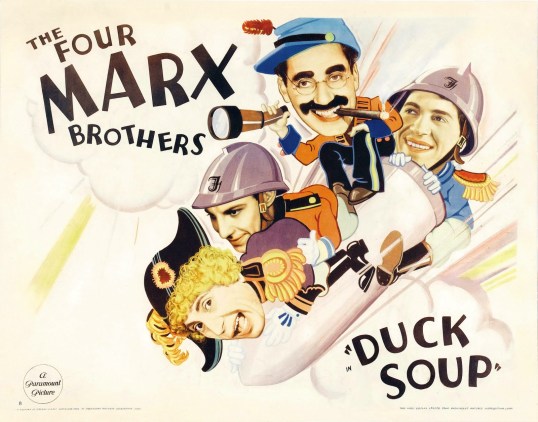
Scenes That I Love: The Mirror Scene From Duck Soup


Since today is May Day, how about a little Marx for today’s scene of the day?

Believe it or not, when Duck Soup was initially released in 1933, it was considered to be something of a failure.  Especially when compared to previous Marx Brothers films, it was seen as being a box office disappointment.  The critics didn’t care much for it, either.  They felt that the film’s political satire was preposterous and tasteless.  Much as how today’s critics attacked the Death Wish remake for being released at a time when gun control was trending on twitter, critics in 1933 attacked Duck Soup for being a cynical, anti-government satire released during the Great Depression.

(To be honest, you would think that the Great Depression would have made people better appreciate anything that made fun of the incompetence of government but maybe people were in too bad of a mood to see the joke.  Who knows?  1933 was a strange year.)

Of course, today, Duck Soup is justifiably viewed as being a classic comedy.  It’s certainly my favorite Marx Brothers film.  In the classic scene below, Harpo pretends to be Groucho’s reflection in a shattered mirror.  It’s a marvelous piece of physical humor so enjoy it!

(And the next time you see a film bragging about their Rotten Tomatoes score, consider that if Rotten Tomatoes had existed in 1933, it would have gotten a “rotten” rating.  The truth of the matter is that most critics are as clueless as Rufus T. Firefly looking into a broken mirror.)

What Lisa Watched Last Night #179: Fiance Killer (dir by Fred Olen Ray)


Last night, I turned over to the Lifetime Movie Network and watched the latest Lifetime movie, Fiance Killer!

Why Was I Watching It?

It was on Lifetime!  By now, y’all should know that I’ll watch anything that’s on Lifetime!

What Was It About?

So, Cameron (Felisha Cooper) is about to be very, very rich.  As soon as she turns 25, she’ll be coming into a huge inheritance!  On top of that, Cameron also has a new boyfriend.  His name is Brent (Adam Huss) and he runs a non-profit!  Or, at least, that’s what he says.  Cameron’s mother (Kari Wuhrer) doesn’t trust him.  In fact, she does a background check on him and comes away convinced that Brent is only interesting in Cameron’s money.  Of course, Cameron doesn’t believe that.  In fact, Cameron is so offended by her mother’s paranoia that she elopes with Brent!

Except, of course, mom is right.  Brent is after Cameron’s money.  Of course, Brent doesn’t really have it in him to commit murder.  However, his girlfriend, Lexi (Jean Louise O’Sullivan), definitely does…

What Worked?

Lexi is one of my favorite characters of all time!  Seriously, she must have undergone ninja training at some point because she could seriously just pop up anywhere.  Someone gets in a car and there’s Lexi in the back seat!  Someone goes down to the kitchen and there’s Lexi hiding behind the refrigerator.  My favorite thing about Lexi was that, for all of the intricate plotting that went into her scheme, she didn’t really seem to care whether it actually worked or not.  Lexi was an agent of pure chaos, less a schemer and more a revolutionary.  Jean Louise O’Sullivan had a lot of fun with the role.

What Did Not Work?

Obviously, with any Lifetime film, you’re going to have to suspend your disbelief to a certain extent but seriously, Cameron was occasionally too naive to be believed.  Maybe if she had been 18, I could have bought that she wouldn’t be able to see through Brent and his schemes.  But, by the time you turn 25, you really should know better.

“Oh my God!  Just like me!” Moments

Obviously, it would have been nice if I could have related to Cameron, who was a very nice person and always tried to do the best for everyone.  But, honestly, I could never do the whole eloping thing.  When I do get married, it’s going to be a huge wedding and I’m going to expect a lot of expensive gifts.  As well, I couldn’t ever marry someone who worked for a “non-profit” because bragging about working for a company that doesn’t make a profit just seems strange to me.

So, that pretty much left with me with little choice but to relate to Lexi.  Unfortunately, Lexi killed people and I’m not really into that either.  However, I do enjoy making a scene so I guess Lexi and I had that in common.

Lessons Learned

I should sign up for ninja training as soon as possible.  Admittedly, I might not be a very good ninja and I’m not really sure if there’s much ninja work available where I live but I’d still love to learn how to just pop up anywhere whenever I wanted to.  That seems like that could be a valuable skill to have.

Film Review: The Bounty (dir by Roger Donaldson)


Oh, poor Captain Bligh.

For those who recognize the name, it’s probably because they’ve either read a book or seen a film that portrayed him as being the tyrannical captain of the HMS Bounty.  In 1787, William Bligh and the Bounty set off on a mission to Tahiti.  When, after ten months at sea, the Bounty arrived in Tahiti, the crew immediately fell in love with the relaxed pleasures of island life.  When Bligh ordered them to leave Tahiti and continue with their mission, his own second-in-command led a mutiny.  Bligh and the few men who remained loyal to him were set adrift in a lifeboat while Christian and the mutineers eventually ended up settling on Pitcairn Island.  Against impossible odds, Bligh managed to make it back to civilization, where he faced both a court-martial and a future of being portrayed as a villain.

Though most historians agree that Bligh was a knowledgeable and talented (if strict) captain and that the mutiny had more to do with Christian’s desire to remain in Tahiti than Bligh’s treatment of the crew, most adaptations of what happened on the Bounty have laid the blame for the mutiny squarely at Bligh’s feet.  Personally, I think it has to do with the names of the people involved.  William Bligh just sounds evil, in much the same way that the name Fletcher Christian immediately brings to mind images of heroism.  In 1935’s Mutiny On The Bounty, Charles Laughton portrayed Bligh as being a viscous sadist.  In 1962’s Mutiny in the Bounty, Trevor Howard portrayed Bligh as being an overly ambitious martinet, though ultimately Howard was overshadowed by Marlon Brando, who gave a bizarrely mannered performance in the role Christian.

In fact, it would seem that there’s only one film that’s willing to give William Bligh the benefit of the doubt.  That film is 1984’s The Bounty.

The Bounty opens with Bligh (played by Anthony Hopkins) facing a court-martial for losing the Bounty.  That the admiral presiding over Bligh’s court-martial is played by Laurence Olivier is significant for two reasons.  Olivier’s stately and distinguished presence lets us know that the mutiny was viewed as being an affront to British society but it also reminds us that Hopkins began his career as Olivier’s protegé.  Much as how William Bligh was a star of the British navy, Hopkins was (and is) a star of British stage and screen.  One gets the feeling the scene isn’t just about the admiral judging Bligh.  It was also about Olivier judging Hopkins as the latter played a role that had already been made famous by two other great British thespians, Charles Laughton and Trevor Howard.

By opening with Bligh on trial, The Bounty allows itself to be told largely through Bligh’s point of view.  We watch familiar events play out from a new perspective.  Once again, it takes longer than expected for Bligh and the Bounty to reach Tahiti and, once again, Bligh’s by-the-book leadership style alienates a good deal of the crew.  However, this time, Bligh is not portrayed as being a villain.  Instead, he’s just a rather neurotic man who is trying to do his duty under the most difficult of circumstances.  Bligh knows that the crew blames him for everything that goes wrong during the voyage but he also knows that the only way their going to survive the journey is through maintaining order.

In fact, the film suggests that Bligh’s biggest mistake was promoting Fletcher Christian (Mel Gibson) to second-in-command.  Christian is portrayed as being good friends with Bligh and one gets the feeling that Bligh promoted him largely so he would have someone to talk to.

The film does a good job contrasting the dank claustrophobia of the Bounty with the vibrant beauty of Tahiti.  When the crew first lands, Bligh proves his diplomatic skills upon meeting with the native king.  However, it quickly becomes apparent that, while Bligh views the stop in Tahiti as just being a part of the mission, the majority of the crew view it as being an escape from the dreariness of their lives in Britain.  For the first time in nearly a year, the crew is allowed to enjoy life.  When Bligh eventually orders the crew to leave Tahti, many of the men — including Christian — are forced to abandon their native wives.

Unfortunately for Bligh, he doesn’t understand that his crew has no desire to return to the dreariness of their old life, either on the Bounty or in the United Kingdom.  Bligh’s solution to the crew’s disgruntlement is to become an even harsher disciplinarian.  (Bligh is the type of captain who will order the crew to clean the ship, just to keep them busy.)  However, Bligh no longer has Christian backing him.  When the inevitable mutiny does occur, Bligh seems to be the only one caught by surprise.

Anthony Hopkins gives a performance that turns Bligh into a character who is, in equal amounts, both sympathetic and frustrating.  Bligh means well but he’s so rigid and obsessed with his duty that he can’t even being to comprehend why his crew is so annoyed about having to leave Tahiti.  Since Bligh can’t imagine ever loving anything more than sailing, it’s beyond his abilities to understand why his men are so obsessed with returning to Tahiti.  Hopkins portrays Bligh as being not evil but instead, rather isolated.  He knows everything about sailing but little about emotion or desire.  Ironically, the same personality traits that led to him losing the Bounty are also key to his survival afterward.  By enforcing discipline and emphasizing self-sacrifice, Bligh keeps both himself and the men who stayed loyal to him alive until their eventual rescue.

Interestingly, Mel Gibson portrayed Christian as being just as neurotic as Bligh.  In fact, if Bligh and Christian have anything in common, it would appear to be they’re both obsessed with what the crew thinks of them.  Whereas Bligh is obsessed with being respected, Christian wants to be viewed as their savior.  When the mutiny finally occurs, Christian gets an almost messianic gleam in his eyes.  While Christian is not portrayed as being a villain (and, indeed, The Bounty is unique in not having any cut-and-dried villains and heroes), Gibson’s portrayal is certainly far different from the heroic interpretation offered up by Clark Gable.

(The rest of the cast is full of familiar British character actors, along with a few future stars making early appearances.  Both Daniel Day-Lewis and Liam Neeson appear as members of the Bounty’s crew.  One remains loyal to Bligh while the other goes with Christian.  Watch the movie to find out who does what!)

The Bounty is best viewed as being a character study of two men trying to survive under the most trying of conditions.  Just as Bligh’s personality made both the mutiny and his survival inevitable, the film suggests that everything that made Christian a successful mutineer will also make it impossible for him to survive for long afterward.  Whereas Bligh may have been a poor leader but a good diplomat, Christian proves to be just the opposite and the king of Tahiti makes clear that he has no room on his island for a bunch of mutineers who will soon have the entire British navy looking for them.  Whereas Bligh makes it back to Britain, Christian and the mutineers are forced to leave Tahiti a second time and end up settling on the previously uncharted Pitcairn Island.  (Of course, no one knows for sure what happened to Christian after the mutineers reached Pitcairn Island.  The last surviving mutineer claimed that Christian was murdered by the natives who were already living on the island.)

The Bounty has its flaws.  There are some pacing issues that keep the film from working as an adventure film and a few of the actors playing the crew aren’t quite as convincing as you might hope.  (If you only saw him in this film, you would never believe that Daniel Day-Lewis is a three-time Oscar winner.)  But it’s still an interesting retelling of a familiar story and it’s worth watching for the chance to see one of Anthony Hopkins’s best performances.


Playing Catch-Up: Crisscross, The Dust Factory, Gambit, In The Arms of a Killer, Overboard, Shy People


So, this year I am making a sincere effort to review every film that I see.  I know I say that every year but this time, I really mean it.

So, in an effort to catch up, here are four quick reviews of some of the movies that I watched over the past few weeks!

  • Crisscross
  • Released: 1992
  • Directed by Chris Menges
  • Starring David Arnott, Goldie Hawn, Arliss Howard, Keith Carradine, James Gammon, Steve Buscemi

An annoying kid named Chris Cross (David Arnott) tells us the story of his life.

In the year 1969, Chris and his mother, Tracy (Goldie Hawn), are living in Key West.  While the rest of the country is excitedly watching the first moon landing, Chris and Tracy are just trying to figure out how to survive day-to-day.  Tracy tries to keep her son from learning that she’s working as a stripper but, not surprisingly, he eventually finds out.  Chris comes across some drugs that are being smuggled into Florida and, wanting to help his mother, he decides to steal them and sell them himself.  Complicating matters is the fact that the members of the drug ring (one of whom is played by Steve Buscemi) don’t want the competition.  As well, Tracy is now dating Joe (Arliss Howard), who just happens to be an undercover cop.  And, finally, making things even more difficult is the fact that Chris just isn’t that smart.

There are actually a lot of good things to be said about Crisscross.  The film was directed by the renowned cinematographer, Chris Menges, so it looks great.  Both Arliss Howard and Goldie Hawn give sympathetic performances and Keith Carradine has a great cameo as Chris’s spaced out dad.  (Traumatized by his experiences in Vietnam, Chris’s Dad left his family and joined a commune.)  But, as a character, Chris is almost too stupid to be believed and his overwrought narration doesn’t do the story any good.  Directed and written with perhaps a less heavy hand, Crisscross could have been a really good movie but, as it is, it’s merely an interesting misfire.

  • The Dust Factory 
  • Released: 2004
  • Directed by Eric Small
  • Starring Armin Mueller-Stahl, Hayden Panettiere, Ryan Kelly, Kim Myers, George de la Pena, Michael Angarano, Peter Horton

Ryan (Ryan Kelly) is a teen who stopped speaking after his father died.  One day, Ryan falls off a bridge and promptly drowns.  However, he’s not quite dead yet!  Instead, he’s in The Dust Factory, which is apparently where you go when you’re on the verge of death.  It’s a very nice place to hang out while deciding whether you want to leap into the world of the dead or return to the land of the living.  Giving Ryan a tour of the Dust Factory is his grandfather (Armin Mueller-Stahl).  Suggesting that maybe Ryan should just stay in the Dust Factory forever is a girl named Melanie (Hayden Panettiere).  Showing up randomly and acting like a jerk is a character known as The Ringmaster (George De La Pena).  Will Ryan choose death or will he return with a new zest for living life?  And, even more importantly, will the fact that Ryan’s an unlikely hockey fan somehow play into the film’s climax?

The Dust Factory is the type of unabashedly sentimental and theologically confused film that just drives me crazy.  This is one of those films that so indulges every possible cliché that I was shocked to discover that it wasn’t based on some obscure YA tome.  I’m sure there’s some people who cry while watching this film but ultimately, it’s about as deep as Facebook meme.

  • Gambit
  • Released: 2012
  • Directed by Michael Hoffman
  • Starring Colin Firth, Cameron Diaz, Alan Rickman, Tom Courtenay, Stanley Tucci, Cloris Leachman, Togo Igawa

Harry Deane (Colin Firth) is beleaguered art collector who, for the sake of petty revenge (which, as we all know, is the best type of revenge), tries to trick the snobbish Lord Shabandar (Alan Rickman) into spending a lot of money on a fake Monet.  To do this, he will have to team up with both an eccentric art forger (Tom Courtenay) and a Texas rodeo star named PJ Puznowksi (Cameron Diaz).  The plan is to claim that PJ inherited the fake Monet from her grandfather who received the painting from Hermann Goering at the end of the World War II and…

Well, listen, let’s stop talking about the plot.  This is one of those elaborate heist films where everyone has a silly name and an elaborate back story.  It’s also one of those films where everything is overly complicated but not particularly clever.  The script was written by the Coen Brothers and, if they had directed it, they would have at least brought some visual flair to the proceedings.  Instead, the film was directed by Michael Hoffman and, for the most part, it falls flat.  The film is watchable because of the cast but ultimately, it’s not surprising that Gambit never received a theatrical release in the States.

On a personal note, I saw Gambit while Jeff & I were in London last month.  So, I’ll always have good memories of watching the movie.  So I guess the best way to watch Gambit is when you’re on vacation.

  • In The Arms of a Killer
  • Released: 1992
  • Directed by Robert L. Collins
  • Starring Jaclyn Smith, John Spencer, Nina Foch, Gerald S. O’Loughlin, Sandahl Bergman, Linda Dona, Kristoffer Tabori, Michael Nouri

This is the story of two homicide detectives.  Detective Vincent Cusack (John Spencer) is tough and cynical and world-weary.  Detective Maria Quinn (Jaclyn Smith) is dedicated and still naive about how messy a murder investigation can be when it involves a bunch of Manhattan socialites.  A reputed drug dealer is found dead during a party.  Apparently, someone intentionally gave him an overdose of heroin.  Detective Cusack thinks that the culprit was Dr. Brian Venible (Michael Nouri).  Detective Quinn thinks that there has to be some other solution.  Complicating things is that Quinn and Venible are … you guessed it … lovers!  Is Quinn truly allowing herself to be held in the arms of a killer or is the murderer someone else?

This sound like it should have been a fun movie but instead, it’s all a bit dull.  Nouri and Smith have next to no chemistry so you never really care whether the doctor is the killer or not.  John Spencer was one of those actors who was pretty much born to play world-weary detectives but, other than his performance, this is pretty forgettable movie.

  • Overboard
  • Released: 1987
  • Directed by Garry Marshall
  • Starring Goldie Hawn, Kurt Russell, Edward Herrmann, Katherine Helmond, Roddy McDowall, Michael G. Hagerty, Brian Price, Jared Rushton, Hector Elizondo

When a spoiled heiress named Joanne Slayton (Goldie Hawn) falls off of her luxury yacht, no one seems to care.  Even when her husband, Grant (Edward Herrmann), discovers that Joanne was rescued by a garbage boat and that she now has amnesia, he denies knowing who she is.  Instead, he takes off with the boat and proceeds to have a good time.  The servants (led by Roddy McDowall) who Joanne spent years terrorizing are happy to be away from her.  In fact, the only person who does care about Joanne is Dean Proffitt (Kurt Russell).  When Dean sees a news report about a woman suffering from amnesia, he heads over to the hospital and declares that Joanne is his wife, Annie.

Convinced that she is Annie, Joanne returns with Dean to his messy house and his four, unruly sons.  At first, Dean says that his plan is merely to have Joanne work off some money that she owes him.  (Before getting amnesia, Joanne refused to pay Dean for some work he did on her boat.)  But soon, Joanne bonds with Dean’s children and she and Dean start to fall in love.  However, as both Grant and Dean are about to learn, neither parties nor deception can go on forever…

This is one of those films that’s pretty much saved by movie star charisma.  The plot itself is extremely problematic and just about everything that Kurt Russell does in this movie would land him in prison in real life.  However, Russell and Goldie Hawn are such a likable couple that the film come close to overcoming its rather creepy premise.  Both Russell and Hawn radiate so much charm in this movie that they can make even the stalest of jokes tolerable and it’s always enjoyable to watch Roddy McDowall get snarky.  File this one under “Kurt Russell Can Get Away With Almost Anything.”

A remake of Overboard, with the genders swapped, is set to be released in early May.

  • Shy People
  • Released: 1987
  • Directed by Andrei Konchalovsky
  • Starring Jill Clayburgh, Barbara Hershey, Martha Plimpton, Merritt Butrick, John Philbin, Don Swayze, Pruitt Taylor Vince, Mare Winningham

Diana Sullivan (Jill Clayburgh) is a writer for Cosmopolitan and she’s got a problem!  It turns out that her teenager daughter, Grace (Martha Plimpton), is skipping school and snorting cocaine!  OH MY GOD!  (And, to think, I thought I was a rebel just because I used to skip Algebra so I could go down to Target and shoplift eyeliner!)  Diana knows that she has to do something but what!?

Diana’s solution is to get Grace out of New York.  It turns out that Diana has got some distant relatives living in Louisiana bayou.  After Cosmo commissions her to write a story about them, Diana grabs Grace and the head down south!

(Because if there’s anything that the readers of Cosmo are going to be interested in, it’s white trash bayou dwellers…)

The only problem is that Ruth (Barbara Hershey) doesn’t want to be interviewed and she’s not particularly happy when Diana and Grace show up.  Ruth and her four sons live in the bayous.  Three of the sons do whatever Ruth tells them to do.  The fourth son is often disobedient so he’s been locked up in a barn.  Diana, of course, cannot understand why her relatives aren’t impressed whenever she mentions that she writes for Cosmo.  Meanwhile, Grace introduces her cousins to cocaine, which causes them to go crazy.  “She’s got some strange white powder!” one of them declares.

So, this is a weird film.  On the one hand, you have an immensely talented actress like Jill Clayburgh giving one of the worst performances in cinematic history.  (In Clayburgh’s defense, Diana is such a poorly written character that I doubt any actress could have made her in any way believable.)  On the other hand, you have Barbara Hershey giving one of the best.  As played by Hershey, Ruth is a character who viewers will both fear and admire.  Ruth has both the inner strength to survive in the bayou and the type of unsentimental personality that lets you know that you don’t want to cross her.  I think we’re supposed to feel that both Diana and Ruth have much to learn from each other but Diana is such an annoying character that you spend most of the movie wishing she would just go away and leave Ruth alone.  In the thankless role of Grace, Martha Plimpton brings more depth to the role than was probably present in the script and Don Swayze has a few memorable moments as one of Ruth’s sons.  Shy People is full of flaws and never really works as a drama but I’d still recommend watching it for Hershey and Plimpton.

Kickin’ The Willy Bobo With…LISA MARIE BOWMAN


Earlier this week, Derrick Ferguson interviewed me for his blog Ferguson Ink! I discussed my favorite movies, my reviewing philosophy, and a lot of other things! Please read this interview and also check out Derrick’s sites, Ferguson Ink and The Ferguson Theater, as well as his patreon site! Thank you!