Made-For-Television Movie Review: The Right of the People (dir by Jeffrey Bloom)


1986’s The Right of the People takes place in the small town of St. Lawrence, Kansas.  It seems like a nice enough town, perhaps the ideal place to start a family.  The people are friendly.  The streets appear to be safe.  It’s about as mid as Middle America can get.

Or, at least, that’s the case until a group of armed gunmen attempt to hold up a restaurant.  They enter with their guns drawn and their masks pulled over their faces and they demand that everyone give them their money.  When one person in the restaurant makes a sudden move, one of the thieves open fire.  Soon, all of the thieves are firing and everyone in the restaurant is dead.  Among the victims is the family of District Attorney Christopher Wells (Michael Ontkean).

Wells was a liberal on most law-and-order issues until it was his family that was victimized.  He leads an effort to legalize open carry in the small town of St. Lawrence.  At first, the mayor (M. Emmett Walsh) opposes the effort but, when it becomes apparent that Proposition G (G for Guns!) is going to pass, the mayor switches over and becomes an advocate for the Second Amendment.

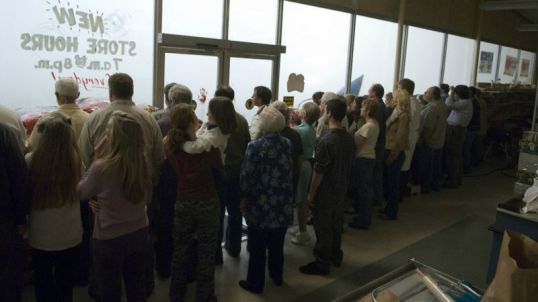
The majority of the citizens are happy that they can now carry guns pretty much anywhere.  Less enthused are a handful of cranky liberals who insist that everyone carrying a gun will make the streets less safe.  When a man uses his gun to thwart a robbery at a grocery store, he is hailed as a hero.  However, nobody talks about the poor cashier who was shot when he tried to use his own gun or any of the innocent people caught in the crossfire.

The Right of the People is an interesting artifact.  On the one hand, it doesn’t hide its own position when it comes to gun control.  The pro-gun rallies and the posters that decorate them are meant to be ominous and reminiscent of various fascist moments throughout history.  At the same time, Christopher Wells is a sympathetic character.  He’s someone who lost his entire family because no one was able to stop the criminals who randomly selected a restaurant to rob.  One would have to have a heart made of stone to not understand how Wells would go from being a bleeding heart liberal to someone who isn’t exactly concerned about the rights of criminals.  (At the same time, Wells is a bit like the fundamentalist who has no problem believing in God when bad things happen to other people but who turns into a rabid atheist as soon as something bad happens to him.)  Michael Ontkean gives a strong performance and he gets good support from M. Emmet Walsh and Billy Dee Williams.  The film starts out strong but, unfortunately, it falters a bit once everyone in town turns into a caricature of a gun nut.  The even hand is tossed out for a heavy hand and the entire film suddenly starts to condescend to the character that it previously treated with such fairness.

What makes this film interesting to me is that I live in an open carry state.  The film’s argument that open carry would lead to people eagerly looking for any excuse to start shooting feels rather false after you’ve spent a lifetime surrounded by responsible gun owners.  The film was obviously made at a time when open carry wasn’t as common as it is today and it’s vision of a trigger-happy town ultimately becomes so over-the-top that it stops being effective.  Fortunately, the film’s vision of the future did not come true.


Film Review: They Shoot Horses, Don’t They? (dir by Sydney Pollack)


1969’s They Shoot Horses, Don’t They? is a film about many different things.

On its simplest level, it’s a film about a group of people who, during the Great Depression, take part in a brutal dance marathon in hopes of winning a $1,500 cash prize and maybe the chance to be spotted by a Hollywood talent scout. It’s a film about the desperation of being poor and forgotten, and it’s all the more effective because it was based on a novel that was actually written during the Great Depression. There’s an authenticity to the characters in They Shoot Horses, Don’t They? The original 1935 novel, which I read a few years ago, was written by Horace McCoy, a hard-living Dallas journalist who sometimes supplemented his income by working as a bouncer. McCoy knew the world about which he was writing.

The film is also about the power and allure of fame. The dancers may be exhausted, but they have fans who sit in the stands and who, in return for a smile and a kind word, will sometimes buy them new shoes or a decent meal. At one point, Hollywood director Mervyn LeRoy appears in the audience, and all of the dancers make a point of smiling as they pass in front of him. Meanwhile, the grueling derbies, in which the dancers tandem race in circles around the dance hall, predict the humiliation rituals of reality television. In its way, They Shoot Horses, Don’t They? is just as prophetic a film as Network.

The film is also about memory. The film is full of flashbacks and flash-forwards, giving us a portrait of the life of Robert Syverten (Michael Sarrazin), a homeless man who wandered into a dance marathon in Santa Monica. In a flashback, young Robert watches as his grandfather euthanizes a horse that has broken its leg. In a flash-forward, we watch as Robert talks to the police about a crime. And, in what we assume is the story’s “present,” we watch as Robert is partnered up with Gloria Beatty (Jane Fonda), a weary woman who continues to dance even though she no longer believes any of the hype that emcee Rocky Gravo (Gig Young) spouts about how the marathon can be the start of a brand new life.

It took me a while to get used to the flashbacks and the flash-forwards. At first, I thought they were a mistake. They seemed like a gimmicky addition to an otherwise straightforward story. But as the story played out, I came to appreciate the film’s nonlinear structure. Ultimately, the film is about Robert trying to come to terms not only with his actions but also with the actions of everyone involved with the marathon. I also came to realize that the film’s present was actually Robert in the police station and that the scenes of Robert at the dance marathon were his own memories of the vent. The film becomes less about the Depression and more about one person, a lost soul in a cold world, trying to figure out how his life eventually led to him sitting in an interrogation room, accused of a terrible crime.

The entire cast does a good job. Susannah York, who plays an aspiring actress, has an intense scene in which she breaks down when she can’t find the dress she wants to wear. Bruce Dern and Bonnie Bedelia are sympathetic as a young couple. Veteran tough guy Michael Conrad rolls around on roller skates and barks at everyone to keep moving. When Red Buttons shows up as a kind-hearted veteran dancer, your immediate response is to smile because, as a lover of classic films, you immediately associate Buttons with comedy and optimism. In The Poseidon Adventure, he was the one passenger who never gave up hope. But even his character is soon dwarfed and consumed by the ominous atmosphere inside the dance hall. At first, I thought Michael Sarrazin was a bit too stiff as Robert and Jane Fonda was too brittle as Gloria, but as the film progressed, I warmed to both of their performances. Say what you will about Jane Fonda’s political activism (and I personally think that many of her actions during the Vietnam War and her subsequent claims that American POWs were lying about being tortured were and are unforgivable), she was one of the best actresses of her generation.

Though Robert and Gloria may be at the center of the film, the narrative’s diseased heart belongs to Rocky Gravo. Rocky is the emcee and the promoter, the one who implores the crowd to applaud as their favorite dancers attempt to keep moving on the dance floor after weeks of little sleep or food. “Yowzah, yowzah!” Rocky exclaims, hyping up the audience and promising everyone that good times are right around the corner. Of course, since Rocky is also the event’s promoter, the longer the dancers suffer, the more money he makes. Whenever Rocky is on screen, the viewer can almost smell the gin and the cigars and the flop sweat. Gig Young won an Oscar for playing Rocky Gravo, and he undoubtedly deserved it. At times, it seems less like a performance and more like Young trying to exorcise his own demons. Ten years later, he would murder his fifth wife and then shoot himself.

They Shoot Horses, Don’t They? received a total of nine Oscar nominations. Sydney Pollack received his first nomination for Best Director, and Jane Fonda her first for Best Actress. Susannah York was nominated for Supporting Actress. The film received nominations for its screenplay, its editing, its art direction, and its score. The only winner was Gig Young. At the time, the film set a record for receiving the most Oscar nominations without also receiving a nomination for Best Picture. It’s tempting to say that the film was too dark and too depressing for the Academy, but then you have to consider that the Academy’s pick for Best Picture for that year was Midnight Cowboy.

(Interestingly enough, Michael Sarrazin was also a top contender for the role of Joe Buck in that film.)

It’s not a happy film or a particularly subtle film. But it remains a powerful film, one that truly sticks with you. The film haunts the viewer, as surely as Gloria will always haunt Robert.

Brad reviews THE HARD WAY (1991), starring Michael J. Fox and James Woods!


There was a time in the ’80s and ’90s when seeing either Michael J. Fox or James Woods on the cover of a VHS box at my local video store would guarantee a rental from me. Fox had been my favorite television star throughout the ’80s thanks to his performance as Alex P. Keaton on “Family Ties,” and I loved him in TEEN WOLF and the BACK TO THE FUTURE films. James Woods had become one of my favorite actors beginning in the latter half of the ‘80’s after I discovered his run of intense performances in films like COP, BEST SELLER, and TRUE BELIEVER. So, when THE HARD WAY paired these two favorites together in a “buddy-cop” film, it felt like a movie that had been made specifically for me. I recently upgraded my old DVD by purchasing the Kino Lorber blu-ray, so it was the perfect time for a revisit.

THE HARD WAY follows Nick Lang (Fox), a pampered Hollywood movie star who wants to prepare for a gritty new cop role by shadowing a real detective in New York City. Much to the frustration of badass Supercop John Moss (Woods), he’s forced by his starstruck Captain (Delroy Lindo) to show Lang around town and keep him out of any trouble. Even though he’s supposed to be protecting the megastar, Moss is also tracking a psychopathic killer known as “The Party Crasher” (Stephen Lang), and soon Nick Lang ends up smack dab in the middle of real danger.

By 1991, the buddy-cop formula had been going strong for a while, but director John Badham found a clever angle by pairing Michael J. Fox’s fantasyland “action star” with James Woods’ tough, no-nonsense New York detective. It sounds like a gimmick, and it is, but both the action and comedic elements somehow work.

The performance of James Woods keeps the movie moving forward from start to finish. His John Moss is perpetually angry, sarcastic to a fault, and always seems one minute away from completely losing it. He’s also exceedingly tough when he has to be. Woods plays the character with so much energy that it’s impossible to look away, and nobody gets on his nerves like the Hollywood golden boy. Michael J. Fox is perfect as the shallow movie star, because he could be completely insufferable, but he ultimately brings enough charm and self-awareness to the role to make the character likable. There’s a particularly funny, running joke where different people keep telling his “undercover” character that he looks kinda like Nick Lang… only shorter, or in one case, whiter. At the end of the day, it’s the chemistry between Woods and Fox that makes THE HARD WAY such an enjoyable action comedy!

I did want to shoutout Stephen Lang as well. His “Party Crasher” is a memorable and crazy villain. For a film that leans heavily into the comedy, Lang’s unhinged performance actually feels dangerous, giving the movie some grit and edge when he’s on the screen. I love watching movies from this time period to see the parade of recognizable actors that always seem to show up. This one doesn’t disappoint as Annabella Sciorra, Luis Guzman, LL Cool J, Delroy Lindo, Christina Ricci, and even Penny Marshall appear, to name a few.

One of the best things about THE HARD WAY is that it never sits still for long, which does keep you from focusing too much on a couple of glaring plot holes. The filmmakers smartly keep things moving back and forth between the jokes and the big action scenes, and most of the time it all works. It doesn’t reinvent the buddy-cop film, and it’s not necessarily the first movie you think of in the genre, but I consider it an underrated gem, and I feel like it may have fallen through the cracks over the years. If you’re a fan of peak James Woods, or if you fondly remember just what a big deal Michael J. Fox was in the 80’s, this one is a must watch.

Scenes I Love: Robby the Robot Makes His Debut in Forbidden Planet


According to the imdb, today is Robby the Robot’s birthday.  I didn’t know that robot’s had birthdays but apparently, they do.  Robby is 67 years old and I think that, along with Earl Holliman, he might be one of the last two surviving cast member of the 1956 sci-fi classic, Forbidden Planet.

So, it only seems appropriate that today’s scene that I love should be Robby the Robot’s debut appearance in Forbidden Planet.  Happy birthday, Robby!

4 Shots From 4 Films: Special Olivia de Havilland Edition


Olivia De Havilland and Friends

Olivia De Havilland and Friends

Today would have been the birthday of the great Olivia de Havilland!  It’s time for….

4 Shots From 4 Olivia de Havilland Films

Gone With The Wind (1939, dir by Victor Fleming)

Gone With The Wind (1939, dir by Victor Fleming)

The Snake Pit (1948, dirby Anatole Litvak)

The Snake Pit (1948, dir by Anatole Litvak)

Lady in a Cage (1964, dir by Walter Grauman)

Lady in a Cage (1964, dir by Walter Grauman)

The Swarm (1978, dir by Irwin Allen)

The Swarm (1978, dir by Irwin Allen)

By the way, do you know who shares a birthday with Olivia De Havilland?  OUR VERY OWN PATRICK SMITH!  Happy birthday, Pat!!!!!!

Icarus File No. 29: 1776 (dir by Peter R. Hunt)


The year is 1776.  The British have landed in Canada and are now marching towards New York with the intention of putting down a revolultion that has sprung up over issues like unfair taxation.  In Philadelphia, John Adams (William Daniels) is frustrated by the refusal the second Continental Congress to take up debate on whether or not the 13 North American colonies should announce their official independence from Britian.  Every day, Adams steps into the chamber and demands that the Congress take some action.  And, every day, his fellow deletates sing, “Sit down, John!”

Yes, you read that correctly.  They sing it.

Based on a 1969 Broadway musical, 1776 features a lot of singing, a lot talking, and not much else.  This is a film about the debate surrounding the writing of the Declaraiton of Independence that sometimes feels as if it’s telling its story in real time.  It’s no shock when Benjaming Franklin (Howard Da Silva) continually falls asleep at his desk or when Thomas Jefferson (Ken Howard) sings that he’d rather be home.  This is a nearly 3-hour film that feels like 3 months.  Some films about the Revolutionary War emphasize the brilliance of the Founding Fathers.  Some films emphazie the struggle to be free.  Other films emphasize the daily violence of serving in the army.  1776 captures the monotony of being trapped in a room full of cranky middle-aged men who will not stop talking.  The film dutifully captures every debate and controversy.  When John Adams shouts at everyone to get on with it, it’s hard not to sympathize until you realize that Adams himself is a huge reason why nothing ever seems to get done.  There’s only so many hours in the day that can be devoted to singing songs.

Perhaps the most shocking thing about 1776 is that it was realsed in 1972.  Nothing about 1776 suggests that it’s a product of the same era in which Bob Fosse was redefining the musical with Caberet and Francis Ford Coppola was refefining the historial epic with The Godfather and John Boorman was risking the lives of Burt Reynolds and Jon Voight to capture a weekend rafting trip.  There’s nothing about Peter R. Hunt’s direction to suggest that this film was made in the same era that saw Robert Altman playfully reinventing genres ranging from the service comedy to the detective film to the ensemble musical.  At a time when American directors were rebelling against convention and experimenting with new ways to tell stories, 1776 is a lengthy, dramatically inert and stagebound Broadway adaptation.  In style and look, it feels like a cinematic product of the 1950s or the early 60s, a film that was made when Hollywood’s only competition was from television.  Even Thomas Jefferson’s longing for his wife (Blythe Danner) is played discreetly.  When she finally does show up in Philadelphia, Jefferson closes the shudders.  When John Adams and Benjamin Franklin notice that the shudders are still closed hours later, it’s treated as a moment for everyone in the audience to turn red as they try not to giggle.  They’re having sex, the audience is meant to think, Good thing they’re married!  It’s a moment that feels as natural and human as Sandra Dee looking over her shoulder and winking as she goes off with Troy Donahue.

The key to understanding 1776 is to be found in the opening credits.  “Produced by Jack Warner.”  By the time 1776 went into production, Warner had been a Hollywood mogul for 54 years.  He started his career in the silent era and he built Warner Brothers into one of Hollywood’s most successful studios.  When he was younger, he was the one breaking the rules, making gangster movies and turning actor like James Cagney, Humphrey Bogart, and Edward G. Robinson into stars.  However, by the time he made 1776, Warner was the last of a dying breed.  Despite having greenlit Bonnie and Clyde, one of the seminal “Now Hollywood” productions, the older Jack Warner had little use for the Hollywood counterculture.  1776 was reportedly a pet project for Jack Warner, a film that he took a strong hand in producting and which he expected would sweep the box office and the Oscars.  Warner recruited the majority of the show’s Broadway cast to appear in the film.  Warner personally ordered the remove of a musical number that seemed to discreetly critcize the Vietnam War.  Warner even went on TV to promote the film.  During an interview on the Merv Griffin Show, Warner launched into a triade about “pinko commies.”  I imagine Warner had a point about the communists but it still was probably not the right way to promote the film in the 1970s.  While other films invited the counterculture into Hollywood, 1776 was essentially Jack Warner shouting, “Stay off my lawn!” with the voice of William Daniels.

1776 was a last attempt to hold onto the old way of making movies.  It was a film about a revolution that was desgined to thwart another revolution.  The Continental Congress was menaced by the British.  Jack Warner was menaced by the shadows of Coppola, Scorsese, and Friedkin.  It would be Jack Warner’s final film as a producer.  He died in 1974, still one of the towering figures in the history of Hollywood.  Of the old time moguls, only Adolph Zuker and Darryl F. Zanuck outlasted Jack Warner.

When Hamilon first came out in 2025, it was often described as being the antidote to 1776Hamilton was entertaining where 1776 was stodgy.  Well, maybe.  1776 may lack great songs but it doesn’t really have any truly bad ones either.  Instead, it’s just a very middle-of-the-road show, inoffensive and designed to keep the tourits happy.  Hamilton was viewed as being revolutionary when it was released but now it feels a bit gimmicky, with both the show and the almost religious initial enthusiasm for it feeling like somewhat embarassing artifacts from a different era.  (From the coverage during the Hamilton’s heyday, you would think no one but Lin-Manuel Miranda had ever written about Alexander Hamilton or Aaron Burr before.)  There is a great film to be made about the Continental Congress but it probably doesn’t invovle any singing.

As for 1776, William Daniels is amusing when he gets frusrated and Blythe Danner is far prettier than the real Martha Jefferson and the film itself is a forgettable tribute to the great men who foudned a great country.

Previous Icarus Files:

  1. Cloud Atlas
  2. Maximum Overdrive
  3. Glass
  4. Captive State
  5. Mother!
  6. The Man Who Killed Don Quixote
  7. Last Days
  8. Plan 9 From Outer Space
  9. The Last Movie
  10. 88
  11. The Bonfire of the Vanities
  12. Birdemic
  13. Birdemic 2: The Resurrection 
  14. Last Exit To Brooklyn
  15. Glen or Glenda
  16. The Assassination of Trotsky
  17. Che!
  18. Brewster McCloud
  19. American Traitor: The Trial of Axis Sally
  20. Tough Guys Don’t Dance
  21. Reach Me
  22. Revolution
  23. The Last Tycoon
  24. Express to Terror 
  25. 1941
  26. The Teheran Incident
  27. Con Man
  28. Looker

Insomina File #77: Rolling Vengeance (dir by Stephen Hilliard Stern)


What’s an Insomnia File? You know how some times you just can’t get any sleep and, at about three in the morning, you’ll find yourself watching whatever you can find on cable or streaming? This feature is all about those insomnia-inspired discoveries!

If you’re having trouble getting to sleep tonight, you can always go over to YouTube and watch 1987’s Rolling Vengeance.

Rolling Vengeance supposedly takes place in Ohio but one look at the perpetually wet weather and the misty country side leaves little doubt that this film was shot in Canada.  Joey Russo (Don Michael Paul) is a trucker who seeks revenge after the antics of Tiny (Ned Beatty) and his redneck sons lead to death of first his mother (Susan Hogan) and sisters and then his father (Lawrence Dane).  Joey’s way of getting revenge is to go down to the junkyard, collect a bunch of parts, and build his own monster truck.  Soon, Joey is tracking down Tiny’s men.  Somehow, Joey is able to sneak up on people while driving a gigantic truck.  Also, for some reason, it never occurs to anyone that the best way to escape from the path of a big, lumbering vehicle is to do anything other than run in a straight line.

It’s a bit of a stupid movie and there’s a gratiotious rape scene that is hard to sit through and which leaves a sour taste that runs throughout the final 20 minutes of the film.  Don Michael Paul makes for a blank-faced hero.  On the plus side, the truck destroys a lot of poorly constructed buildings.  Fan of vehicular mayhem will find a lot to enjoy here.  Fans of great character actors going totally overboard in genre films will enjoy watching Ned Beatty as he wears a leather jacket and talks like the leader of the Canadian Hell’s Angels.

As I watched the film, it occurred to me that, if it had been made in the 70s, it would have starred William Shatner as the good trucker and Leslie Nielsen would have played the Ned Beatty role.  Lawrence Dane would have still played the father.

Previous Insomnia Files:

  1. Story of Mankind
  2. Stag
  3. Love Is A Gun
  4. Nina Takes A Lover
  5. Black Ice
  6. Frogs For Snakes
  7. Fair Game
  8. From The Hip
  9. Born Killers
  10. Eye For An Eye
  11. Summer Catch
  12. Beyond the Law
  13. Spring Broke
  14. Promise
  15. George Wallace
  16. Kill The Messenger
  17. The Suburbans
  18. Only The Strong
  19. Great Expectations
  20. Casual Sex?
  21. Truth
  22. Insomina
  23. Death Do Us Part
  24. A Star is Born
  25. The Winning Season
  26. Rabbit Run
  27. Remember My Name
  28. The Arrangement
  29. Day of the Animals
  30. Still of The Night
  31. Arsenal
  32. Smooth Talk
  33. The Comedian
  34. The Minus Man
  35. Donnie Brasco
  36. Punchline
  37. Evita
  38. Six: The Mark Unleashed
  39. Disclosure
  40. The Spanish Prisoner
  41. Elektra
  42. Revenge
  43. Legend
  44. Cat Run
  45. The Pyramid
  46. Enter the Ninja
  47. Downhill
  48. Malice
  49. Mystery Date
  50. Zola
  51. Ira & Abby
  52. The Next Karate Kid
  53. A Nightmare on Drug Street
  54. Jud
  55. FTA
  56. Exterminators of the Year 3000
  57. Boris Karloff: The Man Behind The Monster
  58. The Haunting of Helen Walker
  59. True Spirit
  60. Project Kill
  61. Replica
  62. Rollergator
  63. Hillbillys In A Haunted House
  64. Once Upon A Midnight Scary
  65. Girl Lost
  66. Ghosts Can’t Do It
  67. Heist
  68. Mind, Body & Soul
  69. Candy
  70. Shortcut to Happiness
  71. Dallas Cowboy Cheerleaders
  72. Dallas Cowboy Cheerleaders II
  73. Don’t Kill It
  74. Listen To Me
  75. 300 Miles For Stephanie
  76. Hackers

Lisa Marie’s Early Oscar Predictions For June


These predictions are still too early to be taken seriously.  The year is getting off to a slow start as far as the Oscars are concerned.  That said, here are my predictions for June!

Check out my predictions for March and April and May!

Best Picture

The Adventures of Cliff Booth

Digger

Dune Part Three

Fatherland

Fjord

I Play Rocky

Primetime

Project Hail Mary

The Social Reckoning

Wild Horse Nine

Best Director

David Fincher for The Adventures of Cliff Booth

Phil Lord and Christopher Miller for Project Hail Mary

Cristian Mungiu for Fjord

Pawel Pawlikowski for Fatherland

Denis Villeneuve for Dune: Part Three

Best Actor

Tom Cruise in Digger

Rami Malek in The Man I Love

John Malkovich in Wild Hose Nine

Robert Pattinson in Primetime

Dominic Sessa in Tony

Best Actress

Daisy Edgar-Jones in Sense and Sensibility

Sandra Huller in Fatherland

Mikey Madison in The Social Reckoning

Julianne Moore in No One Cares

Renate Reinsve in Fjord

Best Supporting Actor

Steve Buscemi in Wild Horse 9

Colman Domingo in Michael

Matt Dillon in I Play Rocky

John Goodman in Digger

Jeremy Strong in The Social Reckoning

Best Supporting Actress

Sandra Huller in Project Hail Mary

Scarlett Johansson in Paper Tiger

Tao Okamoto in All Of A Sudden

Parker Posey in Wild Horse Nine

AnnaSophia Robb in I Play Rocky

4 Shots From 4 Films: Special Sydney Pollack Edition


4 Or More Shots From 4 Or More Films is just what it says it is, 4 shots from 4 of our favorite films. As opposed to the reviews and recaps that we usually post, 4 Shots From 4 Films lets the visuals do the talking!

Tomorrow would have been Sydney Pollack’s 91st birthday.

Sydney Pollack was born in Indiana.  Though Pollack got his start as an actor, he soon moved into directing and was one of the key television directors of the 1960s.  He eventually branched out into film, making a name for himself as a director of intelligent and sensitive comedies and dramas.  Though he only directed 21 films over the course of his career, his films received a total of 48 Oscar nominations and 11 wins.  1982’s Tootsie and 1985’s Out of Africa were both nominated for Best Picture.  Out of Africa won.  Pollack also returned to acting in the 90s, making a name for himself as a skilled character actor.  I’ll always remember him from Eyes Wide Shut, intimidating Tom Cruise while playing pool.

In memory of Sydney Pollack, here are….

4 Shots From 4 Sydney Pollack Films

Jeremiah Johnson (1972, dir by Sydney Pollack, DP: Duke Callaghan)

The Yakuza (1974, dir by Sydney Pollack, DP: Duke Callaghan and Kozo Okazaki)

Three Days of Condor (1975, dir by Sydney Pollack, DP: Owen Roizman)

Out of Africa (1985, dir by Sydney Pollack, DP: David Watkins)