BEST PICTURE
“Boyhood” (Mongrel Media)
Runners-up
“The Grand Budapest Hotel” (Fox Searchlight)
“Inherent Vice” (Warner Bros.)
BEST ACTOR
Tom Hardy, “Locke”
Runners-up
Ralph Fiennes, “The Grand Budapest Hotel”
Jake Gyllenhaal, “Nightcrawler”
BEST ACTRESS
Marion Cotillard, “The Immigrant”
Runners-up
Julianne Moore, “Still Alice”
Reese Witherspoon, “Wild”
BEST SUPPORTING ACTOR
J.K. Simmons, “Whiplash”
Runners-up
Josh Brolin, “Inherent Vice”
Edward Norton, “Birdman Or (The Unexpected Virtue of Ignorance)”
BEST SUPPORTING ACTRESS
Patricia Arquette, “Boyhood”
Runners-up
Tilda Swinton, “Snowpiercer”
Katherine Waterston, “Inherent Vice”
BEST DIRECTOR
Richard Linklater, “Boyhood”
Runners-up
Paul Thomas Anderson, “Inherent Vice”
Wes Anderson, “The Grand Budapest Hotel”
BEST SCREENPLAY, ADAPTED OR ORIGINAL
“The Grand Budapest Hotel”, screenplay by Wes Anderson
from a story by Wes Anderson & Hugo Guinness
Runners-up
“Boyhood”, written by Richard Linklater
“Inherent Vice”, screenplay by Paul Thomas Anderson
based on the novel by Thomas Pynchon
BEST FIRST FEATURE
“The Lunchbox”, directed by Ritesh Batra
Runners-up
“John Wick”, directed by Chad Stahelski
“Nightcrawler”, directed by Dan Gilroy
BEST ANIMATED FEATURE
“The Tale of the Princess Kaguya” (GKids)
Runners-up
“Big Hero 6″ (Walt Disney Studios)
“How to Train Your Dragon 2″ (20th Century Fox)
“The Lego Movie” (Warner Bros.)
BEST FOREIGN-LANGUAGE FILM
“Force Majeure” (filmswelike)
Runners-up
“Ida” (filmswelike)
“Leviathan” (Mongrel Media)
BEST DOCUMENTARY
“The Overnighters” (filmswelike)
Runners-up
“Citizenfour” (Entertainment One)
“Manakamana” (filmswelike)
JAY SCOTT PRIZE FOR AN EMERGING ARTIST
Albert Shin, director of “In Her Place”
And awards season continues! The Florida Film Critics are somewhat unique in that they apparently only have three nominees per category. What fun is that? Add to that, three is an odd number and you know how I feel about odd numbers…
Earlier today, the Austin Film Critics Association announced their picks for the best of 2014. It’s not surprising that they picked Boyhood for best film. It’s an Austin film, after all. However, what brings tears to my mismatched, heterochromatic eyes is that they give a special award to the late Gary Poulter for his outstanding performance in Joe!
Best Film: Boyhood (Richard Linklater)
Best Director: Richard Linklater, Boyhood
Best Actor: Jake Gyllenhaal, Nightcrawler
Best Actress: Rosamund Pike, Gone Girl
Best Supporting Actor: J.K. Simmons, Whiplash
Best Supporting Actress: Patricia Arquette, Boyhood
Best Original Screenplay: Dan Gilroy, Nightcrawler
Best Adapted Screenplay: Gillian Flynn, Gone Girl
Best Cinematography: Emmanuel Lubezki, Birdman
Best Score: Antonio Sanchez, Birdman
Best Foreign Language Film: Force Majeure (Ruben Östlund)
Best Documentary: Citizenfour (Laura Poitras)
Best Animated Film: The LEGO Movie (Phil Lord, Christopher Miller)
Best First Film: Nightcrawler (Dan Gilroy)
Breakthrough Artist: Jennifer Kent, The Babadook
Best Austin Film: Boyhood (Richard Linklater)
Special Honorary Award: Gary Poulter, for his outstanding performance in Joe
AFCA 2014 Top Ten Films
1. Boyhood
2. Whiplash
3. The Grand Budapest Hotel
4. Birdman
5. Snowpiercer
6. Nightcrawler
7. Selma
8. The Imitation Game
9. TIE: Inherent Vice and Gone Girl
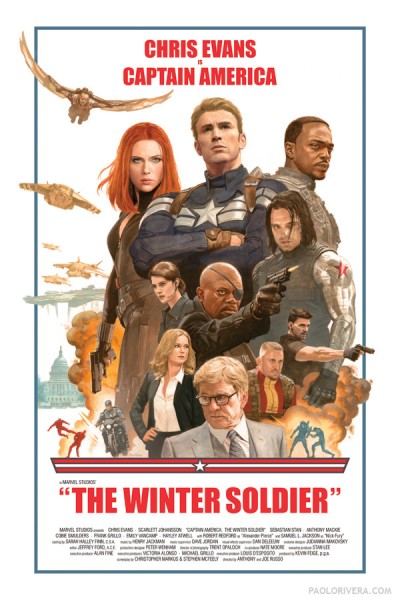
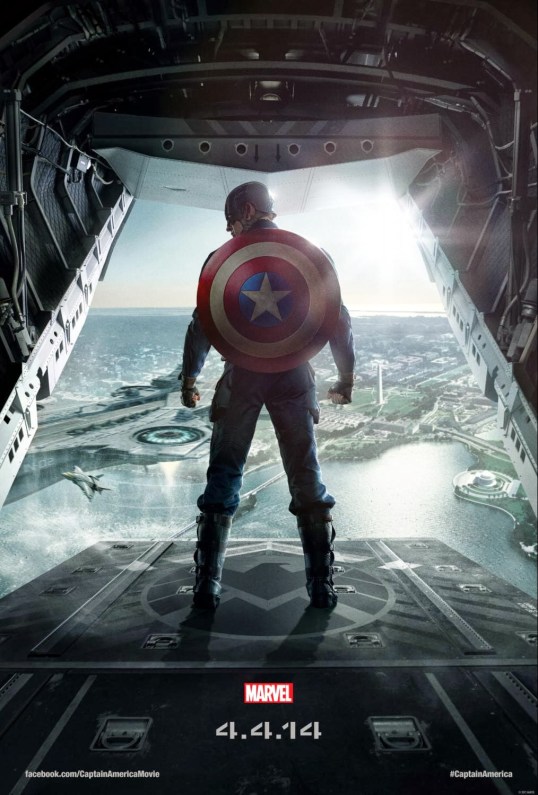
I would estimate that, when it comes to the movies, Ryan the Trash Film Guru and I agree with each other perhaps 95% of the time. What’s interesting is that the 5% of the time that we have disagreed, it’s always been the result of an entry in the Marvel Cinematic Universe. As Ryan has documented many times on this site, he’s not a fan of the MCU. (The title of his review of the second Thor film is probably one of the best that’s ever appeared on this site.) As for me, I’m the exact opposite. In fact, I am such a fan of the MCU that I am about to suggest that Captain America: The Winter Soldier — along with being one of the best action films of the year — deserves serious Oscar consideration.
Now, unlike some of the films that I’ve suggested deserve your consideration, Captain America: The Winter Soldier, along with receiving critical acclaim, was also a major commercial success. What made The Winter Soldier unique was that it deserved both the acclaim and the money. There was a lot that I liked about The Winter Soldier. In the role of Captain America, Chris Evans was both likable and, most importantly, believable as a hero out of time. And while I would have never guessed that her character was supposed to be Russian, Scarlett Johansson continued her streak of kicking serious ass in the role of the Black Widow. Samuel L. Jackson brought his customary style to the role of Nick Fury and Sebastian Stan was properly intimidating as the Winter Soldier. The action scenes were exciting, the dialogue was sharp and witty, and the film worked both as a stand alone film and as a part of the overall Marvel universe.
But, for me, what truly elevated Captain America: The Winter Soldier was the film’s subtext. (In that way, I would compare it to another surprisingly intelligent genre film, The Purge: Anarchy.) For those who may have forgotten, the villains of the Winter Soldier are all members and pawns of Hydra, a secret organization that has so infiltrated the American establishment that it has literally become something of a shadow government. Hydra has also infiltrated SHIELD and plans to use their intelligence capabilities to not only preemptively identify possible threats but to eliminate them as well. In fact, by taking control of the SHIELD helicarriers, Hydra can anonymously deliver death and destruction from above.
Does that sound familiar to anyone?
What truly makes this subtext come alive is that fact that the main villain — Hydra’s double agent in SHIELD — is played by none other than Robert Redford. Any student of American film knows what Robert Redford represents. Early in his career, Redford was the idealistic, ambitious, and frequently laconic protagonist, the perfect symbol of American exceptionalism. In the 1970s, Redford was the audience surrogate in classic paranoia films like Three Days of the Condor and All The President’s Men.Lately, as the man behind the Sundance Film Festival and a frequent director, Robert Redford has been the epitome of bourgeois, establishment liberalism.
Hence, when we hear Redford say, “Hail Hydra,” it’s more than just a catch phrase. It’s also the film’s way of saying that we’re all fucked. If even Robert Redford can be a villain, the film seems to be saying, then how foolish do we have to be to fully trust anyone or anything? If Robert Redford can order people killed and then justify it by claiming that he was acting for a greater good then why are we so shocked when governments do the exact same thing?
We live in paranoid times. In the future, historians will recognize that few films captured that paranoia as perfectly as Captain America: The Winter Soldier.
Unfortunately, with so many different and competing views of our sucky future, I fear that a lot of people may have missed one of the best of them. When taken along with all of the usual Academy biases, I fear that means that Snowpiercer is pretty much out of the running for a best picture nomination. It’s true that Snowpiercer did win best picture from the Boston Online Critics and there’s always an outside chance that Tilda Swinton could pick up a best supporting actress nomination. But, for the most part, Snowpiercer has been overlooked.
And that’s a shame because Snowpiercer is one of the best of the year.
The premise of Snowpiercer is, in its way, brilliant. After environmental scientists go a bit too far in their effort to battle global warming, the world suffers a second ice age. (I have to admit that I enjoyed this development, just because heroic environmentalists are such a cliché.) With the entire world frozen, what is left of humanity ends up on a massive train known as the Snowpiercer. For the next twenty years, the Snowpiercer rushes up and down a track that spans the entire planet.
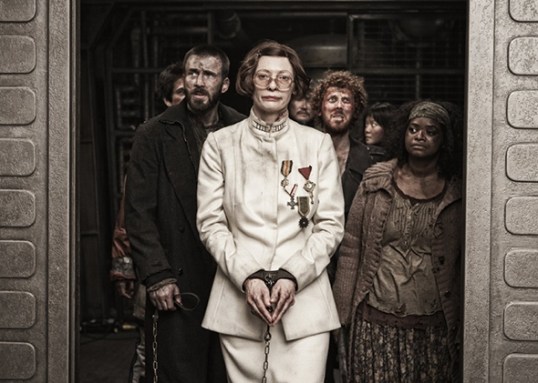
A new society forms on the Snowpiercer and, not surprisingly, it’s a lot like the old society. The rich live up at the front of the train. The poor live in the tail section. All laws are set by the rarely seen Wilford (Ed Harris). Wilford’s will is enforced by faceless soldiers and his blandly monstrous second-in-command, Mason (Tilda Swinton).
Twenty years later, the people in the tail section attempt their latest revolt. This time, they’re being led by the charismatic Curtis (Chris Evans, proving that he’s capable of playing a lot more than just Capt. America). Taking Mason hostage, Curtis leads his people through each car, slowly making their way to the front. Along the way, they meet a lot a violent resistance and Curtis discovers that his rebellion was not quite as virtuous as he originally assumed…
Snowpiercer was one of the most imaginative science fiction films that I saw in 2014, a triumph of acting, direction, and design. Each car has its own unique personality and look. Perhaps the film’s best scene is when Curtis finds himself in the car that serves as the train’s school. He and his grimy rebels listen as a perky and friendly teacher (Alison Pill) indoctrinates her students about the benevolence of Wilford. It’s a surrealistic and tense scene, one that ends with burst of sudden and unexpected violence.
Perhaps what I most appreciated about Snowpiercer was that, despite all appearance to the contrary, it was ultimately a humanistic and optimistic film. This is the rare action film where violence is not designed to look fun. Though many character may not survive, the film never celebrates or cheapens their death. Even the film’s most unsympathetic characters are still allowed moments of humanity. This is a film that not only ends on a hint of hope but which earns that hope as well.
Snowpiercer is one of the best films of the year and it’s one that definitely deserves more consideration than it’s been given.
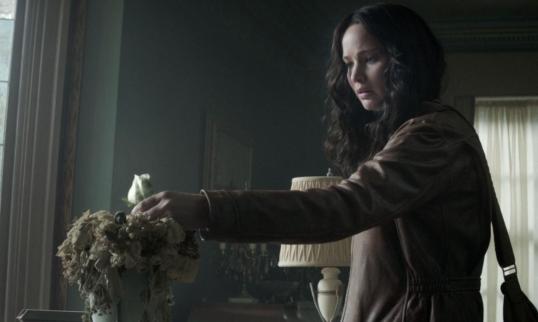
Of the three The Hunger Games films released so far, Mockingjay Part One is definitely the weakest. That does not, however, mean that it’s a bad film. It’s just that it doesn’t quite reach the grandeur of the first film, nor does it have the same political immediacy as the second one. However, there’s a lot of good things to be said about Mockingjay. Julianne Moore is perfectly cast as the charismatic but faintly sinister Alma Coin. Philip Seymour Hoffman’s performance reminds us of what a towering talent we lost earlier this year. Donald Sutherland continues to transform President Snow into a villain for the ages. Even though he’s only in the film for a few minutes, Stanley Tucci is perfectly vapid as Caesar Flickerman.
In fact, the only real problem with Mockingjay is that it’s so obviously a prologue to something bigger. Much as with The Maze Runner, we watch Mockingjay with the knowledge that it’s only part one and that the majority of the issues raised by the film will not be settled until next year. The film itself knows this as well and, as such, it lacks the immediacy and much of the excitement of the first two Hunger Games films.
But yet, with all those flaws in mind, Mockingjay still works and it’s largely because of Jennifer Lawrence’s performance as Katniss Everdeen. Whereas the first two Hunger Games films featured a Katniss who was always at the center of the action and always taking charge of any situation that she found herself in, Mockingjay features a Katniss who has far less control over her fate. (One of the neater ironies of the series is that Katniss was actually more independent as a prisoner of President Snow than as a “guest” of Alma Coin.) In Mockingjay, Katniss finds herself forced — with more than a little reluctance — to become the figurehead for the entire revolution and the film’s best moments are the ones in which others debate how to best “market” her. These scenes are all about how Katniss — who is now not only a celebrity but a political icon as well — deals with losing control over her own public image. Considering that Jennifer Lawrence’s rise to fame and acclaim occurred just as abruptly as Katniss’s, it’s probable that — even more so than in the previous films — the actress brought a lot of herself to the character.
So, yes, I would argue that Jennifer Lawrence does perhaps deserve some awards consideration for her performance in Mockingjay. However, she truly deserves it for the consistent quality of her performance throughout the entire Hunger Games franchise. From the very first film, Jennifer Lawrence’s performance has been iconic. Fiercely independent without giving into the usual cinematic clichés that come with that, Katniss Everdeen has provided an alternative role model for a generation of girls who, otherwise, might have only had the likes of Bella Swan to look up to.
If that’s not worthy of being honored, then I don’t know what is.
Continuing my look at ten films that deserve just as much awards consideration as Birdman, Selma, andThe Theory of Everything, we now turn our attention to Begin Again. Begin Again came out this summer and did pretty well both with audiences and critics. While everyone seems to agree that Begin Again will probably get at least a nomination for Best Original Song, I think that it’s actually worthy of even more consideration.
Begin Again is the latest film from John Carney, who previously directed one of my favorite films of all time, Once. Admittedly, Begin Again is nowhere near as good as Once but it’s still a charming film when taken on its own terms.
Mark Ruffalo plays Dan Mulligan, a record label executive who, at the start of the film, has definitely seen better days. His marriage is collapsing, he’s struggling to connect with his daughter (Hailee Steinfeld), and he’s just recently been fired from the company that he helped to found. After a day of binge drinking, Dan finds himself in a bar where he hears Gretta James (Keira Knightley) sing a song.
Dan is immediately taken with Gretta’s music but she has issues of her own. She had just broken up with her boyfriend and songwriting partner, Dave (Adam Levine, in his film acting debut). Though initially reluctant, Gretta eventually allows Dan to attempt to sign her to his former label. However, Dan’s former partner (played by Mos Def) refuses to sign her which leads to Dan and Gretta independently producing an album together, with the gimmick that the album will be recorded at various public locations across New York.
There’s really not that much plot to Begin Again but that’s actually a huge part of the film’s appeal. The film rejects melodrama and easy sentimentality and instead, it focuses on the characters. (That said, Begin Again is definitely a sentimental movie but it’s sentimental in the best possible way.) The movie is about how two different people come together and, for their own individual reasons, create something special. Ruffalo and Knightley have a lot of chemistry, Levine is hilariously dorky, and Mos Def is entertaining as the epitome of everything that’s wrong with the music industry. Best of all, Begin Again — much like Once before it — perfectly captures the thrill of artistic collaboration. The scenes of Knightley and Ruffalo recording their album are exuberant celebrations of everything that’s wonderful about performance and expression.