Horror Trailer: Send Help


Send Help is a darkly comedic psychological thriller directed by Sam Raimi. The film centers on two coworkers, Linda Liddle and Bradley Preston, who are the only survivors of a plane crash that leaves them stranded on a deserted island. Two people who shouldn’t be together in the same room must now collaborate to survive. The film looks to play on the two characters darkly comedic battle of wills and wits to what looks like survival of the fittest. The film is a mix of survival drama, sharp psychological tension, and Raimi’s signature style, blending horror and black comedy elements.

The film stars Rachel McAdams as Linda Liddle and Dylan O’Brien as Bradley Preston, with a supporting cast including Edyll Ismail, Dennis Haysbert, Xavier Samuel, Chris Pang, Thaneth Warakulnukroh, and Emma Raimi. Send Help is produced by Sam Raimi and Zainab Azizi, with a screenplay by Damian Shannon and Mark Swift, and features music by frequent collaborator, Danny Elfman. It is scheduled for theatrical release nationwide on January 30, 2026, distributed by 20th Century Studios.

The Unnominated #13: Heat (dir by Michael Mann)


Though the Academy of Motion Picture Arts and Sciences claim that the Oscars honor the best of the year, we all know that there are always worthy films and performances that end up getting overlooked.  Sometimes, it’s because the competition too fierce.  Sometimes, it’s because the film itself was too controversial.  Often, it’s just a case of a film’s quality not being fully recognized until years after its initial released.  This series of reviews takes a look at the films and performances that should have been nominated but were, for whatever reason, overlooked.  These are the Unnominated.

First released in 1995, Heat is one of the most influential and best-known films of the past 30 years.  It also received absolutely zero Oscar nominations.

Maybe we shouldn’t be too surprised that Academy — especially the Academy of the 1990s — didn’t shower the film with nominations.  For all of its many strengths, Heat is still a genre piece, an epic three-hour crime film from director Michael Mann.  It’s a film about obsessive cops and tightly-wound crooks and it’s based on a made-for-TV movie that Mann directed in the late 80s.  While the Academy had given a best picture nomination to The Fugitive just two years before, it still hadn’t fully come around to honoring genre films.

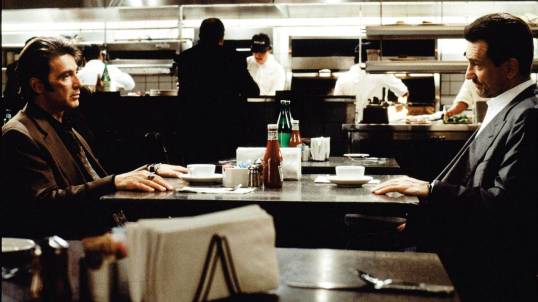
And yet one would think that the film could have at least picked up a nomination for its editing or maybe the sound design that helps to make the film’s signature 8-minute gun battle so unforgettable.  (Heat is a film that leaves you feeling as if you’re trapped in the middle of its gunfights, running for cover while the cops and the crooks fire on each other.)  The screenplay, featuring the scene where Al Pacino’s intense detective sits down for coffee with Robert De Niro’s career crook, also went unnominated.

Al Pacino was not nominated for playing Vincent Hanna and maybe we shouldn’t be too surprised at that.  Pacino yells a lot in this movie.  When people talk about Pacino having a reputation for bellowing his lines like a madman, they’re usually thinking about the scene where he confronts a weaselly executive (Hank Azaria) about the affair that he’s having with Charlene (Ashley Judd), the wife of criminal Chris Shiherlis (Val Kilmer).  And yet, I think that Pacino’s performance works in the context of the film and it’s often forgotten that Pacino has quite scenes in Heat as well.  Pacino’s intensity provides a contrast to Robert De Niro’s tightly controlled career criminal, Neil McCauley.  McCauley has done time in prison and he has no intention of ever going back.  But, as he admits during the famous diner scene, being a criminal is the only thing that he knows how to do and it’s also the only thing that he wants to do.  (“The action is the juice,” Tom Sizemore says in another scene.)  If any two actors deserved a joint Oscar nomination it was Pacino and De Niro.  In Heat, they’re the perfect team.  Pacino’s flamboyance and De Niro’s tightly-controlled emotions come together to form the heart of the picture.

No one from the film’s supporting cast was nominated either, despite there being a wealth of riches to choose from.  Ashley Judd and Val Kilmer come to mind as obvious contenders.  Kilmer is amazing in the shoot-out that occurs two hours into the film.  Ashley Judd has a killer scene where she helps her husband escape from the police.  Beyond Judd and Kilmer, I like the quiet menace of Tom Sizemore’s Michael Cheritto.  (Just check out the look he gives to an onlooker who is getting a little bit too curious.)  Kevin Gage’s sociopathic Waingro is one of the most loathsome characters to ever show up in a movie.  William Fichtner, Jon Voight, Danny Trejo, and Tom Noonan all make a definite impression and add to Michael Mann’s portrait of the Los Angeles underworld.  In an early role, Natalie Portman plays Hanna’s neglected stepdaughter and even Amy Brenneman has some good moments as Neil’s unsuspecting girlfriend, the one who Neil claims to be prepared to abandon if he sees “the heat coming.”

I have to mention the performance of Dennis Haysbert as Don Breedan, a man who has just been released from prison and who finds himself working as a cook in a diner.  (The owner of the diner is played by Bud Cort.)  Haysbert doesn’t have many scenes but he gives a poignant performance as a man struggling not to fall back into his old life of crime and what eventually happens to him still packs an emotional punch.  For much of the film’s running time, he’s on the fringes of the story.  It’s only by chance that he finds himself suddenly and briefly thrown into the middle of the action.

Heat is the ultimate Michael Mann film, a 3-hour crime epic that is full of amazing action sequences, powerful performances, and a moody atmosphere that leaves the viewer with no doubt that the film is actually about a lot more than just a bunch of crooks and the cops who try to stop them.  Hanna and McCauley both live by their own code and are equally obsessed with their work.  Their showdown is inevitable and, as directed by Michael Mann, it takes on almost mythological grandeur.  The film is a portrait of uncertainty and fear in Los Angeles but it’s also a portrait of two men destined to confront each other.  They’re both the best at what they do and, as a result, only one can remain alive at the end of the film.

I rewatched Heat yesterday and I was amazed at how well the film holds up.  It’s one of the best-paced three-hour films that I’ve ever seen and that epic gunfight is still powerful and frightening to watch.  Like Martin Scorsese’s Casino, it was a 1995 film that deserved more Oscar attention than it received.

Heat (1995, dir by Michael Mann, DP: Dante Spinotti)

Previous entries in The Unnominated:

  1. Auto Focus 
  2. Star 80
  3. Monty Python and The Holy Grail
  4. Johnny Got His Gun
  5. Saint Jack
  6. Office Space
  7. Play Misty For Me
  8. The Long Riders
  9. Mean Streets
  10. The Long Goodbye
  11. The General
  12. Tombstone


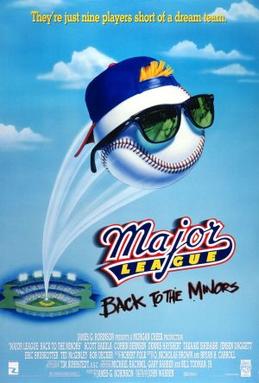
I Watched Major League: Back To The Minors (1998, Dir. by John Warren)


Roger Dorn (Corbin Bernsen), the former third baseman for the Cleveland Indians, is the new owner of the Minnesota Twins.  There’s a hotshot hitter playing for the Buzz, the Twins’s Minor League affiliate.  Downtown Anderson (Walton Goggin) can hit the ball over the fences but he still needs to learn about teamwork before he’ll be ready to move up to the majors.  Roger recruits an old friend, an aging pitcher named Gus Cantrell (Scott Bakula), to manage the Buzz and mentor Downtown.  Under Gus’s leadership, the Buzz starts winning games.  Even some former Indians, like Pedro Cerrano (Dennis Haysbert) and Taka Tanaka (Takaaki Ishibashi), are recruited to play for the Buzz.  When the manager of the Twins, Leonard Huff (Ted McGinley), insults Gus and the Buzz over dinner, Gus challenges the Twins to an exhibition game, the minors against the majors.  Huff accepts the challenge.

I had always heard that Major League: Back To The Minors was the worst of three Major League films but I liked it.  It wasn’t as good as the first one but it wasn’t as boring as the second one.  A lot of it has to do with the cast, who give it their all.  Walton Goggins is great as the cocky Downtown Anderson but really, all of the actors playing entire team did a good job.  They’re all misfits, of course.  I especially liked Doc (Peter Mackenzie), a medical student-turned-pitcher who has the slowest fastball in the game.  This movie had a little of the warmth and insider humor that made the first Major League film so special.  It’s an underdog story, with the minor league players proving that they’re just as good as the spoiled players in the big leagues.

I didn’t find the idea of an exhibition game between the Twins and the Buzz to be believable.  In the movie, they actually play two games against each other and they both take place during the regular season.  When did they find the time to play each other?  I guess they gave up one of their travel days but it still doesn’t seem like something that would happen.

I enjoyed this movie more than I thought I would.  It helped that I love baseball.  And I love the minor leagues, even if they don’t get the same respect as the majors.  Some of the best baseball I’ve ever seen has been in minor league games.  They may not have the huge contracts but they’ve got the talent, they’ve got something to prove, and they’ve got the love of the game.

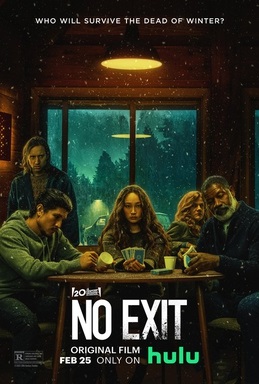
Film Review: No Exit (dir by Damien Power)


After she learns that her mother is in the hospital and possibly on the verge of death, Darby (Hannah Rose Liu) breaks out of drug rehab, steals a car, and starts driving to Salt Lake City.  However, what Darby doesn’t know is that she’s also driving straight into a blizzard.  Soon, Darby is forced to take shelter at a nearby state park visitors center.

Darby isn’t the only person seeking shelter that night.  There’s a married couple, Ed (Dennis Haysbert) and Sandi (Dale Dickey).  Ed is a veteran of the Marine Corp while Sandi is a nurse.  There’s Ash (Danny Ramirez), who has the friendliest smile to ever be seen in the middle of a blizzard.  And then there’s Lars (David Rysdahl), who is distinguished by his long hair and his nervous mannerisms.  When Darby first enters the visitors center, Lars is curled up in a corner and loudly snoring.

And then there’s Jay (Mila Harris).  Jay is a child who happens to be bound and gagged in one of the vehicles parked outside.  When Darby discovers her, she has to not only save the child’s life but also figure out which one of the people in the visitors center is responsible for kidnapping her.

Clocking in at a brisk 90 minutes, No Exit is full of twists and turns.  I’ll do my best to keep spoilers to a minimum in this review.  Not all of the film’s twists work, of course.  There’s a few moments that, in hindsight, didn’t exactly make sense.  After watching the film, you could spend hours debating why certain characters did the things that they did, assuming that you were so inclined and that you could actually find anyone else willing to sit through your analysis.  However, the film itself is so quickly paced and well-directed that it doesn’t matter that the story itself is occasionally a bit implausible.  From the minute Darcy breaks out of that rehab, the film captures the viewer’s attention and it doesn’t let go until the final credits start to roll up the screen.  This is an entertaining B-movie, one that makes good use of its isolated location and its talented cast.  Havana Rose Liu especially deserves a lot of credit for her sympathetic lead performance as Darby.  Darby is a cynic and a survivor but she still has enough humanity inside of her to risk her life for a stranger.

The film looks great, with its scenes of cars driving through the raging snow storm and the film’s cast gathered in the somewhat tacky visitors center.  All of the snow falling reminded me of i’m thinking of ending things and I have to admit that a part of me kept expecting there to be some sort of a metaphysical twist towards the end of the film.  I found myself wondering if the visitors center would be revealed to be Hell, which wasn’t a totally outlandish idea when one considers that the film shares the same name as Sartre’s famous play.  But no, No Exit is a thriller that deals with concerns that are very much earthbound.  It’s an well-executed thriller and an entertaining way to spend 90 minutes.  It can currently be viewed on Hulu.

Major League (1989, dir. by David S. Ward) and Major League II (1994, dir. by David S. Ward)


I’m so excited that baseball’s back!

The 2020 regular season of Major League Baseball is going to start on July 22nd and it’s going to last until September 27th.  The teams will play 60 games and the World Series will be held in October.  It’s an abbreviated season but there was no way to avoid that.  I’m just happy that there will at least be some games played this year.

Of course, as excited and happy as I am, I can’t deny that baseball almost always breaks my heart.  Just a few years ago, I was so excited when a Texas team finally won the World Series.  Later, we all found out that the Astros won because they cheated, which will forever taint both the legacy of the team and the MLB.  It breaks my heart to say it but, as far as I’m concerned, no Texas team has yet to legitimately win the World Series.

And then there’s the Rangers.  I’m a Rangers fan.  I love the Rangers.  I was so excited the two times that they made it to the World Series and I’ve never gotten over their loss to the Cardinals.  (Their loss to the Giants I can accept because the Giants were a great team and they earned their wins.  The Cardinals, on the other hand…)  Ever since 2012, though, the Rangers have always broken my heart.  It’s been a while since we’ve had a great Rangers season.  At the start of every season, though, I say, “This is our season!”  And no matter how badly things end, I always say, “Next season, we’re going all the way!”

I guess that’s why I love Major League.

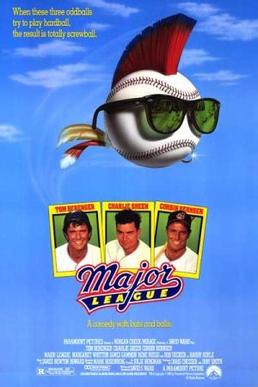
Major League is the ultimate underdog baseball movie.  It’s a film about a fictional version of the Cleveland Indians.  Rachel Phelps (Margaret Whitton), the new owner of the Indians, wants to move the team to Miami but to do that, she’s going to need to have the worst season ever, one where the team plays so badly and breaks so many hearts that even the most loyal fans stop coming to the games.  It shouldn’t be too hard since the Indians have’t even won a pennant in over 30 years.  But to make sure that it happens and that the team only wins 15 games over the entire season, Phelps recruits the worst players she can find.

The team that she puts together is made up of has-beens and never-weres.  Some of them have raw talent but none of them know how to play as a team.  Ex-con Ricky Vaughn (Charlie Sheen) has a killer fastball but is so near-sighted that he’s a danger whenever he steps on the mound.  Catcher Jake Taylor (Tom Berenger) is a veteran team leader but his knees are so bad that he can barely walk.  Willie Mays Hayes (Wesley Snipes) is fast but can’t hit worth a damn.  Pedro Cerrano (Dennis Haysbert) can hit home runs but only if the pitcher throws him a fastball.  Just as Rachel expected, the team struggles at first.  Even when they start to show signs of improvement, she cut back on their budget and sells their equipment, all to try to make winning impossible.  It’s only when their manager, ex-drywall salesman Lou Brown (James Gammon), tells them that Rachel wants them to lose that the team comes together and starts to win.

Everything that’s great about baseball can be found in Major League.  I love all the scenes with the fans slowly coming around to believing that maybe the Indians actually could win it all.  I’ve been through that so many times with the Rangers that I know exactly how they all felt.  I love the interactions between all the players on the team, from the new players eager to win to the veterans who just want to survive another season.  I love the scenes with the play-by-play announcer (Bob Uecker) trying to put a good spin on the way the team plays.  (All together: “Just a bit outside!”)  And mostly, I love that the film treats the game and its players with the respect that they deserve.  So many other films would have turned a character like born-again pitcher Eddie Harris (Chelcie Ross) into a punchline.  Instead, in Major League, he gets a standing ovation after he pitches his last game.  The best thing about Major League is that it loves baseball, both the games and the players.

Since Major League was a success at the box office, it was eventually followed by a sequel, Major League II.

Major League II picks up the season after the first movie ended and it tells the exact same story as the first film, just not as well.  Almost everyone from the first film is back (though Omar Epps takes over the role of Willie Mays Hayes from Wesley Snipes) but the charm and the chemistry from the first movie just aren’t there.  The players have to set aside their egos and learn how to play like a team all over again.  The main difference between the two movies is that it takes a lot longer for the Indians to start winning in the sequel than in the first film.  Plus, the sequel just isn’t as funny.

Even if the sequel is a let down, the first Major League is still one of the best baseball movies ever made.  If the Indians could win the pennant in Major League, maybe there’s hope for my Rangers yet!

Insomnia File #34: The Minus Man (dir by Hampton Fancher)


What’s an Insomnia File? You know how some times you just can’t get any sleep and, at about three in the morning, you’ll find yourself watching whatever you can find on cable? This feature is all about those insomnia-inspired discoveries!

Last night, if you were unable to sleep at one in the morning, you could have turned over to Starz and watched the 1999 film, The Minus Man!

The Minus Man is a strange little film about a rather odd man.  Vann (Owen Wilson) is a drifter.  He avoids questions about his past with the skill of someone who specializes in being whatever he needs to be at the moment.  When he rents a room from Doug and Jane Durwin (Brian Cox and Mercedes Ruehl), he tells them that he’s only drunk one beer over the course of his entire life, he always works, he always pays his rent on time, and that he’s never smoked “the dope.”  He says it so earnestly that it’s difficult to know whether you should take him seriously or not.  And yet, Vann is so likable and so charmingly spacey that you can’t help but understand why people automatically trust him.  Vann succeeds not because people believe him but because they want to believe him.

Vann’s new in town.  As he explains to a cop who pulls him over, he’s just interested in seeing the countryside.  From the minute that Vann shows up, he’s accepted by the community.  He goes to a high school football game and befriends the local star athlete (Eric Mabius).  He tries to help repair Doug and Jane’s marriage, which has been strained ever since the disappearance of their daughter.  With Doug’s aid, Vann gets a job at the post office and proves that he wasn’t lying when he said he was a hard worker.  Vann even pursues a tentative romance with the poignantly shy and insecure Ferrin (Janeane Garofalo).

In fact, it’s easy to imagine this film as being a sweet-natured dramedy where a drifter comes into town for the holidays and helps all of the townspeople deal with their problems.  However, from the first time we see him, we know that Vann has some issues.  As Detective Graves (Dennis Haysbert) puts it, Vann is a “cipher, a zero.”  There’s nothing underneath the pleasant surface.  Of course, Graves doesn’t really exist.  Neither does his partner, Detective Blair (Dwight Yoakam).  They’re two figments of Vann’s imagination.  They appear whenever Vann is doing something that he doesn’t want the world to find out about.

Whenever the urge hits him, Vann kills people.  When we first meet him, he’s picking up and subsequently murdering a heroin addict named Casper (Sheryl Crow).  Vann makes it a point to use poison because he says that it’s a painless death.  Vann also says that he’s doing his victims a favor, as he feels that the majority of them no longer want to live.  Vann is the type of killer who, after having committed his latest murder, sees nothing strange about volunteering to help search for the missing victim.

Like a lot of serial killer films, The Minus Man cheats by giving all of the best lines to the killer.  In real life, most serial killers are impotent, uneducated losers who usually end up getting caught as a result of their own stupidity.  In the movies, they’re always surprisingly loquacious and clever.  While Vann may not be a well-spoken as Hannibal Lecter, he’s still a lot more articulate than the majority of real-life serial killers.  As I watched the film, it bothered me that we didn’t really learn more about Vann’s victims.  (It would have been a far different film if someone had mentioned that Vann’s third, unnamed victim was “Randy, who was just having a bite to eat while shopping for a present for his little girl’s birthday.”)  Too often, The Minus Man seemed to be letting Vann off the hook in a way that a film like Henry: Portrait of a Serial Killer or even American Psycho never would.

That said, The Minus Man may be occasionally uneven but it’s still an intriguing and sometimes genuinely creepy film.  The Minus Man makes good use of Owen Wilson’s eccentric screen persona and Wilson gives a very good performance as a man who has become very skilled at hiding just how empty he actually is.  Much like everyone else in the film, you want to believe that there’s more to Vann than meets the eye because, as played by Wilson, he’s just so damn likable.  Over the course of the film, Vann and Doug develop this weird little bromance and, as good as Wilson is, Brian Cox’s performance is even more unsettling because we’re never quite sure what Doug may or may not be capable of doing.  Even Janeane Garofalo gives a touching and believable performance as a character who you find yourself sincerely hoping will not end up getting poisoned.

With all that in mind, I wouldn’t suggest watching this film if you’re trying to get over insomnia.  This is the type of unsettling film that will keep you awake and watching the shadows long after the final credits roll.

Previous Insomnia Files:

  1. Story of Mankind
  2. Stag
  3. Love Is A Gun
  4. Nina Takes A Lover
  5. Black Ice
  6. Frogs For Snakes
  7. Fair Game
  8. From The Hip
  9. Born Killers
  10. Eye For An Eye
  11. Summer Catch
  12. Beyond the Law
  13. Spring Broke
  14. Promise
  15. George Wallace
  16. Kill The Messenger
  17. The Suburbans
  18. Only The Strong
  19. Great Expectations
  20. Casual Sex?
  21. Truth
  22. Insomina
  23. Death Do Us Part
  24. A Star is Born
  25. The Winning Season
  26. Rabbit Run
  27. Remember My Name
  28. The Arrangement
  29. Day of the Animals
  30. Still of The Night
  31. Arsenal
  32. Smooth Talk
  33. The Comedian

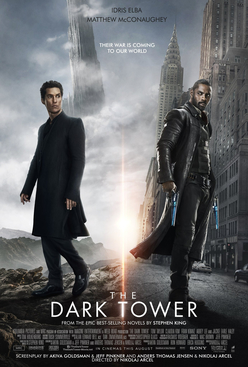
Playing Catch-Up With The Films of 2017: The Dark Tower (dir by Nikolaj Arcel)


What the Hell was The Dark Tower about, anyway?

It’s a legitimate question.  I know that the film was technically a continuation of Stephen King’s overrated Dark Tower books.  Matthew McConaughey was Walter, the Man in the Black, the man who is kidnapping psychic children so that he can weaponize their powers and destroy The Dark Tower.  Idris Elba was Roland, the last of the gunslingers, who is obsessed with killing Walter because Walter killed his father.  And Tom Taylor is Jake, an eleven year-old boy who lives in New York City and who keeps having visions of the Tower, Walter, and Roland.  Walter wants Jake.  Roland wants Walter.  Jake wants to understand it all…

And that’s pretty much the entire movie.  Jake switches back and forth between his world and Roland’s world.  Walter occasionally pops up in New York so that he can kill Jake’s family and assure that Jake won’t have any reason not to continue traveling with Roland at the end of the movie.  It all basically feels like the pilot for a television series and, to be honest, it probably wouldn’t be that bad of a show.  For one thing, if The Dark Tower was a tv show, there would be more of an opportunity to develop the characters of Roland, Walter, and Tom.  The Dark Tower movie only last 95 minutes and the majority of those minutes feel very rushed.

Obviously, if you’ve read Stephen King’s Dark Tower books, this film will be easier for you to follow than it will be for people who have never had to suffer through them.  I know I’m in the minority as far as this is concerned but I find The Dark Tower series to be King at his most pretentious.  Interestingly enough, a little bit of pretension probably would have helped the film version of The Dark Tower.  As it is, The Dark Tower is almost too workmanlike and straight-forward.  It could have really used a pointless Stephen King-style soliloquy about faith, innocence, and horror.  At the very least, they could have had someone in the background, droning on about politics in a Maine accent.

I have to admit that I really, really, really wanted to like The Dark Tower.  I love Idris Elba.  I love Matthew McConaughey.  Even more importantly, I love being a contrarian.  Whenever a film gets as many negative reviews as The Dark Tower, my natural instinct is always to assume that it has to be a secret masterpiece.  I mean, seriously, who trusts critics?  I really wanted to watch The Dark Tower and then write a 1,000-word defense of it.  I was hoping that, much like The Counselor, it would turn out to be a masterpiece that only I could recognize.

Sadly, that didn’t turn out to be the case.  I will say that Matthew McConaughey seemed to be having a sincerely good time playing the bad guy.  And Idris Elba had just the right mix of weariness and compassion to play Roland.  But otherwise, the movie just felt so pointless.

Overall, this has been a pretty good year for Stephen King film adaptations.  It deserves to be nominated for an Oscar, though it won’t be.  Gerald’s Game made people thankful for Netflix.  The Dark Tower, though, will be quickly forgotten.

Playing Catch-Up With The Films of 2017: Fist Fight (dir by Richie Keen)


While I wouldn’t begin to argue that it’s been a great year for movies, there were still some really good movies released in 2017.

Unfortunately, there were also some really bad ones.

Which do you think Fist Fight was?

If you answered really bad, congratulations!

Actually, I don’t think anyone was expecting Fist Fight to be a classic or anything like that.  Basically, the film is about a conflict between two teachers, a conflict that seems destined to end with the event promised by the title.  The two teachers are played by Ice Cube and Charlie Day.  Of course, in the movie, they have different name but it doesn’t matter.  Neither character has an identity outside of the actor who plays him.  Charlie Day is nerdy and quick to yell.  Ice Cube is tough and intimidating and not the type to back down from a fight.

Now, at the risk of losing all credibility, I’m going to be honest about something.  When I first saw the trailer for Fist Fight, I thought it might not be as bad as it turned out to be.  Charlie Day is hilarious on It’s Always Sunny In Philadelphia.  One of the more appealing things about Ice Cube is his willingness to poke fun at his tough guy image.  More often than not, I tend to like movies about teachers acting like children because, when I was in school, I always suspected that was the way teachers actually behaved when they were safely in the teacher’s lounge.  Charlie Day desperately running around the school, hyperventilating while Ice Cube pops up to remind him that they have a fist fight scheduled?  Seriously, it sounded like it could be funny in a dumb way.

Well, I was wrong.  Fist Fight is one of the most painfully unfunny films that I’ve ever seen.  This is a movie that should have been focused on one thing: the fist fight at the end of the day.  The entire movie should have been Charlie Day preparing for a fight that he knows he can’t possibly win.  Instead, the movie kept getting distracted with unnecessary subplots.  For instance, because it’s the last day before summer, all of the students are pulling pranks on their teachers.  In fact, the entire student body is out-of-control.  But who cares?  We’re here to see Charlie Day try to throw a punch at Ice Cube.  We don’t care about a bunch of obnoxious students pulling pranks that seem like they were directly lifted from a Crown International high school movie.  If we want to see that, we can rewatch The Pom Pom Girls or Joy of Sex.  And if we want to watch a teacher stand up to his students, we can watch Class of 1984.

The film is full of funny people but it never really takes advantage of them.  Actors like Tracy Morgan, Kumail Nanjiani, and Christina Hendricks pop up but just as quickly disappear.  Charlie Day does his best but the level of writing never rises to the level of It’s Sunny In Philadelphia.  (I personally would love to see “The Gang Gets In A Fist Fight With Ice Cube.”)  Compared to Fist Fight, even something like Horrible Bosses looks like nuanced and subversive humor.  There’s a lot of screeching in Fist Fight but very little of it is funny.

A Movie A Day #118: Navy SEALs (1990, directed by Lewis Teague)


While rescuing hostages in the Middle East, a team of Navy SEALs discover that terrorist leader Ben Shaheed (Nicholas Kadi) has a warehouse full of stinger missiles.  Hawkins (Charlie Sheen) wants to destroy the missiles but his superior, Curran (Michael Biehn), orders him to concentrate on saving the hostages.  As a result, Shaheed has time to move the missiles to another location.  With the help of a Lebanese-American journalist (Joanne Whalley-Kilmer) and the CIA, the SEALs must now track down the new location and destroy the missiles before they are used by Shaheed’s organization.

Navy SEALs is mostly memorable for the amount of James Cameron alumni who appear in its cast.  The cast not only features The Terminator‘s Michael Biehn and Rick Rossovich but Bill Paxton as well.  Of course, the main star is Charlie Sheen, still technically a serious actor at the time, who gives a wide-eyed and histrionic performance that suggests Hawkins may have snorted a little marching powder before reporting for duty.  24‘s Dennis Haysbert plays a SEAL who is engaged to marry Law & Order‘s S. Epatha Merkerson.  Haysbert spends so much time planning his wedding and talking about both the importance of both duty and love that the only shocking thing about his role is that he manages to survive half the movie before getting killed.  Neither Val Kilmer nor Cary Elwes is in the cast, though it seems like they both should be.

Navy SEALs was a box office bust in 1990 but, after the death of Osama Bin Laden, it experienced a sudden upswing in popularity and even appeared on primetime television a few times.  The scene where the SEALs blow off some steam by playing golf is a classic but, otherwise, this is a largely forgettable Top Gun rip off.

Shattered Politics #60: Absolute Power (dir by Clint Eastwood)


Absolute_power

The main reason that I enjoyed the 1997 Clint Eastwood film Absolute Power was because it features a murderer who also happens to be the President.  As someone who dislike the idea of any one person having absolute power, I always get annoyed by the attitude that authority is something that has to be automatically respected.  Instead, I’ve always felt that all authority should be distrusted and continually questioned.

Just take President Alan Richmond (Gene Hackman) for example.  At the start of Absolute Power, he’s a popular President.  He’s quick with a smile.  He’s quick with a memorable line.  I imagine that excerpts from his State of the Union speech would probably be very popular on YouTube.  However, at the start of the film, elderly burglar Luther Whitney (Clint Eastwood) witnesses President Richmond getting violent with Jan Levinson-Gould.  When Jan resists him, two Secret Service agents (Scott Glenn and Dennis Haysbert) run into the room and shoot her.

Okay, technically, the victim was not really The Office‘s Jan Levinson-Gould.  (They both just happen to be played by Melora Hardin.)  Instead, her name was Christy Sullivan and she was also the wife of one of Richmond’s top financial supporters, Walter Sullivan (E.G. Marshall).  After the murder, President Richmond and his chief-of-staff, Gloria Russell (Judy Davis), attempt to frame Luther for the crime.

Absolute Power is pretty much your typical Clint Eastwood action picture.  In the role of Luther, Eastwood snarls his way through the film and never dispatches a bad guy without providing a ruthless quip.  (When one bad guy begs for mercy, Luther replies that he’s “fresh out.”)  Luther has an estranged daughter, a lawyer named Kate (Laura Linney) and, despite the fact that she’s helping the homicide detective (Ed Harris) who is trying to capture him, Luther still pops up to look out for her.  In the end, Luther’s not only try to prove that the President is a murderer but he’s trying to be a better father as well!  Awwwwwww!

Again, it’s all pretty predictable but the film is worth seeing just for the chance to witness Gene Hackman play one of the most evil Presidents ever.  As far as soulless chief executives are concerned, Alan Richmond makes Woodrow Wilson look like a humanitarian!  And Hackman does a good job embodying the affable type of evil that could conceivably translate into an electoral landslide.

Absolute Power may not be a great film but it’s a good one to watch whenever you need an excuse to be cynical about the absolute power of the government.

http://www.youtube.com/watch?v=5OzynRDuUf4