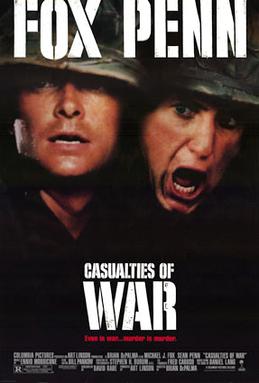
Casualties of War (1989, directed by Brian DePalma)


Private Max Eriksson (Michael J. Fox) is a new arrival in Vietnam, a young infantryman who is called a “cherry” by his fellow soldiers.  No one wants to get close to Eriksson because everyone knows that it’s the new guy who is most likely to make a mistake and get himself killed.  The only person who seems to care whether Eriksson lives or dies is Sgt. Tony Messerve (Sean Penn), a squad leader who is so tough and battle-worn that it is easy to forget that he is only 20 years old.  After a member of Messerve’s squad is killed in a firefight and Messerve’s squad had been denied leave despite all of the stress and pressure that they’ve been under, Messerve decides that, during their next mission, the squad is going to kidnap a woman from a village and take her with them.

Eriksson, who is still naive enough to sincerely say, “We’re supposed to be here to help these people,” is horrified by Messerve’s actions.  At first, only he and Diaz (John Leguizamo) refuse to take part in raping the terrified woman (Thuy Thu Le).  Diaz soon caves to the pressure from the rest of the squad and joins in.  Only Eriksson continues to refuse but his attempt to help the woman escape fails when the members of the squad murder her during a firefight with the Viet Cong.  After the battle, the wounded Eriksson discovers that no one in command wants to hear about what happened.  Messerve’s second-in-command, Clark (Don Patrick Harvey), targets Eriksson, trying to shut him up permanently.

One of the many Vietnam films to come out after the success of Platoon, Brian De Palma’s Casualties of War is an intense and disturbing recreation of a true story.   After years of being accused of making misogynistic and exploitive films, De Palma made an effective and sensitive anti-war film, one that did not exploit the suffering of the kidnapped woman but instead portrays the depravity of war and the courage it takes to do the right thing when everyone around is ordering you not to.  While it always takes a while to get used to Michael J. Fox in a serious role (and, at the start of the film, he really does seem to be miscast), he eventually gives the best performance of his career in Max Eriksson and, by using a framing device of Eriksson back in the United States after completing his tour, both De Palma and Fox show how the Eriksson, like countless other veterans, is still haunted by what he saw in Vietnam even after he returns home.  Sean Penn is equally impressive as Messerve, playing him as someone who sacrificed his soul in order to survive in Vietnam.  Messerve has come to view the entire country with contempt and, in his twisted way, he sees kidnapping the woman as a way to reward his squad for all that they’ve endured.  The rest of the cast is also strong, with John C. Reilly making his acting debut as a member of the squad.

Not surprisingly, the dark and disturbing Casualties of War was a box office disappointment.  It’s still one of most harrowing films made about Vietnam and one of De Palma’s best.

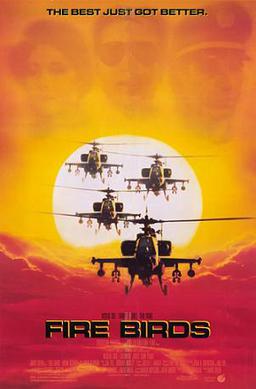
Fire Birds (1990, directed by David Green)


The South American drug cartels have been getting too aggressive so the American government decides to take them out with Apache helicopters.  Missions leaders Tommy Lee Jones and Dale Dye know that these helicopters are the ultimate weapons of death and that things could go terribly wrong if they recruit the wrong pilots.

So, of course, they get Nicholas Cage and Sean Young to fly them.

Fire Birds was an attempt to redo Top Gun with helicopters.  It does actually improve on Top Gun in that it gives the pilots an actual villain to fight.  The drug cartels and the German mercenary (Bert Rhine) that they hire are good B-movie villains and an improvement on the faceless and apparently nationless bad guys who showed up at the end of Top Gun.  What Fire Birds cannot improve on are the flying sequences because fighter planes are just more exciting than to watch than helicopters.

The best thing about the movie is that it brought Nicolas Cage and Tommy Lee Jones together and their acting styles mesh far better than I think anyone would expect.  Sean Young is about as believable as a helicopter pilot as you would expect her to be, which is to say not at all.  There’s a reason why Young’s best performance was as a robot.

“I.  Am.  The.  Greatest!” Nicolas Cage says in the movie and he sounds convinced.  Fire Birds makes the case that Cage is the greatest when it comes to making something bad watchable.  This movie would be thoroughly forgettable if not for his presence and the same can be said about a lot of other movies as well.  But, Tommy Lee Jones can lay claim to the “Greatest” title as well.   Five years after Fire Birds, Tommy Lee Jones would tell Jim Carrey, “I cannot sanction your buffoonery,” and the passage of time has shown that Jones knew what he was talking about.  Nicolas Cage and Tommy Lee Jones should make more movies together.

Lisa Marie Reviews An Oscar Nominee: Born On The Fourth of July (dir by Oliver Stone)


In 1989, having already won an Oscar for recreating his Vietnam experiences in Platoon, director Oliver Stone returned to the war with Born On The Fourth Of July.

Based on the memoir of anti-war activist Ron Kovic, Born on the Fourth of July stars Tom Cruise as Kovic.  When we first meet Kovic, he’s growing up on Long Island in the 50s and 60s.  He’s a clean-cut kid from a nice family.  He’s on the school wrestling team and he’s got a lot of friends.  When he was just 15, he heard John F. Kennedy telling people to ask what they can do for their country and he was inspired.  He decided he wanted to join the Marines, despite the fact that his father (Raymond J. Barry) was still haunted by the combat that he saw in World War II.  (In one of the film’s better scenes, a young Kovic notices that the elderly veterans marching in the Independence Day parade still flinch whenever they hear a firecracker.)  He enlists in the Marines after listening to a patriotic speech from a recruiter (played by Tom Berenger).  Ron runs through the rain to attend his prom and has one dance with Donna (Kyra Sedgwick), on whom he’s always had a crush.  There’s nothing subtle about the way that Stone portrays Kovic’s childhood.  In fact, one might argue that it’s a bit too idealized.  But Stone knows what he’s doing.  The wholesomenss of Kovic’s childhood leaves neither him nor the viewer prepared for what’s going to happen in Vietnam.

Vietnam turns out not to be the grand and patriotic adventure that Kovic thought it would be.  After Sgt. Kovic accidentally shoots one of his own men in a firefight, he is ordered to keep quiet about the incident.  After he is wounded and paralyzed in another firefight, Kovic ends up in a Hellish VA hospital, surrounded by men who will never fully recover from their mental and physical wounds.  Kovic is eventually returns home in wheelchair.  The film then follows Kovic as he goes from defending the war in Vietnam to eventually turning against both the war and the government.  At one point, he ends up with a group of disabled vets in Mexico and there’s a memorable scene where he and another paraplegic (Willem Dafoe) attempt to fight despite having fallen out of their chairs.  Eventually, Kovic returns to America and turns his anger into activism.

There’s nothing subtle about Born On The Fourth Of July.  It’s a loud and angry film and Oliver Stone directs with a heavy-hand.  Like a lot of Stone’s films, it overwhelms the viewer on a first viewing and it’s only during subsequent viewings that one becomes aware of just how manipulative the film is.  Tom Cruise gives a good performance as Ron Kovic but his transformation into a long-haired, profane drunk still feels as if it happens a bit too abruptly.  A good deal of the film centers on Kovic’s guilt about accidentally killing one of his men but the scene where he goes to the soldier’s family and asks them for forgiveness didn’t quite work for me.  If anything, Kovic came across as being rather self-centered as he robs the man’s mother and father of the belief that their son had at least died heroically in combat as opposed to having been shot by his own sergeant.  Did Kovic’s need to absolve himself really give him the right to cause this family more pain?  Born on the Fourth Of July is an effective work of agitprop.  On the first viewing, you’ll want to join Kovic in denouncing the military and demanding peace.  On the second viewing, you’ll still sympathize with Kovic while also realizing that he really owes both his mother and father an apology for taking out his anger on them.  By the third viewing, you’ll be kind of like, “Wow, I feel bad for this guy but he’s still kind of a jerk.”  That said, when it comes to making an effective political film, Adam McKay could definitely take some lessons from Oliver Stone.  Born On The Fourth of July is at its best when it simply captures the feeling of living in turmoil and discovering that the world is not as simple a place as you once believed.  As idealized as the film’s presentation of Kovic’s childhood may be, anyone who has ever felt nostalgia for an earlier and simpler world will be able to relate.

Oliver Stone won his second Best Director Oscar for Born On The Fourth Of July.  The film itself lost Best Picture to far more genteel version of the past, Driving Miss Daisy.


Lisa Marie Reviews An Oscar Winner: Platoon (dir by Oliver Stone)


One of my favorite scenes from TV’s King of the Hill occurs in an episode in which Hank and Peggy are celebrating their wedding anniversary.  They’ve sent Bobby and Luanne away for the weekend.  They have the house to themselves but, after their anniversary party, Peggy is feeling depressed.  She tells Hank that, for the first time ever, she feels old and she regrets all the dreams that she had that have yet to come true, like inventing and selling her own barbecue sauce.

Trying to cheer her up, Hank says, “C’mon, Peg.  We got the house to ourselves for weekend …. and I rented an R-rated movie!”

Peggy looks up, briefly hopeful that Hank did something romantic.  “What movie?” she asks.

Hank hesitates, glances down at the floor, and says, “Uhmm …. Platoon.”

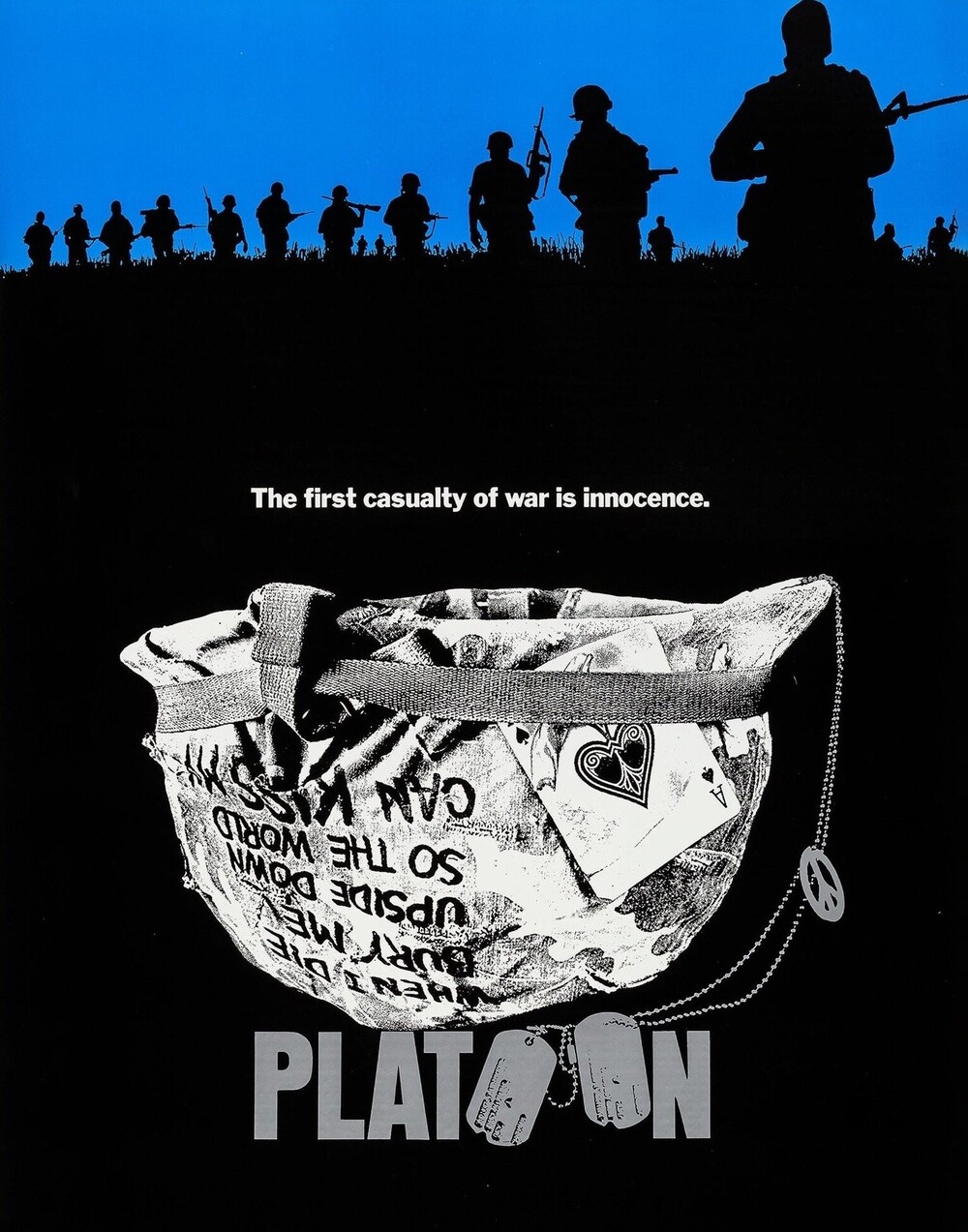
It’s funny because it’s true.  Just about every man that I know loves Platoon.  First released in 1986 and reportedly based on Oliver Stone’s own experiences as an infantryman in Vietnam, Platoon is often cited as being one of the greatest war films ever made.  Oddly enough, the film has an anti-war and anti-military message but, in my experience, those who love it talk more about the battle scenes than any message that Stone may have been trying to impart about the futility of war.  Pauline Kael once wrote that Oliver Stone had left-wing politics but a right-wing sensibility and I think you can definitely see that in Platoon.  Despite all of the characters talking about how pointless the war is and how much they resent being forced to risk their lives for no apparent purpose, the film’s energy comes from the scenes of Chris Taylor (Charlie Sheen) stalking through the jungle and, towards the end, losing his mind and giving himself completely over to the adrenaline that comes from being trapped in the middle of a battle.  Throughout the film, we hear Taylor’s rather pedantic thoughts on the military and his fellow soldiers but it’s hard not to notice that his actions and his dialogue are usually far less eloquent.  Taylor may be a rich intellectual (and wow, is Charlie Sheen ever unconvincing when it comes to portraying that part of Taylor’s personality) but when he’s in the jungle, he’s just fighting for survival.

The film’s plot centers around the conflict between two sergeants, the peace-loving Elias (Willem DaFoe) and the war-loving Barnes (Tom Berenger).  Taylor has to decide which one of the two to follow.  The pot-smoking Elias loves his men and goes out of his way to protect them.  The beer-drinking Barnes has a much harsher view of the world but, at the same time, he’s the type of scarred warrior who seems immortal.  One gets the feeling that he’ll never be defeated.  The rest of the platoon is full of familiar faces, with everyone from John C. McGinley to Francesco Quinn to Tony Todd to Forest Whitaker to Johnny Depp to a baby-faced Kevin Dillon showing up.  (Dillon is especially frightening as a psycho who has, for some reason, been nicknamed Bunny.)  The majority of the platoon is dead by the end of the film.  Even with the leadership of Elias and Barnes, the soldiers are stuck in a winless situation.  As Taylor points out, the Americans aren’t just fighting the enemy.  They’re also fighting each other.

Platoon is certainly not my favorite of the film nominated in 1986.  I would have gone with A Room With A View.  (Blue Velvet, which is as influential a film as Platoon, was not even nominated.)  That said, I can’t deny the power of Platoon‘s combat scenes.  Though Stone’s script is didactic and Taylor’s narration is awkwardly deployed throughout the film, Stone’s direction definitely captures the fear and dread of being in a strange place with no idea of whether or not you’re going to survive.  Stone is critical of the military (at one point, an officer calls an air strike on his own men) but seems to love the soldiers, even the ones who have pushed over to the dark side.

Platoon was not the first Best Picture nominee to be made about the Vietnam War.  The Deer Hunter, Coming Home, and Apocalypse Now were all released first.  But both The Deer Hunter and Apocalypse Now are surreal epics that seem to take place in a dream world.  Coming Home, which has a script that somehow manages to be even more didactic than Platoon‘s, focuses on the war back home.  Platoon is far more gritty and personal film.  Watching Platoon, you can smell the gunpowder and the napalm and feel the humidity of the jungle.  I can understand why it won, even if I prefer to watch Helena Bonham Carter and Julian Sands fall in love.

Film Review: The Caine Mutiny Court-Martial (dir by William Friedkin)


The Caine Mutiny Court-Martial is a film that I wanted to like more than I actually did.

The movie, which is based on a play by Herman Wouk (which was itself based on a novel by Wouk that was adapted into an Oscar-nominated film in 1954), takes place in a Naval courtroom.  Lt. Steven Maryk (Jake Lacey) is on trial, accused of mutiny against his commanding officer.  Maryk claims that, when the ship sailed into a storm, his commanding officer, Philip Francis Queeg (Kiefer Sutherland), was giving orderss that put the entire ship at risk.  With the support of the officers, Maryk relieved Queeg of command.  Maryk claims that he did so with the knowledge that it would lead to him being court-martialed.

Maryk is assigned Lt. Greenwald (Jason Clarke) as his defense counsel.  Greenwald is not happy with his assignment because he think that Maryk is guilty and he believes in the chain of command.  When Maryk and his fellow officers claim that Queeg was showing signs of mental instability, Greenwald wonders how they came to that conclusion.  Whereas Maryk and his fellow officers, including Keith (Tom Riley) and Keefer (Lewis Pullman), claim that Queeg was dangerously unstable, Greenwald sees an insecure commander who was abandoned by his men.  Greenwald comes to realize that keeping Maryk out of the brig will mean destroying Queeg on the stand.

As I said, I wanted to like this film more than I actually did.  The Caine Mutiny Court-Martial was the final film to be directed by William Friedkin.  Friedkin started his career by directing adaptations of plays like The Birthday Party and The Boys In The Band, so another theatrical adaptation does feel like an appropriate bookend for a legendary career.  Friedkin’s best films featured troubled and somewhat obsessive individuals, people who are almost addicted to taking risks.  That’s certainly an accurate description of several of the characters in The Caine Mutiny Court-Martial, from Queeg to Keefer to even Greenwald himself.  After Friedkin passed away in August, I found myself really hoping that The Caine Mutiny Court-Martial would be one final brilliant Friedkin film.

There’s a lot of good things to be said about The Caine Mutiny Court-Martial, including the fact that Jason Clarke is well-cast as Lt. Greenwald.  But, in the end, The Caine Mutiny Court-Martial is essentially a filmed play and, despite a camera that moves frequently, it all feels rather stagey and, at a time, a bit too theatrical.  As good as Clarke is, some other members of the cast can’t break free of the film’s staginess and their performances often feel disappointingly superficial.  This is especially true of Monica Raymund as the prosecutor and, surprisingly, Kiefer Sutherland as Queeg.  Sutherland, who, when he was younger, would have been the ideal pick for the role of Lt. Keefer, gives an overly mannered performance as Queeg, one that is all tics and nerves but with little of the vulnerability that Humphrey Bogart brought to the role in the 1954 film.

Friedkin’s The Caine Mutiny Court-Martial takes place in 2022, as opposed to the World War II setting of Wouk’s original novel.  This does lead to an interesting subtext, as Friedkin’s version of the story is set during a time when many people are no longer confident in America’s military leadership.  (Wouk’s novel and play came out while America was still feeling confident after the victory of the Allies in World War II.)  Friedkin takes a direct approach to the material, allowing the audience to decide for themselves whether Maryk did the right thing.

It’s a solid enough film but one that never quite escapes its stage origins.  Friedkin’s respect for the material comes through, even if the film isn’t totally successful.

Guilty Pleasure No. 65: Invaders From Mars (dir by Tobe Hooper)


The 1986 film, Invaders from Mars, opens with a dark and stormy night.

12 year-old David Gardner (Hunter Carson, son of actress Karen Black and filmmaker L.T. Kit Carson), who dreams of growing up to become an astronaut, witnesses something strange happening outside of his bedroom window.  He watches as a spaceship lands on a nearby hill and apparently drills itself into the ground.  The next morning, David convinces his father (Timothy Bottoms) to go out to the hill and see what he can find.  When his father returns, he says that he didn’t see anything strange at the hill.  However, he is now acting strangely, no longer showing emotion.

Soon, everyone in the small town is also acting strangely, from David’s mother (Laraine Newman) to his teacher (Louise Fletcher).  David notices that everyone has a mysterious mark on the back of their neck.  Even more alarmingly, he walks in on his teacher eating a mouse.  Investigating the hill himself, David discovers that his father was lying about nothing being there.  Instead, there’s a cavernous spaceship that is patrolled by aliens!  A creature with a giant brain has taken control of almost everyone in David’s life.  David discovers that the hill right outside of his house is now the headquarters of an intergalactic invasion.  It’s a war of the worlds and David is stuck right in the middle.

Fortunately, David does have a few allies.  The aliens have not managed to take control of everyone.  The school nurse (Karen Black) believes David and helps him explore the spaceship.  The surprisingly nice General Wilson (James Karen) is not only willing to launch a military operation on the advice of a 12 year-old but he also doesn’t have any problem allowing that 12 year-old to take de facto command of his soldiers.  Can David save his community from the Martians?

A remake of the 1953 sci-fi classic, Invaders from Mars was directed by Tobe Hooper, the Texas-born director who was best known for The Texas Chainsaw Massacre and Poltergeist.  At first, the deliberately campy Invaders from Mars might seem like an unexpected film from Hooper but actually, it has quite a bit in common with Hooper’s other credits.  Like The Texas Chainsaw Massacre, it plays out like an increasingly surreal dream, one with an emphasis on isolation.  Like Poltergeist, it’s ultimately a satire of suburban and small town conformity.  (Indeed, one could argue that Invaders From Mars is Poltergeist without the interference of Steven Spielberg.)  If the original Invaders From Mars was about the dangers of communism, the remake is about the danger of losing your childhood imagination and just becoming a mindless drone.

Invaders From Mars is often a deliberately silly film.  Sometimes, it’s definitely a bit too silly for its own good, hence the guilty in guilty pleasure.  That said, whenever I see it, I can’t help but smile at how quickly General Wilson starts taking orders from David.  (James Karen plays the role with such earnestness that General Wilson seems to be less concerned with David’s age but instead just happy that he has someone around who can tell him what he needs to do.)  But it makes sense when you consider that the film is meant to be a child’s fantasy of what would happen if there was an alien invasion.  Who wouldn’t want to be the one telling the adults how to save the planet?  For all the aliens and the mind control, this is a rather innocent film.  Featuring entertaining performances from Hunter Carson, Timothy Bottoms, Karen Black, and the great James Karen, Invaders From Mars is an entertaining daydream of interstellar conquest.

Previous Guilty Pleasures

  1. Half-Baked
  2. Save The Last Dance
  3. Every Rose Has Its Thorns
  4. The Jeremy Kyle Show
  5. Invasion USA
  6. The Golden Child
  7. Final Destination 2
  8. Paparazzi
  9. The Principal
  10. The Substitute
  11. Terror In The Family
  12. Pandorum
  13. Lambada
  14. Fear
  15. Cocktail
  16. Keep Off The Grass
  17. Girls, Girls, Girls
  18. Class
  19. Tart
  20. King Kong vs. Godzilla
  21. Hawk the Slayer
  22. Battle Beyond the Stars
  23. Meridian
  24. Walk of Shame
  25. From Justin To Kelly
  26. Project Greenlight
  27. Sex Decoy: Love Stings
  28. Swimfan
  29. On the Line
  30. Wolfen
  31. Hail Caesar!
  32. It’s So Cold In The D
  33. In the Mix
  34. Healed By Grace
  35. Valley of the Dolls
  36. The Legend of Billie Jean
  37. Death Wish
  38. Shipping Wars
  39. Ghost Whisperer
  40. Parking Wars
  41. The Dead Are After Me
  42. Harper’s Island
  43. The Resurrection of Gavin Stone
  44. Paranormal State
  45. Utopia
  46. Bar Rescue
  47. The Powers of Matthew Star
  48. Spiker
  49. Heavenly Bodies
  50. Maid in Manhattan
  51. Rage and Honor
  52. Saved By The Bell 3. 21 “No Hope With Dope”
  53. Happy Gilmore
  54. Solarbabies
  55. The Dawn of Correction
  56. Once You Understand
  57. The Voyeurs 
  58. Robot Jox
  59. Teen Wolf
  60. The Running Man
  61. Double Dragon
  62. Backtrack
  63. Julie and Jack
  64. Karate Warrior

A Movie A Day #329: The Fourth War (1990, directed by John Frankenheimer)


The year is 1989 and the Cold War is coming to an end.  Colonel Jack Knowles (Roy Scheider) was a hero in Vietnam but now, years later, his eagerness to fight has made him an outsider in the U.S. Army.  Most people would rather that Knowles simply retire but, as long as there are wars to be fought, Knowles will be there.  His only friend, General Hackworth (Harry Dean Stanton), arranges for Knowles to be assigned to an outpost on the  West German-Czechoslovakia border.  As soon as he arrives, Knowles starts to annoy his superior officer, Lt. Col. Clark (Tim Reid).  When Knowles sees a Czech refugee gunned down by the Soviets while making a run for the border, he unleashes his frustration by throwing a snowball at his Russian counterpart.  Like Knowles, Col. Valachev (Jurgen Prochnow) is a decorated veteran who feels lost without a war to fight.  Knowles and Valachev are soon fighting their own personal war, even at the risk of starting a full-scale conflict between their two nations.
The Fourth War was one of the handful of films that John Frankenheimer directed for Cannon Films.  Much as he did with The Manchurian Candidate, Frankenheimer mixes serious thrills with dark satire in The Fourth War.  Frankenheimer gets good performances from the entire cast, especially Scheider and Prochnow.  The real star of the movie is the snow-covered landscape, which Frankenheimer turns into a metaphor for the entire Cold War.  When Knowles and Valachev end up throwing punches on a frozen lake that’s breaking apart underneath their feet, it is not hard to see what Frankenheimer’s going for with this film.  Released shortly after the fall of the Berlin Wall, The Fourth War is an underrated thriller that deserves to be rediscovered.

Scenes I Love: Spy Game (R.I.P. Tony Scott)


[SPOILERS]

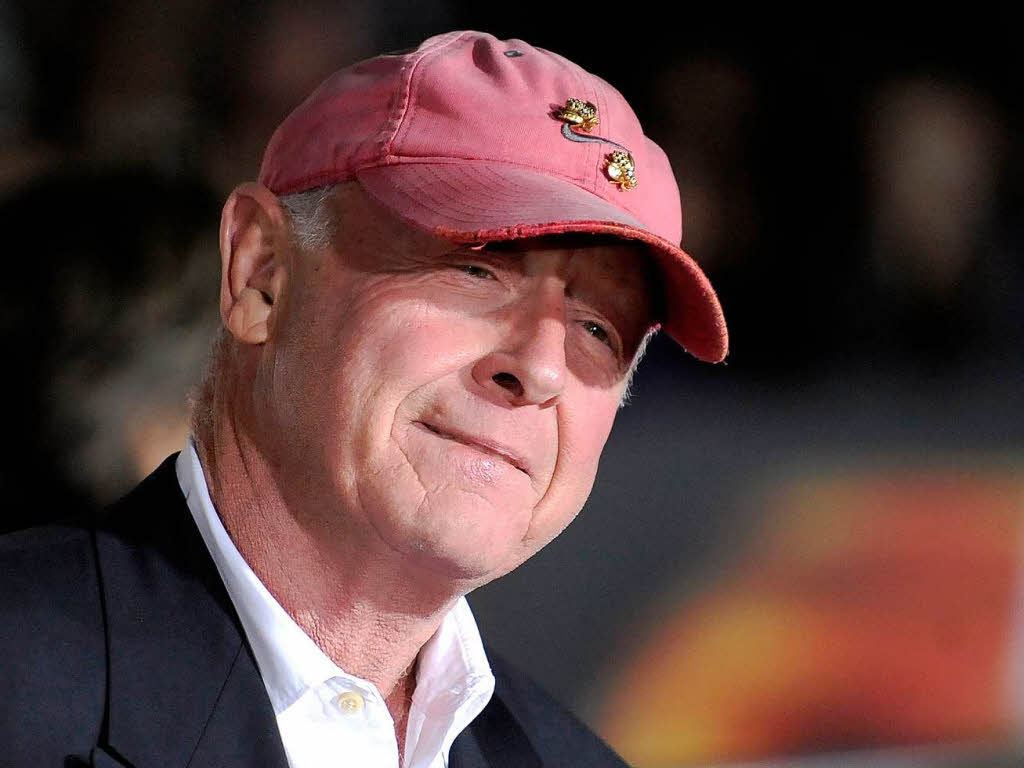
The world of cinema lost one of it’s own with the death of British filmmaker Tony Scott (brother of filmmaker Ridley Scott). The circumstances of Tony Scott’s death has now been confirmed and could be found and read easily on most on-line news site.

This post is not to focus on Tony Scott’s death but on the life he lived and how his contribution to the art of filmmaking. Tony Scott has been a major influenc on me and those who grew up during the 80’s and 90’s. His films were huge commercial successes but also unique in that he tried to advance the genre of action filmmaking beyond the bullet point steps on how to make them that other filmmakers could never get beyond.

Tony Scott experimented and innovated with the action genre these last ten or so years to mixed results, but no one could ever say that his visual style was ever boring. Just like his brother Ridley, Tony Scott was a visual director first and foremost, but he also had a way in getting the most out of the cast he was given. It didn’t matter whether they were award-winning veterans like Denzel Washington or up-and-coming stars like Keira Knightley and Chris Pine. His action films weren’t just all about the visual and auditory overload his contemporaries only focused on. Tony Scott used his actors and got from them good to great performances which raised what would’ve been your typical action film to something more.

One of my favorite scenes Tony Scott ever did was also from one of his films I consider one of his best. It’s the last main sequence for his 2001 spy thriller, Spy Game, which starred Robert Redford and Brad Pitt. It was a film that was the passing of the torch from one blue-eyed star of Hollywood’s yesteryear to the current blue-eyed star. This film could’ve been all about action and explosions and techno-spy babble, but it instead became a great exercise in how to create an action-thriller that allowed for dialogue to become the engine that moved the action.

This scene is a favorite because it was the culmination of the machinations and secret plannings of Redford’s aging spymaster, Nathan Muir, to try and save his wayward protege in Brad Pitt’s Tom Bishop. While it would be best for people to watch this scene having watched the rest of the film beforehand, even just watching Redford take control of the room is a clue to how well Tony Scott allowed his actors to work the scene instead of forcing them to do it his way. It’s no wonder that Denzel Washington, considered to be the best actor of his generation, kept working with Tony over and over for the past decade.


Falling Skies (Official Trailer)


It looks like while vampires and zombies may be battling it out as the “monster of the moment” the past couple of years there’s an oldie quietly sneaking up behind them to try and take up the general public’s attention.

The first shot was a little film from South Africa called District 9. I think more than a few people saw that little film. Then last year we had a film from two special-effects brothers called Skyline. That particular shot wasn’t as good as the previous title mentioned. In fact, it was godawful though not without it’s perverse entertainment value one gets from watching a very awful film that still manages to entertain (though probably not in the way it’s creators intended to).

In less than a couple of months a film called Battle: Los Angeles will hit the bigscreen and will hopefully be a tad better than the similar plotted Skyline. This one has another South African directing it so that may be a good thing.

Coming this June is a tv series that also follows a similar theme of “alien invasion” with the DreamWorks Television series Falling Skies from producer Steven Spielberg and screeenwriter Robert Rodat. The show will premiere on TNT and stars Noah Wylie, Moon Bloodgood, Will Patton and Dale Dye. From what brief snippets of information that has been released about it the show looks to be similar in tone to Spielberg’s own War of the Worlds where it’s about the human armed resistance trying to retake their cities and the planet back from the alien invaders.

It definitely seems to be a very ambitious show and one that hopefully has a much leaner and efficient take on the alien invasion story than the current remake of V: The Series on ABC. That one had many hoping for a sci-fi to make a great return to network tv and instead we got aliens meets True Blood.

Here’s to hoping Falling Skies doesn’t have aliens wanting to have sex with humans and instead aliens just wanting to kill and/or eat humans instead. I think that would make for a much better show.