Spielberg delves into Sci-Fi again with the Disclosure Day Teaser


Spielberg. Williams. Koepp. Kaminski. What the heck is Disclosure Day?

The teaser trailer for Steven Spielberg’s Disclosure Day hit my phone via Letterbox’d. This is connected to those weird X-Files looking posters I’ve been seeing as of late. It looks like another film with aliens, similar to Close Encounters of the Third Kind with a dash of Zemekis’ Contact or sprinkle of Villeneuve’s Arrival. The film stars Josh O’Connor (Wake Up Dead Man: A Knives Out Mystery), Emily Blunt (Jungle Cruise), Colin Firth (Kingsman), Coleman Domingo (The Running Man), Wyatt Russell (Marvel’s Thunderbolts), and Eve Newson (Robin Hood).

Spielberg and Koepp have a good track record together with the Jurassic Park films, and it’a always good to see a pairing with John Williams. Still, this all looks really weird. Either way, we’ll find out when the film is released next June.

Enjoy!

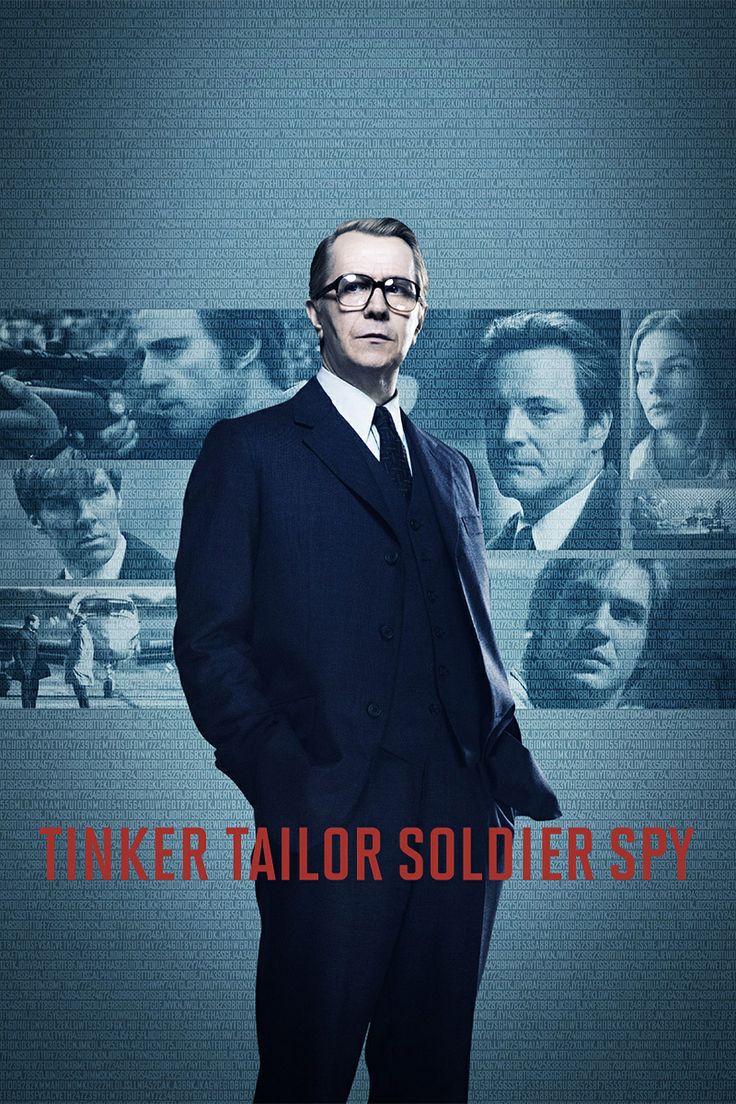
Review: Tinker Tailor Soldier Spy (dir. by Tomas Alfredson)


“We are not so very different, you and I.” — George Smiley

Tomas Alfredson’s Tinker Tailor Soldier Spy (2011) is a cold, coiled, and relentless march into the gray, rain-lashed corridors of British espionage—a film that exchanges Bond’s swagger for bureaucratic unease, where information is traded like poison and every conversation feels weaponized. The film is sheer confidence: so sure of itself, it expects you to keep up, get lost, and piece the puzzle together from the hushed fragments left in close-up reactions and glances across smoke-filled rooms. This is spy cinema not as spectacle, but as slow-burning existential puzzle.

A key element of the film’s mood is its distinctive brutalist aesthetic, which powerfully evokes the Cold War mentality not only behind the Iron Curtain but also in the West. Alfredson and cinematographer Hoyte van Hoytema immerse viewers in a London setting defined by greying, tired walls, bleak drizzle, and decaying interiors that feel as cold and institutional as the very espionage world they depict. This use of brutalism—with its bare concrete textures, utilitarian spaces, and sense of institutional decay—does more than create atmosphere; it visually projects the emotional and material exhaustion of a Britain entrenched in paranoia and internal rot. The characters seem physically and emotionally hemmed in by these spaces, reinforcing the film’s themes of secrecy, alienation, and moral corrosion.

There are no car chases or shootouts to speak of—just a masterclass in stillness where tension arises from precisely what remains unspoken. The film is closer to an autopsy than a thriller, dissecting the social and emotional costs of lives devoted to deception. It begins with a botched operation in Budapest—Jim Prideaux (Mark Strong), one of “the Circus’s” best agents, is captured in a tense, almost wordless scene that sets a tone of brooding unease. The fallout leads to a purge of the leadership, with Control (John Hurt) forced out and George Smiley (Gary Oldman), his quietly watchful confidant, retired—though soon to return for an unofficial mole hunt.

From there, the narrative unfolds elliptically, like a mosaic of recollections and betrayals, requiring viewers to assemble the truth from fractured glimpses. Gary Oldman’s Smiley is the film’s anchor—his performance a masterclass in minimalism and subtext. He’s the ultimate observer, haunted by decades of institutional compromises and personal betrayals.

The supporting cast is nothing short of exceptional, elevating the film through richly textured performances that bring vibrant life to an otherwise reserved script. Colin Firth as Bill Haydon delivers a quietly magnetic portrayal, his charm barely concealing the complexity beneath. Tom Hardy’s Ricki Tarr injects raw energy and restlessness, perfectly contrasting the film’s restrained atmosphere. Benedict Cumberbatch’s Peter Guillam is adept at conveying subtle shifts in allegiance and tension, his nuanced portrayal deepening the intrigue. John Hurt’s brief but potent presence as Control exudes weary gravitas, setting the tone for the murky world of espionage. Mark Strong as Jim Prideaux balances stoicism with vulnerable humanity, particularly in moments laden with pain and regret. Other supporting actors such as Ciarán Hinds, Toby Jones, and Kathy Burke contribute layered, compelling portrayals of individuals trapped within the machinery of the Circus. What binds these performances is a reliance on subtlety—expressing volumes through nuanced gestures and lingering silences, the cast anchors the complex narrative in a palpable human reality.

At its core, Tinker Tailor Soldier Spy is less a whodunnit than an exploration of institutional decay and emotional repression. The brutalist aesthetic mirrors this decline: just as the concrete and ochre walls close in on the agents, so too does the film reveal a Britain worn down by secrets and internal contradiction. Love and loyalty are liabilities in this world where everyone is alienated. The story’s emotional heart revolves around the search for a deeply embedded mole within the Circus—an elusive betrayal that shakes the organization to its core. The film carefully avoids easy reveals, maintaining a deliberate tension and exemplifying the emotional cost that the espionage game of the era had on everyone involved.

The film also explores themes of repressed queerness, class stratification, and misogyny, linking these to the numbing demands of espionage. The gloomy visuals and tightly controlled dialogue echo the emotional constraints on these men, underscoring that beneath the seemingly impenetrable exterior lies a fragile, fragile human cost.

This film is not an easy watch. Its elliptical storytelling, coded conversations, and subtle body language demand patience and multiple viewings. Yet that opacity is part of its power—uncertainty and not-knowing become central to the experience, enhanced by Alberto Iglesias’s restrained score and the claustrophobic mise-en-scène. Unlike many spy films, Tinker Tailor Soldier Spy is about process and detection, not action or glamour. Its cold, meticulous pacing trades on the cerebral seduction of uncovering hidden truths rather than adrenaline-fueled confrontations.

Ultimately, the film refuses easy resolutions. Though Smiley uncovers the mole and the Circus is superficially restored, there’s no real victory—only the acknowledgment of profound damage, both personal and institutional. The brutalist setting, with its unyielding, somber lines, stands as a perfect metaphor for this unresolved tension. Tinker Tailor Soldier Spy is a masterclass in unease and ambiguity, a film that stays with you because it reveals what you’ll never fully know about loyalty, betrayal, and the cost of secrets in a world where the line between friend and enemy is always blurred.

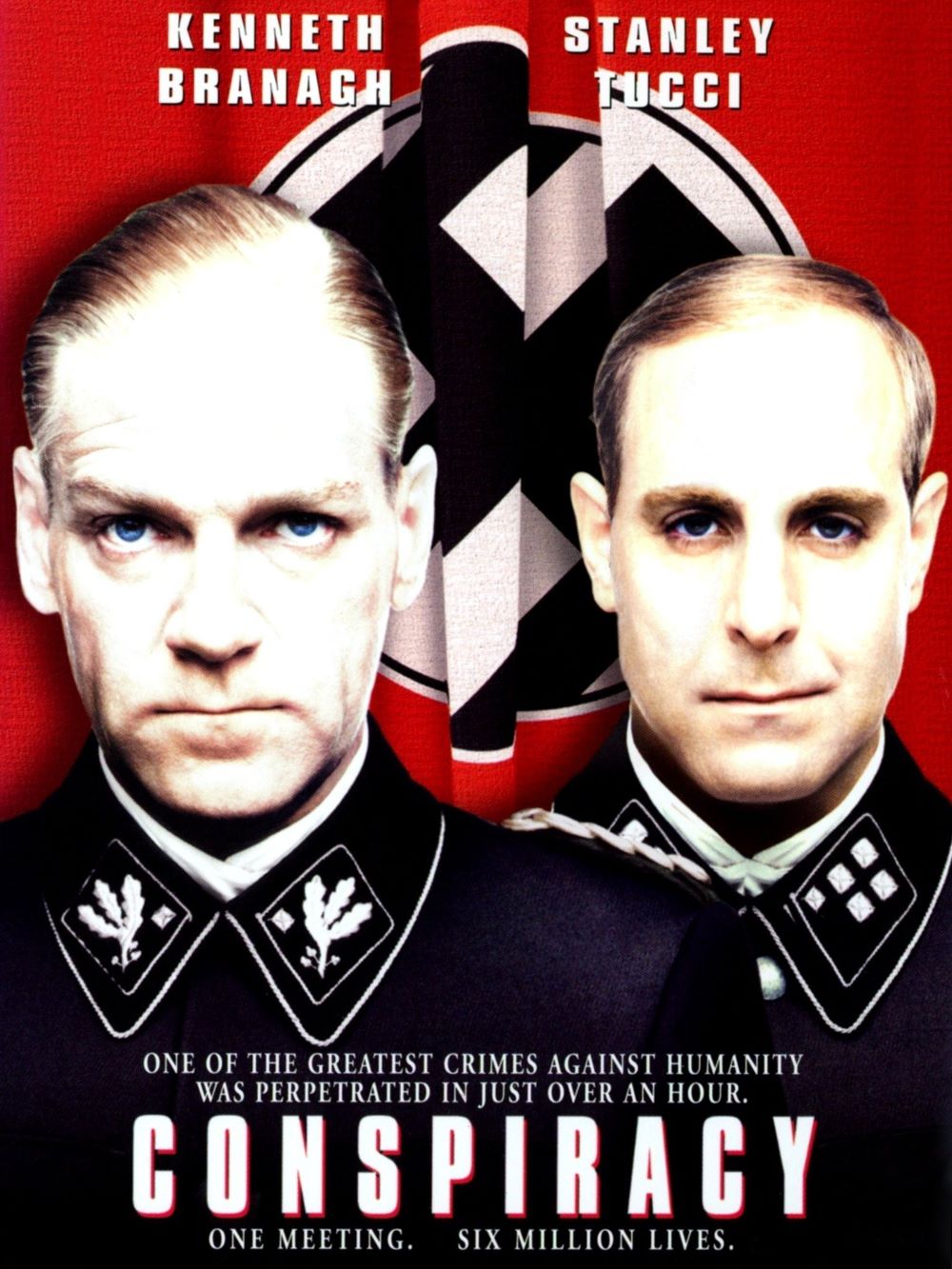
Review: Conspiracy (dir. by Frank Pierson)


“We will not sterilize every Jew and wait for them to die. We will not sterilize every Jew and then exterminate the race. That’s farcical.” — Reinhardt Heydrich

HBO’s Conspiracy (2001) masterfully dramatizes the infamous Wannsee Conference, held on January 20, 1942, where high-ranking Nazi officials orchestrated the Final Solution. The film’s running time mirrors the historical meeting itself, distilling one of the darkest moments in history into a single, chilling sitting that balances historical fidelity, psychological insight, and dramatic restraint. The premise is stark and deceptively simple: a group of men, most of whom had never previously met, gather in a sun-drenched villa outside Berlin to discuss systematic mass murder while enjoying fine food and polite conversation. This contrasting setting, rendered with careful attention to period detail, powerfully underscores what Hannah Arendt called the “banality of evil.” In Conspiracy, evil is not the property of villainous caricatures, but of functionaries and technocrats—chillingly rational and disturbingly mundane.

Much of the film unfolds in real time, utilizing dialogue taken from the sole surviving minutes of the Wannsee Conference. Screenwriter Loring Mandel and director Frank Pierson avoid unnecessary embellishments, allowing the facts and the conversations themselves to carry the full, horrifying weight. Kenneth Branagh gives an Emmy-winning performance as Reinhard Heydrich, the orchestrator and presiding presence at the conference. Branagh’s portrayal is both urbane and authoritative, presenting Heydrich as a figure whose affable composure thinly veils his unwavering commitment to genocide. There is no soaring rhetoric or overt menace; Heydrich’s evil is presented with administrative casualness, making it all the more chilling.

Stanley Tucci is equally compelling as Adolf Eichmann, Heydrich’s logistical right hand and the architect of the machinery of death. Tucci infuses Eichmann with a quiet efficiency and bureaucratic pride—a portrait of a man more attached to process than morality, disturbingly bland in his demeanor. The supporting cast is no less impressive. Colin Firth, as Dr. Wilhelm Stuckart, portrays a legal architect of Nazi race law who appears increasingly unsettled as the agenda shifts from disenfranchisement to extermination. Each attendee is rendered with psychological nuance. Some are disturbingly enthusiastic about their roles, while others are quietly apprehensive, yet ultimately complicit. These subtle gradations of doubt, ambition, and opportunism animate the film’s psychological landscape.

The dialogue, rooted in the actual transcript and skillful dramatic writing, eschews melodrama. The horror emerges not through spectacle, but in analytic exchanges about logistics, quotas, and definitions—the cold calculus of genocide. The men’s debates around how to classify mixed-race Jews, whether sterilization is preferable to extermination, and who should be spared create a bureaucratic puzzle as vile as its intent. Their discussions are delivered in a neutral, even mundane tone, which heightens the chilling reality of what they are planning. Pierson’s direction is restrained; the film never leaves its confined setting, emphasizing the claustrophobic mood of collective complicity. The camera lingers on faces rather than violence, building tension through small gestures—a glance, a pause, the clinking of glassware. The impact of what is said is matched only by the weight of what goes unsaid, until Heydrich, in a quietly devastating moment, makes the true purpose explicit.

More than a simple history lesson, Conspiracy meditates on themes of collective guilt, moral responsibility, and the terrifying ease with which ordinary people become accessories to atrocity. The film is haunted by bureaucracy; if everyone is “just following orders” or “simply doing their job,” the boundaries of blame blur and diffuse. The characters’ debates skillfully skirt the language of murder, favoring euphemisms such as “evacuation” or “resettlement.” This allows viewers to witness, in real time, the kind of moral erosion that enables atrocity on a massive scale. The dry, matter-of-fact tone of the film deepens its emotional impact, forcing the audience to comprehend that such horrors were conjured not in a frenzy, but in calm administrative exchanges over lunch.

For both historians and general audiences, Conspiracy earns praise for its meticulous adherence to historical detail. The screenplay closely follows the Wannsee minutes, and the film’s design choices—muted score, period-accurate costumes, and careful pacing—all serve to render bureaucratic evil as mundane and unremarkable. This unwavering restraint, however, does impose certain limits. The film’s dramatic arc is inherently subdued; the absence of conventional action or narrative tension makes it unfold like an extended negotiation rather than a traditional drama. Some viewers may find this lack of overt conflict stifling or static, resulting in a work that feels more “important” than “entertaining,” but this is clearly by design.

Conspiracy received widespread acclaim for both its historical gravity and psychological depth. Branagh and Tucci, in particular, were celebrated for their nuanced performances. The film is often cited as a model example of how the “banality of evil” operates—not through monsters, but through functionaries in tailored uniforms, sipping wine and rationalizing extermination. For those unfamiliar with the events, the manner in which these men discuss matters of life and death with casual detachment is shocking. As one critic noted, “Most people believe they know what evil looks like… But in Conspiracy, men of true evil met in pristine, gorgeous surroundings… and go about their business leisurely… with a smile and barely a hint of remorse.”

Within the canon of Holocaust cinema, Conspiracy stands apart from films like Schindler’s List or The Pianist, which focus on the suffering and survival of victims. Instead, it occupies a space similar to Downfall and the earlier Die Wannseekonferenz, dramatizing not the machinery of genocide but the mindsets of its architects. By confining itself to dialogue and implication, the film compels viewers to reflect on how civilization’s facades both enable and obscure horror.

The film’s lingering effect is not found in dramatic catharsis or tears, but in an enduring sense of discomfort. Conspiracy dramatizes not just a choice among evil options, but the ease with which those choices become rote procedure and social negotiation. The silence in the final act, as the men calmly disperse after codifying genocide, lands with a cold, almost procedural finality. The closing captions, briefly summarizing the fates of those present, deliver a sobering message: accountability was sporadic, often delayed, and never guaranteed.

Conspiracy is not casual entertainment, nor is it meant to be. Instead, it is essential viewing for anyone interested in the psychology of atrocity, the peril of bureaucratic amorality, and the enduring question of how ordinary people become complicit in extraordinary evil. With a screenplay of surgical precision, outstanding ensemble cast (especially Branagh and Tucci), and a director committed to understatement, HBO’s film demonstrates how history’s darkest decisions are forged not in chaos, but in chilling consensus. To those seeking to understand not only what happened at Wannsee, but how, Conspiracy offers an unblinking and quietly devastating answer.

Film Review: Circle of Friends (dir by Pat O’Connor)


1995’s Circle of Friends tells the story of three friends who come of age in 1950s Ireland.

Bernadette Hogan (Minnie Driver), better known as Benny, is our narrator, the daughter of a local tailor whose shyness and insecurity disguises a quick mind and a sarcastic wit.  After years of jokes about her weight (which feel particularly cruel since Benny doesn’t appear to be particularly overweight), Benny has resigned herself to being alone.  Her parents may want her to marry their accountant, Sean Walsh (Alan Cumming), but Sean is obviously a creep.  He’s one of those guys who drinks his tea with his pinky extended.  Everyone knows better than to trust him.

Eve (Geraldine O’Rawe) is an orphan and was largely raised in a convent.  Now that she’s 18, the Westawards — the protestant heretics who once employed her father — are grudgingly keeping their promise and paying for her education.  She gets 60 pounds per term.  (I know my uncle, who paid my college tuition, would have loved it if my college tuition had been whatever the American equivalent of 60 pounds may be.)  Eve has inherited a cottage, a nice and isolated little building that becomes quite important later on in the film.

And finally, there’s Nan (Saffron Burrows).  Nan grew up with Bernadette and Eve, though her family eventually moved to Dublin.  Benny says that Nan is destined to be known for being pretty.

Nan is reunited with Benny and Eve when they all enroll at University College Dublin.  The film follows their friendship at the college, examining how they grow and change over the course of the term.  Benny develops a crush on and eventually starts dating Jack Foley (Chris O’Donnell), a medical student who enjoys playing rugby.  (I’ve never quite understood rugby, to be honest.  It seems weird to me that everyone always starts all huddled up and then apparently, they all try to grab a muddy ball until someone ends up with a compound fracture.  I’m not sure why someone would want to risk losing a limb over a game.)  Eve dates Jack’s friend, Aidan (played by a young Aiden Gillen).  And Nan …. at first glance, Nan would seem to be living every film lover’s dream!  Not does she lose her virginity to a character played by Colin Firth (in this case, Firth is playing Simon Westward) but they also regularly have sex in Eve’s lovely little cabin.  Of course, they don’t bother to let Eve know what they’re doing.  That’s part of the forbidden appeal of it all!  Unfortunately, despite being played by Colin Firth, Simon turns out to be a bit of cad.

Indeed, all of the men turn out to be a bit of a disappointment, though some do manage to redeem themselves.  The film is less about Benny finding love and more about Benny discovering that it’s even more important to love and respect herself.  As so often happens when it comes to lifelong friends, there are some struggles.  Not all of the friendships survive.  Unfortunately, that’s just a part of growing up.  Still, Benny, Eve, and Nan are all wonderfully written and acted characters and the film does a great job of portraying their difficult but very true-to-life relationship.

Circle of Friends is a lovely film and a personal favorite of mine.  Unfortunately, it’s not always an easy film to watch.  It’s not streaming on any of the usual services.   However, the film has been uploaded to YouTube so be sure to watch it while you can.

Film Review: Conspiracy (dir by Frank Pierson)


The 2001 film, Conspiracy, takes place at a villa on the outskirts of Berlin.  It’s a lovely villa and, as we can see during the film’s opening moments, it’s about to play host to a meeting of very important people.

The date is January 20th and the year is 1942.  Having conquered much of Europe, Nazi Germany is now at war with the Allies.  Reinhard Heydrich (Kenneth Branagh), the young chief of the Reich Security Main Office and the man who many feel will eventually succeed Adolf Hitler as the leader of the Third Reich, has been directed to call a conference so that he and his deputy, Adolf Eichmann (Stanley Tucci), can “discuss” ways to solve “the Jewish question.”  One-by-one, representatives of the Reich’s bureaucracy show up at the villa.

At the start of the meeting, the men discuss various ways to force the Jews out of Germany and all of the occupied territories.  The men chose their words carefully, speaking in euphemisms and doing their best to sound like concerned government officials.  The men know what they’re talking about but they still seem to feel the need to avoid coming right and saying it.  As they talk, it becomes clear that everyone is trying to stay in Heydrich’s good graces while, at the same time, avoiding the fact that they understand the truth about what Germany is doing.  It’s not until halfway through the meeting that Heydrich and Eichmann reveal that Germany’s policy has already been determined and that concentration camps with gas chambers have already been designed and built.  The meeting is less about discussing the policy and more about getting each man at the meeting to sign off on it.  The unspoken subtext is that each man is being tested to determine who will support (and, if need be, help to cover up) the Final Solution and who will have to be otherwise dealt with.

Based on the actual minutes of the meeting, Conspiracy is film that is perhaps even more important now than when it was first released.  It’s a film that explores not only the banality of evil but also seeks to answer the question of why no one in Hitler’s government forcefully objected to the Final Solution.  (Many, of course, claimed not to know what was going on.  This film reveals just how little credibility that claim had.)  Some of the men go along because they understand not going along would mean the end of their careers and maybe their lives.  Some of the men agree because, as members of the military, they believe in supporting their country’s leadership, regardless of what that leadership represents.  Some of the men agree because they want to stay in Heydrich’s good graces.  These men represent a society where anti-Semitism is so normalized that it is accepted as a given and, while some of the men are not as outspoken in their prejudice as the others, it’s clear that all of them view the Jewish people as being a unique problem.  Those who do raise concerns do so only out of worry of what will happen to them if the rest of the world discovers what Germany is planning.  Heydrich insists that there is no need to worry because Germany will win the war.  Some of the men at the Conference are clearly not convinced of Germany’s pre-destined victory but not a single one has either the morality or the courage to refuse to endorse the Final Solution.  The film ends with a series of title cards, letting us know what became of the men who attended the Wannsee Conference.  Heydrich was assassinated during the war.  Eichmann fled to South America and hid there until he was captured by Israel in 1960.  Many of the men were executed for war crimes but a surprising number of them were either acquitted or never put on trial and went to live peacefully after the war.

Well-directed by Frank Pierson, Conspiracy has a distinguished cast who brings the historical characters to terrible life.  It’s one thing to read about what was said and planned at the Conference.  It’s another thing to actually hear those words spoken aloud and it’s a reminder that the evil of the Holocaust was not an accident nor was it something that took its perpetrators by surprise.  It was something that meticulously planned by human beings who were fully aware of what they were doing.  Kenneth Branagh makes for an arrogant and intimidating Heydrich while Stanley Tucci plays Eichmann as being the type of bureaucratic robot who is incapable of seeing human beings as anything more than just dwindling numbers on a report.  Colin Firth and David Threlfall make strong impressions as two of the more weary members of the Conference, as does Ian McNeice in the role of the type of crude, career-driven government functionary who has survived by pretending to be dumb.

At a time when anti-Semitism is on the upswing and Holocaust denialism is being mainstreamed, Conspiracy is an important film.  When others say that the Holocaust didn’t happen or that it doesn’t matter, Conspiracy defiantly says, “Yes, it did and yes, it does.”

Scenes That I Love: George Smiley Confronts Bill Haydon In Tinker, Tailor, Soldier, Spy


Today is Gary Oldman’s 65th birthday and, in honor of the occasion, here’s a scene from one of my favorite Oldman films, 2011’s Tinker Tailor Soldier Spy.

In this scene, British intelligence officer George Smiley (Gary Oldman) confronts his colleague and Russian mole Bill Haydon (Colin Firth).  This scene is a masterclass of good acting, put on by both Firth and Oldman.  As Haydon tries to justify his behavior, Smiley listens with deceptive calmness.  When I first saw this film, Oldman suddenly raising his voice made the entire audience jump.

2022 In Review: Lisa Marie’s Top 30 Films of 2022


Without further ado, here are my top 30 films of 2022!

(Why 30?  Because Lisa doesn’t do odd numbers!  Also, be sure to check out my picks for 2010201120122013201420152016201720182019, 2020, and 2021!  Wow, I’ve been doing this for a while!)

30. Marcel The Shell With Shoes On (dir by Dean Fleischer Camp)

An animated film with heart, Marcel The Shell With Shoes On would probably be ranked higher if Marcel’s favorite news show had been something other than 60 Minutes.  Still, questionable viewing habits aside, Marcel and Nana Connie and all the other shells were amazing characters and the end of the movie brought tears to my mismatched eyes.  With this film and I Want You Back, Jenny Slate had quite a year.

29. Ted K (dir by Tony Stone)

Released in February of this year, this film about Ted Kaczyski and his descent into madness was unfairly overlooked. Sharlto Copley was perfectly cast as Ted K.  This is a film that probably won’t make Ted’s supporters happy but, at the same time, it also avoids painting him as just being a straight-out madman.  It’s refusal to simplify makes the film far more than just another true crime biopic.
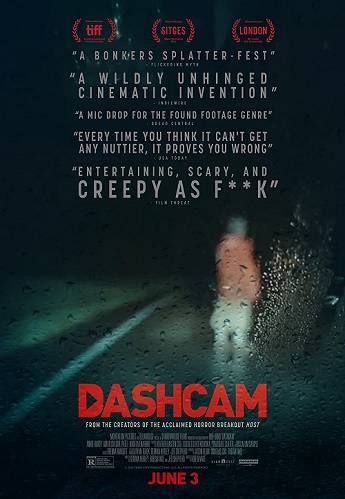
28. Dashcam (dir by Rob Savage)

Starring Annie Hardy as herself, this low-budget horror film is a scathing satire of life during the age of COVID and performative “wokeness.”  After the past few years, there’s something rather cathartic about Hardy’s refusal to obey.

27. The Batman (dir by Matt Reeves)

At this point, I’m fairly cynical about comic book movies in general and Batman films in specific.  I mean, how many Batmen have we had over the past ten years?  (Actually, I think only four but it feels like a lot more!)  That said, I enjoyed The Batman, for both its noirish atmosphere and it’s willingness to embrace the melodrama.  You have to love the fact that the villain was basically a nerdy podcaster.

26. Operation Mincemeat (dir by John Madden)

Based on a true story, this film was a throwback to the earnest World War II films of the past.  Colin Firth, Kelly MacDonald, Matthew McFayden, and Johnny Flynn were all well-cast and did their part to bring this moment of WWII history to life.
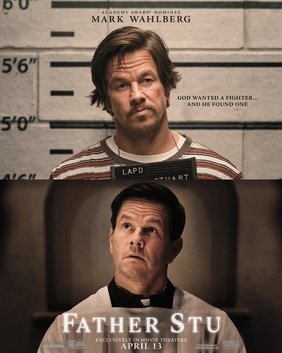
25. Father Stu (dir by Rosalind Ross)

You don’t have to be from a Catholic background to appreciate Father Stu but it probably helps.  This was one of those roles that only Mark Wahlberg could have pulled off.

24. See How They Run (dir by Tom George)

This stylized murder mystery was terrifically entertaining and witty.  Sam Rockwell and Saoirse Ronan are both treasures.

23. I Want You Back (dir by Jason Orley)

Two friends conspire to win back their respective romantic partners and end up falling in love with each other instead.  This was an enjoyable comedy, one that was blessed with an outstanding cast that included Jenny Slate, Charlie Day, Scott Eastwood, and Gina Rodriguez.  The scene in which Jenny Slate sings Suddenly Seymour is a classic.

22. Ambulance (dir by Michael Bay)

This was the film that Michael Bay was born to direct.  For once, Bay’s hyperkinetic style was perfectly matched by the story being told.  It also helped that the ambulance was a real ambulance and not a robot pretending to be an ambulance.

21.Send Me (dir by Nick Palmisciano)

This is a heart-breaking documentary about the efforts of 12 veterans to evacuate as many allies as they could during the disastrous withdraw from Afghanistan.  This film deserved more attention than it got.

20. The Bombardment (dir by Ole Bornedal)

Based on a true story, this Danish film deals with the accidental bombing of a school during World War II.  It’s been overshadowed a bit by All Quiet On The Western Front but, in its quieter way, The Bombardment is also a strong look at the horrors of war.

19. Goodnight Oppy (dir by Ryan White)

This is a poignant documentary about Opportunity, the NASA exploration rover that spent 15 years exploring Mars.  This movie proves that a robot can make you cry.
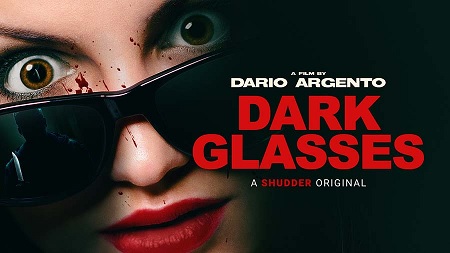
18. Dark Glasses (dir by Dario Argento)

Don’t listen to the critics.  This enjoyably over-the-top giallo was an entertaining return-to-form for Dario Argento.

17. Wildcat (dir by Melissa Lesh and Trevor Fost)

This poignant documentary follows a depressed veteran as he finds purpose helping to raise a baby ocelot in Peru.  Be prepared to cry.

16. Apollo 10 1/2 (dir by Richard Linklater)

Richard Linklater’s animated film was well-received by critics but it’s still hard not to feel that it’s been a bit overlooked.  Narrated by Jack Black, the film details the 1969 moon landing from the perspective of a child with a very active imagination.  Nostalgic, sweet-natured, and ultimately rather moving, Apollo 10 1/2 is a film that celebrates life.

15. Three Minutes: A Lengthening (dir by Bianca Stigner)

This haunting and moving documentary, which is narrated by Helena Bonham Cater, examines a three-minute snippet of 16mm film that was shot in a Jewish town in Poland in 1938, shortly before the Nazis invaded.  By examining every aspect of those three minutes, this documentary becomes both a memorial for the inhabitants of that town and a much-needed reminder of the horrors and reality of the Holocaust.  With anti-Semitism and Holocaust denial on the rise, this is an important documentary.

14. The Northman (dir by Robert Eggers)

The Northman is occasionally thrilling and occasionally ludicrous but it’s always watchable.  Robert Eggers finds moments of humor and odd beauty in this Viking epic.  Nicole Kidman embraces the melodrama and goes all out.  I just hope Valhalla was actually worth all the trouble.

13. Puss In Boots: The Last Wish (dir by Joel Crawford)

Yeah, you knew this film was going to show up on my list.  To be honest, the film could have been about just about anything.  I’d watch Puss In Boots read the phone book as long as Antonio Banderas returned to do his voice.  The fact that the film itself was cute and even touching was an added bonus.

12. Guillermo del Toro’s Pinocchio (dir by Guillermo del Toro and Mark Gustafson)

Yes, a puppet can make you cry.

11. Babylon (dir by Damien Chazelle)

Was it flawed?  You bet.  Did it run a little bit too long?  Yes, it did.  Could I have done without the scene with the elephant?  You better believe it.  That said, this film was so gloriously excessive and over-the-top that it was easy for me to forgive its flaws.  The critics may not have liked it but Babylon is a film that will be rediscovered.

10. The Fabelmans (dir by Steven Spielberg)

I went back and forth over whether to put The Fabelmans or Babylon in the number ten spot.  In a way, they’re kind of similar in that they have their flaws but they’re both saved by their director’s obvious love of cinema.  In the end, David Lynch’s role as John Ford moved The Fabelmans into the 10th spot.

9. Everything Everywhere All At Once (dir by the Daniels)

To be honest, I think some people are going a little bit overboard in their praise for this film.  Yes, it’s one of the year’s best but 2022 wasn’t that strong of a year and Everything is one of those probable Best Picture winners that, like Nomadland and CODA, will probably not be quite as celebrated after it actually wins.  That said, Michelle Yeoh and especially Ke Huy Quan deserve all the praise that they’ve received and I appreciated that the film featured the destruction of an IRS office.  It’s not as perfect as some say but, due largely to the cast, it still deserves to be in my top ten.

8. Nitram (dir by Justin Kurzel)

This is another unfairly overlooked film, this time from Australia.  Caleb Landry Jones gives a powerful and disturbing performance as a troubled young man named Nitram who commits an act of shocking violence.  Anthony LaPaglia and Judy Davis play Nitram’s parents, who are both troubled in their own individual ways.  Essie Davis plays the older woman who falls in love with Nitram, despite the fact that Nitram is incapable of loving anyone.

7. Emily the Criminal (dir by John Patton Ford)

Aubrey Plaza plays Emily, who discovers that not only does crime pay but, in the gig economy, it’s one of those few ways to get ahead.  Part thriller and part satire, Emily the Criminal reminds us that Plaza is one of the most interesting actresses working today.

6. All Quiet On The Western Front (dir by Edward Berger)

This German anti-war epic stays true to the themes of its source material while updating the plot for the modern era.  The contrast between the generals and the diplomats planning battles and the soldiers dying in them is a powerful one.

5. Elvis (dir by Baz Luhrmann)

This wonderfully excessive biopic features good music, a great performance from Austin Butler, and a wonderfully eccentric one from Tom Hanks.  Luhrmann is hardly a subtle director but Butler’s performance keeps the film from spiraling out of control.

4. Vengeance (dir by B.J. Novak)

This whip-smart satire of both true crime podcasts and the red state/blue state divide deserved far more attention than it received.  Ashton Kutcher has actually become a surprisingly dependable character actor.  Director and screenwriter Novak tells the story with sensitivity and a sharp eye for the absurd.
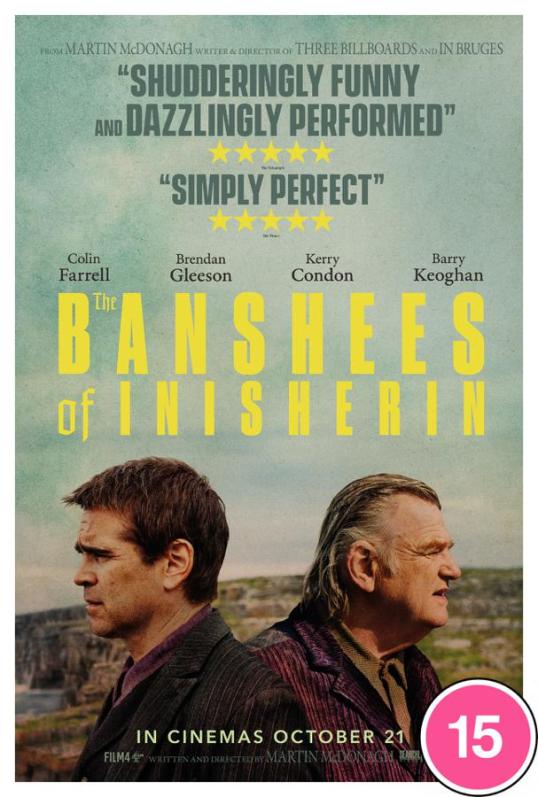
3. The Banshees of Inisherin (dir by Martin McDonagh)

In his best film yet, Martin McDonagh examines friendship, art, violence, and anger in Ireland.  Brendan Gleeson no longer wants to be Colin Farrell’s friend.  Farrell’s attempts to discover why leads to all sorts of surprising and macabre developments.  Gleeson and Farrell have never been better.  Kerry Condon and Barry Keoghan offer up poignant support.

2. Tar (dir by Todd Field)

Lydia Tar is a brilliant artist.  Does it matter that she also might be a terrible human being?  Todd Field’s return to filmmaking meditates on the meaning of art, morality, and the consequences of hubris.  Cate Blanchett is perfectly cast.  The scene where Tar talks to a student who objects to playing music by a white male is a real litmus test.  Do you think Tar is a bully or do you think the student is being too sensitive?  For all the talk about how Lydia dismisses the student’s claims, many also fail to note that the student is the one who calls her a “bitch” and runs out of the room.  Much as in Field’s previous film, no one is as perfect or as justified or as blameless as they may believe.

And, finally, my top film of 2022 is….

  1. Top Gun: Maverick (dir by Joseph Kosinski)

After 2 years of lockdowns and pessimism, Top Gun: Maverick was finally released and it reminded audiences of what they loved about movies in the first place.  Top Gun: Maverick was the movie that we needed in 2022.

Well, that concludes my late look back at 2022!  Now, let’s focus on 2023!

Lisa Marie’s 2022 In Review:

  1. 16 Worst Movies
  2. 10 Favorite Songs
  3. 10 Top Non-Fiction Books
  4. Lisa Marie’s Favorite Novels
  5. The Best of Lifetime
  6. 10 Good Things I Saw On Television

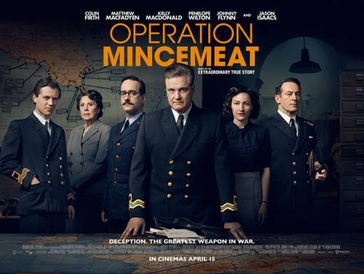
Film Review: Operation Mincemeat (dir by John Madden)


Based on a true story, Operation Mincemeat takes place in 1943, during the second World War.  The British are planning an invasion of Sicily, both to break Hitler’s hold on Europe and to also knock Italy out of the war.  The problem is that the attack on Sicily makes so much strategic sense that the Germans have spent months preparing for it and, even if successful, the invasion will cost an untold number of British lives.  Somehow, British intelligence must trick the Germans into thinking that the British are planning to invade Greece instead.

With the help of Lt. Commander Ian Fleming (Johnny Flynn), Ewen Montagu (Colin Firth) and Charles Cholmondeley (Matthew McFayden) come up with the plan to fool the Germans.  A dead body will be disguised as a British officer.  The body will be transported, via submarine, to Spain, which was technically neutral during the war.  The body will wash up on shore and, when the body is examined, a note detailing Britain’s invasion of Greece will be discovered and passed along to the Germans.  Because the Germans have been fooled by a similar trick in the past, Montagu and Cholmondeley create a fake backstory for “Maj. William Martin” and soon start to think of him as being a someone who truly did live.  Joining them to create a life for Major Martin is Jean Leslie (Kelly MacDonald), a secretary in the office who volunteers a photo of herself to be placed in Martin’s wallet.

Of course, things get complicated.  While plotting out the operation, Jean starts to fall in love with Montagu, whose marriage is currently strained by Montagu’s obsession with his work.  (Because he knows what will happen to a Jewish family in the UK if Germany invades, Montagu has sent his wife and his children to the U.S.)  Cholomondeley is in love with Jean and soon finds himself growing jealous of the man that he’s been assigned to work with.  Meanwhile, the head of British Intelligence (Jason Isaacs) wants to investigate Montagu’s brother for being a communist.  As for Ian Fleming, he keeps himself busy by writing a book.  In fact, so many members of British Intelligence are identified as being aspiring novelists that it becomes a bit of a running joke.

I have always appreciated a good World War II film and I enjoyed Operation Mincemeat.  It’s a bit of an old-fashioned film, of course.  The F-word is used exactly once (which makes this a rarity amongst modern British films) and there’s one scene in which a member of British intelligence discreetly gives an informant a handjob in return for information.  Otherwise, this is pretty much a film that you could safely show your grandma without having to worry about her getting depressed over how much movies have changed since her day.  Old-fashioned or not, it’s a well-made film, full of good performances and sharp dialogue.  It’s not a flashy film but it’s very nicely put together and it’s hard not to admire the craftsmanship responsible for it.  Operation Mincemeat is all the more interesting for being, more or less, true.  While the love triangle was invented for the film, it is true that Ian Fleming was a part of Operation Mincemeat and the film’s use of him as a character works surprisingly well.  The scene where a young Fleming tours the World War II version of Q Branch provides some nice comic relief, particularly when Flemings comes across a wristwatch that doubles as a mini-saw.

What elevates Operation Mincemeat is its theme of loss.  Almost all of the major characters have lost someone or something to the war.  Jean Leslie is a widow.  Cholomendely’s brother was killed in action and his body is still in Europe.  Montagu has had to send his family away for their own safety.  For them, the Major Martin becomes a stand-in for all of the people that they’ve lost.  The effort to make Martin into a real person allows all of them one final chance to honor their loved ones.  Major Martin becomes a stand-in for all British soldiers and civilians who sacrificed their lives to battle Hitler’s war machine.  Operation Mincemeat becomes about more than just fooling the Germans.  It becomes about being worthy of the sacrifice that it took to defeat them.

As is shown in the film, the real Major Martin was a vagrant named Glyndwr Michael, who died after eating rat poison.  The film suggests that Michael deliberately killed himself but no one will ever know for sure what led to him eating that poison.  After his death, he was given the uniform of a British officer and his pockets were filled with things that would identify him as being Major William Martin.  Though he never knew it, Glyndwr Michael become one of the greatest heroes of World War II.  Operation Mincemeat serves a worthy tribute to both Glyndwr Michael and Major William Martin.

Here’s The Trailer for 1917!


Sometimes, you hear about a film and you just know that it’s either going to be brilliant or it’s going to be disaster.

Take 1917, for instance.  The film is World War I epic and right now, a lot of people are predicting that it’s destined for Oscar glory.  I’m one of those people and I’ve said that despite not having seen the film.  What we do know about the film sounds intriguing.  Apparently, much like Hitchcock’s Rope and Birdman, the film is being put together to appear as if it’s just one, long continuous shot, without any breaks, with the idea being that 1917 is going to an immersive film about the horrors of war.  While the film’s two leads are played by unknowns, supporting roles have been taken by Colin Firth, Mark Strong, and Benedict Cumberbatch.

Sounds pretty good, right?

Here’s my concern.  The film is being directed by Sam Mendes, who is one of the most pretentious filmmakers of all time.  Mendes did brilliant work with Skyfall but have you tried to sit through American Beauty or Away We Go recently?

Anyway, I hope that 1917 lives up to the promise of its premise and that we get the Mendes of Skyfall as opposed to the Mendes of SPECTRE.  The trailer looks good and here it is:

Playing Catch-Up: Crisscross, The Dust Factory, Gambit, In The Arms of a Killer, Overboard, Shy People


So, this year I am making a sincere effort to review every film that I see.  I know I say that every year but this time, I really mean it.

So, in an effort to catch up, here are four quick reviews of some of the movies that I watched over the past few weeks!

  • Crisscross
  • Released: 1992
  • Directed by Chris Menges
  • Starring David Arnott, Goldie Hawn, Arliss Howard, Keith Carradine, James Gammon, Steve Buscemi

An annoying kid named Chris Cross (David Arnott) tells us the story of his life.

In the year 1969, Chris and his mother, Tracy (Goldie Hawn), are living in Key West.  While the rest of the country is excitedly watching the first moon landing, Chris and Tracy are just trying to figure out how to survive day-to-day.  Tracy tries to keep her son from learning that she’s working as a stripper but, not surprisingly, he eventually finds out.  Chris comes across some drugs that are being smuggled into Florida and, wanting to help his mother, he decides to steal them and sell them himself.  Complicating matters is the fact that the members of the drug ring (one of whom is played by Steve Buscemi) don’t want the competition.  As well, Tracy is now dating Joe (Arliss Howard), who just happens to be an undercover cop.  And, finally, making things even more difficult is the fact that Chris just isn’t that smart.

There are actually a lot of good things to be said about Crisscross.  The film was directed by the renowned cinematographer, Chris Menges, so it looks great.  Both Arliss Howard and Goldie Hawn give sympathetic performances and Keith Carradine has a great cameo as Chris’s spaced out dad.  (Traumatized by his experiences in Vietnam, Chris’s Dad left his family and joined a commune.)  But, as a character, Chris is almost too stupid to be believed and his overwrought narration doesn’t do the story any good.  Directed and written with perhaps a less heavy hand, Crisscross could have been a really good movie but, as it is, it’s merely an interesting misfire.

  • The Dust Factory 
  • Released: 2004
  • Directed by Eric Small
  • Starring Armin Mueller-Stahl, Hayden Panettiere, Ryan Kelly, Kim Myers, George de la Pena, Michael Angarano, Peter Horton

Ryan (Ryan Kelly) is a teen who stopped speaking after his father died.  One day, Ryan falls off a bridge and promptly drowns.  However, he’s not quite dead yet!  Instead, he’s in The Dust Factory, which is apparently where you go when you’re on the verge of death.  It’s a very nice place to hang out while deciding whether you want to leap into the world of the dead or return to the land of the living.  Giving Ryan a tour of the Dust Factory is his grandfather (Armin Mueller-Stahl).  Suggesting that maybe Ryan should just stay in the Dust Factory forever is a girl named Melanie (Hayden Panettiere).  Showing up randomly and acting like a jerk is a character known as The Ringmaster (George De La Pena).  Will Ryan choose death or will he return with a new zest for living life?  And, even more importantly, will the fact that Ryan’s an unlikely hockey fan somehow play into the film’s climax?

The Dust Factory is the type of unabashedly sentimental and theologically confused film that just drives me crazy.  This is one of those films that so indulges every possible cliché that I was shocked to discover that it wasn’t based on some obscure YA tome.  I’m sure there’s some people who cry while watching this film but ultimately, it’s about as deep as Facebook meme.

  • Gambit
  • Released: 2012
  • Directed by Michael Hoffman
  • Starring Colin Firth, Cameron Diaz, Alan Rickman, Tom Courtenay, Stanley Tucci, Cloris Leachman, Togo Igawa

Harry Deane (Colin Firth) is beleaguered art collector who, for the sake of petty revenge (which, as we all know, is the best type of revenge), tries to trick the snobbish Lord Shabandar (Alan Rickman) into spending a lot of money on a fake Monet.  To do this, he will have to team up with both an eccentric art forger (Tom Courtenay) and a Texas rodeo star named PJ Puznowksi (Cameron Diaz).  The plan is to claim that PJ inherited the fake Monet from her grandfather who received the painting from Hermann Goering at the end of the World War II and…

Well, listen, let’s stop talking about the plot.  This is one of those elaborate heist films where everyone has a silly name and an elaborate back story.  It’s also one of those films where everything is overly complicated but not particularly clever.  The script was written by the Coen Brothers and, if they had directed it, they would have at least brought some visual flair to the proceedings.  Instead, the film was directed by Michael Hoffman and, for the most part, it falls flat.  The film is watchable because of the cast but ultimately, it’s not surprising that Gambit never received a theatrical release in the States.

On a personal note, I saw Gambit while Jeff & I were in London last month.  So, I’ll always have good memories of watching the movie.  So I guess the best way to watch Gambit is when you’re on vacation.

  • In The Arms of a Killer
  • Released: 1992
  • Directed by Robert L. Collins
  • Starring Jaclyn Smith, John Spencer, Nina Foch, Gerald S. O’Loughlin, Sandahl Bergman, Linda Dona, Kristoffer Tabori, Michael Nouri

This is the story of two homicide detectives.  Detective Vincent Cusack (John Spencer) is tough and cynical and world-weary.  Detective Maria Quinn (Jaclyn Smith) is dedicated and still naive about how messy a murder investigation can be when it involves a bunch of Manhattan socialites.  A reputed drug dealer is found dead during a party.  Apparently, someone intentionally gave him an overdose of heroin.  Detective Cusack thinks that the culprit was Dr. Brian Venible (Michael Nouri).  Detective Quinn thinks that there has to be some other solution.  Complicating things is that Quinn and Venible are … you guessed it … lovers!  Is Quinn truly allowing herself to be held in the arms of a killer or is the murderer someone else?

This sound like it should have been a fun movie but instead, it’s all a bit dull.  Nouri and Smith have next to no chemistry so you never really care whether the doctor is the killer or not.  John Spencer was one of those actors who was pretty much born to play world-weary detectives but, other than his performance, this is pretty forgettable movie.

  • Overboard
  • Released: 1987
  • Directed by Garry Marshall
  • Starring Goldie Hawn, Kurt Russell, Edward Herrmann, Katherine Helmond, Roddy McDowall, Michael G. Hagerty, Brian Price, Jared Rushton, Hector Elizondo

When a spoiled heiress named Joanne Slayton (Goldie Hawn) falls off of her luxury yacht, no one seems to care.  Even when her husband, Grant (Edward Herrmann), discovers that Joanne was rescued by a garbage boat and that she now has amnesia, he denies knowing who she is.  Instead, he takes off with the boat and proceeds to have a good time.  The servants (led by Roddy McDowall) who Joanne spent years terrorizing are happy to be away from her.  In fact, the only person who does care about Joanne is Dean Proffitt (Kurt Russell).  When Dean sees a news report about a woman suffering from amnesia, he heads over to the hospital and declares that Joanne is his wife, Annie.

Convinced that she is Annie, Joanne returns with Dean to his messy house and his four, unruly sons.  At first, Dean says that his plan is merely to have Joanne work off some money that she owes him.  (Before getting amnesia, Joanne refused to pay Dean for some work he did on her boat.)  But soon, Joanne bonds with Dean’s children and she and Dean start to fall in love.  However, as both Grant and Dean are about to learn, neither parties nor deception can go on forever…

This is one of those films that’s pretty much saved by movie star charisma.  The plot itself is extremely problematic and just about everything that Kurt Russell does in this movie would land him in prison in real life.  However, Russell and Goldie Hawn are such a likable couple that the film come close to overcoming its rather creepy premise.  Both Russell and Hawn radiate so much charm in this movie that they can make even the stalest of jokes tolerable and it’s always enjoyable to watch Roddy McDowall get snarky.  File this one under “Kurt Russell Can Get Away With Almost Anything.”

A remake of Overboard, with the genders swapped, is set to be released in early May.

  • Shy People
  • Released: 1987
  • Directed by Andrei Konchalovsky
  • Starring Jill Clayburgh, Barbara Hershey, Martha Plimpton, Merritt Butrick, John Philbin, Don Swayze, Pruitt Taylor Vince, Mare Winningham

Diana Sullivan (Jill Clayburgh) is a writer for Cosmopolitan and she’s got a problem!  It turns out that her teenager daughter, Grace (Martha Plimpton), is skipping school and snorting cocaine!  OH MY GOD!  (And, to think, I thought I was a rebel just because I used to skip Algebra so I could go down to Target and shoplift eyeliner!)  Diana knows that she has to do something but what!?

Diana’s solution is to get Grace out of New York.  It turns out that Diana has got some distant relatives living in Louisiana bayou.  After Cosmo commissions her to write a story about them, Diana grabs Grace and the head down south!

(Because if there’s anything that the readers of Cosmo are going to be interested in, it’s white trash bayou dwellers…)

The only problem is that Ruth (Barbara Hershey) doesn’t want to be interviewed and she’s not particularly happy when Diana and Grace show up.  Ruth and her four sons live in the bayous.  Three of the sons do whatever Ruth tells them to do.  The fourth son is often disobedient so he’s been locked up in a barn.  Diana, of course, cannot understand why her relatives aren’t impressed whenever she mentions that she writes for Cosmo.  Meanwhile, Grace introduces her cousins to cocaine, which causes them to go crazy.  “She’s got some strange white powder!” one of them declares.

So, this is a weird film.  On the one hand, you have an immensely talented actress like Jill Clayburgh giving one of the worst performances in cinematic history.  (In Clayburgh’s defense, Diana is such a poorly written character that I doubt any actress could have made her in any way believable.)  On the other hand, you have Barbara Hershey giving one of the best.  As played by Hershey, Ruth is a character who viewers will both fear and admire.  Ruth has both the inner strength to survive in the bayou and the type of unsentimental personality that lets you know that you don’t want to cross her.  I think we’re supposed to feel that both Diana and Ruth have much to learn from each other but Diana is such an annoying character that you spend most of the movie wishing she would just go away and leave Ruth alone.  In the thankless role of Grace, Martha Plimpton brings more depth to the role than was probably present in the script and Don Swayze has a few memorable moments as one of Ruth’s sons.  Shy People is full of flaws and never really works as a drama but I’d still recommend watching it for Hershey and Plimpton.