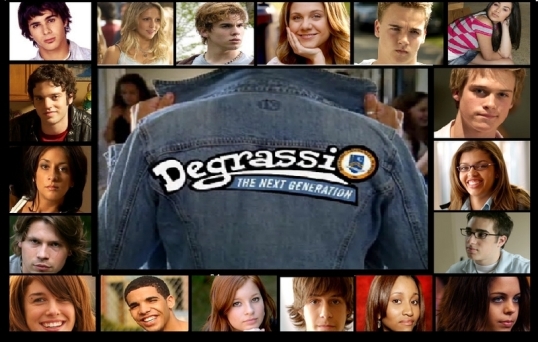
Welcome to Late Night Retro Television Reviews, a feature where we review some of our favorite and least favorite shows of the past! On Sunday, I will be reviewing the Canadian series, Degrassi: The Next Generation, which aired from 2001 to 2015! The series can be streamed on YouTube and Tubi.
This week, we finish up Christmas in Canada!
Episode 3.12 “Holiday Part Two”
(Dir by Philip Earnshaw, originally aired on December 17th, 2003)
Craig has no idea how to cheat.
It’s Christmas and he currently has two girlfriends. He’s scheduled to perform in Degrassi’s holiday pageant with Ashley. At the same time, he’s told Manny that he and Ashley have broken up. For Christmas, he buys gifts for both Ashley and Manny. Ashley gets a badass Ramones t-shirt. (Ashley reminds me a lot of myself). Manny gets a pink sweater and a skating bracelet. Foolishly, Craig leaves Ashley alone in his room and Ashley discovers the gift bags. She sees all of the gifts.
Later, at the Christmas pageant, she notices that Manny is wearing the bracelet. And she has a gift bag with the sweater in it! When Ashley asks Manny who gave her the gifts, Manny refuses to say. However, she does tell Ashley that she hopes Ashley can move on after losing Craig. Agck!
The holiday pageant does not go well for Craig. Ashley walks out on stage and slaps him. So much for their deut of All I Want For Christmas Is You. Joey later finds Craig sulking in the hallway. Joey tells him about the time that he cheated on Caitlin with Tessa Campanelli. Craig responds be telling Joey that he’s obviously still in love with Caitlin.
*sigh*
(By the way, that’s a sigh of frustration, not romance.)
Yes, this is the episode where Joey realizes that he’s still in love with Caitlin and dumps Sydney on Christmas Eve. The first time I saw this episode, I thought that the way that Joey rushed down to the airport and caught Caitlin before she left for Montreal was romantic. Rewatching it, I realized just how self-absorbed both Caitlin and Joey are. Joey treats Sydney like dirt, despite the fact that Sydney has spent months looking after his daughter, taking care of the house, and devoting almost all of her time to him. The show tries to turn Sydney into a villain but all she did was ask Joey’s ex-girlfriend to start trying to break into his house. To me, that seems pretty reasonable.
As for Caitlin, it’s hard to know where to even begin. When this show started, Caitlin was portrayed as being a largely down-to-Earth, mature human being. With this episode, Caitlin is suddenly transformed into a neurotic klutz. Suddenly, she’s slipping a love note through Joey’s mail slot and then getting stuck in the kitchen window when she tries to break in to retrieve it. That’s not the Caitlin who was previously on the show. I assume the show’s writers were trying to make her into an adorkable romantic comedy lead but, as it is, she just seems like someone who has an unhealthy hang-up on a guy who cheated on her in high school.
Oh well. I do appreciate that this was a Christmas episode. All of the snow looked lovely. That said, I will always feel bad for Ashley and Sydney. They both deserved a better holiday.
J.T. Walsh is one of the great character actors of all time. Born on September 28th, 1943, he died way too young at just 54 years of age. You could count on him being good in any role, but I always appreciated him appearing with Billy Bob Thornton at the beginning and end of SLING BLADE (1996). He filmed his scenes about 15 miles from my house.
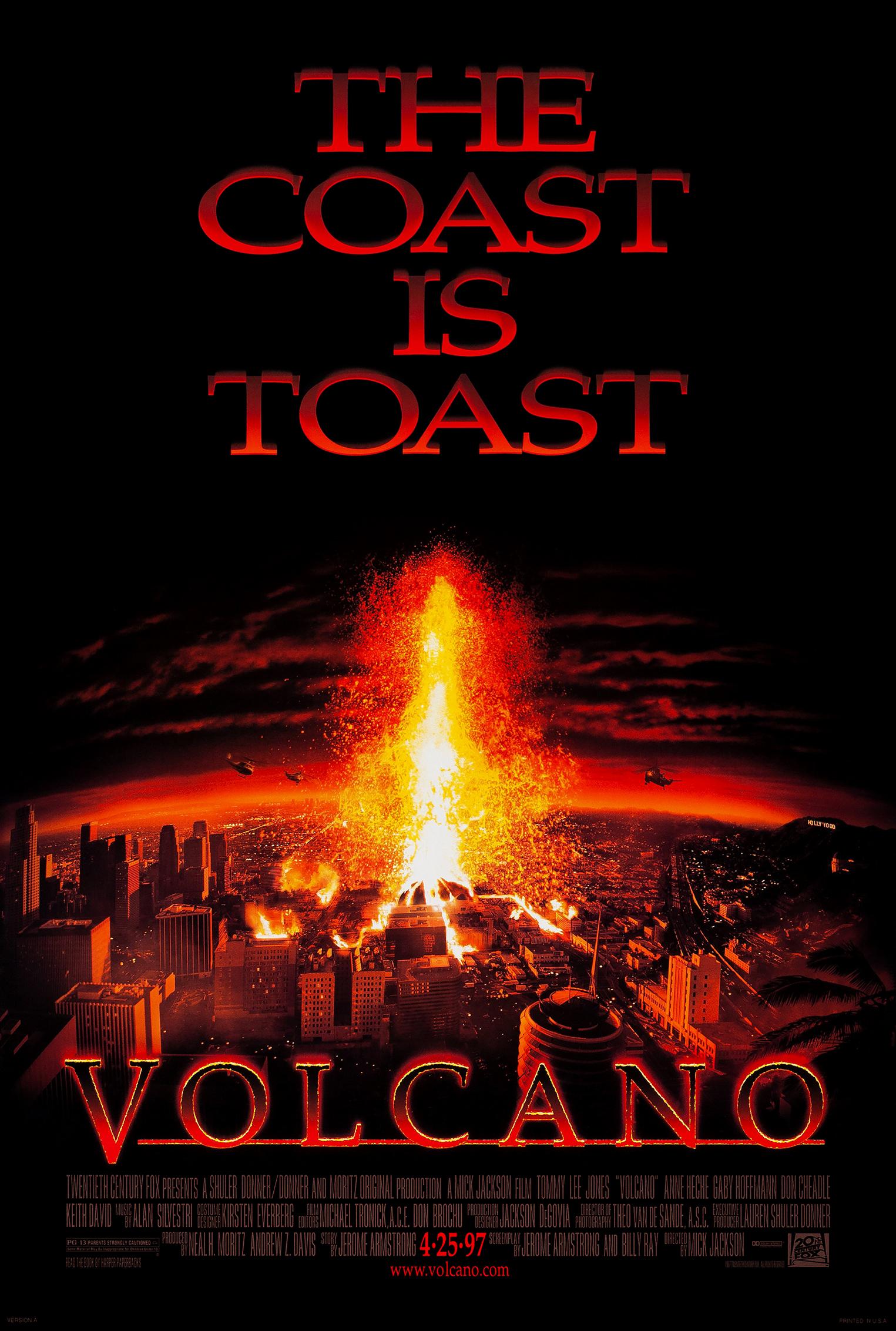
In Volcano, Los Angeles does not just face an earthquake, fire, or some ordinary civic emergency—it finds itself threatened by a river of lava tearing through the heart of the city. Directed by Mick Jackson, the 1997 disaster movie takes a premise that is almost impossible to accept on paper and sells it through speed, scale, and the sheer force of Tommy Lee Jones barking orders at people. A volcano erupting beneath Los Angeles, near the La Brea Tar Pits no less, is not exactly a model of scientific credibility. Still, the film is energetic enough to make its absurdity part of the entertainment.
The setup is wonderfully direct. An earthquake rattles Los Angeles, workers begin dying in underground tunnels, and a strange source of extreme heat is discovered beneath the city. Before long, lava is spilling into the streets, buildings are catching fire, and the city’s Emergency Management director Mike Roark, played by Tommy Lee Jones, has to coordinate an increasingly desperate effort to keep downtown Los Angeles from being wiped out. Anne Heche plays Dr. Amy Barnes, the geologist who realizes that the city is dealing with more than an earthquake or a gas leak. Together, Roark and Barnes become the film’s central problem-solving team: he is the practical, politically frustrated municipal leader, while she is the scientific expert trying to explain the impossible thing happening under everyone’s feet.
What makes Volcano enjoyable is that it does not waste much time pretending to be a subtle character drama. The movie’s main concern is escalation. Every time the heroes think they have contained the problem, the lava finds another way to spread. It comes through the subway. It crashes through pavement. It turns a normal Los Angeles intersection into a landscape from hell. The film understands the simple pleasure of watching ordinary urban infrastructure become a weapon or a liability. A train tunnel, a concrete barrier, construction equipment, storm drains, and even a city block all become parts of an enormous improvised plan to redirect molten rock.
Mick Jackson directs the action with enough urgency that the movie often works even when the science is wobbling badly. The special effects are very much of their era, combining practical fire, miniatures, digital lava, and lots of actors reacting to bright orange light. Some of the CGI has aged about as gracefully as one would expect from 1997, but the physical effects still have impact. The lava itself has a thick, almost muscular quality in the film. It does not just look like glowing liquid; it moves like an unstoppable wall that eats concrete, cars, and people. The images of lava flooding Los Angeles streets remain the reason to watch the movie. They are absurd, but memorably absurd.
The film also benefits from treating the crisis as a citywide emergency rather than simply a personal survival story. Roark is not a scientist, soldier, or superhero. He is basically a city official who has to make decisions under impossible conditions, manage multiple agencies, argue with politicians, and keep people from panicking. Tommy Lee Jones is perfect casting for that role. He has the right mixture of exhaustion, irritation, authority, and reluctant decency. Jones does not play Roark as a polished action hero; he plays him like a man who had plans for a quiet weekend with his daughter and instead ends up trying to stop Los Angeles from being buried under lava. His natural gruffness gives the movie more weight than it might otherwise have.
Anne Heche brings a different energy as Amy Barnes. Her character is often stuck delivering exposition, explaining volcanic activity, underground pressure, and why everyone is probably about to die, but Heche commits to it. She gives Amy enough urgency and intelligence that the scientific dialogue feels less like a lecture and more like another kind of emergency response. The relationship between Roark and Amy is also refreshingly restrained. The movie could have forced a big romantic subplot between them, but it mostly keeps their connection professional. They respect each other because they are both good at their jobs, which is more interesting than a last-minute disaster-movie love story.
The supporting cast is solid as well. Don Cheadle has a memorable role as Emmit Reese, a subway supervisor who becomes one of Roark’s most important allies. Keith David also adds welcome presence as a police lieutenant helping coordinate the response. Gaby Hoffmann plays Roark’s daughter Kelly, and while the daughter-in-peril material is fairly standard, it gives Jones’s character an emotional stake outside the command center. The film occasionally leans hard on familiar disaster-movie formulas, including separated family members, skeptical officials, and civilians making terrible decisions near obviously dangerous lava, but that is part of the package. Volcano is not trying to reinvent the genre. It is trying to make the genre run hot and fast for 104 minutes.
It is hard not to compare Volcano with Dante’s Peak, the other major volcano disaster movie released earlier in 1997. Dante’s Peak at least tries to ground its eruption in recognizable volcanic warning signs, scientific procedure, and the danger of officials ignoring experts until it is too late. Even when it becomes exaggerated, the film wants viewers to feel that its disaster could plausibly grow out of real geological conditions. Volcano, on the other hand, does not have much interest in maintaining that kind of credibility. Its premise is already much wilder: molten lava suddenly emerging beneath one of the largest cities in the United States. Rather than fight that inherent silliness, Mick Jackson’s film leans into it. Where Dante’s Peak aims for science-flavored suspense, Volcano goes for spectacle, turning Los Angeles itself into a giant disaster-movie set piece.
The biggest issue is that the movie never really decides how seriously it wants to take itself. At times, it is a grim urban catastrophe film in which people die in horrifying ways. One scene involving a transit worker trying to rescue another man from the lava is still surprisingly brutal and sad. At other times, Volcano is close to accidental comedy, especially whenever the film attempts to explain its geology with complete confidence. The idea of a full-scale volcanic eruption beneath Los Angeles is already a major stretch, but the movie goes beyond that into a kind of aggressively convenient science. The lava moves where the plot needs it to move, barriers hold until they need to fail, and the city seems able to mobilize massive engineering projects at a speed that would make any real emergency planner laugh.
Still, questioning the realism too closely misses the appeal. Volcano belongs to that specific 1990s era when major studios were throwing big budgets at destruction spectacles with recognizable stars and high-concept premises. The movie is essentially a monster film where the monster is a river of lava rolling through Los Angeles. Instead of a creature smashing buildings, it is molten rock swallowing streets, derailing infrastructure, and forcing ordinary people to run for their lives.
The movie is also unintentionally revealing about late-1990s disaster filmmaking. It has a strong faith in public-service workers, engineers, transit employees, firefighters, police officers, and regular people doing dangerous jobs because somebody has to do them. Roark’s strategy is not to defeat nature through one genius solution. It is to coordinate an enormous group effort, with people hauling concrete barriers, driving equipment, evacuating neighborhoods, and taking risks to buy the city more time. That civic-minded quality gives the film a little more heart than its reputation as a silly lava movie might suggest.
In the end, Volcano is neither a great disaster movie nor a completely disposable one. It is too scientifically goofy to be taken seriously as a realistic thriller, and its dialogue can be very blunt. Yet it has pace, personality, some genuinely effective spectacle, and a reliably entertaining Tommy Lee Jones performance at its center. It is the kind of movie where a man can face a molten river in downtown Los Angeles and somehow make you believe that yelling louder might solve the problem. For viewers in the mood for a big, fiery, unapologetically 1990s popcorn movie, Volcano remains a fun eruption of chaos.
Welcome to Retro Television Reviews, a feature where we review some of our favorite and least favorite shows of the past! On Sundays, I will be reviewing Homicide: Life On The Street, which aired from 1993 to 1999, on NBC! It can be viewed on Peacock.
This week, Homicide crosses over with Law & Order.
Law & Order 8.6 “Baby, It’s You”
(Dir by Edwin Sherin, originally aired on November 12th, 1997)
Homicide 6.5 “Baby, It’s You”
(Dir by Edwin Sherin, originally aired on November 14th, 1997)
In New York City, Lennie Briscoe (Jerry Orbach) and Rey Curtis (Benjamin Bratt) find themselves investigating the death of a 14 year-old model named Brittany Janeway. The daughter of plastic surgeon Steven Janeway (Tom Tammi) and his wife Gayle (Maureen Anderman), Brittany died after complaining to her father about abdominal pain. The medical examiner determines that, two weeks before her death, Brittany was sexually assaulted with such severity that it resulted in internal injuries that led to toxic shock.
When the detectives learn that Brittany was in Baltimore two weeks earlier, they call Lt. Giardello and ask if he can send two of his detectives to check on the family’s Maryland home. The job falls to Detective Munch, who is still angry over the fact that Briscoe once slept with his first wife. Munch asks Falsone (ugh!) to accompany him. When Munch and Falsone learn that the son of the Janeways’s New York housekeeper was seen in Baltimore on the night that Brittany was raped, they have a suspect. Danvers sends them to New York with one mission. Arrest the guy and bring him back to Baltimore to stand trial. Jack McCoy (Sam Waterston) is not happy about that. Because Brittany died in New York, he feels that it’s his case to prosecute. Because the rape that led to Brittany’s death happened in Baltimore, Danvers claims that it’s his case.
Of course, once the suspect is arrested, it turns out that he wasn’t the perpetrator. Instead, he was a witness. According to him, Brittany had already been raped by the time he arrived at the house. The suspicion immediately shifts to Dr. Janeway. When the doctor is arrested in Baltimore, McCoy heads down to Maryland to argue that the case should be tried in New York. Judge Andahl (Sagan Lewis), who was last seen getting Elijah Wood off of a murder charge, disagrees. However, she allows McCoy to be co-counsel with Danvers.
In a twist that will not surprise anyone who has ever seen an episode of Law & Order, it turns out that Brittany was not assaulted by her father. Instead, she was assaulted by her mother.
The last time Law & Order and Homicide did a cross-over, the emphasis was on Pembleton and Bayliss and their unorthodox interrogation technique running up against McCoy’s need for admissible evidence. This time, when McCoy goes down to Baltimore, he quickly befriends and starts to discuss life with — you guessed it! — Detective Paul Falsone! In fact, Pembleton and Bayliss are barely present in this cross-over. While Munch does get to engage in some fun passive-aggressive banter with Lennie Briscoe, this cross-over is ultimately all about Paul Falsone, the super detective who never makes a mistake.
Good Lord, why? WHY DOES EVERYTHING HAVE TO BE ABOUT FALSONE? Falsone is a boring character. We are five episodes into the sixth season and Falsone has been a major part of four of them. The veteran Homicide actors were pushed to the side so that Jon Seda could wander around and mutter his lines. I get that show was trying to appeal to fans of more action-orientated cop shows with the character of Falsone but, in what I’ve seen so far, Seda has not shown a hint of charisma in the role. The fact that Homicide keeps insisting that Falsone is the greatest detective in the history of detectives does not make the character any more intriguing.
This crossover was a disappointment, The story, which was obviously based on the JonBenet Ramsey case, was sordid simply for the sake of being sordid and the big reveal that the murderer was the mother was not quite the shocking moment that it was bult up to be. Anyone familiar with Law & Order could have guessed who the murderer was going to be. And then, on top of everything else — FALSONE!
The Rangers just played their final game of the regular season. By a score of 4-6, they lost to the Twins. Even if they had won, they would have still needed the Astros to lose to the Athletics to make it to the post-season. The Astros are currently leading the Athletics 9-0.
So, it’s over. Usually, this is when I try to stay positive and look forward to the next season but I’m not in the mood right now. We came so close to making it to the post-season but then we lost the games that we really needed to win. It’s such a familiar story.
I love my Rangers but my heart is broken right now. I’ll still watch the play-offs and I’ll find a team to cheer for. It won’t be the 81-81 Astros.
With today’s song of the day, we continue our Bonnie and Clyde theme!
This song is from 1968 and was inspired by Arthur Penn’s classic crime film, Bonnie and Clyde. Oddly enough, this song insists that Bonnie and Clyde were from Savannah, Georgia when everyone knows that they were from my part of the world, North Texas. Then again, “Savannah” does sound a bit better when set to music than “West Dallas.”
In this scene, from Arthur Penn’s 1967 film Bonnie and Clyde, Bonnie Parker (played by Faye Dunaway) writes a poem and tries to craft the future image of Bonnie and Clyde. Though it has none of the violence that made Bonnie and Clyde such a controversial film in 1967, this is still an important scene. (Actually, it’s more than one scene.) Indeed, this scene is a turning point for the entire film, the moment that Bonnie and Clyde goes from being an occasionally comedic attack on the establishment to a fatalistic crime noir. This is where Bonnie shows that, unlike Clyde, she knows that death is inescapable but she also knows that she and Clyde are destined to be legends.
(Of course, Dunaway and Warren Beatty — two performers who once epitomized an era but who are only seen occasionally nowadays — are already legends.)
4 (or more) Shots From 4 (or more) Films is just what it says it is, 4 (or more) shots from 4 (or more) of our favorite films. As opposed to the reviews and recaps that we usually post, 4 (or more) Shots From 4 (or more) Films lets the visuals do the talking.
104 years ago today, Arthur Penn was born in Philadelphia. In the 50s, Penn was one of the new crop of directors who made a name for themselves directing for television. Like most of his colleagues, he transitioned into film. Unlike many of his colleagues, he remained a fiercely iconoclastic director, one who was willing to challenge the conventions of Hollywood. While his early films often struggled at the box office, he was respected by actors and hailed as a visionary by the directors of the French New Wave.
In 1967, he and Warren Beatty changed the course of American cinema with Bonnie and Clyde. Penn followed up that classic film with movies like Alice’s Restaurant, Little Big Man, Night Moves, and a handful of others. When he died in 2010, Penn was hailed as one of the most influential (if sometimes underrated) directors of all time.
Today, in honor of the anniversary of his birth, the Shattered Lens offers up….
4 Shots From 4 Arthur Penn Films
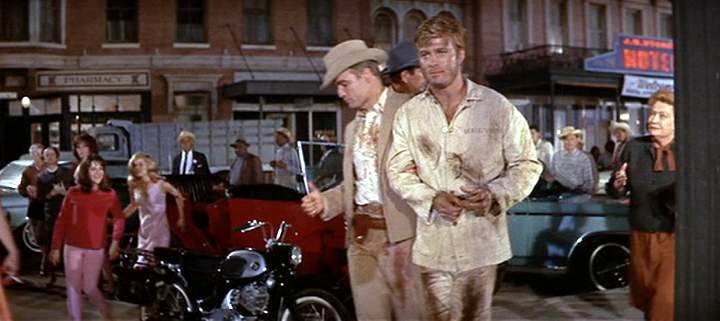
The Chase (1966, dir by Arthur Penn, DP: Joseph LaShelle)
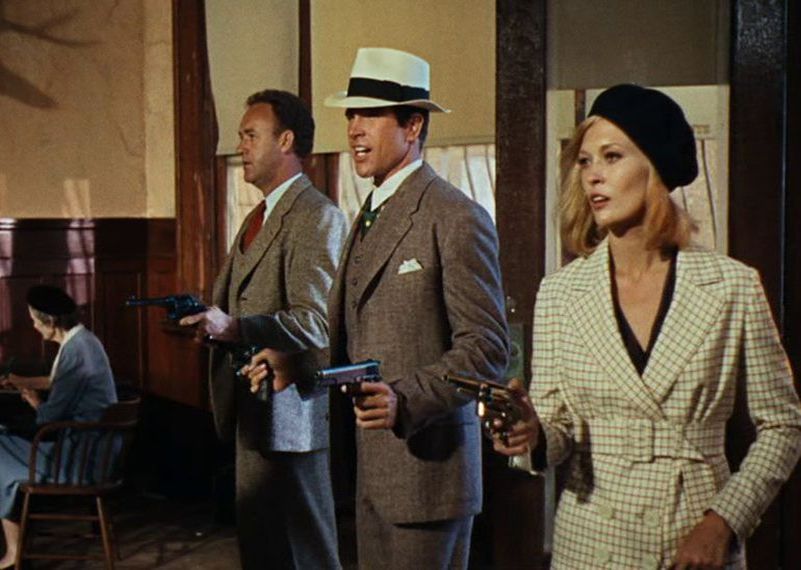
Bonnie and Clyde (1967, dir by Arthur Penn, DP: Burnett Guffey)
Alice’s Restaurant (1969, dir by Arthur Penn, DP: Michael Nebbia)
Little Big Man (1970, dir by Arthur Penn, DP: Harry Stradling Jr)