Today’s song of the day comes to us from Adi Ulmansky, a singer to whom I was introduced by my best friend, Evelyn! Here, to help the site prepare for the incoming onslaught of Horrorthon reviews, is Adi with Bombs Away!
Today’s song of the day comes to us from Adi Ulmansky, a singer to whom I was introduced by my best friend, Evelyn! Here, to help the site prepare for the incoming onslaught of Horrorthon reviews, is Adi with Bombs Away!
With our annual Horrorthon starting in three days, I thought that this would be an appropriate time to share a creepy scene that I love from The Sopranos.
The Sopranos was well-known for its dream sequences. For me, this dream from the season 4’s Calling All Cars is one of the best and scariest of the series. It’s full of menace and ominous atmosphere, from the minute we see Tony being led to the house by the deceased Ralphie. And then, when that mysterious shadow appears on the staircase — AGCK!
I look forward to inviting you inside the TSL House of Horrors this October.
4 Or More Shots From 4 Or More Films is just what it says it is, 4 shots from 4 of our favorite films. As opposed to the reviews and recaps that we usually post, 4 Shots From 4 Films lets the visuals do the talking!
With October approaching, it will soon be time for our annual Horrorthon here at the Shattered Lens. We’ve been working hard getting things ready! Here are 4 shots from 4 of the many films that we will be reviewing this October.
4 Shots From 4 Horror Films
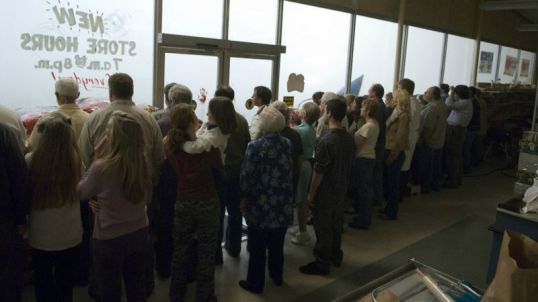
The Mist (2007, dir. by Frank Darabont)
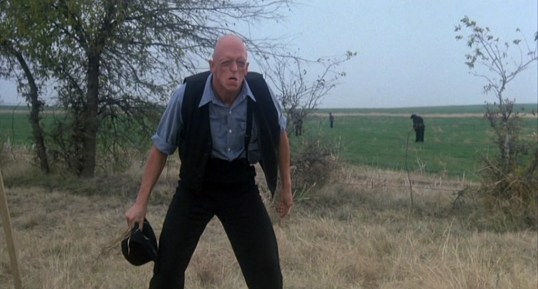
Deadly Blessing (1981, dir by Wes Craven)
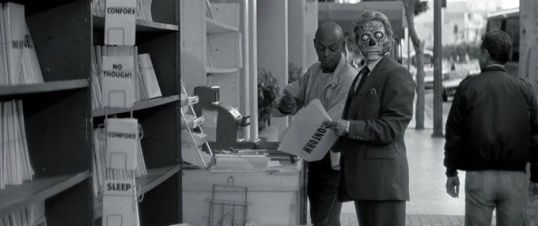
They Live (1988, dir by John Carpenter)
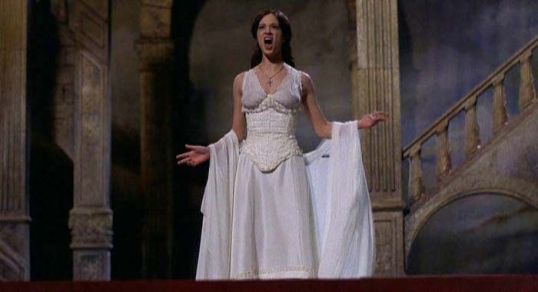
The Phantom of the Opera (1998, dir by Dario Argento)
As some of our regular readers undoubtedly know, I am involved in hosting a few weekly live tweets on twitter and occasionally Mastodon. I host #FridayNightFlix every Friday, I co-host #ScarySocial on Saturday, and I am one of the five hosts of Mastodon’s #MondayActionMovie! Every week, we get together. We watch a movie. We snark our way through it.
Tonight, for #MondayActionMovie, the film will be John Woo’s A Better Tomorrow!
If you want to join this watch party, just hop onto Mastodon, pull up A Better Tomorrow on YouTube, start the movie at 8 pm et, and use the #MondayActionMovie hashtag!
Enjoy!
A German film from 1970, o.k. opens with a black-and-white shot of a group of men walking into a two-story house that’s sitting near a forest. The camera tracks them as they walk through the front hallway and enter a larger room. Uniforms of the U.S. Army hang on a rack in the room. Members of a film crew greet the men. A young woman sits quietly at a window and looks at the forest outside.
One by one, the men turn to the camera and introduce themselves. They give their name, their age, their religion, and their marital status. Two say that they are Roman Catholic but are no longer members of the Church. One Protestant says that he also no longer attends services. Another actor introduces himself as being a 28-year-old virgin and then briefly looks as if he regrets his candor. Director Michael Verhoeven joins the men to explain that the film we are about to see was filmed in Bavaria but it takes place in Vietnam. The film is based on an actual incident that occurred in 1966, when the Vietnam War was still in its early stages. While on patrol, four soldiers abducted, raped, and killed a young Vietnamese girl. Only one soldier refused to take part and reported the incident to his superiors, all of whom said that it was simply the type of incident that takes place in all wars.
(Known as the Incident on Hill 192, this crime also served as the basis of Brian De Palma’s far more straightforward Casualties of War.)
I have to admit that my first reaction to this was to think, “I’m not sure if I’m in the mood to be lectured about war crimes by the Germans.” However, one gets the feeling that Verhoeven himself knew that this would be the reaction of quite a few viewers and he was prepared for it. His actors explain that they didn’t film in Vietnam because Vietnam is “far away.” Instead, they filmed in Bavaria because “Here is closer.” I found myself thinking about that turn of phrase quite a bit as I watched o.k. “Here is closer.” o.k. may have been inspired by what happened in Vietnam but it was also about what happens in every war. The American soldiers, who have lost their humanity to war, all have American names but the actors make no effort to hide their German accents. The Vietnamese girl who was killed is played by German actress Eva Mattes and, again, no attempt is made to hide the fact that she is German. The characters emerge as universal soldiers and universal victims, playing out the same cycle, war after war. Verhoeven is not attacking America. He’s portraying the cost of tossing people into a situation where they have no control over their fates. The soldiers adopt a philosophy of kill-or-be-killed. Civilians, like Phan Ti Mao (played by Mattes), have no choice but to try to live in the middle of a war zone. The film is simply-told and starkly shot. We are continually reminded that we are watching a film, a production. We’re put at a distance and asked to just consider the film’s story and message without having the benefit of any of the usual war movie clichés or adrenaline-fueled action scenes to provide us with an emotional escape. Here is closer.
o.k. engendered more than a little controversy when it was released. It was entered into the 1970 Berlin Film Festival. Director George Stevens was the head of the jury that year and he led an effort to have the movie removed from competition. He cited a festival by-law that stated that the films at the festival should “contribute to a better understanding between nations.” When the jury voted 7-2 to remove o.k., the other filmmakers at the festival withdrew their films in solidarity and the Berlin Film Festival was canceled for that year. o.k. was later submitted as Germany’s entry for the Best Foreign Language Film Oscar (as it was known back then) but it was not nominated.
Seen today, o.k. can sometimes seem a bit too studied for its own good but again, that was the point. It was a film that was deliberately made to force the audience to consider the production’s anti-war message without the benefit of easy sentiment. That said, it makes its argument effectively. It’s a film that epitomizes its own difficult era.
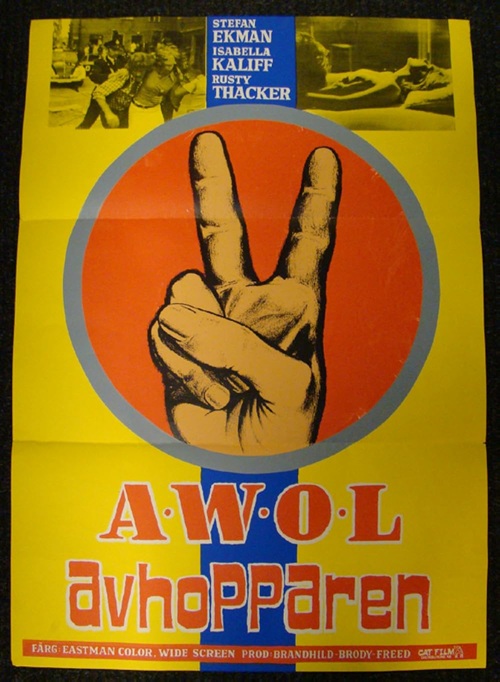
1972’s AWOL tells the story of an American soldier named Willy (Russ Thacker) who decides that he’s no longer going to fight in Vietnam. He goes to Sweden and informs the police that he has decided to desert. The bored policeman tells him to stay out of trouble. “No narcotics,” he says. “Of course,” Willy says, shocked to discover just how easy it is to desert.
Willy struggles to adapt to life in Sweden. At first, he has fun seeing the sights and wearing a silly little hat and visiting the carnival. Unfortunately, he has little money and no friends, and he soon finds himself feeling lonely. A job working on an adult film leads to him meeting another American expatriate, Mohammed G (Glynn Thurman). Mohammed introduces Willy to his friends, a group of rather shallow Leftists. Willy starts a relationship with Inga (Isabella Kaliff). They don’t agree on the merits of Che Guevara, but they fall in love anyway.
(Just a quick sidenote: Che was a racist butcher who executed thousands of innocent Cubans and who is only remembered today because of one good picture and the fact that he was executed by the Bolivians. The fact that he’s held up as some sort of icon is proof of just how shallow most political activists actually are.)
Meanwhile, the CIA wants Willy to come back home. A corpulent agent with the name of Cupp (Dutch Miller) continually appears and tries to bribe Willy into returning. He promises that nothing bad will happen to Willy if he returns to America. At worst, he’ll be required to do a few months of therapy. When that doesn’t work, Cupp drags Willy to his station house and has Willy’s parents appear on television. There’s a big moose head on the wall of the station house and its eyes glow red.
AWOL‘s a bit of an odd film, which should not be taken to mean that it’s necessarily an interesting film. The tone is all over the place. Willy and Mohammed discuss America and whether or not they can love the country from which they’ve fled. Cupp appears and uses a mini-camera hidden in his class ring to take pictures of Willy and Inga. Willy and Inga get a falling in love montage, complete with a syrupy ballad. Cupp offers Willy a briefcase full of American candy bars and soft drinks. There is footage of a demonstration. There are moments of goofy humor, and Russ Thacker wanders through the film with a somewhat dazed look on his face, a Vietnam-era Candide, a stranger in a Swedish land. The film ends on a dark note, leaving one to wonder if the film is trying to punish us for smirking at the shallowness of its politics. It’s not necessarily a good film, but it is definitely a film of its time.
AWOL was directed by Herb Freed, who got his start in commercials and later went on to direct the classic slasher, Graduation Day. The film was obviously meant to appeal to a combination of hippies and fans of Swedish sex films. That said, the sex is fairly tame and the film itself doesn’t seem to really have much affinity for the counterculture. If anything, the film’s Leftists come across as being so self-righteous that they make the openly amoral CIA agent seem likable by comparison. It’s tempting to compare this film to An American Hippie In Israel. An American Hippie was also a counter-culture film about a soldier who was traumatized by Vietnam and, like AWOL, it was tonally all over the place. But An American Hippie In Israel worked because, whatever else you might want to say about it (and I love the film), it’s actually sympathetic to the main character and his plea for people to “stop pushing buttons.” AWOL, on the other hand, doesn’t seem to even like Willy, much less understand him.
AWOL is very much a film of its time and, when it is interesting, it’s interesting as a portrayal of the early 70s. It’s a time capsule, one that is fit to be dug up and investigated at least once before being forgotten about again.
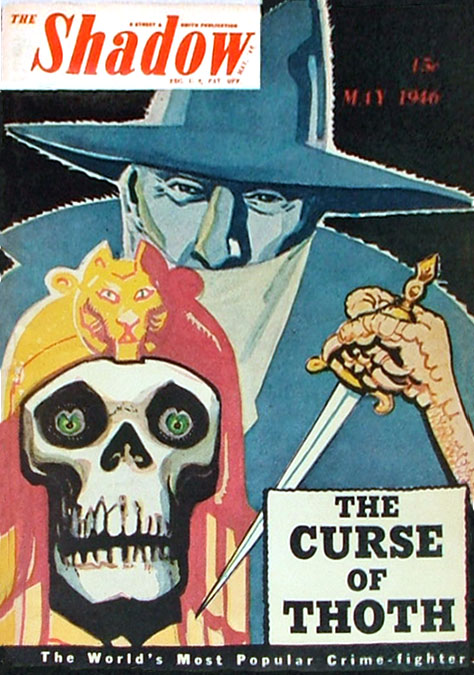
by Charles Coll
This is from 1946. I’m using it in 2026 to get a head start on October!
The year was 1977 and Don Letts had a video camera.
Letts was the DJ at The Roxy, a nightclub in London that gained some notoriety by hosting Punk acts like Sex Pistols, The Clash, The Slits, Siouxsie and the Banshees, Generation X, and several others. In his role as DJ, Letts is often credited with introducing British punks to Jamaican reggae. (I’ve occasionally seen it misreported that Letts himself was from Jamaica. Letts commented in an interview that, until he visited the country with Johnny Lydon, the closest he had come to Jamaica was watching The Harder They Come.) As an amateur filmmaker, Letts was responsible for making one of the key documentaries about the early days of Punk Rock, 1978’s The Punk Rock Movie.
Shot largely at the Roxy, The Punk Rock Movie features raw but candid footage of some of the key Punk bands. Sex Pistols are there, of course. The Clash get a lot of footage and it’s interesting to see the young members of the band doing something other than screeching about imperialism. Billy Idol appears and shows off the rough charisma that would make him a star. We watch as The Slits argue in rehearsal. Siouxsie Sioux both performs and appears backstage, playing the enigmatic Punk diva. We also see quite a few Punks acts who are no longer as well-remembered as The Clash or Sex Pistols. Even with the DIY, anti-star ethos of the Punk Rock era, stage presence counted for a lot. Some bands just naturally had it and some bands did not.
I watched The Punk Rock Movie on Tubi and the most frequent caption was one informing me that the lyrics were unintelligible due to the music. It was a caption that I saw so frequently that I found myself both predicting when it would pop up and laughing when it did so. The Punk Rock Movie is a raw film. Don Letts shot the footage with a Super 8 Camera and, as a result, there’s nothing slick about the film. The images are sometimes blurry. It can be hard to make out what everyone is saying. It’s a far cry from the type of carefully choreographed and meticulously shot concert footage that we’re used to seeing. Needless to say, that’s a good deal of the film’s appeal. It’s often said, perhaps incorrectly, that Punk was started as a reaction to the commercialization of rock. At a time when soulless hitmakers and aging millionaires were dominating music, Punk came along with a burst of anger and vitality. The Punk Rock Movie captures that youthful anger. It captures the feeling of people refusing to accept that only a certain few were allowed to make music or express themselves. Scenes of the police raiding a Punk store add a political element of the film while the backstage and tour bus footage serve to remind us of just how English the original Punks were.
It’s no surprise that Sex Pistols dominate the film. We don’t see them backstage but we don’t have to. All we have to do is see Johnny Rotten (as he was known then) staring out at the audience. One of the more interesting thing about Punk is that the Sex Pistols were sold as being a band that didn’t know how to play their instruments or sing. This film reveals that, for whatever they lacked in formal training, they were naturals on stage. Regardless of what Malcolm McLaren and the press may have insisted, they were born to be stars.
For today’s music video of the day, we have Kim Wilde performing Kids in America. This was her first single and one of two of Wilde’s singles to chart in the United States, the other one being her cover of The Supremes’s You Keep Me Hangin’ On. (Wilde found more success in her home country, with 25 singles charting on the UK charts.) The song was written by Wilde’s father and her older brother, both of whom were fascinated by American youth culture.
The video, which finds Kim Wilde literally looking out a “dirty old window,” was directed by Brian Grant, who was one of the busiest music video directors of the 1980s. He also did videos for The Human League, Squeeze, Queen, and Tina Turner.
Myself, I will always associate this song with stealing cars in Vice City.

The only thing better than stealing a golf cart is stealing a golf cart while listening to Kim Wilde sing Kids in America!
Enjoy!
Welcome to Late Night Retro Television Reviews, a feature where we review some of our favorite and least favorite shows of the past! On Sunday, I will be reviewing the Canadian series, Degrassi: The Next Generation, which aired from 2001 to 2015! The series can be streamed on YouTube and Tubi.
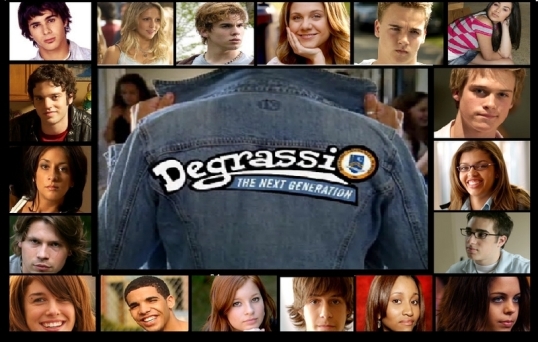
This week, we finish up Christmas in Canada!
Episode 3.12 “Holiday Part Two”
(Dir by Philip Earnshaw, originally aired on December 17th, 2003)
Craig has no idea how to cheat.
It’s Christmas and he currently has two girlfriends. He’s scheduled to perform in Degrassi’s holiday pageant with Ashley. At the same time, he’s told Manny that he and Ashley have broken up. For Christmas, he buys gifts for both Ashley and Manny. Ashley gets a badass Ramones t-shirt. (Ashley reminds me a lot of myself). Manny gets a pink sweater and a skating bracelet. Foolishly, Craig leaves Ashley alone in his room and Ashley discovers the gift bags. She sees all of the gifts.
Later, at the Christmas pageant, she notices that Manny is wearing the bracelet. And she has a gift bag with the sweater in it! When Ashley asks Manny who gave her the gifts, Manny refuses to say. However, she does tell Ashley that she hopes Ashley can move on after losing Craig. Agck!
The holiday pageant does not go well for Craig. Ashley walks out on stage and slaps him. So much for their deut of All I Want For Christmas Is You. Joey later finds Craig sulking in the hallway. Joey tells him about the time that he cheated on Caitlin with Tessa Campanelli. Craig responds be telling Joey that he’s obviously still in love with Caitlin.
*sigh*
(By the way, that’s a sigh of frustration, not romance.)
Yes, this is the episode where Joey realizes that he’s still in love with Caitlin and dumps Sydney on Christmas Eve. The first time I saw this episode, I thought that the way that Joey rushed down to the airport and caught Caitlin before she left for Montreal was romantic. Rewatching it, I realized just how self-absorbed both Caitlin and Joey are. Joey treats Sydney like dirt, despite the fact that Sydney has spent months looking after his daughter, taking care of the house, and devoting almost all of her time to him. The show tries to turn Sydney into a villain but all she did was ask Joey’s ex-girlfriend to start trying to break into his house. To me, that seems pretty reasonable.
As for Caitlin, it’s hard to know where to even begin. When this show started, Caitlin was portrayed as being a largely down-to-Earth, mature human being. With this episode, Caitlin is suddenly transformed into a neurotic klutz. Suddenly, she’s slipping a love note through Joey’s mail slot and then getting stuck in the kitchen window when she tries to break in to retrieve it. That’s not the Caitlin who was previously on the show. I assume the show’s writers were trying to make her into an adorkable romantic comedy lead but, as it is, she just seems like someone who has an unhealthy hang-up on a guy who cheated on her in high school.
Oh well. I do appreciate that this was a Christmas episode. All of the snow looked lovely. That said, I will always feel bad for Ashley and Sydney. They both deserved a better holiday.

