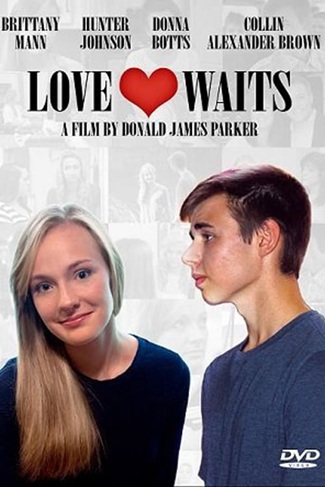
 I decided to review one more Donald James Parker film for October. Admittedly, Parker doesn’t have a huge role in 2015’s Love Waits. He plays a band director who offers some kind advice to one of his students, Cheri Martin (Brittany Mann), and tells her not to feel bad for challenging the other members of the band in her quest to move up to first chair. Indeed, there’s very little anger to be found in the band director, and that certainly sets him apart from the fire-and-brimstone characters that Parker usually plays. Parker is—dare I say it?—actually a bit likable in the role.
That said, the film was also directed and written by Parker, and it’s easy to see that his usual anger has been divided amongst several other characters. When the film first started, I was convinced that Cheri’s father was meant to be the film’s villain and that the movie would hopefully end with him being led away in handcuffs. Imagine my surprise when it became clear that Jeff Martin (played by Collin Alexander Brown) was meant to be a sympathetic character. When we first meet Mr. Martin, he’s coming home from work and throwing a fit when he discovers that his 14-year-old daughter has yet to start making dinner. She apologizes for forgetting. “That’s not going to fill my stomach!” he snaps. Later, when he’s again driving home, he catches Cheri out walking with Duke Williams (Hunter Johnson), a boy who is supposedly her own age. (I say supposedly because all of the actors playing the teen characters either look too young or too old.) Mr. Martin orders Cheri to get in his car and then starts yelling at her, freaking out like Terry O’Quinn in The Stepfather. Mr. Martin reminds Cheri that she’s not allowed to leave the house without permission and she’s not allowed to talk to a boy without having an adult present. Again, I assumed Mr. Martin was being set up as a villain, but the film actually treats him like a hero. One of the big problems is that Collin Alexander Brown yells almost all of his lines and comes across as an utter lunatic.
Of course, it’s not just Mr. Martin who orders Cheri around. When Cheri tries to practice her flute, her babysitter (Cheri is fourteen but cannot be left on her own) immediately starts to correct her. A major theme of the film appears to be that Cheri’s job is to follow orders and not complain, even if her father does seem to spend a lot of time yelling at her over the least little thing. Even beyond the adults around her, Cheri has to deal with her school’s resident mean girl, Judy (Haleigh Johnson). At the start of the film, Judy and her friends walk up to Cheri and say, “I hear you’re a virgin, Cheri Martin, and that makes you a loser.” When Cheri asks Judy’s friends if they’ve “done it,” one of them replies, “Duh, I’m nearly fourteen.” Eventually, Judy’s promiscuity leads to her getting her face slashed, and everyone in Cheri’s youth group agrees that, even though they don’t like Cheri, they didn’t want that to happen. “We should visit her in the hospital,” someone says. They don’t so much visit her to offer sympathy as to tell her “I told you so,” and that’s really all Judy needs to hear to change her ways and agree to wear a purity ring.
The message is about resisting peer pressure, and I actually happen to agree with that. You shouldn’t do anything unless you actually want to do it and that’s especially true when it comes to sex. That said, the film’s youth group seems to largely operate under a system of peer pressure, and the film also seems to suggest that things like sex education are actually a conspiracy to turn girls like Cheri into girls like Judy. I didn’t agree with that at all and I actually found the argument to be more than a little offensive, as if women can’t be trusted with the knowledge necessary to make their own decisions. The main thing is that, like all Parker films, Love Waits seems to take place in an alternate universe where 1850s morality is combined with a truly over-the-top bitterness. Also in typical Parker fashion, Love Waits takes a 15-minute story and stretches it out to a punishing two hours.
Every time the members of Cheri’s youth group proclaimed, “We have to do something!,” I found myself wishing someone would say, “No, you don’t.” Whenever a non-religious character was dragged into the school library so the youth group could pray over them, I was reminded of Hank Hill’s famous verdict on his town’s megachurch: “No offense, but your church just keeps coming at you.”

