As you probably noticed from today’s previous posts, it’s Oscar Sunday!
For many humans and cats, today is an unofficial holiday! Today is the day that we find out who and what the Academy has selected for the best of last year! We may agree. We may disagree. But a lot of us will be watching!
Happy Oscar Sunday, everyone! Please enjoy today’s Oscar-related posts. Who knows? We might even toss in some non-Oscar related posts as well! You never know!
(Next year’s sure winner for Best Supporting Kitty, Goose!)
Remember how, an hour ago, I listed 6 actresses who I hope will soon get the role for which they’ll win their first Oscar?
Well, now it’s time to look at 6 actors for whom I have the same hope. Some of the actors listed below have been nominated in the past. Some of them have not. Some of them will probably win an Oscar at some point in their career. And some of them, sadly, probably will not.
However, what all six of them have in common is that all six of them deserve at least one more opportunity to take home a gold statuette.
Ethan Hawke
I’m still stunned by the fact that Ethan Hawke wasn’t, at the very least, nominated for his performance in First Reformed. It was certainly one of the best performance of the year and probably one of the best of his career. Ethan Hawke has been nominated a total of four times (twice for supporting actor and twice for adapted screenplay) but has yet to win. Hopefully, that will someday change for both him and his frequent director, Richard Linklater.
Jake Gyllenhaal
How the Hell was Jake Gyllenhaal not nominated for Nightcrawler? Ever since Donnie Darko, Gyllenhaal has been one of the most enjoyably unpredictable actors around. He’s even managed to become a star even though it’s obvious that the mainstream film industry has no idea what to do with his eccentric persona. While Gyllenhaal can occasionally be miscast (as evidenced by films like Demolition and Love and Other Drugs), both Nightcrawler and Stronger showed just how special an actor Gyllenhaal can be.
Ryan Renolds
The next time you find yourself enjoying an R-rated comic book movie that features nudity, profanity, and grotesque ultra-violence, you better take a few minutes to thank Ryan Reynolds. Reynolds will probably never win an Oscar for playing Deadpool but just imagine the acceptance speech he would give if he did.
Hugh Jackman
Amazingly, the multi-talented Hugh Jackman has only one nomination, for his performance in Les Miserables. He probably deserved a nomination for his performance in Logan, though that film has the misfortune to be released before Black Panther legitimized the idea of a comic book film as a genuine Oscar contender. Jackman seems like he’s destined to win an Oscar someday. Hopefully, in the future, he’ll chose better films than The Front Runner.
Kyle Chandler
Despite appearing in several best picture nominees and giving an award-worthy performance in The Spectacular Now, Kyle Chandler has never received an Oscar nomination. It’s hard not to feel that the right role is somewhere out there, waiting for him. Someday, someone will write the perfect script about a small-town sheriff solving the biggest case of his career and the next thing you know, Kyle Chandler will be accepting his first Oscar.
Giovanni Lombardo Radice
Someday, someone is going to write a great role for the greatest living Italian horror actor, Giovanni Lombardo Radice.
As of right now, it seems like there’s a very good chance that Glenn Close will win the Academy Award for Best Actress tonight. In a film career that started 19 years ago and which has seen Close nominated for seven Academy Awards, tonight would be her first win.
That’s the way it goes with the Oscars. Some performers win an Oscar for their first film. Some don’t win until they’ve got several decades of work behind them. Others, sadly enough, go through their entire life getting nominated but never actually winning. Some come out of nowhere, win an Oscar, and then promptly vanish. Others, like Meryl Streep, are given nominations largely just for showing up. One of the biggest Oscar traditions has been the beloved artist who, after years of distinguished work, finally picks up for her first award.
The cliché, of course, is that every performer just needs the right role. So, with that in mind, here are 6 previously unrewarded actresses who I hope get the right role sometime in the near future:
Ashley Judd
Ashley Judd was one of the best actresses working the 90s and the early 21st Century but her career was deliberately sabotaged by a monster named Harvey Weinstein. In Twin Peaks: The Return, Judd proved that she’s still more than capable of playing intriguing and unpredictable characters. If anyone is both owed a great role and has repeatedly shown herself to have the talent to handle one, it’s Ashley Judd.
Jennifer Jason Leigh
It’s hard to believe that her nomination for The Hateful Eight was Jennifer Jason Leigh’s first. While Leigh was undeniably good in the film, the nomination was also a recognition of the fact that, since the 1980s, Leigh’s been one of the best and bravest actresses around. Hopefully, The Hateful Eight will not be her only nomination.
Saoirse Ronan
When is Saorise Ronan going to win an Oscar? One gets the feeling that she came close with Lady Bird and Brooklyn but, both times, the Oscar went to another. Ronan seems like one of those performers that’s destined to win sometime.
Zoe Kazan
Zoe Kazan has been Oscar-worthy in two films, Ruby Sparks and The Ballad of Buster Scruggs. One could also argue that she deserved some consideration for her performance in The Big Sick. Based on the scripts for Ruby Sparks and Wildfire, Kazan could just easily win an Oscar for writing as for acting,
Scarlett Johansson
It still continues to amaze me that, with credits like Lost In Translation and Under the Skin on her resume, Scarlett Johansson has yet to even be nominated for an Academy Award. As of late, Johansson has been best known for playing Natasha in a countless MCU films. So, how about an award-worthy Black Widow stand-alone film? Get to it, Marvel!
Carey Mulligan
Ever since I first saw An Education, Carey Mulligan’s been one of my favorite actresses. Mulligan is such a good actress that I think there’s a tendency to take her for granted. That she was nominated for neither Mudbound nor Shame is …. well, a shame.
4 Shots From 4 Films is just what it says it is, 4 shots from 4 of our favorite films. As opposed to the reviews and recaps that we usually post, 4 Shots From 4 Films lets the visuals do the talking.
Today is Oscar Sunday! Tonight, a new film will join the exclusive list of the 90 previous best picture winners!
Sometimes, we spend so much time focusing on the winners that shouldn’t have won that we forget that some truly great films have managed to take the top prize. So, with this edition of 4 Shots From 4 Films, I’m highlighting for the four best Best Picture winners!
4 Shots From 4 Films
All About Eve (1950, dir by Joseph L. Mankiewicz)
The Godfather Saga (1972 and 1974, dir by Francis Ford Coppola)
It Happened One Night (1934, dir by Frank Capra)
West Side Story (1961, dir by Robert Wise and Jerome Robbins)
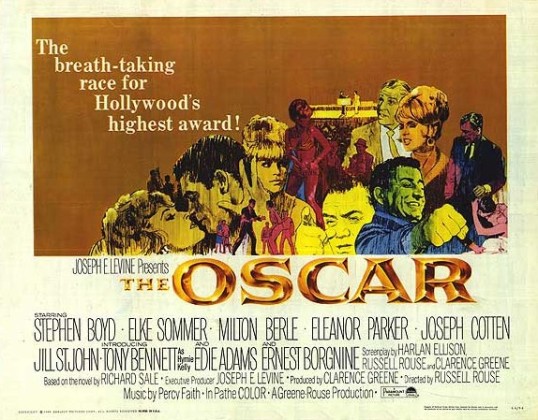
Since the Oscars are going to be awarded on Sunday night, now seems like a good time to remember the 1966 film, The Oscar. My friends and I have a running joke. Whenever I invite anyone to watch a bad movie with me, I never actually say, “Let’s watch this terrible movie.” Instead, I always say, “This is a cult classic.” Let’s just say that The Oscar is a classic among cult classics.
Directed by Russell Rouse, The Oscar tells the story of Frankie Fane (Stephen Boyd) and his friend, Hymie Kelly (Tony Bennett ….. yes, the singer). Frankie uses everyone in the world to become a film star and abandons them all once he becomes famous. Frankie is determined to cement his stardom by winning an Oscar and he’s totally willing to go to all sorts of unethical lengths to win that golden statuette. He even hires a private investigator (Ernest Borgnine, naturally) to leak private information about Frankie and his friends, in the mistaken belief that it will cause the Academy to sympathize with him.
However, Hollywood is not a place for heels! Or, at least, that’s the case in this film. In the scenes below, Frankie first gets told off by his old friend Hymie and then he gets the ultimate comeuppance at the Oscar ceremony itself. Apparently, Frankie failed to consider that he wasn’t the only Frank nominated that year!
I constantly tout CASABLANCA as my all-time favorite movie here on this blog, but I’ve never had the opportunity to talk about my second favorite, 1952’s SINGIN’ IN THE RAIN. Sadly, that opportunity has finally arisen with the death today of Stanley Donen at age 94, the producer/director/choreographer of some of Hollywood’s greatest musicals. Donen, along with his longtime friend Gene Kelly, helped bring the musical genre to dazzling new heights with their innovative style, and nowhere is that more evident than in SINGIN’ IN THE RAIN.
The plot of SINGIN’ IN THE RAIN is fairly simple: Don Lockwood (Kelly) and Lina Lamont (Jean Hagen) are a pair of silent screen stars for Monumental Pictures. Lina believes the studio publicity hype about them being romantically linked, though Don can barely tolerate her. At the premiere of their latest film, Don is mobbed by rabid fans, and jumps into a car…
So, I finally sat down and watched the 2017 film, The Post.
The Post is something of an odd film. Imagine if someone made a film about the production of a movie. And imagine if, instead of focusing on the actors or the members of the crew or even the director, the film was instead about the studio executives sitting back in Hollywood and debating whether or not they should agree to give the director another million dollars to complete the film. Imagine dramatic scenes of the execs meeting with their accountants to determine whether they can spare an extra million dollars. Imagine triumphant music swelling in the background as one of the execs announces that they’ll raise the budget but only in return for getting to pick the title of the director’s next film. The Post is kind of like that. It’s a film about journalism that’s more concerned with publishers and editors than with actual journalists.
To be honest, The Post‘s deification of the bosses shouldn’t really be that much of a shock. This is a Steven Spielberg film and a part of Spielberg’s legend has always been that, of all the young, maverick directors who emerged in the 70s, he was always the one who was the most comfortable dealing with the studio execs. As opposed to directors like Martin Scorsese, Brian DePalma, and Francis Ford Coppola, Spielberg got along with the bosses and they loved him. While his contemporaries were talking about burning Hollywood down and transforming the culture, Spielberg was happily joining the establishment and reshaping American cinema. No one can deny that Spielberg is a talented filmmaker. It’s just that, if anyone was going to make a movie celebrating management, you just know it would be Steven Spielberg.
Taking place in the early 70s, The Post deals with the decision to publish The Pentagon Papers, which were thirty years worth of classified documents dealing with America’s involvement in the Vietnam War. Since the Pentagon Papers revealed that the government spent several decades lying to the American people about the situation in Vietnam, there’s naturally a lot of pushback from the government. It all leads to one of those monumental supreme court decisions, the type that usually ends a movie like this. And while the film does acknowledge that there were journalists involved in breaking the story, it devotes most of its attention to editor Ben Bradlee (Tom Hanks) and publisher Katharine Graham (Meryl Streep).
Gasp as Ben and Katharine debate whether to publish the story!
Shudder as Katharine tries to figure out how to keep the Post from going bankrupt.
Watch as Ben Bradlee talks to the legal department!
Thrill as Katharine Graham learns that her family friends, John F. Kennedy and Lyndon B. Johnson, weren’t always honest with her!
And listen, I get it. The Post isn’t as much about Nixon and the Vietnam War as it’s about Trump and the modern-day war on the media. And yes, we get plenty of scenes of Tom Hanks explaining why freedom of the press is important and the movie ends in typical Spielberg fashion, with triumphant music and all the rest. But watching The Post, it’s hard not to think about other films that celebrated journalism, films like All The President’s Menand Spotlight. Both of those films featured scenes of editors supporting their reporters. In fact, All The President’s Men featured Jason Robards playing the same editor that Tom Hanks plays in The Post. But Spotlight and All The President’s Men focused on the journalists and the hard work that goes into breaking an important story. Robards and Spotlight‘s Michael Keaton played editors who were willing to stand up and defend their reporters but, at the same time, those films emphasized that it was the underpaid and underappreciated reporters who were often putting their careers (and sometimes, their lives) on the line to break a story. Whereas Spotlight and All The President’s Men showed us why journalism is important, The Post is content to merely tell us.
The Post was a famously rushed production. Shooting started in May of 2017 and was completed in November, all so it could be released in December and receive Oscar consideration. Production was rushed because Spielberg, Streep, and Hanks all felt that it was important to make a statement about Trump’s treatment of the press. While I can see their point and I don’t deny that they had noble intentions, a rushed production is still going to lead to a rushed film. The Post is a sloppy film, full of way too much on-the-nose dialogue and scenes that just seem to be missing Spielberg’s usual visual spark. It feels less like a feature film and more like a well-made HBO production. Tom Hanks and Meryl Streep give performances that are all surface. Streep’s performance is all mannered technique while Hanks occasionally puts his feet up on his desk and furrows his brow.
It gets frustrating because, watching the film, you get the feeling that there’s a great movie to be made about the Pentagon Papers and the struggle to publish them. I’d love to know what the actual reporters went through to get their hands on the papers. But The Post is more interested in management than the workers.
All through 2017, The Post was touted as being a sure Oscar front-runner. When it was released, it received respectful but hardly enthusiastic reviews. In the end, it only received two nominations — one for best picture and one for Streep. In a year dominated by Lady Bird, Shape of Water, Get Out, and Three Billboards Outside Ebbing, Missouri,The Post turned to be a nonfactor. For all the hype and expectations, it’s the film that you usually forget whenever you’re trying to remember everything that was nominated last year.
The 2014 film, The Imitation Game, takes place in three very different time periods.
The majority of the film takes place during World War II. While the Germans are ruthlessly rolling across and conquering huge swaths of Europe, the British are desperately trying to, at the very least, slow them down. A key to that is decrypting the secret codes that the German forces use to communicate with each other. Since the Germans change the code every day, the British not only have to break the code but also predict what the next day’s code will be.
Working out of a 19th century mansion called Bletchley Park, a small group of mathematicians, chess players, and spies work to design a machine that will be able to decode the German messages. Heading up this group is a man named Alan Turing (Benedict Cumberbatch). Alan is a remote and, at times, rather abrasive figure, a man who appears to be more comfortable dealing with equations than with other human beings. The people working under him occasionally chafe at Alan’s lack of social skills. Commander Denniston (Charles Dance) suspects that Alan’s a Russian spy and would just as soon close down the entire operation. At first, the only person who seems to have any faith in Alan’s abilities appears to be Winston Churchill himself.
It’s only when Joan Clarke (Kiera Knightley) joins Alan’s team that they start to make progress. Joan brings Alan out of his shell and teaches him how to deal with other human beings. When Joan’s parents object to her being away from home, Alan even offers to marry her. Of course, Alan also explains that it would just be a marriage of convenience, one that will last until they get Christopher up and working.
Christopher is the name that Alan has given to his encryption machine. Why Christopher? Throughout the film, we get flashbacks to Alan’s time in boarding school and his close friendship to another student, a boy named Christopher.
And finally, serving as a framing device to both the World War II intrigue and Alan’s relationship with Christopher, is a scene that’s set in 1951. Alan’s home has been broken into and, as the police investigate the matter, they come to realize that Alan is hiding something about both his past and his present. Their initial assumption is that Alan must be a communist spy. The truth, however, is that Alan is gay. And, in 1951 Britain, that is a criminal offense….
The Imitation Game is based on a true story. During World War II, Alan Turing actually was a codebreaker and he did play a pivotal role in creating the machine that broke the German code. After World War II, Turing was arrested and charged with “gross indecency.” Given a choice between imprisonment or probation and chemical castration. Turing selected the latter and committed suicide in 1954. Alan Turing’s work as a cryptographer is estimated to have saved 14 million lives during World War II but he died a lonely and obscure figure, a victim of legally sanctioned prejudice.
Admittedly, The Imitation Game does take some liberties with history. For one thing, most of the people who worked with Turing described him as being eccentric but not anti-social. Though the film pretty much portrays the decoding machine as solely being Turing’s creation, it was actually a group effort. Perhaps the biggest liberty that the film takes is that the machine was never called Christopher. Instead, it was called Victory.
That said, The Imitation Game is still a strong and effective film. Anchored by a brilliant lead performance from Benedict Cumberbatch, The Imitation Game is a film that manages to be both inspiring and infuriating at the same time. It’s impossible not to get caught up in the team’s joy as they realize that they actually can beat the Germans at their own encryption game and, after spending 90 minutes listening to everyone doubt Alan’s abilities, you’re more than ready to see him and his unorthodox methods vindicated. And yet, because of the film’s framing device, you already know that Alan is not going to get the credit that he deserves for his hard work. Instead, he’s going to be destroyed by the laws of the very country that he worked so hard to save. Success and tragedy walk hand-in-hand throughout The Imitation Game and the end result is a very powerful and very sad movie.
I have to admit that it was a bit jarring when the opening credits appeared onscreen and the first words that I read were “The Weinstein Company Presents.” It’s only been a year and a half since Harvey Weinstein was finally exposed and forced out of power but it’s still easy to forget just how much the Wienstein Company used to dominate every Oscar season. In many ways, with its historical setting and its cast of up-and-coming Brits, The Imitation Game feels like a typical Weinstein Company Oscar contender. In this case, The Imitation Game was nominated for a total of 8 Oscars, including Best Actor for Benedict Cumberbatch, Best Supporting Actress for Keira Knightley, Best Director for Morten Tyldum, Best Adapted Screenplay for Graham Moore, and Best Picture. In the end, only Moore won his category. In a decision that continues to confound me, the Academy named Birdman the best film of the year.
Listen, there’s a lot of things that can be said about the 1952 Best Picture winner, The Greatest Show on Earth. Not only was it one of three Cecil B, DeMille films to be nominated for best picture (along with 1934’s Cleopatra and 1956’s The Ten Commandments) but it was also the only one to win. It brought Cecil B. DeMille his first and only nomination for best director. (DeMille lost that directing Oscar to John Ford but he still took home an award, as the producer of The Greatest Show On Earth.) The Greatest Show on Earth not only featured Charlton Heston in his first starring role but, with a finale that featured everyone involved in the same spectacular train crash, it also set the standard for the countless disaster movies that would follow.
But, with all of that in mind, the main thing that you’ll remember about this movie is that Jimmy Stewart was Buttons the Clown.
Buttons is a beloved member of the Ringling Bros. and Barnum & Bailey’s Circus. He travels with the circus across the country, entertaining children and generally helping out wherever he can. Everyone loves Buttons, despite the fact that no one has ever seen him without his makeup. (That said, you only have to hear him speak to immediately recognize him as being played by Jimmy Stewart.) Not even the circus’s no-nonsense manager, Brad Braden (Charlton Heston, naturally), knows what Buttons actually looks like. Everyone assumes that Buttons is just a dedicated performer, a method clown.
However, it turns out that Buttons has a secret. Of course, nearly everyone at the circus has a secret but Buttons’s secret is a little bit more serious than just a love triangle or a case of professional jealousy. There’s a reason why Buttons is surprisingly good at providing first aid to the members of the circus. Before he was a clown, Buttons was a doctor. And, while he was a doctor, he killed his wife.
NO! NOT JIMMY STEWART!
In Buttons’s defense, it was a mercy killing and he feels really bad about it. That, of course, doesn’t matter to the FBI agent (Henry WIlcoxon) who suspects that the doctor may be hiding among the circus performers. At first, Buttons views that train crash as the perfect opportunity to escape but then he finds out that many of his fellow performers have been seriously injured. A doctor is needed. Perhaps even a doctor in clown makeup….
Even under all that makeup, Jimmy Stewart does a great job of bringing Buttons to life. Sometimes, we associate Stewart so much with his famous way of speaking that we overlook just what a good actor Jimmy Stewart actually was. Even before you discover why Buttons is running from the cops, Stewart does a good job of capturing the sadness and the regret that lies at the heart of Button. He’s truly a tragic clown.
Buttons’s status as a fugitive is just one of the many subplots to be found in The Greatest Show On Earth. There’s a lot of drama (not to mention parades and performances) to get through before that train crashes. Brad, for instance, is struggling to keep the circus from going bankrupt. Meanwhile, his girlfriend, Holly (Betty Hutton), is torn between him and the arrogant but charming Great Sebastian (Cornel Wilde). In fact, every woman in the circus — including Gloria Grahame and Dorothy Lamour — is in love with the Great Sebastian. Sebastian is a bit self-centered but he’s famous enough to ensure that the circus won’t have to be closed. Or, at least, he is until he’s injured in a trapeze accident. Will Sebastian ever perform again? Meanwhile, there’s a jealous elephant trainer named Klaus (Lyle Bettinger) and a crooked concessionaire named Harry (John Kellog). A local gangster, Mr. Henderson (Lawrence Tierney), is trying to muscle his way into the circus’s business. Is it any surprise that Brad always seems to be in something of a bad mood? He’s got a lot to deal with!
And yes, it’s all a bit overblown and a bit silly. And yes, the film really does feel like it was meant to be a commercial for Ringling Bros. And yet, in its way, the film definitely works. There’s a sincerity at the heart of the film, one that’s epitomized by Cecil B. DeMille’s opening narration. “”A fierce, primitive fighting force that smashes relentlessly forward against impossible odds: That is the circus — and this is the story of the biggest of the Big Tops — and of the men and women who fight to make it — The Greatest Show On Earth!” DeMille was 71 years old when he made The Greatest Show On Earth and he was coming to the end of a legendary filmmaking career. DeMille was one of the founders of the American film industry and you can argue that, if not for some of his silent spectacles, Hollywood would have always remained just a neglected suburb of Los Angeles. If anyone understood that importance of that old saying, “The show must go on!,” it was Cecil B. DeMille. And really, that’s what The Greatest Show On Earth is all about. It’s a tribute to the performers who refuse to give up. Love triangles? Fugitive clowns? Injured acrobats? Lawrence Tierney? No matter what, the show must go on!
The Greatest Show On Earth is often described as being one of the worst films to win the Academy Award for Best Picture. That has more to do with the quality of the films that it beat — High Noon, The Quiet Man, Moulin Rouge, and Ivanhoe — than the film itself. The Greatest Show On Earth is old-fashioned and a bit silly but it’s still entertaining. Should it have beaten High Noon? That would be a definite no. But it’s still better than Crash.
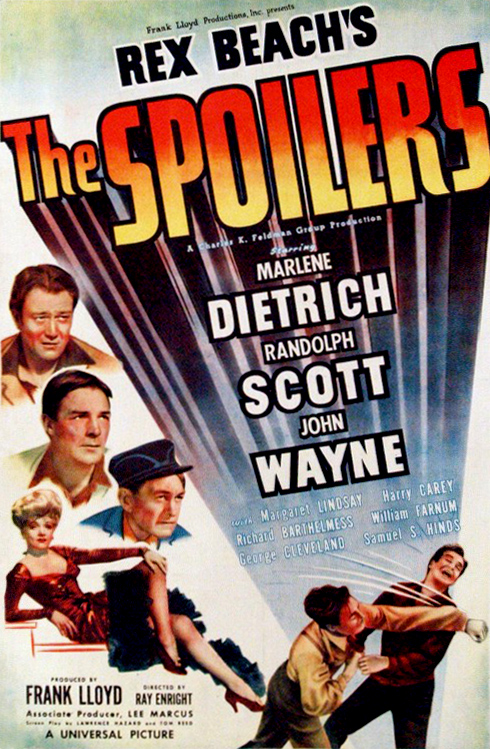
What’s this?? A “Northern” Western set in 1900 Alaska Gold Rush territory starring my two favorite cowboys, John Wayne and Randolph Scott ? With the ever-enticing Marlene Dietrich thrown in as a sexy saloon owner? Count me in! THE SPOILERS is a big, brawling, boisterous film loaded with romance, action, and, most importantly, a sense of humor. It’s the kind of Hollywood entertainment epic that, as they say, “just don’t make ’em like that anymore”. I’ve never been quite sure who “they” are, but in regards to THE SPOILERS, they’re right – and more’s the pity!
Rex Beach’s popular 1906 novel had been filmed three times before (1914, 1923, 1930), and would be one more time after (in 1955), but with The Duke, Rugged Randy, and La Dietrich on board, this has got to be the best of the bunch. Even though audiences were more than familiar with the story…