Review: Welcome Home, Brother Charles (dir. by Jaama Fanaka)


Recently, I decided to try to track down and watch every single movie featured in Synapse’s 42nd Street Forever DVD collection.  Some of these movies have been unexpectedly brilliant and quite a few have been the exact opposite.  But none have been quite as wonderfully odd as a low-budget blaxploitation film entitled Welcome Home, Brother Charles.  If ever I have to explain who I am, I’ll do so by stating that I hated Avatar but I loved Welcome Home, Brother Charles.

The plot of Welcome Home, Brother Charles is almost simplicity itself.  Charles (played by Marlo Monte) is a small-time criminal who is struggling to get by in the Los Angeles ghetto.  At the start of the movie, Charles is arrested by two, white policemen.  While making the arrest, the more racist of the two cops attempts to castrate Charles (or as Charles later puts it, “damn near cuts off my manhood”).  Unfortunately, this is America in the 1970s and that can only mean that Charles is destined to go to prison while the racist cop is proclaimed a hero. 

After doing the “man’s time,” Charles is released from prison and finds himself back out on the mean streets of L.A.  However, things have changed.  His former best friend has now set himself up as the local godfather and is none too happy to see Charles wandering around.  Even worse, Charles discovers that the man who “damn near cut off (his) manhood” is still being proclaimed a hero.  Charles responds the way anyone would.  He seeks revenge against his enemies by 1) seducing their wives and 2) strangling those who have betrayed him with his penis.

Yes, that’s right.  Charles goes into prison as a small-time criminal but he comes out as some sort of X-rated super hero.  Not only can he seduce women simply by kissing them but he can now mentally turn his penis into a boa constrictor.  Add to this, director Jaama Fanaka doesn’t shy away from showing us Charles’ penis stretching across the screen and strangling his enemies.  When you consider that this feat was accomplished without CGI, you can only conclude that either Fanaka is a very talented director or that Marlo Monte was a very lucky man.

Whether it’s Charles constantly lamenting the fact that he nearly lost his “manhood” or then using that manhood to kill his enemies, Welcome Home Brother Charles is a penis-obsessed film. 

(Strangely enough, that word is never actually uttered in the film.  Nor do we hear any other of the common terms for the male organ.  Instead, we just hear the term “manhood” a few hundred times.) 

What was especially odd was that the film took an almost nonchalant attitude towards the scenes involving Charles and his magic penis.  At no point are we offered any explanation of just how exactly Charles acquired this power.  Nobody seems to be all that shocked by it.  You would think at least one of his victims would, at some point, say, “Oh, c’mon, you’re not seriously going to strangle me with your penis, are you?” 

I found myself wondering if perhaps this was actually a common thing, maybe one of those guy things that I, as a result of gender, simply do not know about.  After I watched the movie, I called up my friend Jeff and I asked him, “If you concentrate really hard, can you use your penis to pick things up and maybe strangle people?”

He was quiet for a few minutes before saying, “Uhmm…sure.” 

What’s even stranger than the sight of grown men being strangled by a gigantic penis is that director Fanaka appears to be taking this story very seriously.  There’s little deliberate humor in the movie and the actors all play their roles with an admirable seriousness.  In the lead role, Monte is probably as a convincing as anyone could be while using their penis to strangle another human being.

The thing about this movie is that when Welcome Home, Brother Charles works, it truly does work.  Charles’ time in prison is represented by a series of grim, black-and-white stills that roll over a soundtrack composed of horrific screams.  This montage is surprisingly disturbing and, in a manner of minutes, let’s us know the Hell that Charles goes through as a convict.  When, after being released from prison, Charles visits his old neighborhood, Fanaka gives us a much more joyful montage of Monte interacting with the people living there.  Directed in a cinema verite style, there’s a lively energy to these scenes that actually adds a rather tragic dimension to the rest of Charles’ story. 

These are the type of scenes (along, of course, with the sight of Charles strangling people with his penis) that would never appear in a mainstream film.  The prison scenes would have been filled with stereotypical predatory homosexuals and shanks-in-the-shower scenes that would have served as traditional crowd pleasers but would have carried absolutely no emotional impact.  As for the montage of Charles in his old neighborhood, forget about it.  That sequence would have hit the cutting room floor, sentenced to maybe show up as a DVD extra if that.  If nothing else, this movie shows why the grindhouses were necessary and how much we’ve lost with their decline.

Like many grindhouse films, Welcome Home, Brother Charles was released under several different titles.  It’s been released on DVD under the title Soul Vengeance.  If you’re the type of DVD snob who likes to show off by talking about “transfers,” the transfer here is a bit grainy but quite honestly, this is a movie that needs to be grainy.  For best viewing experience, invite several homeless drug addicts over to hang out as you watch the movie and turn your living room into your own private grindhouse.
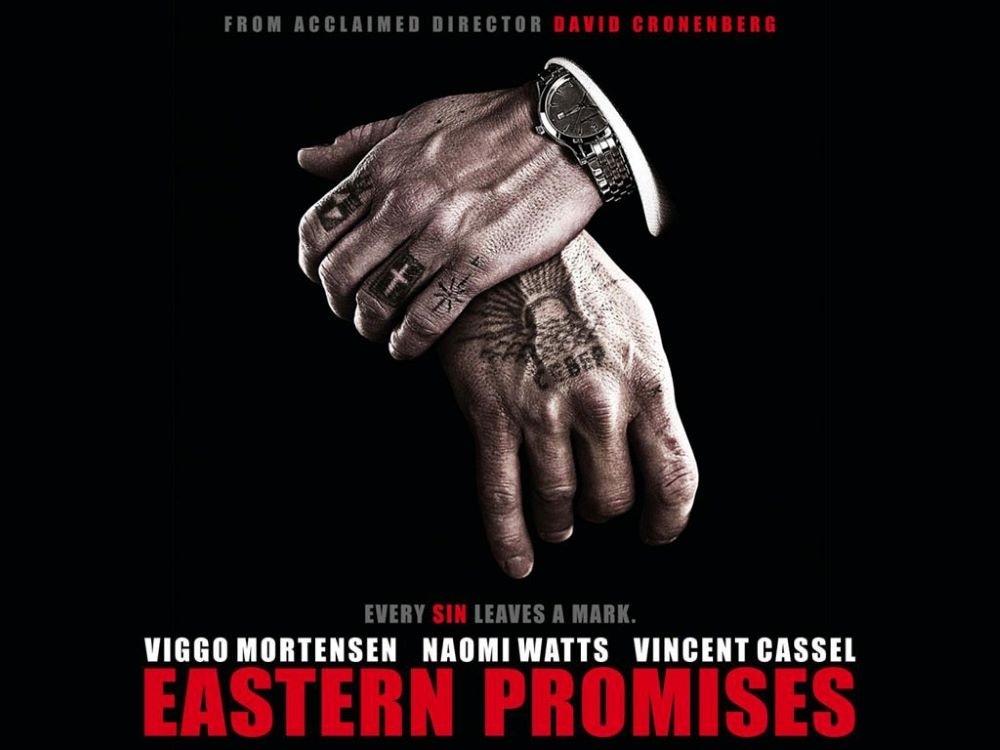
Review: Eastern Promises (dir. by David Cronenberg)


“You can’t always be in control.” — Nikolai Luzhin

In 2005 Canadian filmmaker David Cronenberg brought to the silver screen a film that was both a taut, smart crime-thriller and also a well-done film treatise on the nature of violence and how it changes not just witness’ perception of an individual but about themselves as well. The film also introduced what might be the newest creative pairing that could be on par as other pairings like Scorsese-DeNiro and Burton-Depp. The pairing I speak of is that of Cronenberg and his growing repertoire with actor Viggo Mortensen. They scored a critical hit with A History of Violence and in 2007 they collaborate in another crime-drama that more than lives up to their initial collaboration. Eastern Promises is a taut and meticulous drama which brings new eyes and a different approach to the mob film genre made famous by Coppola and Scorsese.

The film begins innocently enough with a very pregnant teenage Russian girl named Tatiana entering a neighborhood store. While Cronenberg chose to open up A History of Violence nary any musical cues and backgrounds to create a sense of naturalism and plant a seed of unease in the audience of what’s to come, he does the opposite with Eastern Promises by allowing long-time collaborator Howard Shore to score this opening scene with a haunting violin solo. Even right from the start Cronenberg’s propensity to use a sudden image of violence to shock the audience works well to set the tone for the film. It is not the usual filmgoing experience to see a young girl, looking lost and afraid of her surroundings, suddenly and bloodily starts to give birth in the middle of a store. It is from the diary entries of this young girl where we get glimpses of the true meaning of the film’s title and sets up the clues and tidbits that Cronenberg gradually fills in as the film progresses and the main characters investigate the girl’s death and the full contents of her diary.

We’re quickly introduced to Anna Khitrova (played with touching compassion and a certain naivete by Naomi Watts), midwife at the London hospital where Tatiana dies from bloodloss due to childbirth. Having had experienced her own personal tragedy regarding a past pregnancy Anna takes it upon herself to find the next of kin or, at the very least, close friends who might know Tatiana and thus claim the child and care for her. It was finding Tatiana’s diary and the business card tucked within amongst the young girl’s meager possessions which gives Anna a starting point for her investigation and search.

It is during this search into Tatiana’s life that Anna encounters Nikolai Luzhin (Viggo Mortensen at his most chameleonic), the personal driver of one Semyon (as played by Armin Mueller-Stahl). Semyon charms Anna with his old world grandfatherly persona yet both the audience and Anna feels something off, even sinister beneath the charm and twinkling eyes. Semyon is not just the owner of the Trans-Siberian, a Russian restaurant, but a boss in the vory v zakone also known as the Russian Mafia. It is through Nikolai that we see the underbelly of Tatiana’s life before her death.

It is during the second half of the film that the film takes a clear turn into Cronenberg territory. With all the players in play Eastern Promises starts to peel the layers on all the characters. Just like in A History of Violence every character in this unofficial follow-up to that film go on through the film living dual-lives. Even Anna’s seeming naivete, in regards to the danger she faces in Semyon and his unstable son Kirill, shows a modicum of world-weariness born out of personal tragedy and those she sees on a daily basis when working as a midwife in the hospital.

Cronenberg doesn’t just try to tell a crime drama about the mob and the subculture they live and die in but he adds his own personal stylistic and metaphorical touches on the mob film conventions. While in the past he has taken on the immutability of the body and the physical nature of man in his later years he has moved on to the amorphous nature of man’s very nature as both a civilized and reasoned animal to the primal being which lurks within each. Eastern Promises delves into this metaphysical topic by showing the natures of both Nikolai and Semyon. Both of whom, at first glance, inhabiting a particular stereotype but soon showing the opposite as the audience gets to know them. Even the twists in the story in the middle section and close to the end doesn’t seem like cheap plot tricks but a logical and almost mathematical conclusion to the very themes Cronenberg has been exploring right from the beginning.

The performances by the cast was top-notch from top to bottom. David Cronenberg’s always has had a reputation for being an actor’s director. His willingness to allow his actors to not just play the part but find ways to become their characters makes his films some of the more well-acted one’s of the last quarter-century. From Watts’ own touching performance as the moral center of the film in Anna to Cassel’s unstable and coward of a bully in Kirill the work put on by the actors adds a level of gravitas to a story that has it’s roots in pulp crime stories and not the high-brow tales prestige films like Eastern Promises has been compared to. But the two stand-out work comes from Viggo Mortensen as the enigmatic Nikolai and Armin Mueller-Stahl as Russian mob boss Semyon. Where Watt’s performance was subtle and Cassel’s literally scene-chewing both Mortensen and Mueller-Stahl bring forth nuanced performances full of life and complexities that makes both characters stand out above a cast already doing great work.

Mortensen’s work as Nikolai actually surpasses his previous Cronenberg-directed role in Tom Stalls of A History of Violence. Viggo has always been quite the Method actor and really loses himself in every role he takes on, but it took him being paired up with Cronenberg for critics and cineastes to finally realize how great an actor he really has become in the last decade. His Nikolai oozes a charisma from the moment he enters the film. He makes Nikolai not just a thug with a brain and a semblance of compassion beneath the rough surface. Mortensen literally becomes Nikolai right down to the very tattoos which tells his character’s criminal past in ink. One could not help but be mesmerized by Mortensen’s work in this film that it was easy to forget that he was playing a part and not actually living that life. To say that Mortensen may have found his creative soulmate in Cronenberg would be quite the understatement and with more projects in the future linking the two together it wouldn’t be a surprise if the two in conjuction finally get the critical awards that has eluded both.

While A History of Violence showed that Cronenberg could work beyond the genre and esoteric genres of his part works, it is with Eastern Promises that we see him move towards a more mainstream type of work. Yet despite a work more accessible than before he still was able to add his own style of storytelling and explore themes usually not seen in crime dramas and mob films. It is this ability to marry the violent pulp with the intellectual high-brow which makes Eastern Promises a delight for both the general filmgoer and the arthouse cineaste. Time will only tell if the successful streak by the duo of Cronenberg-Mortensen continues as the two continue to work together in the years to come.

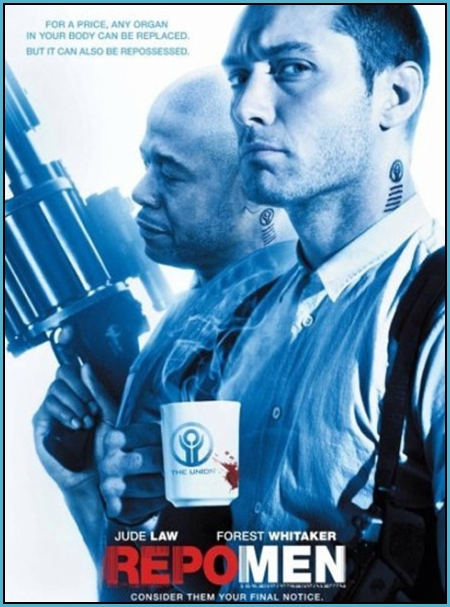
Review: Repo Men (dir. by Miguel Sapochnik)


In the beginning of 2010 a scifi-horror film arrived in the theaters to much internet hype. This film showed a future world where a massive societal change and the resulting health crisis following it was described in detail. It was a film which cleverly built a world so different from out very own yet still very similar in its foundation. This film was Daybreakers and for all the wonderful world-building it did to establish a foundation for the story being told the film couldn’t find it’s way to having the film’s plot match what the filmmakers’ established in the beginning. I say this because it is now late March 2010 and another film has done another wonderful job of establishing a future world so very different and yet so very similar in many ways. Where the Spierig Brothers failed in more ways than one to have the rest of Daybreakers live up to the world established in the beginning and a premise that was quite new, Miguel Sapochnik did a much better job — albeit still flawed — in allowing the plot for Repo Men live up to the world established in the opening minutes of the film.

In the near future of Repo Men medical science and technology has advance far enough that most organs and parts of the human body can be artificially replaced when they failed. While this detail of the film sounds like the makings of a future utopia it’s actually much closer to our own reality in that these organs, despite being mass-produced, are still only affordable to the rich. Artificial organs (artiforgs in this film’s vocabulary) sold to the rich like luxury items. Those not-so-rich, but desperate to try and find a way to change a fatal health situation, also offered these artiforgs on a monthly payment plan suitable to their current expense situation. It’s mostly these payment plan artiforg owners who experience the skill sets of the so-called “repo men.” These are individuals employed by the artiforg company called The Union who sell the products. When someone misses too many payments on their artiforgs and goes delinquent on their payment plan then the repo men will be knocking on their door to take back the synthetic organ. It’s similar to banks repossessing cars and homes when payments are not made.

The film’s told in the point of view of one of these repo men. Jude Law’s character Remy is one of The Union’s top repo men who we see enjoys his work despite the ultimate consequence of what he does to the people whose artiforgs he takes back. His partner is Jake (played with childish glee by Forest Whitaker). The two have been friends since grade school and both share a similar sense of sociopathy when it comes to violence. To say that they’re like brothers minus the shared genetics won’t be too far off. The first third of Repo Men shows the audience these two organ repossessors in their element as they hunt down those delinquent in their plan and those who have turned to the black market for their artiforgs. The film’s touches upon the current public hysteria of the two sides in the health care debate. While the film touches upon this current debate it does so without being too broad or preachy. It’s done subtly and without having it distract the audience from the film’s story.

The film does sing and move at an entertaining pace during the first third, but inevitably it does reach a point where the conflict of the story shows itself to add a dramatic ingredient to the film. It’s during what was to be Remy’s final repo mission before he heads over to a less paying, but safer job as sales in The Union that he goes from the repossesser to potential possessee. The switch in roles soon has Remy unable to do what he’s been so good at as cutting into someone delinquent on their artiforg when he himself now has one keeping him alive. It’s a common storytelling telling idea of the insider getting a taste of their own medicine and seeing how the other side lives. Avatar used it late last year and Daybreakers did it clumsily earlier this year.

This second third of the film has some character development flaws which could be attributed to some of the script’s weakness. While Remy’s sudden inability to do his job as a repo man after his own artiforg surgery makes sense the one-note characterization of his wife (played by the Black Book‘s Carice von Houten) who leaves him during this crisis of faith adds an unnecessary factor to his problems. In actuality the roles of the wife and Remy’s son could’ve easily been left off the film and just had the story be about Remy and his long-time friend and fellow repo man Jake. This would’ve been enough conflict and drama to power the rest of the film. This is where less would’ve definitely more and keep the story lean, mean and definitely more efficient. But even with this misstep in the film’s script it doesn’t sink the film. This could be attributed to some strong performances from Jude Law who manages to credibly transition from what amounts to be a paid serial killer to one having his eyes opened to the devastation he has wrought on individuals and families. Even the scene-chewing done by Whitaker as Jake doesn’t diminish Law’s performance and instead just shows that despite some of the horrible things Remy’s done he’s actually the sanest person in the film w/ everyone else close around him playing certain caricatures whose roles are to push him one way or another to picking a side on the issue of artiforgs and their repo issues.

It is in the beginning of the third act which may make or break the film for those who have stayed with it through the first acts. A particular even happens which transitions act to three which ramps up the action to it’s bloodiest and, at times, quite Cronenbergian level. It is this third act which pays homage to several great action-thrillers of the past decade. One scene in particular tries to emulate the classic hallway fight scene from Oldboy. This time around more weapons are used from knives, guns and all the way to a medical hacksaw. This scene leads up to another which pays homage to another Jude Law film of the past with a Cronenberg pedigree. While bloodier than similar scenes in eXistenZ there’s no denying that Sapochnik sure loves his Cronenberg. The climactic finish to the film before a sort of epilogue of a twist just builds and builds throughout the third act. For some the epilogue’s reveal may and will ruin the rest of the film as it seems like a cop-out of a plot twist, but I thought it was actually well done and gives a new meaning to the conventional Hollywood happy ending to an action-thriller.

As a first-time feature-film director Miguel Sapochnik has a deft and keen eye for visuals. The artistic design of the near-future world of Repo Men shows influences from the consumeristic dystopian future of Blade Runner up to the grounded in futurist science of Spielberg’s Minority Report. He’s quite adept at blocking and handling the many action setpieces which helped keep the film from being bogged down by flaws in the script and some uninspired characters. Sapochnik does need to get a better feel for how his cast interacts with each other. As stated earlier with the exception of Law’s Remy character and Liev Schrieber’s delicious turn as a gleefully amoral example of corporate evil at its best, the rest of the cast seem uninspired from von Houten’s role as Remy’s wife right up to Alice Braga’s performance as Beth, the artiforg addicted singer Remy hooks up with halfway through the film.

Repo Men could’ve easily gone highbrow in addition to keeping to it’s genre trappings the way the Spierig Brothers tried to do with Daybreakers. Fortunately, Sapochnik w/ writers Eric Garcia and Garrett Lerner kept things focused on Remy’s journey from hunter to prey to “savior” without trying to overly explain his motivations. While they weren’t subtle in all things they tried to tell with the story they gamely tried to stick to the rule of showing and not telling everything. For his directing debut Sapochnik does a good job despite he flaws and shows promise.

In the end, Repo Men is a very good scifi action-thriller which delivers on its title. Despite missteps in the writing and some uninspired characters the film still turned out to be quite entertaining. It was a fast-paced film with several bloody, gore-filled action setpieces timed to pick up the film when dialogue and exposition starts to drag it down. Miguel Sapochnik’s debut feature-film could easily have turned off the rails and went in so many different directions but he kept things on the straight and narrow. While for some the ending will infuriate and negate what fun they were having through most of the film it also would be seen by others as an inspired take on the Hollywood happy ending. Repo Men won’t be mistaken as the next Brazil and Sapochnik won’t be mistaken as the next Cronenberg or Park Chan-wook, but both filmmaker and film is better than it should be and wholly entertaining from start to finish.

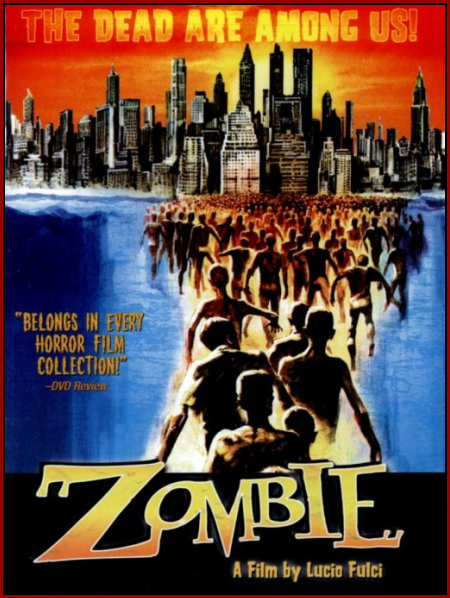
Review: Zombie (dir. by Lucio Fulci)


1979 saw the release of a film titled Zombi 2. It was suppose to be an unofficial sequel to Romero’s own Dawn of the Dead which was released in Italy under the title of Zombi. many thought this pseudo-sequel was a way to cash-in on the success of Romero’s film in Italy. This wasn’t true for the fact that it’s director and producers had already been working on their own zombie film as Romero started on Dawn of the Dead. It was by coincidence that both were released within the same year and in order to try and tie the two films together their titles reflected it.

Lucio Fulci’s Zombi 2 (or just plain Zombie in the US) has no connection whatsoever with Romero’s own Dawn of the Dead except for the zombies and the rules governing their destruction. This is not to say that Fulci’s Zombi 2 wasn’t good. In fact, I would say that Zombi 2 was, and still a great horror movie that’s been unfairly compared with Romero’s ultimate zombie classic. The two films tell different type of stories even when sharing similar plot devices and rules. Where Romero used the backdrop of the zombie epidemic as a damning visual commentary on the growing consumerism culture in the United States, Fulci’s film eschews any such social observations and goes for pure horror instead.

Zombi 2 helped begin the Italian cinema’s love of zombie movies and Fulci’s film still stands as the best of the lot. Starring Tisa Farrow as Ann, the daughter of a missing doctor working in the Carribean, and Ian McCulloch as reporter Peter West who helps Ann try to solve the mystery of her father’s disappearance in one of the Carribean Islands. The only clue they have being the mysterious reappearance of a boat belong to Ann’s father. A drifting yacht which, when inspected by NY Harbor Patrol, a disfigured, obese man violently attacks one of the patrolmen before falling overboard into the city harbor. From that moment on, Ann and Peter head off to her father’s last location on the Carribean island of Matool. Once on Matool, Ann and Peter discover that one of her father’s colleagues, a Dr. Manard, has been trying to solve the mysterious disease, or curse as the native islanders call it, which her father became afflicted with. A disease which seem to kill those it infects and then return them to life to attack the living.

These two are soon joined by a vacationing couple who seem to have arrived on Matool at the worst time. Ann and Peter soon enlist the aid of Brian and Susan, but before they could solve the island’s deadly mystery the island’s dead, both past and recent, rise up from their resting place and doom the remaining inhabitants. One sequence involving these zombies has gone down in horror history as one of the most cringe-inducing scenes on film. It involves the torturously slow sequence where a woman’s head is dragged forward toward a door splinter aimed directly at the woman’s eye. This gore-sequence in addition to the scenes of the zombies attacking and feeding on the visiting Westerners and the remaining living islanders were very well done and all due to make-up FX master Giannetto de Rossi. There’s even a spectacular sequence where a zombie tries to attack and feed on a live shark. Even to this day I still marvel at whichever stuntman volunteered for that action shot.

Zombi 2 has been called a dumbed down attempt to capitalize on Dawn of the Dead. I wholeheartedly disagree with this obeservation. Zombi 2 was never meant to be socially relevant, but one whose only goal was the scare, disgust and disturb its audience with scenes of extreme violence and gore. In this respect Fulci succeeded with the final cut of Zombi 2. The acting itself was very well done considering that half the cast spoke in English as their natural language while the other half were saying their lines in Italian. The dubbing of the Italian-spoken lines were done particularly well. A rarity when it comes to dubbed films.

The final few minutes of Zombi 2 where the Matool survivors make it back to New York through its harbor makes for a great ending. With a city radio station recounting the growing zombie crisis which seemed to have begun while Ann and Peter were on Matool, the final shot of zombies walking on the pedestrian level of the Brooklyn Bridge with cars below them seeming to be rushing out of the city to escape the crisis still makes for a haunting scene. Lucio Fulci’s Zombi 2 might not have been the iconic, cultural and societal masterpiece that was Romero’s Dawn of the Dead, but it more than holds its own when seen as a pure horror film.

Review: A History of Violence (dir. by David Cronenberg)


“In this family, we do not solve our problems by hitting people.” — Tom Stall

David Cronenberg’s A History of Violence opens like a familiar American story but soon transforms into something far darker and more complex—a meditation on how violence reshapes identity and reality itself. The film begins in small-town Indiana where Tom Stall, a mild-mannered diner owner, becomes an overnight hero after killing two violent spree killers who attempt to rob his restaurant. These killers—Billy and Leland—serve as the initial violent intrusion that shatters Tom’s peaceful world and propels the narrative forward. Their actions attract the attention of Carl Fogarty, an East Coast mobster whose relentless pursuit gradually forces Tom and his family to confront a buried, violent history. This confrontation unravels the fragile facade of domesticity and sets the stage for the film’s profound exploration of identity, perception, and the primal tensions beneath civilization.

Cronenberg’s direction is a study in restraint and precision. Far from glamorizing violence, the film presents it as brutally efficient and intimately physical. Cronenberg himself described the action sequences as neither choreographed nor aestheticized but raw, unembellished, and quick—realistic portrayals of violence drawn from street-fighting techniques rather than cinematic spectacle. This choice heightens the emotional impact, making every outbreak of violence feel sudden, close, and devastatingly human. The opening extended shot of the spree killers, for example, follows them in a languid, almost eerie calm before revealing their cold-blooded brutality, establishing an unsettling tone early on. Cronenberg’s camera work—often tight and intimate—immerses viewers in moments where violence erupts not as a fantasy but as a harsh reality, forcing the audience to reckon with its consequences rather than its thrill.

Viggo Mortensen anchors the film with a layered performance that seamlessly navigates the duality of Tom Stall—a man striving for peaceful normalcy—and the darker instincts touched by his mysterious past. Mortensen’s portrayal moves fluidly between the affable family man and the capable, restrained force beneath, embodying the film’s exploration of how violence shapes identity and perception. His physicality and subtle shifts in tone reveal a man perpetually caught between two worlds, never fully belonging to either. Maria Bello as Edie complements Mortensen beautifully, delivering a performance rich in emotional complexity. Her character oscillates between nurturer and survivor, revealing a raw, sometimes unsettling vulnerability beneath her composed exterior. Bello’s nuanced acting gives weight to the evolving dynamics of fear, desire, and trust within their marriage, especially evident in scenes that contrast tender intimacy with underlying tension.

The supporting cast enriches the film’s moral landscape. Ed Harris brings a quiet menace to Carl Fogarty, embodying violence as a cold, business-like inevitability rather than a source of pleasure or spectacle. William Hurt’s portrayal of Richie Cusack is especially memorable—his eight-to-ten-minute screen time is electrifying, providing a darkly charismatic figure who embodies familial loyalty intertwined with brutal pragmatism. Hurt’s performance deftly balances charm and cruelty, offering one of the film’s starkest reminders of violence’s cyclical nature within families. These actors contribute to the film’s thematic depth, portraying violence as a heritage passed down and a force that both defines and corrodes.

Cronenberg’s screenplay, coupled with Howard Shore’s minimalist score, emphasizes mood and psychological tension over action set pieces. The film refuses to indulge in excessive gore or prolonged combat; instead, it presents violence as a disruptive force that shatters normalcy and forces internal reckonings. A notable subplot involving Tom’s teenage son and a school bully underscores the generational transmission of violence and fear, reinforcing the idea that violence’s impact extends beyond immediate events to shape social and familial identities.

One of the film’s most powerful effects is the way it forces viewers to reconsider notions of safety, civility, and identity. Tom’s line, “In this family, we do not solve our problems by hitting people,” starkly contrasts with his son’s chilling rejoinder, “No, in this family, we shoot them.” This exchange encapsulates the film’s core tension—the desire to reject violence while simultaneously being shaped by its inescapable presence. Moments of quiet domesticity are undercut throughout by an ever-present undercurrent of menace, illustrating Cronenberg’s thesis that violence is not merely an event but a contagion of perception and reality.

Ultimately, A History of Violence is a film of dualities—between past and present, civility and savagery, love and fear. Cronenberg’s direction delicately balances these tensions, crafting a film that is at once a taut thriller and a profound psychological study. The performances, especially those of Mortensen and Bello, give the film its emotional resonance, while the supporting cast strengthens its examination of violence’s personal and social ramifications. By the film’s haunting conclusion, viewers are left with a haunting question: can anyone truly escape the shadows cast by violence, or are we forever altered by its imprint?

Review: The Crazies (dir. by Breck Eisner)


While remakes of older films have a tendency to fail in terms of storytelling and just overall quality, for some reason most remakes of George A. Romero’s films seem to do quite well. The Tom Savini-directed remake of the original Night of the Living Dead wasn’t better than the first but was very entertaining and stood on its own merits. The next Romero film to be remade was another of his horror classics, Dawn of the Dead. Another first time director in Zack Snyder handled this remake (despite howls of protests about the attempt to remake a film many consider one of the greats) and what he ended up making didn’t disappoint and has become of the the last decade’s best horror entries. While the remake of Day of the Dead ended up becoming a huge pile of crap I am happy to say that the remake of Romero’s bio-terror flick, The Crazies, under the directing work of Breck Eisner ended up better than I expected and, in my opinion, surpassed the original.

The film adheres pretty close to the original with just the setting having changed from Evans City, PA to Ogden Marsh, Iowa. Using this Midwest backdrop the film quickly establishes that Ogden Marsh is the prototypical Middle America town with everyone in the town of 1260 knowing everyone. They town even celebrates itself as the friendliest town in America. This all changes when a seemingly random and tragic event at a high school baseball game shatters the thin edifice of the town’s neighborly facade. The town’s sheriff (played by Deadwood’s Timothy Olyphant) knows that something is not right when another inexplicable murder happens the following day. The final clue which reinforces this hunch of his is when a trio of local hunters stumble upon the decomposing body of a pilot who died attempting to parachute and landing in a creek marsh close to town. The plane of the said dead pilot is later found. Not knowing what exactly was being ferried (later discovered to be a bio-weapon code-named “trixie”) on this plane the sheriff and his deputy (played by Joe Anderson) soon find the town’s phone lines, cellphone signal and network connection down.

The middle section of the film happens occur with the arrival of “help” in the form of biohazard-suited soldiers forcibly taking all accounted for townspeople from their homes and herding them in the local high school. It is in this section of the film where the remake deviates somewhat from the original. The story never truly establishes just exactly why the soldiers were using extreme tactics and protocols to contain the town and the surrounding area. The film seem to set the military as a faceless machine doing things by-the-book to the detriment of the town and it’s population. The original had the infected and uninfected civilians trapped between the military apparatus trying to contain the outbreak by any means necessary and the scientists flown in to try and find a cure. Writers Kosar and Wright keeps the film centered on the Sheriff Dutton, his pregnant wife (played by Radha Mitchell), his deputy and the his wife’s assistant.

By keeping the film focused on these four individuals the film loses the epic, grand-scale Romero was trying to do with the original and instead we get a more intimate, personal film about survival in a world that suddenly has gotten apocalyptic overnight for these four. It helped the film and Eisner that his two leads in Olyphant and Mitchell were up to the task of giving their husband and wife characters some gravitas in what could’ve easily been just a paycheck performance for them. Olyphant as Sheriff Dutton was especially good in his performance. He kept his character grounded throughout most of the film. Never did he play his character false in that one-minute we get a confused, desperate husband searching for his wife and then next minute we get a badass action hero who can’t get hurt and always coming up aces. Joe Anderson as Deputy Russell Clank who added just a tad bit of levity to an otherwise very tense film from beginning to end.

The infected townsfolk were not zombies as others might like to say. They have a certain similarity to Danny Boyle’s “Rage-infected” but while those seem to get a boost in strenght and speed in The Crazies those who become infected seem to just go all nutfuck crazy. While physical changes occur the longer a person was infected (veins beame inflamed and show up visibly) the “trixie” bioweapon does to those infected what the title says: crazy. Some behave in a crazy non-violent manner with uncontrollable giggling. Some would start rambling for no apparent reason while others become homicidal. It’s the last example which becomes the film’s second danger to the film’s leads in their attempt to survive the night and find safe haven.

It’s from the viewpoint of these four individuals that the audience experiences the night when Ogden Marsh must survive not just the “crazies” but also the government sent in to “help” contain the situation. As stated earlier this time around we do not know the motivations of those sent in to help. The government and the military force sent in are not just faceless, but mechanical in their handling of the situation. People were gathered en masse from their homes and paraded through a series of checkpoints to be checked, prodded and separated from those infected. We hear random bits and pieces of radio communication amongst the soldiers and the scientists controlling the situation, but not enough to know what their true agendas.

As the film progresses the danger posed by the “crazies” themselves seem to pale in comparison when we finally see the final solution the military and the government has come to in dealing with the outbreak. An outbreak caused by an accident and one which happens to occur near this small Iowa town. Just like in Boyle’s own 28 Days Later the solution which the military has come up with to deal with both infected and uninfected ends up being the craziest and horrific action by any and all in the film. There’s a sense of detached horror in how the government decided to truly contain the trixie outbreak.

The film was by no means a great one, but director Breck Eisner does a good job of keeping the film moving forward at a brisk pace right from the start then turning things up the farther in the film we get. By the time The Crazies hit the midway point the film the pacing has gone from brisk to unrelenting. There’s barely a chance for the audience to take a breather from the tension and terror before another one comes along. The decision by the filmmakers to just show the film from the point of view of the sheriff, his wife, the deputy and the assistant keeps some of the moral questions brought up by Romero in the original. Just like with Snyder’s remake of Dawn of the Dead, Eisner goes for the easier route and concentrates on making a thriller instead of trying to push complex social and moral commentaries. While this  might disappoint some fans of the original in the end it makes the film more accessible for the wider audience.

In the hands of a more capable filmmaker and writers would this compromise to simplify the film have been avoided. Sure it could’ve but for what Eisner and company ended up creating was still quite engaging and entertaining. In the end, The Crazies was a remake of a horror master’s earlier film that more than hold it’s own against the original and actually surpasses it despite a storyline which had been simplified. It’s not one of the best films in the early part of 2010, but it definitely wasn’t the trainwreck may think horror remakes always end up being.

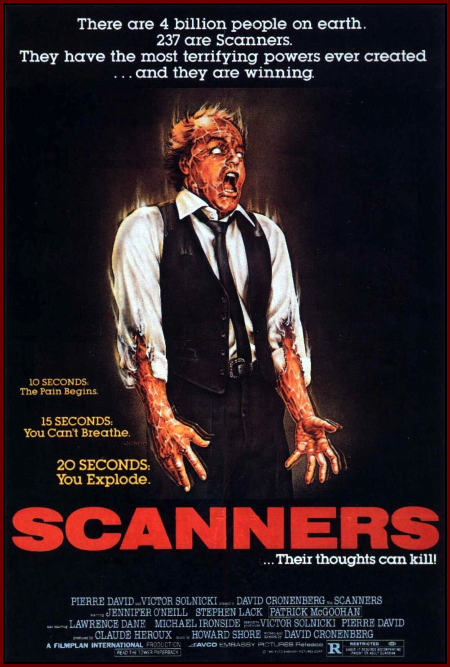
Review: Scanners (dir. by David Cronenberg)


Scanners marks the emergence of David Cronenberg from low-budget horror auteur to one of the most unique voices in filmmaking of the last thirty or so years. He first came onto the scene directing such low-budget horror films such as Shivers, Rabid and The Brood. These three films were later said to have had that Cronenberg propensity to show the horror of the body-politic at its most basic. Cronenberg pretty much points out of how true horror might not be lurking on the outside, but within the the human body. Cronenberg makes the human body as forever changing and mutating against the individual person’s wants and desire of what was suppose to be the ideal. The horror that we as a people do not and will never have control over our own body was where the true horror lie.

In 1981, Cronenberg moves from the purely physical horror to one where the technology man was forever trying to create and achieve perfection would turn on the biological aspect of the human condition. This new form of techno-organic mutation was as terrifying as it was seductive in its potential to those afflicted with it. Cronenberg begins this phase in his filmmaking voice with his excellent, underappreciated and cult-classic Scanners.

The premise for Scanners had alot in common with Stephen King’s novel Firestarter in the fact that in dealt with an omnipresent and powerful organization: the CIA’s shadowy branch that dealt with experimental weapons programs for Firestarter and the ultra-powerful CONSEC multinational corporation in Scanners. These two organizations experiment on random select individuals using experimental drug treatments under the guise of helpful medications. What results from these experiments are more than what was truly expected by their handlers. In Scanners the result comes from mental abilities never seen or documented in the past. CONSEC’s experiments have yielded a unique group of individuals, 237 of them, to manifest powers of the mind that make them living weapons of mass destruction. Instead of becoming a new wonder-weapon for CONSEC to sell to their government contacts, these 237 become unstable in personality, some going as far as to develop a God-complex. Others are driven insane by these new abilities and retreat away from the rest of humanity in order to achieve a semblance of mental peace.

These two different reactions from the 237 are keenly represented by two of the main character’s in Cronenberg’s film. There’s Cameron Vale (played by Stephen Lack who had an eerie resemblance to the same named character of Stephen in Dawn of the Dead) who we first see as a vagrant who seems to be suffering from some sort of mental problem. This is farther from the truth as Dr. Paul Ruth (father of the CONSEC drug effemerol that causes the mutation and played with eccentric flair by Patrick McGoohan) soon discover that Vale’s mental problems is due to him possessing preternatural mental abilities of the highest order. Ruth’s guilt over what his experiments have done and created leads him to use Vale to counter the growing underground of those 237 who have seen their newfound abilities as a stepping stone to supplanting the normal status quo with their own in a plan of global domination that would make fans of X-Men very proud.

Leader of this underground groups of scanners (as the 237 were called) is one Darryl Revok. A scanner whose abilities rival those of Vale’s but whose mental instability for wanting to dominate the normals of the world makes him the most dangerous individual on the face of the planet. Genre veteran Michael Ironside steals the film from everyone else. His grand and classic introduction early in the film has gone down in filmmaking history as one of the most shocking scenes put on film. Ironside’s performance as the scanner with the God-complex was truly megalomaniacal and it was easy to root against him, but hard to take one’s eyes from the screen when he was on. Revok truly made for one of film history’s classic villains.

In the middle of Vale and Revok’s war for control lies Kim Obrist (played by the beautiful Jennifer O’Neill) who tries to lead those who just want to be left alone from being used by both Revok and CONSEC. O’Neill’s performance was the most grounded in reality, as much as a film about people with mental powers could be, and tries to keep the film from getting too fantastic.

This I think was what made Scanners such a great film. As ludicrous a premise as the film had to base its sotry on, there was always a sense of realism to keep everything form becoming too much like a comic book. The story paints a story that could happen in reality since similar things have occurred in the past such as the LSD testing on US military personnel during the 50’s and 60’s. Cronenberg plays on such fears of outside factors introduced by scientists looking to forever improve on what nature took eons to evolve. It’s this hubris about man’s attempt to dominate his own body which interests Cronenberg and what would happen if he did succeed in doing something nature and humanity wasn’t ready for.

Scanners marked Cronenberg’s interest in examining the effect of man’s quest for better and better technology, whether mechanical or biological, on humanity’s physical and mental existence. What he brongs forth, first with Scanners then later on with Videodrome and The Fly, was something both horrific and seductive. Who wouldn’t want to have such abilities as Vale and Revok had at their command. But by the end of Scanners the film posits the question of how much of one’s humanity must be sacrificed for such huge leaps on the evolutionary ladder. Will the resulting amalgamation of nature and technology still leave something human or just something that pretends to look like one.

Some have called Scanners a horror movie and some have called it a sci-fi thriller. It’s both those and more. It’s really hard to pin down just exactly which genre Scanners falls under since Cronenberg never tried to stay within one particular one. The film works as a thriller, as a science-fiction story, a horror flick and a philosophical exercise in examining the human condition. Cronenberg’s skill was clearly evident in keeping all these differing themes and genres from becoming out-of-place and bringing the finished product from becoming too flawed. Cronenberg’s first foray into this new phase of his filmmaking career ushered in what some have called Cronenberg at his most daring and pure. I wouldn’t argue with such an argument. Scanners is a film of great quality that would forever be used as an example of Cronenberg’s genius as a filmmaker.

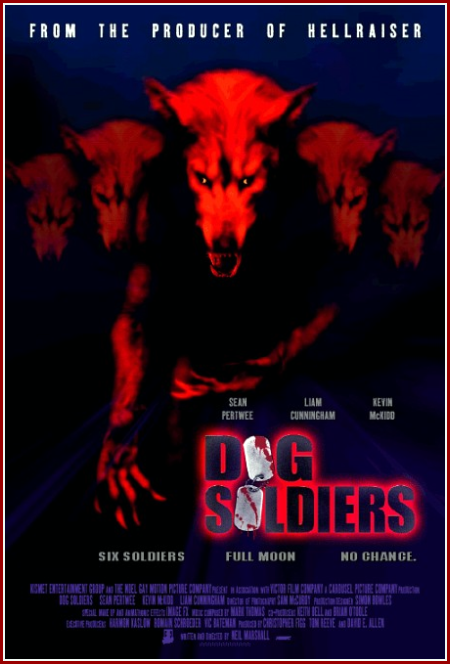
Review: Dog Soldiers (dir. by Neil Marshall)


Werewolf films have always felt like they’ve been given the short end of the stick when it comes to quality and artistry. In horror cinema, vampires tend to be the ones treated with glamour—getting richly developed lore, elegant aesthetics, and narratives that weave romance with menace. Werewolves, by contrast, are too often relegated to playing second fiddle, treated more as brutish monsters than complex characters. This isn’t to say there haven’t been standout entries in the genre—classics such as An American Werewolf in London, The Howling, and Wolfen proved that werewolf tales could be inventive, atmospheric, and even poignant. Unfortunately, many modern werewolf films still feel stuck emulating the aesthetics and narrative beats of the 1940s Universal Wolf Man formula, unwilling to evolve past its roots.

That’s why Dog Soldiers, Neil Marshall’s 2002 action-horror film, came as a breath of fresh air. Marshall, then an up-and-coming director from the UK, took the basic premise of a werewolf story and infused it with the pacing, intensity, and tone of military survival thrillers. In doing so, he leaned into genre hybridity, crafting something closer to Aliens meets Zulu, peppered with elements from siege films like Assault on Precinct 13 and even hints of Night of the Living Dead. This fusion not only differentiates Dog Soldiers from typical werewolf fare, it also helps the film sidestep some of the genre’s usual narrative pitfalls.

The plot is refreshingly straightforward and tightly executed. A squad of British soldiers is dispatched to the Scottish Highlands on what appears to be a routine training exercise. However, the mission is actually part of a covert operation led by Captain Ryan (Liam Cunningham) from British special operations. The higher-ups believe there is an unidentified creature prowling the remote wilderness—something worth capturing and experimenting on. Naturally, plans unravel almost immediately when the soldiers stumble upon the very real threat: a pack of predatory werewolves. In quick order, both the military squad and Ryan’s covert team suffer heavy casualties, forcing the handful of remaining survivors to retreat to the relative safety of an isolated country cottage.

At this point, Dog Soldiers shifts from a creature-hunt narrative to a tense siege story. The soldiers, along with Megan (Emma Cleasby), a young anthropologist who happens upon them while driving along a desolate road, barricade themselves inside the cottage. It’s a familiar setup to horror fans—a small, heavily outnumbered group defending themselves against a monstrous threat—but Marshall handles it with sharp pacing and escalating stakes. The werewolves never attack in full force right away; instead, they probe the survivors’ defenses, testing weaknesses, thinning numbers, and forcing improvisation. The incremental nature of these assaults keeps the tension high and recalls the strategic pacing of Aliens and Zulu. By the final act, the film’s momentum surges into a frenetic, revelation-laden climax, where buried secrets between the survivors come to light, confirming that the encounter in the Highlands was anything but accidental.

The performances are one of the film’s strongest assets. Kevin McKidd anchors the story as Private Cooper, a grounded, quick-thinking soldier with a contentious past involving Captain Ryan. McKidd brings a combination of sharp competence and understated emotional weight, keeping the film from tipping into camp even when the gore and action turn exuberant. Liam Cunningham’s Ryan complements this dynamic by embodying the archetype of the cold, mission-focused officer—aloof, calculating, and ultimately morally questionable.

Sean Pertwee’s Sergeant Wells deserves special mention for his portrayal of a gruff but paternal squad leader. Despite being wounded early on, Wells remains a symbol of resilience, offering the squad guidance and resolve amid desperate circumstances. Emma Cleasby’s Megan strikes a balance between being a narrative catalyst and a functional participant in the group’s survival. As the siege wears on, she lets slip fragments of information about the nature of their attackers, deepening the mystery and tension without leaning on clumsy exposition.

Then there’s Darren Morfitt as Private “Spoon.” His performance injects the film with a lively combat bravado that stands out from the rest of the ensemble. Spoon isn’t just a trigger-happy soldier—he revels in the absurdity and extremity of their plight, seeing it as an ultimate test of British military skill against impossible odds. His confidence and gallows humor recall Bill Paxton’s Hudson in Aliens, but with less overt panic and more disciplined enthusiasm. Spoon references historic battles like Rorke’s Drift—famously depicted in Zulu—as touchstones of courage, further cementing Marshall’s homage to siege war films.

For a production with limited resources, the effects work is impressively convincing. With a budget far below that of major Hollywood horror films, Marshall and his crew leaned into practical effects and selective creature reveals. Some critics have accused the werewolf suits of looking like men in costumes, but in execution the designs work well within the film’s framework. The creatures are tall, lean, and menacing without relying on heavy CGI. Importantly, Marshall applies a “less is more” philosophy reminiscent of Spielberg’s handling of the shark in Jaws. Full, lingering views of the werewolves are reserved for the final act, allowing the audience’s imagination to do much of the work until the climax. This restraint helps sustain suspense while ensuring that, when the creatures finally take center stage, viewers are already fully invested in the world of the film.

When the action does explode, Marshall doesn’t shy away from gore. Dog Soldiers takes a hard-R approach, delivering violent set pieces that are as visceral as they are functional to the narrative. Bodies are torn apart, entrails spill onto floors, and dismembered remains are devoured on-screen—a rare choice for werewolf films, which often cut away from feeding scenes. Yet the gore never overshadows the horror elements; rather, it complements them, reinforcing the brutality of the attackers and the hopelessness of the situation.

At its core, what makes Dog Soldiers so memorable and effective is its clever blend of genre DNA, drawing inspiration and structure from both Aliens and Zulu. Much like James Cameron’s Aliens, Marshall’s ensemble of soldiers must depend on each other to survive, facing off against an external threat in an environment where resources and options dwindle by the hour. The tension is ramped up through a progressive siege, with monsters probing at the group’s defenses, forcing rapid adaptation—an approach that maintains the audience’s suspense and empathy. The way the squad’s camaraderie is tested amid escalating shock and violence feels akin to the Colonial Marines in Aliens, with Spoon and Wells providing flashes of humor and heroism reminiscent of Paxton’s Hudson and Biehn’s Hicks.

Meanwhile, the homage to Zulu manifests in the setting and the sense of a last stand. The cottage becomes not just a shelter, but a makeshift fortress, echoing Rorke’s Drift in Zulu, where British defenders held out against overwhelming odds. Spoon’s direct references to the historic battle, coupled with strategic use of terrain and improvisational defense, strengthen the film’s identity as a genre junction—a supernatural thriller rooted in military siege drama. The sense of camaraderie, tactical ingenuity, and resilience facing certain death is palpable throughout, elevating the intensity far above ordinary monster fare.

By fusing these influences, Dog Soldiers revitalizes the werewolf genre and offers a reminder that horror doesn’t have to retreat into soft scares or ironic pastiche. Its hybrid approach creates a kinetic, emotionally resonant narrative, where supernatural terror and military heroism collide. The suspense not only builds from the threat outside, but also from the evolving relationships and secrets inside, giving the film depth and dimension.

In summary, Dog Soldiers succeeds not only as a visceral werewolf film but also as a smart genre blend, marrying elements of action-horror and siege war drama to make something memorable and genuinely thrilling. For fans of both horror and action cinema—especially those that crave suspense, teamwork, and practical effects—it’s an exemplary demonstration of how fresh vision can rejuvenate even the most familiar legends. Neil Marshall proves with his debut that he understands exactly what makes horror gripping, and with Dog Soldiers, he gives audiences a wild, unrelenting ride they won’t soon forget.

Review: The Thing (dir. by John Carpenter)


In what may well be John Carpenter’s finest film—greater even than Halloween and Escape from New York—the director boldly remakes Howard Hawks’ 1950s sci‑fi classic The Thing from Another World and, incredibly, surpasses the original. Unlike Hawks’ version, steeped in Cold War anxiety, Carpenter draws more directly from John W. Campbell Jr.’s short story Who Goes There?, shifting the focus to paranoia festering within an isolated group of men. His setting, an American scientific station buried deep in the frozen desolation of Antarctica, becomes the perfect pressure cooker for suspicion, distrust, and barely contained madness.

Carpenter’s vision announces itself immediately. The film begins with an overhead shot of jagged, snow‑capped mountains—an endless expanse of icy barrenness. This stark imagery is paired with Ennio Morricone’s minimalist score, a low, pulsating bass throb that mimics a heartbeat. In just these opening moments, Carpenter and Morricone establish the film’s defining tone: desolation, unease, and a creeping inevitability. Carpenter never lets this sense of dread relent; the unease initiated in the opening frames lingers throughout, until the final note of the end credits.

Where the 1951 film wasted no time showing an alien in the flesh, Carpenter follows Campbell’s original concept more faithfully: the creature hides, assimilates, and imitates. It kills and replicates members of the Antarctic crew, transforming everyday interactions into moments of terror. This conceit allows Carpenter to stage his film not just as a monster movie, but as a psychological exercise in tension. Each man is a potential threat. Each argument, however trivial, is laced with suspicion. The audience feels trapped alongside the crew, caught in their spiral of mistrust. At its core, the film is less about the monster’s abilities than about what happens when trust is stripped away from a community forced to live in isolation. The most chilling moments often occur not during the creature’s violent reveals, but in quiet exchanges where fear and doubt spread faster than the Antarctic cold.

The special effects remain legendary, an enduring benchmark even decades later. In the early 1980s, CGI was not a viable option, so Carpenter entrusted Rob Bottin, then in his early 20s, with designing the creature effects. Puppetry, animatronics, latex, and rivers of stage blood combined to create some of the most grotesque and imaginative transformations ever put on film. The kennel scene—when the alien first erupts from the body of a sled dog—remains a horrifying pinnacle of practical effects, unsettling in its creativity and biological plausibility. Bottin’s work is still studied in film schools as a triumph of practical ingenuity. The tactile, slimy, unpredictable reality of these effects would be nearly impossible to replicate with CGI. If any film demonstrates why computer graphics can feel cold and weightless compared to visceral practical effects, The Thing is it.

Anchoring the film is Kurt Russell as helicopter pilot R.J. MacReady, equal parts rugged pragmatist and reluctant leader. Russell’s performance gives the film its center of gravity, portraying a man forced into command when order collapses. Keith David brings an equally commanding presence as Childs, his wary, confrontational energy making him a perfect foil to Russell. The ensemble cast is one of Carpenter’s great strengths here. Each character is distinct, each performance meaningful; there are no throwaway roles. Even smaller parts resonate, as every man crumbles at his own pace under the weight of fear. One of the film’s most unsettling turns comes from Wilford Brimley, whose genial, trustworthy persona makes his gradual descent into paranoia and violence all the more disturbing.

The music deserves as much recognition as the visuals. Rather than scoring the film himself, as he had done in his earlier works, Carpenter handed the task to legendary composer Ennio Morricone. The gamble paid off. Morricone’s spare, throbbing motifs mesh seamlessly with Carpenter’s minimalist style, complementing the stark visuals rather than overwhelming them. The score is skeletal, almost primal—music that feels less composed than unearthed, vibrating with dread. It remains one of the finest examples of how sound can serve as a force multiplier for tension.

The Thing is not for the squeamish. The violence is graphic, the gore extreme, and the imagery deeply unsettling. Yet for those who admire masterful filmmaking, it stands as essential viewing: a perfect marriage of vision, execution, and atmosphere. For students of cinema, it offers a lesson in how genre filmmaking can transcend cliché and attain something close to pure, operatic terror. In the end, Carpenter’s The Thing is more than a remake—it is a redefinition. It strips away the veneer of mid‑century optimism and replaces it with a stark meditation on distrust, survival, and the alien within us all. Few horror films hold up this well or manage to stay this scary for fans old and new.

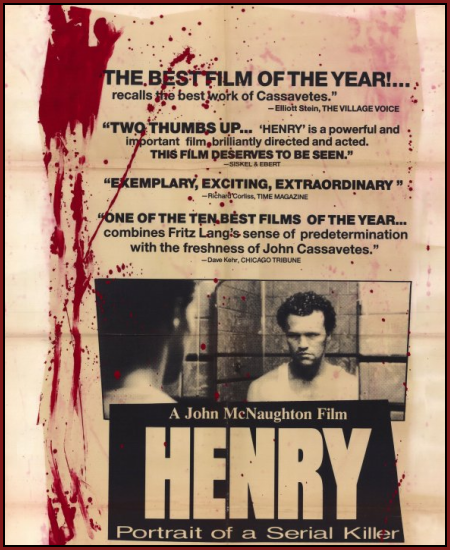
Review: Henry – Portrait of a Serial Killer (dir. by John McNaughton)


John McNaughton’s directorial debut has been hailed as one of the best by any first-time director. I won’t be one to disagree with those who agree. McNaughton took $125,000 dollars, an idea of fictionalizing a week in the life of one real-life serial killer Henry Lee Lucas, and a dedicated crew of filmmakers to create a raw, unflinching, visceral piece of filmmaking. Originally filmed and finished in 1986, Henry: Portrait of a Serial Killer languished in ratings limbo as the filmmakers struggled with the MPAA over its X-rating. In fact, it’s been reported and written in many publications that it is one of the few films screened by the MPAA where they saw no way an edit here or there can ever lower it to an R-rating. I think its fortunate for film fans and academics everywhere that McNaughton and company decided to release the film in 1990 unrated.

Henry: Portrait of a Serial Killer was loosely-based on the life of one Henry Lee Lucas. One of the most prolific (though Lucas has since discounted ever killing over 600 people) serial killers in American history. From the beginning, Henry plunges the audience into a world seen through the eyes of a sociopath and as, Ebert once wrote in his own review: “an unforgettable portrait of the pathology of a man for whom killing is not a crime but simply a way of passing time and relieving boredom.”

The first scene is haunting in its graphic and realistic portrayal of the randomness of a serial killer’s passing through the myriad roads and highways that criss-cross the American landscape. It was this stark and realistic portrayal of the aftermath of violence and death that has made some people label McNaughton’s directorial debut as a snuff-film masquerading as an arthouse production. It’s difficult to disagree with such people since the violence (though it doesn’t go as far as most horror films of the era and barely a blip on the MPAA’s radar in today’s mega-blockbuster-shoot’em-ups) has no look of articiality and not glossed-over with your typical horror/suspense sensibilities. It doesn’t have that exploitation look that the horror films of the 70’s and early 80’s. What it did have was the look and feel of a documentary. The titular character (chillingly portrayed by Michael Rooker) commits his murders as one who sees nothing wrong in what they’re doing. To Henry what he does he does to pass the time and to break-up the boredom of his existence. This behavior shows the banality of Henry’s view of the world around him. It goes to show that as horrific as Henry must seem to the audience there’s a sense of reality in what he does. We read about it on the news, in true-crime documentaries, and in the sensationalist shows dealing with serial and mass murderers.

Henry is not the only one who wades into the dark underbelly of American life and society. There’s Henry’s former cellmate, Otis (played with relish by Tom Towles) who at first seems like a buffoon, but later shows his own pathology for senseless killings as Henry finally brings him into his own world. In fact, Otis’ reaction to Henry’s revelations about what he does in secret looks similar to the reaction of the violence addicted mass audience who revel in the violence in action films and horror retreads. Otis is at first confused and knows that he should be disgusted with the killings he first witness Henry committing, but he later gives in to his own primal impulses. He soon revels in the act of murder and even sees it as his own form of entertainment. It’s during the home-invasion and subsequent murders of the home’s family captured on videotape by Henry and Otis that this change in Otis hits home.

This is the juncture in the film that posits the damning question the filmmakers want to ask the audience. Do we recoil in horror and disgust at this horrifying, voyeuristic sequence or does the audience continue to watch with the dispassionate eyes of one who has become desensitized to onscreen violence. There’s no clear answer to this question and the filmmakers don’t condescend to the audience and try to sugar-coat the violence. It is also this sequence where we see the difference between Henry and Otis. Henry almost feels remote and disconnected from the acts he’s committing. To him breaking the neck of a teenage boy might be the same as stepping on an ant. But to Otis the killings themselves becomes his addiction and only form of joy. He’s willing to go beyond what his mentor has done to sate his appetites. We see Henry’s reaction to this change in Otis and realize that as much as the audience want to hate Henry, he is the lesser of two evils. He doesn’t take joy from his work and we cling to that barely there shred of decency in the hope that salvation and redemption is at the end of the ride.

To the filmmakers’ credit Henry doesn’t trivialize the gruesome events from scene one right up to the end credits by tacking on a Hollywoodize happy ending. As the final reel comes to a conclusion and we see Henry and Otis’ sister, Becky driving off into the night (a sort of reverse-negative of the typical riding-off into the sunset of Hollywood past), the audience is ready to breath a sigh of relief from the relentless visual and emotional pounding the film has put on the audience. But the rug is pulled out from under the audience’s feet. McNaughton and his writers do not believe in the redemption of Henry. In fact, they know that such things are only seen in Hollywood and fairytales. What they give the audience instead is a scene that continue to show that the film is steeped in the real world. People like Henry do not find forgiveness and salvation from their evil deeds. People like Henry continue to ply the roads and highways of America. Their seeming normalcy hiding the calculating, sociopathic murderous instincts just below the surface.

I credit Henry: Portrait of a Serial Killer as one of the truest work of American filmmaking. A great character study of a sociopathic individual whose banality can truly be called the face of evil. McNaughton’s film is admired and reviled and both sides have credible points in taking their sides. It is a great piece of work that shows that filmmaking can go beyond its basic need to entertain. It is also a brutal piece of film that didn’t have to be made the way it was made, but to do it in any other way would’ve diluted the message and impact of the story.