‘Her’ (dir. Spike Jonze)


*Disclaimer…I haven’t posted a review in like 4 months [holy crap] so I think I am a bit rusty…but sometimes a film comes along that you just can’t help but want to write about…so here goes.*
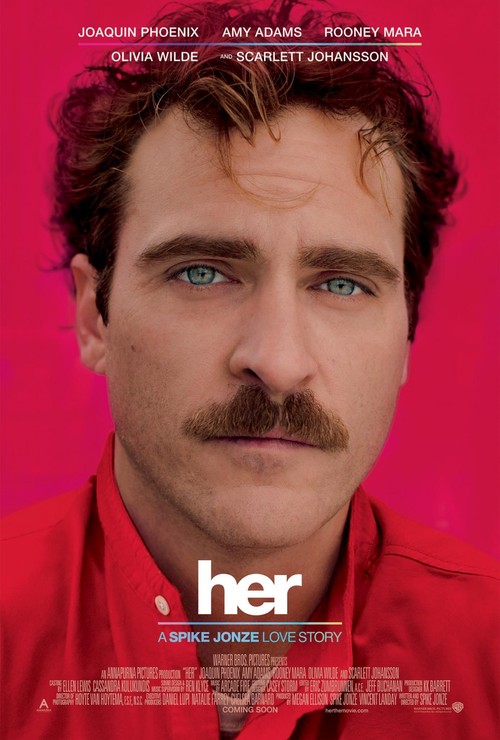
poster

“Her”, Spike Jonze’s latest creation, stars Joaquin Phoenix as a writer who falls in love with his operating system. It is the sort of synopsis that would make anyone do a double take, and for good reason. There is a cheesy B-horror movie in there somewhere. However, in the hands of Jonze, who approaches the story and its characters with just the right level of serious sentiment and carefree whimsy, this tale of man and machine not only feels less ridiculous than it sounds, but is also arguably the most fitting romance for a society that is nose deep in the dawn of a technological revolution.

Her review picture 1

Phoenix plays Theodore, a quiet man left emotionally detached following the divorce with his childhood sweetheart. The only emotions he can seemingly express now are artificial, literally created to write love letters for other people as part of his job. So it comes as no surprised then that the first real connection he makes in over a year is with an artificial intelligence, a new OS by the name of Samantha. She is generated based on a quick questionnaire to be his perfect “other half” and do everything from helping him organize his life to keeping him company at night. Because she offers intimacy, with few complications beyond not having a physical body, Theodore soon finds himself attracted to her ever evolving intelligence and the sense of wonder she expresses in experiencing the world for the first time.

​In a sense, Samantha becomes his “rebound”, but because of her unique existence she does not just reawakening Theodore’s interest in love and relationships, allowing him to simply move on. Instead, her personal growth and struggles with discovering emotion also give Theodore a whole new perspective on what it actually means to love and be loved.

Her review picture 2

Love, like Samantha, is an ever evolving state, one that takes time, devotion and can make us do crazy things. How we love is often based on the things that made us who we are, like the relationships we had with our mothers; a question asked when Samantha is created. Love is, as one character puts it, also “a socially acceptable form of insanity”. As love changes so do we, and vice versa. Often, these changes happen faster or sooner than expected, or in ways we might not have imagined or ever saw coming. We often blame ourselves when love fails, or avoid it all together in fear of that failure. But, love isn’t something that can so be so easily controlled, explained or forgotten. The person you’ve loved and shared your life with since an early age might grow distant and hateful. Or, maybe you will develop affection for a voice inside your computer. What becomes important then, through all life’s trials and adversities, is that you never lose that ability to love.

This has become harder and harder. As technology has advanced over the years, as clichéd as it may sound, we have become more connected virtually and more disconnected socially than ever before. “Her” seems to explore how this has had an effect on how we are able to handle our emotions or express ourselves to one another without some sort of filter. Samantha in the beginning, in all her virtual glory, can easily love and be loved. However, as she evolves and discovers things such as physics and philosophy, even she finds emotions far more complicated than maybe even Theodore could imagine them being. Therefore, he is left as witness to the full evolution of love, for that is what Samantha is, pure love. Eventually it grows beyond his control and it is up to him to take the next steps.

I guess what I am trying to say is maybe all we need to do is unplug – forget about how love does or should work, stop wishing for it and everything else to be so damn perfect and simply embrace the insanity.

Of course it isn’t all as simple as that, and it would require spoiling the film to go any deeper.

Her review picture 3

Visually, the film has a subtle beauty. A lot of thought and detail clearly went into the design of the film, from the awkward looking clothing to the muted color scheme, enough to make a second viewing necessary to truly appreciate all the imagery. What I loved most about the future Jonze envisions, is that there are no cars, smog, steaming vents or flashing lights. This isn’t a future of excess. It is quite the opposite actually, as if our inability to express has seeped its way into the city streets.

The performances are superb. Joaquin Phoenix is perfect for the role, bringing equal amounts of reserve and raw emotion. Scarlet Johansson is truly brilliant as Samantha. I honestly feel like she expressed more with just her voice than many other actors have done with their entire bodies this year. Whether it is sultry flirting, heartache, or a child-like enthusiasm, each emotion comes across clear and with depth. Amy Adams also plays a small, but rather important role, as Theodore’s friend and neighbor. This is Adams at her most loving and adorable, the polar opposite of her role in “American Hustle”; a perfect example at just how talented she is.

Her review picture 4

As it stands, and probably always will, this is my favorite film of 2013. “Her” is on the same wave-length as “Lost in Translation” and “Eternal Sunshine of the Spotless Mind”. Fans of those two films will find Jonze’s work strikes the same emotional chords, but also remains its own unique work of art, one of pure bliss and enlightenment. Go see it if you have the chance. 

44 Days of Paranoia #32: The Purge (dir by James DeMonaco)


For our latest entry in the 44 Days of Paranoia, we take a look at one of the more unexpected box office successes of 2013, The Purge.

The Purge takes place in the year 2022.  In some ways, America is much the same as it is today but in other ways, it is significantly different.  Unemployment is down to 1% and crime rates have plunged.  Before you can say, “So, this is what we have to look forward to once Obama is no longer President,” we are told that America is now being led by the “New Founding Fathers.”

We also learn that every year, for one 12-hour period, all crime is legal.  The Purge is designed to act as a catharsis, a time for the American people to release all of their pent-up frustrations and act on all the desires that the government has since forbidden.  As the film opens, we listen to people discussing how they’re going to celebrate 2022’s Purge.  Some say that they’re going to stay inside and keep their doors locked.  Another brags about how he’s planning to take the opportunity to murder his boss.

The Purge has also created an entirely new economy that is completely centered around preparing for the Purge.  As a result, men like James Sandin (Ethan Hawke) have become millionaires by selling home security systems.  The Purge opens with James pulling up in front his gigantic mansion, going inside, and getting his family prepared for that night’s Purge.

When the Purge begins, James, his wife (Lena Headey), and his family believe themselves to be safe inside their mansion.  However, things don’t go quite as planned.  For one thing, daughter Zooey’s (Adelaide Kane) older boyfriend Henry (Tony Oller) is hiding out in the house.  Henry knows that James doesn’t approve of him but is convinced that he can either change James’s mind or, failing that, simply kill him while it’s perfectly legal to do so.

An even bigger complication arises when a bloody stranger (Edwin Hodge) approaches the house and begs to be let in.  When James’s son opens the door to the man, the house is suddenly surrounded by a group of masked purgers who demand that the stranger be sent back out.  When the purgers start to attack, the Sandins’s jealous neighbors suddenly see a chance to take out their own resentments on James and his family…

The Purge got terrible reviews but, judging from its box office success, it obviously struck a nerve with audiences.  And why not?  Like many so-called exploitation films, The Purge may not be subtle but it does manage to perfectly capture the fears and prejudices that everyone in the audience has.   I saw The Purge when it was first released and then I recently rewatched it on DVD and I have to say that I was a little surprised to discover just how well The Purge holds up to repeat viewings.   The Purge is effective because, as over-the-top as it may seem, it’s still a disturbingly plausible portrait of the type of society that our “leaders” seem to be so eager to create.

https://twitter.com/ItsHoodTV/status/356241203588640771

As a side note, shortly after the film completed its initial run, George Zimmerman was acquitted in the Trayvon Martin case and I can still remember seeing hundreds of people on twitter saying that it was time to have a real-life Purge in Florida, which indicates how much of a part of the popular culture this film became.  It’s not surprising that a sequel is going to be released in 2014.

Other Entries In The 44 Days of Paranoia 

  1. Clonus
  2. Executive Action
  3. Winter Kills
  4. Interview With The Assassin
  5. The Trial of Lee Harvey Oswald
  6. JFK
  7. Beyond The Doors
  8. Three Days of the Condor
  9. They Saved Hitler’s Brain
  10. The Intruder
  11. Police, Adjective
  12. Burn After Reading
  13. Quiz Show
  14. Flying Blind
  15. God Told Me To
  16. Wag the Dog
  17. Cheaters
  18. Scream and Scream Again
  19. Capricorn One
  20. Seven Days In May
  21. Broken City
  22. Suddenly
  23. Pickup on South Street
  24. The Informer
  25. Chinatown
  26. Compliance
  27. The Lives of Others
  28. The Departed
  29. A Face In The Crowd
  30. Nixon
  31. The Hunger Games: Catching Fire

44 Days of Paranoia #31: The Hunger Games: Catching Fire (dir by Francis Lawrence)


For our latest entry in the 44 Days of Paranoia, we take a look at a film that might, at first, seem out-of-place in this series — The Hunger Games: Catching Fire.

Why is Catching Fire included in a series of films about conspiracy and paranoia?  Because, even more than the first film, Catching Fire is a film with a political subtext.  Beneath its franchise surface, Catching Fire is about how the government and media establishment manipulates its citizens and how, occasionally, the citizens are smart enough to manipulate them.

When reviewing Catching Fire, probably the first and most important question is how it compares to The Hunger Games.  Is it that film’s equal, is it better, or is it worst?  That’s not necessarily an easy question to answer because Catching Fire is a very different film from The Hunger Games.

One of the main reasons that I loved The Hunger Games is because, after a countless number of Twilight-style films that all featured teenage girls willingly sacrificing their independence for a boyfriend, The Hunger Games finally gave us a female protagonist who kicked ass and made no apologies for doing so.  Katniss Everdeen was defined by her mind and her soul and not her relationship status.  I loved The Hunger Games because, like Brave, it celebrated female strength and independence.  While I have always been willing to defend the Twilight films for what they are, I would not want my niece or my future daughter to grow up to be Bella Swan.  Katniss Everdeen, however, is a role model for both our times and our future.  The Hunger Games was all about celebrating girl power and, for that reason, I loved it.

Katniss Everdeen is still a worthy and independent role model in Catching Fire but the film itself is far more political than The Hunger Games.  Whereas The Hunger Games was all about establishing Katniss as a strong woman, Catching Fire is about how that strength can be used to challenge the status quo.

As the film opens, Katniss (played, of course, by Jennifer Lawrence, who I have such a girl crush on) and Peeta (Josh Hutcherson) have returned to District 12 after having “won” the 74th Hunger Games.  Realizing that their act of defiance could lead to a full-scale revolution, President Snow (Donald Sutherland) attempts to co-opt their rebel image.  He orders that Katniss and Peeta continue to pretend to be in love so that, during their Victory Tour, the citizens of the other districts will be convinced that Katniss’s actions were the result of love and not of defiance.

This is actually a very interesting premise and definitely that shows a lot more sophistication than what we, as filmgoers, have been conditioned to expect from a movie based on YA fiction.  While thousands of films have depicted love as a form of political rebellion, Catching Fire is unique in suggesting that love (or the appearance of love) can also be used to maintain political suppression.

During the Victory Tour, both Katniss and Peeta balk at having to play the roles that Snow has assigned them.  While at District 11, Katniss pays tribute to Rue and then watches in horror as Snow’s “peacekeepers” executes a man who dared to hold up the three-finger salute.  Trying to avoid further violence, Katniss agrees to become engaged to Peeta.

Snow, however, realizes that, as long as Katniss is alive, she’ll be a threat to him.  He announces a special all-star edition of The Hunger Games, in which all the tributes will be past winners.  Since Katniss is the only female tribute from District 12 to have ever survived the Hunger Games, she knows that she’s going to have to compete for a second time. When Haymitch (Woody Harrelson) is selected to be the male tribue, Peeta immediately volunteers to go in his place.

The first hour of Catching Fire, which deals with the media and political manipulation surrounding the Victory Tour, is brilliant.  The second half, which features Katniss and Peeta competing in their second Hunger Games, feels a bit familiar and rushed.  It’s not that the second half of the film isn’t good.  It’s just far more predictable.

But here’s what’s important — everything that worked about The Hunger Games works for Catching Fire.  Josh Hutcherson seems a lot more confident here than he did in the first film, Donald Sutherland makes for a great villain, Stanly Tucci is a lot of fun as Caesar Flickerman (what a great name!), and the film is a visual feast.  Among the new cast members, Jena Malone is perfectly cast as tribune Johanna Mason while Philip Seymour Hoffman is properly Philip Seymour Hoffmanish as the new director of the Hunger Games.

However, the film belongs to and works because of Jennifer Lawrence.  Whether she’s playing Katniss or Mystique or Ree Dolly or Tiffany Maxwell or Rosalyn Rosenfeld, Jennifer Lawrence kicks ass.

Yes, that is my official review as a film critic.

Jennifer Lawrence kicks ass.

Other Entries In The 44 Days of Paranoia 

  1. Clonus
  2. Executive Action
  3. Winter Kills
  4. Interview With The Assassin
  5. The Trial of Lee Harvey Oswald
  6. JFK
  7. Beyond The Doors
  8. Three Days of the Condor
  9. They Saved Hitler’s Brain
  10. The Intruder
  11. Police, Adjective
  12. Burn After Reading
  13. Quiz Show
  14. Flying Blind
  15. God Told Me To
  16. Wag the Dog
  17. Cheaters
  18. Scream and Scream Again
  19. Capricorn One
  20. Seven Days In May
  21. Broken City
  22. Suddenly
  23. Pickup on South Street
  24. The Informer
  25. Chinatown
  26. Compliance
  27. The Lives of Others
  28. The Departed
  29. A Face In The Crowd
  30. Nixon

6 Reviews of 6 More Films That Were Released in 2013: The Company You Keep, Dracula 3D, Getaway, Identity Thief, Pawn, Welcome to the Punch


In part of my continuing effort to get caught up on my 2013 film reviews, here are 6 more reviews of 6 more films.

The Company You Keep (dir by Robert Redford)

Shia LeBeouf is a journalist who discovers that attorney Bill Grant (Robert Redford) is actually a former 60s radical who is still wanted by the FBI for taking part in a bank robbery in which a security guard was killed.  In one of those coincidences that can be filed directly under “Because it was convenient for the plot,” LeBeouf’s girlfriend (Anna Kendrick) works for the FBI.  Anyway, all of this leads to Grant going on the run and meeting up with a lot of his former radical colleagues (all of whom are played by familiar character actors like Susan Sarandon, Nick Nolte, Richard Jenkins, and Julie Christie).  Ben pursues him and discovers that Grant could very well be innocent and … oh, who cares?  The Company You Keep is a big smug mess of a film.   It’s full of talented actors — like Stanley Tucci, Brendan Gleeson, and Brit Marling (who, talented as she may be, is actually kinda terrible in this film) — but so what?  I lost interest in the film after the first 20 minutes, which was a problem since I still had 101 more minutes left to go.

Has there ever been a movie that’s actually been improved by the presence of Shia LeBeouf?

Dracula 3D (dir by Dario Argento)

Dario Argento’s version of the classic Dracula tale got terrible reviews when it was briefly released here in the States but I happen to think that it was rather underrated.  No, the film can not compares to classic Argento films like Deep Red, Suspiria, and Tenebre.  However, the film itself is so shamelessly excessive that it’s impossible not to enjoy on some level.  The film’s moody sets harken back to the classic gothic villages of the old Hammer films, Thomas Kretschman turns Dracula into the type of decadent European aristocrat who you would expect to find doing cocaine in 1970s New York, and Rutger Hauer is wonderfully over-the-top as Van Helsing.  Yes, Dracula does turn into a giant preying mantis at one point but if you can’t enjoy that then you’re obviously taking life (and movies) too seriously.

Getaway (dir by Courtney Solomon)

I saw Getaway during my summer vacation and the main thing I remember about the experience is that I saw it in Charleston, West Virginia.  Have I mentioned how in love I am with Charleston?  Seriously, I love that city!

As for the movie, it was 90 minutes of nonstop car chases and crashes and yet it somehow still managed to be one of the dullest films that I’ve ever seen.  Ethan Hawke’s wife is kidnapped by Jon Voight and Hawke is forced to steal a car and drive around the city, doing random things.  Along the way, he picks up a sidekick played by Selena Gomez.  Hawke and Voight are two of my favorite actors and, on the basis of Spring Breakers, I think that Gomez is a lot more talented than she’s given credit for.  But all of that talent didn’t stop Getaway from being forgettable.  It’s often asked how much action is too much action and it appears that Getaway was specifically made to answer that question.

Identity Thief (dir by Seth Gordon)

My best friend Evelyn and I attempted to watch this “comedy” on Saturday night and we could only get through the first hour before we turned it off.  Jason Bateman’s a great actor but, between Identity Thief and Disconnect, this just wasn’t his year.  In this film, Bateman is a guy named Sandy (Are you laughing yet?  Because the movie really thinks this is hilarious) whose identity is stolen by Melissa McCarthy.  In order to restore both his credit and his good name, Bateman goes down to Florida and attempts to convince McCarthy to return to Colorado with him.  The film’s “humor” comes from the fact that McCarthy is sociopath while Bateman is … not.

It’s just as funny as it sounds.

Pawn (dir by David Armstrong)

An all-night diner is robbed by three thieves led by Michael Chiklis and, perhaps not surprisingly, things do not go as expected.  It turns out that not only does Chilklis have a secret agenda of his own but so does nearly everyone else in the diner.  Pawn is a gritty little action thriller that’s full of twists and turns.  Chiklis gives a great performance and Ray Liotta has a surprisingly effective cameo.

Welcome to the Punch (dir by Eran Creevy)

In this British crime drama, gangster Jacob (Mark Strong) comes out of hiding and returns to London in order to get his son out of prison.  Waiting for Jacob is an obsessive police detective (James McAvoy) who is determined to finally capture Jacob.

In many ways, Welcome To The Punch reminded me a lot of Trance and n0t just because both films feature James McAvoy playing a morally ambiguous hero.  Like Trance, Welcome to the Punch is something of a shallow film but Eran Creevy’s direction is so stylish and Mark Strong and James McAvoy both give such effective performances that you find yourself entertained even if the film itself leaves you feeling somewhat detached.

Film Review: Drinking Buddies (dir by Joe Swanberg)


Drinking Buddies is one of the best films of 2013.

It’s important to state that from the beginning because it can be difficult to explain the appeal of Drinking Buddies.  In fact, it can be argued that nothing really happens in the film.  For 90 minutes, we follow four likable and familiar characters as they drink, talk, flirt, and occasionally fight.  In many ways, this is a very funny film but it’s definitely not a comedy.  It’s a serious movie that’s notable for lacking any real drama.  Instead, it’s a warm and sympathetic portrait of life as it’s lived.

Luke (Jake Johnson) and Kate (Olivia Wilde) both work at a Chicago brewery.  Luke is an almost stereotypical nice guy while Kate is good at her job but totally neurotic with almost every other aspect of her life.  When we first see them on-screen together, it’s easy to assume that Kate and Luke are in a relationship.  However, despite being perfect for each other, Luke and Kate are both involved with others.  Kate is involved with Chris (Ron Livingston) while Luke is trying to get over his nervousness over the prospect of getting married to Jill (Anna Kendrick).  After the four of them go on a camping trip with each other, Kate and Chris break up and Luke is forced to deal with his feelings for both Kate and Jill.

Now, I knew that sounds like the set-up for a romantic comedy, the type where Chris would turn out to be a complete cad and Jill would be so obviously wrong for Luke that the audience would be openly rooting for Luke to dump her so he could get together with Kate.  However, and this is what makes this film brilliant, Joe Swanberg isn’t interested in making a film full of romcom stereotypes.  If anything, Chris and Jill are both portrayed as being far more sympathetic than either Luke or Kate.  (Livingston and Kendrick have an extended picnic scene that should be remembered as one of the best cinematic moments of 2013.)

In the end, Drinking Buddies doesn’t do anything that you expect it to do.  Swanberg is less interested in romance and more interested in observing and celebrating the friendship of these four characters.  This is one of those unexpected films where every single detail rings true and you end up feeling as if you could hop a plane to Chicago and find any of these four characters living their own lives beyond what the audience has been lucky enough to observe.

How good is Drinking Buddies?

I don’t even drink and I still loved this movie.

Film Review: All Is Lost (dir by JC Chandor)


I have to admit that when I first heard the plot of All Is Lost, I was skeptical.

Essentially, the film is 100 minutes of Robert Redford (playing a nameless sailor) floating out in the middle of the ocean and trying not to die.  Beyond delivering some deliberately ambiguous narration at the beginning of the film and then shouting at some profanity about halfway through the film, Redford’s performance is almost entirely silent.  We’re never really sure why Redford was out in the ocean in the first place, though there are hints to be found by those who are willing to take the time to track down the small details.  Myself, I know nothing about sailing and, considering how utterly terrified I am of drowning, I doubt that I ever will.  As such, I spent most of the film not having the slightest idea what Redford was doing or why he was doing it.

(To just give one example of my lack of nautical knowledge, I was stunned to discover, while watching All Is Lost, that a boat can be flooded with water without automatically sinking to the bottom of the ocean.)

So, I really should have hated All Is Lost.

But I didn’t.

I have to admit that it took me a while to get into the film.  There were a few times when I thought the movie was going to lose me.  But every time that I thought I was going to zone out on the film, Robert Redford snapped me back.  Redford brings such a sense of immediacy to his role that you can’t help but watch him even if, like me, you’re not always sure what he’s doing.

If not for the all of the Oscar talk being generated by Redford’s performance, I probably would not have seen All Is Lost.

But I’m glad that I did.

Film Review: Lee Daniels’ The Butler (dir by Lee Daniels)


Dare I admit it?

When I saw Lee Daniels’ The Butler, I was not impressed.

Yes, the audience applauded as the end credits rolled.  And yes, I know that almost all of the mainstream critics have given it a good review.  I know that Sasha Stone has been hyping it as a surefire Oscar contender.  I know that, up until 12 Years A Slave introduced us all to an actress named Lupita Nyong’o, Oprah Winfrey was considered to be the front-runner for the Best Supporting Actress Oscar.

But it doesn’t matter.  The Butler did little for me.

I also realize that the film ended with a title card that announced that what I had just watched was dedicated to the American civil rights movement.  In many ways, that title card felt like emotional blackmail, implying that if you criticized The Butler than that meant you were also criticizing the brave, real life men and women who risked their lives to fight for equal rights.

However, when you put emotions and good intentions to the side, the fact of the matter is that Lee Daniels’ The Butler is not that good of a movie.  One need only compare The Butler to some of the other films that were released this year that dealt with the African-American experience — films like 12 Years A Slave and Fruitvale Station — to see just how safe and uninspiring The Butler truly is.

The Butler tells the story of Cecil Gaines (Forrest Whitaker), the son sharecroppers (played by David Banner and Mariah Carey) in the deep south.  After Cecil’s father is murdered by plantation owner Thomas Westfall (Alex Pettyfer), Cecil is raised and educated by the wealthy Annabeth Westdall (Vanessa Redgrave).  Eventually, the teenaged Cecil leaves the plantation and ends up working in a hotel where he’s educated in how to be a master servant by the elderly Maynard (Clarence Williams III, who brings a quiet dignity to his role).  Cecil eventually gets promoted to a hotel in Washington, D.C.  It’s there that he meets and marries Gloria (Oprah Winfrey).

In 1957, Cecil is hired to work at the White House.  Along with befriending two others butlers (played by Cuba Gooding, Jr. and Lenny Kravitz), Cecil also gets the chance to observe history play out first hand.  Starting with Dwight Eisenhower (played by Robin Williams) and ending with Ronald Reagan (Alan Rickman, giving a performance that is incredibly bad), Cecil watches as President after President deals with the civil rights movement.  Some presidents, like John F. Kennedy (James Marsden) are portrayed as being heroes while others, like Richard Nixon (John Cusack), are portrayed as being villains but all of them have the watchful eye of Cecil Gaines in common.

Meanwhile, at home, Gloria has a brief affair with Howard (played by Terrence Howard and really, you have to wonder what Cecil was thinking leaving his wife alone with anyone played by Terrence Howard) and Cecil’s oldest son, Louis (David Oyelowo), gets involved with the civil rights movement and grow increasingly estranged from his father.

The Butler actually starts out pretty well.  There’s a lengthy sequence where Louis and a group of students are trained on how to conduct a sit-in that’s extremely compelling to watch.  However, then John Cusack shows up wearing a big fake nose and the entire film starts to fall apart.

From a cinematic point of view, the film fails because it ultimately seems to be more dedicated to trotting out a parade of celebrity cameos to actually telling a compelling story.  As is his usual style, Lee Daniels directs with a heavy hand and, as a result, the film is full of emotionally-charged scenes that fail to resonate for longer than a handful of minutes.

My main issue with The Butler is that the film literally contains no surprises.  Nothing out of the ordinary happens and, at no point, is the audience actually challenged to consider the way they view history or race relations.  Whereas films like Fruitvale Station and 12 Years A Slave truly challenge our assumptions, The Butler encourages us to pat ourselves on the back for being so enlightened.  Every single frame of The Butler is specifically designed to fool us into thinking that we’re watching an important and challenging movie.

Because of a silly copyright lawsuit, the official title of The Butler is Lee Daniels’ The Butler.  However, that title is very appropriate because The Butler is definitely a Lee Daniels film.  Even if you didn’t know it beforehand, it would be easy to guess that the  same man who directed Precious and The Paperboy also directed The Butler.  As a director, Daniels specializes in making simplistic points in the most bombastic way possible.  The results are films, like The Butler, that are more concerned with manipulating an audience than challenging an audience.  When audiences applaud at the end of The Butler, they aren’t so much applauding the film as much as they are applauding themselves for having seen it.

Film Review: The Canyons (dir by Paul Schrader)


Do you remember that YouTube video of Chris Crocker screaming, “LEAVE BRITNEY ALONE!” while tears and eye liner ran down his face?

That’s often the way that I feel about Lindsay Lohan, a talented actress and a fellow redhead whose career has been destroyed not so much by her own mistakes but by the fact that the tabloids refuse to allow her to move on from those mistakes.  It seems that, regardless of what Lindsay Lohan does, not a single story will be written about her that doesn’t mention that she’s spent time in rehab and jail or that doesn’t offer up some sort of tawdry speculation about her private life.

And that’s unfortunate because, regardless of what the tabloids may say, Lindsay Lohan remains an excellent actress who is capable of doing a lot more than parodying her own image in Scary Movie 5.

Consider, for instance, her performance in The Canyons.

In The Canyons, Lohan plays Tara, the world-weary girlfriend of a wealthy sociopath named Christian (James Deen, who may not be a great actor but still projects a proper mix of charm and menace).  Christian is a film producer whose need to control and dominate is demonstrated in both the way he manipulates actor Ryan (Nolan Funk) and the way he arranges for Tara to have sex with strangers while he films the action.

Tara and Christian live a life that epitomizes empty luxury, an existence defined of ennui where casual cruelty is the norm.  However, when he discovers that Tara is secretly having an affair with Ryan, Christian’s carefully constructed facade of control starts to fade away.  Perhaps not surprisingly, Christian’s obsessiveness and manipulative mind games eventually lead to a brutal act of violence…

When it was released earlier this year, The Canyons got terrible reviews and the film is definitely uneven.  Bret Easton Ellis’s script is predictable and, while director Paul Schrader captures some haunting images of Los Angeles at its most languid, the film also is a bit too slow for its own good.  Schrader takes Ellis’s pulpy script and attempts to use it to craft an existential portrait of American culture and he doesn’t quite succeed.

However, to a large extent, The Canyons is redeemed by Lohan’s excellent performance.  In Lohan’s hands, Tara becomes a survivor who has sacrificed her innocence but still has yet to develop the hardness that one needs to survive in Ellis and Schrader’s Los Angeles.  As cynical and decadent a character as Tara may be, Lohan plays her with just enough hints of optimism that it’s impossible not to regret the loss of who she was before she met Christian.

It’s a performance that manages to redeem a film that, without Lohan, would have been one of the worst films of 2013.

For that reason alone, perhaps it’s time to leave Lindsay alone and she what she’s capable of doing when she’s simply allowed to act.

Ghosts of Christmas Past #24: It’s a Wonderful Life


Just in case you somehow missed your chance to see one of the greatest films ever made, here’s Frank Capra’s classic It’s A Wonderful Life.  I’ve seen this movie a countless number of times.  I can recite every line by memory.  And yet, every time I watch it, I still get tears in my eyes.  If you missed it on TV this year, please feel free to watch it below.

Incidentally, I always related to Violet.

44 Days of Paranoia #30: Nixon (dir by Oliver Stone)


For our latest entry in the 44 Days of Paranoia, we take a look at Oliver Stone’s 1995 presidential biopic, Nixon.

Nixon tells the life story of our 37th President, Richard Nixon.  The only President to ever resign in order to avoid being impeached, Nixon remains a controversial figure to this day.  As portrayed in this film, Nixon (played by Anthony Hopkins) was an insecure, friendless child who was dominated by his ultra religious mother (Mary Steenburgen) and who lived in the shadow of his charismatic older brother (Tony Goldwyn).  After he graduated college, Nixon married Pat (Joan Allen), entered politics, made a name for himself as an anti-communist, and eventually ended up winning the U.S. presidency.  The film tells us that, regardless of his success, Nixon remained a paranoid and desperately lonely man who eventually allowed the sycophants on his staff (including James Woods) to break the law in an attempt to destroy enemies both real and imagined.  Along the way, Nixon deals with a shady businessman (Larry Hagman), who expects to be rewarded for supporting Nixon’s political career, and has an odd confrontation with a young anti-war protester who has figured out that Nixon doesn’t have half the power that everyone assumes he does.

Considering that his last few films have been W., Wall Street: Money Never Sleeps, and Savages, I think it’s understandable that I’m often stunned to discover that, at one point in the distant past, Oliver Stone actually was a worthwhile director.  JFK, for instance, is effective propaganda.  Nixon, which feels a lot like an unofficial sequel to JFK, is a much messier film than JFK but — as opposed to something like Savages — it’s still watchable and occasionally even thought-provoking.  Thanks to Hopkins’ performance and, it must be admitted, Stone’s surprisingly even-handed approach to the character, Nixon challenges our assumptions about one of the most infamous and villified figures in American history.  It forces us to decide for ourselves whether Nixon was a monster or a victim of circumstances that spiraled out of his control.  If you need proof of the effectiveness of the film’s approach, just compare Stone’s work on Nixon with his work on his next Presidential biography, the far less effective W.

(I should admit, however, that I’m a political history nerd and therefore, this film was specifically designed to appeal to me.  For me, half the fun of Nixon was being able to go, “Oh, that’s supposed to be Nelson Rockefeller!”)

If I had to compare the experience of watching Nixon to anything, I would compare it to taking 10 capsules of Dexedrine and then staying up for five days straight without eating.  The film zooms from scene-to-scene, switching film stocks almost at random while jumping in and out of time, and not worrying too much about establishing any sort of narrative consistency.  Surprisingly nuanced domestic scenes between Anthony Hopkins and Joan Allen are followed by over-the-top scenes where Bob Hoskins lustily stares at a White House guard or Sam Waterston’s eyes briefly turn completely black as he discusses the existence of evil.  When Nixon gives his acceptance speech to the Republican Convention, the Republican delegates are briefly replaced by images of a world on fire.  Familiar actors wander through the film, most of them only popping up for a scene or two and then vanishing.  The end result is a film that both engages and exhausts the viewer, a hallucinatory journey through Stone’s version of American history.

Nixon is a mess but it’s a fascinating mess.

Other Entries In The 44 Days of Paranoia 

  1. Clonus
  2. Executive Action
  3. Winter Kills
  4. Interview With The Assassin
  5. The Trial of Lee Harvey Oswald
  6. JFK
  7. Beyond The Doors
  8. Three Days of the Condor
  9. They Saved Hitler’s Brain
  10. The Intruder
  11. Police, Adjective
  12. Burn After Reading
  13. Quiz Show
  14. Flying Blind
  15. God Told Me To
  16. Wag the Dog
  17. Cheaters
  18. Scream and Scream Again
  19. Capricorn One
  20. Seven Days In May
  21. Broken City
  22. Suddenly
  23. Pickup on South Street
  24. The Informer
  25. Chinatown
  26. Compliance
  27. The Lives of Others
  28. The Departed
  29. A Face In The Crowd