The TSL’s Daily Horror Grindhouse: Tombs of the Blind Dead (dir by Amando de Ossorio)


(After you read my review, be sure to check out Arleigh’s thoughts on this film!)

If you really want to see something scary this Halloween season, I suggest tracking down Tombs of the Blind Dead, a Spanish film from 1971.

file_748728_lone9

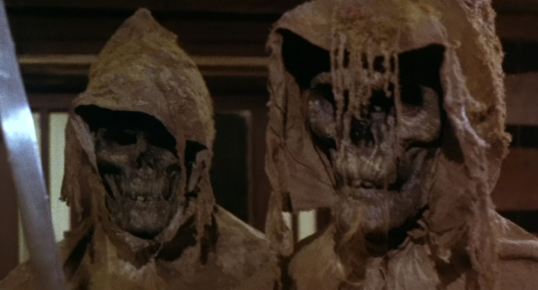
Who are the Blind Dead?  Well, the obvious answer is that they’re a group of dedicated horsemen who have not allowed being both dead and blind to keep them from accomplishing their goals.  Of course, since all of their goals are evil, that’s not necessarily a good thing.  When they were alive, the Blind Dead were 14th century knights.  (The usual assumption is that they were Knights Templar, even though this is never specifically stated.)  Accused of witchcraft and heresy, the knights were executed and, as their corpses hung from the gallows, bird pecked out their eyes.  The bodies were eventually buried in an isolated Spanish monastery.

The future members of the Blind Dead

The future members of the Blind Dead

Jump forward six centuries.  The year is 1970 and Spain is still under the repressive grip of the feared dictator, General Francisco Franco.  (This is important because some critics have suggested that the Blind Dead were meant serve as a metaphor for Franco’s regime.)  The monastery sits deserted, an otherwise menacing ruin on the beautiful Spanish countryside.  There’s a train that regularly runs by the monastery but the train’s conductor is always quick to tell his son to never stop the train.  The monastery, he explains, is a cursed place and no one should go near it.

tombsoftheblinddead

Unfortunately, someone does go near it.  A passenger on the train, Virginia (María Elena Arpón) is annoyed that her boyfriend, Roger (Cesar Burner) has been flirting with Virginia’s former schoolmate and lover, Betty (Lone Fleming).  So, naturally, Virginia hops off the train and decides to take a cheerful stroll across the Spanish countryside.  With night falling, she decides to camp out in the ruins of the old monastery.

Now, if you guessed that this leads to a bunch of decaying blind knights coming out of nowhere and chasing her down, you’re absolutely right.  That’s exactly what happens.  And, when Betty and Roger come to the monastery to investigate what happened to their friend, the Blind Dead are waiting for them.

The Blind Dead are also waiting for that train, which leads the film to its bloody conclusion…
zoltan1

Now, you may have noticed that I was very careful not to describe the Blind Dead as being zombies.  That’s because the film’s director, Amando de Ossorio, frequently stated that the Blind Dead were not meant to be zombies.  He stated that, if anything, the Blind Dead were mummies with vampiric tendencies.  He also pointed out that, unlike zombies, the Blind Dead are not mindless.  Instead, they are calculating, deliberately cruel, and, unlike the living, they work together.  Because of this, they’re even more dangerous and frightening than your typical zombie.

So, what distinguishes The Tomb of the Blind Dead from every other mummy/vampire/zombie/living dead film?  It’s certainly not the film’s plot.  This is one of those films were characters frequently do the stupidest thing they can at the worst possible time.  Instead, it’s the fact that the Blind Dead themselves are pure nightmare fuel.  Some of it is the brilliant makeup.  The Blind Dead truly do look like they’ve spent the last 600 years decaying.  Some of it is the fact that the Blind Dead are shockingly cruel and merciless, even by the standards of a European horror film.  When they finally do get on that train, no one — not even the cute little girl who sobs as her mother is killed in front of her — is shown a hint of mercy.

exploring-the-blind-deads-tombs-not-a-good-idea

But you know what makes the Blind Dead truly frightening?  It’s an amazingly simple thing.  de Ossorio films them in slow motion.  I know that doesn’t sounds like much but, along with the film’s brilliant soundtrack, it really does create a relentless atmosphere of impending doom.  When you watch the Blind Dead as they ride their similarly decaying horses across the Spanish countryside, you truly do feel that they’ve come from a different time and place.  The Blind Dead are so relentless and determined that, even though they may move slowly, there’s still no way you could ever escape them.

tombs-7

(And, of course, it doesn’t help that the Blind Dead are basically indestructible.  You can shoot the walking dead in the head and go on about your day but that’s not going to help out when it comes to the Blind Dead.)

Amazingly, when Tombs of the Blind Dead was first released in the United States, the film’s American distributor added a nonsensical prologue that described the Blind Dead as actually being super intelligent apes and changed the film’s title to Revenge From Planet Ape, all in an attempt to cash in all the popularity of Planet of the Apes.

That PG-rating should clue you in on just how much material was cut out of Tombs of the Blind Dead in order to make Revenge From Planet Ape!

That PG-rating should clue you in on just how much material was cut out of Tombs of the Blind Dead in order to make Revenge From Planet Ape!

apex1

Well, Tombs of the Blind Dead may not actually involve any super intelligent apes but it’s still a shocking and effective horror film and I highly recommend it for your Halloween viewing.  Just make sure you see the uncut Spanish version!

The Films of Dario Argento: Deep Red


I’ve been using this year’s horrorthon as an excuse to watch and review all (well, almost all) of Dario Argento’s films!  Today, I take a look at one of Argento’s best — 1975’s Deep Red!

profondo_rosso_poster

After the successful release of Four Flies on Grey Velvet in 1971, Dario Argento announced his retirement from the giallo genre.  His next film was 1973’s The Five Days of Milan, a historical comedy-drama with a political subtext.  The Five Days of Milan was a huge box office flop in Italy and, to the best of my knowledge, it was never even released in the United States.  To date, it is Argento’s most obscure film and one that is almost impossible to see.  In fact, it’s so obscure that, in two of my previous posts, I accidentally called the film The Four Days of Milan and apparently, no one noticed.

Forgotten Argento

Forgotten Argento

After the failure of Five Days, Argento returned to the giallo genre.  And while he was undoubtedly stunned by the failure of his previous film, Argento ended up directing one of the greatest Italian films of all time.  If The Bird With The Crystal Plumage and Four Flies on Grey Velvet were both great giallo films, Deep Red is a great film period.  It is Argento at his over the top best.

Now, before I go any further, I should point out that there are many different versions of Deep Red floating around.  For instance, it was released in the United States under the title The Hatchet Murders and with 26 minutes of footage cut from the film.  For this review, I watched the original 126-minute Italian version.  I’ve always preferred the original to the shorter version that was released in America.  Oddly enough, Argento has said that he prefers the shorter version.

hatchetmurders

Deep Red opens with a blast of music that both announces Argento’s return to the giallo genre and also provides some hints to his future as a filmmaker.  Whereas his previous films had all featured an excellent but rather serious score by Ennio Morricone, Deep Red was the first Argento film to be scored by Goblin.  There’s a gothic, almost operatic playfulness to Goblin’s work on the film.  (If the Phantom of the Opera had ended up working in Hollywood and writing film scores, the end result would have sounded a lot like Goblin.)  Goblin’s deafening score works as the perfect sonic companion to Argento’s constantly roving camera and vibrantly colorful images.  (The blood spilled in Deep Red is the reddest blood imaginable.)

deepred6511

Deep Red‘s protagonist is Marcus Daly (David Hemmings) and, like so many Argento protagonists, he’s both an artist and a man without a definite home.  At one point, he explains that he was born in England, grew up in America, and now lives in Italy.  He’s a jazz pianist but he supports himself by giving music lessons.  In a scene excised from the American cut, Marcus tells his students that, while classical music should be respected and appreciated, it’s also necessary to be willing to embrace art that some critics would dismiss as being “trashy.”  Marcus, of course, is talking about jazz but he could just as easily be Dario Argento, defending his decision to return to the giallo genre.

deepred4k3

While Marcus plays piano and tries to help his alcoholic friend, Carlo (Gabriele Lavia), a German psychic named Helga Ulmann (Macha Meril) is giving a lecture when she suddenly announces that someone in the audience is a murderer.  Later, Helga is brutally murdered by a gloved, hatchet-wielding attacker.

deep-red-hatchet

(Helga’s murder scene is always difficult for me to watch, even if Argento doesn’t — as Kim Newman pointed out in a review written for Monthly Film Bulletin — linger over the carnage in the way that certain other horror directors would have.  I have to admit that I also always find it interesting that Helga is played by the same actress who, that same year, would play the evil Lady On The Train in Aldo Lado’s The Night Train Murders.  Playing one of the Lady’s victims was Irene Miracle, who later co-starred in Argento’s Inferno.)

deepredscream1655_copy0_original

The only witness to Helga’s murder?  Marcus Daly, of course.  He’s standing out in the street, having just talked to Carlos, when he looks up and sees Helga being murdered in her apartment.  Marcus runs up to the apartment to help, arriving just too late.  And yet, Marcus is convinced that he saw something in the apartment that he can’t quite remember.  Deep Red is yet another Argento film that deals with not only the power of memory but the difficulties of perception.  Marcus knows that he saw something but what?

deep-red-12

Well, I’m not going to spoil it for you!  In this case, the mystery and its solution makes a bit more sense than the mysteries in Argento’s first three films.  Argento isn’t forced to resort to debunked science, like he did in both Cat o’Nine Tails and Four Flies on Grey Velvet.  One reason why Deep Red is so compulsively watchable is because, for perhaps the first time, Argento plays fair with the mystery.  After you watch the film the first time, go back and rewatch and you’ll discover that all the clues were there.  You just had to know where to look.

dr

That said, the way that Argento tells the story is still far more important than the story itself.  Argento’s first three films may have been stylish but Deep Red finds Argento fully unleashed.   The camera never stops moving, the visuals are never less than stunning with the screen often bathed in red, and Goblin’s propulsive score ties it all together.  This is one of those films from which you can’t look away.  It captures you from first scene and continues to hold you through the gory conclusion.  Deep Red is an undeniably fun thrill ride and, even today, you can easily see why Argento frequently refers to it as being his personal favorite of his many films.  In fact, Argento even owns a store in Rome that is called Profondo Rosso.

03_42

But you know why I really love Deep Red?

It’s all because of the relationship between David Hemmings and Daria Nicolodi.  Daria Nicolodi plays Gianna Brezzi, a reporter who helps Marcus with his investigation.  After three films that featured women as either victims or killers, Gianna is the first truly strong and independent woman to show up in an Argento film.  I know that some people have criticized the scenes between Hemmings and Nicolodi, feeling that they drag down the pace of the movie.  I could not disagree more.  Both Hemmings and Nicolodi give wonderful performances and their likable chemistry feels very real.

Gianna and Marcus arm westle. (Gianna wins. Twice.)

Gianna and Marcus arm westle. (Gianna wins. Twice.)

To me, that’s what sets Deep Red apart.  You care about Marcus and you care about Gianna.  Yes, the mystery is intriguing and the murder set pieces are brilliantly choreographed, and Deep Red is definitely Argento at his best.  But for me, the heart and soul of the film will always belong to the characters of Marcus and Gianna and the performers who brought them to life.

deep-red

deep-red-2

Deep Red was the start of Dario Argento and Daria Nicolodi’s long and often contentious relationship.  (Dario and Daria’s daughter, Asia Argento, was born around the same time that Deep Red was released and has directed two films, Scarlet Diva and Misunderstood, that deal with her often chaotic childhood.)  This relationship would play out over the course of six films and, as much as I love those six films, it’s always a little sad to consider that, when watched in order, the provide a portrait of a doomed and dying romance, one that did not particularly end well.  (It is possibly not a coincidence that, with the exception of Deep Red and Tenebrae, Daria Nicolodi suffered some type of terrible death in every film she made with Argento.)

But, regardless of what may or may not have been going on behind the scenes, Deep Red remains a triumph for both its director and its stars.

david-daria-dario

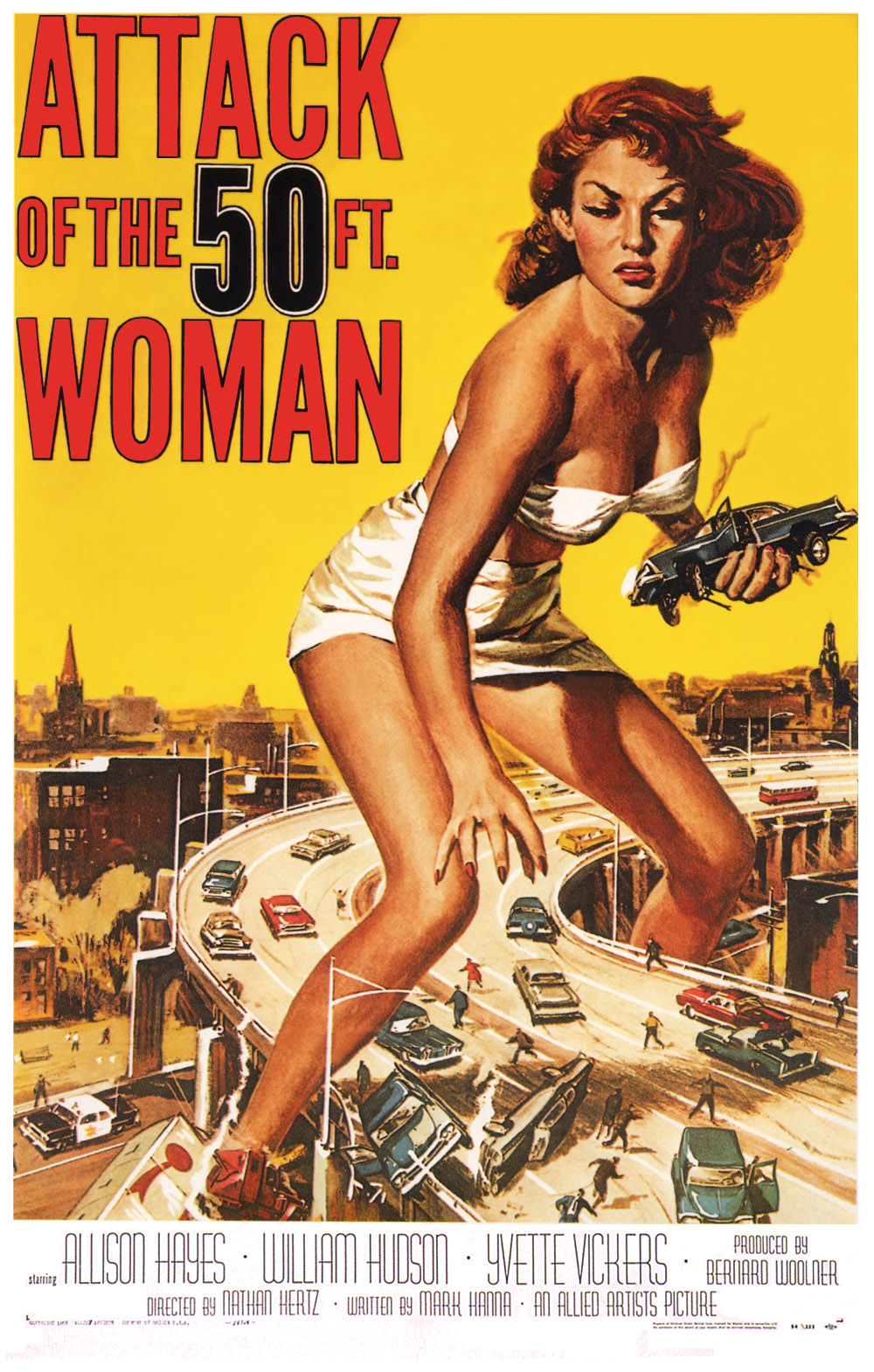
Halloween Havoc!: ATTACK OF THE 50 FOOT WOMAN (Allied Artists 1958)


gary loggins's avatarcracked rear viewer

“HAAARRRY!!!”

50ft1

It’s hard not to like ATTACK OF THE 50 FOOT WOMAN. Sure the premise is ridiculous, the script’s way over-the-top, the acting’s hammy, the direction’s practically non-existent, and the special effects flat-out stink. Yet the movie has an endearing, ragged charm in its unintentionally funny way that, like PLAN NINE FROM OUTER SPACE  , sucks the viewer right into its bizzaro world. Plus, it’s got two of the 1950’s hottest sci-fi/horror babes, Allison Hayes and Yvette Vickers!

50ft2

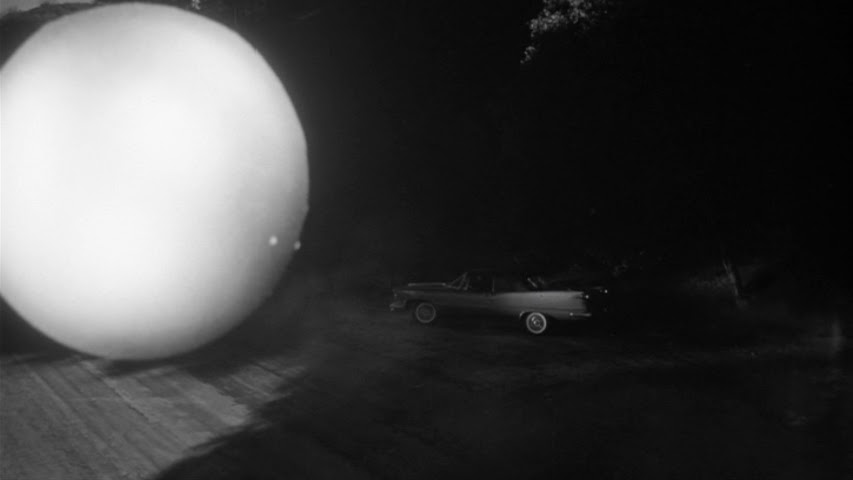
A giant space ball lands smack in the middle of Route 66 in the California desert. Heiress Nancy Archer swerves to avoid it, and next thing you know a giant hand grabs her! Meanwhile at Tony’s Bar & Grill, her louse of a husband Harry is living it up with local floozie Honey Parker. No one believes Nancy’s wild tale, as she’s known for being a boozer and has spent time in a sanitarium. Sheriff Dubbitt and…

View original post 836 more words

Horror Film Review: The Mummy (dir by Karl Freund)


220px-the_mummy_1932_film_poster

Did H.P. Lovecraft enjoy movies?  I’d love to think that he did but in all probability, he didn’t.  After all, Lovecraft frequently wrote, in both his fiction and his personal correspondence, that he found the modern world to be “decadent.”  He was not a fan of technological development, viewing it as being the source of civilization’s decline.

In all probability, Lovecraft did not enjoy the movies.  When The Mummy was first released in 1932, it’s probable that Lovecraft did not rush out to a local Providence movie theater and buy a ticket.

And, really, that’s a shame.  Of the many horror films released by Universal Pictures in the 1930s, The Mummy was perhaps the most Lovecraftian.  The bare bones of the film’s plot could have easily been lifted from one of Lovecraft’s stories: a group of rational and educated men are confronted with an ancient evil that defies all reason.  When the title character is brought back to life by a man foolishly reading from the fictional Scroll of Thoth, one is reminded of not only the Necronomicon but also of the dozens of other fictional-but-plausible texts that have appeared in the works of both Lovecraft and his successors.  Just the sight of the Mummy coming back to life causes one man to have an immediate nervous breakdown, a fate shared by almost every Lovecraft protagonist who was unfortunate enough to learn about Cthulhu, Azathoth, and the truth concerning man’s insignificant place in the universe.

The story of The Mummy goes something like this:  In ancient Egypt, a priest is caught trying to bring his dead lover back to life and, as punishment, he is mummified alive and locked away in a tomb.  Centuries later, a group of explorers discover the tomb.  The mummy comes back to life and, ten years later, he abducts the woman (played by the very beautiful Zita Johann) whom he believes to be the reincarnation of his former love.

I’ve watched The Mummy a few times and one thing that always surprises me is how little we actually see of the Mummy as a mummy.  After he’s accidentally resurrected by Ralph Norton (Bramwell Fletcher), the Mummy steps out of his sarcophagus and stumbles out into the streets of Cairo, leaving a now insane Norton to giggle incoherently about how the mummy just stepped outside for a walk.  That is pretty much the last time that we ever see the Mummy wrapped up in bandages.  When we next see the Mummy, he’s going by the name Ardath Bey and he bears a distinct resemblance to Boris Karloff.

Karloff gives one of his best performance as the sinister and calculating Bey.  Of all the horror films that were released by Universal in the 1930s, The Mummy is perhaps the only one that can still be considered to be, at the very least, disturbing.  That’s largely due to the fact that, as played by Karloff, Bey is the epitome of pitiless and relentless evil.  I’m always especially shaken by the scene in which Bey uses his magical powers to make a man miles away die of a heart attack.  It’s not just the fact that Bey has the power to do something like this.  It’s that Bey seems to get so much enjoyment out of it.  There’s a sadistic gleam in Karloff’s eyes during these scenes and his expression of grim satisfaction is pure nightmare fuel.

Just compare Bey to the other Universal monsters: The Invisible Man was driven insane by an unforeseen side effect of his formula.  Frankenstein’s Monster was destructive because he didn’t know any better.  The Wolf Man spent five movies begging people to kill him and put him out of his misery.  And while Dracula was certainly evil, he had as many limitations as he had power.  He couldn’t go out in daylight.  He was easily repelled by both crosses and garlic.  He often didn’t do a very good job of hiding his coffin.  Ardath Bey, on the other hand, was not only evil but apparently unstoppable as well.

The rest of the cast is pretty much overshadowed by Karloff but fans of the old Universal horror movies will enjoy picking out familiar faces.  They’ll recognize David Manners from Dracula.  Edward Van Sloan also shows up here, fresh from playing Van Helsing in Dracula and Dr. Waldman in Frankenstein.  But ultimately, it is Karloff who dominates the film and that’s the way it should be.  There’s a reason why Boris Karloff could get away with only his last name appearing in the credits.  He was an icon of both cinema and horror and The Mummy reminds us why.

For a film that was first released 84 years ago, The Mummy holds up surprisingly well.  There have been countless movies about homicidal mummies over the years but none have yet to match the original.

Horror On The Lens: Time Walker (dir by Tom Kennedy)


Today’s horror on the lens is 1982’s Time Walker!

Time Walker tells the story of what happens when a mummy that’s actually an alien awakens on a college campus.  As you might guess, mayhem and bad fashion choices ensue.  To be honest, Time Walker is not the best horror film ever made.  In fact, it’s actually pretty bad.  However, it is definitely a time capsule of the era in which it was produced and it has one of those WTF endings that you kind of have to see for yourself.

Enjoy!

Halloween On Hulu 2016 : “Infernal”


Ryan C. (fourcolorapocalypse)'s avatarTrash Film Guru

infernal-movie-poster

What happens when you cross Paranormal Activity with The Omen? Nothing good, I assure you —

sswxbk

So, yeah. writer/director Bryan Coyne has offered up another low-budget indie “found footage” horror flick to largely bored and indifferent audiences with 2015’s risible Infernal, the story of  hastily-married couple (she got knocked up, he popped the question, and they’ve never really gotten along since) Nathan (played by Andy Ostroff) and Sophia (Heather Adair), who are raising a possible demon-child named Imogene (Alyssa Koerner) and documenting the whole thing on home video. We’ve been down this road before —

infernal-bed-and-baby-scene

The problems here are too numerous to count, but let’s just skim over the basics so you know what you won’t be getting into provided you take my advice and blow this sorry flick off : both parents are thoroughly unlikable and can’t seem to get through a sentence without saying “fuck” three times…

View original post 389 more words

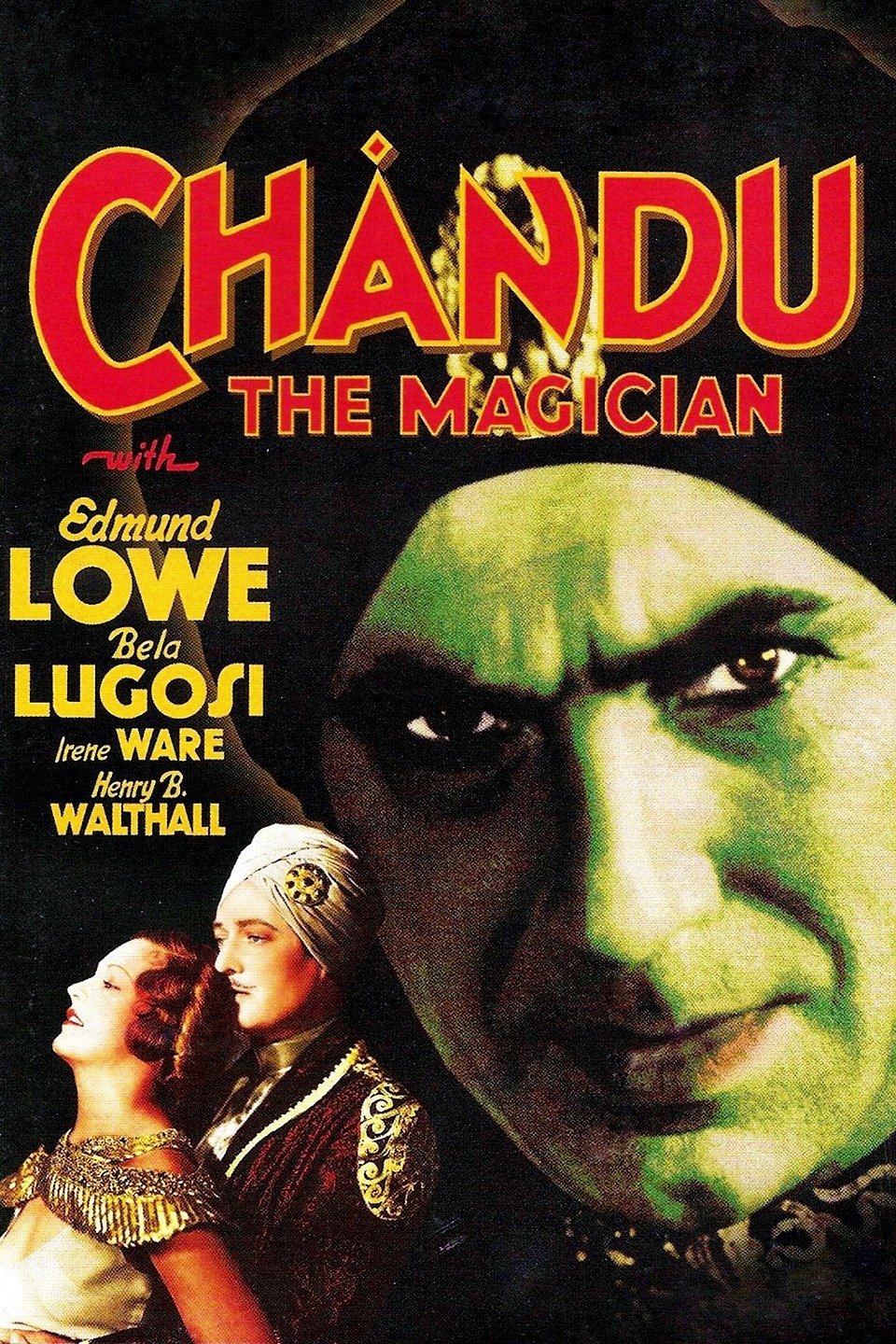
Halloween Havoc!: Bela Lugosi in CHANDU THE MAGICIAN (Fox 1932)


gary loggins's avatarcracked rear viewer

chandu1

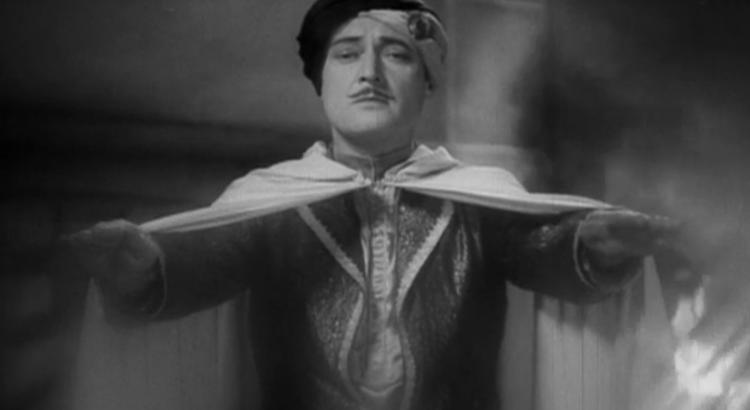
Thrills! Chills! Romance! Action! CHANDU THE MAGICIAN plays like a Saturday matinée serial aimed directly at the kiddie crowd. Based on a popular radio series, the film is pretty antiquated seen today, its saving graces being the special effects wizardry of co-director William Cameron Menzies and the deliciously evil Bela Lugosi as the megalomaniacal villain Roxor.

chandu2

The movie kicks off with the banging of a gong and an offscreen narrator ominously intoning “Chan-du the Magician”. A hand is used to wipe the screen credits, the first of Menzies’ many filmic tricks. We’re taken inside a temple where Frank Chandler, aka Chandu, has spent three years learning the ancient secrets of the mystic arts (move over, Dr. Strange!). He’s a yogi now, master of the hypnotic eye and astral projection, and demonstrates his prowess by performing the old Indian rope trick and walking through fire. His mentor bids him to “go…

View original post 682 more words

Halloween On Hulu 2016 : “Haunting Of Cellblock 11”


Ryan C. (fourcolorapocalypse)'s avatarTrash Film Guru

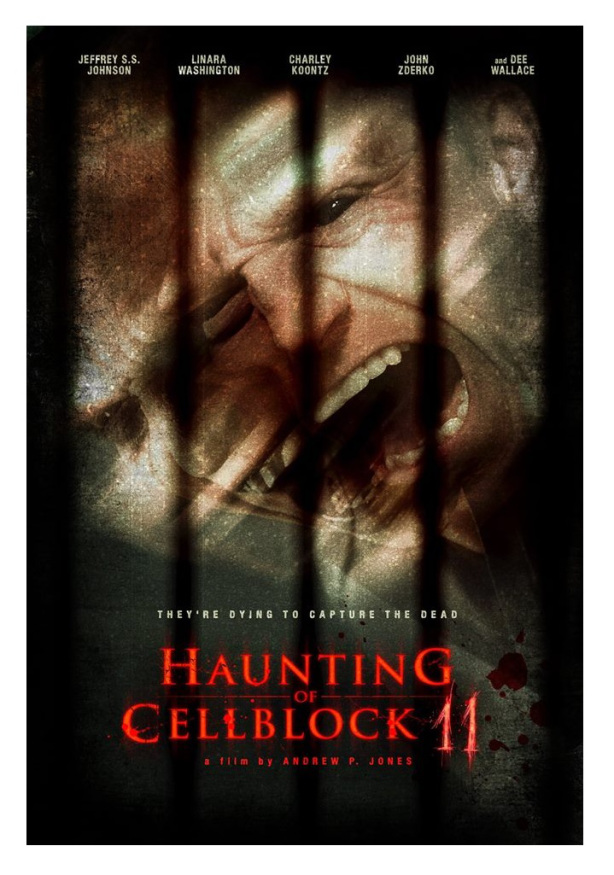
hauntingcellblock111

Every October for the past few years I’ve done a little something called “Netflix Halloween” that surveys a random sampling of the horror flicks available on America’s purportedly favorite streaming service, and every year I’ve noticed the same thing : the pickin’s are getting slimmer and slimmer on Netflix all the time for horror fans. This year I finally decided to break the mold, quit scraping the bottom of the barrel, and jump ship over to Hulu for the Halloween season, and whaddya know? They have a shit-ton more to choose from, and lots of it is stuff that I’ve never even heard of, much less seen — which, believe you me, takes some doing.

Sufficiently chuffed to find some films to review that you won’t see covered on many other movie blogs, I dove right in with just a couple of ground rules in mind : everything I’ll be…

View original post 631 more words

The TSL’s Daily Horror Grindhouse: The Erotic Nights of the Living Dead (dir by Aristide Massaccesi)


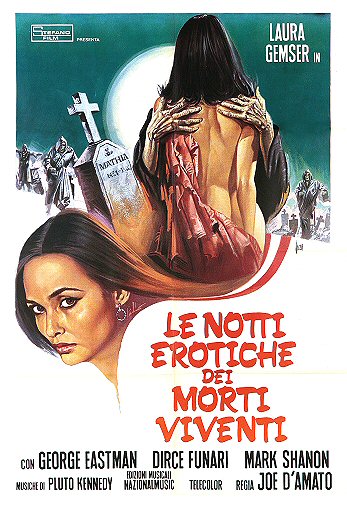
erotic_nights_of_the_living_dead

It is too a real movie!

Yes, I know that The Erotic Nights of the Living Dead sounds like something that someone made up but the movie totally exists and you probably won’t be surprised to know that it really doesn’t live up to the brilliance of the name.  There is a lot sex but most of it involves a really unattractive guy with a mustache and a perm that makes him look like he should be a part of Anchorman‘s Channel 5 Action News Team so it’s debatable how erotic it is.  The living dead do show up and, let’s give credit where credit is due, the zombie effects are undeniably well done.  They really do look like the dead come back to life.  However, none of the zombies are particularly sexual.  There is a ghost who, in close-up, castrates a man while giving him a blow job but, since she’s a ghost, it’s debatable whether or not she can truly be considered one of the living dead.  Finally, the title promises us “nights of the living dead” but it’s really more of an evening of the living dead.

Details matter.

Released in 1980, The Erotic Nights of the Living Dead was directed by Aristide Massaccesi, a filmmaker who was better known by the name Joe D’Amato.  D’Amato had a deserved reputation for directing some of the sleaziest Italian exploitation flicks of all time, though he also directed one of my personal favorites, Beyond the Darkness.  (For the record, Joe D’Amato was not the only alias used by Massaccesi.  Over the course of his long career, he was credited under at least 43 different names.  Also, for the record, I’ve read several interviews from people who worked with Massaccesi and, without fail, all of them have reported that he was one of the nicest and most generous people that one could hope to work with during the Italian horror boom of the 1980s.)

The Erotic Nights of the Living Dead is really two bad films in one.  The first film features a land developer named John Wilson (Mark Shannon).  Wilson has purchased an island and wants to build a luxury hotel on the island.  However, he’s having some trouble convincing anyone with a boat to give him a ride out to his property.  It seems that the location has a bad reputation.  John finally convinces local boat captain and adventurer, Larry O’Hara (George Eastman), to take him to the island.  Accompanying them is Fiona (Dirce Funari) who is either John’s girlfriend or just didn’t have anything better to do.  (To be honest, it was kind of hard to follow.)  Before heading out for the island, John takes a long shower with two prostitutes and Larry languidly watches as a stripper does a dance that involves popping a champagne cork without using her hands.

The second movie involves the trip to the island.  It turns out that the island isn’t as deserted as Mark assumed.  There’s an old man with a massive bump on his head.  There’s also the man’s mysterious daughter, played by Laura Gemser who also starred in D’Amato’s Black Emanuelle films.  The old man and his daughter warn everyone that they should leave the island but, of course, people are stupid.

Anyway, there are two good things about The Erotic Nights of the Living Dead.  First off, the great George Eastman gets a lengthy scene in which he giggles like a madman and it’s fun to watch because Eastman truly throw himself into the performance.  Secondly, the arrival of the zombies is heralded by a mysterious black cat.  The cat has the most Hellish meow that you’ll ever hear but he’s a black cat so he’s cute.

In the end, though, the best thing about The Erotic Nights of the Living Dead is the title.

The Films of Dario Argento: Four Flies On Grey Velvet


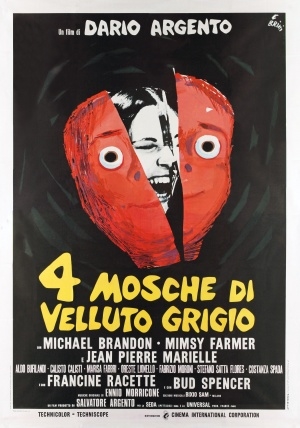
quattro_mosche

After the good but somewhat generic Cat o’Nine Tails, Dario Argento returned to form with his third film, 1971’s Four Flies on Grey Velvet.

It’s not particularly easy to describe the plot of Four Flies because, much like The Bird With The Crystal Plumage, the storyline is less important than the way that Argento tells it.  The film tells the story of Roberto Tobias (Michael Brandon), a drummer with an up-and-coming rock band in Rome.  In many ways, Roberto is a typical drummer.  He’s the guy who, even though he’s often obscured in the background, keeps things balanced.  He has a loving wife, Nina (Mimsy Farmer), a nice house, and worldly, politically woke friends who smoke weed and praise art.  Admittedly, one of those friends does tell a rather gruesome story about witnessing a beheading in Saudi Arabia which leads to Roberto having a reoccurring nightmare but otherwise, Roberto would appear to have a great life.

(Incidentally, Roberto’s nightmares are Argento at his best.)

So, why is this stable and easy-going guy suddenly being followed by a mysterious man in a suit?  And why, when Roberto confronts the man, does he discover that there’s yet another mysterious figure — this one wearing a mask — following him and taking pictures?

That’s the mystery that opens Four Flies on Grey Velvet but it’s not the only mystery to be found in the film.  In fact, this movie finds Argento at both his most macabre and his most playful.  At times, he literally seems to be seeing just how far he can push and how complicated he can make things before totally losing his audience.  The film may start with Roberto being followed and having nightmares but eventually, it comes to involve everything and everyone from Nina’s enigmatic cousin, Dalia (Francine Racette) to a beatnik named God (played by none other than spaghetti western mainstay, Bud Spencer) to a flamboyant private investigator (Jean-Pierre Marielle).  (By today’s standards, the portrayal of the gay detective has a few cringey moments but you have to remember that Four Flies On Grey Velvet was made in 1971.  It was nothing less than revolutionary for an Italian film of that era to portray an openly gay contemporary character in any type of positive light.)  To top it all off, the solution to the film’s main mystery is discovered through optography, the long-since discredited idea that an eye will “save” the last image seen before death.  It’s ludicrous but Argento pulls it off with a cheerfully over-the-top style that perfectly matches the film’s twisted plot.  After the toned down Cat o’Nine Tails, Four Flies was Argento’s way of reminding viewers of who he truly was as a filmmaker.

The film’s brilliant opening sets the tone for the entire film.  Watch it below and thank me later:

It’s rare that anyone every really discusses the acting in an Argento film.  Argento has himself admitted that he doesn’t worry much about actors and many of his films have been released in badly dubbed versions, which often makes it difficult to fairly judge any of the performances.  That said, Roberto Tobias is one of my favorite Argento protagonists and it’s all due to Michael Brandon’s performance.  Brandon makes Roberto into such a nice guy and does such a good job of capturing his descent into paranoia that it’s impossible not to get caught up in his story.  (I would even argue that the long-haired and politically concerned Roberto is almost an autobiographical stand-in for Argento himself.)  Though I can’t really explain why without running the risk of spoiling a major part of the movie, Mimsy Farmer is also excellent.  Reportedly, Argento originally wanted to cast Mia Farrow and you can imagine a post-Rosemary’s Baby pre-Woody Allen Farrow in the role.  But I’m glad that Argento couldn’t get her because Mimsy Farmer gives a close to perfect performance.

Four Flies was the third and final part of Argento’s “animal trailer,” and, at the time, Argento declared that Four Flies would also be his final giallo film.  He followed up Four Flies with The Four Days, a historical comedy that was considered to be such a failure that, after its release, Argento returned to the safety of the giallo genre and gave the world one of his greatest triumphs, Deep Red.  However, if The Four Days had been a success and Four Flies had been Argento’s final giallo film, it would have been a triumphant note to go out on.

Here’s the very misleading trailer that was used for Four Flies On Grey Velvet‘s American release.

And here’s the even more obscure European trailer!