Back to School Part II #11: Skatetown U.S.A. (dir by William A. Levey)


Poster_of_the_movie_Skatetown,_USA

Now that I’ve fully recovered from the trauma of writing about Grease, let me tell you about a little movie from 1979.  It’s a movie about teenagers, love, and competition.  It’s also a movie about disco and some actors who had some extra time on their hands.  It has a great soundtrack and the whole movie is pure 70s.  It even features the debut performance of a future movie star!

What film am I talking about?

SKATETOWN, USA, of course!

But before I talk about the movie, check out the trailer.  This is one of my favorite trailers of all time.  It pretty much tells you everything that you need to know about the movie.  There’s not a deceptive moment to be found in this preview:

Skatetown, U.S.A. is one of those movies that you watch and think, “This could only have been made in the 70s.”  Remember how watching Hollywood High caused me to doubt whether or not the 70s were actually all they were cracked up to be?  Well, Skatetown USA has renewed my faith!  Skatetown is such a 70s film that I personally think someone should send me an honorary coke spoon to reward me for watching it.

(Maureen McCormick, who is best known for playing Marcia Brady and who had a small role in Skatetown, wrote in her autobiography that the main thing she remembers about Skatetown is all the cocaine on the set.)

Skatetown USA doesn’t really have a traditional plot.  Instead, it’s a collection of “comedic” skits mixed in with roller skating performances and a nonstop soundtrack.  There is not a second that music is not playing in the background and, for what appears to be a low-budget film, the soundtrack is truly impressive.  Basically, almost every great disco song from the 1970s is heard at some point during Skatetown USA.  (Even that “Boogie Nights” song that Paul Thomas Anderson was apparently not allowed to actually use in Boogie Nights!  Imagine being the copyright holders who said yes to Skatetown but no to Paul Thomas Anderson…)

The film’s main character appears to be an unnamed DJ (Denny Johnston).  The DJ wears a big white afro wig and is always dancing in his booth.  Occasionally, he shoots a lightning bolt from his middle finger and suddenly, professional roller dancers appear and do a routine.  At the end of the movie, he looks at the camera, says that it’s all a fantasy, and winks.

Skatetown is the most popular disco roller rink in town.  Clean-cut teenager and all around nice guy Stan Nelson (Greg Bradford) wants to win Skatetown’s roller dancing contest.  (The prize is $1,000 and a moped!)  His best friend, Richie (Scott Baio), accompanies him and hopes to win a lot of money by betting on the outcome of the contest.  Stan angrily reprimands him, “This isn’t the streets!  This is Skatetown, U.S.A!”

That’s right — don’t mess with the good name of Skatetown!

Anyway, Stan’s actually a pretty good performer and he does this trick where he rides a skateboard while wearing roller skaters so you would think he would be a sure bet to win.

BUT NO!

The reigning Skatetown champion is Ace Johnson (Patrick Swayze, making his film debut) and we know that Ace is a bad guy because he wears all black and he occasionally snaps a whip while he’s rolling around!  Ace isn’t above cheating to win but really he doesn’t have to cheat!  Ace may be the bad guy but, seriously, he totally kicks ass while wearing roller skates.  As soon as he rolls out there, you understand why he’s the reigning champion.

See, here’s the thing with Skatetown: We’re supposed to be rooting for Stan but Ace really is a hundred times better than him.  There’s a reason why Patrick Swayze went on to have a career after Skatetown while Greg Bradford only has 8 credits on the imdb.  Swayze, even in this silly role, had movie star charisma whereas Bradford — well, he’s comes across as a nice guy but there’s nothing special about him.  Swayze, meanwhile, is dangerous and smoldering.

For instance, when Stan does his routine, his background music is The Village People singing “Macho Man” and you can’t help but snicker a little.  Whereas, when Ace performs, his background music is a slightly menacing cover of Under My Thumb.  Stan is the Village People.  Ace is the Rolling Stones.

Anyway, the film might not be good in the traditional sense but I absolutely loved Skatetown, U.S.A.  Why?  Because it’s a total time capsule! Watching it is such a totally 70s experience that I was even tempted to get a frizzy perm, start wearing bell bottoms, and stop wearing a bra.  Fortunately, the temptation passed but still, I enjoyed getting to use my cinematic time machine.

Add to that, the film itself is just so over-the-top and silly that … well, you can really believe that everyone involved in the movie was snorting mountains of cocaine in between takes.  There’s not a subtle moment to be found in Skatetown, U.S.A.  Instead, it’s all bright neon, loud music, flamboyant characters, silly melodrama, and corny humor.

(My personal theory is that Skatetown, U.S.A. was taking place in the same cinematic universe of A Clockwork Orange and it was showing what normal teenagers were doing while Alex and his droogs were seeking out the ultraviolence.  The over-the-top design of Skatetown reminded me of the similar flamboyance of the Korova Milk Bar and the droogs’s bowlers and oversized codpieces weren’t that different from some of the costumes worn by the cast of Skatetown.)

Anyway, Skatetown is one of those films that everyone should see once.  Unfortunately, because of all the music in the film, it’s never been released on DVD or Blu-ray and it probably never will be because life sucks.  It is on YouTube, though it was recorded off an old VHS tape so the transfer is not the best.

Here’s Skatetown, USA:

One final note: Skatetown, USA was directed by the same William Levey who also directed Blackenstein, Hellgate, and The Happy Hooker Goes to Washington.  It was written Nick Castle, who played Michael Myers in the original Halloween and directed a film that is well-liked by several of the writers here at the Shattered Lens, The Last Starfighter.
Back to School Part II #10: Grease (dir by Randal Kleiser)


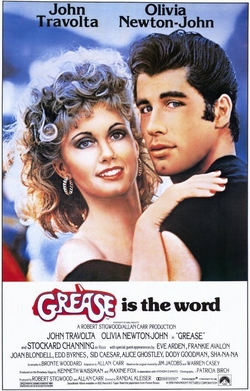
Grease_ver2

When it comes to reviewing Grease on this site, the film and I have a long and twisted history.  There have been several times when I was tempted to review Grease but one thing has always stopped me:

I absolutely hate this film.

Grease is one of my least favorite films and, to be honest, just thinking about it causes me pain.  Just about everyone that I know loves Grease.  They love the songs.  They love the music.  They love the performances.  They want to see it on stage.  They want to see it on the big screen.  They watch every time it pops up on AMC.

Growing up as a theater nerd means being surrounded by people who love Grease.  I cannot begin to count the number of times that I forced to watch this movie in school.  So many theater teachers seemed to feel that showing Grease in class was some sort of reward but, for me, it was pure torture.  And the fact that I was usually the only one who disliked the film made the experience all the more unbearable.

Back in 2014, when I was doing the first set of Back To School reviews, I was planning on reviewing Grease.  But I just could not bring myself to voluntarily relive the film.  Instead of putting myself through that misery, I decided to watch and review Rock ‘n’ Roll High School instead.  It was the right decision and I stand by it.

Jump forward two years and here I am doing Back to School again.  And again, for some reason, I had put Grease down as a film to review.  It’s just a movie, right?  And yet, after I finished writing my excellent review of Animal House, I again found myself dreading the idea of having to even think about Grease.

So, I said, “Fuck this,” and I promptly erased Grease from the list and I replaced it with Skatetown USA.  Then I watched Skatetown and I’m glad that I did because that was an experience that I can’t wait to write about!  And yet, I still had this nagging voice in the back of my mind.

“You’re going to have to review Grease at some point,” it said, “If not now, when?”

The voice had a point.  However, I was soon reminded that there was an even more important reason to review Grease.  A little further down on my list of Back to School films to review was a little film called Grease 2.  How could I possibly review Grease 2 if I hadn’t already reviewed Grease?  My OCD would not allow it!

And so, here I am, reviewing Grease.

Grease, of course, is a musical about teenagers in 1958.  Danny (John Travolta) is in love with Sandy (Olivia Newton-John) and Sandy is in love with Danny.  But Danny’s a greaser and Sandy’s Australian!  Will they be able to work it out, despite coming from different worlds?  Of course they will!  Danny’s willing to dress up like a jock in order to impress Sandy while Sandy’s willing to wear black leather to impress Danny!  Yay!  They go together!  And they’ve got a flying car, too!  YAY!

Screen-Shot-2013-07-12-at-13.51.48

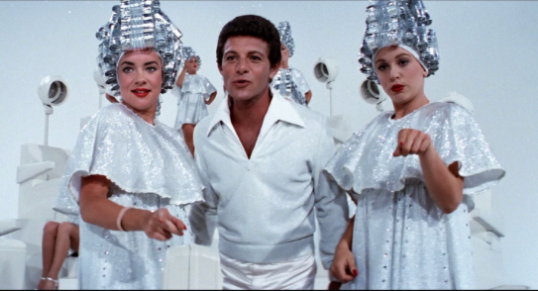
And then Satan arrived…

Of course, there’s other subplots as well.  For instance, Frenchy (Didi Conn) nearly drops out of school but she’s visited by Satan (Frankie Avalon) and he manages to change her mind.  And Rizzo (Stockard Channing) might be pregnant because Kenickie (Jeff Conaway) hasn’t bought any new condoms since the 8th grade.  Comparing the sensitive way that teen pregnancy was handled on a show like Degrassi: The Next Generation with the way it’s handled in Grease is enough to make you want to sing “O Canada” every day for the rest of your life.

Here’s what I do like about Grease: Stockard Channing is great as Rizzo, though it’s hard not to feel that she deserves better than a doofus boyfriend like Kenickie and a boring bestie like Sandy.  I also like You’re The One That I Want.  That’s a fun song.

But as for the rest of the movie … BLEH!  I mean, it is so BORING!  It takes them forever to get to You’re The One That I Want.  Olivia Newton-John is so wholesome that she literally makes you want to tear your hair out while John Travolta pretty much acts on auto pilot.  As for the supporting cast, most of them appeared in the stage production of Grease and they still seem to be giving stage performances as opposed to film performances.  They’re still projecting their lines to the back of the house.  Worst of all, it’s obvious that director Randal Kleiser had no idea how to film a musical because the dance numbers are so ineptly staged and framed that, half the time, you can’t even see what anyone’s doing with their feet.  If you can’t see the feet, it defeats the whole purpose of having an elaborate dance number in the first place!

So, no, I don’t like Grease.

Sorry, everyone.

However, I’m sure I’ll enjoy Grease 2….

Love you, Canada!

Love you, Canada!

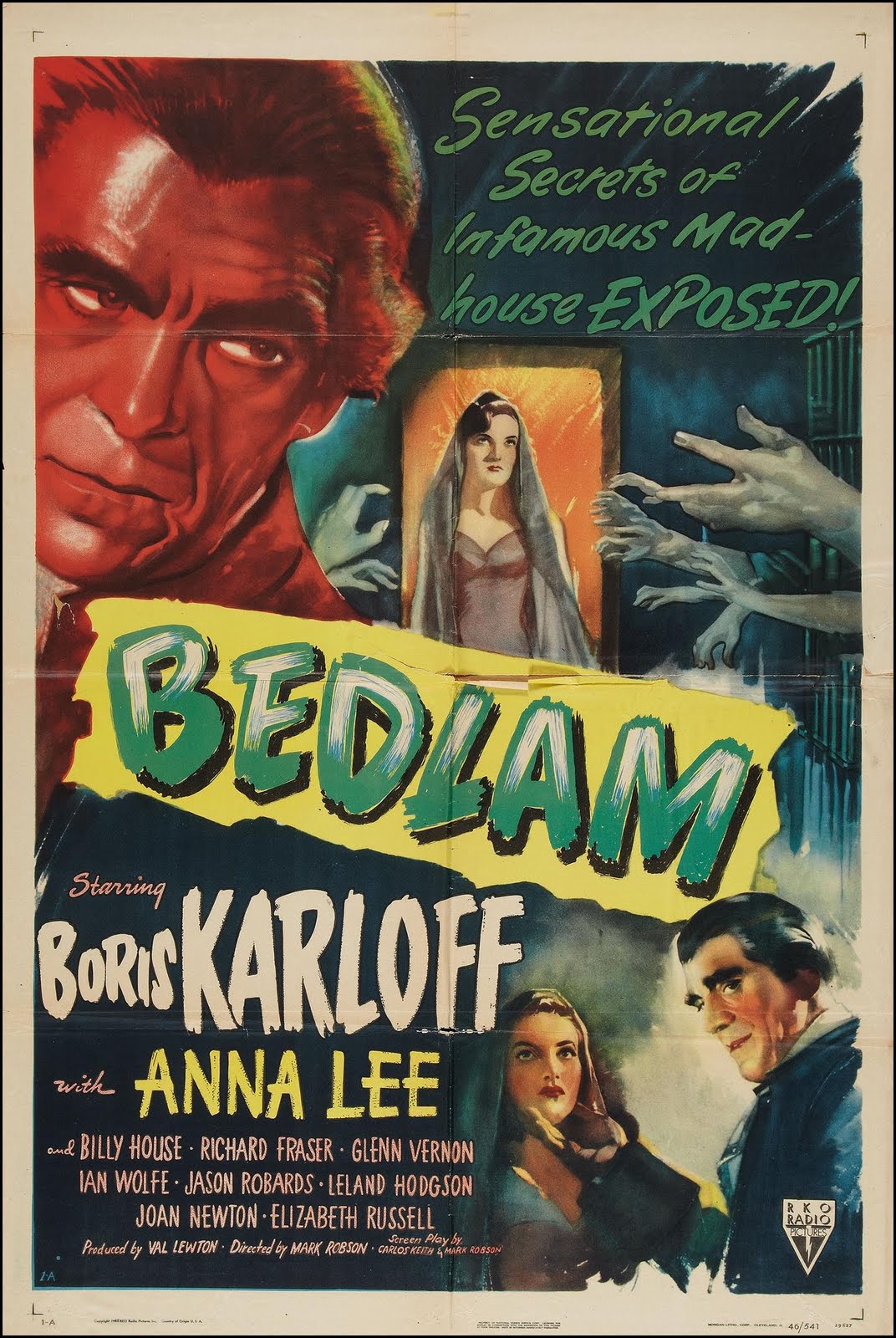
Master of Horror: Boris Karloff in BEDLAM (RKO 1946)


gary loggins's avatarcracked rear viewer

bedlam1

(This post is part of the TCM SUMMER UNDER THE STARS blogathon hosted by Kristen at JOURNEYS IN CLASSIC FILM! )

bedlam2

Boris Karloff made a trio of films for producer Val Lewton in the mid-40’s: THE BODY SNATCHER , ISLE OF THE DEAD, and BEDLAM. The Old Master of Terror was given the opportunity to show off his acting prowess in these dark, psychological horrors. Freed from the restraint of playing yet another mad scientist or creature, Karloff excels in the roles of murderous Cabman Grey, plague-ridden General Pherides, and here as the cruel martinet of Bedlam, Master George Sims.

bedlam3

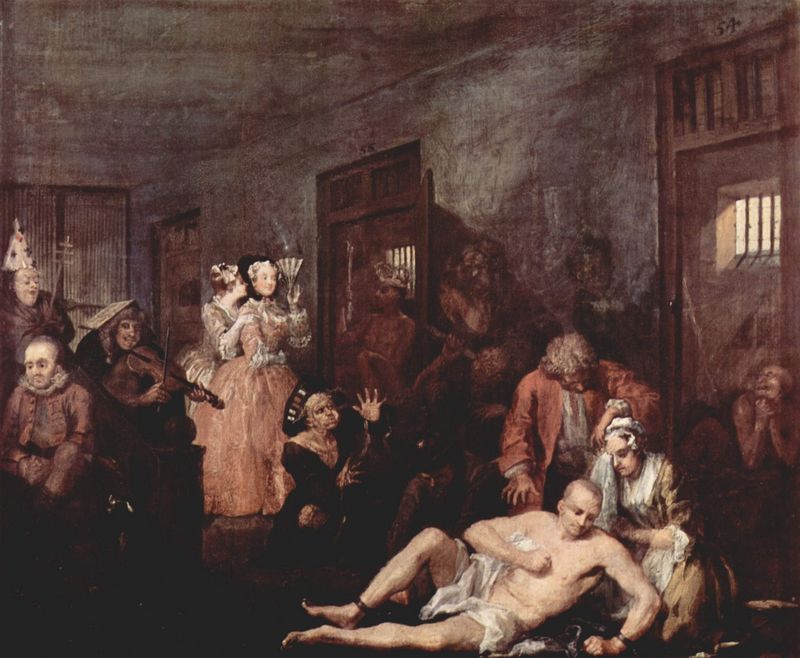
Lewton cowrote the script with director Mark Robson  , “suggested by” William Hogarth’s 8th painting in the series “A Rake’s Progress”. There are a lot of sly references to Hogarth in BEDLAM, and the artist even gets a screenwriting credit. It’s 1761 London, and the class struggle between rich and poor rages…

View original post 615 more words

Back to School Part II #9: National Lampoon’s Animal House (dir by John Landis)


NATIONAL-LAMPOONS-ANIMAL-HOUSE

You know what?  I’m going to start this review with the assumption that you’ve already seen the classic 1978 college comedy, National Lampoon’s Animal House.  At the very least, I’m going to assume that you’ve heard of it and that you know the general details.  Animal House was not only a huge box office success but it’s also one of the most influential films ever made.  Almost every comedy released since 1978 owes a debt to the success of Animal House.  Just as every subsequent high school film was directly descended from American Graffiti, every college film features at least a little Animal House in its DNA.

So, with that in mind, who is your favorite member of Delta House?

toga

Most people, I think, would automatically say Bluto (played by John Belushi) and certainly, Bluto is the best known and perhaps best-remembered member of the cast.  As played by Belushi, Bluto is the film’s rampaging ID and he’s such a force of nature that, whenever I rewatch Animal House, I’m surprised to be reminded of the fact that he’s not really in the film that much.  He’s present for the parties, of course.  He imitates a zit and starts a food fight.  He gives a rousing speech, in which he reminds the members of the Delta House that America didn’t give up after “the Germans bombed Pearl Harbor!”  He destroys a folk singer’s guitar and I personally love the scene where he tries to cheer up a despondent pledge by smashing a beer bottle over his head.  But really, Bluto is used very sparingly and he’s one of the few members of the ensemble not to get his own subplot.  Bluto’s great but he’s not my favorite member of Delta House.

Hoover

Believe it or not, my favorite member of Delta House is Robert Hoover (James Widdoes).  Hoover is the president of Delta House and, when we first meet him, he seems like he’s way too clean-cut to be in charge of the “worst house” on campus.  But then, as the film progresses, we discover that Hoover may not be as openly crazy as everyone else but he’s definitely a Delta.  Just watch him in the Toga party scene.  Just look at him in the picture that shows up during the closing credits.  It took me a while to realize that Hoover, the future public defender, was giving the camera the finger.  Hoover may look uptight but he’s secretly a wild man!

animal-house 1

One of the things that I love about Animal House is that it truly is an ensemble film.  There’s not a weak performance to be found in the entire movie.  No matter how wild or over-the-top the humor gets, the entire cast commits to their roles and, as a result, they keep this movie grounded.  You actually find yourself caring about whether or not they get kicked off campus.  You truly believe that the members of Delta House have been friends for years but, even more importantly, you believe the same thing about their rivals at Omega House.  For that matter, it may be easy to make fun of Dean Wormer (John Vernon, setting the template for all evil deans to come) but you never doubt that he’s been in charge of Faber College for years and that he’s planning on being in charge for years to come.  As played by the deep-voiced and sinister-looking Vernon, Wormer becomes every unreasonable authority figure.  When he explains the concept of super secret probation, he does so with a smug pleasure that is practically chilling.  When he mentions that the members of Delta House can now be drafted, the smile on his face is terrifying.

Wormer

You know who else gives a really good performance in Animal House?  Donald Sutherland.  At the time, Sutherland was the biggest star in the film.  He was offered either a percentage of the grosses or a flat fee.  Sutherland thought the film would flop, took the flat fee, and missed out on millions as a result. Sutherland plays Prof. Jennings, an English teacher who, in the only scene actually set in a classroom, desperately tries to get his bored students to pay attention to him.  There’s something so poignant about the way Jennings begs his students to turn in their papers.  “I’m not joking,” he sputters, “this is my job!”

Jennings

Jennings turns out to be free thinker.  He turns Boone (Peter Riefert), Katie (Karen Allen), and Pinto (Tom Hulce) onto marijuana.  There’s an anachronistic peace sign hanging in his apartment (Animal House takes place in 1963) but no matter.  Far worse is the fact that he temporarily breaks up Boone and Katie!  Everyone knows those two belong together!

Bluto and Flounder

You know who else doesn’t get enough credit for his performance in Animal House?  Stephen Furst.  He plays Flounder, a new pledge.  Flounder is just so enthusiastic about everything and he doesn’t even seem to be upset when Wormer tells him, “Fat, drunk, and stupid is no way to go through life.”  I love the enthusiastic way that Furst delivers simple lines like, “What’s my Delta Chi name?” and “Brother Bluto!  Brother D-Day!  What are you doing here!?” My favorite Flounder moment comes when he accidentally gives a horse a heart attack.  Technically, it shouldn’t be funny but it is because Furst, Belushi, and Bruce McGill (playing the role of D-Day) so thoroughly throw themselves into their roles.  For that matter, the horse did a pretty good job too.

Boone and Otter

But that’s not all!  How can I praise the ensemble of Animal House without mention Tim Matheson, who plays Otter, the future Beverly Hills gynecologist?  Or what about Kevin Bacon, playing Omega pledge Chip Diller?  This was Bacon’s first role and who can forget him shouting, “Thank you, sir, may I have another!” while being initiated into Omega House?  Or how about James Daughton and Mark Metcalf, as the two leaders of Omega House?  They were villains truly worth hissing!

Omega House

And yes, I know that a lot of the humor in Animal House is not politically correct but who cares?  It’s a hilarious movie, one that is full of good actors at their absolute best.  Yes, they’re all a bunch of privileged sexists blah blah blah, but I’d still party with the Delta House.  They know how to have fun and, even if they did wreck the Homecoming Parade, they had a good reason!

parade

And so is the movie.  Every time I see Animal House, I feel good about the world.  In 1978, The Deer Hunter was named best picture by the Academy.  Well, you know what?  With all due respect to that long epic about the tragedy of America’s involvement in the Vietnam War,  all the Oscars should have gone to Animal House!

Animal-House-e1349570128550

In conclusion … SING IT!

Let me t-t-tell you ’bout some friends I know
They’re kinda crazy but you’ll dig the show
They can party ’till the break of dawn
at Delta Chi you can’t go wrong

Otter, he’s the ladies man
Every girl falls into his hands
Boon and Katy playing “Cat and Mouse”

and Mrs. Wormer, she’s the queen of the
ANIMAL HOUSE

ANIMAL HOUSE

ANIMAL HOUSE

That Pinto he’s a real swell guy
Clorette was jailbait but he gave her a try
Chip, Doug, and Greg, they’re second to none
They studied under Attila the Hun

Mr. Jennings has got his wig on tight
Flouder’s left shoe’s always on his right
Babs and Mandy are having a pillow fight
With D-Day, Hoover, Otis Day and the Knights

DO THE BLUTO

Come on baby, dance with me
Maybe if we do the Bluto
We will get an “A” in lobotomy

DO THE BLUTO
DO THE BLUTO

DO THE BLUTO
DO THE BLUTO

Aw, come on!
Let me tell ya
Dean Wormer tried to shut us down
But he fell and he broke his crown
He didn’t know about the Delta spunk
He came in handy when we were short a skunk

At the

ANIMAL HOUSE

5650948_std

Back to School Part II #8: Hollywood High (dir by Patrick Wright)


517prRI0TEL

If I may, for a second, quote the theme song from Degrassi, the greatest television show ever:

Whatever it takes…

I know I can make it through!

That song was running through my head as I watched the 1977 “comedy,” Hollywood High.  At times, I didn’t know if I’d be able to make it through.  Hollywood High was not only bad but it was boring as well!  This is one of those films where every line of dialogue is followed by a minute or so of awkward silence as the cast struggles to remember who speaks next.  I’ve often written of the importance of ensemble chemistry.  Well, Hollywood High is a perfect example of what happens when a cast doesn’t have any chemistry at all.  They’re all playing friends and lovers but you get the feeling that none of them knew each other before film started and no one saw each other after it ended.

Whatever it takes…

I know I can make it through!

It’s a comedy but nothing funny ever happens.  As far as plot goes, it’s about four interchangeable girls who go to Hollywood High School and who spend most of their time on the beach, getting naked while some of the most generic west coast music imaginable plays in the background.  One of the girls (it’s never clear which) has a super cool boyfriend named Fenzie.  Fenzie wears a leather jacket and starts every sentence with, “Heeeeeeeey!” and he also says stuff like, “The Fenzie needs a beer!” No, his name is not Fonzie.  It’s FENZIE!

Whatever it takes…

I know I can make it through!

At one point, the four girls are driving down the highway in their red roadster.  (And you better believe that there’s a song on the soundtrack called “Red Roadster.”)

“We need gas!” one of them says.

“We need oil!” another one replies.

“We need a lube job!” one points out.

“We need Big Dick!” the driver announces.

Well, of course … oh wait.  It turns out that Big Dick is an auto mechanic.  He’s also a dwarf!  When he first shows up on screen, one of the girls says, “Oh, I see.  That’s funny.”

Whatever it takes…

I know I can make it through!

Anyway, Big Dick tries to cheat film star June East (Marla Winters).  The girls all love June East so one of them has sex with Big Dick so that June won’t have to pay her bill.  June is so impressed that she says, “Why don’t you come down and see me sometime?”  You know what that means!  It’s orgy time at June East’s mansion.  The girls are shocked to discover that June’s lover is the flamboyant teacher (played by an actor named Hy Pyke) who they previously assumed was gay!

Whatever it takes…

The girls then look straight at the camera.

“This,” one of them says.

“Is,” another one adds.

“The,” the third chimes in.

“End!”  the fourth one says with a smile.

…I know I can make it through!

And somehow, I did make it through!  Finally, this movie ended!  I breathed a huge sigh of relief and then I wrote this review.  And, in case I haven’t made it clear, Hollywood High is one of the worst movies ever made.  It didn’t even work as a time capsule because it left me hating the 70s with such a passion that I’m probably going to have to rewatch Saturday Night Fever, Dazed and Confused, Boogie Nights, and American Hustle to remind myself why I was ever fascinated by the decade in the first place!

I made it through Hollywood High.  And now, let us never speak of it again…

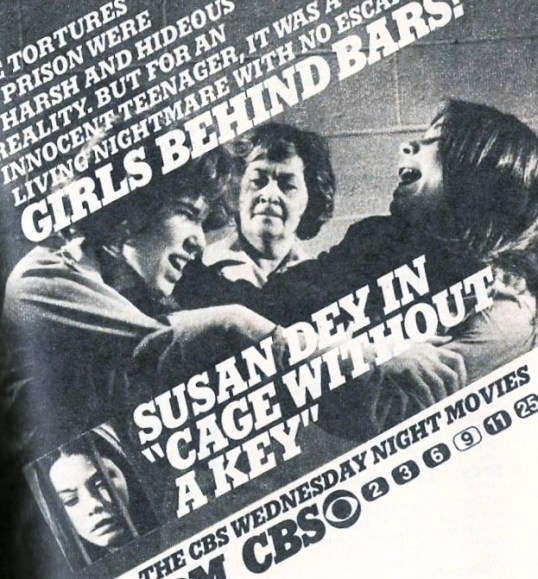
Back to School Part II #7: Cage Without A Key (dir by Buzz Kulik)


Cage-without-a-key_tv-guide-poster

For the fifth film in my Back To School series of reviews, I watched Cage Without A Key, a made-for-TV movie from 1975.

17 year-old Valerie Smith (Susan Dey) would appear to have everything.  She has a loving mother and a loyal best friend.  She just graduated from high school and has been accepted to a good college.  She’s looking forward to going down to San Francisco for the weekend before starting her summer job.  The future look great and, of course, that means that she’s about to make the biggest mistake of her life.

And she’s going to do it 70s style!

When her car breaks down on the way to San Francisco, she makes the mistake of accepting a ride from a long-haired guy in a Volkswagen microbus.  Buddy Goleta (Sam Bottoms, in full 70s weirdo mode) went to high school with Valerie and appears to have a crush on her.  Buddy also appears to be a little bit crazy himself as he tells everyone that he meets that Valerie is “my old lady.”  Finally, Buddy pulls over to a convenience store and kills everyone inside.  Since Valerie’s in the microbus, she gets arrested along with Buddy.  Since Buddy claims that he and Valerie are lovers, she’s convicted of being an accessory and is sentenced to a … REFORM SCHOOL!

(Cue dramatic music.)

The warden — Mrs. Little (Katharine Helmond) — insists that she’s not running a prison.  Instead, she’s running a very progressive school where the students all happen to be thieves and murderers.  The school even has pleasant euphemisms for all the standard prison film elements.  For instance, no one is put in solitary confinement.  Instead, they’re sent to meditation.

Anyway, while Valerie waits for her dedicated public defender (David Brandon) to prove her innocence and get her out of reform school, she finds herself being approached by the various gangs who run the school.  Valerie says she doesn’t want anything to do with any of that.  She just wants to fly under the radar until she’s set free.  But then she’s approached by a predatory lesbian and, as we all known from watching other prison films, nothing will make you join a gang faster than being approached by a predatory lesbian…

Okay, Cage Without A Key is not exactly Orange Is The New Black.  What it is, however, is a time capsule of the time it was made.  Everything from the slang to the clothes to the attitudes to the squishy, upper class liberalism of Valerie’s lawyer practically screams 1970s.

Add to that, classic film lovers will appreciate the fact that the evil gang leader is named Suzy Kurosawa!

Incidentally, Cage Without A Key was written by Joanna Lee, who readers of this site will probably best remember for playing one of the alien invaders in Plan 9 From Outer Space.

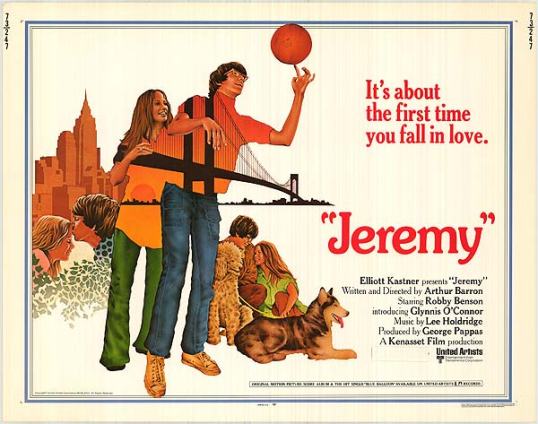
Back to School Part II #6: Jeremy (dir by Arthur Barron)


Jeremy

After I finally finished working out my thoughts concerning A Clockwork Orange, I continued my back to school reviews by watching a 1973 teen romance called Jeremy.  I have to admit that it was kind of a shock going from Stanley Kubrick’s confrontational masterpiece to this rather gentle and sweet-natured film about two nice kids who fall in love.  But that’s one of the things that I love about reviewing movies.  You get to see all sorts of things.

As for Jeremy — it’s a film that tells a familiar story but it doesn’t quite go in the direction that you’re expecting.  15 year-old Jeremy (played by Robby Benson, who was apparently the Justin Bieber of his day) is a 15 year-old student at a private high school in New York City.  He’s a brilliant but painfully shy student.  He’s very serious about learning the cello, even though his teacher (Leonardo Cimino) tells him that he’s good but he’ll probably never be great.  He’s also really into horse racing, though he never bets himself.  Instead, he just likes to pick the winner and is content with the knowledge that he was right.  Jeremy is largely ignored by his parents and has only one friend but he seems to be okay with his largely solitary life.

That is, of course, until he spots Susan (Glynnis O’Connor) practicing ballet in a classroom.  Jeremy is instantly attracted to her and it’s obvious that she likes him as well but, because of his pathological shyness, Jeremy cannot bring himself to ask her out.  (In fact, he even forgets to ask her name the first time that they meet.)  It’s not until Susan compliments him on his cello playing that Jeremy is able to work up the courage to ask her out.  It’s not that Jeremy is arrogant or stand-offish or any of the other stuff that people regularly say about shy people.  It’s just that talking about his cello gives Jeremy the courage to be himself.  It’s rather sweet, actually.

Jeremy and Susan go out for three weeks and, in a tastefully handled scene, even end up making love for the first time.  However, Susan’s father has been transferred to another city and Susan is about to move away.  Even when Susan and Jeremy say that they’re in love, all of the adults ignore them.

At this point, I was expecting Susan and Jeremy to enter into a suicide pact but it didn’t happen.  That’s not the type of film that Jeremy is.  Jeremy is a very sweet but ultimately realistic film about first love and first heartbreak.

As for the two lead performers, they apparently dated for a while after making Jeremy and they both display a very real chemistry in the film.  Admittedly, there’s a few scenes where Benson goes a little bit overboard but, watching him, I could tell why he was a teen idol in the 70s.  There’s not a threatening or dangerous thing about him and when he’s insecure or sad, you just want give him a big hug.  Glynnis O’Connor brings a bit of an edge to Susan (there always seems to be a poignant sadness right under the surface when it comes to Susan) and it contrasts nicely with Benson’s performance.

In the end, it may not add up too much but it’s heartfelt and nicely done and I’m glad that I watched it.

Back to School Part II #5: A Clockwork Orange (dir by Stanley Kubrick)


It may seem strange, at first, that I am including the 1971 best picture nominee, A Clockwork Orange, in a series of Back to School reviews.  Certainly, Stanley Kubrick’s iconic adaptation of Anthony Burgess’s novel is not usually described as being a film about juvenile delinquency but that’s exactly what it is.

Many viewers tend to forget that Alex (played by Malcolm McDowell, who was nearly 30 at the time) and his three droogs are all meant to be teenagers.  (Only Michael Tarn, who played Pete, was actually a teenager at the time the film was shot.  Warren “Dim” Clarke and James “Georgie” Marcus were both in their late 20s.)  There’s even a lengthy scene in which Alex is interrogated by a social worker, P.R. Deltoid (Aubrey Morris).  Viewers are usually so surprised when Deltoid suddenly grabs Alex’s crotch that they forget that the whole reason Deltoid even came to the flat was to find out why Alex had been skipping school.  (“Pain in my gulliver,” was Alex’s oft-quoted excuse.)

So, make no mistake about it.  Among other things, A Clockwork Orange is a film about both the problem of juvenile delinquency and the continuing debate concerning what the authorities should do about it.  Stylistic and philosophical differences aside, A Clockwork Orange comes from the same cinematic family tree that’s given us everything from Rebel Without A Cause to Bully to Spring Breakers.

Of course, that’s not all that A Clockwork Orange is about.  It’s a Kubrick film, which means that there’s several different layers to work through and multiple interpretations for what we see on-screen.  For those who may not be familiar with the film, it takes place in a recognizable but futuristic England.  (One of my favorite theories is that A Clockwork Orange was about what was happening on Earth while David Bowman was becoming the starchild in 2001: A Space Odyssey.)  It’s a violent world, one where there appears to be significantly fewer people around than in the past.  The streets are deserted and bombed out.  Occasionally, when Alex returns to his home, he passes a mural of idealized working men creating a new world.  This rather banal work of Socialist realism has been defaced by obscene drawings and mocking graffiti.

Teenage Alex spends his nights hanging out with his friends (or, as he calls them, droogs), Pete, Georgie, and Dim.  They drink at the Korova Milk Bar and wear obscenely oversized codpieces, signifying this society’s obsession with outsized masculinity. When they speak (and when Alex narrates the film), they do so in a rhyming slang called Nadsat.  Under Alex’s sociopathic leadership, they spend their nights raping women, beating the homeless, and fighting with other gangs.  When Alex is not with his droogs, he enjoys lying around the house and listening to Beethoven (or “Ludwig Van” as he calls him).

After being betrayed by his droogs (who have tired of Alex’s cockiness), Alex ends up imprisoned for murder.  However, Alex is offered an early release if he’s willing to take part in the Ludovico Treatment.  For two weeks, Alex is drugged and forced to watch violent and sexual films while the music of Beethoven plays in the background.  As a result of the treatment, Alex grows physically ill at the thought of both violence and sex but he can also no longer listen to Beethoven.  Arguably, as a result of being cursed of his anti-social tendencies, he has lost the only non-destructive thing that he enjoyed.

Over the objections of the prison chaplain (who argues that robbing Alex of his free will is not the same as rehabilitating him), Alex is sent back into the real world and he quickly discovers that he now has no place in it.  His parents have rented his room out to a boarder who is now more of a son to them than Alex ever was.  The streets are full of men who were previously tormented by Alex and who now wants revenge.  In perhaps the film’s most brilliant moment, Alex discovers that his former droogs are now members of the police force.  Though they may now be wearing uniforms, Dim and Georgie are still as destructive and dangerous as Alex once was.  The difference is that Alex was caught and cured whereas Dim and Georgie discovered they could do just as much damage as authority figures as they did as juvenile delinquents.

In fact, the only people who now care about Alex are the political dissidents who hope to use Alex to discredit the government.  However, the dissidents aren’t particularly worried about Alex’s well-being either.  He’s just a prop to be used for their own ambitions.  Even worse, for Alex, is the fact that one of the dissidents is Mr. Alexander (Patrick Magee), a writer who lost both his ability to walk and his wife to an earlier assault committed by Alex…

(Interestingly enough, Mr. Alexander’s boyguard is played by David Prowse, who later become the ultimate symbol of government oppression when he was cast as Darth Vader in Star Wars.)

A Clockwork Orange is a brilliant film but it’s one about which I have very mixed feelings.  On the one hand, you can’t deny the power of the film’s imagery.  How many times has just the opening shot — of McDowell staring at us while wearing one fake eyelash — been imitated on TV and in other movies?  How much of the film’s dialogue — from “pain in my gulliver” to “the old in-out” — has lived on long past the movie?  Regardless of how many times I’ve seen A Clockwork Orange, the film’s electronic score (from Wendy Carlos) never ceases to amaze me.  Finally, it’s a film that argues that free will is so important that even a sociopath like Alex must be allowed to have it and that, as the chaplain argues, true goodness comes from within and cannot be manufactured or regulated by a government agency.  (It’s also a film that suggests that the government would be just as quick to use the Ludovico Treatment not just on the evil Alexes on the world but on anyone who dared to dissent from the party line.)  As I’m something of a “Freedom of Choice” absolutist, that’s a message to which I responded.

(At the same time, A Clockwork Orange does not argue that Alex’s actions should be free of consequences.  If anything, the film’s message seems to be that things would have been better for literally everyone if the government had just left Alex in jail, as opposed to trying to “fix” what was wrong with him.)

And yet, I have mixed feelings about A Clockwork Orange.  I guess my main issue is that the film doesn’t always play fair.  Malcolm McDowell is allowed to give a charismatic and well-rounded performance as Alex but nearly everyone else in the film is directed and written as a one-dimensional caricature.  Whereas Anthony Burgess’s novel emphasized the very real damage that Alex did to his victims, the film tends to surround Alex with comedic grotesqueries.  By both making Alex the only fully developed character in the entire film and then casting the energetic and charismatic Malcolm McDowell in the role, the film seems, at times, to come dangerously close to letting Alex off the hook for his worst crimes.  It also leaves the film open to the oft-repeated charge of glamorizing sex and violence.  (According to Roger Lewis’s biography of the author, that was Anthony Burgess’s opinion of the film.)  For the record, I don’t think A Clockwork Orange is an immoral film but I understand why some people disagree.

For that reason, A Clockwork Orange remains a controversial film.  In fact, I’m somewhat surprised that this subversive and deliberately confrontational film was nominated for best picture.  It was only the 2nd (and last) X-rated film to receive a best picture nomination.  Though it lost to The French Connection, A Clockwork Orange continues to be a powerful and controversial film to this day.  Perhaps the biggest indication of A Clockwork Orange‘s success is that it’s still being debated 45 years after it was first released.

Clockwork_orangeA

Tall (Tales) in the Saddle: THE LAW WEST OF TOMBSTONE (RKO 1938)


gary loggins's avatarcracked rear viewer

lawwest1

Cowboy star Harry Carey had been around since motion pictures were knee-high to a cactus. He made his first film in 1908, working with pioneer director D.W. Griffith. He was already one of silent film’s biggest sagebrush stars by the time he made 1918’s STRAIGHT SHOOTER, the directorial debut of John Ford. When the  talkies rolled around, Carey was over fifty and his leading man days were behind him. He transitioned into a fine character actor, and his talents are given a good showcase in the low-budget Western THE LAW WEST OF TOMBSTONE.

lawwest2

Carey is champion liar Bill Barker, a charming rascal who spins tall tales of his bravery fighting bloodthirsty Indians. The old windbag gets himself thrown out of New York circa 1881 when he tries to run a con on Wall Street tycoon Sam Kent. Not even his ex, a former saloon girl now passing herself off as continental singing…

View original post 531 more words

Back to School Part II #4: Summer of ’42 (dir by Robert Mulligan)


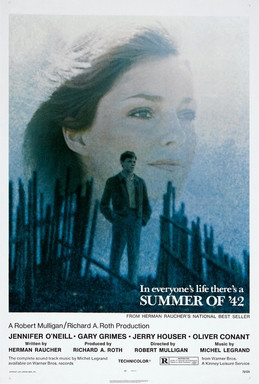
Summer_of_'42_POSTER

Originally, I was going to finish up the first day of my back to school reviews by talking about A Clockwork Orange.  I figured that, since the second film I reviewed was Andy Warhol’s Vinyl, it would just make sense that the fourth film would A Clockwork Orange.

But, I don’t know.  As I sat down and started to work on my fourth review, I realized that I’m not quite ready to write about A Clockwork Orange.  Instead, I’d rather hold off on that until tomorrow.  So, instead, I’m going to talk about Summer of ’42, another coming-of-age film that came out the same year.

That’s right — A Clockwork Orange and Summer of ’42 both came out in 1971 but — in content and sensibility — they might as well exist in different universes.  In fact, the only thing that they have in common is that they both tend to show up on TCM fairly frequently and that they’ve both influenced countless other films.

Speaking of TCM, that’s where I first saw Summer of ’42.  I have to admit that I’m writing this review from memory and that may not be the best way to review a film.  I saw Summer of ’42 about four months ago and, at the time, I thought it was a well-done but predictable little movie.  I even took notes for a future review but I didn’t get around to writing that review because … well, at the time, it just seemed like there wasn’t a lot to say about it.  Summer of ’42 is a sweet film but almost everything about it is right on the surface.  What you see is what you get.  I’m not surprised to discover that it was the 6th highest grossing film of 1971.  In a year that saw not only A Clockwork Orange but The Last Picture Show, The French Connection, Brother John, Billy Jack, Carnal Knowledge, Dirty Harry, Harold and Maude, Let’s Scare Jessica To Death, Klute, Straw Dogs, Pretty Maids All In A Row, and The Zodiac Killer, audiences were probably relieved to see a film that was neither violent, morally ambiguous, nor apocalyptic.

Instead, Summer of ’42 is a coming-of-age story that was specifically crafted to appeal to a world-weary audience’s nostalgia for the simple and carefree days of World War II.  This is one of those films where an older narrator continually reassures us that we’re seeing the most defining moment of his youth and all of the pretty images are in soft focus.  Hermie (Gary Grimes), Oscy (Jerry Houser), and Benjie (Oliver Conant) are three fifteen year-olds, all of whom are spending their summer on Nantucket Island.  Benjie is obsessed with sex but he’s nerdy.  Oscy is obsessed with sex but he’s a jerk.  Hermie is obsessed with sex but he’s the narrator so we already know that he’s too sensitive to lose his virginity to any girl his own age.

Luckily, there’s a woman in her 20s who is living in a nearby beach house.  Dorothy (Jennifer O’Neill) is beautiful but she’s married.  However, her husband’s a soldier and it is 1942 so, pretty soon, he’s out of the picture.  Hermie develops a mad crush on her and then, luckily for him, her husband dies and she spends a night teaching him the ways of love.  The next morning, she vanishes but leaves Hermie a note, telling him that she will never forget him and that it’s up to him to decide what their night together meant.

(Hermie never gets around to telling us what their night together meant so I guess it’s up to us to decide.  Personally, I just hope Hermie was careful who he told because, nowadays, a 23 year-old can get in a lot of legal trouble if she’s caught having sex with a 15 year-old.  Maybe things were different in 1942…)

As I said before, my initial response was that Summer of ’42 was sweet but predictable.  And that’s the way I still feel about it.  It was well-acted, well-filmed, and Jennifer O’Neill was amazingly beautiful but there was still something about Summer of ’42 that kind of bothered me.  We never really got to know who Dorothy was.  Her entire character was defined by her one night with Hermie.  Yes, I do understand that was kind of the point because the story was being told exclusively from Hermie’s point of view.  But it still bothered me.  Beyond being beautiful, tragic, and ultimately available, who was Dorothy?

But really, it wasn’t just something about the Summer of ’42 that was bothering me.  Instead, it was something about the coming-of-age genre in general.  I have lost track of how many nostalgic films and TV shows that I have seen that feature a narrator talking about the summer that he “became a man.”  It’s amazing how many awkward teenage boys apparently lost their virginity to a beautiful older woman who promptly vanished afterwards.  If, as has been recently suggested, I spent next summer in a rented beach house, am I going to be obligated to be the first lover of every 15 year-old, aspiring writer who happens to come wandering down the beach?  That could be time consuming, depending on how popular the beach is.

I guess what I’m saying is that perhaps somebody needs to remake Summer of ’42 and tell it from Dorothy’s point of view.

Just a thought.