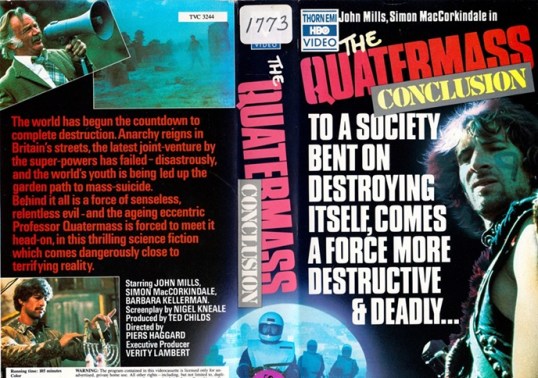
Film Review: The Quatermass Conclusion (dir by Piers Haggard)


1979’s The Quatermass Conclusion opens with a narrator telling us that civilization is collapsing and no one knows why.

Though the film takes place in London and the English countryside, we are told that societal collapse a worldwide phenomenon.  What we see in London is a city that has been taken over by criminal gangs, where the police stand-by helplessly and watch as battles play out.  The elderly, abandoned by their government, hide out in decrepit homes and try to avoid being noticed.  The future is a world that is pretty much ruled by the young and the young appear to be insane.

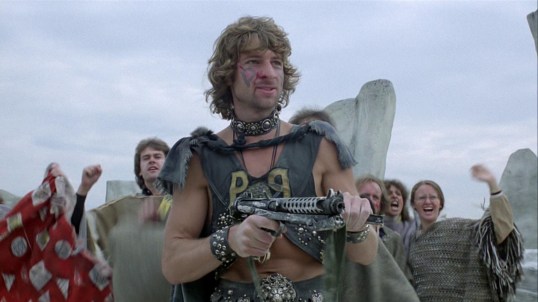
Even if one escapes the gangs, there’s still the Planet People to deal with.  The Planet People are a group of hippies, who walk across the countryside and who claim that they are going to be transported to another planet.  At first glance, they make seem innocent and even a bit ludicrous.  But they are actually aggressive and angry, convinced that the adults have destroyed the Earth and that the young are the chosen ones who will be transported to a better world.  They are led by a man who calls himself Kick Along (Ralph Arliss), an anti-Semite who smiles when he manages to find a gun and who clearly relishes getting to decide who deserves to be saved and who doesn’t.

Into all of this comes a retired scientist named Bernard Quatermass (John Mills).  Elderly and suffering from heart disease, Quatermass has come to London to search for his missing granddaughter.  Because Quatermass has spent the last few years living in the Scottish highlands and because the British government has covered-up the extent of the unrest, he is shocked to discover just how bad things have become.  Rescued from a gang by another scientist, an astronomer named Joe Kapp (Simon MacCorkindale), Quatermass finds himself watching as humanity slowly sacrifices itself to an alien presence who is not interested in saving anyone but who instead just wants to feast.

The Quatermass Conclusion started life as a 4-episode British television simply called Quatermass, which was the last to feature the character of Prof. Bernard Quatermass.  The four-hour miniseries was edited down to a 100-minute feature film that was subsequently released outside of the UK.  As a result of the editing, The Quatermass Conclusion is a occasionally intriguing, frequently messy, and almost relentlessly downbeat.  Having seen both the original miniseries and the subsequent film, I can tell you that tragedies that were evenly spaced out over the course of four hours come at you nonstop in the feature version.  It seems like every other scene features someone either dying or giving up hope.  Themes that were fully developed in the miniseries are only hinted at in the feature film.  Events that were fully explained and built-up in the miniseries seem to spring out of nowhere in the movie, giving the whole thing a disjointed but nightmarish feel.

Taken on its own, the film has its flaws.  I’m not really sure that the plot can truly be followed if you haven’t already watched the original miniseries. As the unfortunately-named Kick Along, Ralph Arliss gives a disturbingly plausible portrayal of a fascist who has adapted to the latest trend and John Mills is instantly sympathetic as the mentally strong but physically weak Prof. Quatermass but some of the other performances are definitely more appropriate for television than a film.  And yet the film has moments that work incredibly well.  A scene where the alien presence feasts on the thousands who have gathered at Wembley Stadium is undeniably well-done and brings to mind the real-life reports of political dissidents being held and executed in South American soccer stadiums.  By the end of the film, the atmosphere has become so polluted with the particles of human remains that it takes on a sickly yellow hue.  Even the film relentlessly bleak tone works.  If you’re going to make a movie about the collapse of civilization, you should definitely go all out.  There’s not much deliberate humor in The Quatermass Conclusion but, then again, there’s not much to smile about when the world’s collapsing.

Watching The Quatermass Conclusion, what struck me is just how much writer Nigel Kneale and Piers Haggard got right about the future.  On the one hand, the film is anti-youth to the point of almost feeling like a parody.  This is a movie that often seems to be shouting, “Get off my lawn!”  Watching this, one can easily guess how Nigel Kneale felt about everyone from the hippies to the punks.  However, the film’s portrayal of cities where people are scared to go out at night and of bureaucrats who would rather cover-up a problem than solve it feels rather prophetic today.  (In the miniseries, there’s a youthful government official who is overjoyed at the idea of creating an entirely new civilization after destroying the current one and it’s hard to watch him without being reminded of some of the rhetoric of the COVID lockdowns.)  It’s easy to laugh at the Planet People, with their face paint and their chanting, but they really don’t feel that far off from a lot of today’s wannabe activists.  There’s really not that much difference between the smugly ignorant Kick Along and the people who used to throw paint on works of art.

The Quatermass Conclusion is a flawed, messy, intriguing, and prophetic.  It may not be subtle but it’s a film that feel very relevant today.
 

Back to School Part II #5: A Clockwork Orange (dir by Stanley Kubrick)


It may seem strange, at first, that I am including the 1971 best picture nominee, A Clockwork Orange, in a series of Back to School reviews.  Certainly, Stanley Kubrick’s iconic adaptation of Anthony Burgess’s novel is not usually described as being a film about juvenile delinquency but that’s exactly what it is.

Many viewers tend to forget that Alex (played by Malcolm McDowell, who was nearly 30 at the time) and his three droogs are all meant to be teenagers.  (Only Michael Tarn, who played Pete, was actually a teenager at the time the film was shot.  Warren “Dim” Clarke and James “Georgie” Marcus were both in their late 20s.)  There’s even a lengthy scene in which Alex is interrogated by a social worker, P.R. Deltoid (Aubrey Morris).  Viewers are usually so surprised when Deltoid suddenly grabs Alex’s crotch that they forget that the whole reason Deltoid even came to the flat was to find out why Alex had been skipping school.  (“Pain in my gulliver,” was Alex’s oft-quoted excuse.)

So, make no mistake about it.  Among other things, A Clockwork Orange is a film about both the problem of juvenile delinquency and the continuing debate concerning what the authorities should do about it.  Stylistic and philosophical differences aside, A Clockwork Orange comes from the same cinematic family tree that’s given us everything from Rebel Without A Cause to Bully to Spring Breakers.

Of course, that’s not all that A Clockwork Orange is about.  It’s a Kubrick film, which means that there’s several different layers to work through and multiple interpretations for what we see on-screen.  For those who may not be familiar with the film, it takes place in a recognizable but futuristic England.  (One of my favorite theories is that A Clockwork Orange was about what was happening on Earth while David Bowman was becoming the starchild in 2001: A Space Odyssey.)  It’s a violent world, one where there appears to be significantly fewer people around than in the past.  The streets are deserted and bombed out.  Occasionally, when Alex returns to his home, he passes a mural of idealized working men creating a new world.  This rather banal work of Socialist realism has been defaced by obscene drawings and mocking graffiti.

Teenage Alex spends his nights hanging out with his friends (or, as he calls them, droogs), Pete, Georgie, and Dim.  They drink at the Korova Milk Bar and wear obscenely oversized codpieces, signifying this society’s obsession with outsized masculinity. When they speak (and when Alex narrates the film), they do so in a rhyming slang called Nadsat.  Under Alex’s sociopathic leadership, they spend their nights raping women, beating the homeless, and fighting with other gangs.  When Alex is not with his droogs, he enjoys lying around the house and listening to Beethoven (or “Ludwig Van” as he calls him).

After being betrayed by his droogs (who have tired of Alex’s cockiness), Alex ends up imprisoned for murder.  However, Alex is offered an early release if he’s willing to take part in the Ludovico Treatment.  For two weeks, Alex is drugged and forced to watch violent and sexual films while the music of Beethoven plays in the background.  As a result of the treatment, Alex grows physically ill at the thought of both violence and sex but he can also no longer listen to Beethoven.  Arguably, as a result of being cursed of his anti-social tendencies, he has lost the only non-destructive thing that he enjoyed.

Over the objections of the prison chaplain (who argues that robbing Alex of his free will is not the same as rehabilitating him), Alex is sent back into the real world and he quickly discovers that he now has no place in it.  His parents have rented his room out to a boarder who is now more of a son to them than Alex ever was.  The streets are full of men who were previously tormented by Alex and who now wants revenge.  In perhaps the film’s most brilliant moment, Alex discovers that his former droogs are now members of the police force.  Though they may now be wearing uniforms, Dim and Georgie are still as destructive and dangerous as Alex once was.  The difference is that Alex was caught and cured whereas Dim and Georgie discovered they could do just as much damage as authority figures as they did as juvenile delinquents.

In fact, the only people who now care about Alex are the political dissidents who hope to use Alex to discredit the government.  However, the dissidents aren’t particularly worried about Alex’s well-being either.  He’s just a prop to be used for their own ambitions.  Even worse, for Alex, is the fact that one of the dissidents is Mr. Alexander (Patrick Magee), a writer who lost both his ability to walk and his wife to an earlier assault committed by Alex…

(Interestingly enough, Mr. Alexander’s boyguard is played by David Prowse, who later become the ultimate symbol of government oppression when he was cast as Darth Vader in Star Wars.)

A Clockwork Orange is a brilliant film but it’s one about which I have very mixed feelings.  On the one hand, you can’t deny the power of the film’s imagery.  How many times has just the opening shot — of McDowell staring at us while wearing one fake eyelash — been imitated on TV and in other movies?  How much of the film’s dialogue — from “pain in my gulliver” to “the old in-out” — has lived on long past the movie?  Regardless of how many times I’ve seen A Clockwork Orange, the film’s electronic score (from Wendy Carlos) never ceases to amaze me.  Finally, it’s a film that argues that free will is so important that even a sociopath like Alex must be allowed to have it and that, as the chaplain argues, true goodness comes from within and cannot be manufactured or regulated by a government agency.  (It’s also a film that suggests that the government would be just as quick to use the Ludovico Treatment not just on the evil Alexes on the world but on anyone who dared to dissent from the party line.)  As I’m something of a “Freedom of Choice” absolutist, that’s a message to which I responded.

(At the same time, A Clockwork Orange does not argue that Alex’s actions should be free of consequences.  If anything, the film’s message seems to be that things would have been better for literally everyone if the government had just left Alex in jail, as opposed to trying to “fix” what was wrong with him.)

And yet, I have mixed feelings about A Clockwork Orange.  I guess my main issue is that the film doesn’t always play fair.  Malcolm McDowell is allowed to give a charismatic and well-rounded performance as Alex but nearly everyone else in the film is directed and written as a one-dimensional caricature.  Whereas Anthony Burgess’s novel emphasized the very real damage that Alex did to his victims, the film tends to surround Alex with comedic grotesqueries.  By both making Alex the only fully developed character in the entire film and then casting the energetic and charismatic Malcolm McDowell in the role, the film seems, at times, to come dangerously close to letting Alex off the hook for his worst crimes.  It also leaves the film open to the oft-repeated charge of glamorizing sex and violence.  (According to Roger Lewis’s biography of the author, that was Anthony Burgess’s opinion of the film.)  For the record, I don’t think A Clockwork Orange is an immoral film but I understand why some people disagree.

For that reason, A Clockwork Orange remains a controversial film.  In fact, I’m somewhat surprised that this subversive and deliberately confrontational film was nominated for best picture.  It was only the 2nd (and last) X-rated film to receive a best picture nomination.  Though it lost to The French Connection, A Clockwork Orange continues to be a powerful and controversial film to this day.  Perhaps the biggest indication of A Clockwork Orange‘s success is that it’s still being debated 45 years after it was first released.

Clockwork_orangeA