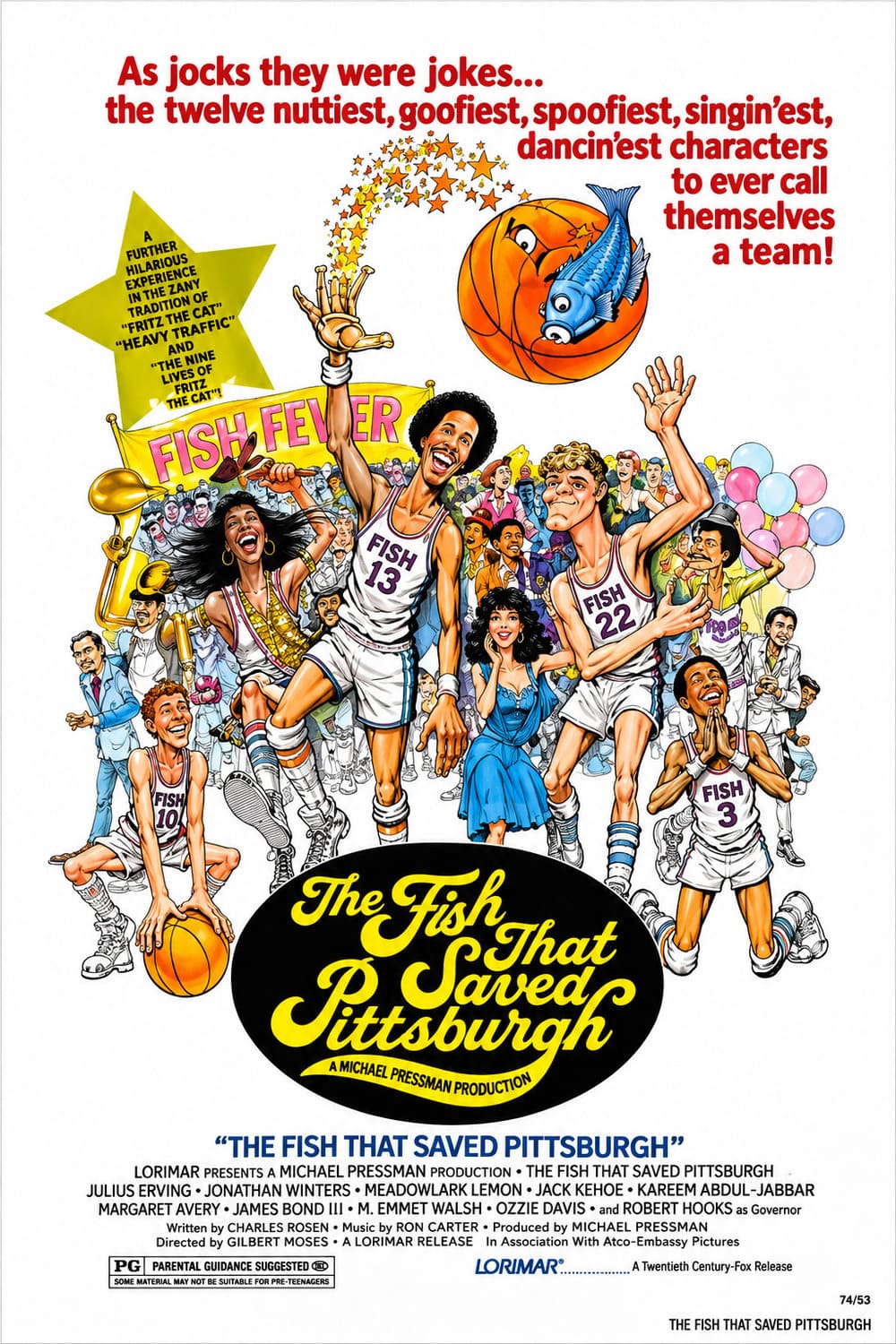
Film Review: The Fish That Saved Pittsburgh (dir. by Gilbert Moses)


“The stars don’t lie. I do, but they don’t.” — Mona Mondieu

Winning is usually the whole point of a sports movie, but The Fish That Saved Pittsburgh makes a pretty good case for looking fabulous while you figure everything else out. Gilbert Moses’s 1979 basketball comedy is full of music, outlandish ideas, and the kind of confidence that can make a shaky premise surprisingly entertaining. Its plot involves rebuilding a losing team through astrology, which should tell you how much realistic sports management to expect. The movie is messy, sometimes sluggish, and not nearly as funny as it wants to be. Yet its greatest asset is enthusiasm, especially when it stops explaining itself and lets basketball and music take over.

The struggling team is the Pittsburgh Pythons, whose star player, Moses Guthrie, cannot single-handedly turn things around. Guthrie is played by Julius “Dr. J.” Erving, and casting a basketball legend gives the film an immediate advantage: nobody needs convincing that this guy belongs on the court. The unconventional rescue plan comes from Tyrone Millman, the team’s young ballboy, played by James Bond III. Tyrone turns to astrologer Mona Mondieu, played by Stockard Channing, and together they pursue a roster built around Guthrie’s zodiac sign. With enough Pisces playing together, the thinking goes, chemistry should take care of itself. The newly named Pittsburgh Pisces are born.

As a hook, that is silly in an appealingly specific way. Plenty of sports comedies bring together oddballs and hope their clashing personalities will generate laughs. This one adds the suggestion that the universe has already handled the personnel decisions. The astrology gives the familiar comeback story an eccentric identity, and the movie deserves some credit for not constantly winking at its own ridiculousness. Tyrone believes in the plan, Mona has her own unusual authority, and the story gives their scheme room to work. The audience is not asked to take astrology seriously so much as accept it as the rule of this particular playground.

The trouble is that the setup promises more comic invention than the screenplay consistently delivers. Once the players have been gathered, the narrative becomes much more ordinary. The team improves, the games provide milestones, and the expected feel-good trajectory settles into place. There is nothing inherently wrong with a predictable sports story, but predictability needs support from strong characters or especially good jokes. Here, both are uneven. Too many players feel like introductions waiting for further development. We understand that they are a colorful bunch, but the film does not always give us enough reason to care about them individually.

Some of that broad characterization has also aged badly. Winston Running Hawk, the Native American player, is an obvious example of the movie leaning on a stereotype instead of building a personality. Those shortcuts make the comedy feel lazier than its central idea deserves. A film about discovering an unexpected connection among outsiders ought to be curious about the people making that connection. Instead, it sometimes seems satisfied simply to put unusual figures in the same uniform. The result is a team whose visual identity is stronger than its emotional one. You can enjoy watching the Pisces without becoming particularly invested in everybody wearing the jersey.

Erving is the exception, although not because he turns out to be a natural screen actor. His dialogue scenes can feel stiff, and the romantic material involving Guthrie and Tyrone’s sister, Toby, played by Margaret Avery, never develops much spark. On the court, however, the movie suddenly has something it cannot fake. Erving’s movement is fluid, assured, and genuinely pleasurable to watch. His athletic ability supplies the charisma that the dramatic scenes struggle to capture. Rather than wishing he were a more polished actor, you start wishing the movie would stop interrupting him with scenes that require a different set of skills.

Channing and James Bond III help keep the off-court material alive. Mona’s eccentricity fits the movie’s peculiar logic, while Tyrone supplies the sincere desire underneath the gimmick. His faith in the team gives the story a small but useful emotional anchor. Still, the most reliable source of energy is Thom Bell’s soundtrack. The music gives the basketball sequences a buoyancy that makes the film feel less like a conventional competition narrative and more like an extended celebration. When the action and soundtrack click together, the looseness becomes easier to accept. You stop waiting for the next plot development and start enjoying the atmosphere.

That atmosphere reaches its natural peak in the extravagant arena spectacle, complete with silver-lamé uniforms and a hot-air-balloon entrance. It is excessive, but excess is where this movie feels most comfortable. The flashier it becomes, the less its ordinary storytelling seems to matter. That does not magically repair the weak jokes or thin relationships, but it makes clear what the film has been reaching for all along: not sporting realism, but a fantasy in which a basketball team can become the center of a joyful, slightly ridiculous communal event.

The fairest way to judge The Fish That Saved Pittsburgh is probably by the mood it leaves behind rather than the strength of its story. Its flaws are easy to list, and a tighter script could have made much better use of its cast and premise. Even so, there is something appealing about a movie that treats basketball as an excuse for imagination rather than another lesson in grit. It does not earn every laugh or emotional payoff, but it earns some affection through sheer commitment to its own oddball pleasures. The Pisces may need the stars to align; the movie mostly needs the music turned up and Erving back on the court.
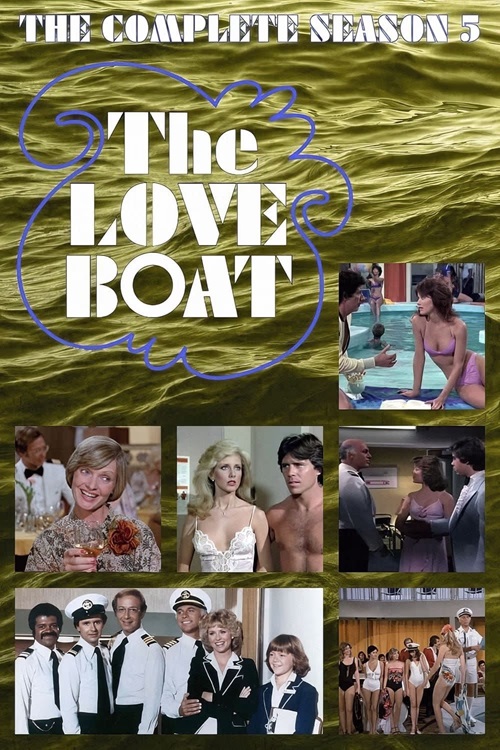
Retro Television Review: The Love Boat 5.4 “The Incredible Hunk/Isaac, the Marriage Counselor/Jewels & Jim”


Welcome to Retro Television Reviews, a feature where we review some of our favorite and least favorite shows of the past!  On Wednesdays, I will be reviewing the original Love Boat, which aired on ABC from 1977 to 1986!  The series can be streamed on Paramount Plus!

This week, The Love Boat sets sail without a laugh track and things get awkward.

Episode 5.4 “The Incredible Hunk/Isaac, the Marriage Counselor/Jewels & Jim”

(Dir by Howard Morris, originally aired on October 24th, 1981)

Julie has hired a new entertainer for this cruise.  His name is Hank Austin (Brian Kerwin) and he’s a teacher-by-day and a dancer-by-night.  Julie has never actually seen Hank perform but Hank’s agent assured Julie that he’s amazing.  How will Julie (and Captain Stubing) react when Hank turns out to be a …. STRIPPER!?

Even more importantly, how will the head of Hank’s PTA react?  Shelley (Christopher Norris) is also a passenger on the boat and she and Hank take an immediate liking to each other.  Fortunately, for Hank, Shelley does not see his performance but afterwards, she tells Hank that she’s heard a lot of people talking about how there’s a male stripper on the ship.  Hank laughs it off.  But then Julie walks up to Shelley and starts to complain about Hank’s act, which is seriously immature of her.  I mean, Julie doesn’t even know Shelley but Julie still acts like she’s morally offended that Shelley would associate with someone with whom Julie is upset.  It’s seriously out-of-character for Julie and it made me wonder if maybe Julie picked up some coke when the ship was docked at Acapulco.

Don’t worry, though.  Julie eventually apologizes for lashing out and Shelley and Hank leave the ship together.  From now on, the only stripping that Hank will be doing will be at PTA meetings.

Things also work out for Frank Dalton (Flip Wilson).  Frank boards the ship and tells Isaac that he changed Frank’s life.  Isaac has no idea who Frank is.  Frank explains that he took the same cruise last year.  He had a fight with his wife and went into the Pirate’s Cove for a drink.  Frank told Isaac his problems.  Isaac told him that sometimes, a man just has to put his foot down.  Frank took Isaac’s advice and, as a result, his wife left him.  Now, Frank is single and suicidal.  Isaac tries to set Frank up with some other passengers.  When that doesn’t work, Isaac calls Frank’s ex-wife and convinces her to board the boat in Acapulco and take him back.  Frank and Janet (Marla Gibbs) are reunited.  Good work, Isaac!

Finally, a jewel thief named Jim Pickett (Michael Zaslow) boards the boat.  He just wants to steal a valuable necklace but instead, he ends up falling in love with Lilia Chandler (Joan Van Ark).  When Jim does steal a necklace from Mrs. Landers (Henny Backus), he gives it to Lila.  However, when it looks like Jim’s going to get caught by the Captain, Lila gives the necklace back to Mrs. Landers.  It turns out that Lila is a jewel thief as well!  She was going to let Jim steal the necklace for her but then she fell in love with him.  The two reformed thieves leave the ship as a couple.

This was a weird episode because there was no laugh track.  There was several moments where it was obvious that a laugh track was meant to be heard but instead of canned laughter, there was only dead air.  It made the entire episode feel a bit awkward.  Laugh tracks are definitely dork and corny but then again, so is The Love Boat.  If anything, The Love Boat is one of the rare shows that benefitted from having a laugh track.  It’s absence made the entire cruise feel weird.

As for the guest stars and their stories, I liked Michael Zaslow and Joan Van Ark.  They had an enjoyable chemistry.  The other two stories weren’t that interesting.  The male stripper story only succeeded in making Julie look totally incompetent at her job.  She got mad at Hank for being a stripper but did it seriously not occur to her to ask what type of dancing he actually did before booking him?  As for the other story, it was just depressing.  A laugh track would have helped….

This was just not a very good cruise, I’m afraid.  It happens.  Hopefully, next week will be better.

Back to School Part II #11: Skatetown U.S.A. (dir by William A. Levey)


Poster_of_the_movie_Skatetown,_USA

Now that I’ve fully recovered from the trauma of writing about Grease, let me tell you about a little movie from 1979.  It’s a movie about teenagers, love, and competition.  It’s also a movie about disco and some actors who had some extra time on their hands.  It has a great soundtrack and the whole movie is pure 70s.  It even features the debut performance of a future movie star!

What film am I talking about?

SKATETOWN, USA, of course!

But before I talk about the movie, check out the trailer.  This is one of my favorite trailers of all time.  It pretty much tells you everything that you need to know about the movie.  There’s not a deceptive moment to be found in this preview:

Skatetown, U.S.A. is one of those movies that you watch and think, “This could only have been made in the 70s.”  Remember how watching Hollywood High caused me to doubt whether or not the 70s were actually all they were cracked up to be?  Well, Skatetown USA has renewed my faith!  Skatetown is such a 70s film that I personally think someone should send me an honorary coke spoon to reward me for watching it.

(Maureen McCormick, who is best known for playing Marcia Brady and who had a small role in Skatetown, wrote in her autobiography that the main thing she remembers about Skatetown is all the cocaine on the set.)

Skatetown USA doesn’t really have a traditional plot.  Instead, it’s a collection of “comedic” skits mixed in with roller skating performances and a nonstop soundtrack.  There is not a second that music is not playing in the background and, for what appears to be a low-budget film, the soundtrack is truly impressive.  Basically, almost every great disco song from the 1970s is heard at some point during Skatetown USA.  (Even that “Boogie Nights” song that Paul Thomas Anderson was apparently not allowed to actually use in Boogie Nights!  Imagine being the copyright holders who said yes to Skatetown but no to Paul Thomas Anderson…)

The film’s main character appears to be an unnamed DJ (Denny Johnston).  The DJ wears a big white afro wig and is always dancing in his booth.  Occasionally, he shoots a lightning bolt from his middle finger and suddenly, professional roller dancers appear and do a routine.  At the end of the movie, he looks at the camera, says that it’s all a fantasy, and winks.

Skatetown is the most popular disco roller rink in town.  Clean-cut teenager and all around nice guy Stan Nelson (Greg Bradford) wants to win Skatetown’s roller dancing contest.  (The prize is $1,000 and a moped!)  His best friend, Richie (Scott Baio), accompanies him and hopes to win a lot of money by betting on the outcome of the contest.  Stan angrily reprimands him, “This isn’t the streets!  This is Skatetown, U.S.A!”

That’s right — don’t mess with the good name of Skatetown!

Anyway, Stan’s actually a pretty good performer and he does this trick where he rides a skateboard while wearing roller skaters so you would think he would be a sure bet to win.

BUT NO!

The reigning Skatetown champion is Ace Johnson (Patrick Swayze, making his film debut) and we know that Ace is a bad guy because he wears all black and he occasionally snaps a whip while he’s rolling around!  Ace isn’t above cheating to win but really he doesn’t have to cheat!  Ace may be the bad guy but, seriously, he totally kicks ass while wearing roller skates.  As soon as he rolls out there, you understand why he’s the reigning champion.

See, here’s the thing with Skatetown: We’re supposed to be rooting for Stan but Ace really is a hundred times better than him.  There’s a reason why Patrick Swayze went on to have a career after Skatetown while Greg Bradford only has 8 credits on the imdb.  Swayze, even in this silly role, had movie star charisma whereas Bradford — well, he’s comes across as a nice guy but there’s nothing special about him.  Swayze, meanwhile, is dangerous and smoldering.

For instance, when Stan does his routine, his background music is The Village People singing “Macho Man” and you can’t help but snicker a little.  Whereas, when Ace performs, his background music is a slightly menacing cover of Under My Thumb.  Stan is the Village People.  Ace is the Rolling Stones.

Anyway, the film might not be good in the traditional sense but I absolutely loved Skatetown, U.S.A.  Why?  Because it’s a total time capsule! Watching it is such a totally 70s experience that I was even tempted to get a frizzy perm, start wearing bell bottoms, and stop wearing a bra.  Fortunately, the temptation passed but still, I enjoyed getting to use my cinematic time machine.

Add to that, the film itself is just so over-the-top and silly that … well, you can really believe that everyone involved in the movie was snorting mountains of cocaine in between takes.  There’s not a subtle moment to be found in Skatetown, U.S.A.  Instead, it’s all bright neon, loud music, flamboyant characters, silly melodrama, and corny humor.

(My personal theory is that Skatetown, U.S.A. was taking place in the same cinematic universe of A Clockwork Orange and it was showing what normal teenagers were doing while Alex and his droogs were seeking out the ultraviolence.  The over-the-top design of Skatetown reminded me of the similar flamboyance of the Korova Milk Bar and the droogs’s bowlers and oversized codpieces weren’t that different from some of the costumes worn by the cast of Skatetown.)

Anyway, Skatetown is one of those films that everyone should see once.  Unfortunately, because of all the music in the film, it’s never been released on DVD or Blu-ray and it probably never will be because life sucks.  It is on YouTube, though it was recorded off an old VHS tape so the transfer is not the best.

Here’s Skatetown, USA:

One final note: Skatetown, USA was directed by the same William Levey who also directed Blackenstein, Hellgate, and The Happy Hooker Goes to Washington.  It was written Nick Castle, who played Michael Myers in the original Halloween and directed a film that is well-liked by several of the writers here at the Shattered Lens, The Last Starfighter.