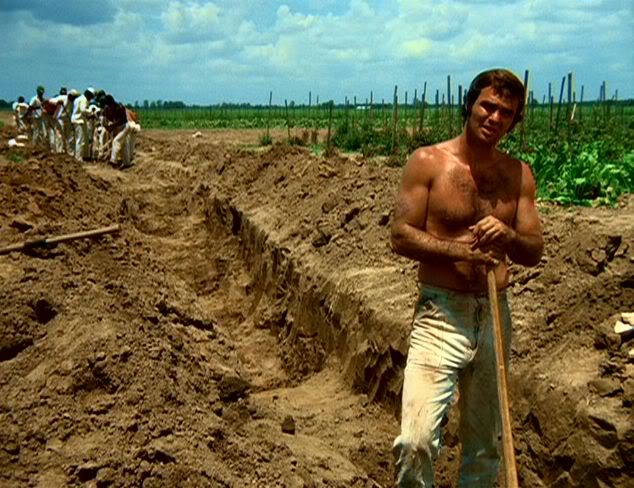
Burt Reynolds labored for years in the Hollywood mines, starring in some ill-fated TV series (his biggest success on the small screen was a three-year run in a supporting role on GUNSMOKE) and movies (nonsense like SHARK! and SKULLDUGGERY) before hitting it big in John Boorman’s DELIVERANCE. Suddenly, the journeyman actor was a hot property (posing butt-naked as a centerfold for COSMOPOLITAN didn’t hurt, either!), and studios were scurrying to sign him on to their projects. WHITE LIGHTNING was geared to the Southern drive-in crowd, but Reynolds’ new-found popularity, along with the film’s anti-authority stance, made it a success across the nation.
WHITE LIGHTNING takes place in rural Arkansas, and Gator McKluskey (Burt) is doing a stretch in Federal prison for running moonshine. His cousin visits and tells Gator his younger brother Donnie was murdered by Sheriff J.C. Connors, the crooked boss of Bogan County. A raging Gator tries to escape, but is immediately caught, so he…
Originally made for HBO, Boycott is one of the best and, unfortunately, least-known films made about the life of Martin Luther King, Jr. Boycott tells the story of the Montgomery Bus Boycott, starting with the arrest of Rosa Parks for refusing to sit in the back of the bus to the eventual integration of the Montgomery public transportation system. Clark Johnson directs Boycott in a semi-documentary, handheld style, which adds an immediacy to the oft-told story.
Boycott focuses on the role that 24 year-old Martin Luther King, Jr. (played by Jeffrey Wright) played as the leader of the Montgomery Bus Boycott and how the boycott’s success turned King into a national figure. Jeffrey Wright does a great job playing the young King and it’s interesting to watch as the initially uncertain King finds both his voice and his strength as a leader. Boycott works as a good companion piece to Selma, not the least because Carmen Ejogo plays Coretta Scott King in both of them.
Also giving a noteworthy performances are Terrence Howard as King’s second-in-command, Ralph Abernathy and Erik Dellums in the role of Bayard Rustin, who was one of King’s closest confidants but, because he was gay, was often left outside of the movement’s inner circle. Before they worked together on Boycott, Dellums, the son of former U.S. Rep. Ron Dellums, co-starred with Clark Johnson on Homicide: Life on the Street.
Boycott is a tribute to not just Martin Luther King but also the entire civil rights movement.
“We interrupt our regularly scheduled programming for a special report…”
Led by veteran anchor John Woodley, the RBS news team is providing continuing coverage of a developing crisis in Charleston, South Carolina, where terrorists are holding several members of the coast guard, a local new reporter, and his cameraman hostage on a small tugboat. These are not typical terrorists, though. Two of them are nuclear scientists. One of them is a social worker. Another one is a nationally-renowned poet. The final terrorist is a former banker robber who was just recently released from prison. This unlikely group has only two demands: that the U.S. government hand over every single nuclear trigger device at the U.S. Naval Base and that RBS give them a live television feed so that they can explain their actions to the nation. If either of those demands are not met, a nuclear bomb will be detonated and will destroy Charleston.
This made-for-TV movie was shot on video tape, to specifically make it look like an actual news broadcast. Though much of the movie seems dated when compared to today’s slick, 24-hour media circus, Special Bulletin was convincing enough that, when it was originally broadcast in 1983, it caused a mini-panic among viewers who missed the opening disclaimer:
Because the movie deals with the threat of nuclear terrorism instead of a U.S.-Soviet nuclear war, it still feels relevant in a way that many of the atomic disaster films of the 1980s do not. Beyond making an anti-nuclear statement, Special Bulletin is also a critical look at how the news media sensationalizes every crisis, with the RBS news team going from smug complacency to outright horror as the situation continues to deteriorate. David Clennon and David Rasche are memorable as the two most outspoken of the terrorists and Ed Flanders is perfectly cast as a veteran news anchor struggling to maintain control in the middle of an uncontrollable situation. Special Bulletin won an Emmy for Outstanding Drama Special and can be currently be found on YouTube.
Keep an eye out for Michael Madsen, who shows up 57 minutes in and gets the movie’s best line: “That guy’s a total psycho ward.”
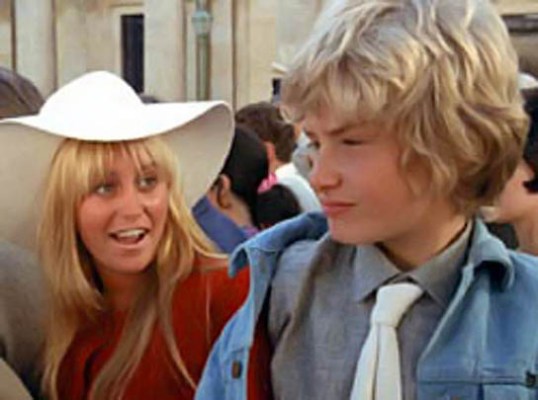
In Eyewitness (which is also known as Sudden Terror), eleven year-old Ziggy (Mark Lester) witnesses a policeman (Peter Vaughan) assassinating a visiting African dignitary but, because he has a history of “crying wolf,” he can’t get anyone to believe him. Not his older sister, Pippa (Susan George). Not his grandfather (Lionel Jeffries), the lighthouse keeper. Not the housekeeper, Madame Robiac (Betty Marsden). Not even Tom Jones (Tony Bonner), a tourist who fancies Pippa. When he sees two policemen driving up to his grandfather’s lighthouse, Ziggy panics and runs. Though John Hough’s direction, which is full of zoom shots and Dutch angles, is dated, Eyewitness holds up well as a tight thriller. Susan George was beautiful in 1970 and Peter Vaughan is a great villain.
If Sam Peckinpah had ever made a children’s movie, it would probably look a lot like Eyewitness. The movie starts out with Ziggy playing on the beach and pretending to be a soldier while imaginary gunshots and explosions are heard in the background. It ends with a strange joke about a man who looks like Hitler, followed by a cheery freeze frame. In between all that cheeriness, the assassin and his brother (Peter Bowles) chase Ziggy across Malta and kill anyone who gets in their way, from a friendly priest to a ten year-old girl being held by her father. I counted ten onscreen death, which is a lot considering that this British movie was released at a time when some were still arguing that Jon Pertwee-era Dr. Who was too scary for children. There’s even an exciting car chase that ends with one car overturned and the blood-covered survivors struggling to drag themselves out from underneath the wreckage. How many British children were traumatized by Eyewitness?
Francis Ford Coppola was still a UCLA film student when he made YOU’RE A BIG BOY NOW, the 1966 coming of age comedy he used as his MFA thesis. The young Coppola was 27, and had gained experience working for Roger Corman ; indeed, Corman gave him his first break when he hired Coppola to write and direct the horror quickie DEMENTIA 13. But YOU’RE A BIG BOY NOW was his first major studio release, and put him on the map as a talent to keep an eye on.
Bernard Chanticleer is a 19 year old nerd with a way-overprotective mother and disinterested, authoritarian father. He works for Dad at a New York City library, and is constantly goofing up on the job. Dad thinks it’s time for Bernard to spread his wings and move on his own, much to Mom’s displeasure. She finds him a room at a house owned by Miss Thing, who’s tenants include conservative…
Well, the time is here! It’s time for me to reveal my picks for the best 26 films of 2016!
If there’s been any theme that I’ve found myself constantly returning to while looking back at the previous year, it’s that 2016 just wasn’t as good as 2015. That’s certainly true as far as movies are concerned. Whereas 2015 provided us with an embarrasment of riches, 2016 was — overall — a pretty bland year as far as cinema is concerned.
That doesn’t mean there weren’t some great films released in 2016. I’m proud of this list below. At the same time, I’m also a little bit frustrated. As happens every year, there are a few films that, as of this writing, I have yet to see. Weather permitting, I will see Silence and Jackie tomorrow and on Monday. If I feel that they need to be included in my top 26, I will come back and edit this list. And, of course, I still need to see some of the films that are no longer playing in theaters — Captain Fantastic, Hunt for the Wilderpeople, and some others. The list below should be considered my picks for the best 2016 films that I actually got to see.
Also, I still need to write reviews for two of the films listed below. Hopefully, I’ll be able to do that today. As soon as those reviews are posted, I’ll add links.
Arrival was one of the best films of 2016. In fact, I would argue that it’s one of the best science fiction films that I’ve ever seen. There were a lot of reasons for that, of course. There was the brilliant script by Eric Heisserer. There was the starring performance of Amy Adams, who is one of the best actresses working today. There was a surprise and thought-provoking twist, one that forced you to reconsider everything that you previously believed. There were so many reasons why Arrival was a great film but, ultimately, it call came down to Denis Villeneuve.
Working with material that would have led most directors down the road to bombast, Villeneuve instead took a deliberately low-key approach. Whereas most directors would have encouraged their cast to play up the drama, Villeneuve encourages his actors to take a more inward and cerebral approach to the material. Arrival is a rarity — a film about smart people in which the people actually seem to be smart. For once, we don’t need expositionary characters to pop up and tell us that Louise Banks (Amy Adams) and Ian Donnelly (Jeremy Renner) are brilliant. Instead, we simply believe they are from what we see on the screen. Much like last year’s Sicario, Arrival proves that Villeneuve is a visionary director.
Arrival is a hard film to describe, not because it’s overly complicated but because there’s a huge twist that I really can’t reveal. Before the twist, Arrival is simply a well-directed sci-fi film. After the twist, it is something all together different, an intense meditation on faith, love, language, and destiny. Since I’m reviewing the film late, chances are that you already know about the twist but I’m still not going to spoil it.
What I can tell you is that Arrival opens with the arrival of twelve spaceships, all of which land at different places across the world. The Chinese have a spaceship. The British have a spaceship. I imagine that the Canadians have a spaceship, because who wouldn’t want to hang out with the Canadians? And, of course, the Americans have a spaceship. The aliens are inside the spaceships. They’re octopus-like creatures, ones that almost look as if they could have come from one of Lovecraft’s Cthulhu stories. The aliens may appear to be fearsome but they actually seem to be rather benevolent. No one’s quite sure because the aliens communicate through a complex series of symbols and nobody can understand what those symbols mean.
Louise Banks is a linguist. Ian Donnelly is a physicist. The Americans bring both in to help translate the symbols. Of course, the rest of the world has their own linguists and physicists working to translate the symbols and, humans being humans, it often seems that the Americans and the Chinese are less concerned with translating what the aliens are saying and more concerned with being the first to understand. While Louise works, she continues to be haunted by dreams and visions of her daughter’s death from cancer.
And that’s really all I can tell you without spoiling the film and potentially making myself cry. But I will say that if you haven’t seen Arrival, you must go out and see it now. It’s one of the most thought-provoking and emotionally wrenching films of the past year.
Add to that, it’s probably going to be nominated for best picture. It’s been overshadowed a bit by all the attention paid to La La Land, Moonlight, and Manchester By The Sea. But Arrival is just as good a film as any of them. In fact, in the future, we’ll probably look at Arrival and say that it was better than all of them.
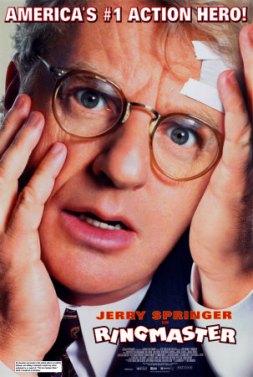
Jerry Springer has been many things over the course of his long life. Lawyer. Anti-war activist. Adviser to Bobby Kennedy. Congressional candidate. City councilman. Brothel aficionado. Mayor. Journalist. Commentator. Talk show host. Destroyer of culture. Scourge of humanity. Twice, he was a highly recruited candidate for the U.S. Senate but, both times, it was decided that there was no way a morally questionable television personality could actually win high political office in the United States.
(Yeah, about that…)
There is one thing that Jerry Springer has never been and that is a movie star. However, that’s not for lack of trying. At the height of his talk show’s popularity, Jerry Springer starred in Ringmaster. Though he played a character named Jerry Farrelly and his show was retitled The Jerry Show, there was never any doubt that Jerry Springer was meant to be playing himself.
Who is Jerry Springer, according to Ringmaster? He’s a sad and weary man who sleeps with his guests and worries that his raunchy show will be his only legacy. After one show, he tells his staff that he will never again be elected to political office. His staff laughs but Jerry didn’t sound like he was making a joke. Why does Jerry do it? Because he cares about America! When a man in his audience starts yelling that Jerry and his guests are all going to Hell, Jerry gets in his face and let him know that his show is providing a voice for the people who live in the real America.
In Ringmaster, the real America is made up of people like trailer park nymphomaniac Angel Zorzak (Jaime Pressly) and her mother, Connie (Molly Hagan). Angel and Connie appear on The Jerry Show after Angel sleeps with her stepfather (Michael Dudikoff, the American Ninja himself) and Connie gets revenge by sleeping with Angel’s boyfriend. Also on the show is Demond (Michael Jai White), who cheated on his girlfriend with her two best friends and, the night before the show, cheats with Angel too. Thanks to the show, Demond gets his comeuppance and Angel and Connie’s relationship is repaired. The movie ends with mother and daughter back in the trailer park, talking about how their new neighbor has big feet.
Pressly and Hagan are the best thing about Ringmaster. The worst thing is undoubtedly Jerry Springer. For someone who has made a career in both politics and television, Jerry Springer turns out to be a terrible actor. He sleepwalks through the movie with a please-kill-me look on his face, keeping his head down and muttering the majority of his lines.
According to Wikipedia, Ringmaster had a budget of $20,000,000 and grossed back less than half of that. Why would people pay money to watch what they could see on TV for free? Jerry Springer never became a senator or a movie star. He continues to host his talk show and probably will until the end of time.
In the 1980s, Mark “Gator” Rogowski was a superstar. A professional skateboarder, Gator was one of the most popular vert skaters, competing and partying alongside Tony Hawk, Christian Hosoi, Steve Caballero, and Lance Mountain. Yet today, unlike his contemporaries, Gator is almost totally forgotten. In 1991, after having changed his name to Mark Anthony and declared himself to be a born again Christian, Gator raped and killed Jessica Bergstrom, a friend of his ex-girlfriend. Convicted of first degree murder, Gator was sentenced to life imprisonment. He is currently an inmate of the California State Prison System.
Through archival footage and interviews with both his fellow skaters and his ex-girlfriend, Stoked tells the story of Rogowski’s rise and fall. Even if you know nothing about the history of skating, the interviews are interesting and frequently insightful about the fickle nature of fame. Anyone who was not already a fan of Jason Jessee’s will be after seeing him interviewed in Stoked. Because California state law prohibits inmates from giving video interviews, Rogowski is interviewed over the phone and his disembodied voice provides a ghostly accompaniment for much of the film.
Stoked not only tells the story of how Gator ended up in jail but also of how vert skating became big business in the 1980s. At the height of his popularity, Gator was making $20,000 a month, just through board sales and the sponsorship of Vision Street Wear. When street skating became popular in the 90s and a new generation of skaters rejected Vision’s commercial approach, Gator found himself washed up before he even turned 25. By using Gator’s story as a way to examine an entire era, Stoked is to skateboarding what O.J.: Made in America is to football.
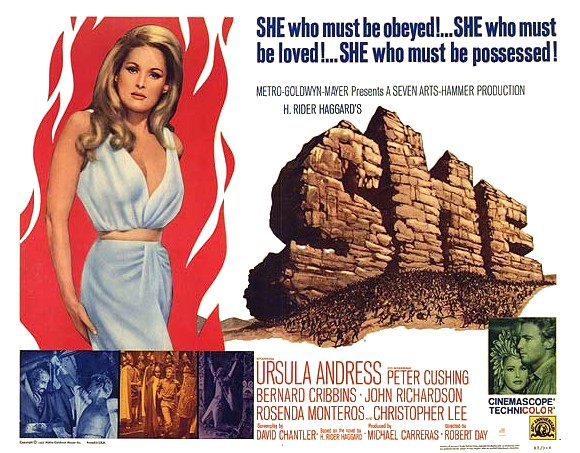
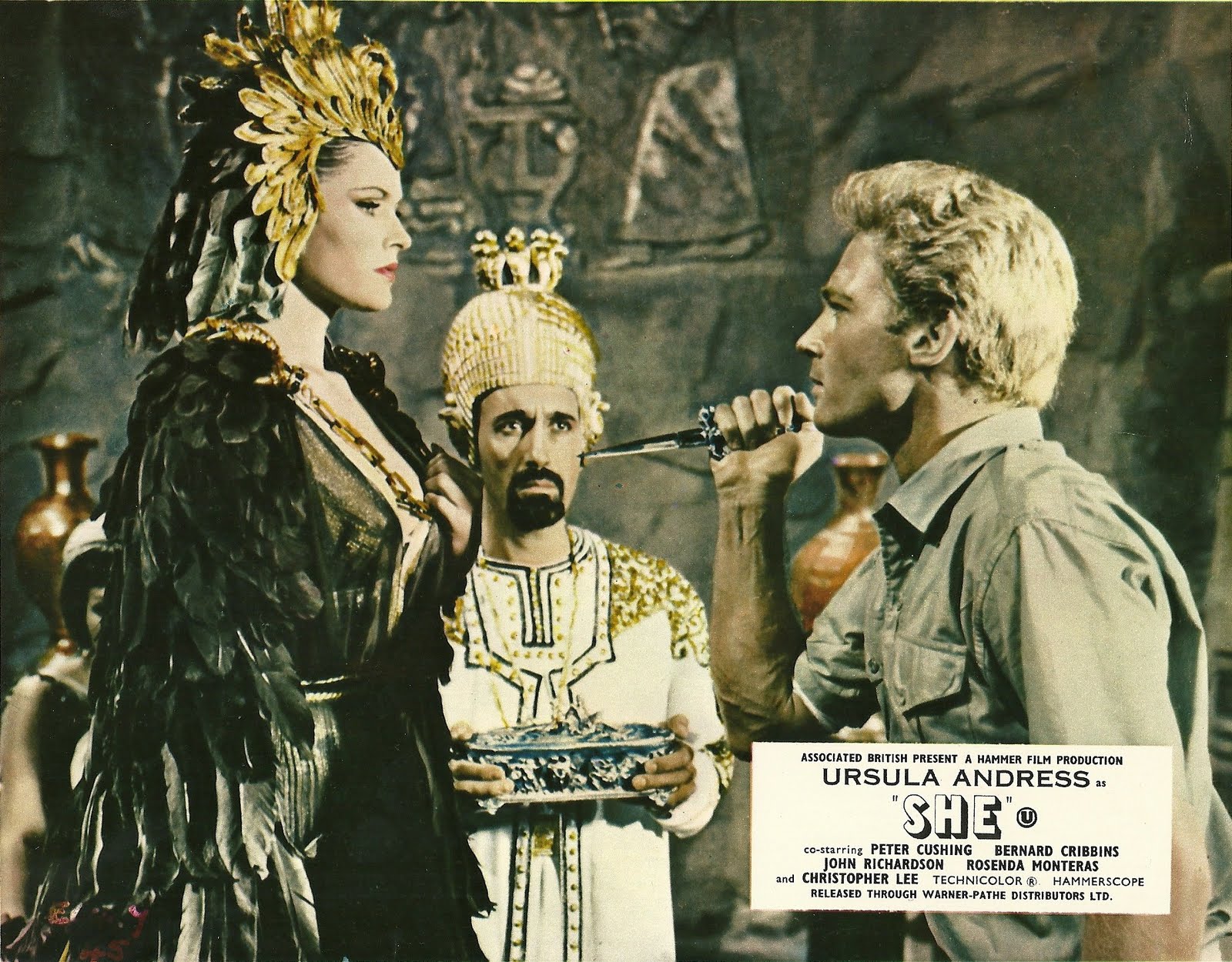
…didn’t manage to keep me awake, that is! That’s right, I actually dozed off in the middle of SHE for a good fifteen minutes! This so-called adventure film, a remake of the rousing 1935 Merian C. Cooper production starring Helen Gahagan and Randolph Scott, is based on a novel by H. Rider Haggard, a pretty big-deal adventure novelist back in the day, who also wrote the novels KING SOLOMAN’S MINES and ALLAN QUARTERMAIN. The ’35 version was filled with sumptuous Art Deco sets and a dynamic score by Max Steiner, and proved popular with moviegoers of the day.
But the times, they do a-change, and so do tastes. Hammer Films decided to do this remake thirty years later, with Ursula Andress in the title role. ONE MILLION YEARS B.C. caveman John Richardson plays Leo Vincey, who’s the spitting image of Queen Ayesha’s long-lost love Kallilkrates. Hammer’s top tag-team Peter Cushing and Christopher Lee are in the cast…







 Jerry Springer has been many things over the course of his long life. Lawyer. Anti-war activist. Adviser to Bobby Kennedy. Congressional candidate. City councilman. Brothel aficionado. Mayor. Journalist. Commentator. Talk show host. Destroyer of culture. Scourge of humanity. Twice, he was a highly recruited candidate for the U.S. Senate but, both times, it was decided that there was no way a morally questionable television personality could actually win high political office in the United States.

 Through the Shattered Lens