A Movie A Day #22: Messenger of Death (1988, directed by J. Lee Thompson)


messenger_of_deathIn rural Colorado, the three wives and all the children of Orville Beecham (Charlie Dierkop) have been murdered.  Veteran journalist Garret Smith (Charles Bronson) discovers that Orville is the son of an excommunicated Mormon fundamentalist named Willis Beecham (Jeff Corey).  Willis, who lives on a heavily armed compound, practices polygamy and wants nothing to do with the outside world.  However, Willis’s brother, Zenas (John Ireland), long ago split with Willis and set up a compound of his own.  At first, Garret suspects that Orville’s family was killed by Zenas.  As Zenas and Willis go to war, Garret discovers that there’s actually a bigger conspiracy at work, one dealing with corporate greed and water rights.  (Forget it, Bronson, it’s Chinatown.)

Messenger of Death was the 2nd to last film that veteran tough guy Charles Bronson made for Cannon Films.  Especially when compared to the other films that he made for Cannon (10 To Midnight, Kinjite, Murphy’s Law, three Death Wish sequels), Messenger of Death features Bronson in a surprisingly cerebral role.  While there is violence, very little of it is actually the result of anything that Bronson does.  For once, Charles Bronson isn’t running around with a gun and blowing away bad guys. If Death Wish‘s Paul Kersey ever did start blowing away muggers in Colorado, Garret would probably be the first to condemn him in a carefully written editorial.  The only time he fights is in self-defense and even then, it’s hand-to-hand combat.  Instead, he spends most of the film doing research and asking questions.  As a result, Messenger of Death is never as much fun as the other films that Bronson made for Cannon but it’s still interesting to see him playing a regular guy.
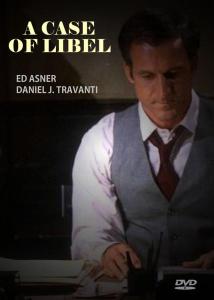
A Movie A Day #21: A Case of Libel (1983, directed by Eric Till)


a-case-for-libelIn the 1950s, at the height of the McCarthy era, no one is more feared than Boyd Bendix (Daniel J. Travanti), an acerbic, right-wing gossip columnist.  Anyone who crosses Bendix the wrong way runs the risk of being accused of everything from sexual deviancy to communism.  Bendix’s latest victim is prominent journalist named Dennis Corcoran (Gordon Pinset).  Unlike everyone else who has been bullied by Bendix, Corcoran refuses to quietly submit.  Working with a gruff but brilliant attorney, Robert Sloane (Ed Asner), Corcoran takes Bendix to court.
A Case of Libel was made for Showtime and it is very much the type of movie that was made for teachers to show in classrooms full of aspiring Clarence Darrows.  Adapted from a Broadway play, A Case of Libel is also based on the true story of a successful lawsuit that was brought against columnist Westbrook Pegler in 1955.  A Case of Libel is basically a filmed play but is memorable for the performances of Ed Asner and especially Daniel J. Travanti.

A Case of Libel is a movie that I used to rent, on VHS, from my local video store when I was just starting to get interested in politics.  Because it was a cheap production on a cheap tape, the picture always looked terrible but I still enjoyed it.  Despite what the picture above claims, it’s never gotten an official DVD release and it probably never will be since there’s not a huge demand for old Ed Asner/Daniel J. Travanti courtroom dramas.  If it ever does come out on DVD, I’ll buy it.

Cheers for THE LAST AMERICAN HERO (20th Century Fox 1973)


gary loggins's avatarcracked rear viewer

lah1

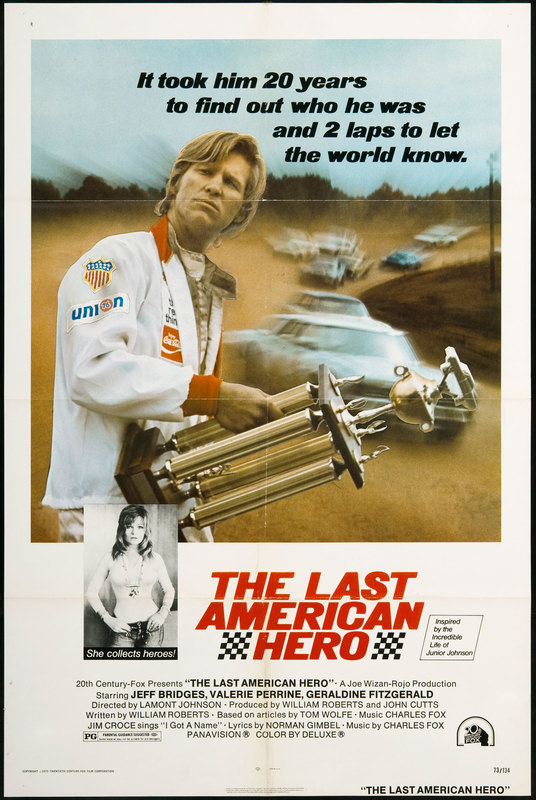
The world of NASCAR racing takes center stage in THE LAST AMERICAN HERO, a fictionalized biopic of legendary driver Junior Johnson. But this isn’t just a film about stock cars; it’s an extraordinary character study of a young man from the backwoods of North Carolina who discovers himself and what’s important to him. Jeff Bridges is outstanding in his first full-fledged starring role, demonstrating at age 24 the acting chops that have carried him to a long and prosperous film career.

lah2

Junior Jackson hauls moonshine for his Daddy on the winding backroads of  the Carolina hills, his tactics eluding the cops at every turn. He’s cocky and confident, and pisses the local law off so much they bust up Daddy’s still and send him back to prison. Junior decides to use his only marketable skill to raise money for the family while Daddy’s away – driving. He enters a demolition derby…

View original post 407 more words

A Movie A Day #20: First Family (1980, directed by Buck Henry)


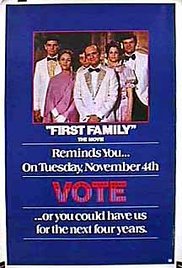
first-familyLike any newly inaugurated President, Manfred Link (Bob Newhart) faces many new challenges.  The biggest challenge, though, is keeping control of his family and his White House staff.  His wife (Madeline Kahn) is an alcoholic.  His 28 year-old daughter (Gilda Radner) is so desperate to finally lose her virginity that she is constantly trying to sneak out of the White House.  General Dumpson (Rip Torn) wants to start a war.  Press Secretary Bunthorne (Richard Benjamin), Ambassador Spender (Harvey Korman), and Presidential Assistant Feebleman (Fred Willard) struggle and often fail to convince everyone that all is well.
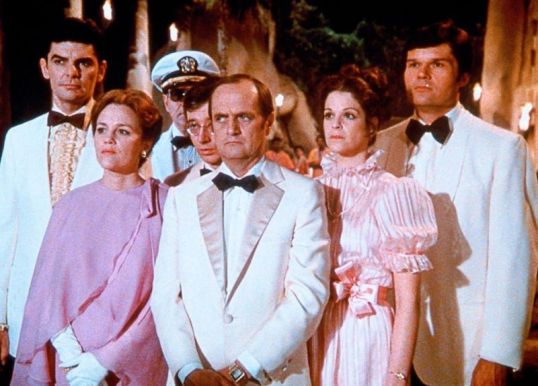
President Link needs to form an alliance with the African country of Upper Gorm, a country that speaks a language that only one man in America, Prof. Alexaner Grade (Austin Pendleton), can understand.  The President of Upper Gorm (John Hancock) orders that the kidnapping of Link’s daughter.  Holding her hostage, he demands that Link send him several white Americans so that the citizens of Upper Gorm can know what it is like to have a minority to oppress.

First Family not only featured a cast of comedy all-stars but it was also directed by one of the funniest men in history, Buck Henry.  So, why isn’t First Family funnier?  There are a few amusing scenes and Newhart can make a pause hilarious but, for the most part, First Family feels like an episode from one of Saturday Night Live‘s lesser seasons.  Reportedly, Henry’s first cut of First Family tested badly and Warner Bros. demanded that certain scenes, including the ending, be reshot.  Perhaps that explains why First Family feels more like a sitcom than a satire conceived by the man who wrote the script for The Graduate and whose off-center perspective made him one of the most popular hosts during Saturday Night Live‘s first five seasons.  Famously, during one SNL hosting gig, Henry’s head was accidentally sliced open by John Belushi’s samurai sword.  Without missing a beat, Henry finished up the sketch and performed the rest of the show with a band-aid prominently displayed on his forehead.  Unfortunately, there’s little sign of that Buck Henry in First Family.

first-family-2


A Movie A Day #19: Kill Me Again (1989, directed by John Dahl)


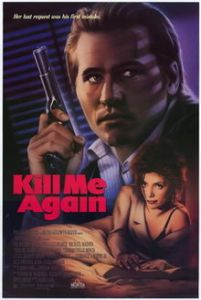
killmeagainFay Forrest (Joanne Whalley) and her boyfriend, Vince Miller (Michael Madsen), make their living stealing from the mob.  After their latest job results in the death of a made man, Fay decides that she needs to escape from the abusive Vince.  She runs away to Las Vegas, where she looks up a small-time, financially strapped P.I., Jack Andrews (Val Kilmer).  She hires Jack to help her fake her death, offering to pay him $5,000 upfront and $5,000 after she’s dead.  Jack is reluctant to get involved but he also has a loan shark threatening to break every bone in his body.  Jack helps Fay fake her death but then Fay leaves town without paying him the second $5,000.  Even worse, both Vince and the mob quickly figure out that Fay is not actually dead and join Jack in trying to track her down.

Predictable but entertaining, Kill Me Again is an early example of the type of modern neo-noir that would become extremely popular in the 1990s.  In his directorial debut, John Dahl shows some hints of the style that he later brought to films like Red Rock West and The Last Seduction.  Val Kilmer was miscast and a few years too young for his role but Joanne Whalley (or Joanne Whalley-Kilmer as she was known when Kill Me Again was filmed) fully inhabitanted the stock role of the sultry femme fatale who can never quite be trusted.  Michael Madsen goes all out as Vince, giving an early version of his performance in Reservoir Dogs.


Quench the Devil’s Thirst: Robert Mitchum in THUNDER ROAD (United Artists 1958)


gary loggins's avatarcracked rear viewer

thund1

Robert Mitchum  puts the pedal to the metal as a moonshine runner at odds with both the Feds and gangsters in THUNDER ROAD. This is Mitchum’s most personal picture, not only starring but producing, writing the story (and two songs!), and, rumor has it, doing much of the directing. His notorious independent streak comes through in his character Luke Doolin, a Korean War vet who believes in the right of individual ownership, whether on his land or in his car, and free market enterprise, without interference from outsiders or the government. That’s right, Luke Doolin is a true Libertarian hero!

thund2

He’s also the best damn driver in River Valley, Kentucky, as we see in the opening scene, speeding down the backroads, eluding police with the greatest of ease. The Doolins have been making moonshine for generations, with daddy Vernon running the still, baby brother Robin the family mechanic, and mama Sarah praying for…

View original post 667 more words

Playing Catch-Up: Popstar: Never Stop Never Stopping (dir by Akiva Schaffer and Jorma Taccone)


Have you heard of Conner4Real?

If you haven’t, you’re probably just old or else you don’t keep up with what’s happening in the world of popular music.  His real name is Conner Friel and he used to be a member of the Style Boyz.  Of course, the Style Boyz eventually broke up.  Kid Brain became a farmer.  Kid Contact became a DJ.  And Kid Conner — well, he became Conner4Real and he became a bigger star as a solo artist than he ever was as a Style Boy.  His debut album, Thriller, Also, broke records.

But the follow-up, Connquest … well, Connquest wasn’t quite as acclaimed.  In fact, it was hated by just about everyone.  This is despite featuring classic songs like:

Finest Girl (Bin Laden Song)

Mona Lisa

and Equal Rights (featuring P!nk).

Fortunately, when Conner4Real was facing his greatest existential crisis, a film crew was present to record his struggle.  For those of us who were fascinated by the career of Conner4Real, Popstar: Never Stop Never Stopping is a chance to see how Conner dealt with everything from his terminally ill pet turtle to the elaborate marriage proposal ceremony that led to Seal being attacked by wild wolves.  We would have gotten to see Conner and his manager defeat a swarm of mutant bees but, unfortunately, that happened right after the only time that Conner’s manager asked the film crew to stop filming.

Oh well, these things happen.

So, as you should have guessed from all that, Popstar is not a serious film.  It’s a mockumentary, with the emphasis on mock.  It was also one of the funniest films of 2016, a spot-on parody of the silliness and pretensions of fame.  Conner is a combination of Justin Bieber and Macklemore at their shallowest, a well-meaning but thoroughly empty-headed singer.  In fact, if Conner was played by anyone other than Andy Samberg, he would be so annoying that the film would run the risk of being unwatchable.

But fortunately, Conner is played by Andy Samberg.  It’s hard to think of anyone who plays dumb with quite the same panache as Andy Samberg does.  There are plenty of lines in Popstar that shouldn’t work but they do, specifically because they’re being delivered by Samberg.  He brings just the right amount of sweetly sincere stupidity to the role.  Almost despite yourself, you find yourself hoping that things will work out for Conner and the other Style Boyz.  Conner may not deserve to be as big a star as he is but it was obviously going to happen to some idiot so why not a sincere one?

Samberg is not the only funny person in Popstar.  The movie is full of funny people, from Sarah Silverman to Bill Hader to the always underrated Tim Meadows.  It’s also full of celebrity cameos and I have to admit that I usually tend to cringe when I see too many people playing themselves.  But in Popstar, it works.  One need only rewatch something like Zoolander 2 to see how well Popstar pulls off its celebrity cameos.

Sadly, as funny as Popstar was, it was also one of the biggest bombs of 2016.  (The trailer, it must be said, did not do the film justice.)  However, I expect that it will soon develop a strong cult following.  In a few years, we’ll get a sequel.  It probably won’t be as as good.

Oh well.  These things happen.

Playing Catch-Up: The Accountant, Carnage Park, The Choice, The Legend of Tarzan


Continuing my look back at the films of 2016, here are four mini-reviews of some films that really didn’t make enough of an impression to demand a full review.

The Accountant (dir by Gavin O’Connor)

2016 was a mixed year for Ben Affleck.  Batman v. Superman may have been a box office success but it was also such a critical disaster that it may have done more harm to Affleck’s legacy than good.  If nothing else, Affleck will spend the rest of his life being subjected to jokes about Martha.  While Ben’s younger brother has become an Oscar front runner as a result of his performance in Manchester By The Sea, Ben’s latest Oscar effort, Live By Night, has been released to critical scorn and audience indifference.

At the same time, Ben Affleck also gave perhaps his best performance ever in The Accountant.  Affleck plays an autistic accountant who exclusively works for criminals and who has been raised to be an expert in all forms of self-defense.  The film’s plot is overly complicated and director Gavin O’Connor struggles to maintain a consistent tone but Affleck gives a really great performance and Anna Kendrick reminds audiences that she’s capable of more than just starring in the Pitch Perfect franchise.

Carnage Park (dir by Mickey Keating)

I really wanted to like Carnage Park, because it was specifically advertised as being an homage to the grindhouse films of the 1970s and y’all know how much I love those!  Ashley Bell plays a woman who gets kidnapped twice, once by two bank robbers and then by a psycho named Wyatt (Pat Healy).  Healy chases Bell through the desert, hunting her Most Dangerous Game-style.  There are some intense scenes and both Bell and Healy are well-cast but, ultimately, it’s just kind of blah.

The Choice (dir by Ross Katz)

The Choice was last year’s Nicholas Sparks adaptation.  It came out, as all Nichols Sparks adaptations do, just in time for Valentine’s Day and it got reviews that were so negative that a lot of people will never admit that they actually saw it.  Benjamin Walker and Teresa Palmer play two people who meet, fall in love, and marry in North Carolina.  But then Palmer is in a car accident, ends up in a coma, and Walker has to decide whether or not to turn off the life support.

As I said, The Choice got terrible reviews and it’s certainly not subtle movie but it’s actually better than a lot of films adapted from the work of Nicholas Sparks.  Walker and Palmer are a likable couple and, at the very least, The Choice deserves some credit for having the courage not to embrace the currently trendy cause of euthanasia.  That alone makes The Choice better than Me Before You.

The Legend of Tarzan (dir by David Yates)

Alexander Skarsgard looks good without his shirt on and Samuel L. Jackson is always a fun to watch and that’s really all that matters as far as The Legend of Tarzan is concerned.  It’s an enjoyable enough adventure film but you won’t remember much about it afterward.  Christoph Waltz is a good actor but he’s played so many villains that it’s hard to get excited over it anymore.

A Movie A Day #18: Breaker! Breaker! (1977, directed by Don Hulette)


breaker-breaker-lobby-card-2

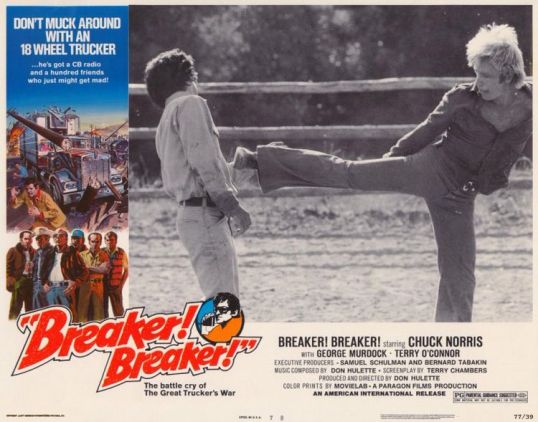
Somewhere, in Southern California, there’s a small town called Texas City.  Texas City is run by a corrupt judge (George Murdock) and a sadistic cop (Don Gentry).  The residents of Texas City make their money by arresting truckers, forcing them to pay huge fines, and selling their rigs to the savage yard.  But they made a mistake when they arrested a trucker named Billy Dawes (Michael Augensten).  Billy has an older brother who is also a trucker.  His name is J.D. and he’s Chuck Norris!

After appearing as an “honorable” villain in Bruce Lee’s The Way of the Dragon and providing martial arts training to the Hollywood elite, Chuck Norris made his starring debut in Breaker!  Breaker!  This is one of those weird only in the 70s hybrid movies.  Mix in a little Deliverance, add a little Smokey and the Bandit, and then toss in Chuck Norris doing a roundhouse kick.  Shake it up and you get Breaker!  Breaker!

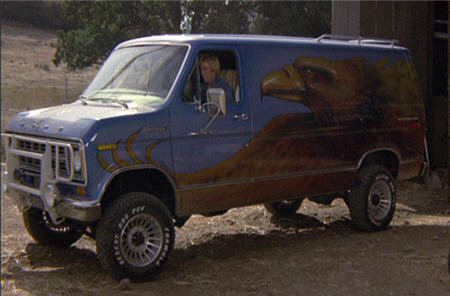
The main problem with Breaker!  Breaker! is that it does not really know what to do with Chuck Norris.  While he’s stil a step above someone like Steven Seagal, Chuck has never exactly been a great actor but, in Breaker!  Breaker!, his inexperience in front of the camera is especially noticeable.  Chuck is at his best when he’s fighting but he spends too much of Breaker!  Breaker! sitting behind the wheel of either his truck or his super groovy 70s van (check out the eagle painted on the side) and doing CB radio patter.  When he does fight, his opponents are all rednecks who, unlike Bruce Lee in Way of the Dragon, don’t stand a chance against him.

norris-van

I did like the movie’s ending, in which an army of big rigs descend on Texas City.  Don’t mess with truckers!

Two final notes: Breaker! Breaker! was edited by Steven Zaillian, who 16 years later, would win an Oscar for writing Schindler’s List.  Also, keep an eye out for Eraserhead himself, Jack Nance, as one of J.D.’s friends.

jack-nance

A Movie A Day #17: The Laughing Policeman (1973, directed by Stuart Rosenberg)


8232729_orig

San Francisco in the 1970s.  Revolution is in the air.  Hippies are on every street corner.  A man named Gus Niles knows that he’s being tailed by an off-duty cop, Dave Evans.  Gus boards a city bus, knowing that Evans will follow him.  On the bus, an unseen gunman suddenly opens fire with an M3 submachine gun, not only killing both Evans and Gus but six other people as well.  After the bus crashes, the gunman calmly departs.  At first, it is assumed that the massacre was another random mass shooting, like Charles Whitman in Austin or Mark Essex in New Orleans.  But one San Francisco detective is convinced that it wasn’t random at all.

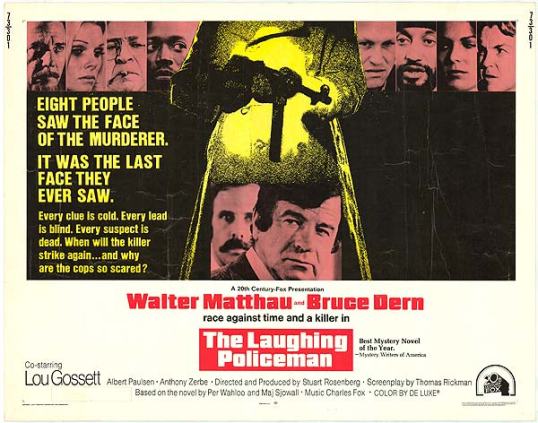
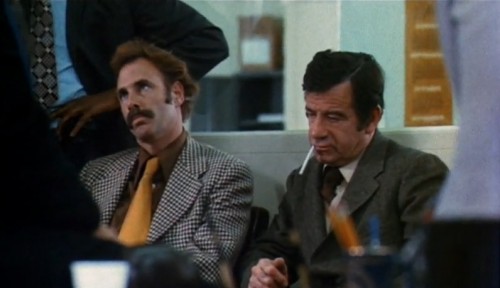
The Laughing Policeman was one of the many police procedurals to be released after the box office success of Dirty Harry and The French Connection and, despite the name, it’s also one of the grimmest.  While the complex mystery behind why Evans was following Gus and who killed everyone on the bus is intriguing, The Laughing Policeman‘s main focus is on the often frustrating nitty gritty of the investigation, complete with false leads, uncooperative witnesses, unanswerable questions, and detectives who frequently make stupid mistakes.  The movie’s first fifteen minutes are devoted to the police processing the bus, with Stuart Rosenberg (best known for directing Paul Newman in Cool Hand Luke) using overlapping dialogue to give the entire scene a documentary feel.  As Detective Jake Martin, Walter Matthau is even more cynical and downbeat than usual while Bruce Dern provides good support as a younger, more volatile detective.  The supporting cast is full of 70s character actors, like Lou Gossett, Anthony Zerbe, Gregory Sierra,and playing perhaps the sleaziest drug dealer ever seen in an American movie, Paul Koslo.

The Laughing Policeman was based on a Swedish novel that took place in Stockholm but, for the movie, Swedish Detective Martin Beck became world-weary Sgt. Jake Martin and Stockholm became San Francisco.  Rosenberg directed the entire film on location, giving The Laughing Policeman the type of realistic feeling that would later be duplicated by TV shows like Hill Street Blues, NYPD Blue, and Law & Order.  Though it may not be as well-known as either Dirty Harry or The French Connection, The Laughing Policeman is a dark and tough police procedural, an underrated classic of the genre.

Incidentally, The Laughing Policeman was one of the first films for which character actor Bruce Dern shared top billing.  According to Dern’s autobiography, Matthau generously insisted that Dern be credited, with him, above the title.

bruce_dern_walter_matthau_the_laughing_policeman_1973-500x288