Playing Catch-Up: White Girl (dir by Elizabeth Wood)


white_girl_film_poster

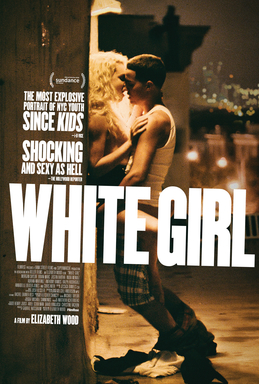
Ever since it premiered at the Sundance Film Festival, I’ve read the White Girl was the most “shocking” film of 2016.  You can take a look at the poster above and see that, according to The Hollywood Reporter, White Girl is “SHOCKING … AND SEXY AS HELL!”

Well, I finally got a chance to watch White Girl on Netflix and the only thing shocking about it is that so many (male) critics were apparently convinced that it was the most shocking movie ever made.  I certainly wouldn’t call it shocking.  (And considering that White Girl features two graphic rapes, I’d love to know why the critic thought “sexy as Hell” would be an appropriate description.)  A better description of White Girl would be “honest.”  Then again, considering the way that the movies usually present the experience of being young, female, and in the city, perhaps the fact that White Girl is an honest film is the most shocking thing of all.

Morgan Saylor plays Leah, a college student who, along with her friend, Katie (India Meneuz), moves into a New York apartment.  The apartment is located in a largely Spanish neighborhood, one that has yet to surrender to gentrification.  While Katie and Leah’s hipster friends are immediately suspicious of everyone else in the neighborhood, the Oklahoma-born Leah is far more adventurous (or perhaps reckless).  She approaches Blue (Brian Marc) on a street corner and asks him if he has any weed.

Blue has weed and a lot more.  He’s the neighborhood drug dealer and soon, he’s also Leah’s boyfriend.  When Leah isn’t getting high and having sex with Blue, she’s working as an intern at a magazine where, early on in the film, she’s sexually assaulted by her boss, Kelly (Justin Bartha, playing a predator who, for many, will seem disturbingly familiar).  Leah invites Blue to a party given by the magazine and Blue is able to make a lot of money selling cocaine to Leah’s wealthy co-workers.

For Blue, drugs are a business and he refuses to do hard drugs himself.  To Leah, it’s an adventure, one that she believes doesn’t have any real consequences.  Or, at least, that’s the way she sees it until Blue is arrested.  With Blue, a repeat offender, facing a life sentence, Leah manages to find a lawyer (Chris Noth, who will make you skin crawl) but she needs to raise the money to pay him.  Fortunately, Leah has a stash of cocaine that Blue was supposed to sell.  Blue tells Leah that she needs to return the cocaine to his dealer but instead, Leah decides to sell the cocaine herself.  Or, at the very least, she’s going to sell whatever cocaine she doesn’t end up snorting herself…

White Girl has been called shocking because of its open and nonjudgmental portrayal of both drugs and sex but, honestly, there’s nothing shocking about it.  It may be a generational thing but, to me, Leah’s story was a familiar one.  I’ve known a lot of Leahs and, personally, there were moments in White Girl that left me cringing just because I could relate to one of Leah’s naive notions or I could remember what it was like to feel like, no matter what I did, there would never be any consequences.  Leah may not always be a likable character but it’s not because she has sex or experiments with drugs.  Instead, it’s because she spends most of the film blissfully unaware of her own privilege.  Leah thinks that she understands the realities of Blue’s world but, as she learns by the end of the film, she’s really just a tourist.  And, unlike Blue and the rest of her neighbors, Leah can always leave whenever she wants.

So, White Girl was not a shocking film to me.  Instead, it was a very honest film.  It can currently be viewed on Netflix.

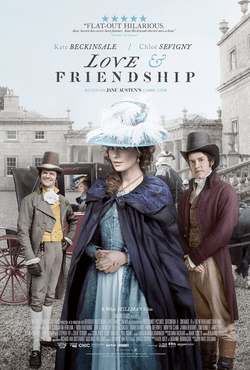
Playing Catch-Up: Love & Friendship (dir by Whit Stillman)


love__friendship_poster

Earlier this week, I named Pride and Prejudice and Zombies as the worst Jane Austen adaptation of 2016.  Of course, I understand that Pride and Prejudice and Zombies isn’t really a Jane Austen adaptation.  Instead, it’s an adaptation of a jokey novel that took Austen’s characters and combined them with zombies.  But you know what?  Nobody would have given a damn if the name of that book and that movie didn’t include three words:  Pride.  And.  Prejudice.  That’s the power of Jane Austen.

But anyway, my point is that Pride and Prejudice and Zombies was pretty much a low point as far as Jane Austen films are concerned.  Fortunately, 2016 also saw the release of a very enjoyable and entertaining Jane Austen film named Love & Friendship and, even better, Love & Friendship was based on something that Austen actually wrote.

Of course, though Austen may have written the novella Lady Susan, it wasn’t published until long after her death and there’s speculation that it was an unfinished (or abandoned) first draft.  In fact, it’s debatable whether or not Lady Susan was something that Austen would have ever wanted to see published.  While it shares themes in common with Austen’s best known work, it also features a lead character who is far different from the stereotypical Austen heroine.  Lady Susan Vernon is vain, selfish, manipulative, and unapologetic about her numerous affairs.  She’s also one of the wittiest of Austen’s characters, a woman who is capable of identifying and seeing through the hypocrisies of 18th century society.

In Love & Friendship, Susan is played by Kate Beckinsale, who does a great job in the role.  One of the best things about Love & Friendship is that it serves to remind us that Kate Beckinsale is a very good actress, even when she isn’t dealing with vampires and Lycans and all that other Underworld stuff.  Lady Susan is a recent widow and has been staying, with her daughter, Frederica (Morfydd Clark), at the estate of Lord and Lady Manwaring (Jenn Murray and Lochlann O’Mearáin) .  That’s a good thing because, as a result of the death of her husband, Lady Susan is now virtually penniless and homeless.  But, once it becomes obvious that Susan is having an affair with Lord Manwaring, she and Frederica are kicked out of the estate.

They eventually find themselves living with Susan’s brother-in-law, Charles (Justin Edwards) and Charles’s wife, Catherine (Emma Greenwell).  Susan, realizing that she needs to find not only a rich husband for Frederica but also one for herself, immediately starts to scheme to win the hand of Catherine’s brother, Reginald DeCourcy (Xavier Samuel).  Meanwhile, Susan also tries to arrange for Frederica to marry the hilariously slow-witted Sir James Martin (Tom Bennett).  Needless to say, things do not go quite as plan and it’s all rather chaotic and hilarious in its wonderfully refined way.

Director Whit Stillman, who has spent his career making refined and witty movies about morality and manners, is the ideal director for Austen’s material and he’s helped by an extremely witty (and, with the exception of Chloe Sevigny, very British) cast.  In the role of Susan, Kate Beckinsale is a force of nature and Tom Bennett is hilariously dense as Sir James, the type of well-meaning dunce who is literally stumped when someone asks him, “How do you do?”  Never before has dullness been so hilariously performed and Bennett’s performance really is a minor miracle.

Love & Friendship was a wonderful excursion into Austenland.  It didn’t even require zombies to be enjoyable.


A Movie A Day #11: O.J.: Made in America (2016, directed by Ezra Edelman)


juicemobile-comic

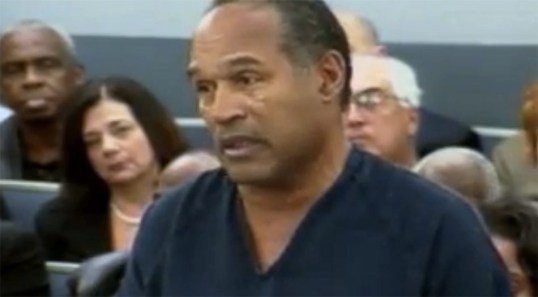
O.J.: Made in America, the best film of 2016, opens with a parole hearing in Nevada.  The inmate is surprisingly friendly and affable.  He talks about how he has tried to make the best use of his time in prison.  He chuckles as he talks about his prison duties.  For a prisoner, he seems like a really nice guy.

Then the parole commissioner asks him about the first time he was ever arrested and the prisoner’s entire demeanor changes.

“We’re going to talk about that?” he asks.
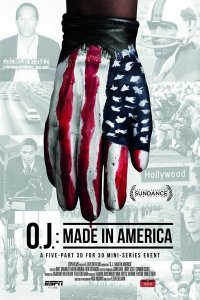
ojThe prisoner, of course, is former football great and actor Orenthal James Simpson and the first time that he was arrested, he was charged with murdering both his ex-wife, Nicole Brown Simpson, and Ronald Goldman.  In 1995, after a long and controversial trial that both forced people to reconsider how they viewed race relations in America and also marked the beginning of what would become reality television, O.J. Simpson was acquitted.  13 years to the day of his acquittal, he was sentenced to 33 years in prison for armed robbery in Nevada.

O.J.: Made in America leaves little doubt that O.J. got away with murder, though it should be pointed out that O.J. Simpson did not respond to requests for an interview and that Johnnie Cochran, who headed the legal team that won Simpson’s acquittal, died in 2005.  But with a sprawling running time of 7 and a half hours and featuring interviews with hundreds of people who either knew or were affected by O.J., O.J.: Made in America is about much more than just the trial of the century.
486940_032

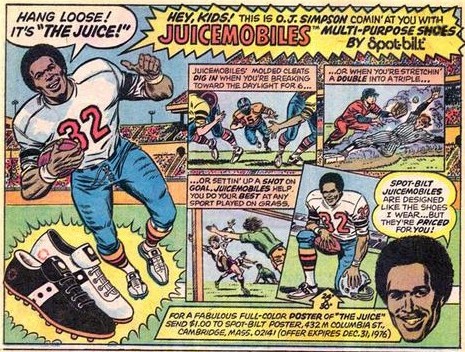
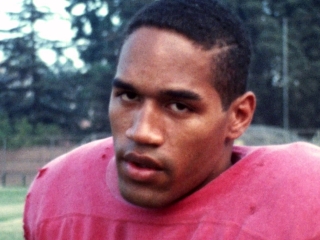
The first three hours of O.J.: Made in America deal with who O.J. was before he was charged with murder.  Things open in the 1960s, with the nation torn apart by racial unrest, and O.J. Simpson winning the Heisman Trophy and setting rushing records with both the USC Trojans and the Buffalo Bills.  While other black athletes, like Mohammad Ali, were putting their careers on the line and speaking out about civil rights, O.J. was deliberately apolitical.  When O.J. was pressured to speak out on civil rights, he would reply, “I’m not black.  I’m O.J.”

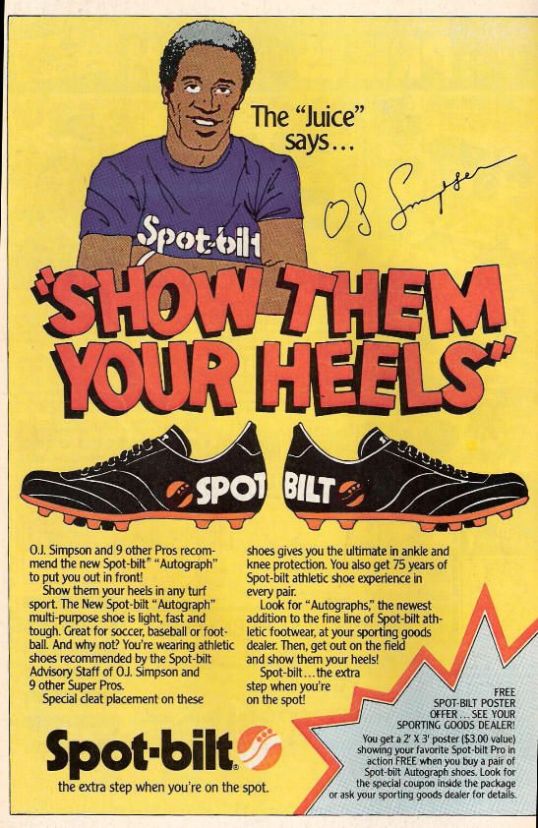
In turbulent times, O.J. emerged as a black celebrity that whites could safely embrace.  O.J. made history as the first black man to be used as a spokesman in an advertising campaign, running through airports for Hertz Rent-A-Car while onlookers shouted, “Go, O.J., go!”  A Hertz executive explains that, whenever they filmed a commercial, they were careful to make sure that it was only white people who were seen cheering O.J. on.  Retiring from football, O.J. moved to Brentwood, an all-white enclave in Los Angeles.  Surrounded by sycophants, O.J. pursued an acting career and remained silent while Los Angeles dealt with a series of racial incidents, culminating in the riots that followed after four LAPD officers was acquitted in the beating of Rodney King.
wedding

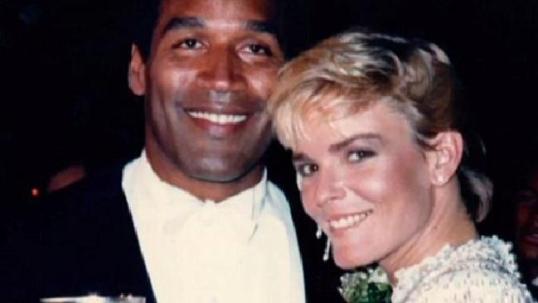
During all of this, O.J. divorced his first wife and married Nicole Brown.  One of the commendable things about O.J.: Made in America is that it gives a face and a personality to Nicole, who is often the forgotten victim when people discuss the O.J. Simpson case.  At the same time, O.J.: Made in America also documents how O.J. never faced any serious consequences for abusing Nicole.  Even after he was charged with domestic battery, all O.J. had to do for his community service was set up a charity golf tournament.  He later did an interview with Roy Firestone where the two of them joked away the charges and Firestone worried that they may have led some people to think that the Juice was a bad guy.

The next three hours deal with not only the murders of Nicole and Ronald Goldman but also with the national ramifications of the so-called “trial of the century.”  The first three hours were dominated by interviews with childhood friends, business associates, and neighbors.  It’s during the 2nd three hours that the familiar faces start to pop up.  Gil Garcetti, Bill Hodgman, and Marcia Clark talk about prosecuting O.J.  (Unfortunately, Chris Darden declined to be interviewed.)  From the defense team, F. Lee Bailey, Barry Scheck, and Carl E. Douglas share their memories of how this murder trial became a national Rorschach test on how Americans viewed race, celebrity, and justice.  The irony is not lost on anyone that O.J., who never made any public commitment to civil rights and who surrounded himself with rich, white people, was largely acquitted because of race.

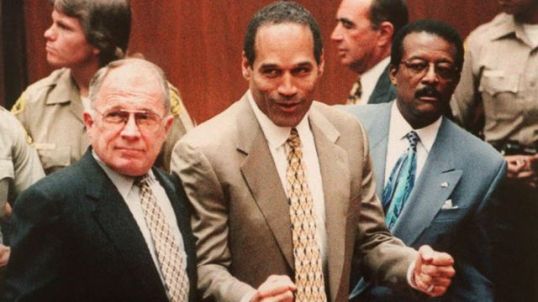
Until I saw O.J.: Made in America, I could never understand how O.J, manages to win acquittal.  His guilt has always seemed so obvious to me.  But, as O.J.: Made in America made clear, reasonable doubt can mean different things to different people.  A black jury in downtown Los Angeles had reason to both distrust and dislike the LAPD.  When Mark Furhman is heard using racial slurs, Carl Douglas says that it confirmed everything that he had always suspected by the LAPD.  Beyond that Cochran and his team put on a better show than the prosecution, who often seemed unsure how to respond and who repeatedly shot themselves in the foot with unforced errors, like asking O.J. to try on the bloody glove.  (Mike Gilbert, O.J.’s agent, reveals that O.J. had stopped taking his arthritis medication during the trial, causing his fingers to swell up.)  Even though the late Cochran could not be interviewed, he still easily dominates the documentary.
o-j

O.J.: Made in America features interviews with two of the jurors, Carrie Bess and Yolanda Crawford.  When Crawford is asked if the acquittal was payback for the Rodney King verdict, she weakly protests that it was not.  When ask the same question, Carrie Bess unapologetically nods in the affirmative.

With the trial over, the best part of the documentary is yet to come.  The final 90 minutes deals with the decade between O.J.’s acquittal and his Nevada conviction.  Freshly acquitted from murdering his wife, O.J. Simpson swore that he was going to track down the real killers, returned to his Brentwood mansion, and discovered that none of his old friends wanted to hang out with him anymore.  The once popular O.J. Simpson was now a pariah.  Simpson was taken to civil court by the Goldmans and the Browns and a new jury found him liable for the deaths of both Nicole and Ron.  Ordered to pay $33,000,0000, a bankrupt and friendless O.J. spent ten years in the wilderness.

If things could not get any more surreal, O.J. was hired to star in a Punk’d-style TV show that would have been called Juiced.  The Juiced footage would have been the strangest part of O.J.: Made in America if not for what happened in Las Vegas.  Convinced that a memorabilia collector had stolen his stuff, O.J. and his entourage confronted the man in his hotel room.  In a comedy of errors, O.J. grabbed everything that he felt had been stolen from him and ended up taking a lot of other things as well, with the entire encounter being audio recorded.  Because a member of Simpson’s entourage had a gun on him, O.J. was charged with armed robbery.
2016-06-18-oj-acting

Tom Riccio, a member O.J.’s Las Vegas entourage, talks about how, in the minutes before leaving to confront the memorabilia collector, O.J. was watching the Tyra Banks Show in his hotel room.  Tyra’s guest?  O.J.’s goddaughter, Kim Kardashian.  Kim announced that she and her family were going to be starring in a new show for E!  O.J. laughed and said, “That show will never last.”  Ironically, just as no one would have known (or cared) who Kim Kardashian was if not for her father’s role on O.J.’s defense team, O.J.’s murder trial also set the stage for the emergence of the reality television genre that would make stars of everyone from the Kardashian daughters to Donald Trump.

One final note about what happened in Las Vegas: O.J.’s Nevada trial was covered, for Entertainment Tonight, by Marcia Clark.

Convicted of armed robbery, O.J. was sentenced to prison.  As Carl Douglas puts it, it was not a coincidence that the judge waited until a year to the day after Simpson’s previous acquittal to sentence him.  And it was not a coincidence that Simpson, found liable for $33,000,000 in the civil lawsuit, was sentenced to 33 years.  Douglas calls it the “fifth quarter,” the fight that happens after the fourth quarter to determine who really won the game.  O.J.’s childhood friend, Joe Bell, calls it “white justice in America.”

Most people saw O.J.: Made in America when it was broadcast over five nights by ESPN.  But the best way to see this documentary is the way it was originally viewed at Sundance: as a seven and a half hour movie, watched with little break or interruption.  Full of candid and thought-provoking interviews and previously unseen footage, O.J.: Made in America is a powerful look at race, fame, and crime.

For tomorrow’s movie a day, it’s another documentary about a sports hero who ended up in prison, Stoked: The Rise and Fall of Gator.
juice


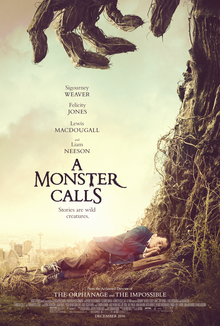
Playing Catch-Up: A Monster Calls (dir by J.A. Bayona)


a_monster_calls_poster

As our regular readers are undoubtedly aware, I was born in Texas and I grew up all over the Southwest.  I don’t believe in trigger warning and quite frankly, I lose respect for anyone who I hear whining about having to have one.  That’s the way we are down here.  If you can’t handle potentially being upset by something or someone, that’s you’re own damn problem.

That being said, I do feel like I should give everyone a heads up about A Monster Calls.  Don’t consider this to be a warning because a warning suggests that something bad is going to happen and A Monster Calls is actually a very good movie and one that I highly recommend.  But I do think I should say that I sobbed almost all the way through A Monster Calls and I wasn’t alone.  When I saw this movie on Sunday, there wasn’t a dry eye in the Alamo Drafthouse.

That’s just the type of film it is.  It’s a movie that deals very sincerely and very forthrightly with what it means to lose someone who you love.  It’s a coming-of-age story that deals with fear, loss, guilt, and those moments when — even while dealing with unbelievable pain and sadness — we can still find happiness in the moments that we have and in the imagination that all people — especially young people — possess.

Technically, A Monster Calls is a fantasy though it actually deals with very real emotions and events.  Conor O’Malley (Lewis McDougall) is a shy and introverted 13 year-old who is haunted by nightmares, one in particular.  His parents are divorced.  His father (Toby Kebbell) lives in America and is barely a presence in Conor’s life.  His mother, Lizzie (Felicity Jones, giving an amazing performance), gave up her own artistic ambitions when she became pregnant.  Now, she’s sick and every day, Conor is told that his mother is starting yet another new treatment because she’s “not responding as expected” to the previous treatment.

With Lizzie growing more and more ill, Conor finds himself living with his grandmother (Sigourney Weaver).  To Conor, his grandmother appears to be overly strict and unemotional but, as the film makes clear, she’s not.  If she seems strict, it’s because she knows that she will soon have to take over as Conor’s guardian.  If she seems unemotional, it’s because she’s trying to stay strong for both her daughter and her grandson.

Meanwhile, at school, Conor finds himself targeted by a strange bully named Harry (James Melville).  The scenes with Harry are some of the oddest in the film.  At times, Harry seems to look at the perpetually miserable-looking Conor with almost an expression of empathy and you wonder if he feels some sort of guilt over what he’s doing.  But whenever Harry approaches Conor, a viscous sadism emerges.  Though Harry always seems to be the one who is staring, he continually demands to know why Conor is always looking at him.  When another student tries to hit Conor, Harry announces that only Harry is allowed to hit Conor.

And then there’s the Monster.  At night, the Monster visits Conor.  A gigantic, humanoid tree, the Monster speaks in the voice of Liam Neeson and he alternates between being threatening and being almost paternalistic.  When Conor gets angry, the Monster encourages him to destroy things.  When Conor gets sad, the Monster taunts him for thinking that his sadness is somehow different from everyone else’s sadness.  The Monster is frightening but, at the same time, he seems to be the only thing in Conor’s life that he can depend on.  The Monster’s words may be harsh but there’s also something oddly comforting in their harshness.  It helps that he sounds like Liam Neeson.

The Monster tells Conor three stories, all of which are full of ambiguity and end with uncertain lessons.  The Monster tells Conor that, after he finishes the third story, Conor will be required to tell him about his greatest nightmare.  Conor finds himself both frightened and fascinated by the Monster but, as quickly becomes clear, his main fear is talking about his nightmare.

A Monster Calls is a beautifully done story about dealing with loss, one that will make you cry but, at the same time, will leave you feeling almost grateful for those tears.  The Monster is a truly spectacular creation and Liam Neeson does a perfect job voicing him.  What makes A Monster Calls so special is the way that director J. A. Bayona deftly balances Conor’s apocalyptic encounters with the Monster with the small, every day details of real life.

It makes for a powerful film.

Just make sure you’re ready to shed some tears.

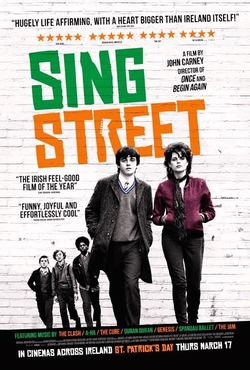
Playing Catch-Up: Sing Street (dir by John Carney)


sing_street_poster

The Irish musical comedy drama romance (that’s a lot of genres to take in, I know) Sing Street was one of the great and most sadly overlooked films of the previous year.  Fortunately, it’s on Netflix now and I seriously recommend that you watch it.  I watched it last night and I absolutely loved it.

Well, actually, it took me a while to realize that I loved it.  When the movie first started, I was kinda like, “Well, that’s cute and sweet but it’s not exactly blowing me away…”  It tells the story of a 15 year-old boy named Conor (Ferdia Walsh-Peelo) who is growing up in Dublin in the early 80s.  His father (Aidan Gillen) and his mother (Maria Doyle Kennedy) are constantly fighting and Conor suspects that they’re on the verge of separating.  His older brother, the charismatic but bitter Brendan (Jack Reynor), has dropped out of college and moved back home.  Brendan spends his days stoned and talking about music.

Because the family is short on money, Conor has been transferred to a free school, Synge Street.  It’s a far rougher school than what Conor is used to.  Bullies target him as soon as he arrives.  Meanwhile, the principal, Brother Baxter (Don Wycherly), has taken a somewhat disturbing interest in his newest student.  When Conor can’t afford to buy the black shoes that he’s required to wear to school, Baxter forces him to spend the school day in his socks.

Perhaps the only positive in Conor’s life is Raphina (Lucy Boynton), a 16 year-old who lives across the street from the school.  Raphina is an aspiring model with an older boyfriend and plans to move to London.  Conor tells Raphina that he’s in a band and that he wants her to star in a music video.  To Conor’s surprise, Raphina agrees.

Now, Conor just has to get a band together…

Sing Street was directed by John Carney, the same man who previously gave us the wonderful Once and the somewhat-less-wonderful-but-still-good Begin Again.  Much like those previous two films, Sing Street is a deliriously romantic and rather bittersweet little film, one in which love and emotion are expressed through song.  As a director, Carney has a real skill for capturing the excitement of creation.  The scenes in which Conor and his friend Eamon (Mark McKenna) work on their songs are just as enthralling as the scenes of Raphina and Conor falling in love.

And the music itself is wonderful.  While the soundtrack never quite reaches the heights of Once, it is a definite improvement over Begin Again.  The songs are all catchy and enjoyable but, even more importantly, they sound like the songs that actually would have been written by a talented but confused 15 year-old who has just started his own band.  There’s an aching sincerity to Sing Street‘s songs and they stay with you.  They remind you of how wonderful it is to know that you have your entire future ahead of you.

As I said, I didn’t realize how good Sing Street was until I had nearly reached the end of the movie.  Sing Street is one of those low-key films that kind of sneaks up on you.  At first, you think that you’re just watching another well-made coming of age film and then suddenly, you’re in tears.  You’re hoping that Raphina will make it to London and that Conor will find some sort of happiness.  The film ends on a somewhat ambiguous note but, in the end, you realize you really don’t need to know the exact details of what happened to Raphina and Conor in the future.  Instead, what’s important is that they had this wonderful experience when they were young.  Regardless of what happens to them in the future, you’re happy that they had the experience.

The whole film is undeniably well-acted but I want to make special mention of Jack Reynor, who brings a wounded dignity and rueful humor to the role of Brendan.  He dominates his few scenes and you find yourself happy that, regardless of how messed up the rest of his family may be, Conor has a brother like Brendan.

As I said at the start of this review, Sing Street is on Netflix.  And you should definitely watch it.

A Movie A Day #10: The Longest Yard (1974, directed by Robert Aldrich)


longest-yard-burt-reynolds

Once, Paul “Wrecking” Crewe (Burt Reynolds) was a superstar NFL quarterback.  That was until he was caught up in a point-shaving scandal and kicked out of the league.  When a drunk Crewe steals his girlfriend’s car, gets into a high-speed police chase, and throws a punch at a cop, he ends up sentenced to 18 months at Citrus State Prison.

The warden of the prison, Rudolph Hazen (Eddie Albert), is a football fanatic who, at first, is excited to have Crewe as an inmate.  The prison guards have a semi-pro football game and Hazen wants Crewe to coach the team and help them win a national championship.  Though initially reluctant and just wanting to do his time, Crewe relents after witnessing and experiencing the cruelty of the prison system.  Crewe forms The Mean Machine, a team made up of prisoners, and agrees to play an exhibition game against the guards.

At first, the members of the Mean Machine are just looking for an excuse to hit the guards without being punished but soon, they realize that they have a chance to win both the game and their dignity.  But Hazen is not above blackmailing Crewe to throw the game.

When it comes to understanding the Tao of Burt, The Longest Yard is the place to start.  Starting with a car chase and ending with near martyrdom, The Longest Yard is the ultimate Burt Reynolds film.  Paul Crewe ranks alongside Deliverance’s Lewis Medlock and Boogie Night‘s Jack Horner as Reynolds’s best performance.  Before injuries ended his athletic career, Reynolds was a college football star and, on the prison’s playing field, he holds his own with the large group of former professional football players who were cast to play the guards and the prisoners.  The Longest Yard’s climatic football game takes up over an hour of screen time and reportedly, the action was largely improvised during shooting.  Unlike most movie football games, the one in The Longest Yard looks and feels like a real game.

The Longest Yard was directed by Robert Aldrich, who specialized in making movies about anti-authoritarians fighting the system.  The scenes of Crewe recruiting and training The Mean Machine are very reminiscent of Aldrich’s best-known movie, The Dirty Dozen.  With its combination of dark humor, graphic violence, rebellious spirit, and Southern-friend melodrama, The Longest Yard is a movie that could only have worked in the 1970s.  The Adam Sandler remake may have made a lot of money at the box office but it still comes nowhere close to matching the original.

For tomorrow’s movie a day, it’s the best film of 2016, which also happens to be about a football player in prison.

thelongestyard

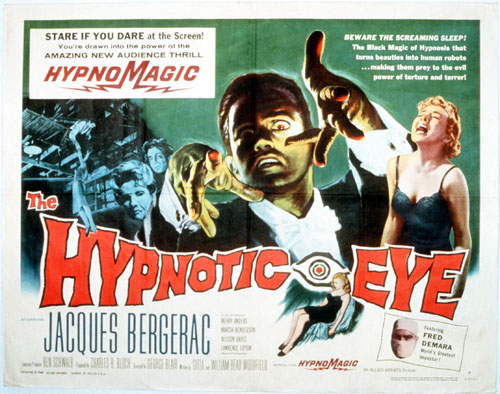
Stage Fright: THE HYPNOTIC EYE (Allied Artists 1960)


gary loggins's avatarcracked rear viewer

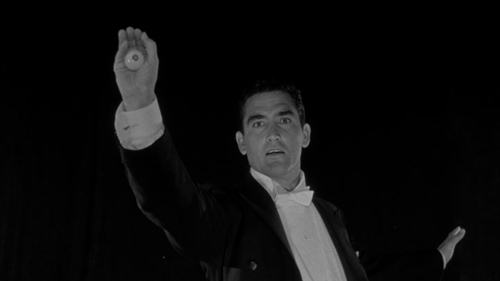
The Hypnotic Eye (1960) Directed by George Blair Shown: Lobby card

Evil hypnotists have been a movie staple since Svengali first mesmerized Trilby in 1911, but THE HYPNOTIC EYE is in a class of its own. This demented little tale is sufficiently creepy enough to overcome its meager budget limitations, and features the Ice Queen of Horror, Allison Hayes, in the pivotal role of Justine, assistant to master trancemaker Desmond.

hypno2

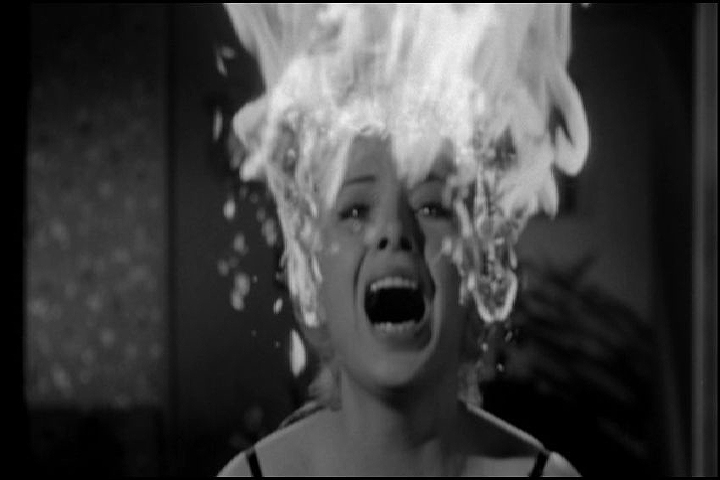
We start with an opening shot of a woman, thinking she’s washing her hair, sticking her head directly into the flame of a stove pilot. That’ll get your attention! A series of horrible self-mutilations have left a dozen beautiful women disfigured and the police scratching their heads. Detective Dave Kennedy discusses the bizarre cases with police psychologist Phil Hecht: “One of them stuck her face in the blade of an electric fan. Thought it was a vibrator. Another one sliced her face with a straight razor. Thought it was a lipstick brush”.

hypno3

Dave’s girlfriend Marcia…

View original post 447 more words

A Movie A Day #9: Gator (1976, directed by Burt Reynolds)


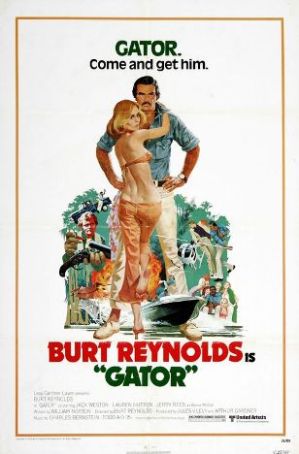
gatorposterGator McClusky is back!

Since the events in White Lightning, Gator (Burt Reynolds) has been released from prison and he’s now living in the Okefenokee Swamp.  Other than running moonshine, Gator is laying low and keeping to himself.  Gator may be done with the feds but the feds are not done with him.

Gator’s old friend, Bama McCall (Jerry Reed), is now unofficial boss of Dunston County and both the Department of Justice and the Governor of Georgia (played by talk show host Mike Douglas) are determined to take him down.  Federal agent Irving Greenfield (Jack Weston) is convinced that he can get Bama on charges of tax evasion.  But Irving’s from New York and he does not know how to talk to the good ol’ boys.  He needs someone on the inside and that’s where Gator comes in.

Gator not only starred Burt Reynolds but it was his directorial debut as well.  Though it’s a sequel to White Lightning, Gator feels like a very different movie.  Whereas Joseph Sargent kept White Lightning relatively serious, Reynolds take a more jokey approach with Gator.  Reynolds has his famous mustache and his hairpiece in Gator and the self-amused attitude that went along with them.  Gator is full of car chases, fist fights, willing women, and corny jokes.  It also has Lauren Hutton, playing a familiar character who would appear in all of Reynolds’s movies, the sophisticate who cannot resist Burt’s good ol’ boy, country charm.  In the 1970s, audiences couldn’t resist Burt’s good old boy charm, either.  Critics hated Gator but it made a lot of money.

Gator is dumb but fun.  The most interesting part of the movie is seeing Jerry Reed playing a ruthless villain.  Reed is thoroughly convincing as a Dixie Mafia crime boss, the type of redneck who earlier inspired Buford Pusser to pick up a baseball bat and destroy pool halls.  One year later, Jerry would play Burt Reynolds’s best friend in Smoky and the Bandit so it’s interesting to see them playing deadly rivals in Gator.

For tomorrow’s movie a day, Burt’s a football player in jail in The Longest Yard.

Playing Catch-up: Yoga Hosers (dir by Kevin Smith)


I have to admit that the main reason I watched Yoga Hosers is because I’m currently in the process of making out my “worst of 2016” list and everyone that I’ve talked to has insisted that Yoga Hosers happens to belong on that list.

Well, for once, I actually happen to agree with other people.  At the risk of losing my contrarian reputation,  Yoga Hosers definitely belongs on any list of the worst films of 2016.

I mean … Look, I get it.

I know that making crappy-looking films with juvenile humor has, in the past, worked out very well for Kevin Smith.  It’s made him an icon.  It’s won him legions of fans.  Some of my best friends love Kevin Smith and his movies.  I, personally, appreciate that he’s a fan of Degrassi.

And I know that there are literally thousands of interviews with Kevin Smith where he talks about the fact that he’s not the world’s greatest visual stylist.  He always pokes fun at the fact that he rarely moves the camera.  He’s open about the fact that he’s better at writing dialogue than filming it.  And I also know that he has regularly encouraged people not to take anything that he does too seriously.

I get all of that.

But here’s the thing … Yoga Hosers is really, really bad.  And Kevin Smith openly admitting that he’s not a very good director doesn’t make Yoga Hosers any less painful to sit through.

It’s actually kind of sad that Yoga Hosers isn’t better.  The film deals with two 15 year-old Canadian convenience store workers.  They’re both named Colleen and they’re best friends.  They’re also very well-played, by Harley Quinn Smith and Lily-Rose Depp.  In fact, they both give such likable performances that it actually makes the film just a little more bearable than it otherwise would have been.  And, hey — Kevin specifically made Yoga Hosers so that his daughter could have a starring role.  That’s more than my Dad ever for me when I was fifteen!

But, God, the movie is just so bad.

And by bad, I mean boring.  It’s not even so bad that it’s good.  It’s just a boring, bad movie.

Of course, If you just heard a rough outline of the film’s plot, you would probably think that Yoga Hosers was destined for cult immortality.  The Colleens are forced to spend a Friday night working at the store and they end up having to fight off a bunch of Nazi bratwursts, all of whom seeking to continue the hateful legacy of a Canadian Nazi played, in painfully unfunny flashbacks, by poor Haley Joel Osment.  Johnny Depp shows up as Guy LaPointe, a “man-hunter” who has a huge mustache and who speaks with a thick accent that’s obviously supposed to be hilarious.

But seriously, it takes forever for those little Nazis to show up. First, you have to deal with about an hour of the Colleens obsessing over their phones and saying “aboot” a lot.  This is one of the slowest films that I’ve ever seen and Kevin Smith is not the type of director to make a joke and then move on after he gets a laugh.  No, instead, he’s going to make a joke and then make it a second time and then keep pounding you over the head with it.  Watching Yoga Hosers is the equivalent of having Kevin Smith in your face for 90 minutes, screaming, “This is funny, right!?  RIGHT!?”

For instance, do you think it’s funny that Canadians say “aboot” and “oot?”  If you do, Yoga Hosers might be for you.  Or it still might not be, because how many times can you laugh at the Colleens saying “aboot?”  After the 10th time, you’ve gotten the joke but rest assured, you’re going to hear it a hundred more times.  Do Canadians ever get tired of Americans demanding that they say “aboot?”  I think I would.  I’m from Texas and I know I get sick of people from up north going crazy whenever I say “y’all.”

I think the main problem with Yoga Hosers is that Kevin Smith apparently didn’t trust his audience to pick up on all of the film’s comedic details.  Hence, the film never makes a joke without then beating us over the head to make sure that we understand that we’ve just heard or seen a joke.  For instance, it’s clever that, in Yoga Hosers, Canadian cereal is called “Pucky Charms.”  I saw one of the Colleens walking around with an open box of Pucky Charms and I smiled and I thought it was a clever little joke.  But it becomes less clever once Smith starts to have other characters specifically point out that Canadian cereal is called “Pucky Charms.”  Then it becomes just another mildly funny joke that quickly gets old.

I love Canada!  And I’m pretty sure Kevin Smith is a nice guy too.  But seriously, Yoga Hosers is the worst.

A Movie A Day #8: White Lightning (1973, directed by Joseph Sargent)


white-lightning-02

A year after co-starring in Deliverance, Burt Reynolds and Ned Beatty reunited for another movie about life in the backwoods, White Lightning.

White Lightning starts with two hippies, bound and gagged and floating in a canoe.  While a banjo plays in the background, two rednecks use a shotgun to blow the canoe into pieces.  They watch as the hippies drown in the swamp.  It turns out that one of those hippies was the brother of legendary moonshiner and expert driver, Gator McCluskey (Reynolds).  Gator is doing time but when he hears that his brother has been murdered, he immediately realizes that he was probably killed on the orders of corrupt Sheriff J. C. Connors (Ned Beatty).  The Feds arrange for Gator to be released from prison, on the condition that he work undercover and bring them enough evidence that they can take Connors down.

Back home, Gator works with a fellow informant, Dude Watson (Matt Clark), teams up with local moonshiner, Roy Boone (Bo Hopkins), and has an affair with Roy’s girl, Lou (Jennifer Billingsley).   Connors and his main henchman, Big Bear (R.G. Armstrong) both suspect that Gator and Dude are working for the government.  Since this is a Burt Reynolds movie, it all ends with a car chase.

A classic of its kind and a huge box office success, White Lightning set the template for almost every other film that Burt Reynolds made in the 1970s and 80s.  There is not much to the movie beyond Burt’s good old boy charm and Ned Beatty’s blustering villainy but if you’re in the mood for car chases and Southern scenery, White Lightning might be the movie for you.   Joseph Sargent also directed the New York crime classic, The Taking of Pelham One Two Three, and he gives White Lightning an edginess that would be lacking from many of Burt Reynolds’s later movies.

For tomorrow’s movie a day, it’s the sequel to White Lightning (and Burt Reynolds’s directorial debut), Gator.

white-lightning-05