I know all of you, like me, will be watching tonight’s 89th annual Major League Baseball All-Star Game, and… wait, what’s that? You say you WON’T be watching the All-Star Game? You have no interest in baseball? Heretics!! But I understand, I really do, and for you non-baseball enthusiasts I’ve assembled a quartet of Pre-Code films to view as an alternative, starring some of the era’s most fabulous females. While I watch the game, you can hunt down and enjoy the following four films celebrating the ladies of Pre-Code:
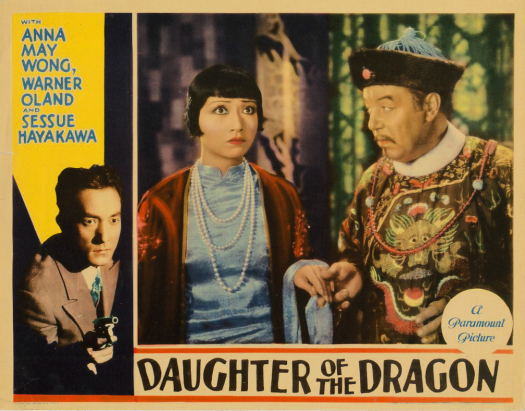
DAUGHTER OF THE DRAGON (Paramount 1931; D: Lloyd Corrigan) – Exotic Anna May Wong stars as Princess Ling Moy, an “Oriental dancer” and daughter of the infamous Dr. Fu Manchu (Warner Oland)! When Fu dies, Ling Moy takes up the mantle of vengeance against the Petrie family, tasked with killing surviving son Ronald. Sessue Hayakawa (BRIDGE ON THE RIVER KWAI)…
In the beginning, there was a yacht in the Caribbean.
Working on that yacht was a waiter named Manuel (Juan Pablo Di Pace). Manuel was strong, handsome, and as sexy as a reality show participant. He knew how to repair things. He knew how to catch fish. His job may have required him to serve margaritas to rich assholes from the United States but he always did it with an attitude. Manuel was the type of arrogant working man who one would typically expect to find Giancarlo Gianinni playing in a Lina Wertmuller film. Of course, Manuel is more interested in getting laid than leading a worker’s revolution. In fact, just before setting out on his latest voyage, he broke up with his girlfriend. She reacted by pointing at him and laughing evilly. In a movie like this, that can only mean one thing: VOODOO CURSE!
And then there was Jenny (Kelly Brook) and her husband, Jack (Billy Zane). While Jenny was the trophy wife, Jack was the American businessman who rented out the yacht for a fishing expedition. Jack was arrogant. Jack was outspoken. Jack was convinced that he knew how to survive at sea, even though he didn’t. He and Manuel took an instant dislike to each other. It didn’t help Manuel’s cabin was right next to Jenny and Jack’s and that the sound of Jenny’s ecstatic moaning kept Manuel from getting a goodnight’s rest.
(Of course, another reason that Manuel was having trouble getting any sleep was because, at that very moment, his ex-girlfriend was dancing in a candle-filled room and apparently taking part in some sort of Santeria-related ceremony.)
Well, you can guess where this is going, can’t you? Jack and Manuel have an argument on the boat. Manuel gets fired and reacts by taking a towel and throwing it on a stove. Soon, the boat’s on fire. Jenny and Manuel wash up on the shore of an isolated island. For two days, Manuel takes care of Jenny. He catches fish for her. He encourages her to swim naked in the ocean. He yells at her, “You have a perfect ass, senora! It’s shaped like a heart because God didn’t give you a real one!” (If I had a dollar for every time I’ve heard that…) Despite herself, Jenny starts to fall for Manuel. Suddenly, Jack shows up on the beach!
Jack soon proves himself to be just as obnoxious on dry land as he was on the boat. Earlier, Jenny and Manuel had buried the body of the boat’s captain. Jack promptly digs the captain back up so he can get a change of clothes and some cigars. Jenny is stunned that Jack would do something so gross. Jack laughs it off as only Billy Zane can.
Soon, Jack is living on one end of the beach while Manuel is on the other. And Jenny is stuck in the middle. Meanwhile, Manuel’s ex-girlfriend is still dancing in that candle-filled room…
Survival Island is a movie that manages to both bad and brilliant at the same time. In the role of Jenny, Kelly Brook gives a performance that hits so many wrong notes that it almost becomes a perfect example of outsider art. When she should be scared, she seems to be mildly annoyed. When she should be happy, she again seems to be mildly annoyed. The script itself can’t decide whether Jenny is meant to be a noirish femme fatale or a repressed trophy wife. Jenny never really comes to life as anything other than a plot device but I do have to admire the fact that, even after a shipwreck and several days on a desert island, her makeup was always perfect and her hair was always clean. Still, considering that the film revolves around her, Jenny is a surprisingly insubstantial character.
Fortunately, the fact that Jenny is such a poorly written character almost doesn’t matter. What does matter is that Billy Zane is in this movie and he’s exactly the type of shameless, over-the-top performer that this story needs. There’s nothing subtle about Zane’s performance. Jack talks to himself. Even before they end up fighting over Jenny, Jack is always glaring at Manuel. When he manages to catch something to eat, Jack breaks out into a wonderfully self-satisfied grin and when he suspects that Jenny may have cheated on him, he pouts like a child who has just been informed that his favorite toy was donated to the Goodwill while he wasn’t looking. Jack’s the type of character who has a snarky comment about everything and Billy Zane is one of those actors who definitely knows how to deliver a sarcastic line or two. Jack may be a jerk but so what? He’s an American jerk so, as an American film reviewer, I’m required to be on his side. Once Jack — and Billy Zane — loses it and goes crazy on that island, nothing else matters. On the basis of Billy Zane’s presence alone, the film is a guaranteed a certain immortality. Indeed, the main conflict in Survival Island isn’t between Jack and Manuel. Instead, it’s between a film that takes itself seriously and a star who does not.
That’s really what makes Survival Island into such a slyly (if, perhaps, unintentionally) subversive film. The movie may think that it has something to say about class, relationships, and sex but Billy Zane is always on hand to announce,, “No, this is all about watching me go batshit crazy on an island! That’s all that matters!” Just as how Jenny must choose between Jack and Manuel, the viewer is forced to choose between taking the movie seriously or just enjoying Billy Zane at his zaney best.
I have a feeling that most people will go with the latter.
I recorded My Husband’s Secret Life off of Lifetime on March 25th.
Agck!
That looks like quite an accident, doesn’t it?
Lying on the ground is Freddy (Brett Donahue). Freddy owns a flower store so you might wonder how exactly he ended up lying in the middle of the street, covered in blood. Some of it could have to do with the fact that Freddy is the husband who is mentioned, in the title, as having a secret. Freddy may seem like a nice guy but he sure is shady about certain aspects of his past. For instance, why does he carry a lighter that was made in Russia? And when he talks in his sleep, why does he speak with slightly foreign accent? And then there’s his slightly creepy and rather overprotective mother.
As for why he’s lying in the middle of the road, he’s just been run by a man named Arthur (Joe Cobden). Arthur drinks too much and is frequently a nervous wreck. Interestingly enough, he once had a respectable job and a strong family. Whenever Freddy and Arthur meet, it’s on one of those park benches that practically screams, “Secret spy meeting place!”
Hovering over him is Jennifer Jones (Kara Killmer). Jennifer is Freddy’s wife and, to be honest, she was a bit concerned about her marriage even before Freddy ended up in the middle of the street. They’ve been married for seven years and yet, there’s still things that Jennifer doesn’t really known about Freddy. And when she just happens to spot him in the city, getting yelled at by an angry woman, Jennifer’s suspicions become even stronger. It gets even worse when she twice tries to call him and, after first ignoring her, he answers the second time and blatantly lies about where he is.
Later, when she confronts him, he admits that he was lying about where he was but then asks her why she didn’t call him out if she knew he was lying. I mean, how dare she allow him to lie!? That’s classic gaslighting and enough to make everyone watching the film shout, “Get away from him!”
But, shortly afterward, Freddy ends up in the middle of the street and, suddenly, the whole idea of leaving him gets a lot more awkward. Freddy’s in a coma now and how can you leave someone when they’re in a coma? While Jennifer waits for Freddy to wake up, her mother-in-law continues to push her away. What was Jennifer’s husband hiding and why is his mother searching through his house in the middle of the night? Jennifer is determined to find out!
In all probability, you’ll figure it out long before Jennifer does. I mean, honestly, when a guy starts speaking in a foreign accent in his sleep, it doesn’t take a genius to figure out that he’s probably not who he says he is. In fact, it takes a certain suspension of disbelief to accept that Freddy could have fooled Jennifer for all this time.
But — hey, this is Lifetime and Lifetime is all about suspending your disbelief and having a good time! Kara Killmer gives a sympathetic lead performance and Joe Cobden has a few good scenes as the perpetually shaky Arthur. At its most effective, My Husband’s Secret Life deals with a question that we’ve all asked (whether we admit it or not): How well do we know the people we love?
My Husband’s Secret Life is also known as Sleeper.
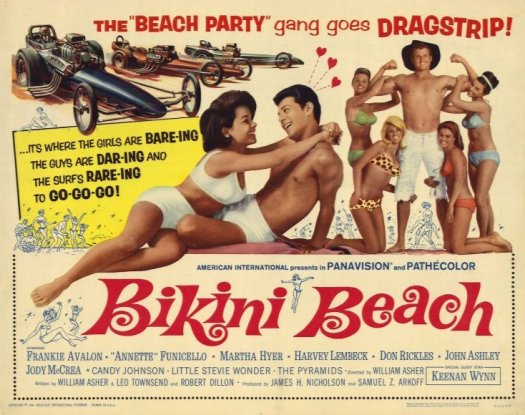
Welcome back to Drive-In Saturday Night! Summer’s here, and the time is right for a double dose of American-International teen flicks, so pull in, pull up a speaker to hang on your car window, and enjoy our first feature, 1964’s BIKINI BEACH, starring Frankie Avalon and Annette Funicello:
BIKINI BEACH is the third of AIP’s ‘Beach Party’ movies, and this one’s a typical hodgepodge of music, comedy, and the usual teenage shenanigans. The gang’s all here, heading to the beach on spring break for surfing and swinging. This time around, there’s a newcomer on the sand, British rock star The Potato Bug, with Frankie playing a dual role. Potato Bug is an obvious spoof of the big Beatlemania fever sweeping the country, with all the beach chicks (or “birds”, as he calls ’em) screaming whenever PB starts singing one of his songs, complete with Lennon/McCartney-esque “Wooos” and “Yeah, yeah, yeahs”…
I recorded Family Vanished off of the Lifetime Movie Network on July 6th!
“Give me my wedding ring, you white trash bitch!”
— Lisa (Kelly Packard) in Family Vanished (2018)
Here’s two lessons that I learned from Family Vanished:
Be careful how much information you post online.
Seriously, Lisa (Kelly Packard) thought it would be a good idea to post how much she had sold a painting for online. She also thought it would be a good idea to let the world know that she, her husband (Madison Dirks), and her daughter (Elisa Luthman) would all be in Hawaii on a work vacation.
What happened as a result? Well, Mike (Todd Cahoon), Carol (Jennifer Taylor), and their daughter (Megan Littler) saw Lisa’s posting. And they decided that Lisa and her family must have a lot of money. So, they broke into the family’s house. They lived there for several days. They tried on everyone’s clothes. They slept in everyone’s beds. They made the house their own and, since they never took off their black gloves, they managed to do it without leaving behind any DNA or fingerprint evidence.
Of course, they quickly discovered that Lisa and her family wasn’t as rich as they assumed. In fact, a quick perusal of Lisa’s diary revealed that the family itself wasn’t particularly happy. Still, Mike and Carol were determined to get something for all of their trouble so they stayed in the house until Lisa and the family returned from their vacation.
Second lesson learned:
2. You can only push people so far before they snap.
Sure, Mike and Carol had a lot of fun tormenting Lisa and her family. They revealed that Lisa had been unfaithful. They forced Lisa’s husband to bark like a dog. They taunted Lisa’s daughter for having won so many trophies in school. Mike and Carol had a lot of fun but they failed to consider just how far some people will go to get revenge.
When their initial ordeal finally ended, Lisa and her husband were not happy to learn that the police had no real leads as to where Mike and Carol went off to. So, they decided to investigate on their own. And when they did track down Mike and Carol, well, let’s just say that even the most normal-seeming people can be pushed too far…
So, Family Vanished was a film that I had mixed feelings about. I’m not a huge fan of movies about people being held hostage. Films about hostage situations are always a bit too predictable for me. It always starts with the hostages pleading for their lives and then the nosy neighbor comes over and there’s the big tense scene where the main hostage has to try to get rid of him while someone stands behind the front door with a gun or a knife pointed at his back. The hostage takers always start taunting the hostages. I’ve seen it so many times that I just automatically get bored with the situation.
So, the first half of Family Vanished didn’t do much for me but then Lisa and her husband set out to get revenge and it became this totally different, wonderfully over-the-top movie! I loved watching Kelly Packard and Madison Dirks get mean and vengeful. Kelly Packard has appeared in many Lifetime movies but I think this is the first one where she actually gets to kick some ass and both she and Dirks seemed to be having a lot of fun with the role reversal. Add to that, Mike and Carol were so obnoxiously cruel that it was impossible not to get some guilty pleasure out watching Lisa demanded the return of her wedding ring.
With its theme of a terrible crime leading to an even worse revenge, Family Vanished is what I imagine a Wes Craven-directed Lifetime movie would have been like. It’s Lifetime’s Last House On The Left.
Last night, I watched the latest Lifetime movie premiere, Killer Caregiver!
Why Was I Watching It?
Why not?
What Was It About?
While visiting one of her clients, Mariah Wilson (Nicole Hayden) is shocked when an accident leads to not only his death but also to her breaking her arm. With months of physical therapy ahead of her, Mariah hires a home caregiver. Tara (Camila Banus) seems like she’s perfect. She gets along with Mariah’s estranged husband, Greg (George Stults). She helps Mariah exercise her arm. Most importantly, Mariah’s son, Jacob (Jaeden Bettencourt), loves her!
It all seems perfect, except … uh oh! It turns out that Tara is the daughter of Mariah’s dead client and she’s out for revenge!
What Worked?
Oh my God, the houses were to die for! Seriously, one of the things that I love about Lifetime films is that they always take place in these huge houses, the majority of which have a pool in the back yard. But, even by the standards of Lifetime, this film featured some nice houses. In fact, Greg and Mariah’s house was so nice that I was half expecting Greg to reveal that he worked as a money launderer for the mob. But no, Greg’s job had something to do with computers. Having seen this film, I’m now encouraging my boyfriend to get an IT-related job because I could have a lot of fun with a house that big.
However, it wasn’t just Greg and Mariah who had a nice house. Tara also had a really nice house, too. For that matter, when Greg, Mariah, and Jacob were forced to stay in a motel for a night, the motel looked really, really good.
From her first appearance, Tara established herself as being a classic Lifetime villain and Camila Banus really threw herself into the role. From the minute Tara showed up, she was like, “This is my film and now, everyone’s at my mercy!” A film like this is only as good as its villain and Tara was a great one.
What Did Not Work?
What happened to Eugene? The well-meaning but intellectually disabled groundskeeper (played by David Meyers) seemed like he was going to be an important character but then he just kinda disappeared. It was hard not to feel that the character deserved a resolution to his subplot, as minor as it may have been.
Other than that, it all worked! I mean, I could sit here and wonder if perhaps Tara could have come with a simpler revenge scheme (spoiler: she could have) but that would be kind of silly on my part. Melodrama is one of the reasons why I love Lifetime movies! Besides, how can you go wrong when you’ve got a great psycho and a big house?
“Oh my God! Just like me!” Moments
While I personally would never plot anyone’s downfall, I still found myself admiring how organized Tara was about it. You could tell that she probably made out a To-Do List before she set about destroying Mariah’s life:
Become a caregiver
Get hired
Brainwash Jacob
Drug Mariah…
And so on and so forth. At least, that’s what I would do.
Lessons Learned
With enough planning and preparation, there’s nothing you can’t accomplish.
You would think THE TWO MRS. CARROLLS is just the type of movie I’d love. It’s a Warner Brothers pic from the 1940’s, it’s got Humphrey Bogart and Barbara Stanwyck , there’s mystery and murder, a Gothic atmosphere… and yet, I didn’t love it, or particularly like it, either. For the first three-quarters, it’s too mannered, slow-moving, and (the cardinal sin) boring for my tastes. Things do pick up a bit towards the end, with Bogie menacing Babs alone in that gloomy mansion, but the denouement failed to satisfy me.
There are a number of reasons why the movie just doesn’t work. It was filmed in 1945, but held back two years by the studio for some reason or another (reports vary). Director Peter Godfrey, a Stanwyck favorite, just wasn’t up to the task of creating much suspense. Then again, the screenplay by Thomas Job practically gives everything away early…
All she wants to do is throw a surprise party for her new boyfriend and enjoy the 4th of July. Is that too much to ask? However, things are never easy. Her friends are ruthless in their critique of what she’s planning to wear. Her mother (Jane Kaczmarek) keeps pressuring her to go down to CVS and buy more makeup. As for her father (Tim Matheson) — well, he’s just too damn good-looking. All of her friends want to know if it was difficult for Katie to grow up with a “hot dad.” Katie says it was.
You know what’s even more difficult though?
Trying to throw a surprise birthday party while also trying to take care of your niece and your junkie brother!
From the minute we meet Seth (Dave Franco) it’s obvious that he’s on something. As soon as Katie orders him to roll up his sleeves, we know that this is not a new thing with Seth. Seth is a junkie, the type who shoots up in grocery store bathrooms and who buys his heroin from a man who lives in a yellow tent. Seth isn’t one of those charming junkies, either. He’s not Ewan McGregor in Trainspotting. He’s a manipulative, self-centered asshole who agrees to go to detox but only if Katie agrees to pay for it and not tell anyone that he’s using again. He’s the type who thinks nothing of begging his sister to leave the party that she’s spent weeks planning because he needs a ride to get one last hit before “getting clean.”
6 Balloons is a short film, one that takes place over the course of one long night. While the party goes on without her, Katie drives Seth around the city. Whenever Katie objects to what Seth is asking her to do, Seth guilts her. He continually assures her that he just needs to get high one last time and then he’ll be able to do detox. Meanwhile, Seth’s daughter sits in her car seat and begs to be taken home.
The acting is okay. Both Dave Franco and Abbi Jacobson are best known for their comedic work so it’s interesting to see them taking on such dramatic roles here. At the same time, it sometimes seems like both of them are trying too hard. The same could be said of 6 Balloons. This is a film that could have used a little dark humor. Instead, it’s relentlessly grim and serious and, as a result, a bit of a chose to sit through. For a 70 minute film, 6 Balloons seems to go on forever.
The problem with films about junkies is that, for the most part, hardcore junkies are dull people and not much fun to be around. Christiane F,Trainspotting and several of the films influenced by them dealt with this problem by featuring a propulsive soundtrack and some imaginative cinematography. (Trainspotting also wisely devoted more screen time to Mark and Sick Boy than to Spud. Just imagine how difficult it would be to watch Trainspotting if the entire film had centered on Spud getting high and crawling underneath cars.) With its hand-held camerawork and it’s subdued soundtrack, 6 Balloons takes more of a documentary approach. The film will leave you with no doubt that heroin is bad and it’s not good to be an enabler but, at the same time, it’ll probably also inspire you to glance at the time and ask yourself, “Is this thing over yet?”
What’s an Insomnia File? You know how some times you just can’t get any sleep and, at about three in the morning, you’ll find yourself watching whatever you can find on cable? This feature is all about those insomnia-inspired discoveries!
Last night, if you were in a hotel room in Alabama and you discover that you couldn’t get to sleep despite having a busy day ahead of you, you could have always turned on the TV and watched the 1996 musical extravaganza, Evita.
That’s what I did!
Evita, of course, is based on the award-winning musical by Tim Rice and Andrew Lloyd Webber. Opening in 1952, with Argentina being thrown into mourning and chaos by the death of Eva Peron (Madonna), the film then flashes back to follow Eva as she goes from being a child of poverty to a well-known actress to eventually the wife of Argentina’s president, Juan Peron (Jonathan Pryce). The majority of her story is told to us by Che (Antonio Banderas), a cynical observer who pops up in various disguises and who is always quick to accuse Eva of selling out the poor while, at the same time, professing to be as obsessed with her as everyone else. Much as they did with the story of Jesus in Jesus Christ Superstar, Rice and Lloyd Weber use the story of Eva Peron to explore what it means to be a celebrity in an unstable world.
(If anyone ever decides to produce a musical about the Kardashians, they would be fools not to approach Rice and Lloyd Webber to write it.)
Evita is kind of a strange film. On the one hand, it’s a wonderful spectacle. Director Alan Parker does a wonderful job visually interpreting the music. The sets are huge and ornate. The costumes are to die for. There’s never a moment when you don’t want to look at the screen. Parker keeps the action moving and, regardless of how cynical one may be about politics, it’s hard not to be impressed by the army of extras that march through the film, chanting “Peron.” While both the musical and film undoubtedly took liberties with the actual story (and don’t watch this film expecting to see any acknowledgment of the countless number of Nazi war criminals that Peron welcomed to Argentina after the fall of the Third Reich), it still does a great job of capturing the sweep of change and revolution. You watch the film and you understand why the citizens of an unstable country would put their faith in messianic leaders like the Perons. Jonathan Pryce does a good job playing Peron and Antonio Banderas is absolutely on fire as Che.
(In some stage productions, Che is specifically portrayed as being a young Che Guevara. Guevara, of course, was a racist mass murderer who became an icon because he was photogenic. Fortunately, the film is content to portray Che as simply being a politically active citizen of Argentina.)
And yet, there is an emptiness at the center of this adaptation of Evita and that emptiness is named Madonna. Strangely, for someone who has been a star longer than I’ve been alive, Madonna has absolutely zero screen presence. She looks glamorous enough for the part and she’s got a good enough voice for the songs but, whenever she actually has to act, Madonna’s performance feels awkward and forced. Her performance is too obviously calculated, and, as a result, there’s nothing natural about her or her interpretation of Evita. To put it simply, she tries too hard. She comes across as the type of performer who doesn’t so much smile as she acts the process of smiling. When Madonna performs opposite Pryce and Banderas, they’re both good enough to carry her through their shared scenes. But whenever Madonna has to hold the screen on her own, the film falls strangely flat.
The end result is a strangely uneven film, one that leaves little doubt that Eva Person was loved while, at the same time, never seeming to understand why.
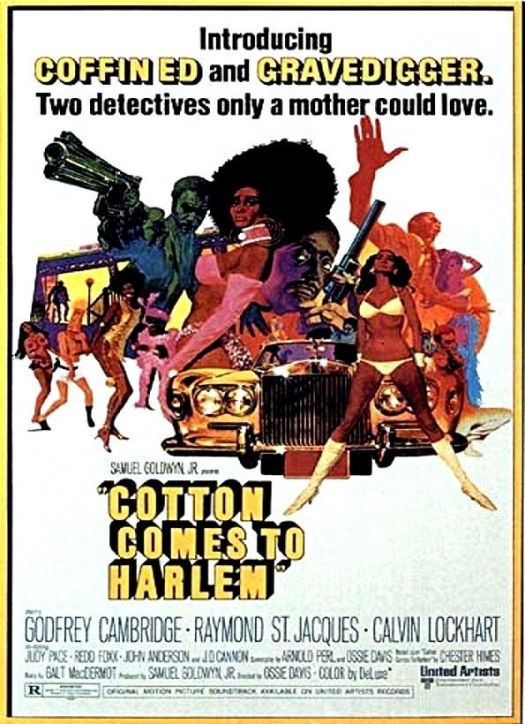
I’m not really sure if COTTON COMES TO HARLEM qualifies as a Blaxploitation film. Most genre experts point to Melvin Van Peebles’ SWEET SWEETBACK’S BADASSSSS SONG and/or Gordon Parks’s SHAFT , both released in 1971, as the films that kicked off the Blaxploitation Era. Yet this movie contains many of the Blaxploitation tropes to follow, and is based on the works of African-American writer Chester Himes.
Hardboiled author Chester Himes
Himes (1909-1984) began his writing career while doing a prison stretch for armed robbery. After his short stories started being published in Esquire, he was paroled in 1936, and soon met poet Langston Hughes, who helped him get established in the literary world. Reportedly, Himes worked for a time as a screenwriter for Warner Brothers in the 40’s, but was let go when a racist Jack Warner declared he “don’t want no n*ggers on this lot” (1). His first …