Horror Film Review: Strange Invaders (dir by Michael Laughlin)


In 1983, two years after the release of Strange Behavior, director Michael Laughlin and Bill Condon teamed up for another “strange” film.  Like their previous collaboration, this film was a combination of horror, science fiction, and satire.

The title of their latest collaboration?

Strange Invaders.

Strange Invaders opens in the 1950s, in a small, all-American town in Illinois.  Innocent children play in the street.  Clean-cut men stop off at the local diner and talk to the waitress (Fiona Lewis, the scientist from Strange Behavior).  Two teenagers (played by the stars of Strange Behavior, Dan Shor and Dey Young) sit in a car and listen to forbidden rock’n’roll music.  A lengthy title crawl informs us that, in the 1950s, Americans were happy and they were only worried about three things: communists, Elvis, and UFOs.  On schedule, a gigantic UFO suddenly appears over the town.

Twenty-five years later, mild-mannered Prof. Charles Bigelow (Paul Le Mat) teaches at a university and wonders just what exactly is going on with his ex-wife, Margaret (Diana Scarwid).  In order to attend her mother’s funeral, Margaret returned to the small Illinois town where she grew up.  When she doesn’t return, Charles decides to go to the town himself.  However, once he arrives, he discovers that the town appears to still be stuck in the 50s.  The townspeople are all polite but strangely unemotional and secretive.  Charles immediately suspects that something strange is happening.  When the towns people suddenly start shooting laser beams from their eyes, Charles realizes that they must be aliens!

Fleeing from the town, Charles checks all the newspapers for any reports of an alien invasion.  The only story he finds is in a cheap tabloid, The National Informer.  The author of the story, Betty Walker (Nancy Allen), claims that she just made the story up but Charles is convinced that she may have accidentally told the truth.  At first, Betty dismisses Charles as being crazy.  But then she’s visited by an Avon lady who looks just like the waitress from the small town and who can shoot laser beams.

Teaming up, Charles and Betty investigate the aliens and try to figure out just what exactly they’re doing on Earth.  It’s an investigation that leads them to not only a shadowy government operative (Louise Fletcher) but also a man (Michael Lerner) who claims that, years ago, he helplessly watched as his family was destroyed by aliens.

Like Strange Behavior, Strange Invaders is a … well, a strange film.  I have to admit that I prefer Behavior to Invaders.  The satire in Strange Invaders is a bit too heavy-handed and Paul Le Mat is not as strong a lead as Michael Murphy was in the first film.  I was a lot more impressed with Nancy Allen’s performance, if just because I related to both her skepticism and her sudden excitement to discover that her fake news might actually be real news.  I also liked Micheal Lerner, so much so that I almost wish that he and Le Mat had switched roles.  Finally, I have to say that Diana Scarwid’s performance was so bizarre that I’m not sure if she was brilliant or if she was terrible.  For her character, that worked well.

Strange Invaders gets better as it goes along.  At the start of the film, there are some parts that drag but the finale is genuinely exciting and clever.  If the film starts as a parody of 1950s alien invasion films, it ends as a satire of Spielbergian positivity.  It’s an uneven film but, ultimately, worth the time to watch.


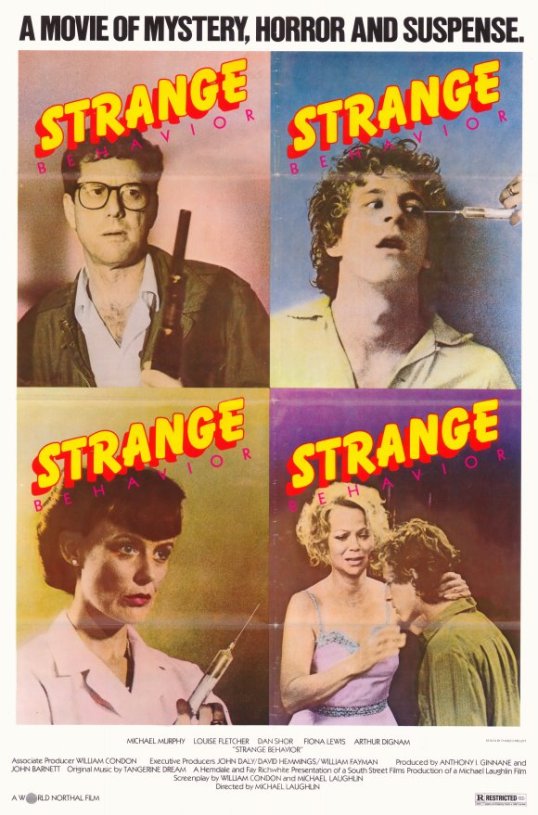
Horror Film Review: Strange Behavior (a.k.a. Dead Kids) (dir by Michael Laughlin)


I want to tell you about one of my favorite horror films.  It’s a strange one and I think you might like it.

It’s a movie from 1981.  It was filmed in New Zealand, even though it takes place in a small town in the American midwest.  It was directed by Michael Laughlin and the screenplay was written by Bill Condon, who has since become a director of some note.  This was Condon’s first screenplay.  In Australia and Europe, this movie is known as Dead Kids.  In America, the title was changed to Strange Behavior.

Here, watch the trailer:

It’s a pretty good trailer, actually.  That said, as good as the trailer may be, it doesn’t even come close to revealing just what an odd film Strange Behavior actually is.  If David Lynch had followed up The Elephant Man by directing a slasher movie, chances are the end result would have looked something like Strange Behavior.

Here’s another scene that I want you watch.  It’s kind of a long scene, clocking in at 7 minutes.  But I want you to watch it because, in many ways, this scene is the epitome of Strange Behavior:

Strange Behavior is perhaps the only 80s slasher film to feature a totally random and totally choreographed dance number.  It comes out of nowhere but, in the world that this film creates, it somehow feels totally appropriate.  Of course, the nun is going to announce that she’s not wearing any underwear and then pretend to stab a guy in the back.  Of course, the cowboy’s going to throw up and then want to go out to his car with his date.  And of course, a bunch of people in costume are going to end up dancing to Lightnin’ Strikes.  In Strange Behavior, the strangest behavior is the only behavior that makes sense.

As for the film itself, it’s a mix of small town melodrama, slasher horror, and gentle satire.  Teenagers are being murdered by other teenagers and no one is sure why.  The chief of police, John Brady (played by character actor Michael Murphy, who gives a quietly authoritative performance that counters some of the weirdness of the rest of the movie), is trying to solve the crimes while trying to cope with the mysterious death of his wife.  His son, Pete (Dan Shor), is going to the local college, where classes are taught by a professor (Arthur Dignam) who died years ago but who filmed a few lectures before passing.  To make extra money, Pete does what many of the local teenagers do — he volunteers for medical experiments.  Researcher Gwen Parkinson (Fiona Lewis) oversees the experiments, handing out pills and occasionally administering a hypodermic needle to the eyes of a test subject.  Gwen is always cool, calm, and collected.  When one irate father draws a gun on her, Gwen quips, “I can’t stop you.  I don’t have a gun.”

But there’s more to this movie than just medical experiments and murder.  Strange Behavior is full of wonderfully eccentric supporting characters.  Other than John, there’s really nobody normal to be found in either the town or the movie.  Pete’s best friend, Oliver (Marc McClure), is cute and dorky.   Barbara (Louise Fletcher) just wants to marry John and live in a town where dead bodies don’t turn up in the middle of corn fields, propped up like scarecrows.  John’s best friend and fellow cop, Donovan (Charles Lane), has been around forever and has a great, no-nonsense approach to even the strangest of things.  When it becomes obvious that John is not going to be able to solve the murders on his own, big city cop Shea (Scott Brady) shows up and wanders ineffectually through the movie, spitting out hard-boiled dialogue like a refugee from a 1930s gangster flick.  And finally, receptionist Caroline (Dey Young) sits at her desk in the clinic, gossiping about the patients and smoking cigarette after cigarette.  Caroline is probably the smartest person in the movie.  As an administrative assistant, I appreciated that.

It’s an odd little movie, which is why I love it.  Laughlin, Condon, and the entire cast created a world where everything is just a little off-center.  It makes for terrifically entertaining and weird movie, one that works as both satire and straight horror.

Strange Behavior is a film that deserves to much better known than it currently is so my advice is go watch it and then tell you friends to watch it too.

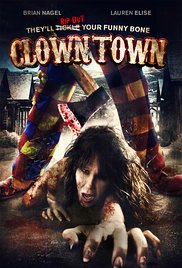
A Movie A Day #283: ClownTown (2016, directed by Tom Nagel)


To quote a wise man named Forrest Gump, shit happens … especially if there is a clown nearby.
Six idiots take a wrong turn and end up in a deserted, desolate town.  It turns out that the town is populated by a gang of clowns and one homeless man who looks like a skinnier version of Randy Quaid.  It turns out that the clowns are crazy and homicidal and will kill anyone who is not wearing clown makeup.

That is the entire movie!  Other than the amateurish acting, ClownTown is not badly made.  The town is creepy.  The gore looks real.  The clowns are freaky.  The main problem with the movie is that crazy clowns are not unique or surprising anymore.  Even before It went into production and there were all those real-life evil clown sightings last summer, lunatics in clown makeup had become a cliché.  The clowns in ClownTown are evil and sadistic and do some messed up things but who cares?  They’re clowns.  Everyone already knows they’re crazy.

Horror on the Lens: The Night Stalker (dir by John Llewelyn Moxey)


For today’s horror on the lens, we have a real treat!  (We’ll get to the tricks later…)

Long before he achieved holiday immortality by playing the father in A Christmas Story, Darren McGavin played journalist Carl Kolchak in the 1972 made-for-TV movie, The Night Stalker.  Kolchak is investigating a series of murders in Las Vegas, all of which involve victims being drained of their blood.  Kolchak thinks that the murderer might be a vampire.  Everyone else thinks that he’s crazy.

When this movie first aired, it was the highest rated made-for-TV movie of all time.  Eventually, it led to a weekly TV series in which Kolchak investigated various paranormal happenings.  Though the TV series did not last long, it’s still regularly cited as one of the most influential shows ever made.

Anyway, The Night Stalker is an effective little vampire movie and Darren McGavin gives a great performance as Carl Kolchak.

Enjoy!

The TSL’s Horror Grindhouse: Scream Blacula Scream (dir by Bob Kelljan)


Am I correct in assuming that everyone knows who Blacula was?

Blacula is often described as being the black Dracula but actually, it’s a little bit more complicated than that.  In life, he was an African prince named Mamuwalde who, in 1780, went to Dracula’s castle and asked for the count’s help in suppressing the slave trade.  Dracula turned him into a vampire instead and, after declaring that Mamuwalde would forever be known as Blacula, he proceeded to lock Mamuwalde in a coffin.  That’s where Mamuwalde remained for 290 years, until he managed to escape.  By that point, his coffin had been relocated from Transylvania to Los Angeles.

All of that was revealed in the 1972 film, BlaculaBlacula, which starred a distinguished Shakespearean actor named William Marshall in the lead role, was a surprise hit so, of course, Mamuwalde (played again by Marshall) returned the following year in a sequel.  It didn’t matter that the first Blacula ended with Mamuwalde deliberately ending his existence by walking out into the sunlight.  Blacula would return!

It also didn’t matter if anyone in the audience for Scream, Blacula, Scream had somehow missed seeing the first movie.  Scream, Blacula, Scream features lengthy flashbacks to the first film.  It makes sense, really.  Why waste money on all new footage when you can just pad the sequel with scenes from its predecessor?

I’m disappointed to say that Scream, Blacula, Scream did not feature any disco action.  When I saw that this movie would be airing on TCM Underground, I decided to watch it specifically because I figured there would be at least one scene of Blacula dancing underneath a spinning disco ball.  I mean, it was a movie from the 70s, right?  Honestly, I think that if Scream, Blacula, Scream had been made later in the decade, it would have featured at least one disco dance scene.

What the film did have was a lot of voodoo.  Judging from this movie, Live and Let Die, and the House on Skull Mountain, it would appear that people in the early 70s were really obsessed with voodoo.  When the movie opens, a voodoo priestess named Mama Loa is dying and she’s just named her apprentice, Lisa (Pam Grier), as the new head of the cult.  Mama Loa’s son, Willis (Richard Lawson), isn’t happy about this decision so, for some reason, he decides that it would be a good idea to bring Blacula back to life.

Willis apparently thought that the revived Blacula would be his servant but it doesn’t work out like that.  First off, Blacula was perfectly happy being dead.  Secondly, he is no one’s servant.  Blacula promptly bites Willis on the neck and then proceeds to vampirize nearly everyone that he comes across.  Soon, Blacula has an army of vampires but all he wants is to be human again.

And who can help him reach that goal?

How about the city’s newest voodoo priestess, Lisa?

Now, I will say this about Scream, Blacula, Blacula.  The main character is named Lisa and that automatically makes it an above average movie.  The entire movie features people saying, “Lisa” over and over again and you know I loved listening to that.

Other than that, though, the movie was kind of a mess.  It was obviously written and filmed in a hurry and, as a result, a lot of the action felt like padding.  For a subplot that wasn’t that interesting to begin with, the voodoo cult power struggle got way too much screen time.  On the plus side, William Marshall and Pam Grier were both a hundred times better than the material that they had to work with.  Regardless of how ludicrous the dialogue was, Marshall delivered it with dignity and just the right hint of ennui.

Scream, Blacula, Scream is not a particularly good film but it’s worth seeing for Marshall and Grier.


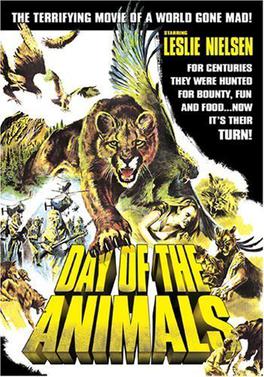
A Horror Insomnia File #29: Day of the Animals (dir by William Girdler)


What’s an Insomnia File? You know how some times you just can’t get any sleep and, at about three in the morning, you’ll find yourself watching whatever you can find on cable? This feature is all about those insomnia-inspired discoveries!

Last night, if you were having trouble sleeping around 2:30 in the morning, you could have turned on your television, changed the station to Movies TV, and watched the 1977 nature-goes-crazy horror film, Day of the Animals!

Now, I should admit that I was not suffering from insomnia last night.  Jeff and I are currently up at beautiful Lake Texoma and we just happened to be up late last night and flipping through the stations.  I should also admit that, unlike most of the other movies reviewed for this feature, Day of the Animals was not one of “those insomnia-inspired discoveries.”

No, we had both seen Day of the Animals before.  The thing with Day of the Animals is that it’s one of those films that, if you see that it’s on TV, you simply have to stop what you’re doing and watch it.  Considering that the man had a long career in the movies and I haven’t seen every film that he made, I could be wrong on this but I am fairly certain that Day of the Animals is your only opportunity to see Leslie Nielsen wrestle a grizzly bear.

Leslie Nielsen plays Paul, a businessman who is part of a group of hikers.  Shortly before he wrestles with the bear, Paul stands, bare-chested, in the middle of a rainstorm and attempts to taunt God.  “Melville’s God, that’s the God I believe in!” Paul shouts, “You want something!?  YOU TAKE IT!”  Then he turns to one of the hikers and says, “I know what I want and I’m taking it!  I killed a man for you!”

Now, at this point, I should probably make it clear that Day of the Animals is not a comedy, though it’s always inspired a lot of laughter whenever I’ve watched it.  Day of the Animals attempts to be a very serious horror movie.  It even has an environmental message.  Because of the hole in the ozone layer, solar radiation is driving all of the mountain animals crazy.  Mountain lions attack campers.  A grizzly bear wrestles Leslie Nielsen.  A group of rats attempt to kill a policeman.  German shepherds tear a man apart.  And it’s not just the wild animals that are being affected.  Leslie Nielsen goes crazy too.

Of course, Leslie Nielsen isn’t the only hiker.  Genre vet Christopher George plays the leader of the tour and Lynda Day George is along for the ride as well.  If you’ve seen the movie Pieces, you’ll remember Christopher George as the tough cop and Lynda Day George as the tennis pro who, at one point, dramatically screams “BASTARD!” into the wind.  Susan Backlinie, who was the first victim in Jaws, also has a role in this film and that seems appropriate.  Director William Girdler found quite a bit of success in ripping off Jaws.  Before Day of the Animals, he directed Grizzly.

But good ole Leslie Nielsen is pretty much the entire show here.  He tries really, really hard to give an intense and frightening performance.  In fact, he tries so hard that you almost feel guilty for laughing at times.  But then you see that head of perfect silver hair and you hear that deadpan voice saying, “Come here, you little punk!” and you just can’t help yourself.

Anyway, Day of the Animals may be bad but I defy anyone not to watch it.

Previous Insomnia Files:

  1. Story of Mankind
  2. Stag
  3. Love Is A Gun
  4. Nina Takes A Lover
  5. Black Ice
  6. Frogs For Snakes
  7. Fair Game
  8. From The Hip
  9. Born Killers
  10. Eye For An Eye
  11. Summer Catch
  12. Beyond the Law
  13. Spring Broke
  14. Promise
  15. George Wallace
  16. Kill The Messenger
  17. The Suburbans
  18. Only The Strong
  19. Great Expectations
  20. Casual Sex?
  21. Truth
  22. Insomina
  23. Death Do Us Part
  24. A Star is Born
  25. The Winning Season
  26. Rabbit Run
  27. Remember My Name
  28. The Arrangement

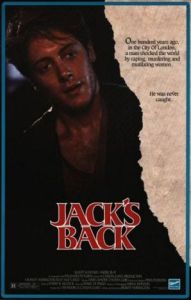
A Movie A Day #282: Jack’s Back (1988, directed by Rowdy Herrington)


When med student Rick Westford (James Spader) is found hung at the free clinic where he worked, the police say that he committed suicide.  Rick’s estranged twin brother, John (James Spader), does not agree and launches an investigation of his own.  With the help of Rick’s co-worker, Chris (Cynthia Gibb), John discovers that Rick may have learned the identity of a serial killer who has been copying the crimes of Jack the Ripper and murdering prostitutes in Los Angeles.  However, the killer knows that John is getting close to discovering his identity so the killer sets out to frame John not only for the prostitute murders but for the murder of his brother as well.
Jack’s Back is a movie that deserves to be better known than it is.  James Spader gives two great performances, as both Rick and John.  He and Cynthia Gibb make a good team and Jack’s Back actually does some unexpected things with their relationship.  Jack’s Back was directed by Rowdy Herrington, who is best known for Roadhouse and Gladiator.  Jack’s Back is part murder mystery, part action thriller, and part horror movie and Herrington does a good job of switching back and forth through Jack’s Back constantly shifting tone.  Because this is a low-budget movie with a small cast, there really are not enough suspects to make the murderer’s identity a surprise but Spader, Herrington, and Gibb always keep things interesting.

This is a film that really does deserve to be better known.

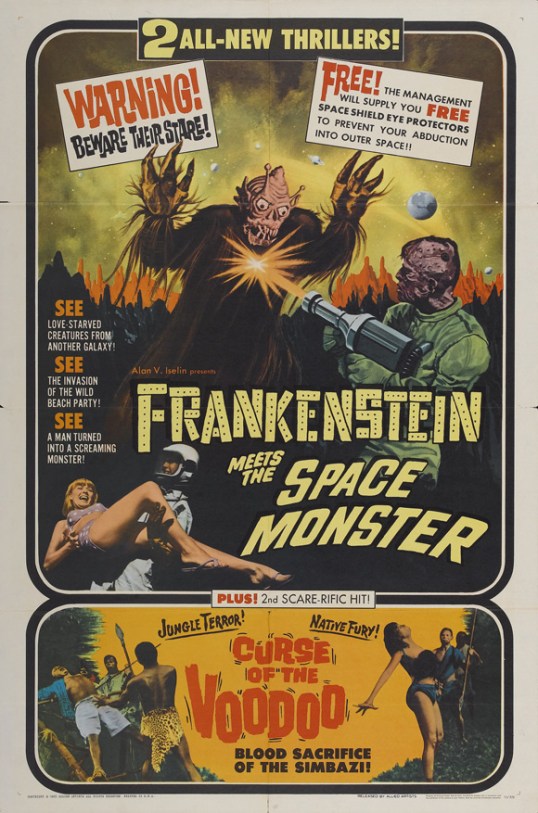
Horror on the Lens: Frankenstein Meets The Space Monster (dir


For today’s selection of horror on the lens, we offer up the odd 1965 horror/sci-fi/beach movie hybrid, Frankenstein Meets The Space Monster.  Despite the movie’s title, it’s not about Frankenstein.  Instead, it’s about an astronaut named Frank who is actually an android.  When his latest mission into space goes wrong, Frank ends up crashing in Puerto Rico.  Now malfunctioning, Frank causes some major chaos.  Can his creator, Dr. Adam Steele (played by character actor James Karen, who years later would appear in Return of the Living Dead), track Frank down and put an end to his reign of terror?

And what about the Martians?  Android Frank isn’t the only threat in Puerto Rico.  A group of Martians have landed and are determined to kidnap any girl wearing a bikini so that they can use them to repopulate their race.  We’re told that every woman on Mars — with the apparent exception of Princess Marcuzan, played with evil haughtiness by Marilyn Hanold — has been killed as the result of an atomic war.  Assisting Princess Marcuzan is Dr. Nadir (Lou Cutell), a short, bald Martian with pointy ears.

One of the oddest things about Frankenstein Meets The Space Monster is that, despite being a standard — if wonderfully nonsensical — low-budget B-movie, it features a great soundtrack!

Enjoy!

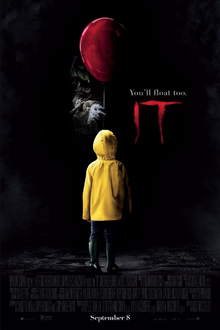
Horror Film Review: It (dir by Andy Muschietti)


Here’s something that Leonard Wilson and I have often pondered here at the TSL offices:

Why is it sometimes easier to write about a film that you hate than a film that you love?

Seriously, whenever I watch a film that I hate, the review is practically written in my head before the end credits have even finished.  Take Wolves At The Door, for instance.  It took me 15 minutes to write that review, largely because I hated the movie and I knew exactly why.  Perhaps it’s because the films that we hate are usually films that have absolutely nothing going on beneath the surface.  It’s a lot easier to write a review when you don’t have to consider things like nuance or subtext.

But, whenever I see a film that I absolutely love, it always takes me longer to write the review.  It’s intimidating to try to explain why you loved a film.  After all, if you loved it then you want everyone else to love it too.  And you want to be able to explain yourself with something more than just: “This was a really good movie.”

Take It, for instance.  It opened last month.  I saw it on opening weekend.  I thought it was a great movie, one that worked in almost every way possible.  I thought it was well-acted.  I thought Andy Muschietti did an excellent job directing it.  I thought that the film’s screenwriters did a wonderful job adapting a challenging novel.  When It was scary, it made me scream.  When It was funny, it made me laugh.  Most importantly, when It was dramatic, it brought tears to my eyes.  It was not just a brilliant horror movie but it was a brilliant movie period, one of the best of the year so far.

And yet, it’s taken me a month to write the 300 words that you just read.  Fortunately, back in September, Ryan C. posted a review of his own.

I assume that most of our readers have already seen It or, at the very least, they’re familiar with what the film is generally about.  It’s based on the famous novel by Stephen King, a work that many feel is King’s best.  It follows a group of 12 year-old outcasts, the so-called Losers Club, as they spend the summer of 1989 trying to avoid both local bullies and Pennywise the Dancing Clown (played by Bill Skarsgard), the cannibalistic demon who lives in the sewers and who awakens every 27 years so that it can feed.  Pennywise has already killed George, the younger brother of Bill Denborough (Jaeden Leiberher), the unofficial leader of the Losers Club.

Now, don’t get me wrong.  Pennywise is terrifying.  If horror films actually get Oscar nominations, Bill Skarsgard would, at the very least, be in the running for best supporting actor.  But what’s interesting is that Pennywise is not necessarily the scariest thing about the film.  As both outcasts and children, the members of the Losers Club are in the unique position to be able to understand that, despite its placid surface, Derry would be a scary place even without a killer clown.  Much like the town of Twin Peaks, there is much going on underneath the surface.

Overweight Ben Hanscom (Jeremy Ray Taylor) is attacked by bully Henry Bowers (a terrifying Nicholas Hamilton), who proceeds to try to carve his name into Ben’s stomach.

Hypochondriac Eddie Kaspbrak (Jack Dylan Glazer) is literally held prisoner by his domineering mother.

African-American Mike Hanlon (Chosen Jacobs) and Jewish Stan Uris (Wyatt Oleff) spend their days being targeted over their skin color and religion.

Beverly Marsh (Sophia Lillis) lives in poverty with her sexually abusive father.

Ever since the disappearance of George, Bill Denborough has watched his family fall apart.

Richie Tozier (Finn Wolfhard) tells jokes because making people laugh is the only way he can convince them not to beat him up.

Even the fearsome Henry Bowers lives with an abusive father who has obviously passed down his twisted worldview to his son.

And yet, despite all of that, It is not a relentlessly grim movie.  In some ways, it’s one of the most hopeful horror films that I’ve ever seen.  This may be a horror film but it’s also a celebration of friendship.  The members of the Losers Club may be outcasts but at least they have each other.  It may be a horror film but it’s also a coming-of-age story, an adventure of growing up that the members of the Losers Club will never forget.  (Except, of course, they will…but not until the sequel…)  All of the child actors are natural and believable in their roles.  Since he gets the funniest lines, Finn Wolfhard is an obvious audience favorite but really, the entire ensemble does a good job.

Between Get Out at the start of the year and It in September, this has been a very good year for horror.  It is one of the best films of 2017 so see it.

Horror Film Review: It (dir by Tommy Lee Wallace)


Last month, before I saw the latest film version of Stephen King’s It, I watched the 1990 miniseries version.

This was my first time to watch the It miniseries, though I had certainly heard about it.  Most of the reviews that I had read seemed to be mixed.  Everyone seemed to agree that Tim Curry was the perfect choice for the role of Pennywise the Dancing Clown.  However, many other reviewers complained that the program’s television origins kept It from being as effective as it could be.  “Not as scary as the book,” everyone seemed to agree.  The actors who played the members of the Loser Clubs as children all seemed to receive general acclaim but not everyone seemed to be as enamored with the adult cast.  And everyone, even those who liked the miniseries as a whole, complained about the show’s finale, in which Pennywise took the form of a giant spider.

Well, I have to agree about the giant spider.  That spider looked painfully fake, even by the standards of 1990s television.  Not only does the spider look too fake to truly be scary but, once that spider showed up, that meant that Tim Curry disappeared from the film.  Curry deserved every bit of acclaim that he received for playing the role of Pennywise.

All that said, the miniseries was still a lot better than I had been led to believe.

Certainly, it’s not as frightening as the book or the movie.  Considering that the It miniseries was produced for network television, that’s not surprising.  As opposed to the movie, the miniseries attempts to cover King’s entire novel.  That’s a lot of material, even when you have a five hour running time.  Obviously, a good deal of the story had to be cut and there are a few scenes in the miniseries that feel a bit rushed.  Characters like Audrey Denbrough and Stanley Uris, who were compelling in the novel, are reduced to being mere bystanders.  Some of the novel’s most horrific scenes — like Henry Bowers cutting Ben — are either excised or heavily toned down.  If the novel was as much about the hypocrisy of the adults of Derry as the paranormal horror of Pennywise, that theme is largely left out of the miniseries.

That said, It still had its share of memorable moments.  The image of a clown standing on the side of the road, holding balloons, and waving is going to be creepy, regardless of whether it’s found in a R-rated film or on ABC.  The death of little George Denbrough is horrific, regardless of whether you actually the bone sticking out of his wound or not.  Even the library scene, in which a grown-up Richie Tozier deals with a balloon filled with blood, was effectively surreal.

As for the actors who played the members of the Losers Club, the results were occasionally uneven.  The actors who played them as children were all believable and had a credible group chemistry.  You could imagine all of them actually being friends.  As for the adults, some of them I liked more than others.  Harry Anderson, Dennis Christopher, and Tim Reid gave the best performances out of the group.  John Ritter and Annette O’Toole were somewhere in the middle.  Richard Thomas was absolutely awful and I found myself snickering whenever he was filmed from behind and I saw his pony tail.  Richard Masur, unfortunately, wasn’t around long enough to make much of an impression one way or the other.

Ultimately, though, the miniseries (much like the book) suffers because the adults are never as interesting as Pennywise.  Tim Curry dominates the entire movie and, when he’s not onscreen, his absence is definitely felt.  Watching the miniseries made me appreciate why the film version kept Pennywise’s screen time to a minimum.  Pennywise is such a flamboyant and dominant character that, if not used sparingly, he can throw the entire production out of balance.

Despite its flaws, I liked the miniseries.  Yes, it’s uneven.  Yes, it’s toned down.  Yes, it works better in pieces than as a whole.  But, taken on its own terms, It was effective.  Director Tommy Lee Wallace creates a suitably ominous atmosphere and the child actors are all properly compelling.  And, finally, that damn clown is always going to freak me out.

Just for fun, here’s a trailer for It, recut as a family film: