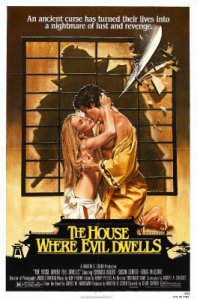
When writer Ted Fletcher (Edward Albert) moves his family into a house in Kyoto, Japan, he does not know that the house comes with a violent history. 140 years ago, the house was occupied by a samurai and his wife. When the samurai discovered that his wife had taken a lover, he killed both them and himself. The three spirits remain in the house, haunting Ted and his wife, Laura (Susan George). When a possessed Laura starts an affair with Ted’s best friend (Doug McClure), will history repeat itself?
When I was growing up, The House Where Evil Dwells used to frequently show up on television. When you are a kid, anything that combines ghosts, sex, and samurai swords is automatically the coolest thing that you have ever seen so I used to really like The House Where Evil Dwells. A few weeks ago, I rewatched it for the first time in years and I was shocked by how boring the movie actually is. There are a few well-composed scenes with the ghosts silently watching the Fletcher family and Susan George does the best she can do with what she is given but has there ever been any two actors as wooden as Edward Albert and Doug McClure? Any film about passion and anger is doomed to fail when it stars two actors who cannot show emotion. This is one haunted house movie that will make you want to hang out with the ghosts because the living are just too boring.
For today’s horror on the lens, we have the low-budget, 2006 indie zombie film, My Dead Girlfriend.
The Late Night Movie Gang and I watched this move on Saturday night and it amused the Hell out of us. It’s about a guy (played by director Brett Kelly) who somehow manages to roll over his girlfriend while backing out his car. She’s dead but, fortunately, there’s some black magic books lying around so, before you know it, she’s alive again!
Except, of course, she’s kind of undead and hungry now. Amy, the formerly dead girl, is played by Caitlin Delaney and she has a blast trying to eat everything that she comes across. Eventually, Kelly decides to take her up to a cabin so that he can figure out what to do next. Unfortunately, a lot of their friends decide to come hang out at the cabin at the same time…
Anyway, this is a fun movie. I always like watching movies like this. For what they may lack in budget, they often make up for it in passion.
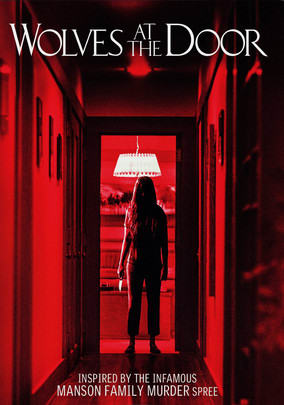
I’m really not sure what to make of Wolves at the Door.
I knew the film was inspired by the crimes of Charles Manson and his family before I watched the film. Not only was Wolves at the Door specifically advertised as being “Inspired by The Infamous Manson Family Murder Spree” but just check out the plot description that was provided by Warner Bros:
Four friends gather at an elegant home during the Summer of Love, 1969. Unbeknownst to them, deadly visitors are waiting outside. What begins as a simple farewell party turns to a night of primal terror as the intruders stalk and torment the four, who struggle for their lives against what appears to be a senseless attack.
The Manson Family have inspired a countless number of films, so that’s not really an issue. Almost all of those films either presented Manson and his followers as being the epitome of evil or they told stories that were heavily and obviously fictionalized.
Wolves at the Door, however, is different. Other than in some news footage that is shown during the end credits, Manson is not seen in the film. For that matter, the members of the Family don’t get much screen time either. Mostly, they’re just seen as shadows, creeping down hallways and sometimes materializing in a doorway before vanishing. There’s no mention of Helter Skelter or the Beatles. I’d have to rewatch the film to say for sure but I think it’s possible that we only hear them say one or two words over the course of the entire movie.
Instead, Wolves at the Door spends most of its running time with the victims of the Manson Family, following them as they are unknowingly stalked inside of a Los Angeles mansion. Usually, in a film like this, you would expect the names to be changed but, for some reason, that doesn’t happen in Wolves At The Door.
So, Katie Cassidy plays a pregnant actress who is named Sharon.
Elizabeth Henstridge plays a coffee heiress who is named Abigail.
Adam Campbell plays Abigail’s Polish boyfriend, who is named Wojciech.
Miles Fisher plays a hairdresser who is named Jay and who just happens to be Sharon’s ex-boyfriend.
And, finally, Lucas Adams plays a teenager stereo enthusiast named Steven, who just happens to be in the wrong place at the wrong time.
Speaking as someone who loves horror and who has defended some of the most critically derided films of all time, everything about Wolves at the Door just feels icky, tacky, and wrong. Many grindhouse horror films have been inspired by actual crimes but most of them at least changed the names of the victims. You really have to wonder just what exactly the filmmakers were thinking here.
(Then again, just two years ago, NBC greenlit a show called Aquarius, which could have just as easily been called “The Adventures of Young Charlie Manson.”)
It’s not just that Wolves at the Door is offensive. In fact some of the best movies of all time were specifically designed to be offensive. The problem with Wolves at the Door is that it’s also just a very shoddy film. (In fact, if the film had been well-made, it wouldn’t be quite as offensive.) Though the actors may be talented, they’re let down by a script that’s full of some of the clunkiest dialogue that I’ve ever heard. Though the soundtrack may feature some good songs, they’re still the same damn songs that show up in every movie set in 1969. (Judging from the movies, everyone in 1969 just listened to the same five songs over and over again.) Though the movie itself is only 73 minutes long, it is so abysmally paced that it feels much, much longer.
Sadly, this film was directed by John Leonetti, who did a pretty good job with Annabelle. Again, I’m not sure what exactly he or anyone else was thinking with Wolves at the Door, which I’m going to go ahead and declare to be the worst film of 2017. I know that the year isn’t over yet but I just can’t imagine anything as bad as this.
1980’s The Funhouse opens with an almost shot-for-shot recreation of the famous shower scene from Psycho, with Amy (Elizabeth Berridge) getting attacked in the shower by a masked, knife-wielding maniac.
The only difference is that there’s no shrieking violins, there’s no blood, and the knife is quickly revealed to be a fake. It turns out that the “killer” is actually Amy’s younger brother, Joey (Shawn Carson). Joey loves horror movies. In fact, he’s pretty much the perfect stand-in for The Funhouse‘s intended audience. Joey was just playing a rather mean-spirited prank but now, as a result, Amy snaps that she’s not going to take him to the carnival.
Of course, Amy isn’t supposed to be going to the carnival either. Her parents have strictly forbidden it. Everyone knows that traveling carnivals are dangerous and, at the last town the carnival visited, two teenagers disappeared! There’s no proof that the carnival has anything to do with those disappearances, of course. But still…
Amy does exactly what I would have done in her situation. She tells her parents that she’s going over to a friend’s house and then she goes to the carnival anyway! Accompanying her is her boyfriend Buzz (Cooper Huckabee), who is so cool that he has a name like Buzz. Also along for the ride: Amy’s best friend, Liz (Largo Woodruff), and her boyfriend, Richie (Miles Chapin). Richie’s kind of a loser but that’s to be expected. Every group needs at least one idiot who can do something stupid that gets everyone else killed. We all know how that works.
The carnival turns out to be just as sleazy as Amy’s parents thought it would be. There’s a fake psychic (Sylvia Miles). There’s a magician who dresses like Dracula. There’s a barker (Kevin Conway), whose deep voice is constantly heard in the background. And, of course, there’s a funhouse! Still, everyone’s having a good time. Either that or they’re all just stoned.
For his part, Joey sneaks out of the house and goes to the carnival himself. He doesn’t have quite as much fun as Amy. In fact, his experience is pretty scary. Weird carnival people keep yelling at him. He keeps getting lost. Still, things could be worse. By the time his parents arrive to pick Joey up, Amy and her friends are all trapped in the funhouse. They’re being pursued by the barker and his deformed son (Wayne Doba). Needless to say, it’s all pretty much Richie’s fault.
Richie. What a dumbass.
With its teenage victims and its lengthy chase scenes, The Funhouse is often dismissed as just being another early 80s slasher film. However, The Funhouse is actually a fairly clever, entertaining, and occasionally even witty horror film. Much like director Tobe Hooper’s best-known film, The Texas Chainsaw Massacre, The Funhouse gets its scares by convincing audiences that they’re actually seeing more than they are. Hooper emphasizes atmosphere and performances over gore. While The Funhouse has its share of jump scares, it mostly succeeds by convincing us that anyone could die at any moment. It’s an intense film, with excellent performances from both Elizabeth Berridge and Kevin Conway.
After kickstaring the slasher genre with The Texas Chainsaw Massacre, Hooper used The Funhouse to poke a little fun at it. From the opening shower scene to the electrifying finale, Hooper plays with the genre-savvy expectations of the audiences. Our four victims even do the smart thing for once — they try to all stay together. Needless to say, that doesn’t work out too well.
The Funhouse is an entertaining thrill ride and, seen today, it’s more evidence that Tobe Hooper deserved better than he got from the film industry.
Mikey (Brian Bonsall) is a little boy who kills people. Over the course of this movie, he kills eight people. He gets away with it because everyone that he meets is extremely stupid. When his teacher notices that Mikey is drawing pictures based on his previous murders, no one thinks anything of it. When she sees that Mikey is now pushing thumbtacks into his arm, no one is too concerned. When the principal goes looking for Mikey, he takes a gun which he then leaves unattended on the kitchen counter. When Mikey tells his teacher that he wants her to teach him “how to die,” everyone figures out that something’s wrong with Mikey but, by then, it’s too late.
For a few years, Mikey had a strong cult following because of the killer kid theme and a few scenes of Josie Bissett in a hot tub. But it really is a dumb movie and Brian Bonsall gave a lousy performance as Mikey. It takes a good deal of stupidity for an adult to get murdered by a ten-year old and this movie proves it.
It says a lot about the state of things that movies about the end of the world have recently become not just popular but also extremely plausible. It seems like every time I look at a list of upcoming films, I see predictions of fear, desperation, and apocalypse. Almost every end of the world scenario now seems to come with zombies. Perhaps people are taking that famous line from Dawn of the Dead to heart. When there is no more room in Hell, the dead will walk with Earth.
The British film The Girl With All The Gifts is one of the latest examples of the apocalyptic genre. It has everything that we’ve come to expect from films like this: flesh-craving zombies, blighted urban landscapes, soldiers trying to maintain order as the world collapses into chaos, sinister scientists, children faced with rebuilding the world, and that one lone idealist who doesn’t want to give up on the present. It’s a familiar story but The Girl With All The Gifts tells it well.
In this case, the end of the world has been brought about by a fungal infection. Those afflicted not only lose the ability to think but are also transformed into flesh-eating maniacs. Interestingly enough, the term zombie is never used in the film. Instead, the infected are called “the hungries.” I assume that’s because the infected aren’t actually the living dead. In fact, even after transforming them, the infection still eventually kills them.
(If you really want to freak yourself out while watching The Girl With All The Gifts, consider that the fungal infection is actual thing, though it only affects carpenter ants. For now…)
In an isolated army base, a group of children are kept in cells and guarded over by soldiers, like the gruff Sgt. Eddie Parks (Paddy Considine). They are experimented on by scientists, like Dr. Caldwell (Glenn Close). And they are taught by a kind-hearted teacher named Helen Justineau (Gemma Arterton). One of the most intelligent of the children is Melanie (Sennia Nanua), who often asks Helen to tell the class a story.
The children are often bound and required to wear masks. The adults are under strict orders not to touch or even get too close to the children. Why? Because the children are hungry too. Born after the end of the world, the children are unique in that they crave flesh but they also retain the ability to think and speak. The soldiers view them as freaks and potential enemies. Dr. Caldwell views them as test subjects. Only Helen views them as children.
You can probably already guess where this is going. When the hungries overrun the army base, only a small group of people manage to escape — Helen, Dr. Caldwell, Sgt. Parks, another solider, and Melanie. They eventually make it to London, which is now overgrown with vegetation. Some of the film’s most haunting and tense moments come as the group attempts to maneuver through a crowd of docile, unsimulated hungries. They know that making the wrong move or the least little sound will result in the hungries waking up and attacking.
It’s in London that a lot is revealed about both the nature of the disease and why Melanie is, as the title states, the girl with all the gifts.
For the most part, it’s all very well done. The film has such a strong opening and powerful ending that it’s easy to forgive the fact that the middle of the film occasionally drags. Director Colm McCarthy creates some haunting images of the post-apocalyptic world and, even if he does borrow a bit heavily from 28 Days Later, at least he’s borrowing from the best. He makes good use of his cast, too. Glenn Close is as perfectly sinister as Gemma Arterton is perfectly idealistic. Sennia Nanua is both sympathetic and a little bit frightening as the girl who might eat you as quickly as she might save you.
The Girl With All The Gifts is a good movie but it left me feeling incredibly depressed. Post-apocalyptic ruin no longer seems as safely far-fetched as it once did.
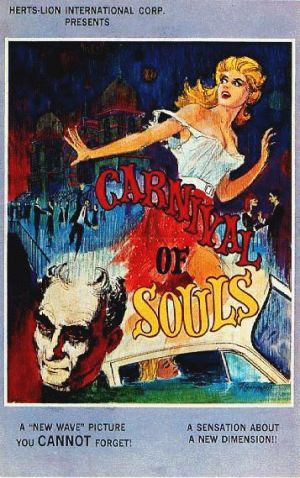
Directed in a dream-like fashion by Herk Harvey (who also directed several of the educational short films that I’ve occasionally shared on this site, including Cheating, The Show-Off, andThe Gossip), Carnival of Souls tells the story of Mary (Candace Hilligoss) who, after a car accident, finds herself haunted by visions of ghostly figures. Independently produced and distributed, Carnival of Souls did not get much attention when it was originally released but it is now generally acknowledged as a horror classic. Reportedly, David Lynch loves this movie and, when you watch it, you’ll be able to see why!
It’s October. It’s 16 more days ’til Halloween. It’s time to watch Carnival of Souls!
What’s an Insomnia File? You know how some times you just can’t get any sleep and, at about three in the morning, you’ll find yourself watching whatever you can find on cable? This feature is all about those insomnia-inspired discoveries!
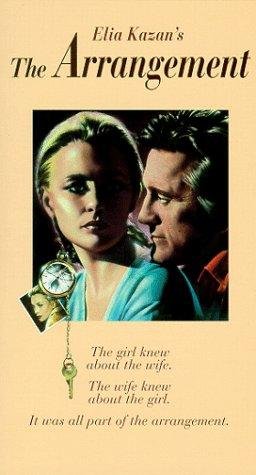
If, on Saturday you were having trouble sleeping at three in the morning, you could have turned on TCM and watched the 1969 film, The Arrangement.
The Arrangement is one of those films where a rich guy gets hit by a sudden case of ennui and, as a result, spends the entire movie acting like a jackass. However, as often happens in films like this, The Arrangement makes sure that we understand that it’s not the guy’s fault. Instead, it’s his wife’s fault for not being as much fun as his mistress.
In this case, the guy is an ad executive who goes by the name of Eddie Anderson (Kirk Douglas). His original name was Evangelos Arness but he changed his name when he was younger because he apparently didn’t want anyone to know that he came from a Greek family. When we first meet Eddie, he’s attempting to commit suicide by driving his car into an 18 wheeler. If he had died, the movie could have ended quickly. However, since Eddie survived, the audience is now required to spend two hours watching Eddie as he tries to figure out what it all means.
Eddie’s father (Richard Boone) is dying. His long-suffering wife (Deborah Kerr) just doesn’t understand that Eddie needs more than a big house and a nice pool to feel like a man. Eddie’s mistress is Gwen (Faye Dunaway), whose new baby may or may not be Eddie’s. Who could blame Eddie, the film demands to know, for being disillusioned with his comfortable life?
The Arrangement was one of the last films to be directed by Elia Kazan, who was a big deal in the 40s and the 50s and whose goal with The Arrangement was apparently to prove that he should still have been a big deal in the 60s and 70s. Kazan’s way of doing this is to fill The Arrangement with all types of tricks that were designed to make young filmgoers say, “Man, that Eliza Kazan may be old but he’s one of us!”
Freeze frames? Kazan’s got them! Flashback after flashback? Kazan spreads them all throughout the movie, even when they don’t really have anything to show us. Scenes where the action is sped up for no identifiable reason? Just watch Kirk Douglas trot down that hallway! Rack focus shots? Zoom shots? A scene where the young Kirk Douglas argues with the old Kirk Douglas? Casual nudity that’s still filmed in such a way that it feels oddly reticent, as if the filmmaker was just including it to try to establish his rebel credentials? The Arrangement has it all!
It also has a lot of close-ups of Kirk Douglas. In far too many scenes, he’s just sitting around with this blank look on his face and it doesn’t quite work because, as an actor, Douglas has never exactly come across as the type to get trapped in an existential crisis. We’re supposed to view Kirk as being depressed and conflicted but, in all of his films, Kirk has always come across as someone who hasn’t known a day of insecurity in his entire life.
There are also a few scenes of Kirk just laughing and laughing. For some reason, movies in the late 60s and early 70s always seemed to feature at least a handful of closeups of people laughing uncontrollably. I’m not sure why. (If you want to see the most extreme example of this, check out Getting Straight.) These scenes are always kind of annoying because there’s only so much time you can spend watching someone laugh at the absurdity of it all before you want them to just close their damn mouth. Especially when the person in question is a middle-aged man. I mean, shouldn’t have Kirk figured out that the world is absurd before his 50th birthday?
Anyway, The Arrangement is a pretentious mess. Of course, most films from the 60s are pretentious. The problem with The Arrangement is that it’s also boring. If you’re going to be pretentious, at least have some fun with it, like The Graduate did. The Arrangement goes on forever and it’s never quite as profound as it seems to think that it is. I once read a short story that a former friend of mine wrote. She explained that writing the story had caused her to realize that, the longer you know someone, the more likely your initial impression of that person is going to change. “You had to write an entire short story to figure that out?” I replied. (That’s one reason why she’s a former friend.) But that’s kind of how The Arrangement is. For all the drama and the technique and the pretension, it has nothing to teach us that we shouldn’t already know.
Josh Baker (Eric Roberts) is an extroverted artist for Marvel Comics who meets Cheryl (Janine Turner) while walking around New York City. Josh and Cheryl hit it off but when Cheryl suddenly collapses, she is picked up by a mysterious ambulance. When Josh goes to the hospital to check on her, he is told that Cheryl was never brought in. Soon, Josh discovers that people all over New York have been put into back of the ambulance and have never been seen again. Unfortunately, nobody believes Josh. Not the veteran NYPD detective (James Earl Jones) who Josh approaches with his suspicions. Not the staff of the hospital. Not even Stan Lee! The only people willing to support Josh are an elderly investigative reporter (Red Buttons) and an inexperienced detective (Megan Gallagher).
Yes, Stan Lee does play himself. While he had made a few cameo appearances on television and had previously narrated a French film, The Ambulance was Stan Lee’s first real film role. Josh works at an idealized version of Marvel Comics, where the artists are well-paid, no one is pressured into producing substandard work, and Lee is an avuncular father figure. It is the Marvel Comics that I used to imagine working at when I was growing up, before I found out about what actually happened to artists like Jack Kirby, Joe Simon, and Steve Ditko.
Idealized though it may be, the Marvel connection is appropriate because The Ambulance is essentially a comic book adventure. It does not matter how many times Josh gets hit by a car or falls out of a window, he always recovers in time for the next scene. When Josh does discover who is behind the ambulance, it turns out to be a villain who would not be out-of-place in a Ditko-era Spider-Man story.
The Ambulance is another one of Larry Cohen’s New York horror stories. Like most of Cohen’s films, it is pulpy, cheap, and entertaining. Eric Roberts is as crazy as ever and the movie is full of good character actors like James Earl Jones, Red Buttons, Richard Bright, and Eric Braeden. The Ambulance may be dumb but it is always entertaining.
 When writer Ted Fletcher (Edward Albert) moves his family into a house in Kyoto, Japan, he does not know that the house comes with a violent history. 140 years ago, the house was occupied by a samurai and his wife. When the samurai discovered that his wife had taken a lover, he killed both them and himself. The three spirits remain in the house, haunting Ted and his wife, Laura (Susan George). When a possessed Laura starts an affair with Ted’s best friend (Doug McClure), will history repeat itself?

 Dumb. Just dumb.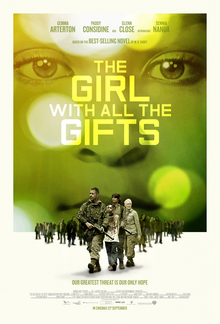
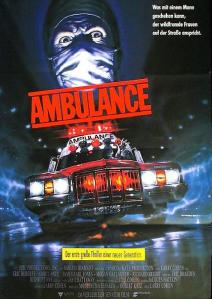 Josh Baker (Eric Roberts) is an extroverted artist for Marvel Comics who meets Cheryl (Janine Turner) while walking around New York City. Josh and Cheryl hit it off but when Cheryl suddenly collapses, she is picked up by a mysterious ambulance. When Josh goes to the hospital to check on her, he is told that Cheryl was never brought in. Soon, Josh discovers that people all over New York have been put into back of the ambulance and have never been seen again. Unfortunately, nobody believes Josh. Not the veteran NYPD detective (James Earl Jones) who Josh approaches with his suspicions. Not the staff of the hospital. Not even Stan Lee! The only people willing to support Josh are an elderly investigative reporter (Red Buttons) and an inexperienced detective (Megan Gallagher).
 Through the Shattered Lens