Okay, I’ll be the first to admit that 1966’s Gammera The Invincible is not really a horror film. Maybe there was a time when people found the idea of a giant, fire-breathing turtle to be scary but I kind of doubt it.
But let’s think about this! What better time is there to watch a movie about giant, fire-breathing turtle than in October?
Seriously, this is a fun movie and if you’ve got some time to kill this morning, I guarantee this movie will make you smile.
Did Umberto Lenzi direct the 1989 film, Nightmare Beach?
That’s a question that Italian horror fans have been debating for a while now. The film’s credited director is Harry Kirkpatrick. Due to the fact that Kirkpatrick has no other known credits, it’s generally agreed that Kirkpatrick was a pseudonym. But was it a pseudonym for Lenzi, screenwriter James Justice, or both of them? In an interview for the book Spaghetti Nightmares, Lenzi said that he was originally hired to direct but, at the last minute, he changed his mind because he felt the film was too similar to his 1972 giallo, Seven Blood-Stained Orchids. Lenzi says that he withdrew from directing but that he remained on set to provide technical assistance to the film’s actual director, “Harry Kirkpatrick,” who Lenzi also says co-wrote the script. That may sound simple enough but skeptics point out that worrying about repeating himself didn’t dissuade Lenzi from following up Eaten Alive with Cannibal Ferox. (Add to that, would Lenzi really have been concerned about duplicating a film that he made 17 years previously?) As well, James Justice only has two credits listed on the imdb, one for writing this film and one for 2006’s Lesser Evil.
(For the record, I did a google search on James Justice and I didn’t find much. However, I did comes across several Scientology sites that featured testimonials from “James Justice, screenwriter.”)
As for what the film’s about, it’s a strange combination of genres. It starts out with a prisoner named Diablo (Tony Bolano) being sent to Florida’s electric chair. Diablo was the leader of an infamous motorcycle gang. He was convicted of murdering a teenage girl but, as he dies, Diablo yells that he’s been framed and that he was innocent.
However, no need to worry too much about Diablo! No sooner has Diablo been sent to the chair then suddenly, Nightmare Beach turns into a spring break comedy! Teenagers and college students are flooding the beaches of Florida and all they want to do is have a good time! The local fire-and-brimstone preacher (Lance Le Gault) can’t stop the party, no matter how many times he says that everyone’s going to Hell. The police chief (John Saxon) puts extra patrols on the beach. The local doctor (Michael Parks) prepares to treat a hundred cases of alcohol poisoning.
The beach turns into a huge party! Bands play. T-shirts get wet. For some reason, one dorky frat boy does the whole pretending to be dead while floating in the pool routine. A young woman tries to stay in a hotel for free without getting caught. Meanwhile, two college football players, Skip (Nicolas de Toth) and Ronny (Rawley Valverde) roll into town. Skip is depressed because he lost the big game but Ronny is determined that his best friend is going to have a good time and get laid! Whenever Skip gets depressed, Ronny pelts him with condoms.
It’s Spring Break! Everyone’s going to have a good time…
Except, suddenly, a mysterious figure on a motorcycle rolls into town. He never speaks. He never takes off his helmet. However, he does electrocute everyone that he meets. Sometimes, he uses live wires and sometimes, he just has them sit on the back of his motorcycle, which has been designed to act as an electric chair. Could it be the ghost of Diablo, seeking vengeance? When Ronny disappears — NO! NOT COMEDY RELIEF RONNY — Skip is determined to find out what’s going on. Working with him is Gail (Sara Buxton), the sister of the girl that Diablo was convicted of murdering…
One reason why so many Italian horror aficionados are convinced that Umberto Lenzi must have directed Nightmare Beach is because, with its odd mix of genres and its weird combination of comedy and extreme gore, it just feels like an Umberto Lenzi film. Add to that, around the same time that Nightmare Beach was filmed and released, Lenzi also filmed and released another film about teenagers being murdered during spring break, Hitcher In The Dark.
Because it’s such a strange mix of genres, Nightmare Beach is a much more interesting film than Hitcher In The Dark. The motorcycle-driving killer is somehow both ludicrous and frightening at the same time. Plus, how can you resist a movie with both John Saxon and Michael Parks as ineffectual authority figures? It just can’t be done.
Yesterday, Italian horror fans were saddened to hear of the passing of director Umberto Lenzi.
Over the course of his long career, Lenzi worked in almost every possible genre of Italian film. He directed spy films. He directed westerns. He did a few comedies. He directed two movies about Robin Hood. In the wake of the international success of The French Connection, he was one of the leading directors of Italian crime films. Among fans of Italian horror, he is best known for his cannibal films and his work in the giallo genre. He even directed the first fast-zombie film, Nightmare City, a film that very well may have served as an inspiration for 28 Days Later. According the imdb, Lenzi is credited with directing 65 films. Some of them were good. Many of them, if we’re to be honest, were rather forgettable.
But none were as strange as 1974’s Spasmo.
Attempting to detail the plot of Spasmo is a challenge. Even by the twisty standards of the giallo genre, the mystery at the heart of Spasmo is a complicated one. According to Troy Howarth’s So Deadly, So Perverse Volume Two, even Lenzi admitted that Spasmo‘s storyline made no sense. Add to that, Spasmo features so many twists and turns that it’s difficult to judge just how much of the movie’s plot you can safely describe before you start spoiling the film.
Spasmo tells the story of a man named Christian (Robert Hoffman). While Christian is out walking on the beach with his girlfriend, they come across a woman lying face down in the surf. The woman is named Barbara (Suzy Kendall) and, though she declines to explain why she was lying in the middle of the beach, Christian still becomes obsessed with her. Barbara runs off but then he just happens to run into her at a party that’s being held on a boat. Christian may be with his girlfriend and Barbara may be with her boyfriend but they end up leaving together. Barbara says she will make love to Christian but only if he shaves his beard.
Meanwhile, lingerie-clad mannequins are being found on the beach.
Christian ends up getting attacked by a man named Tatum. Christian shoots Tatum but then the body disappears. Christian and Barbara hide out at a lighthouse. There’s another couple at the lighthouse and where they came from is never quite clear. They say that a dead body has recently been discovered but, when Christian demands to know what they mean, they say that they’re just joking. Later, Christian thinks that he sees Tatum walking around but, just as suddenly, Tatum’s gone.
Christian is convinced that his brother, Fritz (Ivan Rassimov) can help him. Barbara says that there is no hope. We know better than to trust Fritz because he’s played by Ivan Rassimov. Possessing the best hair in Italian horror, Ivan Rassimov almost always played the heel…
Meanwhile, mannequins continue to be found on the beach.
That may sound like I’ve described a lot of plot but I’ve actually only begun to scratch the surface. Even by the standards of Italian thrillers, Spasmo is chaotic. The film may not make any sense but it’s never boring. Between the mannequins and the murders, it’s pretty much impossible to follow the plot but who cares? As directed by Lenzi, Spasmo plays out like a dream, full of surreal images and memorably weird performances. Robert Hoffman and Suzy Kendall are ideally cast while Ivan Rassimov is wonderfully slick and enigmatic as Fritz. Spasmo is a film that keeps you guessing. Whether it keeps you guessing because the plot is clever or because the plot itself is deliberately designed (and filmed) to make no sense is something that viewers will have to determine for themselves. Personally, I think it’s a little of both.
Lenzi may not have cared much for Spasmo but it’s one of his most memorable films.
Kim Basinger is Maggie, a nurse who has adopted her autistic niece, Cody. Her sister, Jenna (Angela Bettis), used to be a junkie but now she has cleaned up her act and married a former-child star-turned-cult leader, Eric Stark (Rufus Sewell). Because Jenna’s daughter has supernatural powers and Eric is a Satanist, they want the little girl back. Christina Ricci is Cheri, a junkie goth who used to be a member of the cult and who tries to warn Maggie before getting her head chopped off. Jimmy Smits is John Travis, the FBI agent who helps Maggie out when Jenna and Eric kidnap Cody. Mostly, though, he’s just Jimmy Smits, a TV actor who looks out of place whenever he appears in a movie.
Bless the Child was one of two movies that Kim Basinger made after winning an Oscar for L.A. Confidential. She also made I Dreamed Of Africa, which probably did the most damage to her career but the box office and critical failure of Bless The Child probably did not help either. Bless The Child was an overlong rip-off of The Omen films. The only suspense is whether Cody is the antichrist or the reborn messiah. Basinger and Jimmy Smits both look lost amid all the theological chaos raging around them. Even Christina Ricci is wasted in a role that could have been played by anyone willing to dye her hair black.
One final note: Rufus Sewell is not terrible in Bless The Child, even if the majority of his lines sound more appropriate for Darth Vader than a former child actor. (He even tells Maggie to feel the hate growing inside of her, like Vader trying to draw Luke over to the dark side.) Sewell is still a busy actor but it seems like he has never really gotten his due in Hollywood. Most of the good Rufus Sewell roles now seem to go to Jude Law.
Today’s horror scene that I love comes from Jean Rollin’s surrealistic 1979 masterpiece, Fascination.
Below, you’ll fin the opening 6 minutes of Fascination, which contains some of the best examples of Rollin’s dream-like imagery. The dance on the bridge remains one of his most haunting images.
Michael Bower (Edward Furlong) is a 15 year-old loser who walks with a limp and still has nightmares about the night his mother was killed in a car wreck. Brainscan is the new PC game that Michael makes the mistake of playing. In the game, Michael is encouraged by The Trickster (T. Ryder Smith) to kill both his friends and complete strangers. When Michael starts finding body parts around his house, he realizes that whenever he kills someone in the game, he kills them in real life too.
Though it may be forgotten now, Brainscan was heavily promoted when it was first released. I think the producers were hoping to turn The Trickster into the new Freddy and get a new horror franchise out of it. Like most films from the 90s that dealt with computers and gamers, Brainscan is now as dated as dial-up internet. T. Ryder Smith does ok as the Trickster but it is difficult to take him seriously because he has a big red mohawk skullet and he dresses like the keyboard player in every new wave band that has ever synthesized. As for Furlong, he had apparently already entered the I-no-longer-give-a-shit phase of his career when he made Brainscan. Add to that one of the worst endings that I have ever seen in a horror movie and Brainscan is one film that is easy to forget.
It is easy to say what Brainscan is lacking: suspense, gore, and horror. It is less easy to say what would have made it better. Considering its suburban setting, I think Brainscan would have been improved by cameos from the stars of Shattered If Your Kid’s On Drugs.
With Burt Reynolds and Judd Nelson around to serve as mentors, Eddie Furlong never would have gotten addicted to playing video games in the first place.
For today’s horror on the lens, we have 1973’s The Night Strangler.
This is the sequel to The Night Stalker and it features journalist Carl Kolchak (Darren McGavin) in Seattle. (After all the stuff that happened during the previous movie, Kolchak was kicked out of Las Vegas.) When Kolchak investigates yet another series of murders, he discovers that paranormal murders don’t just occur in Las Vegas and aren’t just committed by vampires.
I actually prefer this movie to The Night Stalker. The Night Strangler features a truly creepy villain, as well as a trip down to an “underground city.” It’s full of ominous atmosphere and, as always, Darren McGavin is a lot of fun to watch in the role in Kolchak.
What’s an Insomnia File? You know how some times you just can’t get any sleep and, at about three in the morning, you’ll find yourself watching whatever you can find on cable? This feature is all about those insomnia-inspired discoveries!
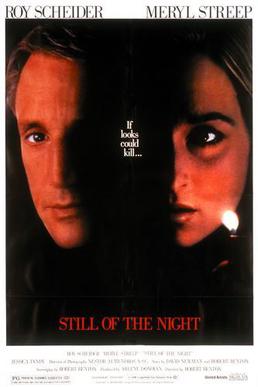
If last night, at 1:30 in the morning, you were having trouble getting to sleep, you could have turned on the TV, changed the channel to your local This TV station, and watched 1982’s Still Of The Night.
Still of the Night actually tells two stories. The first story deals with Dr. Sam Rice (Roy Scheider), a psychiatrist who is living a perfectly nice, mild-mannered, upper class existence in Manhattan. His patients are rich and powerful and his sessions with them provide him with a view of the secrets of high society.
One of Sam’s main patients is George Bynum (Josef Sommer), who owns an auction house and who is a compulsive cheater. George tells Sam that he’s haunted by strange nightmares and that he is also worried about a friend of his. George says that this friend has murdered in the past and George fears that it’s going to happen again. When George is murdered, Sam wonders if the murder was committed by that friend. He also wonders if that friend could possibly have been one of George’s mistresses, the icy Brooke Reynolds (Meryl Streep).
The second story that Still of the Night tells is about our endless fascination with the films of Alfred Hitchcock. Still of the Night is such an obvious homage to Hitchcock that it actually starts to get a little bit silly at times. Almost every scene in the film feels like it was lifted from a previous Hitchcock film. At one point, there’s even a bird attack! (Add to that, Scheider’s mother is played by Jessica Tandy, who previously played Rod Taylor’s mother in The Birds.) Meryl Streep is specifically costumed and made up to remind viewers of previous Hitchcock heroines, like Grace Kelly, Kim Novak, Eva Marie Saint, and Tippi Hedren.
Unfortunately, considering the talent involved, Still of the Night never really works as well as it should. Both Scheider and Streep seem to be miscast in the lead roles. If Still of the Night had been made in the 50s, one could easily imagine James Stewart and Grace Kelly playing Sam and Brooke and managing to make it all work through screen presence along. However, Scheider and Streep both act up a storm in the lead roles, attacking their parts with the type of Actor Studios-gusto that seems totally out-of-place in an homage to Hitchcock. Scheider is too aggressive an actor to play such a mild character. As for Streep, she’s miscast as a noir-style femme fatale. Streep’s acting technique is always too obviously calculated for her to be believable as an enigma.
That said, there were still some effective moments in Still of the Night. The majority of the dream sequences were surprisingly well-done and effectively visualized. I actually gasped with shock while watching one of the dreams, that’s how much I was drawn into those scenes.
According to Wikipedia, Meryl Streep has described Still of the Night as being her worst film. I think she’s being way too hard on the movie. It’s nothing special but it is an adequate way to kill some time. Certainly, I’d rather watch Still of the Night than sit through Florence Foster Jenkins.
Look at it carefully. Examine it. Try to ignore the fact that it’s weird that George Segal was once a film star. Yes, on the poster, Segal has been drawn to have a somewhat strange look on his face. Ignore that. Instead, concentrate on the words in the top left corner of the poster.
“ADULT ENTERTAINMENT!” it reads.
That’s actually quite an accurate description. The Terminal Man is definitely a film for adults. No, it’s not pornographic or anything like that. Instead, it’s a movie about “grown up” concerns. It’s a mature film. In some ways, that’s a good thing. In some ways, that’s a bad thing.
Taking place in the near future (and based on a novel by Michael Crichton), The Terminal Man tells the story of Harry Benson (played, of course, by George Segal). Harry is an extremely intelligent computer programmer and he’s losing his mind. It might be because he was in a serious car accident. It may have even started before that. Harry has black outs and when he wakes up, he discovers that he’s done violent things. Even when he’s not blacked out, Harry worries that computers are going to rise up against humans and take over the world.
However, a group of scientists think that they have a way to “fix” Harry. It’ll require a lot of brain surgery, of course. (And, this being a film from 1973, the film goes into excruciating details as it explains what’s going to be done to Harry.) The plan is to implant an electrode in Harry’s brain. Whenever Harry starts to have a seizure, the electrode will shock him out of it. The theory is that, much like Alex in A Clockwork Orange 0r Gerard Malanga in Vinyl, Harry will be rendered incapable of violence.
Of course, some people are more enthusiastic about this plan than others. Harry’s psychiatrist (Joan Hackett) fears that implanting an electrode in Harry’s brain will just make him even more paranoid about the rise of the computers. Other scientists worry about the ethics of using technology to modify someone’s behavior. Whatever happens, will it be worth the price of Harry’s free will?
But, regardless of the risks, Harry goes through with the operation.
Does it work? Well, if it worked, it would be a pretty boring movie so, of course, it doesn’t work. (Allowing Harry’s operation to work would have been like allowing King Kong to enjoy his trip to New York.) Harry’s brain becomes addicted to the electrical shocks and, as he starts to have more and more seizures, Harry becomes even more dangerous than he was before…
The Terminal Man is a thought-provoking but rather somber film. On the one hand, it’s a rather slow movie. The movie does eventually get exciting after Harry comes out of surgery but it literally takes forever to get there. The movie seems to be really determined to convince the audience that the story it’s telling is scientifically plausible. On the other hand, The Terminal Man does deal with very real and very important issues. Considering how threatened society is by people who cannot be controlled, issues of behavior modification and free thought will always be relevant.
Though the film may be slow, I actually really liked The Terminal Man. Judging from some of the other reviews that I’ve read, I may be alone in that. It appears to be a seriously underrated film. As directed by Mike Hodges, the film is visually stunning, emphasizing the sterility of the white-walled hospital, the gray blandness of the doctors, and the colorful vibrancy of life outside of science. Though he initially seems miscast, George Segal gives a good and menacing performance as Harry.
The Terminal Man requires some patience but it’s worth it.


 Kim Basinger is Maggie, a nurse who has adopted her autistic niece, Cody. Her sister, Jenna (Angela Bettis), used to be a junkie but now she has cleaned up her act and married a former-child star-turned-cult leader, Eric Stark (Rufus Sewell). Because Jenna’s daughter has supernatural powers and Eric is a Satanist, they want the little girl back. Christina Ricci is Cheri, a junkie goth who used to be a member of the cult and who tries to warn Maggie before getting her head chopped off. Jimmy Smits is John Travis, the FBI agent who helps Maggie out when Jenna and Eric kidnap Cody. Mostly, though, he’s just Jimmy Smits, a TV actor who looks out of place whenever he appears in a movie.
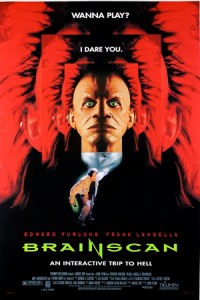 Michael Bower (Edward Furlong) is a 15 year-old loser who walks with a limp and still has nightmares about the night his mother was killed in a car wreck. Brainscan is the new PC game that Michael makes the mistake of playing. In the game, Michael is encouraged by The Trickster (T. Ryder Smith) to kill both his friends and complete strangers. When Michael starts finding body parts around his house, he realizes that whenever he kills someone in the game, he kills them in real life too.


 Through the Shattered Lens