“The value of Pork Chop is that it’s worth nothing.” — Lieutenant Joe Clemons
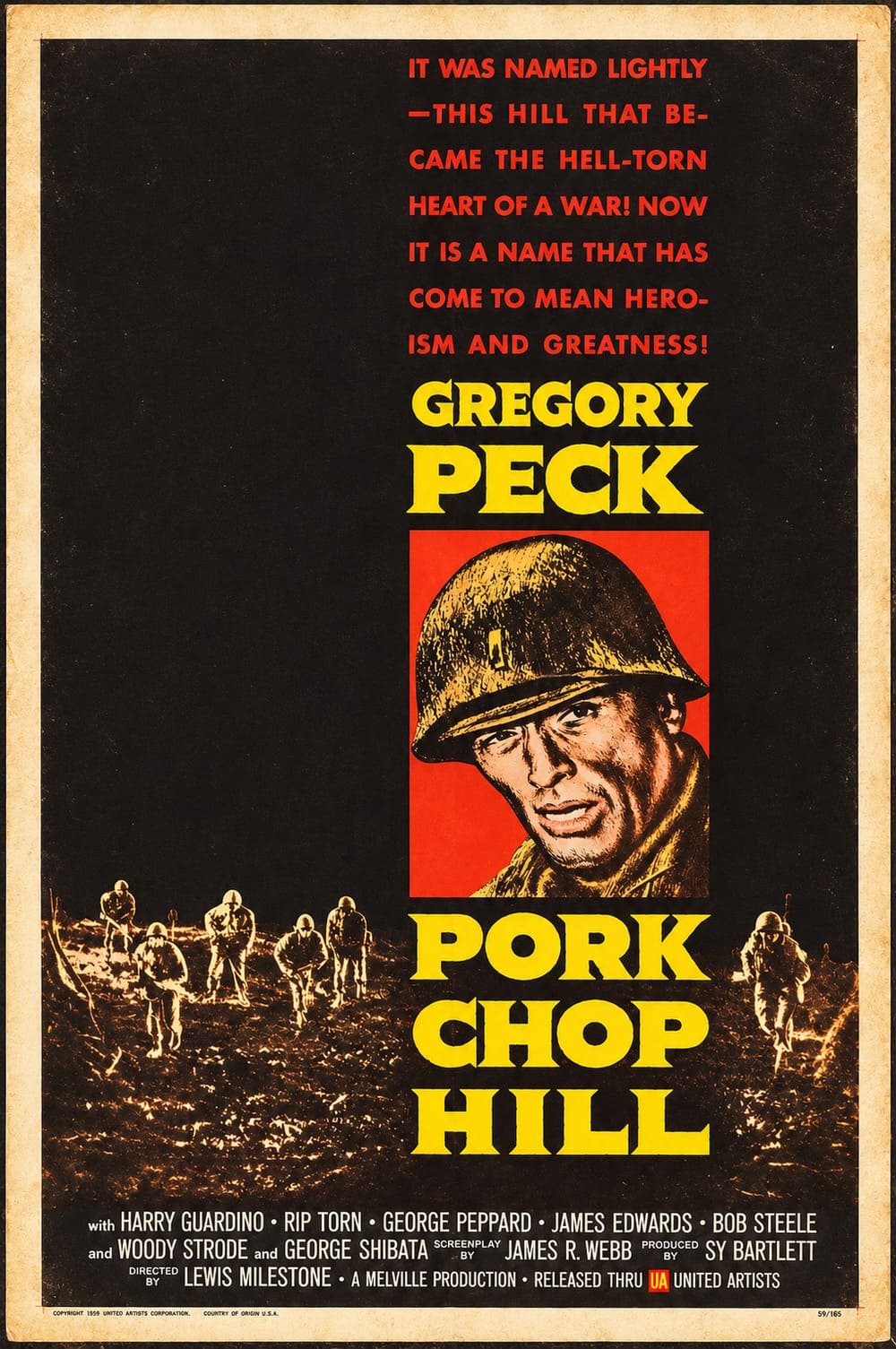
Lewis Milestone’s Pork Chop Hill (1959) is the kind of war movie that makes taking an objective look a lot less impressive than surviving it. There is no beautiful prize waiting at the summit, just torn-up ground, exhausted soldiers, and the possibility of another attack. Starring Gregory Peck as Lieutenant Joe Clemons, the film follows an American company ordered to retake a Korean hill while armistice negotiations grind along elsewhere. Its central question is uncomfortable: what happens when military courage gets put to work defending something that matters mostly because neither side wants to admit it doesn’t?
What makes the movie stick is its refusal to separate the soldiers’ bravery from the futility of their situation. These men can perform extraordinary acts without making the larger operation seem sensible. Milestone doesn’t treat that contradiction as something a stirring speech can clear up. Instead, it hangs over the fighting, making every bit of progress feel provisional. You can admire the men struggling up the slope while wondering why anyone should have to climb it. That tension gives Pork Chop Hill its bite: respect for the people doing the fighting never requires unquestioning respect for the decisions keeping them there.
Peck is a strong choice for Clemons because his authority feels practical rather than flashy. He gives the film a steady center without turning the lieutenant into a superhero who can personally fix a collapsing operation. Clemons has to keep people moving, work out what is happening, and hold together a force being steadily worn down. The performance works best as a portrait of leadership reduced to immediate responsibilities. Grand strategy is somebody else’s department; keeping the next position from being overrun is his. Peck’s restraint fits a film interested less in heroic posing than in the exhausting work behind survival.
Woody Strode provides an especially valuable counterweight as Private Franklin, a soldier who has no interest in dying to prove a point about Korea. Strode gives Franklin’s resistance an angry, defensive edge that makes him more interesting than a stock soldier who loses his nerve. His physical presence makes the contrast striking: looking powerful does not mean feeling willing to sacrifice yourself. When Franklin confronts Clemons, the clash brings the movie’s larger questions down to a painfully personal level. Why should this particular man give his life for this particular hill? Strode makes that question feel urgent rather than abstract.
Franklin’s bitterness also carries a racial dimension. His reference to the conditions he lives in back home complicates any easy appeal to patriotism: he is being asked to risk everything for a country whose treatment of him gives him reasons to feel alienated. The film ultimately steers him toward solidarity with the other soldiers, and Clemons answers his objections by emphasizing their shared danger and hardship. That resolution is not entirely satisfying, since it moves past Franklin’s specific grievances rather quickly. Still, Strode gives the character enough wounded pride and frustration that his objections remain worth considering even after the story pushes him back into the fight.
Milestone’s handling of combat has a nuts-and-bolts quality. Movement, communication, reinforcement, and relief become matters of life and death rather than background details. Orders do not automatically produce results, and information moving away from the battlefield does not necessarily describe what is actually happening there. The film makes the gap between the front line and higher command feel dangerous in itself. A position can look secure to someone elsewhere while the men occupying it know they are barely hanging on. That disconnect is more unsettling than a straightforward story about one obviously foolish officer making one obviously disastrous decision.
Most importantly, Pork Chop Hill doesn’t flinch from the meat grinder. Its violence matters through accumulation: men disappear from the fighting strength, exhaustion builds, and holding the same battered ground becomes harder. This isn’t simply a matter of whether an older film shows enough blood for modern tastes. The horror comes from the sense that human beings are being fed into an argument that has no natural stopping point. The enemy loudspeaker adds another ugly layer, reminding the Americans that they may die for a position being debated by people safely removed from it. Psychological pressure becomes part of the battlefield’s machinery.
The trap extends to both sides, even though the film’s emotional viewpoint stays firmly with the Americans. Chinese troops are also being committed to a struggle whose importance comes from what possession supposedly proves. That distinction matters. The movie does not offer an equally intimate portrait of both armies, but its political framework suggests a shared predicament: soldiers must keep paying because their leaders cannot afford to look unwilling to pay. The hill becomes a test of determination, and every sacrifice helps create the justification for another. It is a brutal circular argument, carried out with artillery and infantry instead of words.
The ceasefire negotiations make that argument especially bitter. Rather than presenting the fighting and diplomacy as separate activities, the film shows how closely they are connected. Leaders understand that the hill’s importance is not really in the ground itself. What matters is whether surrendering it might weaken their position at the negotiating table or suggest that their willingness to fight has run out. Neither side wants to blink. Peace is being discussed while men are being asked to demonstrate that the war could continue, which gives the battle an almost unbearable absurdity. The prospect of an agreement does not stop the killing; it helps explain its immediate purpose.
There is an important historical qualification here. The film dramatizes the April 1953 fighting, not the later July battle that ended with American withdrawal. The battles became controversial because of the casualties incurred over terrain widely described as having little or no strategic or tactical value. Still, “worthless” needs a little unpacking: the hill could lack meaningful military value while acquiring symbolic importance in negotiations. That does not make the losses easier to justify. It explains how commanders could recognize the ground’s limited usefulness and nevertheless insist that abandoning it would carry consequences beyond the battlefield.
As a movie, Pork Chop Hill is strongest when it lets that contradiction emerge through the soldiers’ immediate problems. Its matter-of-fact approach can feel emotionally spare, and viewers looking for extensive personal histories may find its concentration on the operation limiting. But that narrowness also has force. The men’s lives have been compressed into getting forward, finding support, maintaining contact, and lasting long enough to be relieved. Strode’s scenes puncture that operational focus just enough to remind us that each soldier brings his own reasons for resisting or accepting what is demanded of him. These are people, not simply a dwindling number on a commander’s report.
For all its toughness, Pork Chop Hill never makes toughness look like much of a reward. What stays with you is the sheer effort required to get through another stretch of fighting, followed by the realization that surviving it may simply mean being available for the next attack. Peck’s grounded authority, Strode’s simmering resistance, and Milestone’s stripped-down approach make that experience compelling without making it inviting. It’s a gripping war film, but not a comfortable one to cheer along with. By the time it is over, who holds the hill feels less important than how many men have been used up proving that neither side will let it go.