“I’m excusing a lot because I recognize the trauma and the loss you have suffered. But my patience isn’t limitless… unlike my authority.” — Inquisitor Gregor Eisenhorn
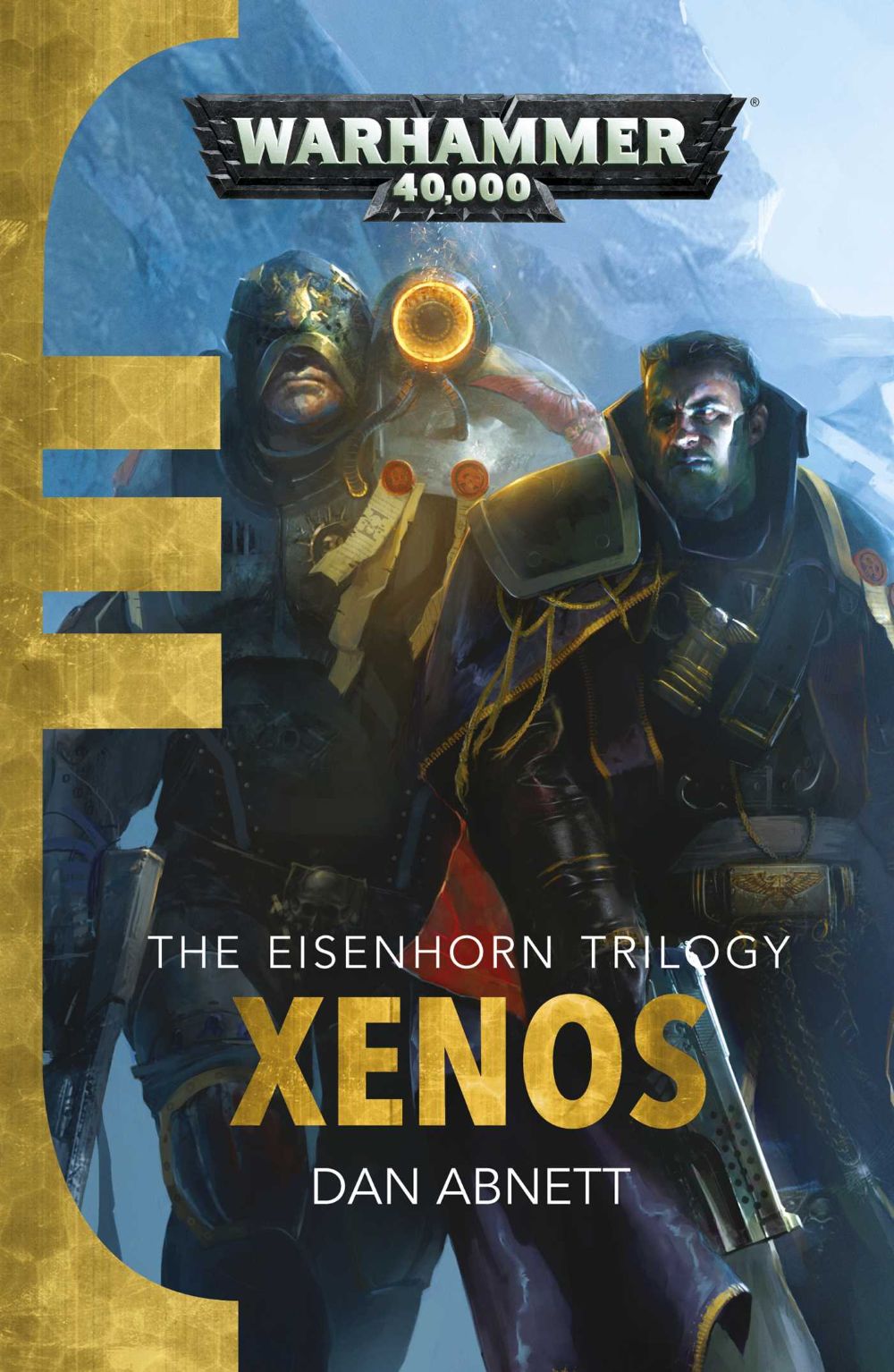
Xenos by Dan Abnett is one of the best places to begin a journey into the immense, intimidating fictional universe of Warhammer 40,000. The setting has decades of lore, countless factions, and a reputation for throwing newcomers into a blizzard of Gothic names, alien species, religious doctrine, and galaxy-wide war. Abnett gets around that problem by starting on a smaller, more personal scale. Rather than opening with armies of Space Marines firing bolters into a battlefield, Xenos follows an investigation. It is a mystery novel first, but one wrapped in political intrigue, supernatural horror, science-fiction adventure, and the oppressive atmosphere that makes Warhammer 40,000 unique.
The novel follows Gregor Eisenhorn, an Imperial Inquisitor investigating the suspicious death of another Inquisitor and the possible return of an infamous forbidden text. What initially appears to be a contained case grows steadily more complicated, carrying Eisenhorn from the polished halls of the powerful to the dangerous, hidden corners of the Imperium. Along the way, he encounters criminal networks, secretive cults, alien interests, old enemies, and clues suggesting that the threat he is following is far larger than it first appears. That is about as much as the plot should be revealed going in. One of Xenos’ greatest pleasures is seeing an investigation expand in unexpected directions as Eisenhorn realizes that every answer seems to reveal another, more disturbing question.
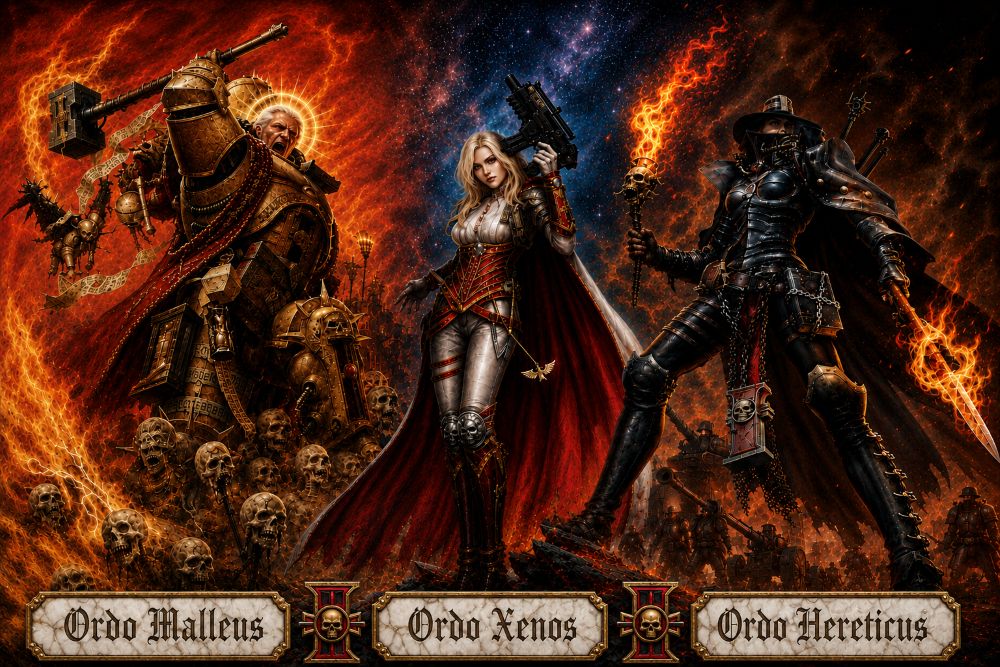
For newcomers, Eisenhorn is a perfect guide through the setting because his job gives him access to virtually every level of Imperial society. The Inquisition is the Imperium’s feared internal-security and investigative force, responsible for hunting down threats such as heresy, Chaos corruption, rogue psykers, dangerous mutants, and alien infiltration. Its three major branches are the Ordo Xenos, which deals with alien threats; the Ordo Malleus, which combats daemonic and major Chaos threats; and the Ordo Hereticus, which investigates internal heresy and corruption within humanity. Eisenhorn belongs to the Ordo Xenos, although Xenos quickly makes it clear that the lines between those responsibilities can become blurry when an investigation leads into forbidden knowledge and the influence of Chaos.
Inquisitors operate with enormous authority inside the sprawling hierarchy of the Imperium’s bureaucracy. They can demand cooperation from military officers, nobles, bureaucrats, religious leaders, and law-enforcement agencies alike, often placing them effectively above the normal chain of command. That vast authority makes them necessary in an empire as corrupt, unwieldy, and permanently threatened as the Imperium, but it also makes them frightening. Eisenhorn can investigate almost anyone, order arrests and executions, seize resources, and disregard ordinary procedure if he believes the situation demands it. The novel’s central moral tension comes from that power: what happens when someone entrusted with protecting humanity has the freedom to do almost anything in its name?
That question gives Xenos considerably more weight than a straightforward sci-fi detective story. Eisenhorn is not a traditional hero, though he is clearly written as the protagonist and often comes across as intelligent, disciplined, and committed to his work. He believes in the Imperium, believes in his duty, and believes that evil has to be confronted before it spreads. At the same time, he works inside a system where fear and brutality are normal tools of governance. An Inquisitor cannot afford to be naïve, especially when dealing with Chaos, cults, and conspiracies built around forbidden knowledge. But Abnett constantly pushes Eisenhorn toward uncomfortable choices, forcing him to decide how much compromise is acceptable when the enemy is capable of manipulating minds, corrupting souls, and destroying worlds.
That is one of the major reasons the book works so well. Warhammer 40,000 can sometimes feel like a setting built from giant concepts: eternal war, fanatical religion, ancient aliens, grim military hardware, and cosmic evil. Xenos does not ignore any of those things, but it makes them matter on a human level. The Imperium is not merely described as a brutal galaxy-spanning empire; Abnett shows how it functions through its people and institutions. There are noble houses, archives, cults, scholars, law officers, ship crews, bureaucrats, mercenaries, and citizens who have learned to survive under a regime where suspicion can be fatal. The book makes the Imperium feel less like a background painting and more like a living, oppressive civilization.
Abnett’s greatest strength is his ability to reveal the setting without drowning the reader in exposition. There are plenty of unfamiliar terms in Xenos, especially for readers coming in cold, but the novel rarely stops to hand over a rulebook-style explanation. You learn about the Warp because it is dangerous and uncanny whenever it enters the story. You understand Chaos because its influence produces paranoia, violence, and spiritual corruption. The Eldar are introduced not as a long historical lecture but as secretive, ancient, unsettlingly intelligent outsiders with motives that human characters cannot fully grasp. That approach preserves the sense that this universe is far bigger than Eisenhorn’s current case, while still making the plot easy to follow.
The pacing is helped by the fact that Abnett never lets the story remain in one mode for too long. Xenos begins with the mood of an investigative thriller, but it gradually expands into something stranger and more dangerous. The novel moves through crime scenes, aristocratic gatherings, interrogation rooms, alien ruins, dangerous underworld spaces, and moments of full-scale action. That variety keeps the book from becoming too bleak or static. The setting is absolutely grim, and the violence can be nasty, but there is also a strong sense of momentum and adventure. Abnett knows that the horror of the 41st Millennium is more effective when the reader is also excited to see what strange corner of it comes next.
His prose is another major advantage. Abnett writes in a style that is clean and readable without losing the ornate, Gothic flavor of the setting. He can handle action well, especially when Eisenhorn and his team are forced into sudden violence, but he is arguably even better with atmosphere. Some of the novel’s most memorable scenes involve conversations where nobody says exactly what they mean, tense interrogations, the discovery of forbidden evidence, or the lingering sense that an apparently routine lead has opened a door that should have remained closed. He gives Xenos the feel of a noir investigation filtered through a nightmare version of space opera.
Eisenhorn’s supporting cast helps keep the novel grounded. Aemos, his loyal savant, brings experience and knowledge to the team, while the warrior Midas Betancore adds a practical edge to their fieldwork. Alizabeth Bequin, whose unusual nature is tied to some of the setting’s stranger ideas, becomes one of the more intriguing figures around Eisenhorn. Each character has a defined role, but they are not simply pieces of equipment for the Inquisitor to deploy. Their reactions to danger, secrecy, and Eisenhorn himself make it clear that he may possess enormous legal authority, but he still depends on people he cannot completely control.
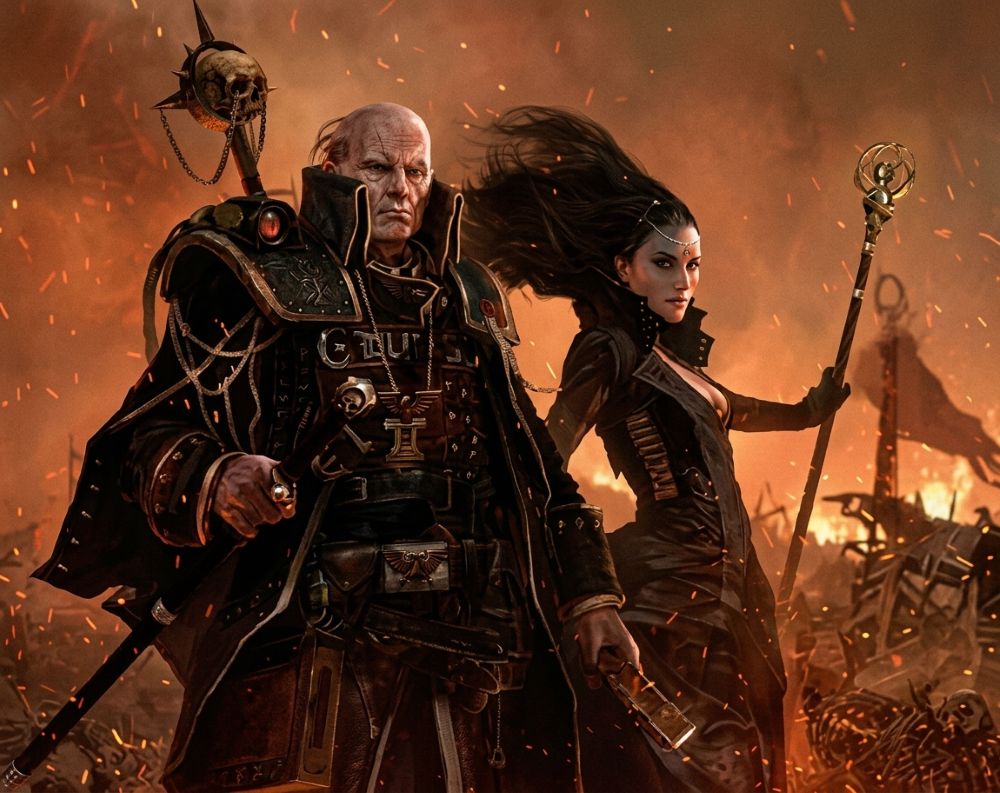
The relationship between Eisenhorn and Bequin is especially effective because Abnett does not force it into an overly simple romance. In a lighter setting, their dynamic might become predictable, but Warhammer 40,000 is not a world where emotional connection comes without consequences. Their growing trust is complicated by secrets, duty, personal history, and the fact that Eisenhorn’s work places everyone around him in danger. The novel is stronger for that restraint. It understands that Eisenhorn’s position makes ordinary human relationships difficult, and that the pressure of the Inquisition can turn even loyalty into something painful.
If there is a weakness in Xenos, it is that the middle section can occasionally feel rushed. Abnett covers a lot of territory, introduces several important concepts, and puts Eisenhorn in contact with a broad cast of characters. Some supporting figures and locations are memorable but could have used a little more time to develop. The book also has the feeling of a first installment in a larger story, particularly as Eisenhorn’s moral compromises begin to take shape. Still, that is not a serious flaw. The novel provides a satisfying central investigation while clearly establishing bigger questions that continue through Malleus and Hereticus.
What ultimately makes Xenos such a successful novel is that it understands the appeal of Warhammer 40,000 without relying entirely on surface-level spectacle. The setting has no shortage of memorable imagery: skull-covered cathedrals, psychic powers, ancient alien technology, daemon-haunted worlds, and armies fighting endless wars across the stars. But Abnett gives all of that a purpose by focusing on a man trying to hold onto his principles in a universe that rewards ruthlessness. Eisenhorn is not merely fighting cultists, aliens, and supernatural conspiracies. He is fighting the possibility that protecting humanity may require him to become something he once would have condemned.
For longtime fans, Xenos offers a welcome change from stories focused solely on battlefield carnage. It shows the day-to-day machinery of the Imperium, the political paranoia beneath its religious language, and the hidden wars being fought far away from the front lines. For newcomers, it is an especially good entry point because it does not require prior knowledge of the tabletop game, its codices, or its enormous chronology. It introduces the setting’s major ideas through a compelling story rather than a lecture.
Xenos is suspenseful, violent, atmospheric, and smarter than many people may expect from a novel tied to a miniature wargame. Dan Abnett turns the colossal scale of Warhammer 40,000 into a strength, giving readers glimpses of a universe full of horrors while keeping the narrative centered on one investigation and one increasingly compromised man. It is a highly entertaining science-fiction thriller in its own right, but it is also one of the clearest demonstrations of why Warhammer 40,000 has endured for so long. If someone wants to take their first step into this massive fictional universe, Xenos is a smart place to start.


Pingback: Malleus: Eisenhorn (by Dan Abnett) Review | Through the Shattered Lens
Pingback: Lisa Marie’s Week In Review: 8/31/26 — 9/6/26 | Through the Shattered Lens
Pingback: Malleus: Hereticus (by Dan Abnett) Review – Through the Shattered Lens