Review: Full Metal Jacket (dir. by Stanley Kubrick)


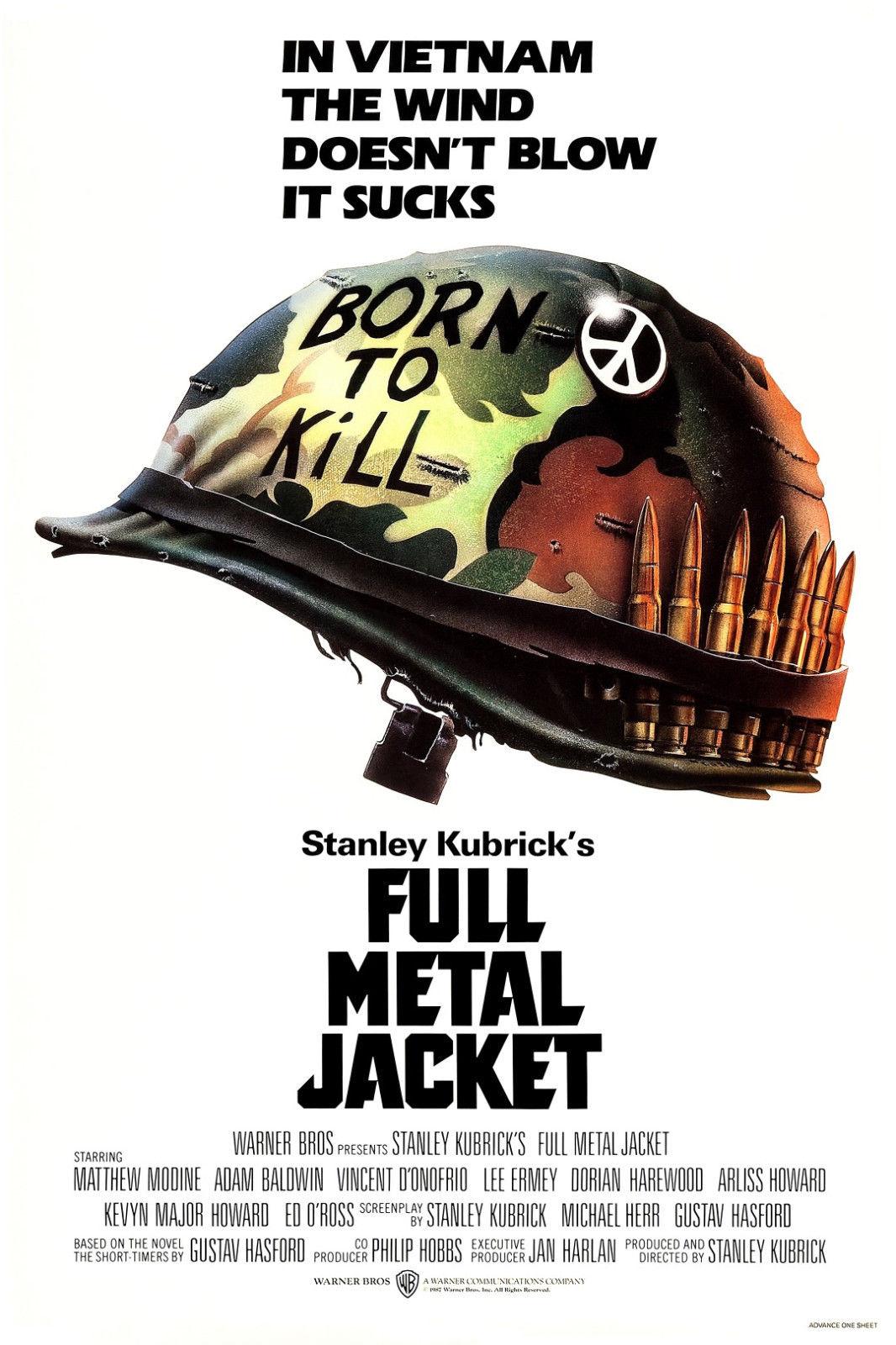
“You write ‘Born to Kill’ on your helmet and you wear a peace button. What’s that supposed to be, some kind of sick joke?” — Colonel

Full Metal Jacket is the kind of war movie that sticks in your craw like old metal shavings. It’s 1987, Stanley Kubrick’s last film released in his lifetime, and it plays less like a traditional Vietnam War saga and more like a taunt packed into two very different acts. One half is a barracks horror show about how the military turns boys into killers; the other is a grubby, almost casual descent into the chaos of combat. Together, they make a movie that feels intentionally disjointed so it can drill down on the same idea from two angles: war doesn’t just brutalize your body, it reshapes your mind into something barely human.

The film follows Private J.T. “Joker” Davis, played by Matthew Modine in one of those quietly watchful performances that’s easy to underestimate. Joker starts as a kind of archetypal smart‑mouth recruit, the guy who thinks he’s above the hysteria until he realizes he isn’t. Around him swirls a platoon of young Marines going through basic training at Parris Island under the merciless Gunnery Sergeant Hartman, played with shark‑like relish by R. Lee Ermey, who was actually a real‑life Marine drill instructor. Hartman’s whole job is to obliterate softness and replace it with drilled‑in aggression, and Kubrick lingers on every insult, every barked command, until the abuse stops feeling like a setup for a war movie and starts feeling like the main event.

The first half of Full Metal Jacket is basically a single, sustained initiation ritual. The camera stays tight, almost claustrophobic, trapping you in the barracks with the recruits, so you feel the same sensory overload they do. The lighting is harsh, the colors washed out, and the camera often locks in on Hartman’s face mid‑rant, making you uncomfortably intimate with his cruelty. This isn’t training so much as a manufactured psychological war waged on the platoon’s collective brain. The recruits are constantly degraded, mocked, and forced into grotesque rituals of humiliation, and the film never lets you forget that this is the system’s idea of “making Marines.” Kubrick doesn’t fake the perverse appeal of this process either; there’s a weird, ugly thrill in how effective it is, in how the boys start enjoying the brutality once they’re inside it.

The standout character in this section is Leonard “Gomer Pyle” Lawrence, played by Vincent D’Onofrio in a performance that’s almost physically uncomfortable to watch. D’Onofrio’s Pyle is this thick‑set, awkward kid who can’t keep up, and the movie doesn’t soften his edges to make him likable. He’s genuinely bad at the routine, slow, clumsy, but he’s also clearly just trying to survive. The film lets you watch, in a very matter‑of‑fact way, how the system turns his inadequacy into a target. The other recruits are instructed to punish him, and soon everyone starts in. The film doesn’t moralize about it; it just shows that this kind of group cruelty is baked into the structure. The infamous scene where the platoon holds Leonard down with piled‑on bed sheets while whacking him with a bar of soap wrapped in a towel is less about a single act of violence than about what it means to normalize dehumanization before you ever see combat.

What’s so unsettling about Full Metal Jacket is that it never pretends Hartman is some rogue sadist. He’s not an outlier; he’s the product of the system, and he’s also the system’s avatar. In that sense, the first half of the film functions like a kind of industrial horror. The Marines are being processed like defective parts on a factory line, streamed through a machine designed to break them and then rebuild them as compliant killers. The film toys with the idea that the military doesn’t want robots so much as creatures that hunger for violence on command. The line about “we don’t want robots, we want men” is repeated with a kind of grim irony because what the film actually shows is the production of something in between: not quite human, not quite machine, but something that can pull a trigger without hesitating.

Jumping from Parris Island to the streets of Huế during the Tet Offensive, the second half of Full Metal Jacket feels like a different movie in tone but the same one in thesis. Joker, now a combat correspondent with a Stars and Stripes hat and a “Born to Kill” slogan on his helmet, is literally split down the middle between observer and participant. He carries a camera and a rifle; he’s supposed to report, but he also has to fight. The film doesn’t resolve that tension the way a more sentimental war movie would. Instead, it lets Joker drift in that gray zone where war is equal parts absurdity and atrocity. The Vietnamese civilians are largely faceless, and the war itself is shown as a series of loosely connected vignettes—raids, ambushes, random firefights—rather than a grand narrative of heroism or tragedy.

Kubrick’s Vietnam is less a country and more a ruined theater set. The cityscapes are wide, desolate, and oddly beautiful in their destruction, as if the war has turned everything into a series of bleak tableaux. The camera doesn’t linger on gore for shock value; it lingers to make the war feel like a permanent, almost aesthetic state of ruin. Individual soldiers pop in and out: Animal Mother, the violently unhinged Marine played by Adam Baldwin; Cowboy, the earnest, almost naive replacement; and the rest of the squad, who oscillate between fear, boredom, and bursts of casual cruelty. None of them are given the kind of tragic backstories that usually make you emotionally invested in a war film. Instead, they’re presented as fragments of a larger machine, each one another cog in the same indifferent system.

The film’s most famous structural trick is its way of keeping politics at arm’s length while still radiating a deeply skeptical view of the war. It doesn’t really bother telling you who’s right or wrong, or why the Marines are there. It just shows what they become and what they do. The movie doesn’t ask you to sympathize with the Marines in the way some war films do; it asks you to recognize the mirror. The famous ending, where the Marines march through flaming ruins to the tune of Mickey Mouse, is pure Kubrick dark surrealism. The cheerful cartoon theme clashes violently with the apocalyptic imagery, and the soldiers chant along with a kind of manic innocence that feels like the last vestige of humanity being cannibalized by the war itself. It’s hard to tell whether the moment is tragic, absurd, or both, and that’s the point.

Full Metal Jacket is also a film about storytelling and the way narratives are weaponized. Joker, as a reporter, is supposed to package the war for a distant audience. He’s there to turn chaos into digestible stories, but the movie quietly undermines that idea by showing how unreliable those narratives are. The soldiers’ own stories are laced with jokes, bravado, misogyny, and casual racism, and the film doesn’t clean them up. It lets you sit with the ugliness, even when it’s delivered with a laugh. The film doesn’t romanticize the Marines’ camaraderie or soften their cruelty; it just lets you watch them behave like ordinary guys who happen to be doing something extraordinary and monstrous.

The cinematography in Full Metal Jacket is cold and precise, which is exactly what the material needs. The camera behaves like a reluctant witness, framing the Marines in symmetrical, almost clinical compositions that make their brutality look routine rather than spectacular. The score is minimal, and the film often relies on diegetic sound—machine‑gun fire, jeep engines, distant explosions, Hartman’s voice echoing off concrete walls—to ground you in the sensory overload of military life. Even the few moments of levity feel like concessions to show business more than true relief. The soldiers’ jokes are rarely funny in a wholesome way; they’re the kind of gallows humor that keeps you from noticing how broken you’ve become.

What ultimately makes Full Metal Jacket endure is that it refuses to offer catharsis. By the time the film ends, nothing has been “resolved” in the way Hollywood usually expects. Joker survives, but the war doesn’t; it just keeps going, and the Marines keep marching, chanting, and killing. The film doesn’t build toward a big speech about the futility of war or a tear‑jerker about fallen comrades. It just suggests, quietly and persistently, that the process outlined in the boot‑camp half is drafted, again, in the streets of Vietnam. You go in as a boy, you’re molded into something sharper and meaner, and then you’re sent out into a world that rewards that sharpness. The movie doesn’t need to say this out loud; it just shows it happening in scene after scene.

In that sense, Full Metal Jacket is one of the most honest anti‑war films precisely because it doesn’t pretend to be a plea for peace. It’s a portrait of a machine that feeds on itself, and of the people who get caught in its gears. It’s funny, disturbing, infuriating, and occasionally mesmerizing, sometimes all at once. It’s not a movie that wants to hold your hand or make you feel better about the human race. It wants you to stare at the gleam on that full metal jacket bullet and wonder what it took to make someone pull the trigger. That’s the real power of Full Metal Jacket: it doesn’t try to redeem the war, the soldiers, or the audience. It just makes sure you can’t look away.
Brad’s “Scene of the Day” – Alex Winter seems hungry in DEATH WISH 3 (1985)!


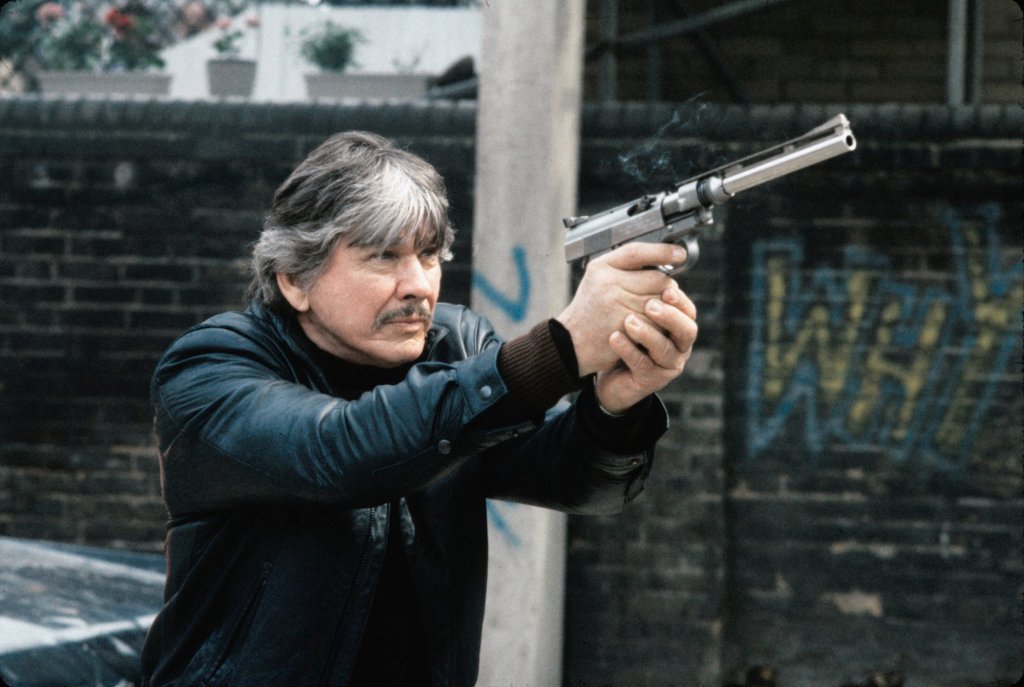
Well everyone has to start somewhere! Today I celebrate Alex Winter’s 60th birthday by watching a scene from DEATH WISH 3, the insane Charles Bronson vigilante classic, where Alex earned his first big screen credit as gang member Hermosa! What an honor it must have been for Alex to get smashed in the head with a tire tool by the legend in his signature series of revenge. If you haven’t seen DEATH WISH 3 before, you may never see “Bill” in quite the same light again!

(Note – the scene below features taunts and threats of an extreme sexual nature. Do NOT hit play if that offends you!)

DEATH WISH 3 – The movie I’ve watched more than any other!


I’m on Day 3 of my discussion of Charles Bronson’s DEATH WISH series in chronological order. This series has brought me countless hours of entertainment over the last 40 years, so enjoy and let me know your thoughts!

DEATH WISH 3 is a very important movie to me. I recently closed my celebration of Charles Bronson’s 103rd birthday movie marathon on November 3rd with another viewing of DEATH WISH 3, the film that turned me into the only Charles Bronson superfan in Toad Suck, Arkansas. After a day of celebratory viewings of CHATO’S LAND, 10 TO MIDNIGHT (on VHS), FROM NOON TIL THREE, COMBAT: HERITAGE (on VHS), THE SEA WOLF (on VHS), and the original DEATH WISH, I had no choice but to watch DEATH WISH 3, a movie I have watched well over 100 times over the course of my life. DEATH WISH 3 is one of only four Charles Bronson films that I have seen on the big screen, as I was able to watch it at the Mahoning Drive-In in Lehighton, PA in June of 2022.

The third entry in the DEATH WISH franchise begins with Paul Kersey (Charles Bronson) riding a Go Big Red Trailways bus into New York City. Since this is an odd numbered DEATH WISH film, it takes place in New York. The even numbered films take place in Los Angeles. Kersey looks kind of grumpy as he rides into town. I would definitely avoid sitting next to him if I was a passenger on the same bus that day. We learn that Kersey’s coming into town to visit his old buddy, Charlie. Unfortunately, his arrival coincides with members of a violent street gang breaking into Charlie’s apartment and beating him to death. Just after the punks go running away from the scene of the crime, Kersey walks into Charlie’s apartment to find the man clinging to his last breath of life and asking Kersey to “take care of his things, until I get back.” Some of Charlie’s neighbors had called the police a little earlier, and they arrive just in time to find Kersey standing over the body, so they arrest him for his old buddy’s murder. This seems reasonable since Kersey is the only person wearing a sports jacket and button up shirt in this gang infested area. Kersey is taken to the police station where a group of cops commence to beating the crap out of him in hopes of getting a confession. After a few punches to the gut by the cops and the old “you can have water if you tell us what we want to know” routine, Lt. Richard Shriker (Ed Lauter) enters the room and promptly asks “Who’s this dude?” You see, Kersey is going under the alias Paul Kimble, but Shriker recognizes the dude as Paul Kersey, the vigilante from the original DEATH WISH. Shriker goes on to explain that he was with the New York PD the night they brought in a vigilante with a bullet in his leg who was out like a light. Having the vigilante in town again, light bulbs immediately go off over Shriker’s head and he quickly hatches a plan. It seems a gang of criminals, led by Mandy Fraker (Gavan O’Herlihy) has taken over the community and police have been powerless to stop them. First, it’s really hard to catch the gang members because some of them can run really fast, and second, when they finally do catch them, the gang members have lawyers who can get them off. Lt. Shriker decides he’ll let Kersey out of jail, but only if Kersey is willing to resume his vigilante ways, shoot some of the creeps, and even throw some street info the police department’s way so they can get a few busts. Paul Kersey immediately agrees even though he seems kind of tired. You can’t help but wonder if Kersey might be needing the release that only can be achieved through violence against creeps. In short order, Kersey sets up shop in his old buddy’s apartment so he can take care of his things, gets to know the local residents, waits for an arsenal of African big game pistols and rocket launchers to arrive via UPS, makes love to public defender Kathryn Davis (Deborah Raffin), and eats all sorts of local delicacies like stuffed cabbage and broiled chicken. As an added bonus, the neighborly Bennett (Martin Balsam) just happens to have a couple of Browning machine guns in his closet that he was somehow able to smuggle home from World War II. It’s against this backdrop that Kersey sets out to wage a one-man war against the violent gang that has turned the corner of Sutter and Belmont into hell on earth!

There’s not much I can say about DEATH WISH 3 that hasn’t already been said.  It’s a wild, over the top action film that would mark the 6th and final film that Bronson would work on with director Michael Winner.  It would also be Charles Bronson’s last film that would rise to #1 at the U.S. box office when it premiered on November 1st, 1985.  It features some fun performances, especially from Ed Lauter as Lt. Shriker, Gavan O’Herlihy as gang leader Mandy Fraker, and Kirk Taylor as the gang member known as the Giggler who “can really move,” but who’s still not fast enough to outrun a bullet! A pre-Bill and Ted’s Alex Winter also plays a gang member named Hermosa, continuing the series tradition of casting actors as street creeps who would go on to be a bigger star a few years down the road. DEATH WISH 3 is not a great movie in the traditional sense, but it’s one of the most enjoyable movies ever made if you’re in the right frame of mind. 

DEATH WISH 3 is the movie most responsible for my obsession with Charles Bronson. I received it as a Christmas present in 1986 when I was thirteen years old, and I proceeded to watch it almost daily for months. It was the only Bronson film I owned on VHS so I would watch it almost every night unless I had a basketball game, or I had been able to rent a different Bronson film from the video store.  I know every line in the film and no other movie holds more nostalgic value in my life. DEATH WISH 3 is a 5-star movie in my book in so many ways that have nothing to do with critical acclaim. As long as I’m breathing, long live DEATH WISH 3!!!

BONUS: We completed a roundtable a few weeks back on the THIS WEEK IN CHARLES BRONSON PODCAST, where we spend the entire episode discussing what we love about DEATH WISH 3. I had a blast on the episode with my partner in crime Eric Todd, as well as fellow “Buchinsky Boys” Chris Manson & David Mittelberg. We even throw some love TSL’s way during the episode. Give it a listen if you get the chance!

Bronson’s Old: Death Wish 3 (1985, directed by Michael Winner)


To quote Roger Murtaugh, “I’m too old for this shit.”

It has been ten years since Paul Kersey (Charles Bronson) left New York City and the place has gone to Hell.  It’s no longer just muggers that you have look out for.  Now, there are roving street gangs of directionless teenagers, terrorizing the elderly and forcing them to live like prisoners in their own apartment building.

One street corner now looks like a war zone, controlled by spiky-haired, face-painting punks who look like something from a Mad Max movie.  Manny Fraker (Gavan O’Herlihy) rules this street corner, supported by a gang that worships him as if he was some sort of god.  Manny thinks that he is immortal but he’s just targeted the wrong person.  The gang may think that Charley (Francis Drake) is just a defenseless old man but what they don’t know is that, when Charley served in Korea, his best friend was Paul Kersey.

The past few years have been busy for Paul.  He’s killed muggers and rapists in Los Angeles, Chicago, and Kansas City and now he’s returned to New York City, to visit his old friend Charley.  Paul arrives at Charley’s apartment just in time to witness Fraker’s gang murdering him.  The gang flees and when the police arrive, they take Paul into custody.

While public defender Kathryn Davis (Deborah Raffin) tries to figure out why Paul is being held in jail, Paul has a conversation with Lt. Shriker (Ed Lauter).  Shriker remembers Paul as being the New York vigilante and he has a proposition for him.  Paul can kill as many members of Fraker’s gang as he wants, as long as he allows the police to take the credit and reports everything that he discovers to Shriker.  Paul agrees.

In the neighborhood, Paul starts to put Fraker and his gang (one of whom is played by pre-Bill and Ted Alex Winter) in their place.  In a scene borrowed from Brian Garfield’s original Death Wish novel, he uses a used car as bait to gun down two aspiring car thieves.  When Paul gets a new gun, he tests it out on a depraved mugger known as the Giggler.  Though some might call him a serial killer, Paul is soon a hero to the entire neighborhood.  Though Charley may be gone, Paul befriends the other residents of the apartment.  He shows the elderly Kaprovs how to catch anyone trying to climb through their window.  He protects Maria Rodriguez (Marina Sirtis) from the gang.  Best of all, he befriend Bennett Miller (Martin Balsam), a World War II vet who still remembers how to load a machine gun.

(Balsam and Bronson previously co-starred in The Stone Killer, though in that one Bronson was a cop and Balsam was on the other side of the law.)

He also finds time to pursue a relationship with Kathryn Davis.  This is one recurring element in the Death Wish franchise that has never made sense to me.  Paul always has a new girlfriend, despite the fact that almost every woman that he ever gets involved with ends up getting killed.  Paul also only seems to go out with women who would be upset to discover that they were dating a notorious vigilante.  In Death Wish II, he went out with a crusading journalist who was against the death penalty.  In Death Wish 3, he falls for a public defender whose job is to provide legal counsel to the very people that Paul is trying to kill.  After Death Wish 3, Paul would date yet another crusading journalist and, finally, the ex-wife of a notorious mobster.  Maybe Paul should just give up and concentrate on mourning his wife.

Michael Winner returned to direct Death Wish 3 and, this time around, he imagines New York City as being a post-apocalyptic wasteland, full of abandoned buildings and murderous scavengers.  Imagine A Clockwork Orange if Charles Bronson suddenly showed up to shoot Alex and the Droogs.  As played by Gavan O’Herlihy, Manny Fraker is the type of seemingly indestructible bad guy who can actually give Paul Kersey a challenge, something that was missing from the previous films.

The other thing that distinguishes Death Wish 3 is that it was one the only film in the franchise to directly confront an obvious truth.  Charles Bronson was 53 when the first Death Wish was released.  By the time he made Death Wish 3, he was 64 and decades older than the typical action star.  (As way of comparison, Clint Eastwood was 55 when Death Wish 3 was released and was already experimenting with less action-orientated roles.)  By partnering him with Martin Balsam and the other elderly residents of the neighborhood, Death Wish 3 not only acknowledged Bronson’s advanced age but also took advantage of it.  Death Wish 3 is a film where the old folks finally get to teach the young punks a thing or two.  If the other Death Wish films were about one man fighting a lonely war, Death Wish 3 is about a community refusing to be silenced.  The chance to put those kids in their place even seems to perk up Charles Bronson, who gives one of his best performances in Death Wish 3.

Death Wish 3 may have been roundly despised by the critics but it’s the best of the Death Wish sequels.  It made a fortune at the box office so naturally, another sequel would follow.

Tomorrow: Death Wish 4: The Crackdown!