Film Review: Red Sonja (by MJ Bassett)


Red Sonja is one of those films that was in development forever.

In 2008, Robert Rodriguez was rumored to be planning to direct a Red Sonja film with Rose McGowan in the title role.  Then, in 2012, it was Simon West who was being mentioned as the film’s director.  In 2018, Bryan Singer announced that he would be directing but he was dropped from the project (and every other project he had going) in 2019.  Joey Soloway, best-known for co-creating the briefly trendy show Transparent, was announced as Singer’s replacement.  Soloway left the project in 2022 and was replaced by MJ Bassett.  Red Sonja was filmed in 2023 and then sat on the shelf for two years before it was finally released in 2025.

Needless to say, a lot happened between 2023 and 2025.  By the time Red Sonja was released, it felt like an artifact from a different world.  Red Sonja is very much a film of the action girl era.  Sonja can beat up just about anyone and she usually does it without breaking a sweat.  As was so often the case with the films of the action girl era, the film is so proud of itself for featuring a woman who can fight that no one involved seemed to notice that they hadn’t really come up with anything interesting for her to do.

Sonja (blandly played by Matilda Lutz) has spent most of her life in the forests of a mythical land, searching for the otnher members of her tribe and communing with the animals.  When she has to hunt and kill a animal in order to eat, she is sure to say, “Thank you for your sacrifice.”  I’m sure her gratitude will provide comfort to the animal’s family.  (I’ve never really gotten the whole attitude that hunting is somehow noble as long as you use every bit of the animal and thank it for dying.  I’m sure the animal would still rather be alive.)   When Sonja is captured and forced to become a gladiator, she discovers that her people are being held prisoner by the effete emperor, Draygan (Robert Sheehan, who is even blander than Matilda Lutz).  In the arena, Sonja shouts questions at the emperor and the audience because, thanks to Russell Crowe and Ridley Scott, that’s what gladiators do.  She’s also given her famous chain mail bikini.  The film is quick to make sure we understand that Sonja isn’t into the whole chain mail bikini thing but she has to wear something.  Unintentionally, the film also reveals that the filmmakers aren’t really interested in making a Red Sonja film.  Everything that made Red Sonja a memorable character in the comic books and the original film is either ignored or viewed with snarky disdain.  The only reason the film is called Red Sonja is because Grim Barbarian Woman didn’t have the same zing.

Now, I will say that Red Sonja does get better as it goes along.  In fact, the film’s climax features an unexpected twist and, if the entire film had that scene’s courage, this review would be very different.  Unfortunately, Red Sonja looks and feels cheap and worst of all, it’s never fun.  It’s very much a 2023 film and 2o23 was a year when anyone who dared to enjoy themselves was viewed with suspicion.  It may have more of a political consciousness than the 80s version but it’s not as entertaining.
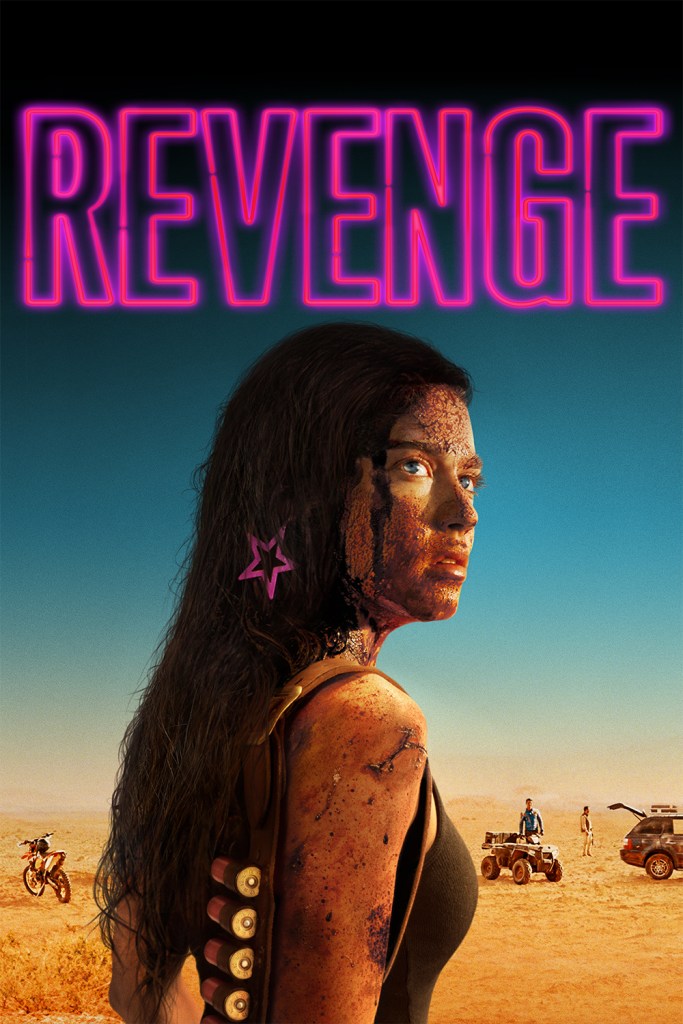
 

Horror Review: Revenge (dir. by Coralie Fargeat)


“Violence is a language written in blood; it tells the story of those who refuse to be silenced.”

Coralie Fargeat’s 2017 film Revenge is an intense and striking blend of horror and thriller that refreshes the rape-revenge genre with a strong emphasis on female empowerment and resistance. At its core, the film follows Jen, a young woman who is brutally assaulted and left for dead in a desert. Against all odds, she survives and seeks brutal revenge on her attackers. What makes Revenge stand out is its blend of graphic, realistic violence and a striking, highly stylized visual approach, resulting in a film that is both visceral and symbolic.

Revenge sits within a long tradition of rape-revenge films that includes both grindhouse exploitation and serious art films. One of the earliest and most influential films in this tradition is Ingmar Bergman’s The Virgin Spring (1960), a somber and moral exploration of a father’s response to his daughter’s rape and murder in medieval Sweden. Bergman’s film inspired many later works, including Wes Craven’s famously brutal The Last House on the Left (1972), which reinterprets the same story through the lens of exploitation horror. Other notorious examples include I Spit on Your Grave (1978), known for its graphic depiction of sexual violence and violent retaliation. More recent films like Jennifer Kent’s The Nightingale (2018) revisit these narrative themes with psychological and political depth. Fargeat’s Revenge draws on this history, combining symbolic storytelling and thematic depth with the raw brutality and energy of grindhouse exploitation.

The narrative structure of Revenge is familiar: Jen, introduced as the mistress of a wealthy man, is assaulted by his friends. Her lover Richard tries to silence her by pushing her off a cliff, but Jen survives, severely injured and impaled on a tree. Her journey is one of intense physical suffering, but also resurrection and fierce empowerment. The film’s use of bright, vivid colors such as hot pinks and blues shifts the story into a surreal, symbolic space where gender roles are exaggerated and the desert becomes a mythic battleground where Jen fights to reclaim control.

Fargeat depicts Jen’s trauma and physical recovery through graphic and detailed body horror—not simply for shock, but as a visual metaphor for reclaiming agency. For example, Jen’s self-treatment of her impalement wound with a hot beer can brands her skin and symbolizes her rebirth and determination. These elements mark a clear departure from earlier rape-revenge films that sensationalized female suffering, shifting the focus to the survivor’s power and autonomy.

Cinematographer Robrecht Heyvaert’s work enhances this dynamic, contrasting the bright, harsh desert landscape with the cold, sterile luxury of Richard’s home. This contrast symbolizes the clash between raw survival and social control. The violence throughout the film is explicit and often hard to watch, but it is deeply rooted in the reality of trauma rather than fantasy.

Matilda Lutz’s performance as Jen is a key strength of the film. She transforms from a vulnerable, objectified figure into a fierce, focused avenger. The male antagonists are less developed, serving as archetypes of toxic male dominance—entitlement, violence, and cowardice—and their downfall reflects the collapse of that social order.

While Revenge maintains the fast pace and suspense of a thriller, its focus on graphic body horror and trauma places it firmly within the horror genre, aligning with the French Extremity movement known for its intense depictions of suffering and transgression. The source of horror here is not supernatural but very much rooted in the physical and psychological impact of violence.

The film has been praised for its technical skill and its focus on female resistance and empowerment. Instead of exploiting female suffering, it forces audiences to confront violence and trauma in a way that centers strength and rage. This is a clear reimagining of the revenge narrative through a modern lens that highlights resilience.

Revenge stands as both a tribute and a reinvention within its genre. It nods respectfully to the moral complexity of Bergman’s The Virgin Spring, the shock tactics of grindhouse staples like The Last House on the Left and I Spit on Your Grave, and the psychological depth of The Nightingale. Yet it simultaneously reinterprets these influences, making a statement that is both timely and provocative.

Coralie Fargeat’s Revenge is a powerful and contemporary entry into the rape-revenge genre, blending horror and thriller conventions with a focus on survival and agency. The film explores the physical and emotional effects of trauma and the possibility of reclaiming power through violence. Its vivid visuals, symbolism, and intense violence challenge audiences to rethink assumptions about gender, justice, and survival. It is a film that provokes strong reactions while delivering a deeply felt story of empowerment and resilience.

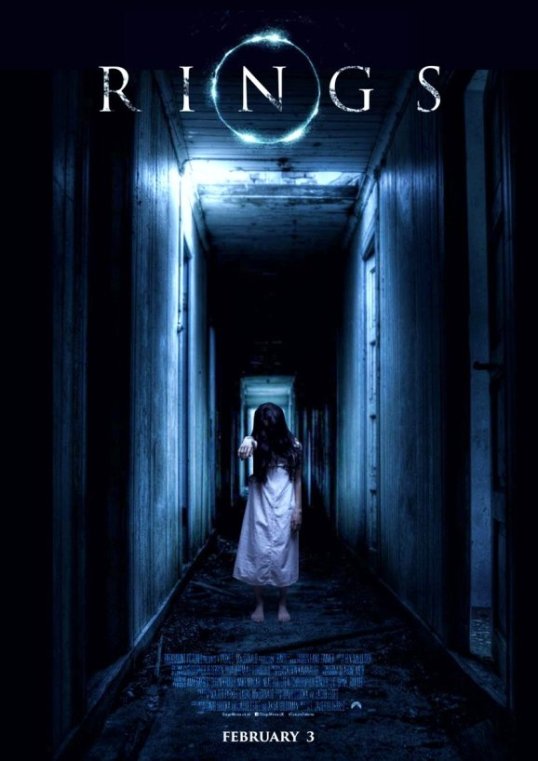
Horror Review: Rings (dir by F. Javier Gutierrez)


As our longtime readers know, I’ve seen my share of stupid movies but it’s hard for me to think of any recent film that’s quite as dumb as Rings.

It’s a shame, really.  Rings, which came out in February of this year, is the second sequel to The Ring.  Despite the fact that it’s been imitated by a countless number of inferior rip-offs and the film’s central premise of evil traveling through a VHS tape has become dated, The Ring actually holds up pretty well.  But, Rings just does not work.

It should be said that Rings gets off to a good and chilling start, with passengers on an airplane asking if they’ve heard about “the tape that can kill you” and then Samara Morgan (Bonnie Morgan) suddenly appearing on every screen in the plane.  It’s the film’s way of declaring, “Just because VHS tapes are a thing of the past, that’s not going to stop our Samara!”  It’s a good opening but it’s also only five minutes and it’s followed by a “two years later…” title card.

Spoiler alert: two years later, everything goes down hill and the movie gets stupid.

The main plot of Rings deals with Holt (Alex Roe) and Julia (Matilda Lutz, who looks and sounds like Ellen Page but isn’t Ellen Page).  They’re teenagers in love and when Holt leaves for college, they promise to skype each other every night.  However, one night, Julia sits down in front of her laptop and discovers that Holt is not in his dorm room.  Instead, there’s a woman demanding to know where Holt is.

HOLT HAS DISAPPEARED!

Julia goes to the college to find her boyfriend.  She discovers that Holt has fallen in with a professor (Johnny Galecki) who apparently watched the infamous video tape.  In order to avoid dying, the professor showed the tape to one of his students.  And then he had that student find someone else to watch the tape and so on and so forth.  I kept waiting for someone to ask the professor why he was ripping off It Follows but, apparently, no one at the college has ever seen a horror film.

Anyway, Holt has yet to force anyone to watch the video tape and he’s running out of time.  In order to save her boyfriend’s life, Julia watched the video.  Oddly, we don’t really get to see much of the video in Rings.  I’m going to assume that the filmmakers felt that it would be pointless to show the whole video again since, presumably, the everyone in the audience has seen either The Ring or The Ring 2 or maybe even Ringu.  But seriously, this is a Ring movie.  Not showing the entire video without interruption feels almost disrespectful to the audience.  It’s kind of like making a Friday the 13th movie and then refusing to actually show us Jason killing any of the counselors.

Anyway, after she watches the video, a weird symbol appears on Julia’s hand and somehow, all of this leads to Holt and Julia going to the town of Sacrament Valley, which is where Samara was buried after she was retrieved from that well at the end of the first Ring.  Julia and Holt do some investigating, which basically means talking to a bunch of overacting character actors with inconsistent Southern accents.  The film spends the majority of its time filling in Samara’s backstory, which is kind of pointless since we learned everything that we needed to know about Samara during the first two films.  It’s enough to know that she’s a little girl who can pop out of your TV and kill you.  She doesn’t really need the Ancestry DNA treatment that she gets from Rings.

Vincent D’Onofrio appears as a reclusive blind man, who might be the key to figuring out whatever’s supposed to be going on.  D’Onofrio gives a performance that makes his work on Law and Order: Criminal Intent look subtle and nuanced.  Normally, I wouldn’t mind an actor going over the top in a film like this but there’s nothing surprising about D’Onofrio’s character.  Even when his big secret was revealed, I shrugged.

Rings is one of those worst movies of 2017, featuring bad acting, bad direction, and totally wasting whatever potential the franchise had left.  The dialogue was so bad and the characters were so inconsistent that the movie actually made me angry.  It doesn’t even work as a self-reflective parody.

For the sins of Rings, we all deserve to watch this: