Welcome to Late Night Retro Television Reviews, a feature where we review some of our favorite and least favorite shows of the past! On Wednesdays, I will be reviewing 1st and Ten, which aired in syndication from 1984 to 1991. The entire series is streaming on Tubi.
This week, OJ has some wisdom to share.
Episode 3.8 “The Brink of Death”
(Dir by Bruce Seth Green, originally aired on November 4th, 1987)
There’s a lot happening in this week’s episode.
For instance, Bubba and Jethro now own the bar where all of the Bulls hang out. To be honest, I thought they always owned the bar but apparently, they didn’t. As I’ve said a few times in the past, the way these episodes were edited for syndication occasionally makes it a bit difficult to actually follow the storyline.
Wide receiver Billy Cooper (Michael Toland) was kidnapped by Stuart (Richard Tanner), the nerdy guy whose girlfriend Billy stole. Stuart wrapped up Billy in a straight jacket, forced him to wear a “Dumb Jock” label on his forehead, and then filmed him screaming in fear of a bunch of fire ants. Billy’s girlfriend dumped him because Stuart was “more interesting.”
But the main plotline dealt with Dr. Death, the defensive player who was played by Donald Gibbs. While playing against Oakland, many of the Bulls were tackled by Joe “The Terminator” Morgan (Andre Newman), a notoriously dirty player. Dr. Death decided to get revenge by tackling Joe Morgan during a kick return, even though Joe had signaled for something called a fair catch. (I guess that meant that no one was supposed to touch Joe.) Joe Morgan ended up in the hospital. The owner of the Oakland team pressured Joe to press assault charges against Dr. Death, who was already feeling guilty about injuring Joe as severely as he did.
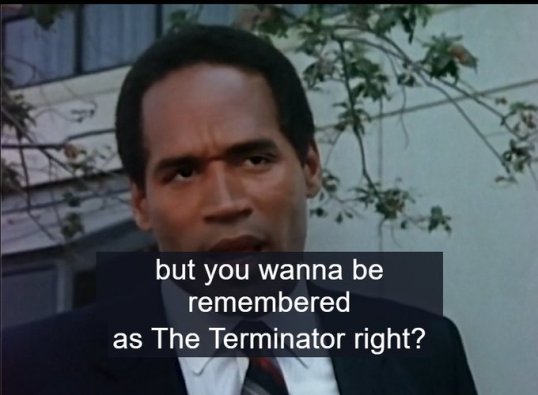
It was up to O.J. Simpson to talk some sense into Joe Morgan. O.J. went to the hospital and told Joe that football was all about getting injured. O.J. asked Joe if this was the way he wanted to go out.
By appealing to Joe’s desire to be remembered as a killer football player, OJ is able to convince Joe to drop the charges.
Welcome to Late Night Retro Television Reviews, a feature where we review some of our favorite and least favorite shows of the past! On Wednesdays, I will be reviewing 1st and Ten, which aired in syndication from 1984 to 1991. The entire series is streaming on Tubi.
Things aren’t looking too good for the Bulls!
Episode 3.7 “A Mutiny on the Bull Team”
(Dir by Stan Lathan, originally aired on October 7th, 1987)
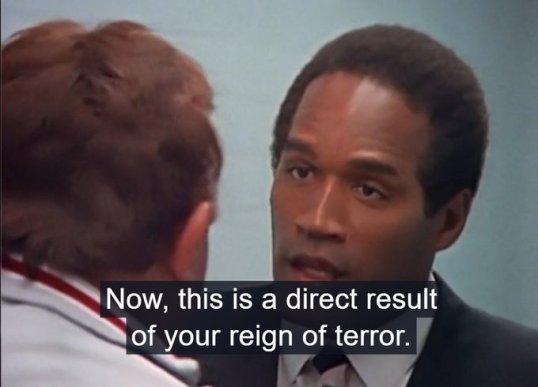
After a terrible start to the season (back-to-back losses!), TD tells Coach Grier that he needs to do something to get the team back into championship shape. Coach Grier launches an intensive training regimen and he posts a list of rules in the locker room — no beer in the locker room, players must shave for game day, and a bunch of other things. The players rebel and, during the next game, they stop running the plays that Grier wants. TD confronts Grier and demands to know what’s going on. Grier says that he just did what TD told him to do. TD says that he didn’t tell Grier to become a dictator even though that is kind of what TD told him to do.
Really, “reign of terror?” Coach Grier is like in his 60s and he’s fat and out of shape. The football players are …. well, football players. What exactly is TD Parker saying? It’s hard to say. OJ Simpson delivers all of his lines in the same amiable and bland manner that he used when he said he would devote his life to searching for the real killers. It’s hard to know what TD is thinking.
Anyway, Grier realizes the errors of his ways and the Bulls win the game! So, TD doesn’t have to cut anyone from the team. He can put away his knife for now. Everyone in the locker room should be breathing a sigh of relief.
Meanwhile, Yinessa and new owner Jill Schrader struggle with their feelings for each other. In the end, Yinessa kisses Jill in the stadium parking lot so I guess they decided to forget about the whole “We have to maintain a professional separation” thing.
One final note: Last week’s episode featured Delta Burke swearing that she was going to reclaim ownership of the Bulls. But, with this episode, Burke is no longer listed in the opening credits so I guess that storyline is over with. Jill is now the owner. Good! Maybe the Bulls will finally win a championship.
Welcome to Late Night Retro Television Reviews, a feature where we review some of our favorite and least favorite shows of the past! On Wednesdays, I will be reviewing 1st and Ten, which aired in syndication from 1984 to 1991. The entire series is streaming on Tubi.
This episode was confusing. Is syndication to blame?
Episode 3.6 “The Bulls Change Hands”
(Dir by Stan Lathan, originally aired on September 9th, 1987)
Diana no longer owns the Bulls!
That was the main plot development to be found in this cluttered episode of 1st & Ten. As I’ve mentioned before, the episodes of 1st & Ten that are available on Tubi are the heavily edited versions that were sold into syndication as opposed to the original, R-rated versions that appeared on HBO. With quite a few of these episodes, it’s obvious that entire plotlines have been pretty much chopped out. That certainly feels like the case here because, despite having watched the episode, I’m still not totally sure how Diane lost the Bulls in the first place.
What I do know is that she threatened to expose Teddy’s insider trading. Teddy responded by leaving the country but, before he left, he gave his ownership shares to his daughter, Jill (Leah Ayres). Teddy explains that this makes Jill the owner of the Bulls. But my understanding was that Teddy only owned half the team so it seems like that would mean Jill and Diane would now be co-owners. Perhaps I missed something in an earlier episode or maybe some line of dialogue was cut out for syndication, I’m not sure. What I do know is that Jill now owns the Bulls. The first thing she does is break up with Yinessa because she can’t be both his boss and his girlfriend.
In her final locker room speech, Diane orders the Bulls to win because Diane is taking Jill to court and she wants the team to be in the playoffs once she returns as the owner. It’s not a bad speech but again, I thought Diane still owned at least half of the team.
Meanwhile, Yinessa is back as quarterback. And he leads the Bulls to their first victory of the season. His new wide receiver, Billy Cooper (Michael Toland) catches the game-winning pass. At the same time that Billy is scoring, some guy who we’ve never seen before is shooting at him from the roof of the stadium. The police arrest the guy and Billy later discovers a bullet lodged in his helmet.
Bubba’s sex therapist (Penny Johnson) is now obsessed with him, despite Bubba’s attempts to set her up with with Jethro. I have a feeling that the Jethro/Bubba storylines were the ones that really got left on the cutting room floor when it came to editing these episodes for syndication. Jethro and Bubba have been with the show since the beginning and they’ve got prominent billing in the opening credits but, when it comes to their roles in the episodes themselves, it seems like the only thing that happens is Bubba says that he needs to get laid and then the two of them disappear for several weeks. When they do finally reappear, Bubba is always in some sort of new trouble with his wife.
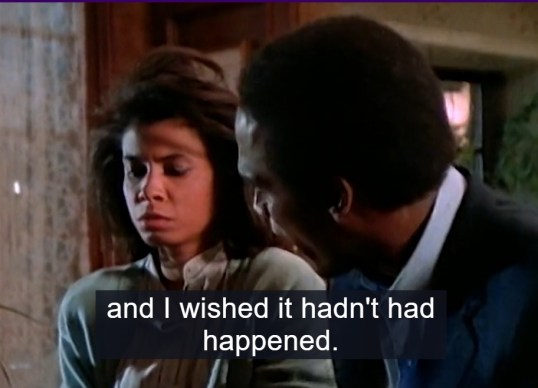
Speaking of marriage, in this episode, TD Parker finally confesses to his wife that he’s been having an affair.
TD apologizes. His wife tells him to get out. Agck! I can see where this storyline is heading but OJ Simpson fighting with his wife still lands differently in 2026 than it probably did in 1987.
This episode was a mess but I guess Jill is the owner of the Bulls now and Teddy’s fled to South America. Can’t the Bull just concentrate on playing football and earning their paycheck?
Welcome to Late Night Retro Television Reviews, a feature where we review some of our favorite and least favorite shows of the past! On Wednesdays, I will be reviewing 1st and Ten, which aired in syndication from 1984 to 1991. The entire series is streaming on Tubi.
This week, OJ Simpson argues with his wife.
Episode 3.3 “A Loaded Gun”
(Dir by Stan Lathan, originally aired on August 19th, 1987)
With Yinessa continuing to hold out for more money, Teddy thinks that he’s come up with a solution. He tells Yinessa that he will personally take out an insurance policy on him so that Yinessa can work out with the team, despite not having a contract. Yinessa agrees. TD Parker tells all of the defenders not to touch Yinessa because they cannot risk him getting hurt.
“Anyone who touches Yinessa is going to wind up in Buffalo!” Parker tells them.
Unfortunately, John Manzak has been taken too many steroids. As a result, the first thing he does is sack Yinessa. Yinessa is injured. As he’s rushed to the hospital, Diane tells Teddy, “Thank God you got that insurance policy.” Teddy looks worried — uh oh, it looks like someone didn’t get that insurance policy!
At the hospital, a doctor tells Diane that Yinessa has a detached retina and he’ll probably never play football again.
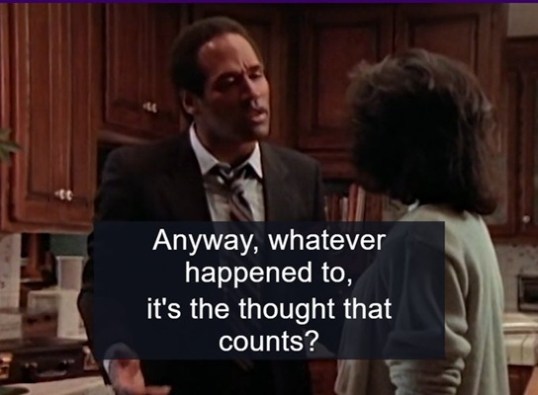
Meanwhile, TD is having trouble in his marriage. He forgets his wife’s birthday but TD’s secretary (Leah Ayres) sends flowers and buys a gift. Unfortunately, TD’s wife sees through the entire ruse. She and TD argue. And because TD Parker is played by OJ Simpson, it’s hard not to worry whenever anyone argues with him.
Hey, that’s a good point, OJ! Let’s move on!
Also, in this episode, Bubba goes to therapy because he hasn’t been able to make love to his wife since she gave birth. Jethro goes with him and pretends to have a shoe fetish. This led to another patient hiding his shoes. 1st and Ten is a comedy that rarely makes me laugh but I have to admit that I did chuckle when Jethro started talking about how much he loved shoes.
Other than the therapy scene, this was a pretty serious episode. Yinessa might never play again. John Manzak is going crazy due to the steroid abuse. (Is he going to be sent to Buffalo? I don’t know how he’s going to handle that!) The kicker is still looking for a wife so he won’t get deported. And Diane has no idea what’s going on with her team.
How will the Bulls ever make it to the championship game!?
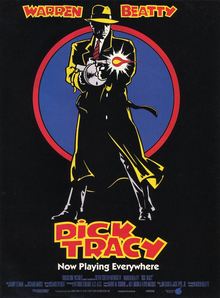
The year is 1937 and “Big Boy” Caprice (Al Pacino) and his gang of flamboyant and often disfigured criminals are trying to take over the rackets. Standing in their way is ace detective Dick Tracy (Warren Beatty), the yellow trench-wearing defender of the law. Tracy is not only looking to take down Caprice but he and Tess Trueheart (Glenne Headly) are currently the guardians of The Kid (Charlie Korsmo), a young street kid who witnessed one of Caprice’s worst crimes. Tracy’s investigation leads him through a rogue’s gallery of criminals and also involves Breathless Mahoney (Madonna), who has witnessed many of Caprice’s crimes but who also wants to steal Tracy’s heart from Tess.
Based on the long-running comic strip, Dick Tracy was a labor of love on the part of Warren Beatty. Not only starring but also directing, Tracy made a film that stayed true to the look and the feel of the original comic strip (the film’s visual palette was limited to just seven colors) while also including an all-star cast the featured Madonna is an attempt to appeal to a younger audience who had probably never even heard of Dick Tracy. When Dick Tracy was released, the majority of the publicity centered around Madonna’s participation in the film and the fact that she was dating Beatty at the time. Madonna is actually probably the weakest element of the film. More of a personality than an actress, Madonna is always Madonna no matter who she is playing and, in a film full of famous actors managing to be convincing as the members of Dick Tracy’s rogue gallery, Madonna feels out of place. Michelle Pfeiffer would have been the ideal Breathless Mahoney.
It doesn’t matter, though, because the rest of the film is great. It’s one of the few comic book films of the 90s to really hold up, mostly due to Beatty’s obvious enthusiasm for the material and the performances of everyone in the supporting cast who was not named Madonna. Al Pacino received an Oscar nomination for playing Big Boy Caprice but equally good are Dustin Hoffman as Mumbles, William Forsythe as Flaptop, R.G. Armstong as Pruneface, and Henry Silva as Influence. These actors all create memorable characters, even while acting under a ton of very convincing makeup. I also liked Dick Van Dyke as the corrupt District Attorney. Beatty knew audience would be shocked to see Van Dyke not playing a hero and both he and Van Dyke play it up for all its worth. Beatty embraces the comic strip’s campiness while still remaining respectful to its style and the combination of Danny Elfman’s music and Stephen Sondheim’s songs provide just the right score for Dick Tracy’s adventures. The film can be surprisingly violent at times but the same was often said about the Dick Tracy comic strip. It wasn’t two-way wrist radios and trips to the Moon. Dick Tracy also dealt with the most ruthless and bloodthirsty gangsters his city had to offer.
Dick Tracy was considered to be a box office disappointment when it was originally released. (Again, you have to wonder if Beatty overestimated how many fans Dick Tracy had in 1990.) But it holds up well and is still more entertaining than several of the more recent comic book movies that have been released.
Welcome to Retro Television Reviews, a new feature where we review some of our favorite and least favorite shows of the past! On Fridays, I will be reviewing St. Elsewhere, a medical show which ran on NBC from 1982 to 1988. The show can be found on Hulu!
This week, William Daniels claims the show as his own.
Episode 1.2 “Bypass”
(Dir by Thomas Carter, originally aired on November 9th, 1982)
“Hey, it’s Tim Robbins!”
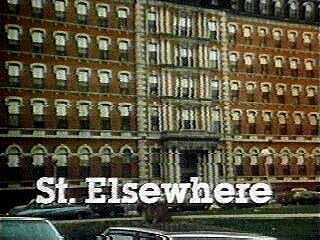
Yes, the future Oscar winner shows up in the second episode of St. Elsewhere, playing a rich kid-turned-terrorist named Andrew Reinhardt. Reinhardt, who no doubt learned all about Marxism during his first semester away at college, set off a bomb in a bank, killing two people and putting a woman named Kathleen McCallister into a coma. Both Reihnhardt and McCallister have been brought to St. Eligius. While Kathleen’s husband, Stephen (Jack Bannon), sobs in the hallway, Reinhardt acts like a petulant brat in his hospital room.
With the nurses refusing to change his sheets or even give him his morphine shots, it falls to Dr. Morrison to take care of him. Reinhardt is not at all appreciative and Morrison finds himself conflicted. How is he supposed to give proper medical treatment to someone who he despises? Morrison is so conflicted that he even goes to Dr. Westphall. Westphall responds by telling a long story about a time that he fell in love with a patient. I’m getting the feeling that Morrison feeling conflicted and Westphall telling long stories are both going to be regular features on this show.
(The correct answer to Morrison’s question about how he can take care of a bad person is as follows: It’s your job and you’re getting paid to do it.)
This episode also gave the viewer a chance to get to know Dr. Craig, the very talented but very egotistical head of surgery who is played by the great William Daniels. Dr. Craig holds a press conference to inform reporters about the conditions of both Reinhardt and Kathleen McCallister and declares that, despite its bad reputation, “St. Eligius is the place to be!” He then proceeds to get angry when the press is more interested in talking to the surgeon who actually saved Kathleen’s life than to him.
Dr. Craig browbeats a Mr. Broadwater (Robert Costanzo) into getting bypass surgery done. The surgery appears to have been a success but it’s hard to ignore that Craig essentially bullied the guy into getting a major operation, one that could have killed him if the least little thing had gone wrong. Resident Victor Ehrlich (Ed Begley, Jr.) assists in the operation and, at one point, Dr. Craig intentionally head butts him when Ehrlich cannot name all of the arteries leading into the heart. It’s a bit aggressive but, on the plus side, Ehrlich does learn all of the names. Afterwards, Dr. Craig brags about how his own son is following in his footsteps and tells Mr. Broadwater’s son that some day, a new Dr. Craig will operate on him. In other words, Dr. Craig is kind of a jerk but he’s good at what he does and he’s played by William Daniels so it’s hard to hold anything against him.
There were other subplots playing out in the background, the majority of which just seemed to be there to remind us that St. Elsewhere is an ensemble show and that, just because someone isn’t a major character in this episode, that doesn’t mean they won’t be important later on. Psychiatrist Hugh Beale (G.W. Bailey) attempted to learn how to swim and ended up taking a class with a bunch of children. Dr. Fiscus (Howie Mandel, the least convincing doctor ever) held court in the cafeteria and claimed that the hormones used in processing food were causing children to develop earlier than ever before. Dr. Peter White (Terrence Knox) wandered around with a bunch of X-rays and begged everyone he met to help him understand what he was (or wasn’t) seeing. If nothing else, this episode did a good job of capturing the idea of the hospital as being a place that’s always busy.
For the most part, though, it was Dr. Craig who carried this episode. While Morrison and Westphall ponderously considered the implications of doing their jobs, Craig was an arrogant, angry, and brilliant dynamo and William Daniels’s high-energy performance was a pleasure to watch. Whenever the episode started to slow down, Dr. Craig would liven things up by yelling at someone. The hospital was lucky to have Dr. Craig and St. Elsewhere was lucky to have William Daniels.
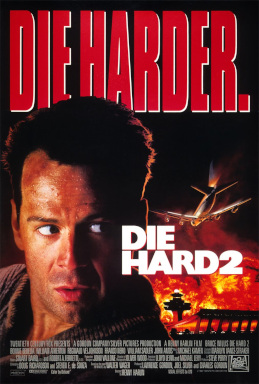
During 1990’s Die Hard 2, John McClane (Bruce Willis) asks himself, “How can the same shit happen to the same person twice?” and he does have a point.
I mean, consider the situation. In 1988, McClane spent his Christmas sneaking around a skyscraper and saving his wife from a group of sadistic mercenaries. Two years later, John McClane spends his Christmas sneaking around an airport and saving his wife from a group of sadistic mercenaries.
There are a few differences of course. In 1988, the mercenaries were only interested in stealing as much money as they could and each mercenary had his own properly ghoulish personality. In 1990, the mercenaries are really more of a cult, led by the fanatical Col. Stuart (William Sadler). And, along with trying to make some money, they are also trying to free General Ramon Esperanza (Franco Nero), a Central American drug lord and former CIA asset. Despite the fact that the mercenaries are played by familiar actors (like Robert Patrick, John Leguizamo, Tony Ganois, and Vondie Curtis-Hall), none of them are quite as memorable as the henchmen that Alan Rickman commanded in the first film. And while Sadler has charisma and makes a big impression during his first scene, his character is nowhere near as interesting or entertaining as Hans Gruber. Franco Nero, it must be said, is as dashing as ever. He really seems to be having fun in this movie.
A lot more people die in Die Hard 2 than died in the first Die Hard and the majority of them are innocent bystanders. This isn’t like the first film, where Harry Ellis died because his coke-addled mind led him to believe that he could outsmart Gruber. The victims in Die Hard 2 include a friendly church caretaker and over 200 passengers of an airplane that Stuart tricks into crashing on an airport runway. The scene where the plane crashes remains disturbing no matter how many times that you see it and it truly makes you hate Colonel Stuart. When the plane crashes, despite McClane’s futile efforts to warn the pilots, McClane sobs and it’s a powerful scene because it’s the first scene in which McClane has not had a quip or a one-liner ready to go. In this scene, McClane fails to save the day and, for a few minutes, he’s helpless. I usually end up crying with McClane. Today, those tears are also a reminder of what a good actor Bruce Willis truly could be whenever he let down his defenses and allowed himself to be vulnerable on screen.
Die Hard 2 is usually dismissed as not being as good as the first movie and …. well, that’s correct. It’s not as good but then again, few actions films are. There’s a reason why Die Hard continues to be held in such high regard. That said, Die Hard 2 is not bad. The stakes are a bit higher and the action scenes a bit more elaborate, as you would expect from a film directed by Renny Harlin. Bruce Willis plays McClane with the blue collar swagger that made his such an awesome hero in the first film. Bonnie Bedelia and William Atherton also return from the first film and Atherton once again gets his comeuppance in a crowd-pleasing moment. The cast is full of character actors, all of whom get a chance to make an impression. Dennis Franz is the profane head of security who eventually turns out to be not such a bad guy. John Amos is the major who eventually turns out to be not such a good guy. Colm Meaney has a few heart-breaking moments as the pilot of the doomed airplane. My favorite supporting performance is given by Fred Thompson, bringing his quiet authority to the role of tough but fair-minded Air Traffic Control director. Watching Die Hard 2, it does feel as if the viewer has been dropped in the middle of these people’s lives. Everyone seems real. No one seems like a mere plot device.
Is Die Hard a Christmas movie? You bet it is! But so is Die Hard 2 and it’s not a bad one.
Here’s a good example of why I need to clean out my DVR more regularly:
I recorded the 1983 legal thriller, The Star Chamber, off of Starz on March 14th. I know what you’re saying. “Big deal! That wasn’t that long ago.” Well, did I mention that it was March 14th, 2017?
That’s right! The Star Chamber sat on my DVR for over a year before I finally got around to watching it last night. You’d be justified in asking why it took me so long and I’m afraid that I really couldn’t give you a definite answer. I can, however, tell you the four main reasons why I recorded it in the first place:
I’m always intrigued whenever I come across a movie of which I haven’t previously heard.
The movie was described as being about a conflicted judge and I just happen to love legal films.
I really, really liked the title. The Star Chamber? Did that mean it took place in a room full of stars?
Before I recorded The Star Chamber, I only had 55 films on the DVR. Since I don’t like odd numbers, recording The Star Chamber took care of that problem.
As for the film itself, The Star Chamber is another one of those movies where a group of vigilantes end up getting pissed off because liberal California judges are letting too many murderers go free because of pesky, constitutional technicalities. The twist here is that the vigilantes are the same judges who keep tossing out evidence and ruling that confessions are inadmissible in court. After spending their day setting free the dregs of society, the judges all gather in a nearby house and review the evidence before voting on whether or not they believe the accused was actually guilty. If the verdict is guilty, the judges promptly hire a hit man who proceeds to clean up the streets.
The newest member of this tribunal is Judge Steven R. Hardin (Michael Douglas). Hardin is haunted by the technicalities that forced him to toss out a case against two accused of child murderers. (Making things even worse, the child’s father commits suicide afterward.) Despite his initial reservations, Judge Hardin signs off on hiring an assassin to take the two men out. But, when it becomes apparent that the two men actually were innocent, Judge Hardin is horrified to discover that there’s no way to call off the hit…
The Star Chamber is an oddly constructed movie. When the movie starts, it feels like a typical police procedural. From there, the movie turns into a rather talky examination of the U.S. legal system, with Judge Hardin trying to balance his idealism with the often frustrating reality of what it takes to uphold the law. The movie then briefly turns into a conspiracy film, featuring middle-aged men in suits holding secret meetings and debating whether or not they’re serving the greater good. And then, towards the end of the movie, it turns into an action film, with Judge Hardin being chased by two drug dealers, a contract killer, and a suspicious police detective (Yaphet Kotto). Judge Hardin may start the movie as a conflicted liberal but he ends at someone who can blow up the entire second floor of a drug lab. In many ways, The Star Chamber is a deeply silly film but, as directed and co-written by Peter Hyams, it’s also just pulpy enough to be entertaining. The dialogue may be over-the-top but so is Michael Douglas’s performance so it all evens out in the end.
It may have taken me a while to get around to watching The Star Chamber but I’m glad that I finally did. It’s a ludicrous film and all the more entertaining as a result.
Back in January, I had to get a new cable box. Sadly, when the boxes were switched, I lost everything that I had saved on the DVR. Over a hundred movies and TV shows were wiped away! However, I did not let this get me down. Instead, I decided to take advantage of the fact that I now had a lot more free space by literally recording anything that looked the least bit interesting.
Well, the day of reckoning has finally arrived. It is now March 21st and the DVR is nearly full. So, for the next few weeks, I am going to clean out my DVR and review what I watch! Now, I can’t say how long this is going to take. In the past, I’ve always given myself unrealistic deadlines. So, this time, I’m not giving myself a time limit. Instead, I’m just going to start watching what I’ve got recorded and hope that I’m done by 2018. We’ll see how it goes.
Anyway, I started things off by watching the 2005 mafia romance film, In the Mix.
I recorded In The Mix off of Starz on March 16th. I did this despite the fact that I’ve actually seen In The Mix quite a few times. In The Mix, which is technically a beyond terrible movie, is a bit of a guilty pleasure of mine. It’s a bit like From Justin To Kelly or On The Line. Even though all my instincts as a movie snob tell me not to do it, I can’t help but watch it.
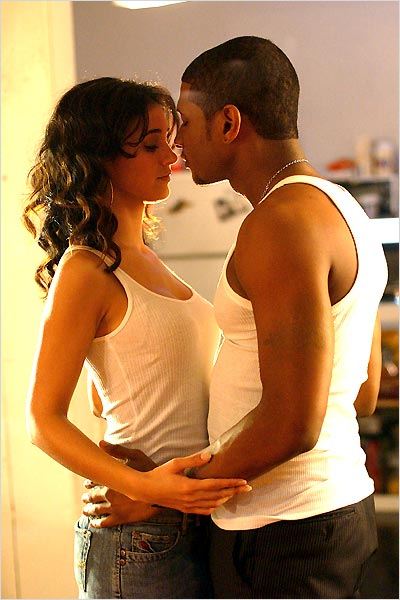
In the Mix stars Usher as Darrell, the hottest DJ in New York. Every woman wants him and every man wants to be him. However, all Usher wants to do is hang out with the family of the local mob boss. It turns out that Don Frank (Chazz Palminteri) was friends with Darrell’s father and Darrell is now friends with Frank’s son, Frankie Jr. (Anthony Fazio). Frank hires Darrell to DJ his daughter’s birthday party.
(Frankie, Jr. is a white kid who wants to be black. Personally, I think there’s probably an interesting story in the idea of the son of an old-fashioned Italian mafia don who idolizes — or appropriates, depending on how you look at it — black culture but Frankie, Jr.’s characterization pretty much starts and ends with him saying, “Yo.”)
At the party, Darrell quickly falls in love with Frank’s daughter, Dolly (Emmanuelle Chriqui) and Dolly likes him too. Especially after he takes a bullet that was intended for her father. While Darrell is recuperating at the mansion, Frank tells Dolly that she can’t go outside unless she has a bodyguard. Dolly says that’s fine as long as the bodyguard is Darrell.
And you know what that means! It’s time for a makeover montage as Darrell gets a whole new wardrobe! Yay!
Anyway, the plot is about as predictable as the casting of Kevin Hart as Usher’s comedic sidekick and Robert Davi as a sinister gangster. Dolly and Darrell fall in love but you already knew that was going to happen. You also probably already guessed that Dolly already has a boring boyfriend named Chad (Geoff Stults) and that Darrell has a crazy ex-girlfriend named Cherise (K.D. Aubert). And, of course, Frank is not initially happy with the idea of Dolly leaving her rich lawyer boyfriend so that she can be with Darrell. However, Darrell eventually gets a chance to prove himself by rescuing Dolly from some rival gangsters and he’s welcomed into the crime family. Of course, he gets shot a second time. “If the ghetto’s so dangerous,” he says as he lies on the ground, “how come I keep getting shot by white people?” Everyone has a good laugh as they wait for the ambulance. That’s the type of movie that In The Mix is.
As I watched In The Mix, I realized that it was actually a lot worse than I remembered and yet, I still enjoyed it. Why? To be honest, it all comes down to Usher and Emmauelle Chriqui, both of whom look really, really good and who have enough chemistry that they can overcome an amazingly clunky script. You reallydo believe that the two of them actually are into each other and you hope that things will work out for them because they’re such a ludicrously attractive couple. In The Mix is an incredibly shallow and silly movie but the stars both look good when they kiss and, ultimately, that’s what a movie like this is all about.
That said, in the future, I probably won’t bother to set the DVR for it again.

 Through the Shattered Lens