A Movie A Day #185: Emperor of the North Pole (1973, directed by Robert Aldrich)


Emperor of the North Pole is the story of depression-era hobos and one man who is determined to kill them.

The year is 1933 and Shack (Ernest Borgnine) is one of the toughest conductors around.  At a time when destitute and desperate men are riding the rails in search of work and food, Shack has declared that no one will ride his train for free.  When Shack is first introduced, the sadistic conductor is seen shoving a hobo off of his train and onto the tracks.  Shack smiles with satisfaction when the man is chopped in half under the train’s wheels.

A-No.1 (Lee Marvin) is a legend, the unofficial king of the hobos.  A grizzled veteran, A-No. 1 has been riding the rails for most of his life.  (The title comes from the hobo saying that great hobos, like A-No. 1, are like the Emperor of the North Pole, the ruler of a vast wasteland).  A-No. 1 is determined to do what no hobo has ever done, successfully hitch a ride on Shack’s train.  He even tags a water tower, announcing to everyone that he intends to take Shack’s train all the way to Portland.

If A-No. 1 did not have enough to worry about with Shack determined to get him, he is also being tailed by Cigaret (Keith Carradine), a young and cocky hobo who is determined to become as big a legend as A-No. 1.  Cigaret and A. No. 1 may work together but they never trust each other.

Like many of Robert Aldrich’s later films, Emperor of the North Pole is too long and the rambling narrative often promises more than it can deliver.  Like almost all movies that were released at the time, Emperor of North Pole attempts to turn its story into a contemporary allegory, with Shack standing in for the establishment, A-No. 1 representing the liberal anti-establishment, and, most problematically, Cigaret serving as a symbol for the callow counter culture, eager to take credit for A-No. 1’s accomplishments but not willing to put in any hard work himself.

As an allegory, Emperor of the North Pole is too heavy-handed but, as a gritty adventure film, it works wonderfully.  Lee Marvin is perfectly cast as the wise, no-nonsense A-No. 1.  This was the sixth film in which Marvin and Borgnine co-starred and the two old pros both go at each other with gusto.  Carradine does the best he can with an underwritten part but this is Borgnine and Marvin’s film all the way.  Marvin’s trademark underacting meshes perfectly with Borgnine’s trademark overacting, with the movie making perfect use of both men’s distinctive screen personas.  As staged by Aldrich, the final fight between Shack and A-No. 1 is a classic.

Even at a time when almost every anti-establishment film of the early 70s is being rediscovered, Emperor of the North Pole remains unjustly obscure.  When it was first released, it struggled at the box office.  Unsure of how to sell a movie about hobos and worrying that audiences were staying away because they thought it might be a Christmas film, 20th Century Fox pulled the movie from circulation and then rereleased it under a slightly altered name: Emperor of the North.  As far as titles go, Emperor of the North makes even less sense than Emperor of the North Pole.  Even with the title change, Emperor of the North Pole flopped at the box office but, fortunately for him, Aldrich was already working on what would become his biggest hit: The Longest Yard.

Keep an eye out for Lance Henriksen, in one of his earliest roles.  Supposedly, he plays a railroad worker.  If you spot him, let me know because I have watched Emperor of the North Pole three times and I still can’t find him.


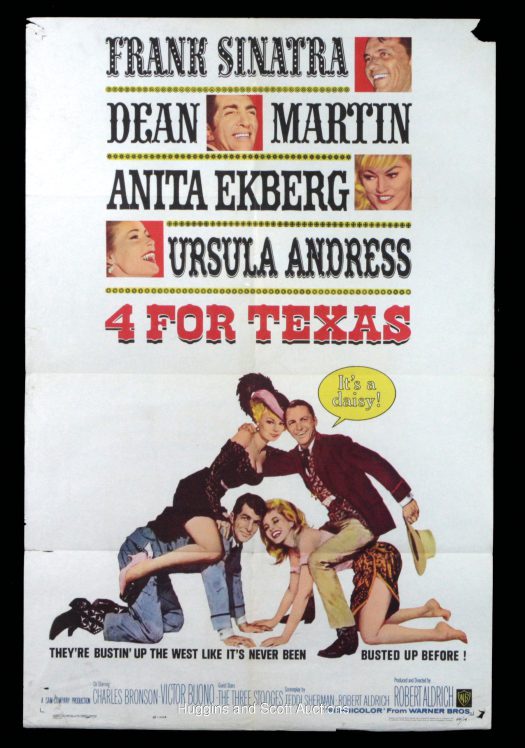
Rat Pack – 3 = FOUR FOR TEXAS (Warner Brothers 1963)


gary loggins's avatarcracked rear viewer

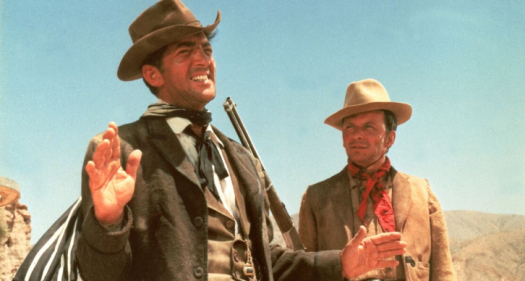
The wait is finally over, my new DirecTV receiver has arrived and is all hooked up! Unfortunately, all my DVR’d movies have vanished. And since it was filled to about 70% capacity, that’s a lot of movies! Needless to say, I’ve got to load up the ol’ DVR again. Thanks to TCM, I re-recorded one of my old favorites the other day, FOUR FOR TEXAS, an action-packed Western comedy I’ve seen about 100 times already (ok, that’s a slight exaggeration). This combines the two leaders of the Rat Pack, Frank Sinatra and Dean Martin , with the talents of director Robert Aldrich. The result is an all-star, slam-bang entertainment that is loads of fun for film fans.

The pre-credits sequence looks like we’re about to watch a traditional Western, with a gang of outlaws led by Charles Bronson   riding out to ambush a stagecoach. But wait, that’s Frankie and Dino…

View original post 684 more words

A Movie A Day #10: The Longest Yard (1974, directed by Robert Aldrich)


longest-yard-burt-reynolds

Once, Paul “Wrecking” Crewe (Burt Reynolds) was a superstar NFL quarterback.  That was until he was caught up in a point-shaving scandal and kicked out of the league.  When a drunk Crewe steals his girlfriend’s car, gets into a high-speed police chase, and throws a punch at a cop, he ends up sentenced to 18 months at Citrus State Prison.

The warden of the prison, Rudolph Hazen (Eddie Albert), is a football fanatic who, at first, is excited to have Crewe as an inmate.  The prison guards have a semi-pro football game and Hazen wants Crewe to coach the team and help them win a national championship.  Though initially reluctant and just wanting to do his time, Crewe relents after witnessing and experiencing the cruelty of the prison system.  Crewe forms The Mean Machine, a team made up of prisoners, and agrees to play an exhibition game against the guards.

At first, the members of the Mean Machine are just looking for an excuse to hit the guards without being punished but soon, they realize that they have a chance to win both the game and their dignity.  But Hazen is not above blackmailing Crewe to throw the game.

When it comes to understanding the Tao of Burt, The Longest Yard is the place to start.  Starting with a car chase and ending with near martyrdom, The Longest Yard is the ultimate Burt Reynolds film.  Paul Crewe ranks alongside Deliverance’s Lewis Medlock and Boogie Night‘s Jack Horner as Reynolds’s best performance.  Before injuries ended his athletic career, Reynolds was a college football star and, on the prison’s playing field, he holds his own with the large group of former professional football players who were cast to play the guards and the prisoners.  The Longest Yard’s climatic football game takes up over an hour of screen time and reportedly, the action was largely improvised during shooting.  Unlike most movie football games, the one in The Longest Yard looks and feels like a real game.

The Longest Yard was directed by Robert Aldrich, who specialized in making movies about anti-authoritarians fighting the system.  The scenes of Crewe recruiting and training The Mean Machine are very reminiscent of Aldrich’s best-known movie, The Dirty Dozen.  With its combination of dark humor, graphic violence, rebellious spirit, and Southern-friend melodrama, The Longest Yard is a movie that could only have worked in the 1970s.  The Adam Sandler remake may have made a lot of money at the box office but it still comes nowhere close to matching the original.

For tomorrow’s movie a day, it’s the best film of 2016, which also happens to be about a football player in prison.

thelongestyard

Hammer Time!: KISS ME DEADLY (United Artists 1955)


gary loggins's avatarcracked rear viewer

kissme1

Mickey Spillane’s Mike Hammer novels have long been one of my favorite Guilty Pleasures. Spillane’s books were the literary equivalent of knocking back shots of Jack Daniels with no chaser. The misanthropic Mike Hammer’s Sex & Violence filled adventures are rapid paced, testosterone fueled trips through a definitely un-PC world where men are men, women are sex objects, and blood and bullets flow freely through a dark, corrupt post-war world.  Spillane turned the conventional detective yarn on its ear and, though critics hated his simplistic writing, the public ate up his books by the millions.

kissme2

The film version of Spillane’s KISS ME DEADLY turns film noir on its ear from its opening shot of Christine Bailey (a young Cloris Leachman) running down a lonely highway, almost getting run over by Mike Hammer. The PI picks her up and the opening credits roll backwards to the strains of Nat King Cole crooning “Rather Have The Blues”. This beginning set-up lets…

View original post 844 more words

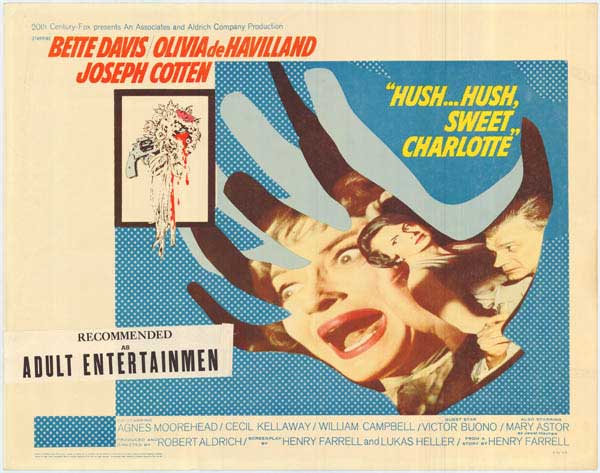
Happy 100th Birthday Olivia de Havilland!: HUSH… HUSH, SWEET CHARLOTTE (20th Century Fox 1964)


gary loggins's avatarcracked rear viewer

char1

Today marks the 100th birthday of one of the last true Golden Age greats, Olivia de Havilland. Film fans across the globe are celebrating the life and career of this fine actress, who fought the Hollywood system and won. Olivia is the last surviving cast member of GONE WITH THE WIND (Melanie Wilkes), won two Academy Awards (TO EACH HIS OWN, THE HEIRESS), headlined classics like THE SNAKE PIT and THE DARK MIRROR, and costarred with dashing Errol Flynn in eight exciting films, including CAPTAIN BLOOD , THE ADVENTURES OF ROBIN HOOD, SANTA FE TRAIL, and THEY DIED WITH THEIR BOOTS ON.

Olivia moved to Paris with her husband in the 1950’s and was semi-retired, acting in a handful of films. In 1962 director Robert Aldrich  scored a huge hit, a psychological horror thriller called WHATEVER HAPPENED TO BABY JANE?, starring screen veterans Bette Davis and Joan Crawford. A new genre was…

View original post 835 more words

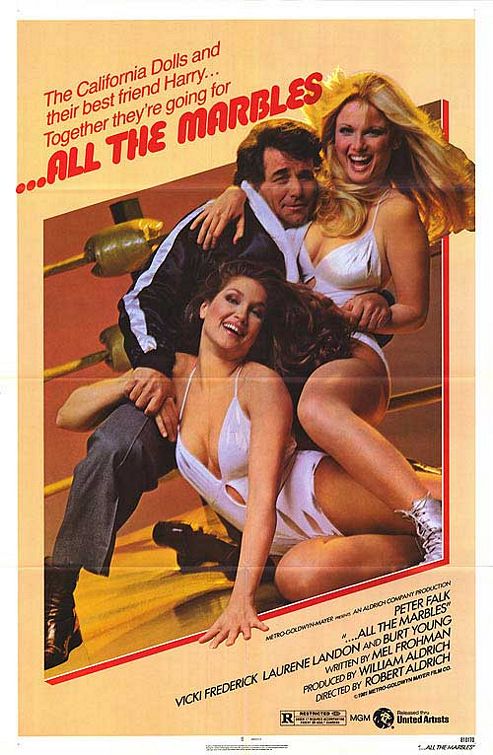
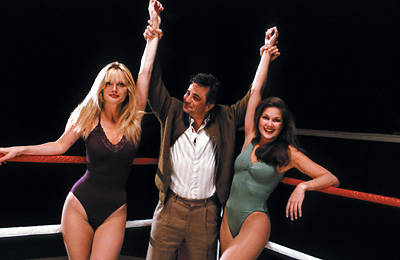
Tag Team Turmoil: …ALL THE MARBLES (MGM 1981)


gary loggins's avatarcracked rear viewer

all_the_marbles

Before Dwayne “The Rock” Johnson, before Hulk Hogan and Roddy Piper , the worlds of professional wrestling and the movies had long been entwined. After all, they’re both show biz! Grapplers like Nat Pendleton , Mike Mazurki, Tor Johnson , Harold Sakata (GOLDFINGER’s Oddjob), and Lenny Montana (Luca Brasi in THE GODFATHER) made the successful transition from the squared circle to Hollywood, not to mention Mexican luchadores like El Santo and Mil Mascaras, who starred in the ring and in their own series of movies south of the border. Even early TV wrestling phenom Gorgeous George had his own feature film, 1949’s ALIAS THE CHAMP.

marbles

1981’s …ALL THE MARBLES was made just before the Hulkamania craze started a boom in pro wrestling’s popularity. It’s a serio-comic character study centering on small time manager Harry Sears and his two young charges Iris and Molly,  better known as tag team The California Dolls. Harry and Iris…

View original post 748 more words

4 Shots From 4 Films: Charles Bronson Edition


I think it’s becoming a sort of unofficial tradition to celebrate a particular film legend’s birthday using the 4 Shots From 4 Films series as platform to showcase these individuals best and lesser-known films.

Today, we focus and celebrate what would’ve been the 93rd birthday of one Charles Dennis Buchinsky. That name may not resonate to the csual film fans, but I’m sure his chosen professional moniker will: Charles Bronson.

Charles Bronson was part of that group of actors during the 60’s and 70’s who epitomized the macho and badass personality on the big-screen. Bronson’s legacy has lived on through such classic films as The Magnificent Seven, The Dirty Dozen and Once Upon A Time In America right up to his more lesser-known films such as Hard Times, Telefon and Death Hunt.

4 shots from 4 films

The Magnificent Seven (dir. by John Sturges)

The Magnificent Seven (dir. by John Sturges)

TheDirtyDozen

The Dirty Dozen (dir. by Robert Aldrich)

Once Upon A Time In the West (dir. by Sergio Leone)

Once Upon A Time In the West (dir. by Sergio Leone)

Death Hunt (dir. by Peter R. Hunt)

Death Hunt (dir. by Peter R. Hunt)

Embracing the Melodrama Part II #49: Hustle (dir by Robert Aldrich)


HustleContinuing our journey into the dark Hell of the 1970s, we now take a quick look at the 1975 cop film, Hustle.

Taking place in Los Angeles, Hustle tells the story of several different people who find their lives intertwined in the desperate dance of existence.  (Does that sound overdramatic?  Well, that’s the type of film that this is.)

There’s Leo Sellers (Eddie Albert), a lawyer with bright rosy cheeks and a friendly manner.  You look at Leo and you automatically assume that he must be a nice guy, the type of guy who puts on a fake beard and plays Santa Claus down at the local orphanage.  But actually, Leo is a lawyer for the mob.  He’s gotten rich through crime and his mansion hides all sorts of secrets.  He also has a weakness for violently abusing prostitutes.

Speaking of prostitutes, one of Leo’s favorite is Nicole (Catherine Deneuve), an icy French beauty who survives by holding the world at a distance.  Though Nicole doesn’t like Leo, she has to keep him happy because Leo could easily arrange for her to be deported back to France.

Nicole is also the girlfriend of Phil Gaines (Burt Reynolds), a cynical homicide detective who, like her, tries to keep the world at a distance.  Phil is obsessed with old films and frequently speaks of how much he wishes the real world could be like a movie.  Throughout the film, he talks about eventually moving to Rome.

Phil’s partner is Louis Belgrave (Paul Winfield), who is not quite as cynical as Phil but who is definitely getting there.  Whereas Phil is always talking about how much the world has disappointed him, Louis mostly accepts things without complaint.  He just wants to do his job and go home at the end of the day.

Phil and Louis’s boss is Santoro (Ernest Borgnine, giving a typical Ernest Borgnine performance).  Santoro is not a bad guy but, in order to hold onto his job, he has to keep powerful men like Leo Sellers happy.

Santoro also has to deal with the complaints of people like the Hollingers.  Marty Hollinger (Ben Johnson) is a veteran of the Korean War and handles the world in a gruff and suspicious manner.  Paula (Eileen Brennan) is Marty’s wife and, as a result of his emotional distance, has recently started having an affair.

And then there’s Gloria (Colleen Brennan), Marty and Paula’s daughter.  Gloria ran away from home a while ago and soon found herself working as a stripper, a porn actress, and eventually as a prostitute.  When Gloria is found dead, Phil and Louis get the case.  It’s obvious to them that Gloria committed suicide.  It’s not so obvious to Marty, who is convinced that his daughter was murdered and, disgusted by Phil’s cynical attitude, sets out to investigate the case on his own.

One of the more interesting things about Hustle is that really is no murder mystery.  Despite what Marty believes, Gloria really did commit suicide.  Marty’s insistence that she was murdered has more to do with his guilt over being a bad father than it does with any real evidence.  As Marty investigates his daughter’s life, he is exposed to a sordid world of strip clubs and prostitution.  He discovers that Gloria’s clients included many powerful men and he decides that the last client she saw must have murdered Gloria.

That client is Leo Sellers.  And while Leo may not have murdered Gloria, he is willing to kill Marty to keep his secret life from being exposed.  Phil and Louis are forced to choose between remaining detached or protecting Marty from himself.

And, since this film was made in the 70s, it all ends on a really dark note!

Hustle shows up on Encore occasionally.  It’s a strange film to watch, as it alternates between being a fairly predictable cop film and being a portrait of existential dread.  The movie doesn’t really work; it’s too long, it features some amazingly pretentious dialogue, and Reynolds, Winfield, and Deneuve all seem to be bored with their characters.  Probably the film’s best performance comes from Ben Johnson.  I imagine that has to do with the fact that Johnson is playing the only character who behaves in a fairly consistent way.

And yet, if you’re like me and you’re fascinated with the nonstop fatalism of 70s cinema, Hustle does have some historical value.  It’s one of those films that you watch and you wonder how anyone survived the 1970s!

Poll: Lisa Marie Submits To Your Will


Last year, I gave up control to the reader of the site and you know what?  I kinda liked it in a sneaky, dirty little way.  So I figured, why not do it again?

Of course, I’m sure you’ve already guessed that I’m referring to my What Movie Should Lisa Marie Review poll.  This is the poll that led to me reviewing Anatomy of a Murder. 

Here’s how it works.  Earlier today, I put on a blindfold and then I randomly groped through my DVD collection until I had managed to pull out ten movies.  I then promptly stubbed my big toe on the coffee table, fell down to the floor, and spent about 15 minutes cursing and crying.  Because, seriously, it hurt!  Anyway, I then took off the blindfold and looked over the 10 movies I had randomly selected.  Two of them — Dracula A.D. 1972 and A Blade in the Dark — were movies that I had already reviewed on this site.  So I put them back and I replaced them with two movies of my own choosing — in this case, Eternal Sunshine of the Spotless Mind and The Unbearable Lightness of Being.

Between now and next Sunday (March 27th), people will hopefully vote in this poll.  On Sunday, I will watch and review whichever movie has received the most votes.  Even if that movie turns out to be Incubus. *shudder*  (Have I mentioned how much I love Eternal Sunshine of the Spotless Mind?)

Now, of course, there’s always the possibility that no one will vote in this poll and I’ll end up looking silly.  Those are the risks you take when you set up an online poll.  However, I have a backup plan.  If nobody votes, I will just spend every day next week shopping for purses at Northpark Mall and then blogging about it.  And by that, I mean blogging every single little detail.  So, it’s a win-win for me.

Anyway, here’s the list of the 10 films:

1) Barbarella — From 1968, Jane Fonda plays Barbarella who flies around space while getting molested by …. well, everyone.  Directed by Roger Vadim.

2) Barry Lyndon — From 1975, this best picture nominee is director Stanley Kubrick’s legendary recreation of 18th-century Europe and the rogues who live there.

3) Caligula — Yes, that Caligula.  From 1979, it’s time for decadence, blood, and nudity in the Roman Empire.  Starring Malcolm McDowell, Helen Mirren, Peter O’Toole, John Gielgud, John Steiner, and Theresa Ann Savoy.

4) Eternal Sunshine of the Spotless Mind — Oh my God, I love this movie.  Jim Carrey breaks up with Kate Winslet and deals with the pain by getting his mind erased by Tom Wilkinson, Mark Ruffalo, Kirsten Dunst, and an amazingly creepy Elijah Wood.

5) Incubus — From 1969, this low-budget supernatural thriller not only stars a young William Shatner but it also features the entire cast speaking in Esperanto.  For.  The.  Entire.  Movie.

6) Inland Empire — If you want to give Lisa nightmares, you can vote for David Lynch’s disturbing 3-hour film about lost identity, sexual repression, human trafficking, and talking rabbits.

7) Kiss Me Deadly — From 1955, this Robert Aldrich-directed cult classic features hard-boiled P.I. Mike Hammer and a host of others chasing after a mysterious glowing box and accidentally destroying the world in the process.

8 ) Mandingo — From 1975, this infamous little film is a look at slavery, incest, and rheumatism in the pre-Civil War South.  Starring James Mason, Ken Norton, Perry King, and Susan George.  Supposedly a really offensive movie, one I haven’t sat down and watched yet.

9) Sunset Boulevard — From 1950, hack screenwriter William Holden ends up the kept man of psychotic former screen goddess Gloria Swanson.  Directed by Billy Wilder.

10) The Unbearable Lightness of Being — From 1988, Philip L. Kaufman’s adaptation of Milan Kundera’s classic novel (one of my favorite books, by the way) features Daniel Day-Lewis, Juliette Binoche, and Lena Olin having sex and dealing with ennui.  After I first saw this movie, I insisted on wearing a hat just like Lena Olin did.

Everyone, except for me, is eligible to vote.  Vote as often as you want.  The poll is now open until Sunday, March 27th.

(Edit: Voting is now closed but check below for the results! — Lisa)