TV Review: The Walking Dead 7.12 “Say Yes” (dir by Greg Nicotero)


the-walking-dead-say-yes-clip

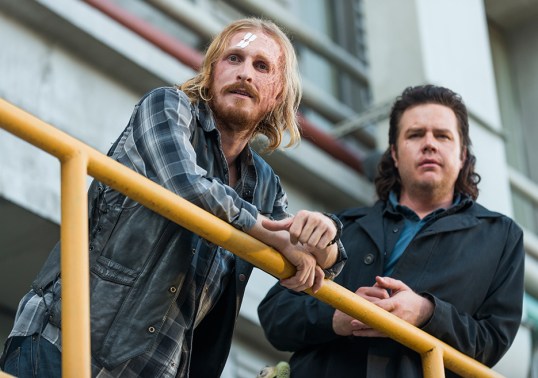
Early on, during tonight’s episode of The Walking Dead, I saw Rick smiling and I thought to myself, “Oh, shit…”

See, it’s a general rule that, whenever Rick’s happy, something terrible is about to happen.  Rick is not allowed to be happy.  Remember what happened when he was happy about being reunited with his wife, son, and best friend Shane?  Remember what happened when he thought he could make a new life as a pig farmer?  Nothing good is allowed to happen to Rick.

So, when it briefly appeared that Rick might be dead towards the end of the episode, I thought he very well might be.  I have to admit that I was kind of excited about the idea.  Who would step up to take Rick’s place?  (Daryl.)  Who would Michonne love without Rick around? (Daryl.)  Who would Carl look up to if Rick was dead?  (Daryl’s the obvious answer but knowing Carl, he’d probably run off and ask Negan to adopt him.)  And I have to admit that, as a reviewer, I was looking forward to not only writing about the impact of Rick’s death but also seeing all the extra hits that my post would get.  I’ll admit it, I’m not that innocent.

Of course, then Rick suddenly emerged from hiding and started killing walkers.  He even got to do a badass slow motion weapon toss to Michonne.  Eventually, if The Walking Dead is to have any integrity, Rick and every other major character, no matter how popular or important, is going to have to die.  But tonight was not that night.

(Of course, next week’s season finale episode is called “Bury Me Here,” so it sounds like someone will be leaving us…)

Tonight’s episode was almost totally devoted to Rick and Michonne and, after all the darkness of the past few episodes, it was nice to see them actually enjoying themselves.  As much as I dread seeing Rick smile, I kind of enjoy it too.  Since Rick tends to carry the weight of the world on his soldiers, it was nice to see that he actually can get some sort of pleasure out of his violent existence.  The fighting, smiling, and lustful Rick that we saw tonight was a nice change from the neutered and whiny Rick who we had to deal with during the first half of the season.  This is the Rick that we want to see!

(On twitter, I suggested that another reason why Rick was so happy was because, for once, he didn’t have to deal with one-eyed Carl standing in the background and making him feel guilty.  Some people apparently did not appreciate my theory, which leads me to wonder when we all suddenly decided that we liked Carl again.)

Tonight, Rick and Michonne were not the only people looking for guns.  Rosita also went searching  but could only find one cap gun and a walker with a double chin.  Father Gabriel, of course, used this as an excuse to lecture her about hate and violence but you know what?  Shut up, Father Gabriel.  How and why are you even still alive at this point?  I don’t blame Rosita for being mad and I don’t blame her for wanting to take action.  And if Rosita’s plan to kill Negan is running the risk of ruining Rick’s plans — well, that’s probably a good thing.  Rick’s plans never work.  Ask Herschel how well Rick’s plans work.  Ask Glenn.  Ask Abraham.

(Checking on twitter, I see that I’m kind of alone as far as my sympathy for Rosita is concerned.  It’s interesting how the people who are continually upset when Daryl doesn’t automatically kill everyone that he meets are apparently the same people upset about Rosita having “an attitude.”  Whatever, people.)

Anyway, this was a pretty good episode.  As much as I may bitch about Rick as a leader, I was happy to see him actually get a chance to enjoy himself without the world automatically ending.  Michonne, who has been underused lately, finally got a chance to remind the viewers of what a badass she truly is.  The moment when she thought Rick was dead was a moment of great acting from Danai Gurira.

As for next week’s episode, it’s getting close to the season finale!  Who will live?  Who will die?  (Eugene, probably.  And, hopefully, sanctimonious Father Gabriel.)  We’ll find out next week!

(CORRECTION: Due to my notoriously short attention span, an earlier version of this post incorrectly stated that next week was the season finale.  I apologize for the error. — LMB)
Film Review: Custody (dir by James Lapine)


custody-2-620x345

Last night’s Lifetime movie premiere, Custody, didn’t really feel like a Lifetime film.

This was largely because it really wasn’t.  Custody was written and directed by the acclaimed theatrical director, James Lapine.  The cast features not only Emmy winner Tony Shalhoub and Oscar nominee Catalina Sandino Moreno but also two Oscar winners, Viola Davis and Ellen Burstyn.  Unlike most Lifetime films, Custody was not filmed in Canada.  There were no Toronto landmarks in the background.  (You never realize how much you miss Canada until it’s gone.)  Custody played at Tribeca last year.  Much like Stockholm, Pennsylvania, Custody was made for a theatrical release but it ended up premiering on television instead.  As a result, Custody did not follow the usual Lifetime 8 act pattern.  The commercial breaks felt awkward.  With a 150 minutes running time, this film tested my four-minute attention span.

The other thing that set Custody apart from most other Lifetime films was that it wasn’t much fun to watch.  The great thing about Lifetime movies is that they are almost always fun.  It doesn’t matter what serious subject is being examined.  It doesn’t matter how dramatic things may get.  Lifetime movies are always fun.  To use one of my favorite terms, Lifetime movies embrace the melodrama.  Lifetime films push the limits.  Lifetime films say, “You think we won’t introduce a crazy twin halfway through the movie?  JUST WATCH US!  You think we won’t toss in a sudden case of amnesia or a cheating husband or a psychotic au pair in lingerie?  YOU DON’T KNOW LIFETIME!”

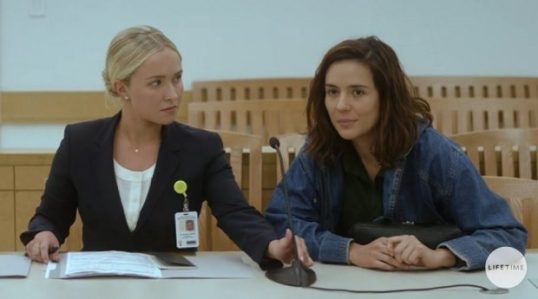
Custody, on the other hand, was a very serious movie about a very serious topic and therefore, it wasn’t much fun to watch.  In fact, Custody was a bit of a well-intentioned mess.  It followed one case as it worked its way through the family court system.  Sara Diaz (Moreno) has been wrongly accused of being an unfit mother.  Her attorney is Ally Fisher (Hayden Panettiere), who has just graduated from law school and who comes from a rich family.  Ally’s grandmother is played by Ellen Burstyn, largely because everyone’s rich grandmother is played by Ellen Burstyn.  Representing the state is Keith (Dan Fogler), who has absolutely horrid taste in ties.  The judge is played by Viola Davis and she’s going through a messy divorce from Tony Shalhoub.

I could see what Lapine was going for.  Custody juggles several plotlines, showing how everyone involved in the case has their own individual biases and problems to deal with.  Will the judge’s dissolving marriage make her more or less sympathetic to Sara?  Will the white and privileged Ally ever be able to truly understand Sara’s situation?  Will Keith ever learn how to properly select a tie?  These issues may seem petty when taken on their own but, when crammed together, they form one big human drama.

Or, at least, that seems to have been the plan.  Lapine gets some good performances from his cast but Custody never quite comes together.  This is one of those heavy-handed films where characterization is more likely to be advanced by a lengthy monologue than by action.  Add to that, Custody is ultimately far too enamored of the family court system.  Everyone means only the best and the bureaucracy is your friend.

I will say this.  Based on my own experience working as an administrative assistant in a law office, Custody does get one thing very right.  Male lawyers are always the worst dressed people at any courthouse.  On this count, Dan Fogler played one of the most realistic attorneys ever seen on TV.


Film Review: Logan (dir by James Mangold)


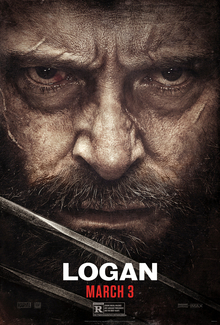
logan_2017_poster

Logan is the first great film of 2017.

It’s also one of the darkest.  The specter of death hangs over almost every scene and, when death does come, it doesn’t discriminate.  Good and likable people are just as likely to die as the film’s villains and, when they do die, it’s never a merciful passing.  There is some humor but it’s the type of humor that’s generated by being trapped in a hopeless situation.  This is one of those movies where, when you do laugh, it’s because the only other alternative is just to give up.

What’s the common complaint about comic book films?  That they only exist to sell more comic books and that they are often fatally compromised by the need to appeal to as many viewers as possible?  Well, that’s not a problem with Logan.  Logan is a film for grown ups.  During the film, when Logan (played, of course, by Hugh Jackman) comes across an X-Men comic book, he dismisses it as a fairy tale.  “In the real world,” he snaps, “people die!”

That’s not to say that Logan’s a hopeless film.  There is an optimistic streak to the film but it’s a cautious optimism.  Much like Mad Max: Fury Road, Logan suggests that the best thing that the world has left to offer is a chance for redemption.

logan2

Now, I should point out that, while I enjoyed some of the previous films (particularly X-Men: First Class), I’m hardly an expert on the X-men franchise.  But, with Logan, that doesn’t matter.  Certainly, it helps to have seen some of the previous films.  There are a few references to X-Men: Apocalypse.  But, in the end, Logan works as a stand alone film.  Even if you’ve seen none of the previous X-men films, you’ll find yourselves getting swept up in the story of Logan, Professor Xavier (Patrick Stewart), Caliban (Stephen Merchant), and Laura (Dafne Keen).

The film opens in 2029.  There are only a few hints that we’re in the future: driverless truck rule the roads and, more disturbingly, it seems as if there’s fewer people around than before.  Watching the film, which is full of wide open spaces and desolate towns, one gets the feeling that something has happened that has wiped out a good deal of the population.  Almost all of the mutants are dead.  Logan (Hugh Jackman) lives across the border, in Mexico.  His only companion is the albino Caliban and Xavier.

However, this Xavier is far different from the one that we’ve seen in previous films.  Suffering from Alzheimer’s, Xavier is often confused as to where he is and, if he’s not properly medicated, he can’t control his psychic powers.  What’s left of Logan’s life is now dedicated to trying to keep the greatest mind in the world from destroying itself.

logan

Logan has also changed.  In the previous films, Logan was indestructible.  However, his powers are weakening.  He no longer heals as quickly as before.  He’s losing his eyesight.  Even his famous claws are no longer as reliable as they once were.  Logan now works as a limo driver in El Paso.  One night, a group of frat boys have him drive by the border crossing so that they can chant “USA!  USA!”  Another night, he drives around a drunken bachelorette party, trying to ignore one of the bridesmaids exposing her breasts to him.  And then, he picks up Gabriella (Elizabeth Rodriguez) and Laura.

Gabriella is a nurse.  Laura is an apparently mute 11 year-old girl who has the same powers as Logan.  Gabriella asks Logan to help them get to North Dakota (or “Eden,” as Gabriella calls it).  Logan says no but he quickly discovers that he doesn’t have a choice.  A sadistic cyborg named Donald Pierce (Boyd Holbrook, giving a disturbingly charismatic performance) is searching for Gabriella, Laura, and Logan.  The only way for Logan to protect Xavier is to make that trip to North Dakota.

logan-boyd-holbrook-as-pierce

Pierce, I should mention, isn’t alone.  Pierce has a black-clad army of mercenaries at his disposal but he, and his employer (Richard E. Grant, in the role of the bad guy with the British accent), have a secret weapon.  This weapon looks and acts like a young Logan and there’s a reason for that.  By the end of the film, Logan truly is at war with the savage beast that he once was.

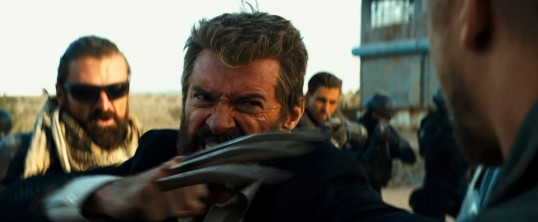
Logan is a violent film, one that doesn’t flinch when it comes to earning its R-rated.  I don’t want to give too much away so excuse my vagueness when I say that, a little over an hour into Logan, there’s a fight scene of such brutality and uncompromising violence that it left me shaken in a way that no other “comic book” film ever has.  Logan earns that R-rating but it never feels exploitive or gratuitous.  When Logan curses (which he does quite a bit), it’s because that’s what people do when they’re in a hopeless situation.  And, for all the fighting and all the blood and all the death, Logan never celebrates violence.

Instead, it celebrates redemption.

la-et-hc-logan-trailer-20161020

Early on, there’s a rather sweet scene where Xavier and Laura watch Shane on television.  It’s an important scene because, in many ways, Logan is a western.  Logan is the mysterious gunslinger who, after a lifetime of violence, finally has a chance to do something to preserve life rather than spread death.  Just in case we missed, director James Mangold includes a scene in which Logan and Xavier help a family of ranchers round up some horses.  Later, there’s a tense stand-off between Logan and a group of cowboy hat-wearing rednecks that feels as if it could have come straight from a spaghetti western.

Hugh Jackman is an acclaimed and accomplished actor but, to many people, he will always be the Wolverine.  This is his 9th time to play the character and Jackman gives not only his best performance in the role but perhaps the best performance of his career.  (It’s certainly the equal of his Oscar-nominated work in Les Miserables.)  One look at Jackman’s weathered face and his haunted eyes and you immediately know that there’s going to be more to Logan than just comic book action.  And then there’s Patrick Stewart, who has never been more heartbreaking and vulnerable than he is here.  Finally, Dafne Keen gives a fierce performance, one that will probably remind many people of Chloe Grace Moretz’s breakthrough role in Kick-Ass.

logan-header-pic

Earlier, I mentioned Mad Max: Fury Road.  It’s an appropriate comparison, as the two films have much in common.  (That said, Logan definitely establishes its own identity.)  There’s been some talk that Logan could be the first comic book film to ever receive a nomination for best picture.  I don’t know if that’s going to happen or not.  (I fear that a lot of Academy members will mentally check out during a jokey pre-credits sequence, one that serves as a teaser for the sequel to Deadpool.  I understand why it was included it at the beginning of the film.  Logan ends on such a poignant note that a post-credits scene would have felt inappropriate.  But still, as much as I love Ryan Reynolds, it feels out-of-place.)  I will say this — Logan deserves consideration.  Logan occasionally had me fighting to catch my breath and it left me with tears in my eyes.  For Logan to get a nomination, it’s going to need the same support from the critics groups that Mad Max: Fury Road received.  The Academy is going to need the critics to reassure them that it’s okay to nominate a film about mutants being chased by a cyborg.  It’s still early in the year.  Anything could happen.

It could be nominated for every Oscar or it could be nominated for none.  But, in the end, Logan is a great film.

logan-9

Celebrate Texas Independence Day With My Favorite Scene From Bernie!


Happy Texas Independence Day!

Down here in Dallas, we celebrate Texas Independence Day by going down to Dealy Plaza and laughing at all the northern tourists sweating and talking about how they’re about to faint because they can’t handle a 75 degreee day.

But, if that sounds a little bit too mean-spirited to you, you can celebrate by watching my favorite scene from Richard Linklater’s Bernie!  I know that I’ve probably shared this before but what can I say?  I really love this quick lesson about my home state:

By the way, that line about “Dallas snobs,” always got a big laugh from the audiences at the Dallas Angelika.  It’s important to have a sense of humor.

Don’t worry, Vermont.  You’ll learn how to laugh at yourself someday.


TV Review: The Walking Dead 7.11 “Hostiles and Calamities” (dir by Kari Skogland)


the-walking-dead-episode-711-eugene-mcdermitt-6-9351

Hi everyone!

I apologize for being late with this review.  Not only did I spend Sunday night watching the Oscars but I’ve also been sick for the past few days.  As a result, I’m running about two days behind when it comes to reviewing stuff.

As for last Sunday’s episode of The Walking Dead…

To be honest, before I watched Hostiles and Calamities, I was really concerned.  I knew three things.  I knew that the episode featured a lot of Negan, which was the main problem with the first half of the seventh season.  I knew that the episode would involve the Saviors, who may be properly hissable villains but whose bully-based society had never seemed particularly interesting.  And I knew that the episode centered around Eugene, a character that I have never been particularly fond of.  When we last saw Eugene, he was being taken away from Alexandria by Negan.  And, to be honest, I was perfectly okay with the idea of never seeing Eugene again.

So, imagine my surprise when Hostiles and Calamities actually turned out to be a good episode!

Note that I didn’t say it was a great episode.  It wasn’t.  Negan and Lucille may be intimidating but they’re still not exactly as compelling as the show seems to think they are.  That said, we did get to see a slightly different side to Negan as he half-seduced/half-bullied Eugene over to the dark side.  For once, Negan actually did seem like a character who was worthy of Jeffrey Dean Morgan’s considerable talent.  But still, as a general rule, Negan is a lot like Jacob from Lost.  He’s best used sparingly.

As usual, Josh McDermitt did a good job as Eugene but, since the character is already fairly annoying, it wasn’t a huge shock to hear him declaring, “I am Negan.”  As smart as he may be, Eugene has always been one of the weakest members of Rick’s little group.  For that reason, it made total sense that Eugene would be the one that Negan would decide to “recruit.”  There’s no way that Negan would have been able to brainwash Daryl.  Daryl is too strong for that.  Daryl is willing to die before betraying Rick.  But Eugene’s a self-described coward.  As we all know, most bullies (and that is the perfect description for the Saviors) start off as cowards.

Seeing as how it was centered around the least likable of Rick’s group, I really shouldn’t have liked Hostiles and Calamities but the episode worked for me.  For the first time, the Savior society actually seemed … well, I wouldn’t go quite as far as to call it compelling.  But still, it was interesting to see a new side to life in the Sanctuary.  Our previous exposure to Savior society came through seeing Daryl in a cell and various Negan lieutenants harassing communities.  In this episode, we got to see how things actually worked on a practical level.  Even more importantly, we saw that Negan may be a jerk but he still manages to maintain order in an otherwise chaotic world.  The scary thing about the collapse of society is that it’s usually the Negans who survive and thrive.

It also helped that this episode actually had some moments of humor.  How couldn’t you smile at the sight of trembling Eugene, wandering around the compound with his jar of pickles?   Personally, I sympathized with Negan’s “wives,” having to pretend to be impressed with Eugene’s video game just out of the hope that Eugene would help them poison Negan.  When Eugene announced that he would never poison Negan, it wasn’t only as close as Eugene will ever get to being in control of his situation.  It was also a declaration that Eugene was now a Savior for life.

(I assume that means that Eugene will eventually be devoured by zombies.  That seems to be the punishment for turning your back on Rick.)

As for Dwight and the consequence of his search for Sherry, I felt bad for Dr. Carson.  Carson seemed like a pretty nice guy but, since Dwight needed someone to blame for Daryl and Sherry’s disappearance, Dr. Carson ended up going head first into the fire.  That whole scene made me cringe.  That worked out well for Eugene, who is now the only “doctor” at the compound.  You do have to wonder what will happen if Negan ever finds out that Eugene is a pathological liar.

In the end, Hostiles and Calamities was a pretty good episode of The Walking Dead.  After a potentially calamitous first half, the second half of season 7 is developing nicely.

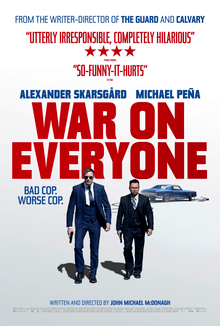
Film Review: War on Everyone (dir by John Michael McDonagh)


war_on_everyone

War on Everyone opens with a question.

“If you hit a mime,” Detective Bob Bolano (Michael Pena) asks, “does he make a sound?”

“Now, you know,” Detective Terry Malone (Alexander Skarsgard) replies, as he drives his car over a mime.

For the record, the Mime was a cocaine dealer so the detectives did have a reason for chasing him.  Then again, the Mime was also on foot while the detectives were in a car.  And the Mime was attempting to surrender when the detectives ran him over.

That scene pretty much sets the tone for the rest of War on Everyone, the latest film from Irish filmmaker John Michael McDonagh.  McDonagh is best-known and rightfully acclaimed for his previous two films, The Guard and Calvary.  Those two films were both darkly comedic and often violent meditations on life, death, morality, guilt, and redemption.  While War on Everyone may not share either one of those films’ deeper concerns, it is definitely violent.  And the comedy is definitely dark.

Bob and Terry are two of the most corrupt cops in the history of cinematic police corruption.  Bob is a family man, who is full of useless trivia and usually seems to speaking a mile a minute.  Terry is single and not quite as talkative.  He views the world through permanently bloodshot eyes and always stands with an insolent slouch.  Terry is the type who, when he drives down a city street, intentionally bumps into every parked car.  When asked why he became a cop, Terry shrugs and replies that it was the only job available where he could shoot people without getting in trouble.  When Bob and Terry confront an informant, they both get so caught up in snorting the informant’s cocaine that they forget what they wanted to ask about.  Their lieutenant is constantly telling them to ease up on the corruption but, since he’s played by Paul Reiser, no one takes him seriously.

War on Everyone does have a plot but it’s debatable just how important it is.  Bob and Terry learn about an up-coming heist.  They decide to let the heist happen so that they can then bust the crooks and take the money for themselves.  However, because there’s nothing that Bob and Terry can’t screw up, they not only fail to stop the heist but end up spending the rest of the movie trying to track down the money.  Along the way, they bond with an orphan and Terry pursues a romance with a former stripper (Tessa Thompson, doing her best with an underwritten role).

The plot is really just an excuse for McDonagh to parody the conventions of the American cop film.  Much like Seven Psychopaths (which was directed by John Michael McDonagh’s older brother, Martin), War on Everyone is a film about tangents.  The point is to see how many weird directions the story can go in.  This is the type of film where, at one point, Terry and Bob fly to Iceland just because.

(Don’t get me wrong.  They have a reason for being in Iceland but still, you mostly come away with the feeling that McDonagh thought to himself, “What other New Mexico-set heist film features a trip to Iceland?”)

Particularly when compared to something like Calvary, War on Everyone doesn’t add up to much and yet that really is a part of the film’s charm.  At a time when so many films are trying way too hard to be something more than what they actually are, War on Everyone is content to be a thoroughly over-the-top action comedy.  It’s a bit like The Nice Guys, just with an even darker worldview.

What’s remarkable is how many critics have insisted in trying to find a deeper meaning where there clearly is none.  I hardly ever do this but I have to point out that the A.V. Club review — headlined, undoubtedly by an intern hoping to impress the bosses with the power of snark, Sorry War On Everyone, but it’s not the best time for a comedy about giddily corrupt cops — is remarkable in just how thoroughly it misses the point of the film.  If anything, it reads as if the reviewer couldn’t think of anything to say so he decided to engage in some preemptive political virtue signaling.

The review cited above makes the mistake of assuming that War on Everyone is supposed to be taking place in the real world.  Everything — from the over-the-top violence to the mix of crude humor with philosophical asides to the mix of 70s music with modern technology — indicates that War on Everyone is meant to take place in a reality other than our own.  It’s a dream-like world that was created by other cop movies and, ultimately, those other movies are the only thing that War on Everyone is attempting to critique.  In much the style of early Tarantino, War On Everyone is a movie about movies.

(Unlike Tarantino’s last few films, War on Everyone only lasts 98 minutes, which would seem to indicate that McDonagh is superior to Tarantino in one important regard: he knows how and when to edit himself.)

War on Everyone is not for … well, everyone.  It’s certainly not a masterpiece in the style of either The Guard or Calvary.  It’s lesser McDonagh but, when taken on its own terms, it’s an enjoyable ramble of a movie that’s distinguished by the perfect casting of Skarsgard, Pena, and Reiser.

Just don’t take it too seriously.


Lisa Reviews An Oscar Nominee: The Champ (dir by King Vidor)


the_champ_poster

“I want the Champ!  I want the Champ!”

Oh good God, shut up you little brat.

Now, nobody actually tells 8 year-old Dink (Jackie Cooper) to shut up at the end of 1931’s The Champ.  I’d like to think that I probably would have said those words if I had been sitting in the audience but, in all honestly, I probably would have been crying along with everyone else.  I’m sure that a lot of people probably cried when The Champ was first released.

And really, it’s probably unfair to criticize Jackie Cooper for repeatedly wailing, “I want the Champ!” during the film’s final five minutes.  It’s actually probably one of the few authentic moments in the film.  It’s just unfortunate that Cooper’s voice was a bit shrill and, as a result, I found myself covering my ears.

As for what The Champ is about, it’s the story of a boy and his alcoholic father.  Andy Purcell (played with loutish charm by the never particularly subtle Wallace Beery) is a boxer.  He used to be the world champion and people still call him The Champ.  Of course, it’s been a while since he’s been in the ring.  Now, Andy just drinks and gambles and continually lets down his son.  However, Dink is always willing to forgive Andy and Andy does truly love his son.  He even buys him a horse, which gets named Little Champ.

It’s while at the stables that Dink meets an upper class woman named Linda (Irene Rich).  What Dink does not realize is that Linda is … his mother!  She was once married to the Champ but his drinking led to divorce.  Linda wants to adopt Dink and perhaps she should because The Champ really is not a very good father.  He even loses Little Champ in a card game.

Fortunately, the Champ has a chance to win the money needed to buy back the horse.  All he has to do is reenter the ring and beat the Mexican heavyweight…

It all leads to “I want the champ!” being screamed several hundred times in a handful of minutes, enough times to make me fear that I would be deaf before the film ended…

The Champ is an old-fashioned and rather creaky melodrama, one that hasn’t aged particularly well.  Director King Vidor specialized in films about the “common man” and The Champ often feels like it was adapted from the first draft of an unproduced Clifford Odets play.  It’s all very sentimental and so thoroughly lacking in snark or cynicism that, for modern audiences, it’s difficult to relate to.  I’ll leave it to you to decide whether that’s a good or a bad thing.

The Champ does hold a place in Oscar history.  Wallace Beery won the Oscar for Best Actor but, for the first time in the history of the awards, there was a tie and Beery shared the Oscar with Fredric March, who won for Dr. Jekyll and Mr. Hyde.

The Champ was also nominated for best picture but it lost to Grand Hotel, which also features Wallace Beery.

Lisa Reviews An Oscar Nominee: Capote (dir by Bennett Miller)


capote_poster

The first time I ever saw the 2005’s Capote, I thought it was a great film.

I guess that shouldn’t be a surprise.  I love movies about writers and I love biopics and, as the title indicates, Capote was both.  I’m also fascinated by true crime and Capote told the story of how Truman Capote came to write the first true crime book, In Cold Blood.  Add to that, I was (and am) a Philip Seymour Hoffman fan and Capote provided Hoffman with not only a rare starring role but it also won him an overdue Academy Award.  Finally, to top it all off, Capote also dealt with Truman’s friendship with Harper Lee (Catherine Keener), the author of To Kill A Mockingbird.  Seriously, a film that dealt with the writing of both In Cold Blood and To Kill A Mockingbird!?  How couldn’t I love that?  While everyone else was outraged that Crash beat Brokeback Mountain, I was upset that it beat Capote.

Needless to say, I was really looking forward to rewatching Capote for this review.  But when I actually did sit down and watched it, I was shocked to discover that Capote wasn’t actually the masterpiece that I remembered it being.

Oh, don’t get me wrong.  It’s still a good film.  At times, it’s even a great film.  I still think it would have been a more worthy Best Picture winner than Crash.  But still, there seemed to be something missing.  Much as with director Bennett Miller’s most recent film, Foxcatcher, there’s a coldness at the heart of Capote.  One can’t deny its success on a technical level but, at the same time, it keeps the audience at a distance.  In the end, we remains detached observers, admiring the skill of the film without ever getting emotionally invested in it.

Interestingly, the film suggests that the exact opposite happened to Truman Capote while he wrote In Cold Blood.  The film suggests that Capote got so invested in one of the killers at the center of In Cold Blood that the process of writing the book nearly destroyed him.  When we first see Capote, he’s at some social event in New York and he’s amusing his rich friends with charmingly risqué anecdotes about his other rich and famous friends.  As played by Hoffman, Capote is someone who is almost always performing.  It only with his friend Harper Lee and his partner Jack Dunphy (Bruce Greenwood) that he ever lets down his guard long enough to reveal who he actually is, a gay man from the deep South who was fortunate enough to escape.

That’s one reason why Capote grows close to Perry Smith (Clifton Collin, Jr.).  The subjects of In Cold Blood, Smith and Dick Hickcock (Mark Pellegrino) killed the Clutter family in Holcomb, Kansas.  Capote, who followed the case from their arrest to their eventual execution, becomes obsessed with Smith precisely because he sees Smith, with his dysfunctional background and his overly sensitive nature, as being who Capote could have been if things had gone just a little bit differently in his life.  Miller further makes this point by skillfully juxtaposing scenes of Truman dropping names and telling jokes at New York parties with the grim reality of life and death in Kansas.

Truman finds himself serving as a mentor to Perry.  (Hickcock is neglected by both Capote and the film.)  Of course, Truman’s also a writer and he knows that he needs an ending for his story.  As his editor (played by Bob Balaban, who seems to be destined to play everyone’s editor at some point or another) points out, Smith and Hickcock have to be executed if the book is ever to be completed.  Truman also has to get Perry to finally talk about what happened in the Clutter family farm.  As much as Capote seems to care about Perry, he’s ruthless when it comes to getting material for his book.  The film suggests that Truman Capote got his greatest success at the cost of his soul.

It’s a rather dark movie, which might explain why I was initially so impressed with it.  (I went through a period of time where I thought any movie with a sad ending was a masterpiece.)  Rewatching it, I saw that the film’s triumph was mostly one of casting.  Miller gets some seriously brilliant performances from the cast of Capote.  Yes, Hoffman is great in Capote but so is the entire cast.  Keener and Greenwood are well-cast as the only two people who have the guts to call Truman on his bullshit.  Chris Cooper gives a very Chris Cooperish performance as Alvin Dewey, the no-nonsense lawman who views Capote with a mix of amusement and distrust.  Clifton Collins, Jr. and Mark Pellegrino are both excellent as Smith and Hickcock.  In fact, Pellegrino makes such an impression that you regret the both Capote and the film didn’t spend more time with his character.

As previously stated, Hoffman won Best Actor but Capote lost best picture to Crash.  How Crash beat not just Brokeback Mountain but Capote as well is a mystery that Oscar historians are still trying to unravel.

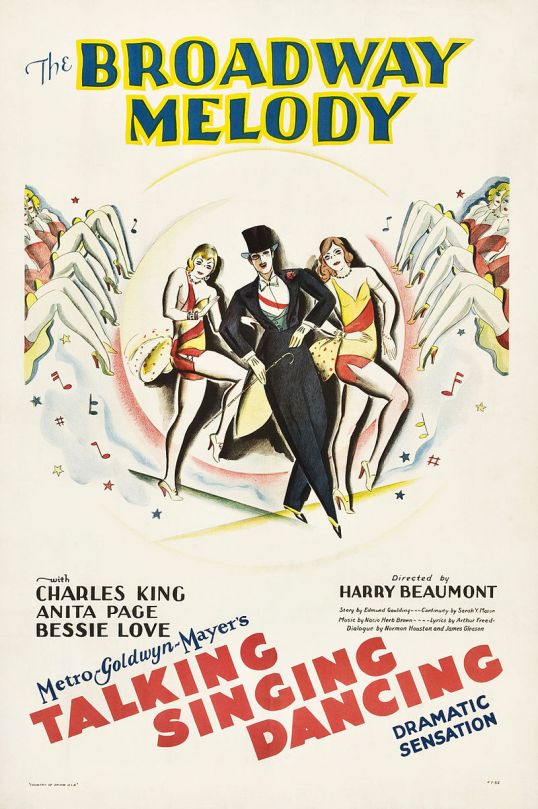
Lisa Reviews An Oscar Winner: The Broadway Melody (dir by Harry Beaumont)


broadway_melody_poster

Oh, The Broadway Melody.

Where to begin?

First released way back in 1929, The Broadway Melody is a historically significant film.  You really can’t talk about the development of film — especially sound film — without taking at least a few minutes to acknowledge The Broadway Melody.  It was the 2nd film to ever win the Oscar for Best Picture (or Best Production, as it was called back then) and it was the first sound film to win the Oscar.  (In fact, it would be 83 years before another silent film won Best Picture and it’s debatable whether or not The Artist can really be considered a silent film in the same way that Wings was silent film.)  It was also the first musical to win best picture and some people consider it to be the first true musical to have ever been produced.  It was such a huge box office success that it could be argued that The Broadway Melody is responsible for nearly every musical that followed it.

To say that The Broadway Melody tells a familiar story would be an understatement.  I’ve read a few reviews that have suggested that the clichés in this film really weren’t clichés until after The Broadway Melody was released but I’ve seen enough silent films to know that this is not the case.  It tells the story of two sisters who want to be stars.  After spending years working in vaudeville, they’ve been invited to perform in a revue that’s being produced by Francis Zanfield (Eddie Kane).

(I assume that Zanfield was meant to be a stand-in for Florence Ziegfeld, himself the subject of a later Best Picture winner, The Great Ziegfeld.)

The sisters are Hank (Bessie Love) and Queenie (Anita Page).  Hank is the driven one.  Hank is the one with the raw talent and she’s also the one who best understands how the business of entertainment works.  Her younger sister, Queenie (Anita Page), may not have Hank’s drive or quite the same level of talent but she does have beauty.  Guess who finds the most success?

Songwriter Eddie Kearns (Charles King) is engaged to marry Hank but soon, both he and Queenie find themselves falling in love.  Not wanting to hurt her sister, Queenie instead runs off with a notorious playboy named Jock Warner (Kenneth Thomson).

As I stated previously, The Broadway Melody has not aged well.  The fact that it’s one of the first sound films just allows contemporary viewers to hear the creakiness of the plot.  As impressive as sound film was to audiences in 1929, it’s obvious today that the cast and crew of The Broadway Melody were still struggling to figure out how to work with the new technology.  As a result the performances are still a bit too broad, which only serves to make the film seem even more melodramatic than it actually is.  As for the songs, they’re not particularly memorable.  I always enjoy backstage musicals but Broadway Melody is no 42nd Street.

I did appreciate the relationship between Bessie Love and Anita Page.  That was one of the few things about the film that felt real to me, perhaps because I have three older sisters.  Interestingly enough, when Anita Page died in 2008, she was the last surviving attendee of the first Academy Awards ceremony.

The Broadway Melody was named the Best Picture of 1929.  This was the year that the winners were selected by a committee and there were no official nominations.  Though the notes from the meeting indicate that there was some consideration given to awarding the Best Actress Oscar to Bessie Love, Best Picture was the only Oscar that The Broadway Melody received.

Lisa Reviews An Oscar Nominee: Boys Town (dir by Norman Taurog)


boys_town

Before writing about the 1938 film Boys Town, I want to share a story that might be false but it’s still a nice little story.  Call this an Oscar Urban Legend:

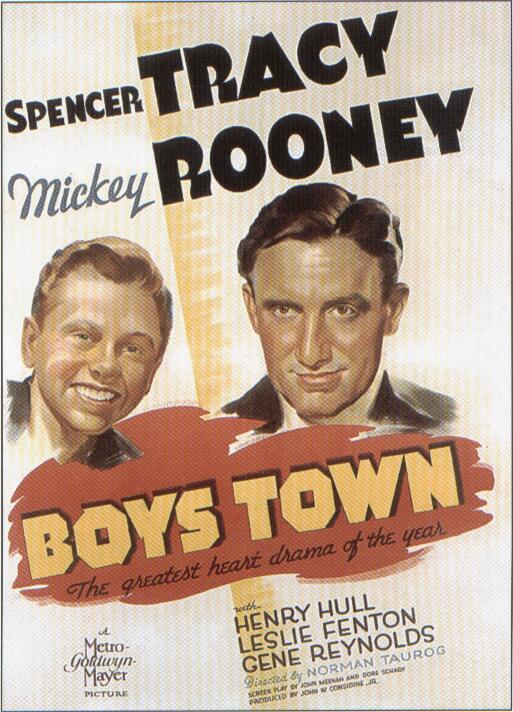
Boys Town is about a real-life community in Nebraska, a home for orphaned and homeless boys that was started by Father Edward Flanagan.  In the film, which was made while Father Flanagan was still very much alive, he was played by Spencer Tracy.  Boys Town was a huge box office success that led to the real Boys Town receiving a lot of favorable publicity.  When Tracy won his Oscar for Boys Town, his entire acceptance speech was devoted to Father Flanagan.

However, a problem arose when an overeager PR person at MGM announced that Spencer Tracy would be donating his Oscar to Boys Town.  Tracy didn’t want to give away his Oscar.  He felt that he had earned it through his acting and that he should be able to keep it.  Tracy, the legend continues, was eventually persuaded to donate his Oscar on the condition that he would get a replacement.

However, when the replacement arrived, the engraving on the award read, “Best Actor — Dick Tracy.”

That’s a fun little story, one that is at least partially true.  (Tracy’s Oscar — or at least one of them — does currently reside at the Boys Town national headquarters.)  It’s also a story that, in many ways, is more interesting than the film itself.

Don’t get me wrong.  Boys Town is not a bad movie.  For me, it was kind of nice to see a movie where a priest was portrayed positively as opposed to being accused of being a pederast.  In a way, Boys Town serves as a nice counterbalance to Spotlight.  But, with all that said, there’s not a surprising moment to be found in Boys Town.  It’s pretty much a standard 1930s juvenile delinquency melodrama.

The movie opens when Father Flanagan giving last rites to a man who is about to be executed.  (Boys Town takes a firm stand against the death penalty, which is one of the more consistent and laudable stands of the modern Church.)  The man says the he never had a chance.  From the time he was a young boy, he was thrown into the reform school system.  Instead of being reformed, he just learned how to be a better criminal.  Father Flanagan is so moved by the doomed man’s words that he starts Boys Town, under the assumption that “there’s no such thing as a bad boy.”

Father Flanagan’s techniques are put to the test when Whitey Marsh (Mickey Rooney ) arrives.  Whitey is angry.  He’s rebellious.  He tries to run away every chance that he gets and, during one such escape attempt, he even gets caught up in a bank robbery.  Can Father Flanagan reach Whitey and prove that there’s no such thing as a bad boy?

Well, you already know the answer to that.  As I said, there’s really nothing surprising to be found in the plot of Boys Town.  It’s just not a very interesting movie, though there is a great shot of a despondent Whitey walking past a several lines of former juvenile delinquents, all kneeling in prayer.  As Father Flanagan, Spencer Tracy is the ideal priest but his role is almost a supporting one.  Believe it or not, the film is dominated by Mickey Rooney, who gives a raw and edgy performance as the angry Whitey Marsh.

(That said, it’s hard to take Whitey seriously as a future gangster when he’s always wearing a bowtie.  Then again, that may have been the height of gangster style in 1938.)

Boys Town was nominated for best picture but lost to You Can’t Take It With You.