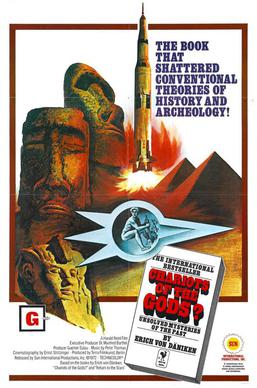
First released in 1970, the German documentary Chariots of the Gods tests the proposition that you can prove anything with stock footage and a narrator.
Chariots of the Gods takes viewers on a tour through some of the most visually impressive locations ever seen by human eyes. Look at the ruins of the Aztec and Inca civilizations! Behold a Mayan observatory! Marvel at Egypt’s pyramids! Trace the amazing Nazca Lines of South America! View the amazing “heads” of Easter Island! Be amazed that an ancient civilization was able to create a primitive battery! Feast your eyes upon colorful cave drawings of mythic beasts and powerful wizards! Examine this skull of a 200,000 year-old bison and think about just how long living things have inhabited this amazing planet!
And then read the ancient texts and consider how every civilization wrote of certain shared events, suggesting that the legendary cataclysms of mythology were based on things that actually happened. Read the words of men and women who lived centuries ago and consider that humans have always been trying to figure out how things work. Humans have always been curious and imaginative creatures and the fact that, from the beginning of time, they were inspired to record their stories indicates that we have an instinctual understanding of the importance of history.
It takes your breath away but, according to this documentary, it shouldn’t.
All of those things that you think humans did? According to Chariots of the Gods, it was the aliens. The aliens built the pyramids. The aliens inspired the cave drawings. All of those ancient texts are actually about spaceships landing on Earth and the aliens saying, “Hi.” The great flood that appears in both the Bible and the epic of Gilgamesh? Aliens! Enoch’s journey into Heaven? Aliens! Elijah’s ascension? Aliens! The Nazca lines? An alien airport! The statues of Easter Island? Alien robots! Chariots of the Gods opens by suggesting that the human race is basically just a big cargo cult, worshipping stuff left behind by the aliens.
Seriously, what a depressing way to look at the world! Instead of marveling at the determination of ancient man, this documentary says that the whole thing was done by aliens and the humans were apparently just standing off to the side. Forget about celebrating ingenuity and imagination. The aliens did it all and all of the ancient stories and all of the cave drawings should be taken very literally because it’s not like the ancient artists could have just been really talented or creative. Instead, when the authors of the Epic of Gilgamesh wrote about Gilgamesh floating over the Earth, it was because it really happened! Imagination had nothing to do with it.
In the tradition of most pseudoscience documents, Chariots of the Gods is one of those documentaries that makes its point by basically refusing to accept that any other viable theories exist. Repeatedly, we’re flatly told that “scientists agree….,” as if every scientist has signed off on the idea of ancient aliens. The documentary’s narrator often informs us that there’s no way ancient people could have constructed and moved giant statues or monuments but he fails to mention that numerous studies that have argued and demonstrated that actually ancient people could very well have done all of that. Essentially, Chariots of the Gods is a travelogue in which we are shown stock footage of some really cool sights while the narrator says, “I bet an alien did that!”
Silly as it was, Chariots of the Gods was still a box office hit and it was nominated for Best Documentary Feature. It’s pseudoscientific legacy lives on today.
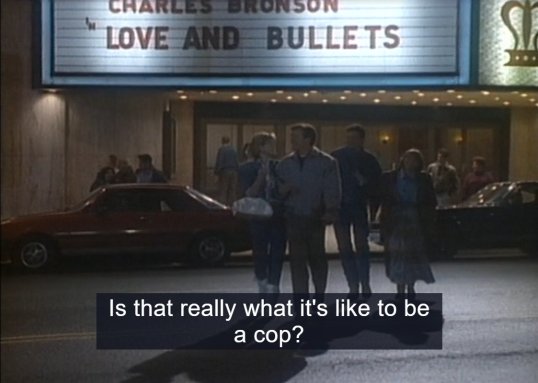
Made for television in 1991 and possessing a rather unwieldy title, Shoot First: A Cop’s Vengeance tells the story of two friends in San Antonio in the early 80s.
Farrell Tucker (Dale Midkiff) and Stephen Smith (Alex McArthur) are both cops. They entered the police academy together, they graduated as a part of the same class, and they both hope to be partners while working to keep the streets of San Antonio safe. Tucker is laid back and friendly and not one to worry too much about following all of the regulations. Stephen Smith, on the other hand, is uptight and, at first, by-the-book. He grew up in a poverty-stricken, crime-riddled neighborhood and it left a definite impression on him. He hates crime and criminals but what he really can’t stand is a justice system that seems to be more concerned with the victimizers than with the victims. Tucker and Smith enjoy spending their time together, drinking at the local cop bars and practicing their shooting on the weekends. Tucker’s not much of a shot, whereas Smith is a sharpshooter who rarely misses.
At first, no one notices or even cares that some of San Antonio’s less upstanding citizens are getting gunned down in the streets. But when Smith somehow manages to be first on the scene to a series of shootings, it gets the attention of Internal Affairs. With Sergeant Nicholas (Terry O’Quinn) investigating the possibility of a cop-turned-vigilante and Chief Hogan (G.D. Spradlin) announcing that no one is above the law, Smith starts to get a bit paranoid and Tucker is forced to consider that his friend could very well be a murderer.
And, of course, Tucker’s right! The first scene features Tucker confronting Smith and then the majority of the film is told in flashback. Even if not for that narrative choice, one could guess at Smith’s guilt just from the title of the film. When Shoot First: A Cop’s Vengeance was released on home video, the title was changed to Vigilante Cop, which made Smith’s guilt even more obvious. Finally, some viewers will guess that Smith is guilty because the film is based on a true story. Officer Stephen Smith actually did go on a killing spree, gunning down men who he felt had escaped the law and even sending threatening letters to his chief when the latter announced that vigilante activity would not be tolerated. Officer Stephen Smith went from being a follower of the rules to someone who attempted to write his own rules. It’s an interesting story for anyone who wants to google it.
As for the film, it’s adequate without being particularly memorable. Alex McArthur and Dale Midkiff both give good performance as Tucker and Smith and the cast is full of talented people like Terry O’Quinn, G.D. Spradlin, Bruce McGill, and Lynn Lowry. Observant viewers will even notice a long-haired Jeremy Davies, showing up for a split-second. I liked the performance of Loryn Locklin, as the waitress who marries Smith and then discovers that her charming husband actually has some very serious issues. The main problem with the film is that the story moves a bit too slowly for its own good and some of the Texas accents were more than a little dodgy. If you’re looking for an action film, this won’t be for you, though the shootings are surprisingly graphic for something that was made for television. Shoot First: A Cop’s Vengeance is a rather routine telling of an interesting story.
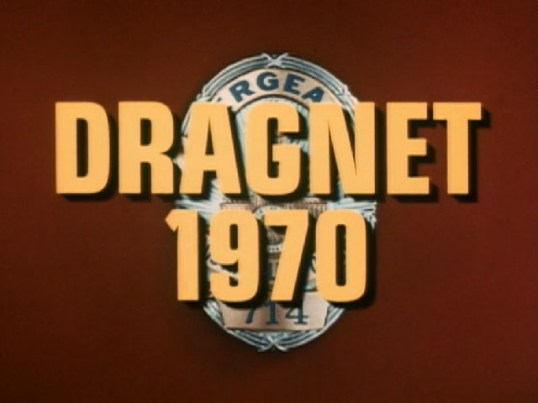
Dragnet began as a radio program in 1949 before making it’s way over to television in 1951. Each episode starred (and the majority were directed by) Jack Webb, who played a no-nonsense cop named Joe Friday. Friday narrated every episode, dropping trivia about the history of Los Angeles while also showing viewers how the cops went about catching criminals. Despite what is commonly believed, Joe Friday never said, “Just the facts, ma’m,” but he did investigate each case with the cool determination of a professional who kept his emotions under control. The majority of Dragnet’s episodes were based on actual cases that were worked by the LAPD, hence the opening declaration of, “The story you are about to see is true.”
On television, Dragnet originally ran from 1951 to 1959, during which time Dragnet also became the first television series to be adapted into a feature film. Jack Webb decided to relaunch Dragnet in 1966 and he produced a made-for-television movie that followed Friday and his latest partner, the far more talkative Bill Gannon (Harry Morgan), as they worked multiple cases over the course of one long weekend. That made-for-television movie led to a series that ran from 1967 to 1970.
The second television series is the best-remembered version of Dragnet, beloved for its scenes of Friday and Gannon debating the issues with a motely collection of hippies, campus radicals, and pipe-smoking academics. Jack Webb viewed Friday as being the voice of the common American, who supported the troops, supported the president, and who wanted to spend the weekend grilling in peace. Friday was the middle-aged suburbanite who wanted to the kids to stay off the grass, whether it was on his front lawn or being sold on a college campus. These episodes were often campy. It’s hard not to smile while listening to Friday and Gannon deadpan their way through conversations with flakey long-haired hippies. It was often obvious that the writers of Dragnet had never actually had any experiences with the hippies, beyond what they saw on the evening news. And yet, as silly as things often were, the show is an interesting time capsule of the era in which it was made. If nothing else, it’s a chance to see the turbulent 60s through the eyes of the other side.
Last year, I shared my favorite episode of Dragnet. For the new year, I’m sharing my second favorite, an episode that originally aired on March 19th, 1970. In Night School, Joe Friday is attending a night class where he and his classmates sit in a circle and just “rap” about the issues of the day. No one knows that Joe is a cop but Joe feels that he is still on duty and when he sees that the guy sitting across from him has a baggie of weed in his notebook, Friday makes an arrest. The professor, who says “There’s nothing wrong with marijuana, I smoke it myself!,” attempts to kick Sgt. Friday out of his class. “Would you rather be known as good ol’ friendly Joe, the class narc?” the professor asks. Joe fights for his right to get an education and a man with an eyepatch emerges as an unlikely voice of reason.
Why do I like this episode? There’s something undeniably entertaining about seeing straight-laced, deadpan Joe Friday attending a class with at least three hippies. It always amuses me that, on this show, Joe Friday loosening up just means that Joe trades his suit for a sweater. Also entertaining is Leonard Stone’s over-the-top performance as the villainous professor. And how can you not smile at Bill Gannon’s weary claim of “I just knew there was no way you could get a B sitting around talking?” Or Jack Webb’s delivery of the line, “That’s my thing, keeping the faith, baby?” Or Jack Curtiss’s hyperactive performance as campus drug pusher Jerry Morgan? “Hey, that’s just oregano!” Whatever you say, Jerry.
Today’s blast from the past certainly does feel like a trip in a time machine. Step on in and take a look at California in 1970!
Though the Academy of Motion Picture Arts and Sciences claim that the Oscars honor the best of the year, we all know that there are always worthy films and performances that end up getting overlooked. Sometimes, it’s because the competition too fierce. Sometimes, it’s because the film itself was too controversial. Often, it’s just a case of a film’s quality not being fully recognized until years after its initial released. This series of reviews takes a look at the films and performances that should have been nominated but were, for whatever reason, overlooked. These are the Unnominated.
“Honorable men go with honorable men.” — Giovanni Cappa
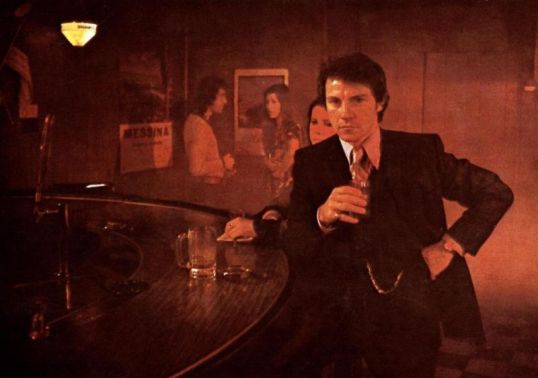
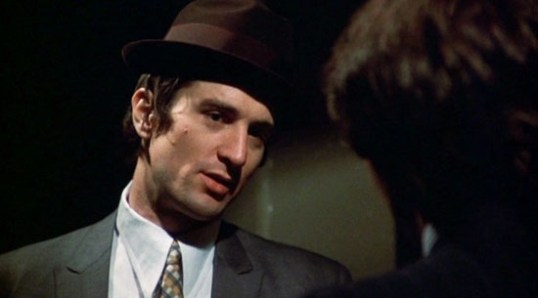
1973’s Mean Streets is a story about Little Italy. The neighborhood may only be a small part of the sprawling metropolis of New York but, as portrayed in this film, it’s a unique society of its very own, with its own laws and traditions. It’s a place where the old ways uneasily mix with the new world. The neighborhood is governed by old-fashioned mafiosos like Giovanni Cappa (Cesare Danova), who provide “protection” in return for payment. The streets are full of men who are all looking to prove themselves, often in the most pointlessly violent way possible. When a drunk (David Carradine) is shot in the back by a teenage assassin (Robert Carradine), no one bothers to call the police or even questions why the shooting happened. Instead, they discuss how impressed they were with the drunk’s refusal to quickly go down. When a soldier (Harry Northup) is given a party to welcome him home from Vietnam, no one is particularly shocked when the solider turns violent. Violence is a part of everyday life.
Charlie Cappa (Harvey Keitel) is Giovanni’s nephew, a 27 year-old man who still lives at home with his mother and who still feels guilty for having “impure” thoughts. Charlie prays in church and then goes to work as a collector for Giovanni. Giovanni is grooming Charlie to take over a restaurant, not because Charlie is particularly talented at business but just because Charlie is family. Giovanni warns Charlie not to get involved with Teresa (Amy Robinson) because Teresa has epilepsy and is viewed as being cursed. And Giovanni particularly warns Charlie not to hang out with Teresa’s cousin, Johnny Boy (Robert De Niro). Johnny Boy may be charismatic but everyone in the neighborhood knows that he’s out-of-control. His idea of a good time is to blow up mailboxes and shoot out street lamps. Charlie, who is so obsessed with sin and absolution that he regularly holds his hand over an open flame to experience the Hellfire that awaits the unrepentant sinner, finds himself falling in love with Teresa (though it’s debatable whether Charlie truly understands what love is) and trying to save Johnny Boy.
Charlie has other friends as well. Tony (David Proval) runs the bar where everyone likes to hang out and he seems to be the most stable of the characters in Mean Streets. He’s at peace with both the neighborhood and his place in it. Meanwhile, Michael (Robert Romanus) is a loan shark who no one seems to have much respect for, though they’re still willing to spend the afternoon watching a Kung Fu movie with him. Michael knows that his career is dependent on intimidation. He can’t let anyone get away with not paying back their money, even if they are a friend. Johnny Boy owes Michael a lot of money and he hasn’t paid back a single dollar. Johnny Boy always has an excuse for why he can’t pay back Michael but it’s obvious that he just doesn’t want to. Charlie realizes that it’s not safe for Johnny Boy in Little Italy but where else can he go? Brooklyn?
Mean Streets follows Charlie and his friends as they go about their daily lives, laughing, arguing, and often fighting. All of the characters in Mean Streets enjoy a good brawl, despite the fact that none of them are as tough as their heroes. A chaotic fight in a pool hall starts after someone takes offense to the word “mook,” despite the fact that no one can precisely define what a mook is. The fights goes on for several minutes before the police show up to end it and accept a bribe. After the cops leave, the fight starts up again. What’s interesting is that the people fighting don’t really seem to be that angry with each other. Fighting is simply a part of everyday life. Everyone is aggressive. To not fight is to be seen as being weak and no one is willing to risk that.
Mean Streets was Martin Scorsese’s third film (fourth, if you count the scenes he shot before being fired from The Honeymoon Killers) but it’s the first of his movies to feel like a real Scorsese film. Scorsese’s first film, Who’s That Knocking On My Door?, has its moments and feels like a dry run for Mean Streets but it’s still obviously an expanded student film. Boxcar Bertha was a film that Scorsese made for Roger Corman and it’s a film that could have just as easily been directed by Jonathan Demme or any of the other young directors who got their start with Corman. But Mean Streets is clearly a Scorsese film, both thematically and cinematically. Scorsese’s camera moves from scene to scene with an urgent confidence and the scene where Charlie first enters Tony’s bar immediately brings to mind the classic tracking shots from Goodfellas, Taxi Driver, and Casino. One gets the feeling that Pete The Killer is lurking somewhere in the background. The scenes between Keitel and De Niro are riveting. Charlie attempts to keep his friend from further antagonizing Michael while Johnny Boy tells stories that are so long and complicated that he himself can’t keep up with all the details. Charlie hold everything back while Johnny Boy always seems to be on the verge of exploding. De Niro’s performance as Johnny Boy is one that has been duplicated but never quite matched by countless actors since then. He’s the original self-destructive fool, funny, charismatic, and ultimately terrifying with his self-destructive energy.
Mean Streets was Scorsese’s first box office success and it was also the film that first brought him widespread critical acclaim. However, in a year when the totally forgotten A Touch of Class was nominated for Best Picture, Mean Streets did not receive a single Oscar nomination, not even for De Niro’s performance. Fortunately, by the time Mean Streets was released, De Niro had already started work on another film about the Mafia and Little Italy, The Godfather Part II.
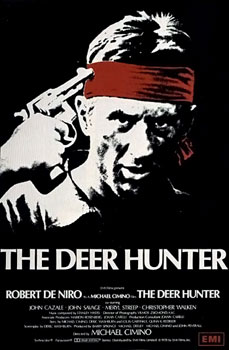
The Deer Hunter, which won the 1978 Oscar for Best Picture Of The Year, opens in a Pennsylvania steel mill.
Mike (Robert De Niro), Steve (John Savage), Nick (Chistopher Walken), Stan (John Cazale), and Axel (Chuck Aspegren, a real-life steel worker who was cast in this film after De Niro met him while doing research for his role) leave work and head straight to the local bar, where they are greeted by the bartender, John (George Dzundza). It’s obvious that these men have been friends for their entire lives. They’re like family. Everyone gives Stan a hard time but deep down, they love him. Axel is the prankster who keeps everyone in a good mood. Nick is the sensitive one who settles disputes. Steve is perhaps the most innocent, henpecked by his mother (Shirley Stoler) and engaged to marry the pregnant Angela (Rutanya Alda), even though Steve knows that he’s not actually the father. And Mike is their leader, a charismatic if sometimes overbearing father figure who lives his life by his own code of honor. The men are held together by their traditions. They hunt nearly every weekend. Mike says that it’s important to only use one shot to kill a deer. Nick, at one point, confesses that he doesn’t really understand why that’s important to Mike.
Steve and Angela get married at a raucous ceremony that is attended by the entire population of their small town. The community is proud that Nick, Steve, and Mike will all soon be shipping out to Vietnam. Nick asks his girlfriend, Linda (Meryl Streep), to marry him when he “gets back.” At the reception, Mike gets into a fight with a recently returned soldier who refuses to speak about his experiences overseas. Mike ends up running naked down a street while Nick chases him.
The Deer Hunter is a three-hour film, with the entirety of the first hour taken up with introducing us to the men and the tight-knit community that produced them. At times, that first hour can seem almost plotless. As much time is spent with those who aren’t going to Vietnam as with those who are. But, as the film progresses, we start to understand why the film’s director, Michael Cimino, spent so much time immersing the viewer in that community of steel workers. To understand who Nick, Mike, and Steve are going to become, it’s important to know where they came from. Only by spending time with that community can we understand what it’s like to lose the security of knowing where you belong.
If the first hour of the film plays out in an almost cinema verité manner, the next two hours feel like an increasingly surreal nightmare. (Indeed, there was a part of me that suspected that everything that happened after the wedding was just Michael’s drunken dream as he lay passed out in the middle of the street.) The film abruptly cuts from the beautiful mountains of Pennsylvania to the violent horror of Vietnam. A Viet Cong soldier blows up a group of hiding women and children. Michael appears out of nowhere to set the man on fire with a flame thrower. An army helicopter lands and, in a coincidence that strains credibility, Nick and Steve just happen to get out. Somehow, the three friends randomly meet each other again in Vietnam. Unfortunately, they are soon captured by the VC.
They are held prisoner in submerged bamboo cages. Occasionally, they are released and forced to play Russian Roulette. Mike once again becomes the leader, telling Steve and Nick to stay strong. Eventually, the three men do manage to escape but Steve loses his leg in the process and a traumatized Nick disappears in Saigon. Only Mike returns home.
The community seems to have changed in Mike’s absence. The once boisterous town is now quiet and cold. The banner reading “Welcome Home, Mike” almost seems to be mocking the fact that Mike no longer feels at home in his old world. Stan, Axel, and John try to pretend like nothing has changed. Mike falls in love with Linda while continuing to feel guilty for having abandoned Nick in Saigon. Steve, meanwhile, struggles to come to terms with being in a wheelchair and Nick is still playing Russian Roulette in seedy nightclubs. Crowds love to watch the blank-faced Nick risk his life.
Eventually, Mike realizes that Nick is still alive. Somehow, Mike ends up back in Saigon, just as the government is falling. Oddly, we don’t learn how Mike was able to return to Saigon. He’s just suddenly there. It’s the type of dream logic that dominates The Deer Hunter but somehow, it works. Mike searches for Nick but will he be able to save his friend?
The Deer Hunter was one of the first major films to take place in Vietnam. Among the pictures that The Deer Hunter defeated for Bet Picture was Coming Home, which was also about Vietnam but which took a far more conventional approach to its story than The Deer Hunter. Indeed, while Coming Home is rather predictable in its anti-war posture, The DeerHunter largely ignores the politics of Vietnam. Mike, Nick, and Steve are all traumatized by what they see in Vietnam. Mike is destroyed emotionally, Steve is destroyed physically, and Nick is destroyed mentally. At the same time, the VC are portrayed as being so cruel and sadistic that it’s hard not to feel that the film is suggesting that, even if we did ultimately lose the war, the Americans were on the correct side and trying to do the right thing. (Many critics of The Deer Hunter have pointed out that there are no records of American POWs being forced to play Russian Roulette. That’s true. There are however records of American POWs being forced to undergo savage torture that was just as potentially life-threatening. Regardless of what one thinks of America’s involvement in Vietnam, there’s no need to idealize the VC.) Released just a few years after the Fall of Saigon, The Deer Hunter was a controversial film and winner. (Of course, in retrospect, the film is actually quite brilliant in the way it appeals to both anti-war and pro-war viewers without actually taking a firm position itself.)
In the end, though, The Deer Hunter isn’t really about the reality of the war or the politics behind it. Instead, it’s a film about discovering that the world is far more complicated that you originally believed it to be. De Niro is a bit too old to be playing such a naive character but still, he does a good job of portraying Mike’s newfound sense of alienation from his former home. In Vietnam, everything he believed in was challenged and he returns home unsure of where he stands. While John, Axel, and Stan can continue to hunt as if nothing happened, Mike finds that he can no longer buy into his own philosophical BS about the importance of only using one shot. Everything that he once believed no longer seems important.
It’s a good film and a worthy winner, even if it does sometimes feel more like a happy accident than an actual cohesive work of art. The plot is often implausible but then again, the film takes place in a world gone mad so even the plot holes feel appropriate to the story being told. Christopher Walken won an Oscar for his haunting performance as Nick and John Savage should have been nominated alongside of him. This was Meryl Streep’s first major role and she gives a surprisingly naturalistic performance. During filming, Streep was living with John Cazale and she largely did the film to be near him. Cazale was dying of lung cancer and he is noticeably frail in this film. (I cringed whenever Mike hit Stan because Cazale was obviously not well in those scenes.) Cazale, one of the great character actors of the 70s, died shortly after filming wrapped. Cazale only appeared in five films and all of them were nominated for Best Picture. Three of them — The first two Godfathers and The Deer Hunter — won.
The Deer Hunter is a long, exhausting, overwhelming, and ultimately very moving film. Whatever flaws it may have, it earns its emotional finale. Though one can argue that some of the best films of 1978 were not even nominated (Days of Heaven comes to mind, as do more populist-minded films like Superman and Animal House), The Deer Hunter deserved its Oscar.
If you study the history of the International Left in the years immediately following the death of Lenin, it quickly becomes apparent that the era was defined by the rivalry between Joseph Stalin and Leon Trotsky.
Trotsky, the self-styled intellectual who was credited with forming the Red Army and who many felt was Lenin’s favorite, believed that he should succeed Lenin as the leader of Communist Russia. Stalin, the ruthless nationalist who made up in brutality what he lacked in intelligence, disagreed. Stalin outmaneuvered Trotsky, succeeding Lenin as the leader of the USSR and eventually kicking Trotsky out of the country. Trotsky would spend the rests of his life in exile, a hero to some and a pariah to others. While Stalin starved his people and signed non-aggression pacts with Hitler, Trotsky called for worldwide revolution. To Stalin, Trotsky was a nuisance whose continued existence ran the risk of making Stalin look weak. When Trotsky was assassinated in Mexico in 1940, there was little doubt who had given the order. After Totsky’s death, the American Communist Party, which had already been weakened by the signing of the non-aggression pact between Hitler and Stalin, was further divided into Stalinist and Trotskyite factions.
Ideologically, was there a huge difference between Stalin and Trotsky? Many historians have suggested that Trotsky probably would have taken many of the same actions that Stalin took had Trotsky succeeded Lenin. Indeed, the idea that Trotsky was somehow a force of benevolence has more to do with the circumstances of his assassination than anything that Trotsky either said or did. In the end, the main difference between Stalin and Trotsky seemed to be Trotsky was a good deal more charismatic than Stalin. Unlike Trotsky, Stalin couldn’t tell a joke. However, Stalin could order his enemies killed whenever he felt like it and some people definitely found that type of power to be appealing. Trotsky could write essays. Stalin could kill Trotsky.
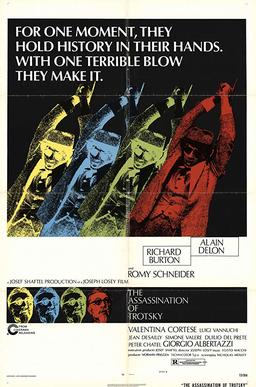
First released in 1972, The Assassination of Trotsky is a cinematic recreation of the events leading to the death of Leon Trotsky in Mexico. French actor Alain Delon plays Frank Jacson, the Spanish communist who was tasked with infiltrating Trotsky’s inner circle and assassinating him with a pickaxe. Welsh actor Richard Burton plays the Russian Trotsky, giving long-winded monologues about world revolution. Italian Valentina Cortese also plays a Russian, in this case Trotsky’s wife, Natalia. And finally, French actress Romy Schneider plays Gita Samuels, who is based on Jacson’s American girlfriend. This international cast was directed by Joseph Losey, an American director who joined the Communist Party in 1946 and who moved to Europe during the McCarthy era.
Losey was an interesting director. Though his first American feature film was the anti-war The Boy With Green Hair, the majority of his American films were on the pulpy side. Not surprisingly, his European films were far more open in their politics. Losey directed his share of undeniable masterpieces, like The Servant, Accident, and The Go-Between. At the same time, he also directed his share of misfires, the majority of which were bad in the way that only a bad film directed by a good director can be. The same director who gave the world The Go-Between was also responsible for Boom!
And then there’s The Assassination of Trotsky. It’s a bit of an odd and rather uneven film. Alain Delon’s performance as the neurotic assassin holds up well and some of his scenes of Romy Schneider have a true erotic charge to them. The scenes of Delon wandering around Mexico with his eyes hidden behind his dark glasses may not add up too much but they do serve as a reminder that Delon was an actor who could make almost any scene feel stylish.
But then we have Richard Burton, looking like Colonel Sanders and not even bothering to disguise his Welsh accent while playing one of the most prominent Russians of the early 20th Century. The film features many lengthy monologues from Trotsky, all of which Burton delivers in a style that is very theatrical but also devoid of any real meaning. As played by Burton, Trotsky comes across as being a pompous phony, a man who loudly calls for world revolution while hiding out in his secure Mexican villa. Now, for all I know, Trotsky could have been a pompous phony. He certainly would not have been the first or last communist to demand the proletariat fight while he remained secure in a gated community. The problem is that the film wants us to admire Trotsky and to feel that the world was robbed of a great man when Jacson drove that pickaxe into his head. That’s not the impression that one gets from watching Burton’s performance. If anything, Burton’s overacting during the assassination scene will likely inspire more laughs than tears.
The Assassination of Trotsky is one of those films that regularly appears on lists of the worst ever made. I feel that’s a bit extreme. The film doesn’t work but Alain Delon was always an intriguing screen presence. (Interestingly enough, Delon himself was very much not a supporter of communism or the Left in general.) The film fails as a tribute to Trotsky but it does make one appreciate Alain Delon.
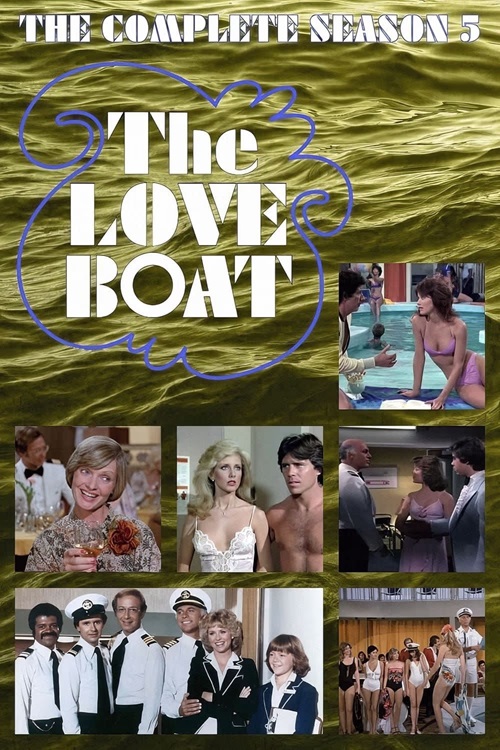
Welcome to Retro Television Reviews, a feature where we review some of our favorite and least favorite shows of the past! On Wednesdays, I will be reviewing the original Love Boat, which aired on ABC from 1977 to 1986! The series can be streamed on Paramount Plus!
The Love Boat is back for a new year of reviews!
Episode 5.11 “He’s My Brother/Zeke and Zelda/Teach Me Tonight”
(Dir by Bruce Bilson, originally aired on December 5th, 1981)
This week, Doc Bricker’s brother boards the Love Boat and boy, does he turn out to be a jerk! Fred Bricker (Jack Bannon) is bitter because their father paid for Doc to go to medical school while Fred had to stay behind on the farm. Now, Fred is married to Nancy (Elaine Joyce) and worried about how he’s going to afford to send his own son to college. Convinced that Doc is rich, Fred thinks that Doc should pay for his nephew’s college tuition. Doc agrees. Fred still acts like an ungrateful jackass but, when he learns that Doc has actually taken out a loan to pay the tuition, Fred realizes that Doc may not be rich but he is a good man.
The weird thing about this storyline is that Fred didn’t have enough money to send his kid to college but apparently, he did have enough money to take an expensive cruise on a luxury liner. The other strange thing is that Fred didn’t know that Doc worked on the ship until he saw him in the lobby. Fred just happened to buy a ticket for the same ship that his brother worked on. Every episode of The Love Boat featured its share of implausible coincidences but this episode really pushes suspension of disbelief to its breaking point. On a positive note, this story did allow us to see another side of Doc. Bernie Kopell is always more believable when he gets to play Doc as being a nice guy as opposed to playing him as being an irredeemable lech.
Speaking of money, two old vaudevillians (played by Milton Berle and Martha Raye) haven’t had much of it ever since their style of performing went out of fashion. Berle and Raye stowaway on the ship and then attempt to freeload their way through the cruise by pretending to be another set of passengers, Zeke and Zelda Van Buren (played by Herb Edelman and Elinor Donahue). The captain is not amused when he finds out that someone is breaking the law on his boat but then Milton and Martha sing a duet of For Me And My Gal and all is forgiven. The Captain arranges for them to get a job as entertainers on another ship. I’ve noticed that the Captain never really seems to punish any of the many stowaways who have taken a trip on The Love Boat. And you know what? Good for him! There’s a place for mercy in this cold world of ours.
Finally, romance novelist Michael Scott (Daryl Anderson) has a one night stand with teacher Emily Parker (Susan Richardson). Michael — and yes, it’s impossible not to think of The Office whenever anyone mentions the character’s name — is stunned when Emily gets emotional after their night together. “You’re acting like you’ve never done this before….” Michael says and, of course, it turns out that she hasn’t. This was a pretty bleh storyline but it did lead to a funny scene where Michael attempts to have a conversation with Emily while two old ladies eavesdrop and freak out every time they hear the word “virgin.”
I enjoyed this cruise, mostly because it gave Bernie Kopell a chance to actually do some real acting for once. I always like it when Doc turns out to be a nice guy. Milton Berle and Martha Raye are, to put it lightly, an acquired taste but both of them give good performances in this episode and even manage to pull off their duet without making it too cringey. As for the third storyline, it was defeated by the lack of chemistry between Daryl Anderson and Susan Richardson. Still, two out of three is not bad.
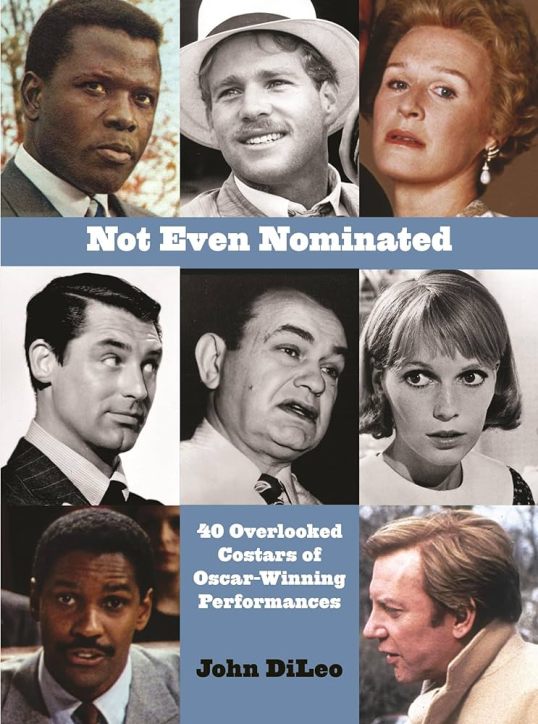
Rod Steiger won an Oscar for playing Chief Gillipsie in In The Heat of the Night but his co-star, Sidney Poitier, wasn’t even nominated. Despite the fact that Poitier delivered the line that everyone remembers — “They call me Mr. Tibbs!” — the Academy saw fit not nominate him alongside his co-star.
Timothy Hutton won an Oscar for his wonderful performance in Ordinary People but Donald Sutherland, cast against type as his conservative father and giving a heartfelt and heart-breaking performance, was not nominated.
In 1949, Walter Huston won a deserved Oscar for his performance in The Treasure of the Sierra Madre but, somehow, Humphrey Bogart was left out of the nominations.
Martin Landau was honored for playing Bela Lugosi in Ed Wood but Johnny Depp, playing the film’s title character, was ignored.
It’s something that has been happening since the announcement of the very first Academy Award nominations. Someone will win an Oscar and usually, they very much deserve it. Often, they’re a very popular winner because they’ve either overcome adversity or they’ve been nominated several times in the past without winning. But, in all the excitement over their victory, their equally worthy co-stars are overlooked.
John DiLeo’s Not Even Nominated takes a look at forty overlooked co-stars of Oscar-winning performers. Along with those that I mentioned at the start of this review, DiLeo also writes about performances from everyone from Charles Farrell in Seven Heaven to Cary Grant in The Philadelphia Story to Joseph Fiennes in Shakespeare in Love and Samuel L. Jackson in Django Unchained. Some of DiLeo’s picks are familiar to film lovers. The fact that Poitier wasn’t even nominated in 1968 despite starring in three popular and acclaimed films is something that has been discussed in many books and cultural histories. But DiLeo also gives some time to some equally strong performances that aren’t always cited, like Ryan O’Neal’s performance in Paper Moon and Dirk Bogarde’s turn in Darling and Stephen Boyd’s brilliant (and rather brave) work in Ben-Hur.
It makes for interesting reading. (It helps the DiLeo has an opinionated but enjoyable writing style.) For Oscar obsessives like you and me, it’s a must-have.
In 1990’s Days of Thunder, Tom Cruise plays Cole Trickle, a talented but headstrong racecar driver who is recruited by businessman Tim Daland (Randy Quaid) to become a NASCAR champion and to also provide some publicity for Daland’s Chevrolet dealership. Tim convinces Harry Hogge (Robert Duvall) to come out of retirement and serve as Cole’s crew chief. Harry builds cars in his barn and then he talks to them, whispering sweet nothings into their side mirrors. (This happens quite a bit.) Both Cole and Harry have something to prove. Cole has to prove that he’s the best. Harry has to prove, to himself, that an accident that killed one of his driver was not his fault. Harry also has to prove that he’s not insane. That’s not an easy thing to do when you’re always in the barn, talking to a car.
At first, Cole’s rival is Rowdy Burns (Michael Rooker) but, after Rowdy is seriously injured in a crash and told that he will never race again, Rowdy becomes Cole’s closest friend and supporter. With Rowdy off the circuit, Russ Wheeler (Cary Elwes) becomes Cole’s main rival. We know that Russ is a bad guy because he never has a hair out of place and he’s played by Cary Elwes, who for some reason was always cast as the smug bad guy in films like this despite having a rather charming screen presence.
Cole’s love interest is Dr. Claire Lewicki (Nicole Kidman), who is there to help Cole deal with his anger issues and who is surprisingly forgiving of all the times that Cole acts like a complete and total jerk. That happens quite a bit. Cole is a bit of brat but eventually, with the help of everyone around him, he learns how to be a great driver.
The first time I ever saw Days of Thunder, I was pretty dismissive of it. The film was producer and directed by the same people who were behind Top Gun and it pretty much tells the same story, except the jets are replaced with cars and the stakes are a bit less than saving democracy. Like Top Gun, it was a film where Tom Cruise played a character who wants to be the best but who has to learn how to set aside his own ego and take control of his impulsive nature. The first time I saw the film, I shrugged and said that, while Nicole Kidman and Tom Cruise had a lot more chemistry than Cruise and Kelly McGillis, it was still nothing that I hadn’t seen before.
But I have to admit that, since then, I’ve rewatched the film a few times. It’s one of those movies that I never specifically seek out but if I see it playing somewhere on cable, I’ll usually watch a bit of it. Some of it is because the race scenes actually are exciting, even if they do get a bit repetitive after a while. Tony Scott was a director who knew how to film action. The other major reason why I often find myself watching Days of Thunder is for the totally over-the-top performances of Robert Duvall and Randy Quaid.
“We looked like a monkey fucking a football out there!” Quaid exclaims, not once but twice. It’s a phrase that doesn’t make the least bit of sense and it’s one of those lines of dialogue that reminds us that Days of Thunder went into production with a script that was being written and rewritten on a daily basis. But Randy Quaid’s delivery is so emphatic that line works despite being totally stupid.
As for Robert Duvall, his performance here is a perfect example of how much fun it can be to watch a legitimately great actor overact. There’s nothing subtle about his performance and I doubt Days of Thunder will ever be a film that shows up when people are talking about the highlights of his legendary career. But when Duvall talks to his car, you believe every minute of it. It’s such a silly scene but Duvall pulls it off like the pro that he is.
Finally, if you’re going to watch a movie about two cocky race car drivers who are constantly taunting each other, wouldn’t you want them to look like Tom Cruise and Cary Elwes? Good lookin’ guys in fast cars, drivin’ around Southern racetracks, what’s not to love?
I swear, the crap that I watch just because it features Eric Roberts….
2016’s Enemy Within takes place in Los Angeles. A drug war is being fought on the streets and the local news is full of stories about violence, immigration, and the presidential election. Born in Italy, Concetta Masconi (Romina Di Lella) has come to Los Angeles to be a dancer and has ended up working as a stripper at a club owned by Jack (Eric Roberts).
When Concetta is attacked by an axe-wielding maniac, she is nearly raped until the sound of an approaching siren scares her attacker away. With Detective Solano (William McNamara) investigating the case and another detective named Nick (Damian Chapa) looking out for her, Concetta continues to date Max (Paulo Benedeti), despite the fact that Max has a history of abusing women and he’s the number one suspect in her own attack. Solano yells that Concetta is not taking any of this seriously. Little does he know that Concetta has been suffering from slow motion, black-and-white flashbacks.
When Concetta is attacked for a second time, she goes into hiding with a group of Latino gangsters. But can even they protect her from her attacker?
So, this is a pretty bad movie. It was obviously meant to be a showcase for Romina Di Lella but whatever hope she may have had of giving a good performance is pretty much sabotaged by a script that is full of confusing motivations and truly risible dialogue. Along with being poorly paced (certain scenes just go on forever!), the film itself is just truly unpleasant to watch. The rapes scenes were filmed to titillate and the inclusion of some light S&M feels less daring and more like an attempt to trick the 50 Shades crowd into watching. I’ve seen a lot of bad films in my quest to see every movie that Eric Roberts has made. This is one of the worst.
As for Roberts’s performance, he gets a few more scenes than usual and he does a good enough job with his one-dimensional role but his character still turns out to be a red herring. Roberts brings a few moments of intentional comedy to the film but otherwise, it’s a role that almost anyone could have played. In his autobiography, Eric Roberts wrote that he largely appears in films like this for the money. Hopefully, he got paid for this one.
Previous Eric Roberts Films That We Have Reviewed:


 Through the Shattered Lens