Review: 8mm (dir. by Joel Schumacher)


“Because he could!” — Daniel Longdale

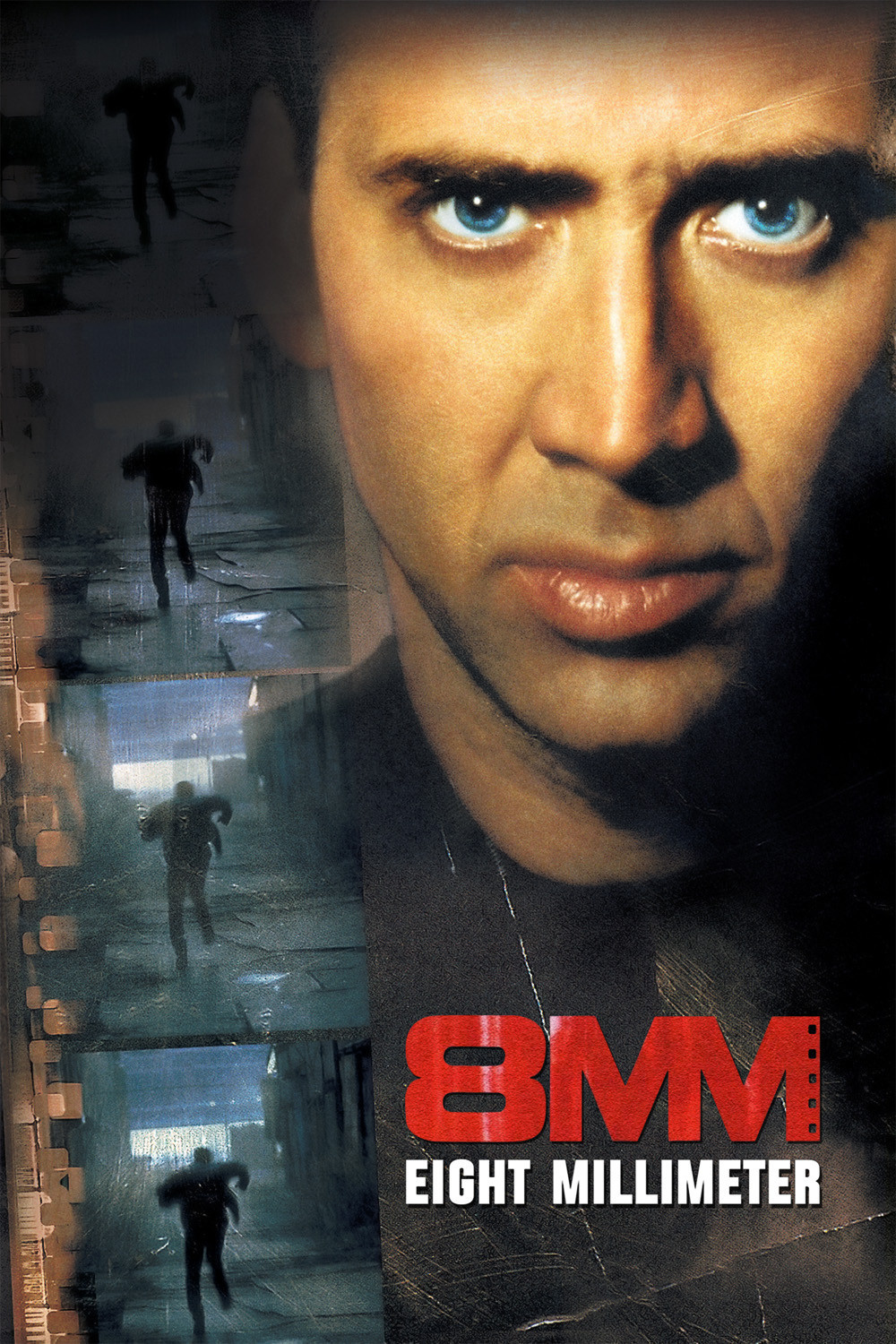
Joel Schumacher’s 8MM (1999) uncoils like a reel of forbidden footage you shouldn’t have found, pulling a buttoned-up private eye into the rancid shadows of underground smut peddlers and whispers of snuff films that may or may not exist. It’s a late-’90s thriller smack in the wake of Se7en and Kiss the Girls, starring Nicolas Cage as Tom Welles, a Harrisburg family man whose crisp suits and steady hands belie the unraveling ahead. Hired by a steel magnate’s widow to verify an 8mm tape depicting a girl’s torture-murder, Welles tumbles down a rabbit hole of L.A. peep shows and New York meatpacking sleaze, his moral compass spinning as the line between fantasy and atrocity blurs. Schumacher crafts a narrative engine that hums with procedural grit, doling out dread in measured doses while mirroring the protagonist’s corrosion, though it occasionally stumbles in its heavier-handed turns.

The setup hooks with surgical efficiency, painting Welles as everydad detective: he buries bodies for a living, kisses his infant daughter goodbye, and screens the tape in a vault-like study that feels like a confessional. Myra Carter’s Mrs. Christian trembles with decorous horror as the projector whirs to life, bathing the room in jaundiced flicker; the footage—grainy, handheld, a pleading teen bound for “Machine’s” blade—lands like a gut punch without lingering on gore. Lawyer Longdale (Anthony Heald, all patrician slime) waves it off as staged porn, but Welles digs anyway, tracing victim Mary Ann Mathews through missing-persons archives to her runaway dreams in Hollywood. Paired with Max California (Joaquin Phoenix), a Sunset Strip tape jockey with pawn-shop cynicism and a Zipperhead tee, they prowl fetish dens where vendors hawk needle-play loops and dismiss snuff as urban legend. Schumacher’s lens, via Robert Elswit, turns these dives into feverish grottos—neon strobes slicing steam, racks of VHS promising the forbidden—building unease through denial upon denial.

That mounting frustration propels the first hour’s finest stretches, a slow immersion where Welles’s calls home grow terse, his wife’s concern (Catherine Keener, quietly anchoring) a lifeline fraying in crosscuts. Max’s street-rat patter—”Snuff? Ain’t no such thing as snuff, man”—leavens the rot without undercutting it, Phoenix layering vulnerability beneath the snark that makes his arc genuinely affecting. Schumacher parcels revelations like a fuse burning short: a Florida trailer confirms Mary Ann’s vanishing, a porn mag scout nods toward “real death” commissions, and suddenly they’re in New York, knocking on Dino Velvet’s door. Peter Stormare vamps as the mulleted auteur of extremity, his studio a cathedral of spotlit chains where Machine (masked, hulking) performs for hidden lenses. The confrontation there explodes into sudden violence and betrayal, shattering assumptions about the tape’s origins and thrusting Welles into a desperate fight for survival, with devastating losses that harden his path forward.

This mid-film rupture peels back layers of the underworld’s machinery, revealing how far some will go to sate forbidden appetites—no vast conspiracy, just raw opportunism turning fantasy lethal. Chaos erupts in a brutal showdown that catapults Welles into lone-wolf payback, though the script’s mechanics creak here, tipping from investigation to vengeance saga with less finesse than its buildup promises. He tracks leads back to L.A., confronting scout Eddie Poole (James Gandolfini) in a derelict factory, beating out confessions amid rusted girders, then facing Machine—unmasked as unassuming accountant George Higgins (Chris Bauer), who shrugs, “I like it”—in a rain-slicked graveyard melee. Schumacher stages the violence as visceral toll, not catharsis: fists land with bone-crunching thuds, blood sprays real, and Welles emerges hollowed, sobbing in his wife’s arms over the unerasable stain. It’s raw consequence over triumph, indicting the watcher as much as the watched.

Cage shoulders the load masterfully, dialing back his manic energy for a portrait of competence curdling into obsession—hesitant stares post-tape, fists unclenching at home, exploding only when the dam breaks. It’s restrained Cage at his peak, the fury earned through incremental fracture, though some beats flirt with overemphasis. Phoenix shines brighter still, turning Max from sidekick gag into soulful foil; his death resonates because Joaquin sells the bravado as fragile armor. Stormare’s Dino struts operatic depravity, a Bond villain in wifebeater, while Gandolfini’s Poole simmers regretful everyman heft—pre-Sopranos groundwork for Tony’s shadows. Heald’s Longdale drips WASP entitlement, and bits like Norman Reedus’s twitchy dealer add lived-in texture. Schumacher elicits extremes without cartooning them, populating the underworld with deviants who feel plausibly human, not pulp cutouts.

Visually, 8MM thrums with Schumacher’s maximalist pulse tamed to noir grit: Elswit’s shadows swallow faces in peep booths’ crimson haze, the snuff reel’s jitter evokes cursed artifacts, and the loft showdown’s spotlights carve brutality like Bosch hellscapes. Mychael Danna’s score slithers—piano sparsity for Welles’s drift, synth throbs for dives—capped by Aphex Twin’s “Come to Daddy” warping a raid into glitch-rage frenzy. Production design nails the era’s analog underbelly: dog-eared tape boxes, industrial decay standing in for L.A. (shot cheap in Florida), all evoking a pre-digital void where evil hides on celluloid. The snuff aesthetic probes voyeurism smartly—we glimpse pleas and steel without exploitation, questioning our gaze alongside Welles’s, though the film’s flirtation with seediness risks tipping into the very prurience it critiques.

Andrew Kevin Walker’s script (fresh off Se7en) structures as moral diptych: procedural probe yields to vigilante spasm, bookended by domestic anchors that underscore the cost. No tidy psychologizing redeems the killers—Higgins kills because appetite wills it, Poole for “business,” others for greed—exposing evil’s flat banality over tortured backstories. The widow’s suicide post-truth, Mary Ann’s mom’s grateful note (“You cared enough to try”), and Welles’s scarred homecoming deny closure; vengeance hardens more than heals, bodies burned sans parade of justice. It’s a gut-punch thesis on film’s limits: some horrors defy capture, watching them unmakes the witness. Schumacher, slumming post-Batman gloss, revels in the ugly, though pacing drags early in porn prowls and the revenge rampage strains credulity.

Yet for all its stumbles—script contrivances like convenient turns, a third act veering punchy over precise—8MM endures as underrated descent, a thriller that stares unblinking into appetite’s void. Cage and Phoenix elevate genre tropes, Schumacher’s design makes depravity stick, and the core query lingers: does filming evil make it real, or us complicit? Flaws aside, it hums with the era’s dark electricity, a flawed reel worth unspooling for its unflinching grind.
An Offer You Can’t Refuse: Irish Eyes (dir by Daniel McCarthy)


First released in 2004, Irish Eyes tells the story of two brother, born eleven months apart.

Tom Phelan (John Novak) is the older brother, the one who is destined to go to law school, join the Justice Department, and to marry Erin (Veronica Carpenter), the daughter of one of Boston’s most prominent attorneys.  Tom’s future lies in politics.  As he makes his reputation by taking down members of the Boston underworld, he finds himself being groomed for attorney general and then who knows what else.

Sean Phelan (Daniel Baldwin) is the younger brother.  Haunted by the murder of his father and stuck at home taking care of his mother (Alberta Watson) while Tom goes to college, Sean soon pursues a life of crime.  He falls under the influence of the Irish mob, led by Kevin Kilpatrick (Wings Hauser).  Sean quickly works his way up the ranks.  It doesn’t matter how much time he does in prison.  It doesn’t matter how many people he has to kill.  It doesn’t matter if it alienates the woman that he loves or if it damages his brother’s political career, Sean is a career criminal.  It’s the one thing that he knows.  When Sean finds himself as the head of the Irish mob and also the American connection for the IRA, his activities are originally overlooked by his brother.  Sean even threatens a reporter who makes the mistake of mentioning that Sean and Tom are brothers.  But soon, Tom has no choice but to come after his brother.  What’s more important?  Family or politics?

Obviously (if loosely) based on Boston’s Bulger Brothers (Whitey became a feared criminal while brother John became a prominent Massachusetts politico), Irish Eyes doesn’t really break any no ground.  Every mob cliché is present here and so is every Boston cliché.  Don’t rat on the family.  Don’t betray your friends.  The only way to move up is to make a move on whoever has the spot above you.  Every bar is full of angry Irish-Americans.  Every fight on the street turns deadly.  Everyone is obsessed with crime or politics.  The film, to its credits, resists the temptation to have everyone speak in a bad Boston accent.  (The Boston accent, much like the Southern accent, is one of the most abused accents in film.)  Sean narrates the films and you better believe he hits all of the expected points about life on the street.

That said, it’s an effective film with enough grit and good performances to overcome the fact that it’s just a wee predictable.  Daniel Baldwin is appropriately regretful as Sean and John Novak does a good job of capturing the conflict between Tom’s love of family and his own political ambitions.  Curtis Armstrong shows up and is surprisingly convincing as a psychotic IRA assassin.  Admittedly, the main reason that I watched this film was because Wings Hauser was third-billed in the credits.  Hauser only appears in a handful of very short scenes and that’s a shame.  In those few scenes, he has the rough charisma necessary to be believable as the crime boss who holds together the neighborhood and it’s hard not to regret that he didn’t get more to do in the film.  That said, the film still works for what it is.  It’s a good mob movie.

This film was originally entitled Irish Eyes.  On Tubi, it can be found under the much clunkier name, Vendetta: No Conscience, No Mercy.

Icarus File No. 16: The Assassination of Trotsky (dir by Joseph Losey)


If you study the history of the International Left in the years immediately following the death of Lenin, it quickly becomes apparent that the era was defined by the rivalry between Joseph Stalin and Leon Trotsky.

Trotsky, the self-styled intellectual who was credited with forming the Red Army and who many felt was Lenin’s favorite, believed that he should succeed Lenin as the leader of Communist Russia.  Stalin, the ruthless nationalist who made up in brutality what he lacked in intelligence, disagreed.  Stalin outmaneuvered Trotsky, succeeding Lenin as the leader of the USSR and eventually kicking Trotsky out of the country. Trotsky would spend the rests of his life in exile, a hero to some and a pariah to others.  While Stalin starved his people and signed non-aggression pacts with Hitler, Trotsky called for worldwide revolution.  To Stalin, Trotsky was a nuisance whose continued existence ran the risk of making Stalin look weak.  When Trotsky was assassinated in Mexico in 1940, there was little doubt who had given the order.  After Totsky’s death, the American Communist Party, which had already been weakened by the signing of the non-aggression pact between Hitler and Stalin, was further divided into Stalinist and Trotskyite factions.

Ideologically, was there a huge difference between Stalin and Trotsky?  Many historians have suggested that Trotsky probably would have taken many of the same actions that Stalin took had Trotsky succeeded Lenin.  Indeed, the idea that Trotsky was somehow a force of benevolence has more to do with the circumstances of his assassination than anything that Trotsky either said or did.  In the end, the main difference between Stalin and Trotsky seemed to be Trotsky was a good deal more charismatic than Stalin.  Unlike Trotsky, Stalin couldn’t tell a joke.  However, Stalin could order his enemies killed whenever he felt like it and some people definitely found that type of power to be appealing.  Trotsky could write essays.  Stalin could kill Trotsky.

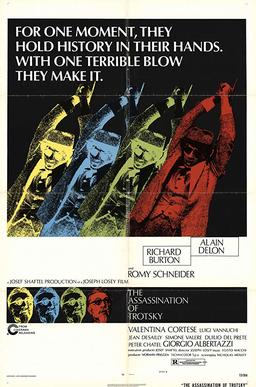
First released in 1972, The Assassination of Trotsky is a cinematic recreation of the events leading to the death of Leon Trotsky in Mexico.  French actor Alain Delon plays Frank Jacson, the Spanish communist who was tasked with infiltrating Trotsky’s inner circle and assassinating him with a pickaxe.  Welsh actor Richard Burton plays the Russian Trotsky, giving long-winded monologues about world revolution.  Italian Valentina Cortese also plays a Russian, in this case Trotsky’s wife, Natalia.  And finally, French actress Romy Schneider plays Gita Samuels, who is based on Jacson’s American girlfriend.  This international cast was directed by Joseph Losey, an American director who joined the Communist Party in 1946 and who moved to Europe during the McCarthy era.

Losey was an interesting director.  Though his first American feature film was the anti-war The Boy With Green Hair, the majority of his American films were on the pulpy side.  Not surprisingly, his European films were far more open in their politics.  Losey directed his share of undeniable masterpieces, like The Servant, Accident, and The Go-Between.  At the same time, he also directed his share of misfires, the majority of which were bad in the way that only a bad film directed by a good director can be.  The same director who gave the world The Go-Between was also responsible for Boom!

And then there’s The Assassination of Trotsky.  It’s a bit of an odd and rather uneven film.  Alain Delon’s performance as the neurotic assassin holds up well and some of his scenes of Romy Schneider have a true erotic charge to them.  The scenes of Delon wandering around Mexico with his eyes hidden behind his dark glasses may not add up too much but they do serve as a reminder that Delon was an actor who could make almost any scene feel stylish.

But then we have Richard Burton, looking like Colonel Sanders and not even bothering to disguise his Welsh accent while playing one of the most prominent Russians of the early 20th Century.  The film features many lengthy monologues from Trotsky, all of which Burton delivers in a style that is very theatrical but also devoid of any real meaning.  As played by Burton, Trotsky comes across as being a pompous phony, a man who loudly calls for world revolution while hiding out in his secure Mexican villa.  Now, for all I know, Trotsky could have been a pompous phony.  He certainly would not have been the first or last communist to demand the proletariat fight while he remained secure in a gated community.  The problem is that the film wants us to admire Trotsky and to feel that the world was robbed of a great man when Jacson drove that pickaxe into his head.  That’s not the impression that one gets from watching Burton’s performance.  If anything, Burton’s overacting during the assassination scene will likely inspire more laughs than tears.

The Assassination of Trotsky is one of those films that regularly appears on lists of the worst ever made.  I feel that’s a bit extreme.  The film doesn’t work but Alain Delon was always an intriguing screen presence.  (Interestingly enough, Delon himself was very much not a supporter of communism or the Left in general.)  The film fails as a tribute to Trotsky but it does make one appreciate Alain Delon.

Previous Icarus Files:

  1. Cloud Atlas
  2. Maximum Overdrive
  3. Glass
  4. Captive State
  5. Mother!
  6. The Man Who Killed Don Quixote
  7. Last Days
  8. Plan 9 From Outer Space
  9. The Last Movie
  10. 88
  11. The Bonfire of the Vanities
  12. Birdemic
  13. Birdemic 2: The Resurrection 
  14. Last Exit To Brooklyn
  15. Glen or Glenda

A Canadian Quickie With Lisa Marie: The Bloody Brood (dir. by Julian Roffman)


As part of my ongoing mission to see all of the film’s featured in Mill Creek’s 50 Chilling Classics box set, I watched a 65-minute Canadian film called The Bloody Brood last night.

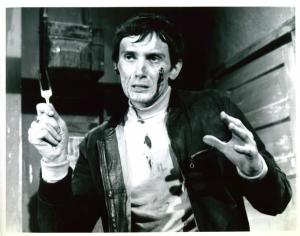
First released in 1959 and filmed in moody, noir-ish black-and-white, The Bloody Brood tells the story of a low-level drug dealer and aspiring beatnik named Nico (Peter Falk).  One night, while hanging out at the local coffeehouse and listening to decadent jazz, Nico witnesses a man drop dead of a heart attack.  Intrigued by the man’s sudden death, Nico and his nervous friend, a tv director named Francis (Ron Hartmann), decide that they want to experience what it would be like to deliberately kill someone.  Before you can say “Leopold and Loeb,” Nico and Francis are feeding a random stranger a hamburger laced with ground glass.  That stranger, a hard-working telegram delivery man named Ricky (George Sperdakous), later dies of an intestinal hemorrhage.

Unknown to Nico and Francis, Ricky has an older brother named Cliff (Jack Betts) and Cliff doesn’t believe that his brother’s death was an accident.  With the covert help of Detective McLeod (Robert Christie), Cliff starts to investigate his brother’s death.  Cliff eventually meets Ellie (Barbara Lord), a disillusioned woman who has fallen in with Nico and his murderous crowd.

The Bloody Brood is an unexpected surprise, a genuinely entertaining B-movie that more than overcomes the confines of its low-budget and limited running time.  While Peter Falk is the obvious center of the picture and steals every scene that he’s in with his coldly charismatic style of evil, the entire film is well cast and well acted with Hartmann and Betts both bringing unexpected nuance to their roles.  However, the real star of the film is director Julian Roffman who gives the film a shadowy and threatening noir-look. 

In many ways, The Bloody Brood represents everything I love about the low-budget, often sordid B-movies of the 50s and 60s.  Working with limited resources and a small cast, director Julian Roffman managed to create a genuinely memorable movie.  Films like The Bloody Brood continue to serve as proof that you don’t need millions of dollars to make a good film.  You just need a strong creative vision and the imagination to make that vision a reality.