Trailer: Straight Outta Compton (Red Band)


Growing up during the 1980’s meant popular music was divided between rock and pop. Yes, there were the non-friendly music genres that hundreds of millions also listened to but were seen as music of the outsider (heavy metal, punk). Yet, something happened in the latter half of the 80’s.

Rap has always been part of the music landscape since it’s early days during the 1970’s. The genre was either about partying or pushing a social awareness agenda that kept it out of mainstream audiences (with the exception of Run DMC and the Beastie Boys). Then a rap group out of South Central L.A. released an album titled Straight Outta Compton which took the world by storm.

Gangsta rap has broken through that wall which has kept most of rap from mainstream popularity.

The latest film from F. Gary Gray will tell the story of the beginnings of the group N.W.A. right up to the tumultuous events of the Rodney King riots. As most biopic go this one may just be a major hit just for the fact that N.W.A. has had such a huge impact on pop culture and the music industry that their music and influence still remain relevant today.

Straight Outta Compton is set for an August 14, 2015 release date.

Trash Film Guru Vs. The Summer Blockbusters : “The Amazing Spider-Man 2”


the_amazing_spider_man_2__2014____alternate_poster_by_camw1n-d7c1h7t

Seriously, folks, this whole contrarian role I seem to have either stumbled or , if you want to be grandiose about things,  been thrust into? Its actually getting pretty old.  Sure, I can’t do much about how my brain works, but once in awhile, maybe just for a day or so to see what it would be like, I’d love to at least like the same stuff everybody else does, and dislike all the same stuff that the rest of you do, too, just to relieve the tedium of seeing things in a fundamentally different way than everyone else. Mind you, I’n only talking about changing things up as far as my taste in films and other ostensibly “entertaining” media go here, these other perfectly mainstream ideas like “corporations are our friends and we shouldn’t tax them too high,” and “problems like racism, sexism, and other forms of discrimination are all in this past” — you can keep those, I’m happy to still keep tilting at windmills and telling Mr. and Ms. Middle America that they’re hopelessly deluded if they really believe the Hallmark Card pseudo-reality being sold to them while their pockets are being picked clean by the same rich assholes who then have the nerve to tell them that the real “moochers” are poor folks, or people of color, or single mothers, or any other group still that’s still easy to scapegoat and demonize.

At this point you’re probably wondering what any of this has to do with reviewing the just-released (“just,” in this case, meaning last week) The Amazing Spider-Man 2, and I can’t say I blame you, so here’s what I’m getting at : received “wisdom” has it that this is just some bog-standard, average-at-best super-hero flick. And the same received “wisdom” has it that the reason this is no great shakes (and you can bet the exact same argument will be trotted out in a couple of weeks in regards to the new X-Men movie) is because it’s not a Marvel Studios product but is, in fact, a Sony/Columbia release under license from Marvel. And I’m sorry, but I smell a serious rat with that fallacious line of “reasoning.”

Let me tell you why : Marvel, and their bosses at Disney,  desperately want the Spider-Man property back “in house” (same goes for X-Men) and have a vested interest in promoting the myth that only they can do it “right.” To that end, I’ll bet my bottom dollar that they’re the ultimate source of this goofy idea that somehow Sony’s Spider-Man lacks the “magic” that they’d bring to the property (and that’s really what Spidey is at this point — a “property” — as opposed to an actual character) and I’d even go so far as to speculate that they’ve contacted their bought-and-paid for media mouthpieces and had off-the-record conversations with them designed to subtly kick up an orchestrated “whisper campaign” against this film.

Shit, as science has proven, always runs downhill, and soon the folks who make their living telling other people what to think have affected the opinions of the legions of unpaid armchair critics (like myself) who in turn affect the opinions of fans and more casual movie-goers, and before you know it, the meme that The Amazing Spider-Man 2 just ain’t all that great has taken firm hold in the public consciousness. Sure, it all looks spontaneous enough, and most of the people playing along with the scheme have no idea that they’re doing, essentially, pro bono work for one monolithic studio conglomerate in their covert “war” against another monolithic studio conglomerate, but there you have it.

Spider-Man-Jamie-Foxx

What’s especially despicable about this, though, is how rancid and idiotic “homer”-ism in the “fan” community is so easily manipulated to shady ends, yet seldom if ever turned in a genuinely positive direction. The same “fans” who are actively and openly rooting for Marvel to “get back their baby,” for instance, don’t seem to care too much about the situation of Spidey’s actual creator, Steve Ditko, who is 86 years old and has never seen a dime from any of the flicks his legendary creation appears in — hell, when Sam Raimi’s first Spider-Man movie came out, Ditko was living under, to put it politely, reduced circumstances in a rented apartment above a New York City thrift store. If even a tiny fraction of the amount of energy fans put into campaigning for Marvel Studios were put into campaigning for the dozens, if not hundreds, of creators that Marvel has screwed over, who knows? Maybe the cause of creators’ rights would finally be getting somewhere. Let me be as blunt as possible here : if you care more about Marvel getting back the cinematic rights to Spider-Man, the X-Men, and the Fantastic Four than you do about folks like Steve Ditko, Gary Friedrich, Bill Mantlo, or the heirs of Jack Kirby, then you’re either a complete asshole, being played for a sucker, or both. These actual people deserve your support — not the corporate suits who continue to profit off the fruits of others’ imaginations.

To that end, I don’t have any real personal stake in whether or not The Amazing Spider-Man 2 is “not as good as it could/would be with Marvel Studios in charge,” because I could care less about the bottom-line corporate balance sheets of either DisMar or Sony/Columbia. They’re all faceless, greedy bastards in my book. But after watching the film, the rat I smelled grew even more pungent, so I decided to put my little “homer” theory to the test via the modern “miracle” of social networking.

Don’t worry, I didn’t waste too much time on this off-the-cuff experiment, only about 30 minutes or so, but the results were telling. I went onto twitter, looked for the first dozen comments of the “this would be so much better if Marvel did it” variety (they weren’t had to find), and asked the folks making such statements why they thought that. Of the 12 folks I asked, seven never responded, three said variations of the exact same thing (“because it’s theirs and they’d know how to do it right”) and two said they flat-out didn’t know why, “it just would be.”

Not done making a nuisance of myself, I then asked all 12 people again “What’s so ‘wrong’ with this movie in the first place in comparison with Marvel Studios product?” and received only two answers, one of which was “it just is,” and the other being “you can tell just by watching that they don’t get it.”

Excuse me, but — what’s not to get? It’s not like I’m going to try to convince you here that The Amazing Spider-Man 2 is necessarily all that great, but for what it is, frankly, it’s just fine, and in fact it’s a damn sight better than the last two Marvel Studios releases, the thoroughly uninspired Captain America : The Winter Soldier and the downright risible Thor : The Dark World, both of which were essentially big-budget TV movies-of-the-week (and overseen by television directors, no less). I’d even go so far as to say it’s quite a bit more enjoyable than Marvel’s most-ballyhooed cinematic endeavors, the incredibly over-rated The Avengers and the obviously-constructed-by-the-numbers Iron Man films.

It’s far from a terrific super-hero movie, mind you, like Christopher Nolan’s  Batman Begins or Richard Donner’s original Superman, but it definitely fits comfortably into the “above average, at any rate” group populated by flicks like The Dark Knight (which is nowhere near as good as  many seem to think, but is still fairly solid) and Raimi’s Spider-Man 2. So I guess my main argument isn’t even necessarily that this is all that much  better than at least the top-tier Marvel Studios flicks, like the first Thor and Captain America : The First Avenger, but that it’s in no way appreciably worse. Given that, then, and taking into consideration how positively homogenized and formulaic Marvel’s “in-house” product has become in the absence of genuinely talented directors like Kenneth Branagh and Joe Johnston, there’s absolutely no reason to believe they’d “do a better job of things” if the web-slinger’s rights suddenly fell back into their lap.

green-goblin-spider-man-the-amazing-spider-man-2

Frankly, some of the criticism being leveled at this flick is just plain absurd on its face, and amazingly hypocritical. I’ve seen folks who gushed over The Avengers claim, with a straight face, that the problem with The Amazing Spider-Man 2 is that it “relies too heavily on CGI battle scenes.” And Whedon’s movie didn’t? I’ve seen many self-styled “opinion makers”  who gushed over the the “human”  characterization in Nolan’s Bat-films say that this movie “has too much Peter Parker, not enough Spider-Man.” I’ve seen people who applauded the revisionist origin story given Superman in Zack Snyder’s Man Of Steel grouse about how director Marc Webb and his committee of screenwriters are “playing too fast and loose” with Spidey’s backstory here. And,  while I’ll grant you that Jamie Foxx’s Max Dillon/Electro character is flat-out absurd in both its human and super-human iterations, and that getting shocked by a big cable and falling into a vat of electric eels is a pretty lame way for a villain to get his powers, it’s worth noting that many of the people poking fun at this have no problem with the idea of a chemically-enhanced “super soldier” being frozen in a block of ice and waking up, without having aged a day, in the Captain America movies, or of the Norse Gods being a real race of inter-dimensional super-beings in the Thor films, and are even willing to swallow the single-most laughable notion in all comic-book flicks, that of a spoiled billionaire rich kid who inherits his daddy’s company and still actually works for a living, as Tony Stark does in the Iron Man series.

There are plenty of folks out there telling you what Webb and company get wrong in The Amazing Spider-Man 2 — from the aforementioned Electro stuff to Andrew Garfield’s take on Peter Parker being “unlikable” (news flash — he’s been a self-pitying, self-aborbed, flat-out selfish little prick in the comics from day one) to Sally Field’s Aunt May being “too young” (whatever ,  she does a really nice job)  to Paul Giamatti’s wasted and pointless cameo as the villainous Rhino at the end —let me take just a few minutes to tell you what this movie gets right.

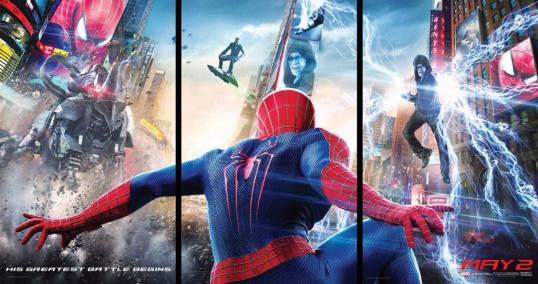
exclusive-the-amazing-spider-man-2-pictures-153555-a-1389698871-470-75

Dane DeHann is positively creepy as Harry Osborn/The Green Goblin and his origin/descent into villainy is portrayed in a way that actually makes sense. Likewise, even though his screen time is limited, Chris Cooper knocks it out of the park as his vicious, megalomaniacal father, Norman. There’s real chemistry between Garfield’s Parker and Emma Stone’s Gwen Stacy, and the film does a nice job of updating/translating the legendary penultimate Spidey/Gwen story for the silver screen. The CGI effects work is solid and a represents a big step up from the lackluster graphics of Webb’s first Spider-film. The characters are allowed to age at least semi-normally, as evidenced by the fact that Peter, Gwen, and their classmates are  shown graduating high school at the start of the film (and a good thing too, since both actors are, what? Pushing 30?). Webb directs the action sequences that he’s being maligned for with far more aplomb than his more-praised counterparts like Jon Favreau or Joss Whedon, who just show one building after another being smashed to rubble in between those fucking interminable shots of Robert Downey Jr.’s face inside of his Iron Man helmet. And at least this movie gives us warts-and-all human beings at its core with plausible psychological motivations for doing what they do rather than mythological gods, science-whiz playboys, sexy Russian super-spies with no accents, or one-dimensional do-gooders fresh out of suspended animation.

It’s not enough to make The Amazing Spider-Man 2 a truly great super-hero movie, and a forced and tacked-on ending epilogue-ish ending doesn’t help (even if there’s plenty of reason for fans to “ooh”and “aah” when we get a sneak peek at the character designs for the members of the sure-to-pop-up-in-the-next-flick Sinister Six, and hey, isn’t that the Black Cat we get to meet — briefly and in her civilian identity — earlier on, too? Where’s the fan-gasming for that?), but it makes it a heck of a lot more involving than much-more-highly-praised (even if it’s dull and repetitious) fare that just so happens to carry the Marvel Studios logo above its title. And you know what? That’s all it would take for fans to love this one, and is the single, solitary reason why many of them don’t. You might call that loyalty, but I call it bullshit.


Movie Review: The Amazing Spider-Man 2 (dir. by Marc Webb)


hr_The_Amazing_Spider-Man_2_59

 One would think The Amazing Spider-Man 2 would be a hit right out of the ballpark. You have a follow up to the highly successful film & one of Marvel’s flagship characters and tons of back story the movie can work with. It’s filmed right in New York – I saw part of the setup at Times Square myself. Perhaps I caught the film at a bad time, or my mindset wasn’t proper, but I had a tough time feeling anything for the film. Perhaps because this is a sequel to a film that rebooted another movie that was only a decade old. Maybe the time has come for Disney/Marvel to knock on Sony’s door and tell them they want their baby back. My only regret is that I didn’t get this review out soon enough to save people from spending money on this. I should have done more.

With Great Power really does come Great Responsibility.

The film picks up some time after the end of the first film and does manage to handle a few story related elements well. Writers Alex Kurtzman and Roberto Orci (Transformers, Star Trek), along with two other writers created a script that connected to the first film. The audience is given some closure when it comes to Peter Parker’s parents and the secrets they were guarding. For long time comic fans, they’ll get a Spider-Man that cracks tons of jokes while taking down the bad guys.

Okay, let’s focus on the good before the bad.

It’s Andrew Garfield and Emma Stone’s chemistry that keep the moments between Peter Parker and Gwen Stacy real. You can tell there’s a good connection between them in any scene they share. You might as well be watching a reality series based on their relationship, really. Additionally, Garfield continues to give Spider-Man all the razor sharp wit he deserves, feeling very much like the comics. Credit also goes out to Sally Field as Aunt May. For a character that is usually in the background, her scenes were the memorable ones – the ones that I’d start a conversation with “Hey, you remember that part when…” Even Dane DeHaan’s Harry Osborne was pretty good for the most part, I suppose.

I can’t complain about the way it was shot or the effects that were used. Spider-Man’s swinging is pretty on point, and the in air acrobatics are as cool as they’ve ever were. Some scenes tend to move a little slow – particularly the Gwen / Peter ones – but it helps to establish where they’re going. It’s more or less a necessary evil.

And that’s about it. I don’t really have much else to say on the good elements to this movie. It’s a shame really, because making movies aren’t easy with restrained budgets and producers breathing down your neck to get the product in the theatre.

Now the Bad:

Let’s start with Electro. While I thought the Electro powers were great and all, I had a problem with the reason behind his existence. It’s almost a page taken out of Batman Forever – literally, that was the first movie that came to mind on watching Oscorp technician Max Dillion’s (Jamie Foxx) Spider-Man fandom blossom into jealousy and then hatred. Foxx does what he can with it, and I’ll admit that once he has that Electro-suit on, it’s kind of cool. The argument could be made that because the character meets his hero and is then shunned by him, this causes him to become a villain – as evidenced by the schizophrenia-like voices that accompany Electro’s theme (“He lied to me, They hate me, they’re using me, He’s dead to me.”) during his fights. My reasoning here is that if the character was a fan of Spider-Man, having witnessed him stop all these crimes, wouldn’t it make sense for Spider-Man to try to stop you if you’re inadvertently disturbing the peace? It’s not even like Dillon had a beef with any of the Oscorp workers who may have mistreated him here. I had a serious disconnect with Electro as a character with justifiable motives for his actions. Granted, this is coming from someone who isn’t as familiar with Electro as many who’ve read the comics. It’s altogether possible that he is working within the comic’s defined role, and if that’s the case, many may find it refreshing. It just seemed a little off to me.

DeHaan has similar issues. As Harry Osborn, he’s great. As the Goblin (you’ve been looking at the posters, it’s not exactly a spoiler), I found myself feeling like the only reason he was there was to push a story arc. Imagine someone watching a fight and then suddenly running in and saying “Aha, now you face me!” It was just about the same setup here. The collective theme of the movie seems to be..”You know what? Let’s hate Spider-Man, because we can. We’ll figure out a detailed, legitimate reason later.”

On Paul Giamatti, I would dare to call his appearance a cameo, but it feels tacked on. I thought it would we better to never mention him at all marketing wise and then surprise audiences with where he goes. That’s all I really have to say about him in this.

One other thing was a standout – the music. The music, though a great change from Horner’s Rocketeer sounding score, almost overpowers the film. I was a little shocked to find out that Hans Zimmer worked on it (Along with friends Johnny Marr and Pharrell Williams), but some of the tracks felt phoned in. If you asked me who did the music before showing me the credits, I would have sworn it was maybe Henry Jackman, or maybe Tyler Bates. That isn’t to say that either of them are bad composers, by the way.

Let me put it this way: You could have switched this score out with the one from Despicable Me and I don’t think anyone would have known the difference. I almost put my hands in my face on hearing “The Itsy Bitsy Spider” in the middle of a track. Zimmer might as well have just went with his “Point of No Return” score here.

Overall, The Amazing Spider-Man 2 was so-so for me. I don’t see myself trying to ever see it again, but depending on what you’re looking for, you may get a different experience from it. I’m hoping that Sony just shelves the Webhead for a while.

Super Bowl Trailer: The Amazing Spider-Man 2 “Enemies Unite”


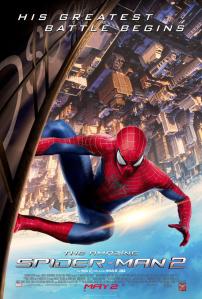
1024px-Amazing-spider-man-2-poster

The Amazing Spider-Man 2 continues the reboot Sony began with the Spider-Man franchise minus Sam Raimi and Tobey Maguire. While The Amazing Spider-Man did quite well in the box-office when it came out in 2012 the general consensus with fans and critics alike was that it was just another origins tale that rehashed events from the Peter Parker story that was already well-known to comic book and non-comic book fans alike.

This sequel will now bring in villains and some plot points that fans have been waiting for since the franchise first began in the early 2000’s. We have Jamie Foxx and Paul Giamatti as the villains Electro and Rhino finally appearing on film with hints that other iconic Spider-Man villains such as the Vulture and the Hobgoblin probably having a cameo. This sudden flood of villains looks to be Sony’s attempt to set-up a Sinister Six film that would be the studio’s way to counter the success of Marvel’s and Disney’s success with The Avengers.

Time will tell if this gamble will end up paying off for Sony and many comic books wish it won’t since there’s a chance it would return Spider-Man to Marvel Studios thus making him available to appear in future films as an Avenger.

Sony went to unprecedented lengths to make sure people knew about the new trailer arriving on Super Bowl Sunday. We had a teaser teasing the trailer for the Super Bowl. Then we had the brief teaser shown during the Super Bowl. Below is the full 3-minute plus trailer that was shown on-line soon after.

The Amazing Spider-Man 2 is set for a May 2, 2014 release date.

A Quickie With Lisa Marie: Cosmopolis (dir. by David Cronenberg)


“I wanted you to save me.” — Paul Giamatti in Cosmopolis

It’ll probably take the rest of the world a few years to realize this but David Cronenberg’s Cosmopolis is not only a good film but occasionally, it’s even a great film.  What it is not is an easy film.  Instead, this film is a throwback to the such Cronenberg films as Videodrome and eXistenZ, films that served to not only challenge the audience’s expectations but to occasionally attack them as well.

Plotwise, Cosmopolis is a day in the life of a 28 year-old billionaire named Eric Packer (played by Robert Pattinson, who gives an excellent performance that hints at the neurosis that boils underneath surface ennui).  Packer wants to get a haircut so he spends nearly the entire day sitting in the back of his stretch limo, being driven through an increasingly violent and disturbing New York.  Rarely leaving the safety of his limo, Packer has several chance meetings with his wife, who refuses to have sex with him, and picks up several other women who are willing to have sex with him.  He also finds the time to have a prostate exam and discuss (and discuss) the meaning of life with several of his cronies, all of whom seem to pop up in the back of his limousine without warning and who also seem to vanish once Packer tires of listening to them.  Along the way, Packer finds both himself and his limousine being targeted for destruction but he never changes his plans or his direction.  After all, he needs a haircut…

Many reviewers are treating Cosmopolis, with its portrayal of a man who has too much money and not enough humanity, as if it’s some sort of Occupy manifesto and, indeed, there are several scenes where Cosmpolis does seem to serve as a mouthpiece for the anti-capitalist Occupy ideology.  There are also several scenes where Cosmopolis plays as a very deliberate modern-day version of Jean-Luc Godard’s Marxist-themed, pro-revolution Weekend.  However, to simply call Cosmopolis a pro-Occupy film is  to offer up an interpretation that’s a bit too simplistic.  After all, when the Cosmopolis version of the Occupy protestors do make an appearance, they’re either rioting in the streets  (and getting nothing more than a bemused smirk from Packer) or else they’re being represented in the form of a shambling and somewhat pathetically bitter character played by Paul Giamatti.  When Giamatti accuses Packer of hurting other people with his lifestyle, Packer confidently replies, “Don’t pretend that you care about other people,” and it’s rather obvious that, in the troubled world of Cosmopolis, both the excesses of the 1% and the Occupy movement spring from the same poisoned well of narcissism and anger.  In Cosmopolis, neither of the competing ideologies are presented as being a solutions but instead, both are seen as signs that the world is beyond saving.

Ultimately, Cosmopolis is a return to themes that should be familiar to anyone who is familiar with Cronenberg’s work.  Like many Cronenberg protaganists, Eric Packer is a neurotic man who has attempted to make himself invulnerable to a messy and imperfect world and, in the process, he has surrendered his humanity.  While the world outside collapses, Packer is sealed off in his stretch limo.  Over the course of the day, it becomes increasingly obvious that he stays in the limo because that limousine is an environment that he can control.  It also becomes apparent that the sterility of his perfect limo has left his incapable of relating to or even understanding the world outside.  It’s only as the film progresses and Packer continually finds himself forced to exit the limousine that his true nature starts to come to the surface.  It’s only when, at the end of the film, Packer finds himself permanently separated from his limousine that the film can reach its apocalyptic ending.

Ever since it appeared at Cannes, Cosmopolis has been getting a lot of mixed reviews and it’ll probably never be the type of film that is embraced by the masses.  It’s too cold and clinical to be beloved by many filmgoers.

Well, that’s their loss.

In a year that’s been dominated by bland and safe movies, Cosmopolis is a film that dares to challenge the audience.  It’s a film that dares to say that all is not right with the world and that there might not be any easy or crowd-pleasing solutions.

Love it or hate it, we need (and deserve) films like Cosmopolis.

A Quickie With Lisa Marie: The Ides of March (dir. by George Clooney)


George Clooney’s new political film The Ides of March opened last Friday and so far it appears to have mostly gotten positive reviews that are more respectful than enthusiastic.  Well, I saw The Ides of March on Tuesday evening and all I can say is “Don’t believe everything you hear.”  That should be a given but it’s always worth repeating.  The Ides of March is a slow, ponderous, and at times completely annoying movie, a minor work dealing with major themes.

The film is based on the play Farragut North and it’s about Stephen (Ryan Gosling), a political consultant who is working on the presidential campaign of Gov. Mike Morris (George Clooney).  Morris is a typical Hollywood Democratic politician in that he gives a lot of speeches attacking America’s dependence on foreign oil and he’s not ashamed to admit that he’s an atheist.  Anyway, despite the fact that Morris comes across as being smug and something of a sexist, he’s the front runner for the Democratic Presidential nomination but only if he can win the Ohio primary.  For all of his attempts to be as cynical as his mentor (Philip Seymour Hoffman, giving a typical Philip Seymour Hoffman performance), Stephen truly believes in Mike Morris.  However, Stephen comes across some information that could potentially destroy Morris’ campaign and he soon finds himself a pawn in a game between Morris, the press (represented by Marisa Tomei, who looks terrible in this film), and the opposing campaign (managed by Paul Giamatti).

Yes, The Ides of March has a lot to say but it’s absolutely nothing you haven’t heard before and, quite frankly, it’s kind of annoying how the film seems to think that this is the first time that anyone’s ever suggested that maybe politics is a dirty business.  The film’s not a total waste because there’s way too many talented people involved here for the film not to have the occasional good moment.  Gosling and Clooney both give strong performances and play off each other well.  They have a scene where they confront each other in a deserted kitchen and for a few brief seconds, the film actually gets interesting.  Playing an emotionally unstable intern, Evan Rachel Wood shows once again that she’s one of the best actresses working today and it’s just a shame that the film treats her more like a plot device than an actual human being.  At the same time, I have to say that this is the first time I’ve ever seen Paul Giamatti actually give a performance that can only be called bad.  Seriously, how could the same actor who was so brilliant in Win Win be so terrible in this movie?

Ultimately though, the film fails because — once you get past all the glamour on-screen — what you have is a very predictable political film that, especially in these days of Tea Parties and Occupy Movements, feels rather quaint and forced.  This is yet another one of those films where, apparently, the only way that the main character can learn a lesson is for a supporting character to commit suicide.  There’s a lot of would-be cynical dialogue and Clooney manages to include references to Rush Limbaugh and the Drudge Report but ultimately, the whole film feels as false as the romantic short stories I used to write in the 8th grade.

The film’s name is obviously meant to carry hints of Shakespeare but perhaps a more honest title would have been Much Ado About Nothing.

2011: The Year In Film So Far


Greetings from the former home of the Flying Spaghetti Monster, Crossville, Tennessee!  Yes, Jeff and I are on our way back to Texas.  It’s been a wonderful vacation but I have to admit, I’m looking forward to seeing a movie at the Plano (or Dallas) Angelika on Sunday.  I’m not sure which movie but, as long as it’s a movie, I’ll be a happy girl.

That’s because I love movies.  Movies are what I schedule my life around.  My birth certificate says I was born in 1985 but I know that I was born in the year of Brazil, Prizzi’s Honor, Blood Simple, and After Hours.  If each year can be judged by the quality of the films then how is 2011 looking now that we’ve reached (and passed) the halfway mark?

Right now, as I sit here in this hotel room in my panties and my beloved Pirates shirt, I’d say 2011 is shaping up to be an average year.  There’s been a few films that I loved and there’s been a few that I’ve absolutely despised but for the most part, this year is shaping up to be comfortable and rather bland. 

Much as I did last year at this time, I’m going to take a few minutes to mention a few high points (and low points) of 2011 so far.  Agree?  Disagree?  Make your opinion known.

Best Film (So Far): Hanna, without a doubt.  Joe Wright’s stylish thriller hasn’t gotten half the acclaim that it deserves.  Runners-ups: The Cave of Forgotten Dreams, Incendies, Jane Eyre, Kill The Irishman, Of Gods and Men, Red Riding Hood, Sucker Punch, The Source Code, Super, 13 Assassins, The Tree of Life, Win Win, X-Men: First Class

Best Male Performance of the Year (so far): Paul Giamatti in Win Win.  Runners up: Bobby Cannavale in Win Win, Joseph Gordon-Levitt in Hesher, Matthew McConaughey in The Lincoln Lawyer, and Rainn Wilson in Super.

Best Female Performance Of The Year (so far): Sairose Ronan in Hanna. Runners up: Lubna Azabal for Incendies, Ellen Page for Super, Amy Ryan for Win Win, and Mia Wasikowska for Jane Eyre.

Best Ending (so far): The charmingly low budget zombie film that runs over the end credits of Super 8.

Best Horror Film (so far): Insidious.

Most Underrated Film Of The Year (so far): A tie, between Sucker Punch and Red Riding Hood.  Red Riding Hood, as a matter of fact, was so underrated that I had to see it a second time before I really appreciated it.

Best Bad Film: Beastly.  Silly but kinda fun in a really, really odd sort of way.

Worst Film of The Year (so far): The Conspirator, a bore of a movie that was apparently filmed through a filter of grime.  Runners up: Priest, The Beaver, Battle L.A. (sorry Arleigh, Leonard, and Erin), Season of the Witch, Your Highness, and The Green Lantern.

Biggest Example of A Missed Opportunity This Year (So Far): The Adjustment Bureau, which could have been a great Eternal Sunshine Of The Spotless Mind-type of film but instead, turned out to be just another predictable and shallow example of new age triteness.

The Get-Over-It Award For The First Half Of 2011: The Conspirator, a film that attempts to be relavent by using the 19th Century to comment on political issues from 2006.

My Prediction For Which Film Will Be The Most Overrated Of 2011: Last year, I predicted The Social Network and, surprise surprise, I was right.  In fact, the folks at AwardsDaily.com are still bitching about how The Social Network lost best picture to The King’s Speech.  (By the way, a few other choice pieces of wisdom from Awards Daily: The Beaver is Jodie Foster’s best film ever and only elitists should be allowed to comment on film.)  This year, I’m going to predict that the most overrated film of 2011 will be the unnecessary remake of The Girl With The Dragon Tattoo.

My Prediction For What Will Be The Worst Film Of 2011: The winner here is another remake — Rod Lurie is remaking Straw Dogs and this time, he’s setting it in the South.  You know what?  Go back to Vermont and fuck yourself ragged, you dumbass, blue state elitist.  

So, that’s 2011 so far.  There’s still quite a few films that I’m looking forward to seeing: Another Earth, The Debt, Don’t Be Afraid of the Dark; Tinker, Tailor, Soldier, Spy; Hugo, and most of all, Harry Potter and the Deathly Hallows, Part 2.

Film Review: Win Win (dir. by Thomas McCarthy)


When I watched the pilot episode of Game Of Thrones, I got very excited when I saw that Thomas McCarthy was credited as the director.  Now, McCarthy isn’t a household name but chances are, you’ve seen him.  He played the plagiarist journalist in the final season of The Wire.  He was John Cusack’s romantic rival in 2012.  He was nominated for an Academy Award for co-writing the Pixar film Up.  However, McCarthy has received most of his critical acclaim as the director of low-key, character dramas like The Station Agent and The Visitor.  I have to admit that I was shocked to see McCarthy’s name linked to Game of Thrones because, with the exception of Peter Dinklage, it appeared to have nothing in common with his previous films.  Well, turns out that I wasn’t the only one who thought that because apparently, despite McCarthy being credited as the director, the majority of the pilot was actually reshot (quite well) by Tim Van Patten.

So, you might not be seeing Thomas McCarthy’s work on television but fortunately, you can still catch it in the movie theaters.  McCarthy’s latest film is a surprisingly poignant comedy called Win Win.

InWin Win, Mike (played by Paul Giamatti) is an attorney who works and lives in small New Jersey town.  Mike is married to Jackie (Amy Ryan), owns a big house, helps to coach the high school’s mediocre wrestling team, and can’t pay his bills.  Rather than let his family know that he’s on the verge of going broke, Mike instead becomes the legal guardian of one of his clients, the increasingly senile Leo (Burt Young).  In return to acting as Leo’s guardian, Mike receives a payment.  He also promises to take care of Leo so that Leo doesn’t have to enter a nursing home.  However, since Mike is played by Paul Giamatti, it doesn’t come as much of a shock that Mike promptly moves Leo out of his home and into the nursing home.  Leo, however, is too senile to understand that he’s being taken advantage of and all of Mike’s second thoughts disappear as soon as he gets the first check.

However, things get complicated once Leo’s delinquent grandson Kyle (Alex Shaffer) shows up looking for his grandfather.  Mike takes Kyle to see Leo and soon finds out that Kyle’s mother (and Leo’s daughter) Jill (Melanie Lynesky) is currently in drug rehab and Kyle has nowhere to go.  Reluctantly, he and Jackie agree to allow Kyle to stay with their family until his mother gets out of rehab.

While Kyle, at first, seems to just be an inarticulate drop out, he quickly reveals to himself to actually be a very intelligent (if very angry) young man.  Even better, from Mike’s point-of-view, Kyle is a former wrestling champion.  Mike arranges for Kyle to enroll in the local high school and join the wrestling team.  With Kyle now on the team, they actually start to win matches.  Suddenly, everything is starting to look up for Mike.  He’s a town hero, Jackie starts to bond with Kyle, and Leo remains unaware of how Mike is taking advantage of him.

And then, Kyle’s mom shows up and everything pretty much goes to Hell.

Win Win is the latest entry in the genre of film known as Paul Giamatti Has A MidLife Crisis.  The fact that the film remains interesting despite being the thousandth time that we’ve seen Giamatti have a midlife crisis is a tribute to both McCarthy’s intelligent script and Giamatti’s excellent lead performance.  Giamatti could play these roles in his sleep and the fact that he doesn’t is what makes him such a consistently interesting character actor.  Giamatti gets strong support from Shaffer and especially Ryan.  However, my favorite performance in the film came from Bobby Cannavale, who plays Giamatti’s loyal if somewhat dull-witted best friend.  Cannavale shows that you can give a very smart performance playing dumb and hopefully, his performance here well lead to greater things for him.

Now, I have to admit — I know nothing about wrestling.  Actually, I know less than nothing about wrestling.  And, to be honest, I really don’t care if I ever know anything about it.  Yet this film, which centered around wrestling, held my attention because McCarthy, as a director, uses the wrestling story to portray something universal.  His direction here is never flashy nor is it technically perfect.  (To be honest, I counted three appearances by the boom mic.)  McCarthy isn’t a polished director but that lack of polish works to this film’s advantage.  He may not have been the right director for Game of Thrones but he was obviously just what Win Win needed.