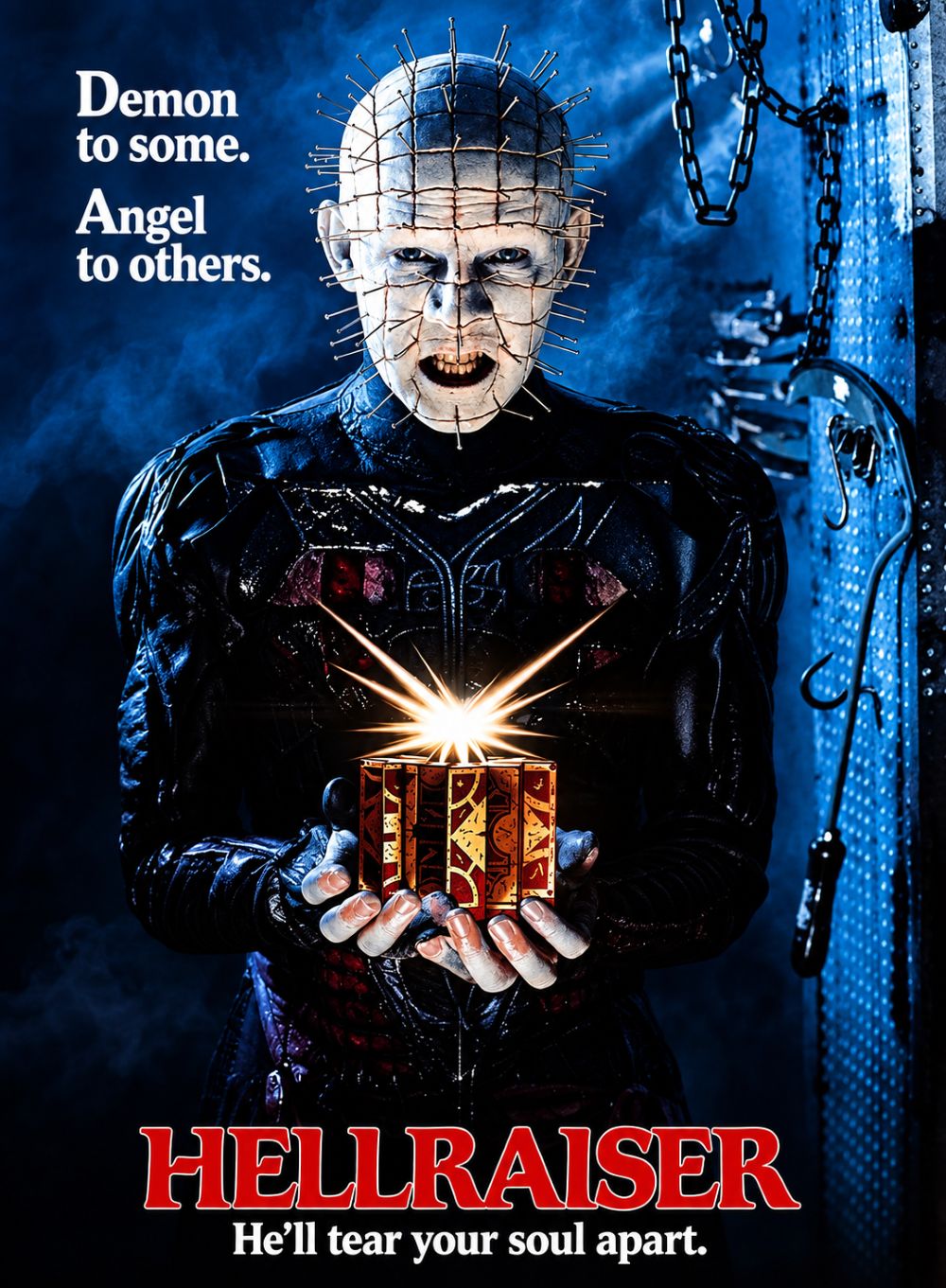
Horror Film Review: Hellraiser (dir. by Clive Barker)


“No tears, please. It’s a waste of good suffering.” — Pinhead

Hellraiser does not ease viewers into its nightmare; it drags them straight into a world where desire, suffering, and obsession have become impossible to separate. Written and directed by Clive Barker from his own novella The Hellbound Heart, the film is bloody, unsettling, weirdly intimate, and much more serious than its pop-culture reputation might suggest. Yes, it is the movie that introduced Pinhead and the Cenobites, but the first Hellraiser is not really a Pinhead showcase in the way later sequels became. It is a rotten little domestic nightmare about lust, betrayal, obsession, and the kind of desire that keeps going long after it should have destroyed a person.

Barker’s big strength is that he does not treat horror as something separate from human craving. In Hellraiser, pain and pleasure are tangled together from the opening scene. Frank Cotton is not some innocent fool who accidentally opens a cursed puzzle box. He actively seeks it out because normal pleasures no longer satisfy him. He wants sensation pushed past every limit, and the Lament Configuration gives him exactly that—just not in the way he expected. The Cenobites arrive with their chains, hooks, leather, scars, and ritualistic calm, offering a version of experience so extreme that it turns the body into something almost unrecognizable. That premise is memorable on its own, but Barker makes it work because Frank is already spiritually disgusting before hell ever gets involved.

The movie’s real surprise is Julia Cotton, played brilliantly by Clare Higgins. Julia could have been a standard unfaithful wife character, someone introduced merely to create tension inside the Cotton family. Instead, she becomes the dark heart of the film. Her attraction to Frank is not romantic in any healthy or even conventionally sensual sense. It is tied to resentment, boredom, humiliation, and a kind of violent need to feel alive. When Frank returns in his skinless, barely human state and needs blood to regenerate, Julia does not hesitate for long before becoming his accomplice. The scenes in which she lures men back to the abandoned house are among the movie’s most disturbing moments precisely because they are played with such cold purpose. She does not seem possessed. She is making a choice.

That decision gives Hellraiser a nasty emotional edge. Frank is obviously monstrous, but Julia is arguably scarier because she begins as an ordinary person trapped in a miserable life and willingly walks into atrocity. Higgins gives the role a detached, almost aristocratic chill. Her face barely needs to change for the audience to understand that something terrible is happening behind her eyes. The film’s central house becomes an extension of her inner life: dusty, decayed, closed off, and hiding a nightmare in the upstairs room. There is something grimly effective about the fact that the gateway to hell is not in an ancient castle or a faraway cemetery. It is in a family home where people are supposed to start over.

Andrew Robinson also deserves credit as Larry, Julia’s decent but oblivious husband. He is not the most dynamic protagonist in horror history, but that works for the story. Larry is a fundamentally ordinary man who cannot imagine the depths of corruption already moving around him. His blindness is frustrating, but it also reinforces the movie’s worldview. In Hellraiser, the people closest to us may carry desires we cannot see, and the house itself may preserve the damage left behind by old secrets. Ashley Laurence, as Larry’s daughter Kirsty, gradually becomes the film’s moral center. She is not an especially flashy final girl at first, yet Laurence gives Kirsty intelligence and genuine fear. Once she learns what the box can do, her panic feels grounded because she understands she has stumbled into something far beyond a killer with a knife.

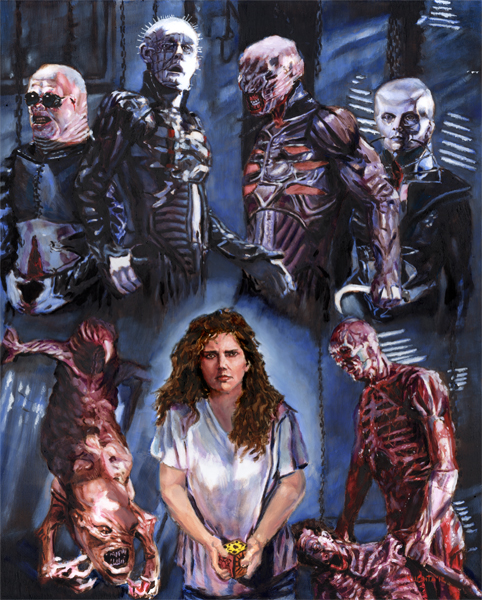
Then there are the Cenobites, who remain some of the most striking horror creations of the decade. Doug Bradley’s Pinhead is the obvious standout, but the film wisely uses him sparingly. Pinhead is not a slasher villain who runs around collecting bodies. He is more like a supernatural official, a priest of pain carrying out a horrifying contract. Bradley’s measured voice and theatrical stillness make the character far more unsettling than a louder performance would have. The famous line, “We have such sights to show you,” works because it is delivered with calm conviction rather than rage. Pinhead is not trying to scare Kirsty for fun. He genuinely believes that torment and ecstasy are parts of the same revelation.

The other Cenobites matter too. Butterball, the Chatterer, and the Female Cenobite create the feeling that Pinhead belongs to a larger order rather than simply functioning as a lone monster. Their designs are grotesque but carefully composed, full of exposed flesh, surgical markings, and fetishistic costume details. They do not look like demons from a traditional Christian image of hell. They look like beings who have remade themselves according to an alien set of desires. That is where Barker’s imagination really separates Hellraiser from more conventional monster movies. The Cenobites are not just evil creatures. They are explorers of sensation who have gone so far beyond humanity that morality barely applies to them anymore.

The practical effects are still a major reason the film holds up. Frank’s gradual reconstruction from blood-soaked remains into a mutilated human body is disgusting in the best possible way. It has a tactile quality that CGI rarely captures. You can see the slime, the tissue, the half-formed muscles, and the painful labor involved in putting a body back together. Even when some of the effects show their age, they retain a handmade ugliness that fits the movie’s atmosphere. Nothing in Hellraiser is clean or sleek. The supernatural realm looks damp, industrial, and biological, as if hell were built out of meat, rust, chains, and bad memories.

Christopher Young’s score also does a lot of heavy lifting. It gives the movie a gothic grandeur that makes the story feel larger than its limited locations and modest budget. The film is mostly confined to a house, a hospital, a few streets, and the Cenobites’ shadowy realm, yet the music makes it feel like a grand tragedy unfolding behind the walls. That contrast is one of the movie’s best tricks. Hellraiser can be intimate and theatrical at the same time. It is essentially a chamber piece about a broken family, but it plays like a myth about forbidden knowledge.

If the film has a weakness, it is that its final stretch gets a little messy. The confrontation with Frank has some excellent makeup work and gruesome imagery, but the pacing becomes more conventional once Kirsty is forced into full survival mode. The ending also feels slightly rushed considering how carefully Barker establishes the family tension earlier on. Still, the movie earns enough goodwill through its atmosphere, performances, and imagination that these flaws do not do much damage. If anything, the roughness adds to its charm. Hellraiser feels like a filmmaker throwing every dark idea he has onto the screen and trusting the audience to follow him into the abyss.

What makes Hellraiser endure is not simply the gore, the puzzle box, or Pinhead’s instantly recognizable appearance. It lasts because it understands that horror is often rooted in the things people want but are ashamed to admit they want. Frank wants infinite sensation. Julia wants escape and emotional intensity. Kirsty wants to save her family but must confront how little of that family was worth saving. The Cenobites offer no easy moral lesson; they are simply waiting for someone foolish or desperate enough to open the door.

Casual viewers looking for a straightforward slasher might find Hellraiser slower and stranger than expected, especially if they only know the character of Pinhead through sequels, posters, and parody. But for anyone willing to meet it on its own grim terms, it remains one of the most original supernatural horror films of its era. It is gross, stylish, perverse, tragic, and surprisingly sad beneath all the blood. Barker did not just create monsters. He created a nightmare universe where desire becomes a trap—and where opening a small box can ruin everything.
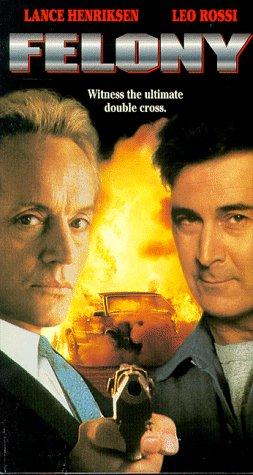
Felony (1994, directed by David A. Prior)


In New Orleans, a drug raid gone wrong leads to eleven cops being gunned down and then blown up.  The disastrous raid was being filmed for a Cops-like reality show  The show’s producer, Bill Knight (Jeffrey Combs) finds himself being pursued through New Orleans by a collection of rogue intelligence agents, cops, and gangsters, all of whom want the tape of the massacre.

It’s a simple direct-to-video premise and the film’s plot hits every chase film cliche, while keeping the action moving at a decent pace.  Bill Knight is not supposed to be a typical action hero.  He’s just a television producer who was in the wrong place at the wrong time.  Yet Knight proves himself to be as indestructible as any Arnold Schwarzenegger hero.  He gets shot, twice.  He falls from a great height.  He crashes through a window.  He repeatedly gets hit over the head.  And yet, his injuries never seem to really slow him down or even hurt that much.  He does hook up with a nurse (Ashley Laurence) but still, it’s hard to believe anyone could take that much punishment and keep running.  Jeffrey Combs, the brilliant star of films like Re-Animator, is miscast as Knight but he’s still always entertaining to watch.

In fact, the cast is the main thing that Felony has going for it.  David Prior was able to assemble a true group of B-movie all-stars.  Lance Henriksen and David Warner are the evil intelligence agents who are determined to kill Knight.  (Warner finally gets to handle a grenade launcher and we’re all the better for it.)  Leo Rossi and Charles Napier are the two New Orleans cops who are investigating the drug raid.  Joe Don Baker is the rogue intelligence agent who dresses like a cowboy and who is trying to clean up everyone else’s mess.  The cast keeps the action moving and there are enough eccentric personalities in this film that it’s always watchable.  I think this might be the only film to feature Joe Don Baker and Lance Henriksen performing opposite each other.  If nothing else, it deserves to be watched for that!

(The cover for Felony features Lance Henriksen and Leo Rossi but not Jeffrey Combs, even though Combs is the lead in the film and Rossi’s role is actually pretty small.  Henriksen also doesn’t have blonde hair in the movie.  There are plenty of double crosses in the movie but I can’t think of any that really qualify as the “ultimate double cross.”)

Even with its miscast lead and its cliche-heavy plot, Felony is what direct-to-video action movies should be all about, fact-paced action and a cast unlike any other,


Late Night Retro Television Review: Highway to Heaven 2.22 “Sail Away”


Welcome to Late Night Retro Television Reviews, a feature where we review some of our favorite and least favorite shows of the past!  On Thursdays, I will be reviewing Highway to Heaven, which aired on NBC from 1984 to 1989.  The entire show is currently streaming on Freevee and several other services!

This week, Jonathan helps a novelist get in touch with his long-passed muse.  He also helps him repair his relationship with his grandson before it’s time to move on.

Episode 2.22 “Sail Away”

(Dir by Michael Landon, originally aired on April 2nd, 1986)

Two novelists travel to a remote island.

Frank Worton (Lew Ayres) grew up on the island and was inspired to write a series of paperback romances based on his love for a girl named Jenna.  Sadly, Jenna died when Frank was a teenager and his books were his way of trying to get continue their relationship, if just in his imagination.

Todd Worton (David Einser) is Frank’s grandson.  Todd writes 3,000 words a day and is very strict about his routine.  He’s never written anything as successful as his grandfather’s pulpy romances and he feels that his grandfather has never respected his work.  What Todd doesn’t realize is that Frank feels the same way about him.

When they travel to the Island, Frank starts to act strangely.  He moves into the abandoned house where Jenna lived and claims that it still looks the same as it did when he was a young man.  At one point, he thinks that he sees Jenna walking along the beach.  Is he going senile or is he being haunted by a ghost?

Or is he being prepared for death?  Jonathan and Mark are running a ferry service, taking people to and from the Island.  (I can understand Jonathan knowing how to do all of this, as he’s an angel.  But how does Mark casually go from job to job?  That man’s resume must be a mess at this point.)  Just as he did with Eli Wallach a few episodes ago, Jonathan is preparing Frank to move on.  By the end of the episode, Frank is boarding a sailboat and heading off with his beloved Jenna.  But not before Todd reads the last novel that Frank wrote about Jenna and Frank reads the novel that Todd wrote about him.  The two finally make peace and Jonathan, in voice-over, tells us that both books became best sellers.

Awwww!  What a sweet episode.  This episode is largely a showcase for Lew Ayres and he definitely delivers, giving a heartfelt performance as a man haunted by his past.  If you don’t cry when he gets on that boat, you don’t have a heart and you might want to get that checked out.  You need a heart to live or so they tell me.

In the end, this is an episode that will make you want to sail away.  And while Highway to Heaven has never exactly been known as a subtle show (and I imagine that was by design), I am somewhat impressed at the restraint it must have taken to not include Styx’s Come Sail Away on the soundtrack.

Late Night Retro Television Reviews: Monsters 1.18 “The Match Game”


Welcome to Late Night Retro Television Reviews, a feature where we review some of our favorite and least favorite shows of the past! On Wednesdays, I will be reviewing Monsters, which aired in syndication from 1988 to 1991. The entire show is streaming on Tubi.

Agck!  The monsters are going to get me for being so late in posting this review!

Episode 1.18 “The Match Game”

(Dir by Michael Brandon, originally aired on April 15th, 1989)

So, if you’ve ever wanted to see Tori Spelling’s head literally get squeezed into nothingness, this is the episode for you.

Spelling plays Beverly, a teenage girl who enjoys breaking into old houses and playing the match game.  That’s the game where you and your friends sit in a circle and a match is passed from person to person.  The person holding the match tells a story until their flame dies.  Then the next person continues the story until their match dies.  The whole idea is to see just how grotesque things can get by the time the story finally ends.  I played a variation of the game when I was in high school.  Admittedly, my friends and I did it in our creative writing teacher’s classroom and we used an hourglass instead of a match and our stories usually turned pretty perverse by the time the third person got their chance to contribute.

Tori Spelling is not the only familiar face to be found here.  Her boyfriend is played by Sasha Jenson, who will forever be known as Dazed and Confused‘s Don Dawson.  Spelling’s best friend is played by Ashley Laurence, who was the lead in the first Hellraiser.  Spelling is not the only well-known actor here but she is the only one to give an amazingly bad performance.  That’s not a surprise, of course.  Spelling has never been a particularly good actress and she did this episode around the same time that she was playing Screech’s girlfriend on Saved By The Bell.  Credit where credit is due, she is better here than she was on Saved By The Bell.

When Paul (Byron Thames), the newcomer to the group, gets his chance to hold the match, it doesn’t go out until he’s gone into great detail about Hubert Waverly, the horribly deformed man who once lived in the house where the group is playing their game.  This brings Hubert to life.  Jenson and Spelling are taken out quickly.  Finally, it occurs to the two survivors that Paul can vanquish Hubert by finishing the story.  That’s good and all but the episode never really explains why Paul’s match didn’t go out the first time.  How did he know about Hubert?  Did Hubert spring from Paul’s mind?  These are important questions that the show just kind of pushes to the side.

Oh well!  This is still an atmospheric episode and probably as close as this show has gotten to being scary since that episode about the makeup box.  Even Tori Spelling’s bad performance felt oddly appropriate for what was essentially a 30-minute 80s slasher film.  I enjoyed this episode so much that I might even go find that old box of matches that we keep out in the garage….

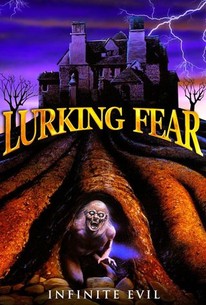
The Lurking Fear (1994, directed by C. Courtney Joyner)


For years, the town of Leffert’s Corners has lived in fear of the criminal Martense family.  The family’s youngest son, John (Blake Bailey), has just been released from prison and now he’s returning home.  He knows that, before he died, his father arranged for a thousand dollars to be buried in the cemetery.  After the town mortician (Vincent Schiavelli, in a too brief cameo) tells him where it is, John heads to the cemetery.  Unfortunately, he’s followed by crime boss Bennett (Jon Finch) and his thugs.

Cathryn (Ashley Laurence) and Dr. Haggis (Jeffrey Combs) are already at the cemetery, though not for the money.  It turns out that subterranean monsters (all of whom are descended from one John’s relatives) are living underneath the cemetery grounds and terrorizing the town.  Cathryn and Haggis are planning on blowing up the graveyard but that plan is put on hold when John and Bennett arrive.  Underground monsters or not, Bennett is planning on getting that money and if that means holding everyone hostage in a church while the monsters prepare to attack, that is exactly what he is going to do.

As is evident by the welcome presence of Jeffrey Combs, The Lurking Fear is another Full Moon production that was loosely adapted from a H.P. Lovecraft short story.  The premise has promise and the cast is full of talent but the film’s direction is flat, the script is shallow, and the monsters themselves look good but there’s nothing that set them apart from a dozen other monsters that have appeared in Full Moon productions.  (The monsters resemble the dungeon dweller from Castle Freak but they are never as scary.)  It’s too bad because The Lurking Fear is one of Lovecraft’s best short stories and it seems like one that would make a great movie.  But, as a movie, The Lurking Fear, like so many other Full Moon productions, doesn’t seem to know what to do with itself whenever the monsters aren’t around.  Hopefully, someday, Lovecraft’s The Lurking Fear will get the film adaptation that it deserves.

Horror Film Review: Hellraiser (dir by Clive Barker)


On Monday night, Dancing With The Stars did a horror night, in which “the stars” did dances that were inspired by horror films. One of the first to perform was a professional wrestler who is apparently known as The Miz. When the Miz performed, he was dressed in black and he had several fake pins attached to his face.

After he danced, host Trya Banks asked The Miz what scared him. Obviously seeing a chance to suck up to the judges and the audience, the Miz grandly announced, “This! Doing this every week terrifies me! Dressing up like Hellraiser and dancing terrifies me….”

Uhmmm, excuse me, Mr. Miz — the character’s name is Pinhead. The movie is called Hellraiser. You were dressed up as Pinhead.

Seriously, I felt that the Miz should have been eliminated from the competition at that exact moment but no. His sucking up worked. Everyone laughed. Everyone applauded. No one called him out on his error. It upset me a bit. I was like, “Who are you to do horror night when you don’t even know the difference between the movie and the character!?”

Really, they should all be forced to watch or rewatch Hellraiser. First released in 1987, the directorial debut of Clive Barker holds up pretty well as a blood-filled horror movie. It tells the story of Larry (Andrew Robinson), his daughter Kristy (Ashley Laurence), and his second wife, Julia (Clare Higgins). Larry’s ne’er-do-well brother, Frank (Sean Chapman), has died under mysterious circumstances so Larry moves into Frank’s old house and tries to renovate it. He hopes that this will somehow help his strained marriage to Julia, who was having an affair with Frank. Why Larry thinks this is a good idea is never quite clear. Larry seems to be a nice guy but it doesn’t take long for the audience to get the feeling that he might not be that smart.

Kristy, on the other hand, is much smarter than her father and she knows better than to trust Julia. In fact, Kristy refuses to even live in the same house as Julia. Still, Kristy does check in on her father occasionally and she quickly realizes that Julia is doing something strange. It turns out that Frank may be dead but his tortured, skinless spirit lives on. Julia has been picking men up in bars and bringing them back to the house so that Frank can steal their skin. On the one hand, you do have to feel kind of sorry for all of the people who die. On the other hand, Frank does look better with skin.

Frank ended up in his skinless state because he foolishly opened up a puzzle box. That’s where Pinhead (played by Doug Bradley) comes into the equation. Pinhead and the other Cenobites live in another demension and they’ve spent so much time “exploring” that they can no longer tell the difference between pain and pleasure. Pinhead’s face is covered in pins. (In fact, Pinhead started out as something of a fan nickname as Bradley is just credited with playing “the Lead Cenobite” in the film’s end credits.) The Cenobites are actually only in Hellraiser for a few minutes. The majority of the film is made up of Julia bringing strange men home and Frank attacking them. But it’s the Cenobites — and Pinhead in particular — who make the biggest impression. Beyond his bizarre appearance, Doug Bradley plays the character with such haughty arrogance that it’s hard not to be intrigued. He knows things.

Hellraiser holds up well. Andrew Robinson does his best but Larry is a bit of a moron. However, Clare Higgins has fun with her femme fatale role while Ashley Laurence is likable and sympathetic as Kristy. For the most part, the special effects hold up well and even the film’s slightly more cartoonish moments add to the feeling that the film takes place in a universe that is becoming increasingly unstable. The puzzle box is wonderful creation. It’s easy to say that you would never mess with something like that but most people would. The temptation would just be too great.

Watch Hellraiser and never get Pinhead’s name wrong again!

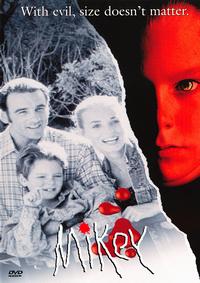
A Movie a Day #280: Mikey (1992, directed by Dennis Dimister)


Dumb.  Just dumb.

Mikey (Brian Bonsall) is a little boy who kills people.  Over the course of this movie, he kills eight people.  He gets away with it because everyone that he meets is extremely stupid.  When his teacher notices that Mikey is drawing pictures based on his previous murders, no one thinks anything of it.  When she sees that Mikey is now pushing thumbtacks into his arm, no one is too concerned.  When the principal goes looking for Mikey, he takes a gun which he then leaves unattended on the kitchen counter.  When Mikey tells his teacher that he wants her to teach him “how to die,” everyone figures out that something’s wrong with Mikey but, by then, it’s too late.

For a few years, Mikey had a strong cult following because of the killer kid theme and a few scenes of Josie Bissett in a hot tub.  But it really is a dumb movie and Brian Bonsall gave a lousy performance as Mikey.  It takes a good deal of stupidity for an adult to get murdered by a ten-year old and this movie proves it.