Trailer: G.I. Joe: Retaliation


I will admit right here and right now that I really enjoyed G.I. Joe: The Rise of Cobra when it came out in 2009. I know that it was really panned by critics and many film-goers, but I thought it brought the cartoonish action of the original cartoon to life. I wasn’t too thrilled with some of the casting choices, but overall I had fun with the film. I wasn’t really the only one who enjoyed it since it made quite enough in the box-office to warrant a sequel. This sequel looks to bring in only a few people from the first film (Channing Tatum, Ray Park and Lee Byung-hun as Duke, Snake Eyes and Storm Shadow respectively) while bringing in a new cast and, most important of all, a new director and writers.

Jon Chu, fresh off the success of Fast Five, took on this project and from the trailer shown above it looks like he has injected the very same fun action he did for the Fast and the Furious franchise. It’s going to be interesting to see if the action in this sequel follows the same cartoonish (lasers and stuff) kind they had in the first film or will Chu and crew go old-school action and just go with bullets, bombs and rockets. If they go with the latter then I am all for it. Plus, it has “The Rock” as Roadblock. That alone had me as ticket-buyer on Day One of it’s release.

G.I. Joe: Retaliation is set for a June, 29, 2012 release.

Review: Captain America: The First Avenger (dir. by Joe Johnston)


It is called the “Marvel Cinematic Universe” and it’s a world-building program that’s been in the making for almost half a decade. It first began when Kevin Feige and the powers-that-be at Marvel Entertainment decided to forgo licensing out the rest of their comic book characters to other studios to play with (Spider-Man, X-Men, Wolverine, Fantastic Four, Daredevil, etc.). Marvel Entertainment was getting rich off of these films without having to help finance any of the films, but the results of these films where hit-or-miss and recently they’ve been really misses (X-Men: Last Stand, X-Men Origins: Wolverine, Fantastic Four: Rise of the Silver Surfer, Ghost Rider to name a few). So, the decision was made for Marvel to open up their own film studio, Marvel Studios, and use money from those licensed films to adapt the remaining characters in the Marvel Universe the Marvel way.

The first film to come out with Marvel Studios as the primary company was 2008’s Iron Man which was followed very closely with a reboot of the Hulk with The Incredible Hulk later that same summer. Iron Man 2 arrived in 2010 (though it was a mixed bagged depending on who one asks about this sequel) and in 2011 two more Marvel Studio films arrived to continue building this so-called “Marvel Cinematic Universe”. In early May 2011, the first one was Kenneth Branagh’s Thor hitting the big-screen which was widely-acclaimed to be a good and fun entry to this cinematic universe. The final piece and the second Marvel Studio film to arrive in 2011 is the Joe Johnston-helmed film adaptation of one of Marvel Comics’ most iconic characters. The “Marvel Cinematic Universe” finally finds it’s last piece before 2012’s arrival of Marvel Studios’ superhero team film, The Avengers.

Captain America: The First Avenger was being predicted as a film that could fail because of the character itself. Steve Rogers aka Captain America is the All-American G.I. who was straight-laced and never morally ambiguous. This was a character sure of himself and saw the world through a moral prism of black and white. The film that came out of the work by Joe Johnston and his capable film crew was one which surprised most everyone by it’s retro and nostalgic look at action serials of the past but without becoming to beholden to those tropes and losing all the fun in the story. This film played out like a throwback to those very serial action films of the 40’s and 50’s before cynicism and snark took over Hollywood and most of the entertainment industry.

Joe Johnston and his screenwriters, Christopher Markus and Stephen McFeely (and an uncredited Joss Whedon whose strength with dialogue could be seen in this film), were able to make an origin tale which didn’t seem too rushed in laying out just who Captain America was and his early adventures during World War II. It was a great decision to keep most of the film set in World War II since Captain America’s origins would be the hardest to pull off and even harder to convince audiences too used to conflicted and unsure superheroes in their superhero films.

The film begins in current Marvel times as an expedition finds Captain America’s shield in the frozen ice floes of Greenland in what looks to be the wreck of a giant flying wing-type aircraft. Once the shield’s discovery was made the film quickly transitions back in time to 1942 where we get to see first-hand the evil mastermind Johann Schmitt aka the Red Skull (Hugo Weaving) whose obsession and search for ultimate power finally garners him the Tesseract from Odin’s weapon’s vault (the Cosmic Cube last scene in Thor). He would use this cosmic power to power the superweapons being developed by his Nazi-funded splinter group, HYDRA, and it’s lead scientist in Dr. Armin Zola (Toby Jones).

Both Markus and McFeely actually wrote the film to be two storylines running concurrently with Red Skull and HYDRA running in one storyline and the other with Steve Rogers (Chris Evans) as the 90-lbs Brooklyn-native weakling whose attempt to enlist in the Army gets shotdown each and every time he tries. Rogers is just not the type of man the US Army requires no matter how much courage and heart his asthmatic and weak body may hold within. But this very non-physical quality of Rogers is what gets the attention of the US Army’s own research division headed by German scientist and expatriate, Dr. Abraham Erskine, who believes Rogers is the perfect candidate for his super-soldier serum program.

Much of the Roger’s storyline in the early-going brings much comedic dialogue and scenes which made Captain America such a fun film. While Roger’s appearance and situation was never played off for laughs, it was how those around him outside of a few people whose reaction never get past the weakling standing in front of them. Once Rogers does become Captain America the film continued to have fun with the character as he’s drafted by politicians who sees him as the perfect pitchman for the government’s program to sell war bonds. This entire part of the character’s arc even got the full Busby Berkeley musical dance number reminiscent of Steven Spielberg’s musical number to start off Indiana Jones and The Temple of Doom (this won’t be the first time Johnston would pay homage to the Indiana Jones series).

Once Captain America moves past his war bond selling phase the film’s two concurrent running storylines of the Captain and the Red Skull converge to begin the second-half of Captain America. While the comedic dialogue and sequences take a back seat the film still remains very fun as Johnston ramps up the action. He begins with the Rogers disobeying orders and attacking a HYDRA base to rescue not just his boyhood friend Bucky Barnes (Sebastian Stan) from the clutches of HYDRA, but all the prisoners held in the same weapons manufacturing base. The action sequences were filmed in an almost old-school fashion. There’s no tricks of fast editing and quick cuts to make the battles and action chaotic and real, but brought to mind more the action scenes from the Indiana Jones films of the 80’s which Johnston was a part of. All the action sequences in this film were choreographed to be seen and understood, but at the same time with a sense of fun energy that most action films seem to have lost in the last decade.

Captain America was also the first film in the “Marvel Cinematic Universe” which added to the fun by creating a genuine romantic subplot for it’s main lead. The relationship between Steve Rogers and British agent Peggy Carter was written quite beautifully as one between two people who saw each other as equals. This relationship unfolded very organically and not forced onto the two characters and to the audience. There was no manipulation to create a false couple. Steve Rogers gradually grew to not just admire Peggy Carter as a strong-willed, capable, but still feminine woman who saw beyond his initial weakling appearance, but by film’s end as a person who he truly had feelings for. It wouldn’t have worked if the Peggy Carter was just written to be a damsel in distress which she wasn’t and this character’s own journey to admiring Roger’s courage and tenacity in the face of impossible odds to mutual admiration once he became Captain to full-blown love by the end really added the emotional punch to the film. It’s no wonder that the bittersweet ending to the film between these two characters had such an emotional impact. The audience followed these two characters’ in their growing relationship from sweet beginnings to the tragic and bittersweet climactic finish.

It’s that very writing which made Captain America: The First Avenger more than just another superhero film. This was a film that went beyond just superhero action sequences, but a film which brought to mind not just the retro film of such films as Johnston’s own 1991 retro-futurist superhero film, The Rocketeer, but also the fun inherent in the serialized action films of the 40’s and 50’s which Spielberg did paid homage to with Indiana Jones and The Raiders of the Lost Ark. The action, explosions and witty (though without the snark and cynicism) dialogue didn’t dominate the film but became supports for the well-written characters. Characters that were well-played by it’s cast of exceptional actors.

This film, like any other superhero film of the past quarter century, lives and dies by how it’s hero and villain were played. It’s a great thing to have not just Hugo Weaving playing the Red Skull with such relish (with a voice that sounded like a mash-up of Werner herzog and Klaus Kinski), but the surprise was Chris Evans as Captain America himself. Evans had the tougher role since he was the titular character. He was an actor who was more well-known as playing wiseass and jokester roles, but in this film he plays Steve Rogers straight with a sense of unabashed goodness and confidence that he became Captain America without having to be unsure of his abilities, conflicted about his new role as a hero. Evans showed depth and range that was only hinted at in films such as Sunshine.

Another delight in the film would be Hayley Atwell as Peggy Carter. She could’ve been the weak-link in this film and no one would’ve noticed, but she became the moral anchor and strength for the film as she became not just Steve Rogers’ eventual love interest but also his sounding board whenever doubts creeped in. She kept not just him, but the film on course and it helped that she was just as much as kickass as Captain America. Also, to say that Atwell as Peggy Carter was gorgeous to the point of blinding would be an understatement. It’s no wonder Captain America fell for her.

The rest of the supporting cast were up to the challenge no matter the size of the role. Stanley Tucci and Tommy Lee Jones were great as the compassionate mentor and grizzled commanding officer respectively. Jones’ Col. Phillips actually got some of the best one-liners in the film. When Tommy Lee Jones plays such a character as well as he does it’s no wonder he’s the go-to-guy for such roles. He just lives the part and pulls off the lines with such great comedic timing. Dominic Cooper as the young Howard Stark (father of Tony Stark/Iron Man) brought images of the suave and debonair Howard Hughes while Sebastian Stan as Bucky Barnes did a great job in making the character not just a sidekick, but also show hints of why he would become the Winter Soldier later on in the Captain America stories. It’s Stan’s role as Bucky which gives me hope that future Captain America sequels would tap and mine this character’s own journey from sidekick to potential rival as the Winter Soldier.

Captain America: The First Avenger is Marvel Studios’ last puzzle piece in what would transition into 2012’s The Avengers by Joss Whedon and it more than delivers the goods which was a testament to the creative forces led by Joe Johnston, Chris Evans and everyone involved. This was a fun, rollicking good time which brought back the concept that films were ultimately started as a form of mass entertainment. Not every film had to explore the meaning of life and existence. Not every film had to be a journey into the light and dark of existential themes. Films could be a couple hours spent entertaining and allowing it’s audiences to have a fun and good time. Captain America: The First Avenger was able to deliver this type of experience and do so with not a cynical gene in its code. It’s definitely Marvel Studios’ best film to date and one of the best films of the summer.

(Leonard Wilson’s review of Captain America)

As an added bonus below are some of the character and propaganda-type posters released for the film.

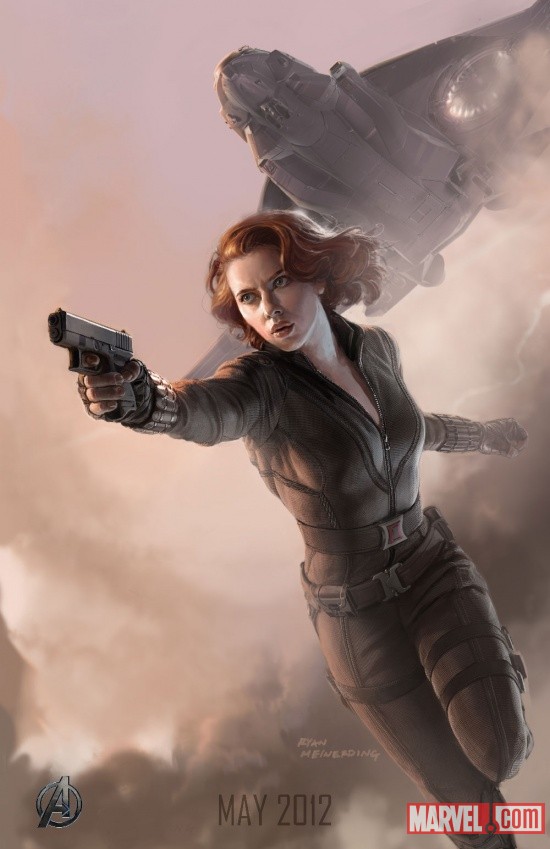
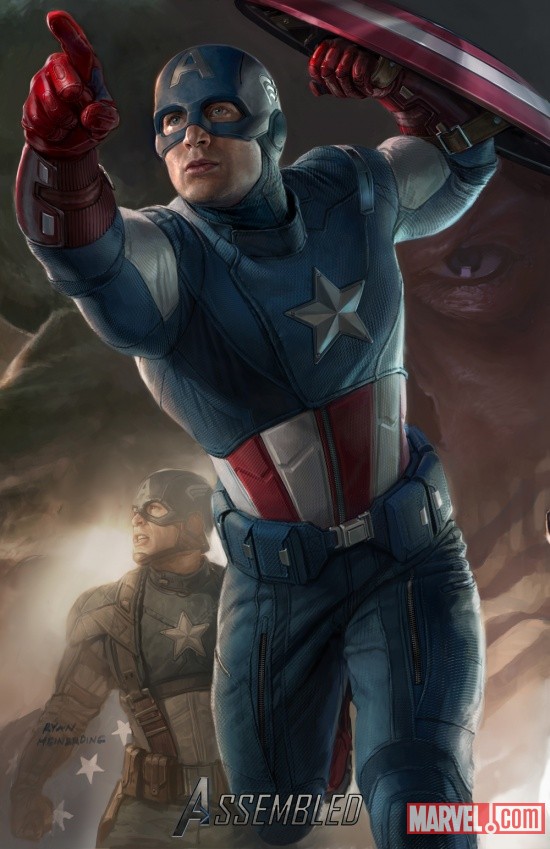
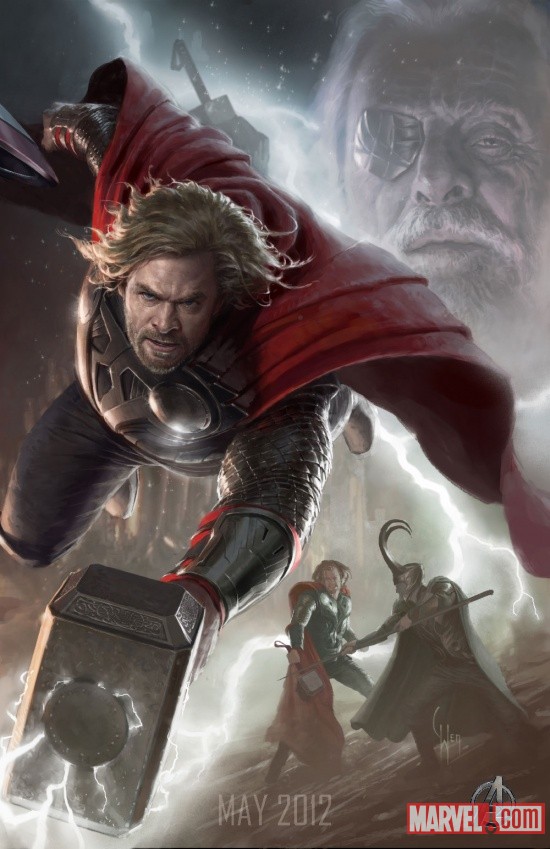
SDCC 2011: The Avengers Line-Up Concept Art Posters


One great thing Marvel has done this year for San Diego Comic-Con 2011 was the begin the major media and ad campaign for their 2012 summer tentpole blockbuster in The Avengers. This is a superhero team project which has been 3-4 years in the making. It all began with 2008’s Iron Man and finally concludes with 2011’s Captain America: The First Avenger. In-between these two films we got other members of Marvel Comics’ iconic Avengers team make their introduction through their own films and/or make appearances in all the films like Thor, the Hulk, Nick Fury, Black Widow, Hawkeye and SHIELD.

One of the coolest things to come out of the Marvel Studios/Paramount Pictures part of Comic-Con 2011 was the release of the concept art posters for not just The Avengers but for all the characters who make up the team. Each character poster shows each team member (even SHIELD gets their own with Nick Fury leading the agents) in a striking pose with background images showing scenes from past films which comprises what is being called “Marvel’s Cinematic Universe”. That term is just one way of saying that these films do not follow the timelines set down in the primary Marvel Comics universe (Marvel-616).

I’m not exactly sure who was the artist responsible for these concept art, but they’re great and brings to mind such cover artwork as Alex Ross, Drew Struzan and Dave Dorman. I’m sure someone over on Twitter or on Facebook will be able to figure out just who this awesome artist is. Some of the details in the background should make the comic book fans quite happy like the Quinjet in the Black Widow poster and the SHIELD Helicarrier which appear in both the Hawkeye and SHIELD posters.

With Comic-Con winding down the hype machine for The Avengers will definitely be on full swing with New York Comic-Con this October up next. Captain America: The First Avengers is now out in the theaters earning universal acclaim. The Avengers will assemble for a May 4, 2012 release date.

Source: Marvel

Movie Review: Captain America – The First Avenger (dir. by Joe Johnston)


This won’t be the only review for Captain America: The First Avenger here on the Shattered Lens. This may very well be considered an editorial on the film, depending on whether I can stay on topic (I gush a lot in this one). Once they see it, both Arleigh and Lisa Marie will probably make their own posts. Either way, you’ll have more than one perspective on the film.

Addendum: Arleigh’s review is up.

Many years ago, Marvel Comics decided that with all of it’s key franchises spaced around various film production companies, they’d create a series of films that would culminate to one big “Team Up” story. That team is known as The Avengers and it’s members (for the sake of the films, anyway) are Iron Man, Thor, The Incredible Hulk, The Scarlett Witch, Hawkeye and Captain America. The project really went into high gear when Marvel Studios was born and Disney purchased Marvel.

I didn’t have a lot of hope for Captain America: The First Avenger. I know very little about the character save for the comics my older brother used to read. He was an army guy given something to make him super and he had a really cool shield that he’d throw and have return to him.. That was basically the bulk of my knowledge. When taken into account the announcement that Joe Johnston was directing the film, after his somewhat disappointing turn in The Wolfman and that Chris Evans was playing the role, I was certain the film was going to fail. I mean, wasn’t he just playing the Human Torch in The Fantastic Four?

Now, you need to understand that hearing Joe Johnston’s name attached to this left a mixture of feelings. I absolutely love The Rocketeer (1991) and period pieces in general. He was able to give it a nice ‘30s feel, right down to the old war serials that used to be shown before films. Hell, even the poster to that film was something grand. My little brother had a Rocketeer toy and I used to film home movies with it, holding the character just in front of the camera and running around the house as if it were flying. Unfortunately, it didn’t quite work out as well for Johnston or Disney then – but that’s another story.

As for Captain America, the movie floored me. The story isn’t as complex as say, The Dark Knight or as full of itself as Green Lantern, but it’s hands down the best story in the whole Avengers arc that Marvel’s worked on. From my viewpoint, only Iron Man comes close to competing with this film.

The premise of the story is pretty straightforward. Steve Rogers (Chris Evans) is a frail man with just about every problem you can think of. He’s short, he’s asthmatic, and he can’t do a pull up to save his life. Yet, as his parents were in the Army, he felt it was right that he do his part. Every time he tries to enlist, however, he’s told he can’t. This doesn’t sway him from the belief that he can do it, it just forces him to find other ways in. When a scientist overhears Steve’s reasoning behind wanting to join, he gives him a big chance to become the first of many Super Soldiers. The process does indeed work, but a mishap leaves Steve as the only Super Soldier the Allies have, and thus, Captain America is born.

Now, I’m kind of summarizing things there as the story’s just a little bigger than that, but it really needs to be noted just how great a job Chris Evans did in this. He portrays Steve Rogers as one of the most noble characters I’ve seen since Superman. The character never loses that drive or passion, and it came across so well that on reflection, I can’t recall ever thinking once about the Human Torch (something I fully expected to do here). I found myself really wanting this character to succeed, which is more than I could say about Hal Jordan in Green Lantern despite loving the comic. Evans truly was the right person for this film, in my opinion. Again, die hard Captain America fans that have grown up with the character may disagree.

Captain America also has a rich supporting cast. Hayley Atwell, coming over off a great role in the Starz Miniseries The Pillars of the Earth plays Peggy Carter, a tough as nails Army Officer that helps to motivate Rogers toward the path he’s destined to take. Atwell is beautiful, demure at times and responsive at others, every bit as she was when playing Alienna. Also from Pillars of the Earth is Anatole Taubman as one of Johan Schmidtt’s (Hugo Weaving’s) Officers. Tommy Lee Jones’ Colonel has some of the funnier lines in the film. Weaving does a great job as always at playing the villian. There’s really very little I can say on that other than the make up job they gave Weaving’s Red Skull was nice, right down to the visible seams just under his ears. Sebastian Stan has a good role in Rogers’ best friend, Bucky, but I think he could have used a little more. Even Natalie Dormer (Cassanova, The Tudors) and Amanda Righetti (Friday the 13th) have cameos. If the film has two supporting anchors other than Atwell, it would be Stanley Tucci (Easy A) and Dominic Cooper (The Devil’s Double). As Abraham Erskine and Howard Stark, respectively, they both almost steal the show from Evans. They both have a few key moments in the film.

If Captain America suffers from any problems, it may be that it gets from Point A to Point B a little quicker than I’d have liked it to. Some of the pacing is done in Montages, which is okay for showing the audience that the Captain is making progress, but I would have liked to have seen another mission or two before the finale. The buildup to Steve Rogers becoming the Captain is fast, and everything else moves pretty quickly from there on in. The last battle sequence could have been stronger – I’m reminded of the tank sequence in Indiana Jones and the Last Crusade – but considering the era in which the story was told, I wasn’t really expecting lightsabers or anything along those lines. It wasn’t bad, but it was over sooner than I expected. I should also point out that it really does help to have seen the other Avenger related movies. It’s not really a requirement, but the larger puzzle really comes into view on seeing this film.

Visually, the film is great. Johnston really catches that sense of old New York, though it may not be as nuanced as Jackson’s in King Kong. The colors are a little muted in some places, but I’m thinking that’s part of the tone that was set. There’s even a musical number that’s somewhat cute. The 3D effects in this are okay for some scenes. The end credits in particular were nice, but over all it’s really nothing to write home about. I’m still of the notion that 3D should really be restricted to animated features.

Overall, Captain America was a fun film in the vein of Joe Johnston’s earlier film, The Rocketeer and is easily the best of the Marvel Studios Avenger prequels. I’ll be heading back to see it again on Sunday.

And remember, when the movie is done, don’t leave. After the credits comes something definitely worth seeing (at least the yelling and cheers from my audience seemed to deem it so).

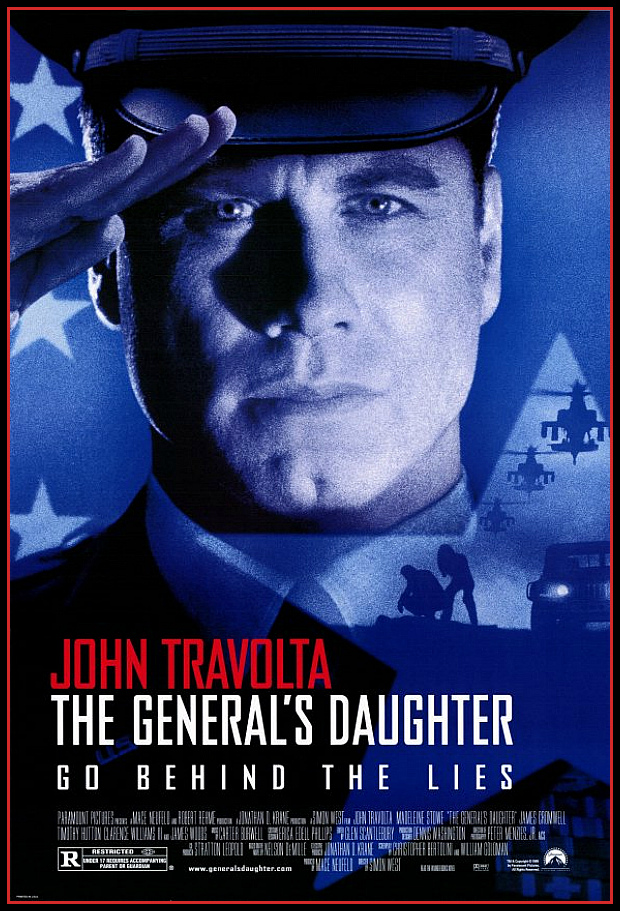
Quickie Review: The General’s Daughter (dir. by Simon West)


The time around the late 1990’s saw a slew of filmmakers who seemed to have been influenced by the filmmaking style of one Michael Bay. In 1998 one such film which had a certain Michael Bay look to it was the crime thriller The General’s Daughter by filmmaker Simon West (fresh off his success from the previous year’s Con-Air). This film adaptation of the Nelson DeMille novel of the same name starred John Travolta when he was still enjoying the second renaissance of his career brought on by his role in Pulp Fiction.

The General’s Daughter was pretty much a crime procedural wrapped around the secretive and insular world of military life. It has Chief Warrant Officer Paul Brenner (played by Travolta) of the Army’s CID investigating what seems to be the apparent rape and murder of a female officer who also happens to be the daughter of the base’s commandant and political-minded general. Brenner’s soon joined by another CID agent, Sara Sunhill (Madeleine Stowe), who must now navigate the insular world which makes up the officer ranks of the military. They find suspects cropping up faster than they could handle and the one prime suspect in base psychologist Col. Moore (James Wood in an over-the-top performance) has secrets about the victim that could jeopardize the lives and career of not just most of the officers on the base but the victim’s own father. This set-up and the basic understanding of the plot should make for a great thriller, but the by-the-numbers direction by Simon West and the over-the-top performances by too many of the characters in the film sinks The General’s Daughter before it could soar.

The story in of itself really has nothing to drag down the film. From the beginning the screenplay does a great job in tossing red herrings to keep the true murderer secret until the very end. It’s these red herrings which manages to bring out the ultimate reason as to the death of Capt. Elisabeth Campbell (Leslie Stefanson) and how a traumatic event in her past became the one major link which would lead to her death early in the film. It’s how these events were acted out which brings down the script. It’s been said that great performances could raise a mediocre script, but the same could be said for the opposite. Very average to bad performances could drag down a great script.

Travolta’s performance was good enough most of the time. He’s especially good when pouring on the Southern charm to try and gain an advantage over those he’s interacting with, but when he suddenly switches over to tough Army investigator that he goes from just beyond campy to over the line into full-blown camp. The same could be said for pretty much everyone in the film from Stowe’s character who manages to just stand around doing nothing but act as a sort of “gal Friday” for Travolta’s character until the very end when she suddenly becomes a crack investigator to help move the plot along. Clarence Williams III really hams it up as the base general’s right-hand man and one would wonder if he realized he wasn’t actually in a grindhouse or exploitation film when it was time to act.

Despite the performances dragging the film down I must admit that The General’s Daughter was quite watchable and entertaining to a certain level. It’s the film’s inadequacies which also makes it quite a disposable fare that should’ve been more. One wonders how the film would be done today with a different set of actors and a filmmaker who knew the nuances of how to navigate around a thriller. Until the inevitable remake from Hollywood gets greenlit (the way things get remade now it’s bound to happen) it’s this version of The General’s Daughter that’d be on record and it’s a film that has too many bad performances for a great screenplay to overcome. A film that ultimately remains mildly entertaining but forgettable in the end.

Trailer: Mission: Impossible – Ghost Protocol (Official)


I’ll be honest and admit that I wasn’t overly impressed by J.J. Abrams’ Mission: Impossible 3 and when it was announced that a fourth film in the franchise was going into production my initial reaction was an emphatic “meh”. It didn’t help when Pixar veteran Brad Bird was chosen to helm this fourth film. This was a filmmaker who did a great job with Pixar animated films, but still an unknown quantity when it came to live-action projects.

As the months passed and news filtered out from the film’s production the news was positive with many who have seen some rough footage becoming convinced that Brad Bird might know what he’s doing outside the Pixar stable. Mission: Impossible – Ghost Protocol was soon being talked as being one of the most-awaited films of 2011. This newly-released first official trailer goes a long way into adding more positive buzz to a film already hyped up on it.

Also, it has Paula Patton in it, nuff said.

Mission: Impossible – Ghost Protocol is set for a December 16, 2011 release.

Trailer: Captain America: The First Avenger (Theatrical)


The summer of 2011 has been called the Summer of Superhero Films. In early May we had Marvel Studios’ Thor film premiere to good reviews and it has had a certain level of success (though not the level of The Dark Knight success rabid fanboys and jaded film bloggers think every comic book-based film should be doing). Then next up was the fourth X-Men film from Twentieth Century Fox by Matthew Vaughn that seem to reboot the franchise from it’s downward spiral begun by the third film and the Wolverine origins film. This film garnered even higher praise than Thor and many saw it as equaling or surpassing the X2. While it’s box-office success has been good it didn’t make the sort of money previous films in the franchise have made in years past. Then we come to the recently released Green Lantern from Warner Brothers and DC Entertainment.

This film was to be the next crown jewel to join DC’s successful Batman film franchise and iconic Superman series which seems to be the only DC properties to have had a successful live-action adaptation. While the film did very good in it’s first weekend the reviews of the film range from “ok and fun” at best to “downright awful” at its worst. All three films have huge budgets and, most likely, all three will be a profit for their studios, but not runaway hits.

Maybe the public has begun to tire of superhero films as a cause for the less than cosmic box-office returns. One other reason could be that too many people have been blinded by the massive box-office success of Christopher Nolan’s The Dark Knight that every superhero film must now be compared to that one fair or not. This makes the job much harder for Marvel Studios’ second film of the summer, Captain America: The First Avenger, as that film looks to cement the foundation for next summer’s major blockbuster ensemble superhero film, The Avengers.

I don’t see Captain America doing TDK level money, but early screenings of the film has earned it some major positive buzz that had been missing from Thor. That early positive buzz and this latest trailer which really showcases the action of this period piece of a superhero film should help push Captain America to be a success no matter if it makes 200million dollars domestic or more.

One thing I’m sure of is that this latest trailer should be more people excited for Captain America: The First Avenger when it comes out on July 22, 2011.

Review: Super 8 (dir. by J.J. Abrams)


The 1980’s was a special time in my life. It was another phase in my development in loving film. That decade saw many films starring kids and teens in coming-of-age tales both comedic, thrilling, dramatic and poignant. While there were many filmmakers who delved into this genre it was Steve Spielberg who mined it to great effect culminating in his classic boy-meets-alien film, E.T.: The Extra-Terrestrial. It’s been almost 30 years since the release of that film and now comes a filmmaker who seem to have grown up idolizing and loving Spielberg films of that era. The year is now 2011 and J.J. Abrams is that filmmaker who dared to pay homage to those very same coming-of-age Spielberg films of the 80’s with his very own simply titled Super 8.

From the very moment the film begins there’s a sense of wonderment as we, the audience, meet young kids who become the central characters of Super 8. The film takes place in the early days of 1979 in the town of Lillian, Ohio as Joe Lamb (Joel Courtney) tries to cope with the death of his mother. His friends keep him busy and dwelling on this tragedy through the Super 8 film they’re making in their spare time after school. These early scenes we begin to see the dynamics of the group as Joe acts as the calming influence on the group’s filmmaker, Charles (Riley Griffiths), the neurotic actor in Martin (Gabriel Basso) and the group’s stuntman/special effects tech in Carey (Ryan Lee). They all meet up at an old train depot where they plan to shoot scenes for their Super 8 zombie film. Into this eclectic group of kids comes in Alice (Elle Fanning) to play the wife to Martin’s detective character in their film.

It’s the scenes between the kids which lifts Super 8 from just being a nostalgic film to one that’s charming and magical. These scenes captures the creativity and youthful energy kids have always had no matter the era and place. These kids don’t act like stereotypes of what Hollywood thinks kids in films should act. There’s still little of the cynical teen dialogue that films nowadays give kids to say to make them seem more mature and worldly. There’s a sense of innocence in how these kids interact with each other. Some have called these scenes as being too on-the-nose nostalgic of Spielberg films of the 80’s. What some might call nostalgic I prefer to call as timeless. I still remember myself behaving with my childhood friends the way these kids did in this film

If Super 8 had just been about these group of kids trying to finish their Super 8 zombie film I conjunction with the dysfunction in the two main leads in Joe and Alice’s home life then Abrams film would’ve been the instant classic some have dubbed it. There’s only one problem with this and that’s the last half hour of the film and the scenes leading up to that involving the train derailment and the arrival of the U.S. Air Force to clean things up. The film begins to take on a split personality as these new elements get introduce to what has been a great coming-of-age story.

It’s these new elements and the final half hour which shows Abrams trying to combine a sweet story of kids and their lives growing up in small-town with an otherworldy and conspiracy tale that seem to come out of left field. By the time the final act of Super 8 arrives it becomes a different film altogether and the transition doesn’t work as well as the filmmakers might have hoped it would. Sure, this final reel has the thrills, explosions and danger, but the tonal shift in the story became so jarring that I had wished that Abrams just made two films instead of one. One film being the coming-of-age story and the other a thrilling sci-fi film.

Despite this I still enjoyed the film and I definitely loved the first two-thirds. The performances by Joel Courtney and Elle Fanning as Joe and Alice became the focal point for the story’s emotional foundation. Elle Fanning’s performance as Alice was one of the best things about Super 8. She nails every scene where she has to show extreme ranges of emotions but at the same time not try to oversell them. There’s a scene in the middle of the film where she begins to recount a personal detail as Joe sits behind her listening. Emotions begin to overwhelm her, but as kids moving towards teenhood are wont to do she tries to hold back the tears just waiting to flow freely and the sobs wanting to escapes. I wouldn’t be surprised if this scene alone had more than a couple people in the audience remembering similar events in their lives and just sobbing along with Alice.

Super 8 has been advertised as this mysterious film that may or may not have aliens but does pay homage to Spielberg and kid films of the 80’s. Abrams’ film definitely delivers on the thrills in the end, but it could’ve been so much more if it just stayed on course with just being about the kids and their magical time together making an amateur Super 8 zombie film in 1979. That would’ve been a film that deserved labels of instant classic.

All in all, Super 8 comes across as one of the more entertaining and magical films of the summer of 2011 if not the entire year. Make sure to stick around as the end credits roll to see the fruits of the kids labor titled simply as “The Case”.

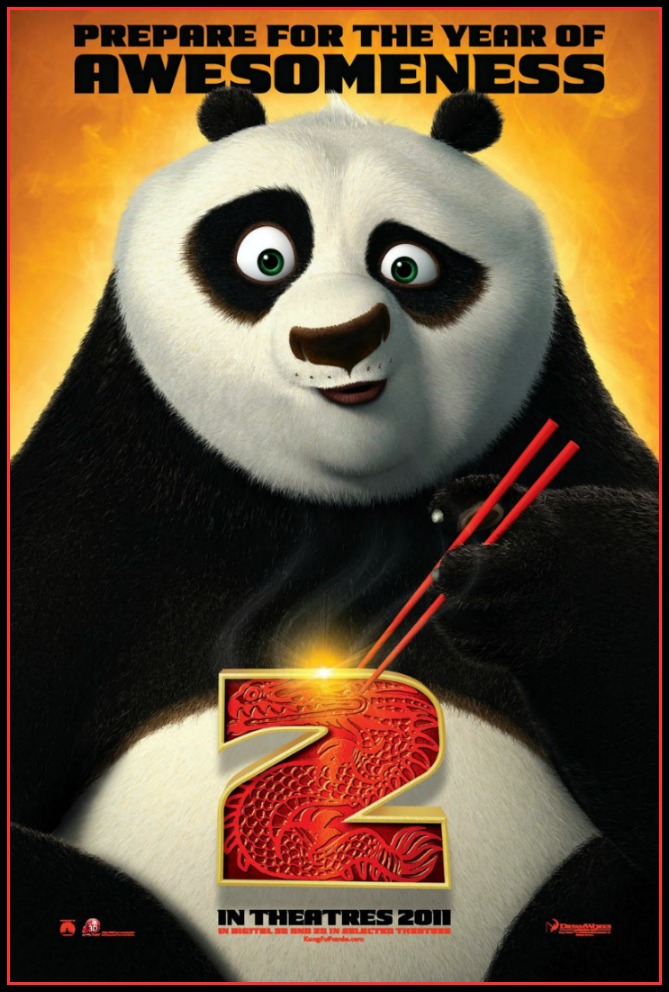
Review: Kung Fu Panda 2 (dir. by Jennifer Yuh Nelson)


In 2008, Dreamworks Animation released what many had thought was one of their animated films. Some even went so far as to consider it on the same level as many of the Pixar animated offerings. This was high praise indeed and the praises from critics was awarded by public acclaim as Kung Fu Panda became an instant classic for Dreamworks Animation. It wasn’t a huge surprise that a sequel was quickly greenlit by the studio and now three years has passed and that sequel has finally come out. Kung Fu Panda 2 does one of those rare feats in film-making where it surpasses it’s original predecessor in all things. This was a sequel that was able to take what made the first one so fun and thrilling and build on it without losing the charm that made it so beloved in the first place.

Kung Fu Panda 2 brings back the Dragon Warrior Po (Jack Black returning in the role of the big fat panda) as he continues to live his dream of having become the Dragon Warrior and fighting evil, bandits and criminals with his fellow kung fu masters, the Furious Five. Instead of the film highlighting Po’s size as a detriment and keeping him a buffoonish character like in the beginning of the first film this sequel actually makes him an equal of his heroes, if not, surpassing them. This is a refreshing change since the writers could’ve easily banked on Po as a character who bungled and stumbled his way through most of the film.

This film was a continuation of Po’s journey as a hero which the first film was just the first step. Despite being a kung fu master in his own right his culture becomes threatened by a villain even more devious than the first film’s Tai Lung. Lord Shen (voiced by Gary Oldman) is the mad peacock heir to Gongmen City who has found an ultimate weapon through fireworks that he plans to defeat kung fu and conquer all of China. Kung fu is everything to Po and he journeys with the Furious Five to confront Lord Shen and stop his plans before it’s too late.

It’s during this journey that Po learns more about his true past and where he truly comes from. The sequences where Po’s adopted goose father tells of Po’s past was some of the best animations Dreamworks has done and I’d say surpasses some of Pixar’s own work. After seeing this film I’m sure many kids and some adults would want themselves their very own baby panda. Who would’ve thought that baby pandas sounded like human babies when they cried. It’s knowing his past that Po must now learn to find his inner peace if he’s to ever go beyond just being a kung fu master.

Kung Fu Panda 2 was actually quite a dark film in places as themes of genocide, destructive march of technology against nature, difficulties of adopted children finding their true origins and many others. That’s not to say that this sequel wasn’t fun to watch. The action took the kung fu fight scenes from the first film to a whole new level, but without turning it into all flash and no substance. It’s during some of the thrilling fight sequences that we see Po truly become part of the Furious Five and even affection from some of it’s members. It would be interesting to see how a third film would explore the growing relationship between Po and certain striped-feline.

The story gets a much needed infusion of creative help from one Guillermo Del Toro who served as creative producer. His inclusion in the film’s development was probably why the film had a much darker and serious tone in addition to the charm it continued from the first film. If there was anyone in Hollywood who knows how to further develop a character through a Campbellian hero’s journey then it’s Del Toro. If Dreamworks Animation is able to keep Del Toro on hand to further treat their other projects then it will be quite a coup for the studio.

The animation in this film is a step above the first film and anything Dreamworks Animation has ever done. With each passing year and release it looks like Dreamworks Animation has been able to come to the same level of animated work Pixar has set with their own projects. While I’m sure there’s no animosity between animators fo the two houses there probably is some sort of friendly rivalry which helps push both studios to improve on their animation work. All this means is that the public wins out in the end as we’re treated to better animated features from both Dreamworks and Pixar. It’s a good thing that Dreamworks Animation has also improved their storytelling with each new film that they’re not being called the weaker films when compared to Pixar’s latest.

In the end, Kung Fu Panda 2 more than lives up to it’s predecessor and actually surpasses it in every way. This sequel’s animation and use of stereoscopic 3D was some of the best in CG animation to date. It had a story that continued to explore and build the characters from the first film that they’ve gone beyond simple, basic animated characters but fully realized and complex individuals. Even the ending scene in the film which definitely sets-up a third film doesn’t seem tacked on but looks like something that would further continue Po’s hero’s journey. Sequels and milking of a franchise usually don’t sit well with serious film fans, but this franchise seems to be doing it correctly and using each new film to further an epic tale. Here’s to hoping we see Po and his Furious Five friends back for more in the coming years.

Review: Thor (dir. by Kenneth Branagh)


Marvel Comics has had a much better success in bringing their 2nd-tier characters over onto the big-screen than DC Comics and they’ve made the risky decision to tie-in every film they make into one shared universe. Comic book fans have begun to call this the Marvel Film Universe since it contains the same characters and backgrounds as those of their comic book counterparts but also with enough changes to make them stand-out on their own. They’ve already begun this with the first two Iron Man films and a recent reboot of the Incredible Hulk. With the X-Men, Spider-Man, Daredevil and Fantastic Four film rights still under the control of other film studios it left Marvel (now Disney) to use other characters in their control to fill out the rest of this shared universe. The next one to get their turn on the bigscreen is the live-action adaptation of Marvel’s Asgardian God of Thunder. The studios picked British filmmaker Kenneth Branagh to handle this adaptation and his background in bringing Shakespeare to the big-screen has made Thor a flwed but very entertaining superhero film.

To start off, it has to be said that Thor was always going to be the most difficult of all the characters that will make up The Avengers film to bring to the bigscreen. While all these Marvel films do have their fantastic elements due to each character’s superhero nature it was even more fantastic with the character of Thor. This character is in effect a being who has been worshipped by humans in the past as one of their deities. God-like characters have always been tough to make human and relatable in stories and film. It’s a testament to Branagh’s handle of the Asgard characters such as Thor, Odin and Loki that we don’t end up with just all-powerful beings, but individuals whose impulses and motivations definitely are human. It’s this dynamic between Thor, his father Odin and his brother Loki which drives the Shakespearean angle of the film’s storyline. It’s where Branagh’s history of making Shakespeare accessible to the general film audience that makes their story easy to follow and understand.

The film actually begins with the human characters of Dr. Jane Foster (played by Natalie Portman) and her colleagues (Stellan Skarsgard and Kat Dennings)  driving around in the New Mexico desert at night looking for atmospheric disturbances which should validate Foster’s theories on the Einstein-Rosen Bridge aka wormholes. What they end up running to instead is Thor himself arriving on Earth (Midgard in Asgardian terms) to begin his banishment from his homeworld. Yes, I say homeworld as the film has turned one of the more difficult aspects of Thor’s background into something that makes sense for the audience not steeped and learned from decades of Thor comic books. Thor’s home of Asgard is just one of nine worlds around the galaxy of which Earth is one.

It’s right after this scene that we go back to what started Thor’s banishment. The film does a great job explaining the role the Asgard’s played in Earth’s past history and the consequences of their war against the Frost Giants of the world of Jotunheim (one of the nine worlds). It’s through the narration by Odin himself (Anthony Hopkins) that we learn of the origins of the Gods and myths of Norse culture. This intro scene also shows Odin showing his two young sons in Thor and Loki the relic he had taken to end the wars between Asgard and the Jotunheim. For an origin sequence it was able to set up the rules of this fantastical world of Asgard and it’s Nine Realms. It’s the sequence right after which would lead to Thor’s banishment from Asgard and the stripping of his all-powerful hammer, Mjolnir, and his powers.

For some, and I would have to agree, this sequence which takes Thor, his brother Loki, childhood friends Sif and Warriors Three to the icy world of Jotunheim made up the best action setpiece for the film. The battle which begins between Thor’s forces and those of King Lauhey (Colm Feore under some very elaborate make-up effects) of the Frost Giants. This scene shares some similar qualities with an earlier action setpiece in the first Iron Man film in that it surpasses all other setpieces which would occur later in their respective films. This is not to say that the other action scenes were boring or just simple fare. They were exhilirating and full of energy, but that very first one in the beginning just had even more energy and action that it might’ve been better saved for the climax of the film.

Once the banishment occurs we finally catch up to the film’s first scene and the film begins to go back and forth between Asgard and Earth. With the former we see the machiavellian side of Loki finally assert itself. While Loki’s character is never truly shown to be evil his mischievious streak does show to have a cruel side to it. The bombshell of a news from Odin about his true origins was a nice touch, but it doesn’t lead to the sort of evil character turn we’re used to. In fact, I would say that Loki’s character (played with Iago-like relish by Tom Hiddleston) ends up becoming like the son who does the wrong things for the right reasons. He’s a nice contrast to the more open-faced Thor who does what he says instead of dancing around the subject even to the detriment of his standing with his father.

The scenes on Earth itself is where the comedic aspect of the film comes in. Most of the comedy comes at the expense of Thor’s “fish out of water” reaction to the new world around him. It’s helped much by some great comedic timing by Jane’s assistant Darcy (Kat Dennings who steals the film from Portman whenever they’re on together). It is also the time on Earth where some of the flaws in the film really become apparent. First and foremost would be Portman’s Jane Foster character who seem to be so uneven. She goes from brilliant astrophysicist one moment then giggling schoolgirl the next whenever she’s in close proximity to Thor. While Portman and Hemsworth do make quite the radioactively beautiful couple there’s a sense of untapped chemistry between the two that might have been left on the editing floor. It’s a shame really since so much could’ve been done with the Foster character to really give reasons to why Thor ends up valuing the lives of said mortals to earn his God of Thunder status once again.

Thor really does entertain despite some character and storytelling (really most of it on the Earth side of things) flaws which could’ve sunk the film right from the start. I believe that it’s director Branagh’s handling of the Shakespearean tragedy on the Asgard side of the film that holds the film together. This is one reason and the other being a star-turning turn by Chris Hemsworth as Thor himself. His performance goes from cocky, brash young man on the cusp of leadership to lost, confused and rudderless once banished then back again to a maturing prodigal son who finally learns the lessons his father has been trying to teach him. It would interesting to see Hemsworth’s Thor truly interact with Downey’s Tony Stark and Chris Evans’ Steve Rogers when The Avengers comes out in 2012.

The riskiest part of Marvel’s attempt to create their Marvel Cinematic Universe succeeds where most seem to think it will fail. It’s not as strong an origin film as Favreau’s first Iron Man, but it does add a sense of wonder that film could never grasp through two films. Even the controversial casting choices to put non-white actors to play Asgard roles (Tadanobu Asano as Hogun and Idris Elba as Heimdall) comes off well that the audience shouldn’t even wonder why a black and Asian person were playing characters written originally as white.

From the look of things there’s no official word whether there will be a second Thor film, but I wouldn’t be surprised if there was no matter how the film does boxoffice-wise. There’s just too much great stories to tell about Thor, Asgard and the rest of the Asgard Nine Realms now that the foundation has been laid down with this first film. I do hope that Branagh returns for those sequels if they do happen. One thing which Branagh has proven was his handling of action sequences. They weren’t amazing, but they were handled with enough skill that I believe a second time around we’d get even better action from a director known more for serious dramatic films.

A final thing to mention would be the Easter Egg final scene which occurs once the end credits finish their run at the end of the film. For those who stayed to see this scene it should be a nice treat for Marvel and comic book fans. It shows a certain artifact that should tie Thor to the upcoming Captain America film later this summer. All I can say for those who didn’t stay to see it and knows their Marvel trivia are two words: Cosmic and cube.

PS: An Avenger member makes a cameo appearance halfway in the film that doesn’t look tacked on despite what some of the more “glass half-empty” film bloggers on the net would make you think…Also, it’s safe to forgo seeing Thor in 3D. It’s not a bad post-conversion but it doesn’t really add to the film. See it in 2D to save yourself a few bucks on the ticket price.