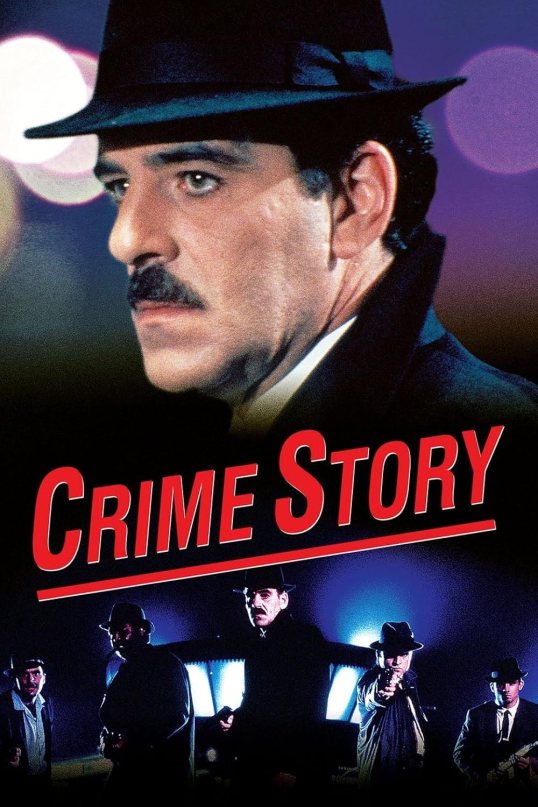
Welcome to Retro Television Reviews, a feature where we review some of our favorite and least favorite shows of the past! On Mondays, I will be reviewing Crime Story, which ran on NBC from 1986 to 1988. The entire show can be found on Tubi!
This week, a member of the Taskforce has an issue.
Episode 2.3 “Always A Blonde”
(Dir by Robert Dalva, originally aired on October 20th, 1987)
Since they apparently have nothing better to do, Torello and the members of the Task Force are trying to bust the Vegas marijuana syndicate. This episode opened with Torello and the boys at a jazz club and, at first, I was worried that Abrams would show up with his saxophone and start playing like he used to do during the first season. (Those scenes were always a bit cringey.)
Instead, the attempted jazz-club sting falls apart because the youngest member of the Task Force, Joey (Billy Campbell), leaves his post when he spots his high-school girlfriend, Doreen (Britta Phillips), walking along the Vegas Strip. It turns out that Doreen is now a prostitute who is working for a notoriously sadistic pimp named Ray Keech (Tony Maggio).
Last week, the Task Force put their actual job on hold so that they could help out Torello’s ex-wife. This week, they do it to help out Joey. When Ray discovers that Doreen is planning on leaving him, he murders her. This leads to a chase through Vegas and a well-shot scene where Joey beats up Ray with the city’s neon glowing behind them.
One thing that I’ve noticed about Crime Story is that, other than Torello and Abrams, the other members of the Task Force often come across as ciphers. We really don’t know much about them, beyond the fact that Joey is young, Danny is Torello’s best friend, Walter is old, and Nate once had a gambling problem. We don’t know much about their families, other than the fact that all of them were able to move from Chicago to Las Vegas without it being too much of an issue. We do know that they’re all loyal to Torello, sometimes to an almost cult-like degree. With this episode, we learn a little about Joey, but it’s still not really enough to make this rather predictable story compelling. If anything, this episode made Joey look totally unprofessional and erratic. Should he even be on the Task Force if he can’t even take part in a simple stakeout?
The absence of Luca and Pauli continues to be felt. Is it really Crime Story if half of the story is missing?
It is called the “Marvel Cinematic Universe” and it’s a world-building program that’s been in the making for almost half a decade. It first began when Kevin Feige and the powers-that-be at Marvel Entertainment decided to forgo licensing out the rest of their comic book characters to other studios to play with (Spider-Man, X-Men, Wolverine, Fantastic Four, Daredevil, etc.). Marvel Entertainment was getting rich off of these films without having to help finance any of the films, but the results of these films where hit-or-miss and recently they’ve been really misses (X-Men: Last Stand, X-Men Origins: Wolverine, Fantastic Four: Rise of the Silver Surfer, Ghost Rider to name a few). So, the decision was made for Marvel to open up their own film studio, Marvel Studios, and use money from those licensed films to adapt the remaining characters in the Marvel Universe the Marvel way.
The first film to come out with Marvel Studios as the primary company was 2008’s Iron Man which was followed very closely with a reboot of the Hulk with TheIncredible Hulk later that same summer. Iron Man 2 arrived in 2010 (though it was a mixed bagged depending on who one asks about this sequel) and in 2011 two more Marvel Studio films arrived to continue building this so-called “Marvel Cinematic Universe”. In early May 2011, the first one was Kenneth Branagh’s Thor hitting the big-screen which was widely-acclaimed to be a good and fun entry to this cinematic universe. The final piece and the second Marvel Studio film to arrive in 2011 is the Joe Johnston-helmed film adaptation of one of Marvel Comics’ most iconic characters. The “Marvel Cinematic Universe” finally finds it’s last piece before 2012’s arrival of Marvel Studios’ superhero team film, The Avengers.
Captain America: The First Avenger was being predicted as a film that could fail because of the character itself. Steve Rogers aka Captain America is the All-American G.I. who was straight-laced and never morally ambiguous. This was a character sure of himself and saw the world through a moral prism of black and white. The film that came out of the work by Joe Johnston and his capable film crew was one which surprised most everyone by it’s retro and nostalgic look at action serials of the past but without becoming to beholden to those tropes and losing all the fun in the story. This film played out like a throwback to those very serial action films of the 40’s and 50’s before cynicism and snark took over Hollywood and most of the entertainment industry.
Joe Johnston and his screenwriters, Christopher Markus and Stephen McFeely (and an uncredited Joss Whedon whose strength with dialogue could be seen in this film), were able to make an origin tale which didn’t seem too rushed in laying out just who Captain America was and his early adventures during World War II. It was a great decision to keep most of the film set in World War II since Captain America’s origins would be the hardest to pull off and even harder to convince audiences too used to conflicted and unsure superheroes in their superhero films.
The film begins in current Marvel times as an expedition finds Captain America’s shield in the frozen ice floes of Greenland in what looks to be the wreck of a giant flying wing-type aircraft. Once the shield’s discovery was made the film quickly transitions back in time to 1942 where we get to see first-hand the evil mastermind Johann Schmitt aka the Red Skull (Hugo Weaving) whose obsession and search for ultimate power finally garners him the Tesseract from Odin’s weapon’s vault (the Cosmic Cube last scene in Thor). He would use this cosmic power to power the superweapons being developed by his Nazi-funded splinter group, HYDRA, and it’s lead scientist in Dr. Armin Zola (Toby Jones).
Both Markus and McFeely actually wrote the film to be two storylines running concurrently with Red Skull and HYDRA running in one storyline and the other with Steve Rogers (Chris Evans) as the 90-lbs Brooklyn-native weakling whose attempt to enlist in the Army gets shotdown each and every time he tries. Rogers is just not the type of man the US Army requires no matter how much courage and heart his asthmatic and weak body may hold within. But this very non-physical quality of Rogers is what gets the attention of the US Army’s own research division headed by German scientist and expatriate, Dr. Abraham Erskine, who believes Rogers is the perfect candidate for his super-soldier serum program.
Much of the Roger’s storyline in the early-going brings much comedic dialogue and scenes which made Captain America such a fun film. While Roger’s appearance and situation was never played off for laughs, it was how those around him outside of a few people whose reaction never get past the weakling standing in front of them. Once Rogers does become Captain America the film continued to have fun with the character as he’s drafted by politicians who sees him as the perfect pitchman for the government’s program to sell war bonds. This entire part of the character’s arc even got the full Busby Berkeley musical dance number reminiscent of Steven Spielberg’s musical number to start off Indiana Jones and The Temple of Doom (this won’t be the first time Johnston would pay homage to the Indiana Jones series).
Once Captain America moves past his war bond selling phase the film’s two concurrent running storylines of the Captain and the Red Skull converge to begin the second-half of Captain America. While the comedic dialogue and sequences take a back seat the film still remains very fun as Johnston ramps up the action. He begins with the Rogers disobeying orders and attacking a HYDRA base to rescue not just his boyhood friend Bucky Barnes (Sebastian Stan) from the clutches of HYDRA, but all the prisoners held in the same weapons manufacturing base. The action sequences were filmed in an almost old-school fashion. There’s no tricks of fast editing and quick cuts to make the battles and action chaotic and real, but brought to mind more the action scenes from the Indiana Jones films of the 80’s which Johnston was a part of. All the action sequences in this film were choreographed to be seen and understood, but at the same time with a sense of fun energy that most action films seem to have lost in the last decade.
Captain America was also the first film in the “Marvel Cinematic Universe” which added to the fun by creating a genuine romantic subplot for it’s main lead. The relationship between Steve Rogers and British agent Peggy Carter was written quite beautifully as one between two people who saw each other as equals. This relationship unfolded very organically and not forced onto the two characters and to the audience. There was no manipulation to create a false couple. Steve Rogers gradually grew to not just admire Peggy Carter as a strong-willed, capable, but still feminine woman who saw beyond his initial weakling appearance, but by film’s end as a person who he truly had feelings for. It wouldn’t have worked if the Peggy Carter was just written to be a damsel in distress which she wasn’t and this character’s own journey to admiring Roger’s courage and tenacity in the face of impossible odds to mutual admiration once he became Captain to full-blown love by the end really added the emotional punch to the film. It’s no wonder that the bittersweet ending to the film between these two characters had such an emotional impact. The audience followed these two characters’ in their growing relationship from sweet beginnings to the tragic and bittersweet climactic finish.
It’s that very writing which made Captain America: The First Avenger more than just another superhero film. This was a film that went beyond just superhero action sequences, but a film which brought to mind not just the retro film of such films as Johnston’s own 1991 retro-futurist superhero film, The Rocketeer, but also the fun inherent in the serialized action films of the 40’s and 50’s which Spielberg did paid homage to with Indiana Jones and The Raiders of the Lost Ark. The action, explosions and witty (though without the snark and cynicism) dialogue didn’t dominate the film but became supports for the well-written characters. Characters that were well-played by it’s cast of exceptional actors.
This film, like any other superhero film of the past quarter century, lives and dies by how it’s hero and villain were played. It’s a great thing to have not just Hugo Weaving playing the Red Skull with such relish (with a voice that sounded like a mash-up of Werner herzog and Klaus Kinski), but the surprise was Chris Evans as Captain America himself. Evans had the tougher role since he was the titular character. He was an actor who was more well-known as playing wiseass and jokester roles, but in this film he plays Steve Rogers straight with a sense of unabashed goodness and confidence that he became Captain America without having to be unsure of his abilities, conflicted about his new role as a hero. Evans showed depth and range that was only hinted at in films such as Sunshine.
Another delight in the film would be Hayley Atwell as Peggy Carter. She could’ve been the weak-link in this film and no one would’ve noticed, but she became the moral anchor and strength for the film as she became not just Steve Rogers’ eventual love interest but also his sounding board whenever doubts creeped in. She kept not just him, but the film on course and it helped that she was just as much as kickass as Captain America. Also, to say that Atwell as Peggy Carter was gorgeous to the point of blinding would be an understatement. It’s no wonder Captain America fell for her.
The rest of the supporting cast were up to the challenge no matter the size of the role. Stanley Tucci and Tommy Lee Jones were great as the compassionate mentor and grizzled commanding officer respectively. Jones’ Col. Phillips actually got some of the best one-liners in the film. When Tommy Lee Jones plays such a character as well as he does it’s no wonder he’s the go-to-guy for such roles. He just lives the part and pulls off the lines with such great comedic timing. Dominic Cooper as the young Howard Stark (father of Tony Stark/Iron Man) brought images of the suave and debonair Howard Hughes while Sebastian Stan as Bucky Barnes did a great job in making the character not just a sidekick, but also show hints of why he would become the Winter Soldier later on in the Captain America stories. It’s Stan’s role as Bucky which gives me hope that future Captain America sequels would tap and mine this character’s own journey from sidekick to potential rival as the Winter Soldier.
Captain America: The First Avenger is Marvel Studios’ last puzzle piece in what would transition into 2012’s The Avengers by Joss Whedon and it more than delivers the goods which was a testament to the creative forces led by Joe Johnston, Chris Evans and everyone involved. This was a fun, rollicking good time which brought back the concept that films were ultimately started as a form of mass entertainment. Not every film had to explore the meaning of life and existence. Not every film had to be a journey into the light and dark of existential themes. Films could be a couple hours spent entertaining and allowing it’s audiences to have a fun and good time. Captain America: The First Avenger was able to deliver this type of experience and do so with not a cynical gene in its code. It’s definitely Marvel Studios’ best film to date and one of the best films of the summer.