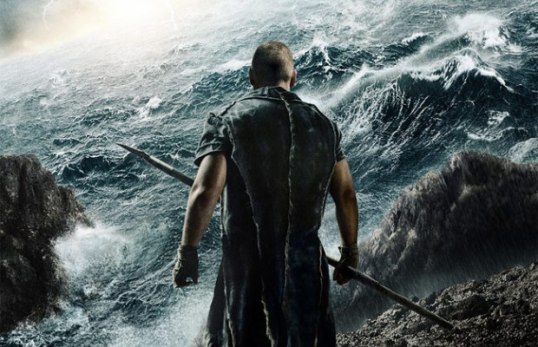
One of the best films (at least in this blogger’s honest opinion) of the year also happens to be one of it’s most controversial. It’s Darren Aronofsky’s follow-up to his equally critically-acclaimed and just as controversial Black Swan. I am speaking of his Biblical epic Noah and the story of the Flood.
It’s a film that doesn’t feel religious yet full of spirituality. It’s a film that dares to take a look at text seen as hallowed by billions in a way that doesn’t take a stand on the debate of science versus religion (though some feel that Aronofsky’s atheist background paints the film on the side of science). Noah has a scene in the beginning of it’s third act (one that some have called the dealbreaker for how they thought of the film in the end) that best exemplifies the conjoining of science and religion. It’s the best retelling of the Creation Story that I’ve heard and/or seen.
Courtesy of Protozoa Pictures…The Creation scene from Noah.
I know, I know, another Transformers extravaganza coming this summer. As if the last two wasn’t enough to swear me off the franchise. Well, guess what this one doesn’t have any of the actors from the first three and drops in a whole bunch of new ones to play war with the aforementioned robots who are more than meets the eye.
Instead of Shia LaBeouf in the lead role screaming like the most unheroic lead ever we get the manly man Mark Walhberg himself playing a Texas dad out to protect his daughter from the men in black while jump starting a rusted Optimus Prime on his spare time.
This fourth film looks to be a new start for the franchise that we all thought ended with a bang and a whimper with Transformers: Dark of the Moon, but there were still more Transformers that never made it to the bigscreen and what better way to do that than make a fourth. So, it looks like fans finally get Grimlock and the Dinobots plus a Decepticon that looks to be Galvatron.
Again, I will be seeing this (it’s like the scifi blockbuster version of Saw) just for the fact that it doesn’t have Shia LaBeouf for people to listen to scream shrilly every two or three minutes. Plus, it has Optimus Prime wrestling and then riding Grimlock.
Transformers: Age of Extinction is ready to make our eyes explode on June 27, 2014.
Yes, it is another Transformers film about to descend on the population this coming summer.
Could we finally get a quality one after the last two which got worse and worse with each new entry? I can’t say for sure, but this fourth entry does have one thing going for it and that is the lack of Shia LaBeouf. Instead we get Mark Walhberg in the lead human role. Optimus Prime and Bumblebee return with new robots filling in the rest.
If there’s one thing about Transformers: Age of Extinction that will get me to see it once it comes out is the fact that it has Grimlock and his merry band of Dinobots finally making their appearance. Yes, Grimlock and that’s all I need.
Transformers: Age of Extinction is set for a July 27, 2014 release date.
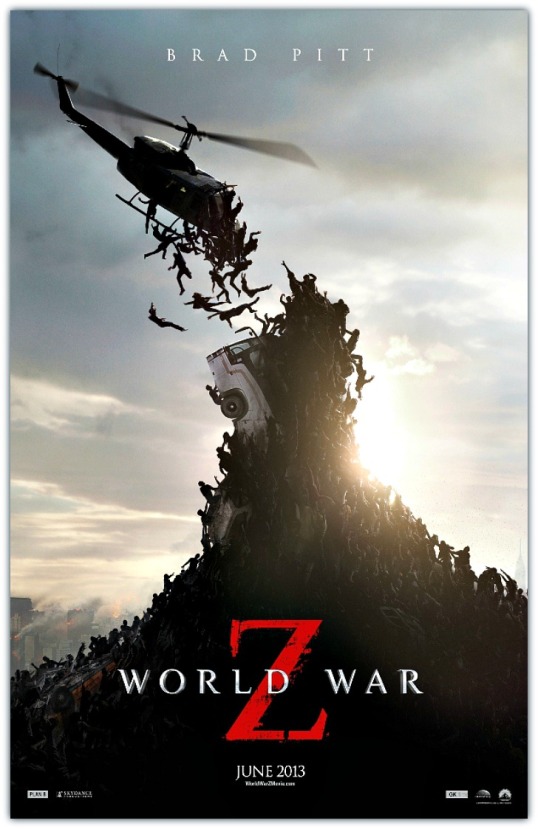
I’ll get this out of the way and just say it: World War Z the film pretty much has nothing in common with the acclaimed novel of the same name by author Max Brooks (reviewed almost at the very beginning of the site). Ok, now that we have that out of the way it’s time to get to the important part and that’s how did the film version turn out on it’s own merits.
World War Z was a film that took the long, winding and rough road to finally get to the big-screen. Whether it was the five different writers brought in to work on the script (J. Michael Straczynski of Babylon 5 fame came onboard first with Christopher McQuarrie coming unofficially to help tighten a few scenes in the end) to the massive changes made to the original source material that was bound to anger the fans of the novel, the film by Marc Forster had an uphill climb to accomplish even before the final product even came to market.
I was as surprised as man others were that the finished product was better than I had anticipated. Some had very low expectations about World War Z coming in due to the rumors and news reports coming in about the problems during production, but it doesn’t change the fact that the unmitigated disaster predicted by every film blogger and critic beforehand never came to fruition.
World War Z might not have been what fans of the novel had wanted it to be, but when seen on it’s own merit the film was both exciting and tension-filled despite some flaws in the final script and use of well-worn horror tropes.
The film begins with a visual montage interspersing scenes of nature (particularly the swarming, hive-like behavior of certain animals like birds, fish, and insects), alarmist news media reporting and the mindless celebrity-driven entertainment media that’s so big around the world. From there we’re introduced to the main protagonist of the film in one Gerry Lane (played by Brad Pitt) and his family. We see that the Lane family definitely love and care for each other with his wife Karin (Mireille Enos in the supportive wife role) and their two young daughters, Rachel and Constance. The film could easily have spent a lot of time establishing this family and their relationship towards each other, but we move towards the film’s first major sequence pretty much right after the opening. It’s this choice to not linger on the characters too long that becomes both a strength and a weakness to the film’s narrative throughout.
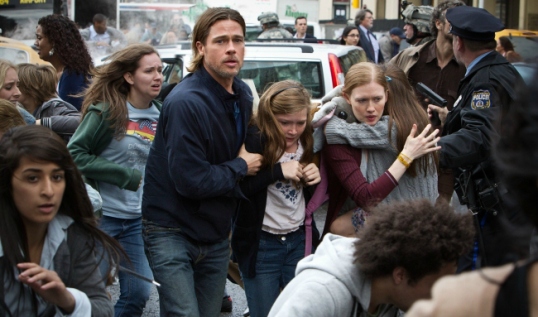
World War Z finally shows why it’s not your typical zombie film with it’s first major sequence in the center of downtown Philadelphia as Gerry and his family sees themselves in bumper-to-bumper traffic. As they wait there are some subtle hints that something might just be somewhat awry ahead of them as we see more and more police racing towards some sort of emergency ahead of the family and more and more helicopters flying overhead. There’s a brief lull in the scene before all hell breaks loose and the film’s zombie apocalypse aspect goes from 0 straight to 11 in a split second.
It’s this sequence of all-encompassing chaos overtaking a major metropolitan city seen both on the ground through the eyes of Gerry Lane and then on flying overhead wide shots of the city that gives World War Z it’s epic scope that other zombie films (both great and awful) could never truly capture. It’s also in this opening action sequence that we find the film’s unique take on the tried-and-true zombie. While not the slow, shambling kind that was described in the novel, these fast-movers (owes a lot more on the Rage-infected from 28 Days Later) bring something new to the zomgie genre table by acting like a cross between a swarm of birds or insects with the rapidly infectious nature of a virus.
These zombies do not stop to have a meal of it’s victims once they’ve bitten one but instead rapidly moves onto the next healthy human in order to spread the contagion it carries. We even get an idea of how quickly a bitten victim dies and then turns into one of “Zekes” as a soldier has ended up nicknaming them. It’s this new wrinkle in the zombie canon that adds to the film’s apocalyptic nature as we can see just how the speed of the infection and the swarm-like behavior of the zombies could easily take down the emergency services of not just a city and state but of entire nations.
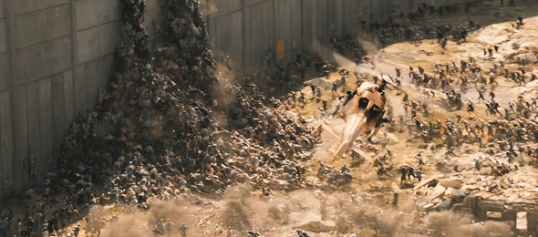
World War Z works best when it doesn’t linger too long between action sequences. Trying to inject some of the themes and ideas that made the novel such a joy to read only comes off as an uncomfortable attempt to try and placate fans of the novel. When we get scenes like Philadelphia in settings like Jerusalem and, in smaller scales but no less tense, like in South Korea and on a plane, the film works as a nice piece of summer action fare. This works in the first two thirds of the film but a sudden shift in the final third in Cardiff, Wales could be too jarring of a tonal shift in storytelling for some.
While the change from epic and apocalyptic to intimate and contained in the final third was such a sudden change this sequence works, but also shows just how bad the original final third of the film was to make this sudden change. It proves to be somewhat anticlimactic when compared to the epic nature of the first two-thirds of the film. We get a final third that’s more your traditional horror film. In fact, one could easily see World War Z as two different films vying for control and, in the end, the two halves having to try to co-exist and make sense.
World War Z doesn’t bring much of the sort of societal commentaries and themes that we get from the very best of zombie stories, but it does bring the sort of action that we rarely get from zombie films. The film actually doesn’t come off as your traditional zombie film, but more like a disaster story that just happened to have zombies as the root cause instead of solar flares, sudden ice age or alien invasion.
So, while World War Z only shares the title with the source novel it was adapting and pretty much not much else, the film wasn’t the unmitigated disaster that had been predicted for months leading up to it’s release. It’s a fun, rollercoaster ride of film that actually manages to leave an audience wanting to know more instead of being bombarded with so much action that one becomes desensitized and bored by it. There’s no question that a better film, probably even a great one, lurks behind the fun mess that’s the World War Z we’ve received, but on it’s own the film more than delivers on the promise that most films during the summer fails to achieve and that’s to entertain.
During the 80’s there were three names who earned the title of megastars. There was Sylvester Stallone with his Rocky and Rambo films. There was also Arnold Schwarzenneger who was pretty much the biggest action star of the decade. Then there’s Eddie Murphy who pretty much redefined the role of comedic action star. Yes, Murphy was an action star in his own right.
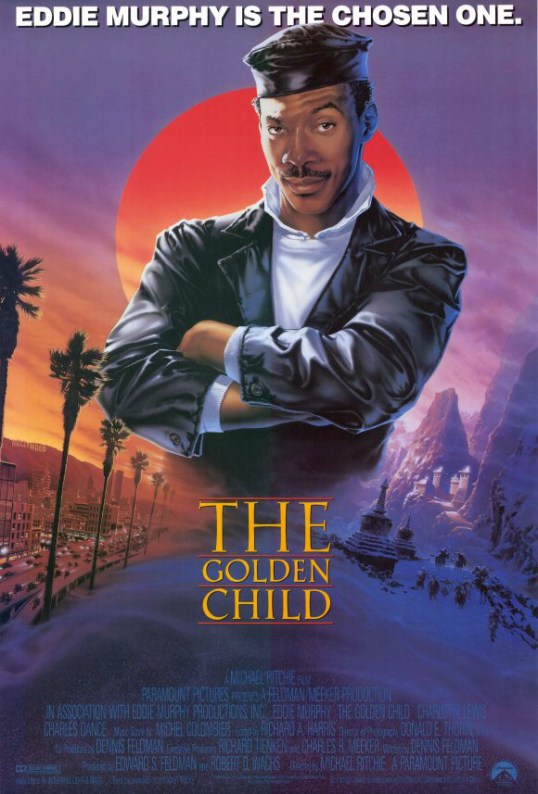
Once Murphy made a huge hit with the odd couple action comedy 48 Hours he began making one action comedy after the next. They all made money and to certain degree they were actually pretty good. There was one Murphy action comedy vehicle that was initially well-received by many when it came out in December of 1986, but has since seen a revisionist take from those who originally hyped up the film. I’m talking about The Golden Child.
Many who seem to have enjoyed and loved this film when it first came out has since backtracked to calling it one of the worst films of the 80’s. A film that indulges the ego of it’s star. While I agree with everything people have said about this film with each passing year I still can’t keep myself from enjoying it whenever it comes on cable (been awhile since it has). It was a fun flick when I first saw it as a 13 year-old and it continues to be fun.
Yes, it hasn’t aged well, but I think how it encompasses the kitchy-style of the 80’s not to mention the egocentricity of Murphy at the height of his stardom makes this one of my guilty pleasures. It even has a much y ounger, but still badass, Tywin Lannister playing the role of the main villain Sardo Numpsa aka Brother Numpsy.
It’s kind of hard to write about Iron Man 3 without giving much away, so this will be kind of condensed. If there’s one thing to learn about Iron Man in Iron Man 3, it’s that the events of the Avengers are really weighing down on Tony Stark. While the movie is more of a stand alone feature than being one part of a larger tale (like the first two leading up to Marvel’s The Avengers), it still manages to be a piece of a puzzle in the Marvel Cinematic Universe. It just happens to be one of those corner pieces. It’s not meant to be viewed the way the others are seen, but still manages to pack a punch.
Taking over the reigns of directing from Jon Favreau’s work on the first two films is Lethal Weapon and Kiss Kiss Bang Bang’s Shane Black. Black brings the witty dialogue and buddy partnership from those film into Iron Man 3 with ease, though the story does take some liberties with the comic.
The movie finds Tony (Robert Downey Jr.) unable to sleep or relax much since the New York Incident, having spent a bit of time in a wormhole and a separate dimension for a few minutes. This has left him with panic attacks as well as doing a lot of research in his workshop. This includes a new improvement to the Iron Man suit that allows him to call it piece by piece when needed, which was a nice touch. As a result of the world finding out that we’re not the center of the universe, they upgraded the War Machine and Colonel James Rhodes (Don Cheadle) to the Iron Patriot. The Iron Patriot acts as the first line of defense, which is just in time, considering that a new threat looms on the horizon in the form of The Mandarin (Ben Kingsley). Through televised declarations and using the same circular pattern from the terrorist group that captured Tony Stark in the first film, The Mandarin pledges to destroy all the President (William Sadler) holds dear.
So, the basis of Iron Man 3 is whether Tony Stark can get past what scared and changed him in The Avengers, stop the terrorism of the Mandarin while still finding a way to protect Pepper Potts (Gwyneth Paltrow).
Let’s first start with any problems before we get to the good stuff – because there’s a lot of great things about Iron Man 3. First off, the movie hasn’t any kind of interaction either from any of the other Avengers or from S.H.I.E.L.D. In any form. This isn’t a bad thing, as the story isn’t about them, but at the same time, it could come off as being expected given everything we saw in The Avengers. For me, personally, I was hoping for more of a connection, but it’s not terrible that it doesn’t exist.
Secondly, the women in the movie aren’t flushed out very well. You won’t find anyone on the level of Peggy Carter (Hayley Atwell) in Captain America here. While Rebecca Hall’s Maya Hansen has an important role in the movie, her screen time is really minimal. Given she’s a scientist, I’m not sure there was a whole lot for her to do, but Elizabeth Shue was a scientist in The Saint and she was all over that movie. Paltrow also takes something of a back seat to Downey and even to Favreau, who returns as Happy Hogan. Instead of concentrating on the girls, they introduced a new individual in the form of a kid. It works to some degree, but kind of felt like filler in some ways until they could get to a point where some action was taken.
For me, outside of these two elements, those are the only real problems with Iron Man 3 for someone unfamiliar with the comic book canon (like myself). If you read Iron Man on a regular basis and know all the characters, you may be really upset at where it goes, because the adaptation in some way really veers off from the comics. Veers off on the levels of Organic Web Shooters in Spider-Man, that kind of deep.
Now for the fun stuff.
What Iron Man 3 does really well is the way it handles the connections and interactions between the characters. Between Black’s and Pacific Rim writer Drew Pearce. The film basically has the same snap as Kiss Kiss Bang Bang and the final confrontation takes place in a location similar to Lethal Weapon II. Between Downey’s narration, James Badge Dale’s (who should get a run at being a comic hero or villain sometime) attitude and the action sequences, the film moves pretty well. Guy Pearce’s Aldrich Killian was cool. While I liked his character a lot, there were a few elements that were over the top. Kingsley’s Mandarin definitely works for the film, but the direction the story goes is a little weird.
Overall, Iron Man 3 is a fun ride for anyone following the Iron Man movies, and is an overall stronger film than the first. The lack of a direct teaser taste for the next Avengers film and a story shift that could upset die-hard comic fans threaten to hurt the story, but it makes up for it (I feel) by at least giving the story a sense of escalation. If Iron Man 2 was about Tony’s efforts in keeping his technology out of the government’s hands, Iron Man 3 would show why it was important. I wouldn’t mind seeing where this all goes.
We see the release of a new trailer for this summer’s epic zombie film based on the equally epic novel of the same name by Max Brooks.
World War Z is already the most expensive zombie film ever made with a budget rumored to be between 125-200 million dollars. Some of this has been due to the delays in filming and most of it seems to stem from a massive rewrite of the third act. Damon Lindelof was first hired to rewrite but due to prior commitments the job went to Drew Goddard. Such a rewrite also meant reshoots had to be done which took another seven weeks of shooting.
All in all, World War Z is one troubled film before it even gets to the general public.
Yet, it is also one of the more anticipated films for this summer. Some from fans of the genre who just can’t get enough of zombie films. Some from people wanting to see just what sort of zombie film ends up with a budget around 200 million dollars. From the trailer we’ve seen some of that money seem to have gone on some massive special effects sequences which includes swarming zombies of the Rage-infected kind. Then again we don’t really see the zombies close-up which tend to make them look like swarming ants from afar. Maybe the look of the zombies themselves have been saved for the release of the film.
This latest trailer actually gives a bit more of the plot of the film which puts Brad Pitt’s UN employee character to travel the world in search for the cause of the worldwide zombie pandemic. The speed by which things happen seems to have compressed all the events in the novel into a film of two hours. This, I’m sure will be a major contention with fans of the novel, but it looks like a decision by filmmaker to try and create a single narrative from a novel that was mostly single-hand accounts of the zombie war from survivors who have no connection with each other whatsoever.
We’ll find out in just under 3 months if this film will be a major flop or succeed despite all the stumbling blocks and problems throughout its production.
World War Z is set for a June 21, 2013 release date.
Less than two months remain before the sequel to J.J. Abrams surprise reboot hit of Star Trek arrives in the theaters this summer. It’s set to be one of this summer’s tentpole event films and this later trailer looks to set to prove that to be true.
While the first two trailers went light on the main narrative of the sequel this international trailer looks to really focus on Benedict Cumberbatch’s character who is either going to be this Star Trek alternate timeline’s Khan or Gary Mitchell or an amalgam of the two. Either way the trailer is all about action and Sherlock-Smaug looking, talking and acting all superior evil towards Kirk and the rest of the Enterprise crew.
Star Trek Into Darkness is set for a May 17, 2013 release date.
Before I came on board here at The Shattered Lens, I joined in on Live Tweeting, where you watch a movie with a group of people, while tweeting about it at the same time. Imagine being one of those audience members in Mystery Science Theatre 3000, and you’ve a rough idea of how fun it can get. Our own Lisa Marie Bowman does this every Saturday with her group, the Snarkalecs, as they cover the SyFy Movie of that week.
On Saturday Nights around 11pm Eastern(or just about every Saturday), Kevin Carr (over at Fat Guys at the Movies) hosts his Late Night Live Tweet, which I’ve participated in from time to time over the last 3 years. Tonight, they’re talking on 1981’s Dragonslayer on Netflix Instant.
Dragonslayer is one of those films that flopped at the box office, but remains iconic for its representation of dragons and for having been Industrial Light and Magic’s first Visual Effects production outside of any of the Lucasfilm movies (Raiders of the Lost Ark and the first two Star Wars films). Even though ILM was popular for what it did for those films, they were considered somewhat exclusive (or rather it’s my belief that they were). Dragonslayer became ILM’s test of whether they were a go to effects studio for the rest of Hollywood. It didn’t quite work out for the film, but at least ILM did well. At one point, the amount of lens flares in this movie would make J.J. Abrams proud.
Walt Disney Pictures, wanting to get into something a little more adult, came up with Dragonslayer just before Tron, but because of then graphic nature of the film (at least by their standards) supposedly had Paramount Pictures handle the distribution of the film and keep their hands clean. The movie contains blood, immolation and a hint of nudity, which seemed unbecoming of the Disney label. Over the years, Disney would come up with Touchstone Pictures, Buena Vista Pictures, and Hollywood Pictures for their more adult fare. I think Disney even had Miramax at one point.
The story behind Dragonslayer is pretty straight forward. In a faraway land in the Dark Ages, a group a people seek out an old wizard named Ulrich (Sir Ralph Richardson – Watership Down and one of my favorites, Time Bandits) to have him slay the dragon known as Vermithrax Pejorative. Why would anyone want to kill a dragon? Well this particular dragon spends it’s time burning nearby villages and to keep it from doing so, the land has a lottery where the winner – a young maiden – is offered as a sacrifice. On looking at the evidence provided – some scales and a claw (to which Urlich exclaims “That’s not a claw, by the gods….that’s a tooth!”), the wizard refuses and asks the team to look for another Dragonslayer. They inform him that he is indeed the last of his kind. His apprentice, Galen Bradwarden (Ally McBeal’s Peter MacNicol) feels that maybe they could do the job, but before Ulrich can get on his way, he is challenged by the head of the King’s Guard, which leads to the wizard’s demise.
Galen, on cleaning up the wizard’s castle, stumbles upon a glowing amulet that enhances his magic ability. then takes it upon himself to get rid of the Dragon after discovering one of Ulrich’s glowing amulets and the ability to perform magic. As a kid, I thought that amulet was the coolest thing. There are of course some complications, mainly the fact that the Monarchy believes having the sacrifices and the Dragon are a good thing, but like all Disney movies, it all works out.
From an acting standpoint, Dragonslayer is okay. None of the performances are really award winning, and actor Peter MacNicol has gone on to say that he was embarrassed to have done the film, and doesn’t even mention it when referencing anything he’s done. Actor Ian MacDiarmid, who played Emperor Palpatine in the Star Wars films, plays a priest in Dragonslayer, which was nice to see.
ILM’s biggest contribution to Dragonslayer was the use of a then new effect called “Go-Motion”. The idea was that most effects at the time were stop motion, similar to what you’d see in a Harryhausen film like Clash of the Titans, As a result, it was often very easy to tell when stop motion was being used due to the jerky but accepted movements of characters. Go Motion used puppets on computers to track their movements, inducing a motion blur and give the appearance that puppets were moving more naturally. I guess it was a lot like rotoscoping for the Lightsaber effects. ILM tried this out with some success in The Empire Strikes Back, and a combination of either Stop Motion or Go Motion was used in many films right up until CGI came along. The look of the Dragon itself was very aggressive and its look can be seen in similar films like Reign of Fire. Most of the effects haven’t held up very well at all under HD, and you can clearly see some of the areas where effects start and end.
It should be noted that Stop Motion is still in use today and is very popular with animated fares like The Nightmare Before Christmas, Coraline, and the Academy Award Nominated Film, Frankenweenie.
The sequel to J.J. Abrams’ 2009 Star Trek is just months away. It returns not just Abrams into the director’s chair but also the whole cast of the rebooted franchise back to boldly go where no one’s gone before.
Star Trek Into Darkness (still an awkward title but then we don’t to watch a film in the theaters because we like or don’t like how the title sounds) just released it’s latest trailer (this time a TV spot) during Super Bowl XLVII. The spot has new scenes and images that the previous teasers and trailers didn’t already show. We may have gotten a hint into the villain portrayed by Benedict Cumberbatch in the film. While the name Khan has never been mentioned in any ad and marketing spots since the film was announced I’d be very surprised if the villain is not some sort of analogue of that classic Star Trek rogue.
Star Trek Into Darkness is set for a May 17, 2013 release date.


 Through the Shattered Lens