Review: Fallout (Season 1)


“War never changes. You look out at this Wasteland, looks like chaos. But here’s always somebody behind the wheel.” — The Ghoul

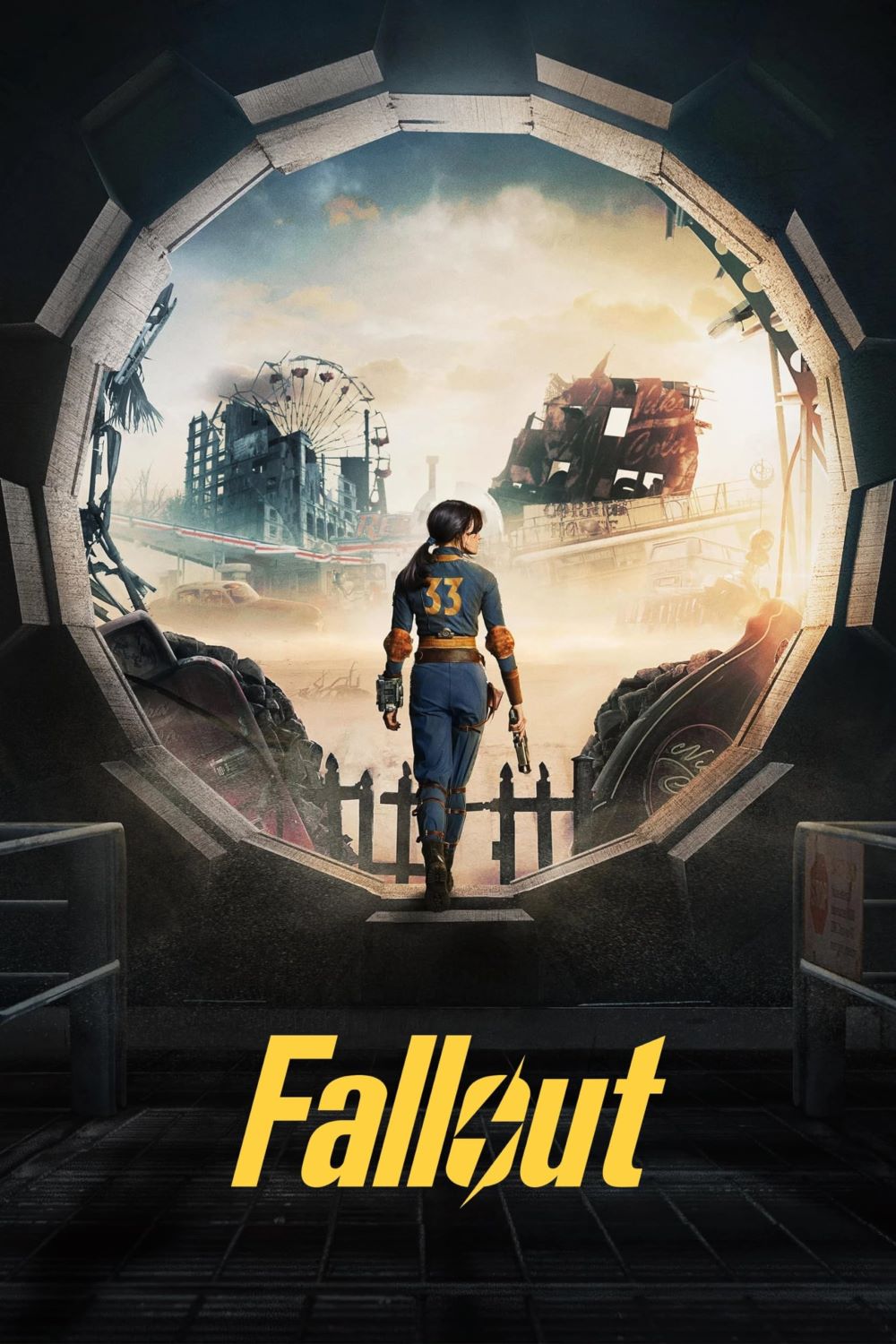
Fallout’s first season lands like a mini-nuke: messy around the edges, but undeniably powerful and surprisingly fun. It’s one of those adaptations that feels comfortable being both a love letter to the games and its own weird, often hilarious beast.

Set a couple of centuries after nuclear war, Fallout drops viewers into a retro-futurist wasteland where 1950s aesthetics collide with irradiated horror and corporate evil turned up to eleven. The show splits its focus between three main threads: Lucy, a bright-eyed vault dweller forced to leave her underground utopia; Maximus, an eager but insecure squire in the Brotherhood of Steel; and The Ghoul, a bounty hunter whose past life as a pre-war actor slowly bleeds through his charred exterior. The decision to juggle these perspectives is smart, because each storyline scratches a different itch: Lucy carries the emotional core and fish-out-of-water comedy, Maximus gives the militaristic, power-armor fantasy with a side of satire, and The Ghoul supplies the hard-boiled noir edge and moral ambiguity. The result is a season that rarely feels static; even when one plotline stalls a bit, another kicks in with fresh energy.

The tone is one of the show’s biggest strengths. Fallout leans hard into pitch-black humor without ever completely undercutting the stakes, which is harder to pull off than it looks. Limbs fly, heads explode, dogs get eaten, and yet the show keeps finding a way to make you laugh at the absurdity without turning the apocalypse into a joke. The violence is graphic and frequent, but it usually serves a purpose: to remind you that this world is brutal, even when the characters are cracking wise or bartering over chems. If the games felt like wandering into a deranged theme park built on the ruins of civilization, the series captures that same feeling of “this is horrible, but also kind of hilarious.” That balance, more than any specific lore reference, is what makes it feel like Fallout rather than just another grimdark sci-fi show.

Performance-wise, the casting is pretty inspired. Ella Purnell plays Lucy with this mix of optimism, naivety, and stubborn decency that could easily have been grating, but instead becomes the emotional anchor of the whole season. She brings just enough steel to the character that her idealism feels like a choice, not a default setting. Aaron Moten’s Maximus is a slower burn, and early on he risks fading into the background as “generic soldier guy,” but the more the show digs into Brotherhood politics, insecurity, and the pressure to be “worthy” of power armor, the more interesting he becomes. Walton Goggins, though, more or less walks away with the show. As The Ghoul, he’s vicious, funny, and weirdly tragic, and the flashbacks to his pre-war life give the season some of its most compelling dramatic beats. There’s a sense of continuity in his performance between the slick actor he was and the monster he becomes that keeps the character from feeling like a one-note cowboy caricature.

Visually, Fallout looks a lot better than a streaming adaptation of a video game has any right to. The production design leans into practical sets and tactile props where possible, and it pays off. Power armor has real heft, the vaults look lived-in rather than just glossy sci-fi hallways, and the wasteland feels like a place where people actually scrape out a living instead of just a CGI backdrop. The show has fun with the franchise’s iconography—Nuka-Cola, Pip-Boys, Vault-Tec branding, goofy radios—but it rarely pauses to point and wink too hard. The design team clearly understands that Fallout is basically “atomic-age corporate optimism weaponized into apocalypse,” and that theme is baked into everything from costumes to billboards rotting in the sand. Even the creature designs, like the mutated critters and ghouls, walk that line between unsettling and cartoonishly over-the-top, which fits the overall tone.

On the writing side, the structure of the season feels very much like an RPG campaign. Episodes often play like individual “quests” that build toward a bigger mystery: Lucy stumbling into a bizarre settlement, Maximus dealing with Brotherhood politics, The Ghoul chasing a lead that intersects with both of them. That quest-chain structure gives the first half of the season a propulsive, almost episodic energy, and it’s one reason the show is so watchable. At the same time, this approach has trade-offs. Sometimes character development feels a bit checkpoint-driven—people change because the story needs them to for the next “quest,” rather than as a smooth emotional progression. You can occasionally see the writers nudging the pieces into place, especially as the season barrels toward the finale.

Fallout sits in an interesting sweet spot when lined up against another prestige video game adaptation like HBO’s The Last of Us. Instead of treating the games as a sacred script that must be recreated line for line, it treats the Fallout universe as a shared sandbox—a tone, a style, a set of rules—rather than a fixed storyline that must be obeyed. Where The Last of Us is largely a faithful retelling of Joel and Ellie’s journey, Fallout seems far more interested in asking, “What else can happen in this world?” instead of “How do we restage that iconic mission?” It borrows the franchise’s black-comedy vibe, retro-futurist Americana, and corporate dystopia, then builds mostly original plots and character arcs on top.

That choice immediately gives the writers room to play. They’re not constantly checking themselves against specific missions, boss fights, or famous cutscenes; they’re free to jump around the timeline, invent new factions or townships, and reframe old ideas in ways that a beat-for-beat adaptation could never manage without sparking outrage. This approach also lets Fallout add to the lore instead of just reanimating it in live action. Because it’s not locked into recreating a particular protagonist’s path, the show can explore corners of the wasteland that were only hinted at in the games, complicate existing factions, or take big swings with backstory and world history. That kind of freedom inevitably creates some continuity friction for hardcore fans, but it also keeps the series from feeling like a lavish, expensive recap of something players already experienced with a controller in hand. Where The Last of Us excels by deepening and humanizing a story many already know, Fallout thrives by expanding its universe sideways, treating the source material as a toolbox rather than a template—and that makes it feel more like a genuine new chapter in the franchise than a live-action checklist.

Thematically, the show has more on its mind than explosions and fan-service, which is nice. Fallout keeps circling back to questions about corporate power, the illusion of safety, and how far people will go to preserve their own little slice of control. Vault-Tec’s smiling fascism is a blunt but effective metaphor for real-world systems that promise protection while quietly planning for everyone’s demise. The Brotherhood of Steel, meanwhile, becomes a vehicle for exploring militarized religion, hierarchy, and the dream of “owning” technology and knowledge. None of this is subtle, but Fallout isn’t a subtle franchise to begin with, and the series has enough self-awareness to let its satire stay sharp without slowing everything down for speeches. When it hits, it feels like the writers are asking, “Who gets to decide what’s worth saving when everything’s already gone?”

Where the season stumbles most is consistency. The pacing isn’t always smooth; some mid-season episodes are stacked with memorable set pieces and character moments, while others feel like they’re mostly there to set up endgame twists. The finale, in particular, is likely to be divisive. On one hand, it ties several plot threads together, drops a couple of bold lore swings, and sets up future seasons with a few big, crowd-pleasing reveals. On the other hand, it rushes emotional payoffs and leans heavily on explaining rather than letting certain developments breathe. The shift in tone in the last episode is noticeable enough that some viewers may feel like they suddenly switched to a slightly different show. It’s not a deal-breaker, but it does mean the season ends with more “wow, that was a lot” than a clean emotional landing.

As an adaptation, this freedom-to-expand strategy pays off by appealing to longtime fans and welcoming newcomers without getting bogged down in purist debates. Fans of the games will catch tons of details, locations, and tonal echoes that feel like affectionate nods rather than empty easter eggs. At the same time, the show isn’t just re-skinning existing game plots, which is a good call. It feels like a side story in the same universe rather than a strict retelling. That said, the lore choices late in the season—especially around the broader timeline and certain factions—are bound to spark arguments. If someone is deeply attached to the canon of the older games, some of the retcons and reinterpretations might play like a slap in the face. If someone is more relaxed about canon and just wants an entertaining, coherent story in that world, the show will probably land much better.

The writing of individual scenes shows a lot of care, especially in the way humor and dread coexist. Some of the best moments aren’t the big action beats but the small conversations: a strange, tense chat in a ruined diner, a piece of pre-war media resurfacing at the worst possible time, or a casual bit of wasteland banter that suddenly turns threatening. The dialogue sometimes leans too modern for the retro setting, but the rhythm feels natural enough that it rarely jars. When the show is firing on all cylinders, it nails that specific Fallout flavor: characters staring at incomprehensible horror and responding with a joke, a shrug, or a desperate sales pitch.

If there’s one area where the season could improve going forward, it’s in fleshing out the secondary cast and giving certain arcs more emotional weight. Some supporting characters are memorable and sharply drawn, while others feel like they exist mainly to be lore-delivery devices or cannon fodder. The world feels rich enough that it can absolutely sustain more side stories and slower, character-focused detours. A little more breathing room for relationships—whether friendships, rivalries, or romances—would help the big twists land harder and keep the show from occasionally feeling like it’s sprinting from spectacle to spectacle.

Overall, Fallout’s first season is a strong, confident debut that understands what made the games stand out without being slavishly beholden to them. It’s funny, brutal, stylish, and surprisingly character-driven for a show that spends so much time reveling in bloodshed and nuclear kitsch. The missteps in pacing and the polarizing choices in the finale keep it from being flawless, but they also signal a series willing to take risks rather than play it safe. For viewers who enjoy genre TV with personality, and for gamers who have been burned by adaptations before, this season is absolutely worth the trip into the wasteland. It doesn’t just survive the jump to live action; it stomps into it in full power armor, flaws and all.

The Unnominated #13: Heat (dir by Michael Mann)


Though the Academy of Motion Picture Arts and Sciences claim that the Oscars honor the best of the year, we all know that there are always worthy films and performances that end up getting overlooked.  Sometimes, it’s because the competition too fierce.  Sometimes, it’s because the film itself was too controversial.  Often, it’s just a case of a film’s quality not being fully recognized until years after its initial released.  This series of reviews takes a look at the films and performances that should have been nominated but were, for whatever reason, overlooked.  These are the Unnominated.

First released in 1995, Heat is one of the most influential and best-known films of the past 30 years.  It also received absolutely zero Oscar nominations.

Maybe we shouldn’t be too surprised that Academy — especially the Academy of the 1990s — didn’t shower the film with nominations.  For all of its many strengths, Heat is still a genre piece, an epic three-hour crime film from director Michael Mann.  It’s a film about obsessive cops and tightly-wound crooks and it’s based on a made-for-TV movie that Mann directed in the late 80s.  While the Academy had given a best picture nomination to The Fugitive just two years before, it still hadn’t fully come around to honoring genre films.

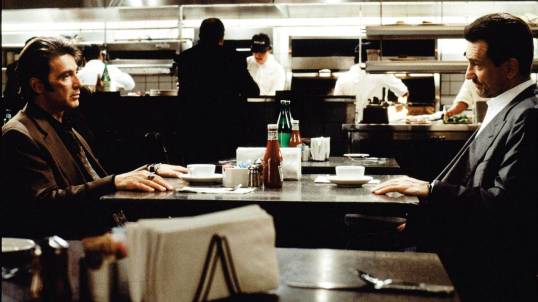
And yet one would think that the film could have at least picked up a nomination for its editing or maybe the sound design that helps to make the film’s signature 8-minute gun battle so unforgettable.  (Heat is a film that leaves you feeling as if you’re trapped in the middle of its gunfights, running for cover while the cops and the crooks fire on each other.)  The screenplay, featuring the scene where Al Pacino’s intense detective sits down for coffee with Robert De Niro’s career crook, also went unnominated.

Al Pacino was not nominated for playing Vincent Hanna and maybe we shouldn’t be too surprised at that.  Pacino yells a lot in this movie.  When people talk about Pacino having a reputation for bellowing his lines like a madman, they’re usually thinking about the scene where he confronts a weaselly executive (Hank Azaria) about the affair that he’s having with Charlene (Ashley Judd), the wife of criminal Chris Shiherlis (Val Kilmer).  And yet, I think that Pacino’s performance works in the context of the film and it’s often forgotten that Pacino has quite scenes in Heat as well.  Pacino’s intensity provides a contrast to Robert De Niro’s tightly controlled career criminal, Neil McCauley.  McCauley has done time in prison and he has no intention of ever going back.  But, as he admits during the famous diner scene, being a criminal is the only thing that he knows how to do and it’s also the only thing that he wants to do.  (“The action is the juice,” Tom Sizemore says in another scene.)  If any two actors deserved a joint Oscar nomination it was Pacino and De Niro.  In Heat, they’re the perfect team.  Pacino’s flamboyance and De Niro’s tightly-controlled emotions come together to form the heart of the picture.

No one from the film’s supporting cast was nominated either, despite there being a wealth of riches to choose from.  Ashley Judd and Val Kilmer come to mind as obvious contenders.  Kilmer is amazing in the shoot-out that occurs two hours into the film.  Ashley Judd has a killer scene where she helps her husband escape from the police.  Beyond Judd and Kilmer, I like the quiet menace of Tom Sizemore’s Michael Cheritto.  (Just check out the look he gives to an onlooker who is getting a little bit too curious.)  Kevin Gage’s sociopathic Waingro is one of the most loathsome characters to ever show up in a movie.  William Fichtner, Jon Voight, Danny Trejo, and Tom Noonan all make a definite impression and add to Michael Mann’s portrait of the Los Angeles underworld.  In an early role, Natalie Portman plays Hanna’s neglected stepdaughter and even Amy Brenneman has some good moments as Neil’s unsuspecting girlfriend, the one who Neil claims to be prepared to abandon if he sees “the heat coming.”

I have to mention the performance of Dennis Haysbert as Don Breedan, a man who has just been released from prison and who finds himself working as a cook in a diner.  (The owner of the diner is played by Bud Cort.)  Haysbert doesn’t have many scenes but he gives a poignant performance as a man struggling not to fall back into his old life of crime and what eventually happens to him still packs an emotional punch.  For much of the film’s running time, he’s on the fringes of the story.  It’s only by chance that he finds himself suddenly and briefly thrown into the middle of the action.

Heat is the ultimate Michael Mann film, a 3-hour crime epic that is full of amazing action sequences, powerful performances, and a moody atmosphere that leaves the viewer with no doubt that the film is actually about a lot more than just a bunch of crooks and the cops who try to stop them.  Hanna and McCauley both live by their own code and are equally obsessed with their work.  Their showdown is inevitable and, as directed by Michael Mann, it takes on almost mythological grandeur.  The film is a portrait of uncertainty and fear in Los Angeles but it’s also a portrait of two men destined to confront each other.  They’re both the best at what they do and, as a result, only one can remain alive at the end of the film.

I rewatched Heat yesterday and I was amazed at how well the film holds up.  It’s one of the best-paced three-hour films that I’ve ever seen and that epic gunfight is still powerful and frightening to watch.  Like Martin Scorsese’s Casino, it was a 1995 film that deserved more Oscar attention than it received.

Heat (1995, dir by Michael Mann, DP: Dante Spinotti)

Previous entries in The Unnominated:

  1. Auto Focus 
  2. Star 80
  3. Monty Python and The Holy Grail
  4. Johnny Got His Gun
  5. Saint Jack
  6. Office Space
  7. Play Misty For Me
  8. The Long Riders
  9. Mean Streets
  10. The Long Goodbye
  11. The General
  12. Tombstone


Retro Television Review: Miami Vice 2.8 “Tale of the Goat”


Welcome to Retro Television Reviews, a feature where we review some of our favorite and least favorite shows of the past!  On Mondays, I will be reviewing Miami Vice, which ran on NBC from 1984 to 1989.  The entire show can be purchased on Prime!

This week, things get weird.

Episode 2.8 “Tale of the Goat”

(Dir by Michael O’Herlihy, originally aired on November 15th, 1985)

It’s hard to know where to begin with this one.

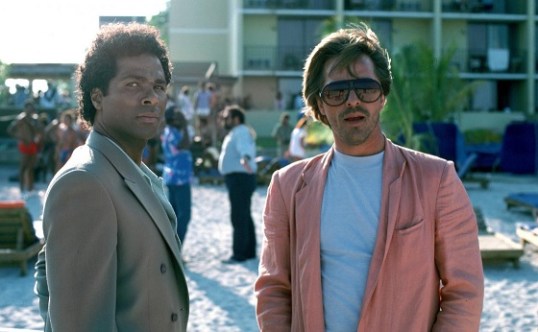
Legba (Clarence Williams III) is a drug lord that Sonny has been trying to take down for three years.  While hiding out in Haiti, Legba reportedly dies.  When his body is flown back to Miami, Crockett and Tubbs are waiting in the airport so that Crockett can snap a picture of Legba in his casket.  Legba does indeed appear to be dead.  But, at his voodoo-themed funeral, a man on a motorcycle riddles the casket with bullets.  When Crockett and Tubbs (who were staking out the ceremony) open up the casket, they discover only a dead goat.

“Zombie!” a priest exclaims.

Legba has come back, though not as a member of the undead.  Instead, while in Haiti, he ingested a toxin that put him in a 48-hour coma.  Unlike a lot of people who take the toxin, Legba survives.  However, when he is revived, he has suffered brain damage and is now walking and talking slowly.  That doesn’t stop Legba from getting his old gang back together (including a dwarf who carries a pickaxe) and going after everyone who he feels has betrayed him.  This includes his former lieutenant (Mykelti Williamson) and an obnoxious money launderer (Ray Sharkey) who owns a used car lot.

Tubbs doesn’t believe in voodoo, despite Crockett warning him of the dangers.  Tubbs is more interested in Marie (Denise Thompson), Legba’s ex-girlfriend.  Looking to keep Marie safe from Legba, Tubbs attempts to infiltrate a voodoo ceremony.  You might think this would give Tubbs the perfect excuse to trot out the fake Caribbean accent that he occasionally used during the first season but instead, Tubbs is captured before he can even utter a word.  He’s injected with the toxin and spends 48 hours in a coma, haunted by visions of Legba staring at him!

Eventually, Tubbs does come out of his coma and, amazingly, it takes him about five minutes to fully recover.  The episode ends with another raid on a yacht.  This time, Tubbs manages to kill the villain, shooting him in the back!  In Tubbs’s defense, he was still having visions and he thought Legba was facing him.  Legba dies and Marie is found in a coma but alive.

This was a weird episode, one that had enough plot for a two-parter.  As it is, the story felt rather rushed.  No sooner had Mykleti Williamson and Ray Sharkey made their appearances as criminals then Legba was doing away with them.  No sooner had Marie stepped onto Crockett’s boat then she was being kidnapped by Legba’s men.  No sooner had Tubbs decided to infiltrate Legba’s cult then he was getting injected with the voodoo toxin.  And no sooner had Tubbs woken up from his coma then he was preparing to raid the yacht.  Add to that, Clarence Williams III gave a performance that was without a hint of subtlety, speaking in accent that was impossible to describe.  This wasn’t really a good episode but it was so weird that it was undeniably entertaining.

Next week, Dean Stockwell appears as an old friend of Castillo’s!  Hopefully, he won’t be a voodoo priest.

Retro Television Reviews: Miami Vice 1.2 “Brother’s Keeper: Part Two”


Welcome to Retro Television Reviews, a feature where we review some of our favorite and least favorite shows of the past!  On Mondays, I will be reviewing Miami Vice, which ran on NBC from 1984 to 1989.  The entire show is currently streaming on Tubi!

This week, we learn who Tubbs really is and one scene changes television forever.

Episode 1.2 “Brother Keeper: Part Two”

(Directed by Thomas Carter, originally aired on September 16th, 1984)

The pilot for Miami Vice originally aired as a two-hour made-for-TV movie but, when it was released in syndication, it was split into two separate episodes.  That’s the way it’s usually aired on the retro stations and that’s also the way that it’s featured on Tubi.  And, as you can tell, that’s the way that I’ve decided to review it for this site.

Picking up where the first half ended, Brother’s Keeper: Part Two finds Sonny and Tubbs searching through the deceased Leon’s apartment.  Calderone’s men obviously visited the place and ransacked it before Sonny and Tubbs arrived but Sonny still manages to find Leon’s collection of important phone numbers.  Tubbs is surprised to discover that Leon lived in a very nice apartment but that’s the way things work in Miami.  Cocaine means big money and any one willing to take the risk can live like a king.  While the cops and the regular people go home to small apartments and houses that they can barely afford, the successful criminal lives a life of relative luxury.  The question is less why so many people are dealing drugs as why so many people aren’t.

While searching the apartment, Tubbs suddenly realizes that Sonny Crockett used to be a football star with the University of Florida.  (“You were a funky honky!” Tubbs exclaims.)  Apparently, Sonny was one of the best but a series of injuries ended his NFL dreams and, instead of going pro, Sonny did two tours of duty in Vietnam.  (The South Asian conference, Sonny calls it.)  Myself, I’m wondering how a semi-famous former football player can also be an undercover detective, working under a false name.  Wouldn’t he always be worried that a drug dealer would recognize him from the college days and figure out that Sonny Burnett was actually Sonny Crockett?

Sonny’s co-worker and girlfriend, Gina (Saundra Santiago), takes a break from working the undercover prostitution detail and lets Sonny know that she did a background check on Raphael Tubbs and he’s dead!  Raphael was a New York cop who was killed in shootout weeks before the other Tubbs landed in Miami.  When Sonny confronts him about this, Tubbs admits that he’s actually Ricardo, Raphael’s younger brother.  Raphael was a decorated Brooklyn detective.  Rico Tubbs, on the other hand, was a Bronx beat cop who forged a lot of documents in order to come down to Florida and convince Vice to allow him to work the Calderone case.  Sonny isn’t happy about being lied to but he has a lot more to worry about because, the night before, he apparently rolled over to Gina and whispered his ex-wife’s name in her ear!  Needless to say, things are a bit awkward between just about everyone.

Actually, awkward doesn’t even begin to describe what happens when Tubbs suggests that Lt. Rodriguez could be Calderone’s mole.  Sonny refuses to consider it until he overhears Rodriguez talking about enrolling his son in a pricey private school.  Fortunately, Rodriguez is innocent and the real mole’s number is found in Leon’s apartment.  Unfortunately, that number belongs to Sonny’s former partner, Scott Wheeler (Bill Smitrovich)!

After getting Wheeler to confess and turning him over to Rodriguez, Sonny and Tubbs drive down the dark streets of Miami at night, heading towards a rendezvous  with Calderone.  They don’t say much.  Tubbs loads his shotgun.  Sonny stops and makes a call to his ex-wife, something that his former partner Eddie didn’t get to do before he was killed.  The neon of Miami glows menacingly in the darkness.  Meanwhile, in the background, Phil Collins sings In the Air Tonight….

And it’s an absolutely beautiful sequence.  Between the surreal menace of Miami at night, the atmosphere of impending doom, and the moody song playing in the background, this sequence plays out like a surreal dream.  Both Tubbs and Crockett know that they are quite possibly driving to their death but, at this point, they have no other choice.  Too many people have died to turn back.  Neither Sonny nor Tubbs has anything in their life at that moment, beyond arresting Calderone.

And they do manage to arrest Calderone, along with killing quite a few of his associates.  However, Calderone is released by a crooked judge and flies away in a private airplane while Sonny and Tubbs can only stand on the runway and watch.  Sonny says that Calderone will return eventually.  Tubbs replies that he probably doesn’t have a job anymore.  Sonny asks Tubbs if he’s interested in a “career in Southern law enforcement.”

The second part of the pilot was dominated by that one scene of Tubbs and Sonny driving down the street.  And that scene was so strong and it made such an impression that it’s easy to ignore that the rest of Brother’s Keeper Part Two was not quite as exciting as Part One.  If the first part of the pilot set up Miami as a hedonistic playground of the rich and corrupt, the second part felt a bit more conventional in its approach.  Or, at least, it did until Phil Collins started to sing and play the drums.  One cannot understate the importance of that one scene.  That one scene, done with next to no dialogue, pretty much told the viewer everything that they needed to know about the show, about Miami, and about Crockett and Tubbs as partners.  In that scene, the show reminded us that no one is guaranteed to get out alive.

Next week: Crockett and Tubbs infiltrate an undercover pornography ring and Ed O’Neill appears as an FBI agent who may have gone over to the dark side.

Retro Television Reviews: Miami Vice 1.1 “Brother’s Keeper: Part One”


Welcome to Retro Television Reviews, a feature where we review some of our favorite and least favorite shows of the past!  On Mondays, I will be reviewing Miami Vice, which ran on NBC from 1984 to 1989.  The entire show is currently streaming on Tubi!

Legend has it that Miami Vice was originally pitched as being “MTV Cops.”  That may or may not be true but what is known is that it was a show that, for many people, continues to epitomize the 80s.  Its cynical and frequently surrealistic portrait of life in Miami continues to be influential to this day.  With Florida currently being at the center of so many discussions, it just seemed like a natural pick for Retro Television Reviews.

(Up until a few days ago, the mayor of Miami was running for President and two other Florida residents are currently the front runners for one party’s presidential nomination.  As I sit here writing this, national politics are often described as Florida vs California.  Even more than in the past, America revolves around Florida.)

Though Miami Vice is often describe as being a Michael Mann production, the show itself was actually created by Anthony Yerkovich, who felt that Miami in the 80s had become the American equivalent of Casablanca during World War II.  Mann served as executive producer and he played a big role in creating the show’s trademark visual style.  And, of course, the theme song was provided by Jan Hammer:

Episode 1.1 “Brother’s Keeper, Part One”

(Dir by Thomas Carter, originally aired on September 16th, 1984)

Though the show is considered, to this day, to be the epitome of the Southern Florida aesthetic, Miami Vice actually begins in New York City.

On a dark and wet New York Street, a detective named Tubbs (Philip Michael Thomas) sits in his car.  When a group of young men approach the car and demand that Tubbs give them some money, Tubb responds by coolly pointing a shotgun at them.  The men take the message and leave.

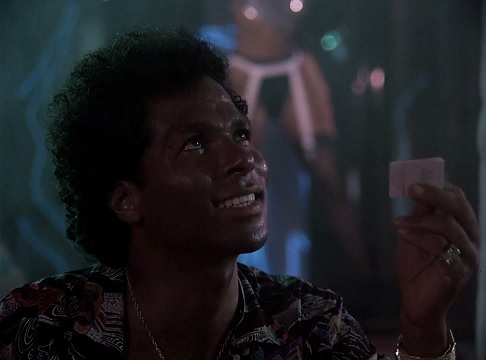
Tubbs is staking out a Colombian drug dealer named Calderone (Miguel Pinero).  Tubbs follows Calderone and his associates to a club, the type of place where even the neon lighting seem to be shadowy.  When Tubbs gets into a fight with some of Calderone’s bodyguards, Calderone flees into the dark night.

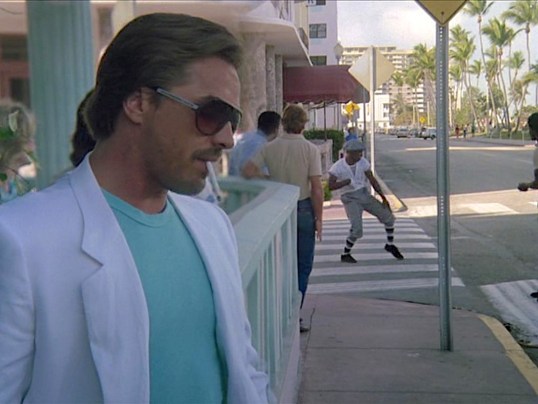
The action moves to Miami, which is as bright and sunny as New York was cold and dark.  Undercover vice cop Sonny Crockett (Don Johnson), wearing a white suit and a green t-shirt, gives advice to his partner, Eddie Rivera (a young and charismatic Jimmy Smits, making his television debut).  Eddie talks about how his wife is nervous about him being a cop.  Sonny tells Eddie to call her after they get finished dealing with a local drug dealer named Corky.

Corky knows Crockett as “Sonny Burnett” and he believes Eddie is a buyer from California.  When Corky arrives, they drive out to an underpass.  Corky and Eddie walk over to another car to check out Corky’s product.  Sonny spots the bomb that’s been taped under car’s hood but he’s too late to keep it from blowing up both Corky and Eddie.

When Lt. Rodriguez (Gregory Sierra) arrives on the scene, he’s not amused to discover two of his detectives — Stan Switek (Michael Talbott) and Larry Zito (John Diehl) — joking about how the police dogs are going to get hooked on all of the cocaine residue.  However, he’s even more annoyed with Sonny, who is quickly established as being the type of cop who does not “do it by the book!”  Rodriguez also says that Sonny hasn’t changed since his “football days.”  Sonny says that Eddie was killed by a mysterious dealer known as The Colombian.  Rodriguez replies that Sonny can’t even prove that the Colombian exists.  Rodriguez is particularly angered when Sonny says that there must be a mole working in the department.

While Sonny tells Eddie’s wife the bad news and then heads over to his son’s birthday party (it’s established that Sonny is divorced), Tubbs lands in Miami.  Hanging out at a strip club and doing an elaborate dance to Rockwell’s Somebody’s Watching Me, Tubbs is approached by a man named Scott Wheeler (Bill Smitrovich).  Pretending to be a Jamaican named Teddy Prentiss, Tubbs arranges to meet a drug dealer that Wheeler claims to know.

What Tubbs doesn’t know is that Wheeler is an undercover DEA agent and that he’s also Sonny Crockett’s former partner.  Sonny is the “dealer.”  That night, Sonny and a real-life drug dealer, Leon (Mykelti Williamson) show up at the meeting with Wheeler and “Teddy.”  Unfortunately, Zito and Switek show up earlier than expected and they end up arresting everyone before Leon can lead Sonny to the Colombian.  Tubbs makes a run for it, jumps into the boat that Sonny drove to the meeting, and speeds away.  Sonny jumps into his own car and chases the boat while the Miami Vice theme song plays in the background.  (Trust me, it’s a supercool scene.)

Finally confronting Tubbs on a bridge, Sonny reveals that he’s a detective.  Tubbs produces his own badge and introduces himself as Raphael Tubbs of the NYPD.  He explains that he’s in Miami because he’s after a Colombian drug dealer named Calderone.  Sonny explains that he’s too busy searching for the Colombian to worry about Tubbs’s search.  Finally, Lt. Rodriguez shows up and helps them to understand that they’re both looking for the same guy.  Rodriguez suggests that they work together but Sonny refuses.

The next morning, Tubbs tracks Sonny down on the houseboat on which he lives.  It’s a tense meeting, with Sonny punching Tubbs for suggesting that he wasn’t a good enough cop to save Eddie’s life.  Sonny apologizes afterwards and Tubbs accepts the apology and then punches Sonny so that they’ll be even.  Sonny then introduces Tubbs to his pet alligator, Elvis.  It’s male-bonding, 80s style!

Sonny and Scott head over to the courthouse so that they can be “arraigned,” along with Leon.  I really liked the performance of Howard Bergman, who played the eccentric judge, Clarence Rupp.  At one point, the lights went out in the courtroom and when they came back, everyone from the judge to the bailiffs to the court reporter had drawn a gun.  After mentioning his appreciation of the second amendment, Judge Rupp announces that Leon is free to go without bail because he’s cooperating with the police.  A panicked Leon yells that he’s not cooperating.

Later, a fearful Leon calls Rodriguez and offers to cooperate in return for protective custody.  Leon is hiding out at the beach, where Tubbs is keeping an eye on him.  When Sonny arrives, he’s not amused to see Tubbs there.  Meanwhile, a hitman who has disguised himself as a woman shoots and kills Leon while Girls Just Want To Have Fun plays on the soundtrack.

And so ends part one of Brother’s Keeper.  And you know what?  Even after all this time, it’s still easy to see why Miami Vice took off and why it continue to inspire a slew of imitators.  The pilot was genuinely exciting, with the perfect mix of music, visuals, and charismatic performances.  Jimmy Smits broke my heart in his tiny role.  Mykelti Williamson made Leon into an almost sympathetic character as he realized that the cops were willing to sacrifice him to get at his boss.  From the start, Don Johnson’s gruff performance as Sonny feels like a perfect match for Philip Michael Thomas’s more earnest portrayal of Tubbs.  If Sonny is a cynic, Tubbs seems to feel that he can make a difference by taking down men like Calderone. We’ll have to see how long that lasts.

Next week, we’ll finish up the pilot with part two of Brother’s Keeper!

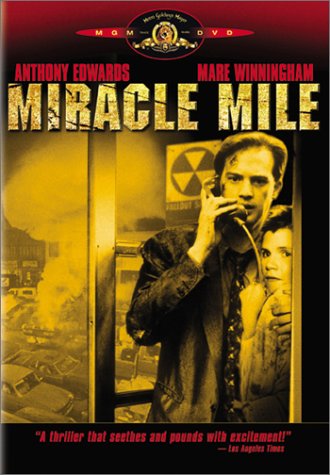
Film Review: Miracle Mile (dir by Steve De Jarnatt)


Last night, as I was watching the 1988 film, Miracle Mile, I found myself thinking about the fact that this film literally could not be made today.

No, it’s not because the film itself is about the treat of nuclear war.  Though nuclear war may no longer be as much of a cultural obsession as it apparently was back in the 80s, the fact of the matter is that the U.S., Russia, the UK, France, and China all still have nuclear weapons.  Pakistan, India, and North Korea all claim to have nuclear weapons.  It’s believed that Israel also has a few.  Iran is apparently working on developing an arsenal.  It’s estimated that there are currently 13,865 nuclear weapons in existence, 90% of which are divided between the U.S. and Russia.  That’s not even counting the threat of a terrorist group setting off a nuclear device.  In short, the threat of nuclear war is still very much a real one.

Instead, what truly makes Miracle Mile stand out as a film of its time, is the fact that almost the entire plot revolves around the character of Harry (played by Anthony Edwards) answering a Los Angeles pay phone at four in the morning.

Why is Harry answering a pay phone at 4 in the morning?  It’s because, earlier, he met Julie (Mare Winningham) at the La Brea Tar Pits and they fell instantly in love.  After spending most of the afternoon together, they made a date to meet at the local diner where Julie worked as a waitress.  Julie’s shift ended at midnight.  Harry went home to get a quick nap before picking her up.  Unfortunately, a power failure — one that was largely caused by Harry carelessly tossing away a cigarette — resulted in Harry’s alarm not going off.  At midnight, while Julie was standing outside the diner, Harry was asleep.

Harry doesn’t wake up until well-past 3 a.m.  After hastily getting dressed, Harry drives down to the diner.  When he arrives, he bumps into a tree and three rats fall off the branches and land on his car, which is a bit of an ominous omen.  (After watching the movie, I did a Google search and discovered that it’s actually not uncommon for rats to hang out in palm trees after dark.  I had no idea.  I’m glad I don’t live near any palm trees.)

By the time Harry arrives, Julie’s already gone.  From the payphone outside the diner, Harry calls Julie and leaves an apologetic message on her answering machine.  (Julie sleeps through it.)  Within minutes of Harry hanging up, the pay phone rings again.  Harry answers it, expecting to speak to Julie.  Instead, he finds himself talking to a panicked soldier who was trying to call his father but who dialed the wrong area code.  The soldier says that a war is about to break out and that everyone is going to die.  Suddenly, Harry hears what sounds like a gunshot.  Another voice gets on the phone and tells Harry to go back to sleep and forget about the call.

Of course, the reason why this story couldn’t take place in 2020 is pretty obvious to see.  No one uses pay phones anymore.  If the movie were made today. Harry would have just Julie on his own phone and then waited for her to call him back.  The soldier would never have misdialed his father’s area code.  Harry never would have gotten the message that the world was about to end and most of the subsequent events in Miracle Mile never would have happened.  Harry would have just sat in the diner and had a cup of coffee and waited for Julie to call until the inevitable happened.  In 2020, that would have been the movie.

So, let’s be happy that this film was made in 1988. during the time when pay phones were everywhere, because Miracle Mile is an excellent film.  Miracle Mile starts out as a romantic comedy, with Anthony Edwards and Mare Winningham making for an incredibly adorable couple.  Then, after Harry answers that pay phone, the movie grows increasingly grim as Harry desperately tries to make his way to Julie and arrange for the two of them to board a plane that a mysterious woman (Denise Crosby) has charted for Antarctica.  The problem, of course, is that in order to reach Julie, Harry is going to need the help of the type of people who are typically up and wandering around at 4 in the morning in Los Angeles.  Several people die as Harry tries to make it to Julie and, smartly, the film doesn’t just shrug off their deaths.  For the majority of the film, Harry isn’t even sure if there’s actually going to be an attack and it’s possible that he’s not only panicking over nothing but that he’s causing others to panic as well.  People are dying because of that phone call and Harry doesn’t even know whether it was real or not.  Even when full scale rioting breaks out, Harry doesn’t know if it’s because the world’s ending or because of a bad joke that he took seriously.  Transitioning from romantic comedy to dark comedy, Miracle Mile eventually becomes a nightmare as it becomes obvious that, even if Harry does reach Julie, escaping the city is not going to be easy.  The sun is rising and the truth is about that phone call is about to revealed….

Miracle Mile is a film that will get your heart racing.  On the one hand, Anthony Edwards and Mare Winningham have such a wonderful chemistry and they’re both just so damn likable that you want them to find each other and stay together.  Even if it means running the risk of being incinerated in a nuclear explosion, you want Harry and Julie to be with each other.  At the same time, you watch the movie with the knowledge that, even if they do manage to reunite, it might not matter because the world’s going to end.  Remarkably, almost everyone who Harry talks to about the phone call believes him when he says that a war is about break out.  Almost all of them have a plan to escape and, as a viewer, you get so wrapped up in the film that it’s only later that you realize that none of their plans made any sense.  Hiding out in Antarctica?  How exactly is that going to work?  Antarctica’s not exactly a place to which you impulsively move.  If there is truly no way to escape the inevitable, perhaps we should just be happy that Julie and Harry found love, even if it was right before the apocalypse.

Film Review: Streets of Fire (dir by Walter Hill)


File this one under your mileage may vary…

Okay, so here’s the deal.  I know that this 1984 film has a strong cult following.  A few months ago, I was at the Alamo Drafthouse when they played the trailer and announced a one-night showing and the people sitting in front of me got so excited that it was kind of creepy.  I mean, I understand that there are people who absolutely love Streets of Fire but I just watched it and it didn’t really do much for me.

Now, that may not sound like a big deal because, obviously, not everyone is going to love the same movies as everyone else.  I love Black Swan but I have friends who absolutely hate it.  Arleigh and I still argue about Avatar.  Leonard and I still yell at each other about Aaron Sorkin.  Erin makes fun of me for watching The Bachelorette.  Jedadiah Leland doesn’t share my appreciation for Big Brother and the Trashfilm Guru and I may agree about Twin Peaks but we don’t necessarily agree about whether or not socialism is a good idea.  And that’s okay.  There’s nothing wrong with healthy and respectful disagreement!

But the thing is — Streets of Fire seems like the sort of film that I should love.

It’s a musical.  I love musicals!

It’s highly stylized!  I love stylish movies!

It’s from the 80s!  I love the 80s films!  (Well, most 80s films… if the opening credits are in pink neon, chances are I’ll end up liking the film…)

It takes place in a city where it never seems to stop raining.  Even though the neon-decorated sets give the location a futuristic feel, everyone in the city seems to have escaped from the 50s.  It’s the type of city where people drive vintage cars and you can tell that one guy is supposed to be a badass because he owns a convertible.  All of the bad guys ride motorcycles, wear leather jackets, and look like they should be appearing in a community theater production of Grease.

Singer Ellen Aim (Diane Lane) has been kidnapped by the Bombers, a biker gang led by Raven (Willem DaFoe).  Ellen’s manager and lover, Billy Fish (Rick Moranis), hires Tom Cody (Michael Pare) to rescue Ellen.  Little does Billy know that Cody and Ellen used to be lovers.  Cody is apparently a legendary figure in the city.  As soon as he drives into town, people starting talking about how “he’s back.”  The police see Cody and automatically tell him not to start any trouble.  Raven says that he’s not scared of Cody and everyone rolls their eyes!

It’s up to Cody to track Ellen down and rescue her from Raven and … well, that’s pretty much what he does.  I think that was part of the problem.  After all of the build-up, it’s all a bit anti-climatic.  It doesn’t take much effort for Cody to find Ellen.  After Cody escapes with Ellen, it doesn’t take Raven much effort to track down Cody.  It all leads to a fist fight but who cares?  As a viewer, you spend the entire film waiting for some sort of big scene or exciting action sequence and it never arrives.  The film was so busy being stylish that it forgot to actually come up with a compelling story.

I think it also would have helped if Tom Cody had been played by an actor who had a bit more charisma than Michael Pare.  Pare is too young and too stiff for the role.  It doesn’t help to have everyone talking about what a badass Tom Cody is when the actor playing him doesn’t seem to be quite sure what the movie’s about.  Also miscast is Diane Lane, who tries to be headstrong but just comes across as being petulant.  When Cody and Ellen get together, they all the chemistry of laundry drying on a clothesline.

On the positive side, Willem DaFoe is believably dangerous as Raven and Amy Madigan gets to play an ass-kicking mercenary named McCoy.  In fact, if McCoy had been the main character, Streets of Fire probably would have been a lot more interesting.

I guess Streets of Fire is just going to have to be one of those cult films that I just don’t get.

Catching-Up With Two Courtroom Dramas: Suspect and 12 Angry Men


As a part of my continuing effort to get caught up with reviewing all of the movies that I’ve seen this year, here’s two courtroom dramas that I recently caught on This TV.

  • Suspect
  • Released in 1987
  • Directed by Peter Yates
  • Starring Cher, Dennis Quaid, Liam Neeson, John Mahoney, Joe Mantegna, Philip Bosco, Fred Melamed, Bernie McInerney, Bill Cobbs, Richard Gant, Jim Walton, Michael Beach, Ralph Cosham, Djanet Sears 

Suspect is a hilariously dumb movie.  How dumb is it?  Let me count the ways.

First off, Cher plays a highly successful if rather stressed public defender.  And don’t get me wrong.  It’s not that Cher is a bad actress or anything.  She’s actually pretty good when she’s playing Cher.  But, in this movie, she’s playing someone who managed to graduate from law school and pass the DC bar.

Secondly, Cher is assigned to defend a homeless man when he’s accused of murdering a clerk who works for the Justice Department.  The homeless man is deaf and mute, which isn’t funny.  What is funny is when he gets a shave and a shower and he’s magically revealed to be a rather handsome and fresh-faced Liam Neeson.  Liam doesn’t give a bad performance in the role.  In fact, he probably gives the best performance in the film.  But still, it’s hard to escape the fact that he’s Liam Neeson and he basically looks like he just arrived for a weekend at Cannes.

Third, during the trial, one of the jurors (Dennis Quaid) decides to investigate the case on his own.  Cher even helps him do it, which is the type of thing that would get a real-life attorney disbarred.  However, I guess Cher thinks that it’s worth the risk.  I guess that’s the power of Dennis Quaid’s smile.

Fourth, the prosecuting attorney is played by Joe Mantegna and he gives such a good performance that you find yourself hoping that he wins the case.

Fifth, while it’s true that real-life attorneys are rarely as slick or well-dressed as they are portrayed in the movies, one would think that Cher would at least take off her leather jacket before cross-examining a witness.

Sixth, it’s not a spoiler to tell you that the homeless man is innocent.  We know he’s innocent from the minute that we see he’s Liam Neeson.  Liam only kills who people deserve it.  The real murderer is revealed at the end of the film and it turns out to be the last person you would suspect, mostly because we haven’t been given any reason to suspect him.  The ending is less of a twist and more an extended middle finger to any viewer actually trying to solve the damn mystery.

I usually enjoy a good courtroom drama but bad courtroom dramas put me to sleep.  Guess which one Suspect was.

  • 12 Angry Men
  • Released 1997
  • Directed by William Friedkin
  • Starring Courtney B. Vance, Ossie Davis, George C. Scott, Armin Mueller-Stahl, Dorian Harewood, James Gandolfini, Tony Danza, Jack Lemmon, Hume Cronyn, Mykelti Williamson, Edward James Olmos, William Petersen, Mary McDonnell, Tyrees Allen, Douglas Spain

The 12 Angry Men are back!

Well, no, not actually.  This is a remake of the classic 1957 film and it was produced for Showtime.  It’s updated in that not all of the jurors are white and bigoted Juror #10 (Mykelti Williamson) is now a member of the Nation of Islam.  Otherwise, it’s the same script, with Juror #8 (Jack Lemmon) trying to convince the other jurors not to send a young man to Death Row while Juror #3 (George C. Scott) deals with his family issues.

I really wanted to like this production, as it had a strong cast and a strong director and it was a remake of one of my favorite films.  Unfortunately, the remake just didn’t work for me.  As good an actor as Jack Lemmon was, he just didn’t project the same moral authority as Henry Fonda did the original.  If Fonda seemed to be the voice of truth and integrity, Lemmon just came across like an old man who had too much time on his hands.  Without Fonda’s moral certitude, 12 Angry Men simply becomes a story about how 12 men acquitted a boy of murder because they assumed that a woman would be too vain to wear her glasses to court.  The brilliance of the original is that it keeps you from dwelling on the fact that the accused was probably guilty.  The remake, however, feels like almost an argument for abandoning the jury system.

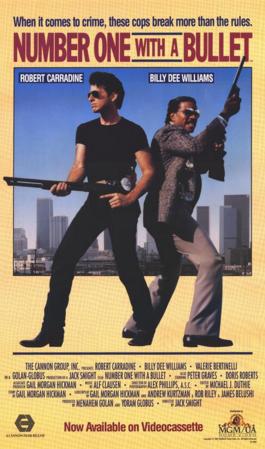
A Movie A Day #308: Number One With A Bullet (1987, directed by Jack Smight)


Number One With A Bullet is the story of two cops.  Nick Barzack (Robert Carradine) is so crazy that the all criminals have nicknamed “Beserk.”  (Who says criminals aren’t clever?)  Nick’s partner, Frank Hazeltine (Billy Dee Williams) is so smooth that jazz starts to play whenever he steps into a room.  Nick keeps a motorcycle in his living room, wants to get back together with his wife (Valerie Bertinelli), and has an overprotective mother (Doris Roberts).  Hazeltine is Billy Dee Williams so all he has to worry about is being the coolest man on Earth.  Their captain (Peter Graves!) may want them to do things by the book but Nick and Hazeltine are willing to throw the book out if it means taking down DaCosta, a so-called respectable citizen who they think is actually the city’s biggest drug lord.

It is natural to assume that, because of the whole crazy white cop/centered black cop storyline, this movie was meant to be a rip-off of a well-known film starring Mel Gibson and Danny Glover but actually, Number One With A Bullet was released a week before Lethal Weapon.  As well, while Carradine’s Nick is almost as crazy as Mel Gibson’s Riggs, it is impossible to imagine Billy Dee Williams ever saying that he’s “too old for this shit.”  Williams is having too good a time listening to jazz and picking up women.  Whenever Hazeltine shows up, Number One With A Bullet feels like a Colt 45 commercial that somehow costars Robert Carradine.  Whenever the film is just Carradine, it feels like an unauthorized sequel to Revenge of the Nerds where Lewis gets really, really pissed off.

Number One With A Bullet is a Cannon film and entertaining in the way that most late 80s Cannon films are.  There is a lot of action, a little skin, and some dated comedy, much of it featuring Robert Carradine having to dress in drag.  There is also a mud wrestling scene because I guess mud wrestling was extremely popular back in the 80s.  They may not be Gibson and Glover but Carradine and Williams still make a good team and they both seem to be having a ball.  For fans of cheap 80s action films, there is a lot to enjoy in Number One With A Bullet.

Playing Catch-Up: Fences (dir by Denzel Washington)


Well, 2016 is officially over and soon, it will be time for me to start posting my picks for the best of the year!  I’ve still got a lot of movies that I need to review (and, in some cases, watch) before making out that last so let’s not waste any time!  It’s time to start playing catch up!

fences

In Fences, Denzel Washington plays Troy Maxson.  When the film begins, Troy is 51 years old and lives in Philadelphia in the 1950s.  He’s a proud, charming, and often angry man.  He’s the type of man who can tell a wonderful story and who can make you laugh but, at the same time, you’re always aware that he could explode at any minute.  It’s hard not to like Troy Maxson but, at times, it’s hard not to be a little scared of him.

Troy is a garbage man, apparently destined to spend the rest of his working life hanging onto the back of a garbage truck because his union does not allow black to drive the trucks.  Troy has recently complained about the lack of black drivers and, as he tells his best friend, Bono (Stephen McKinley Henderson), he’s now expecting to be disciplined.  However, to his great surprise, he is instead reassigned to be a driver, making him the first black man to work as a driver for the Philadelphia Sanitation Department.

And that may not seem like much today but, as the film makes clear, that was a huge deal in the 1950s.

Troy, of course, didn’t grow up wanting to be a garbage man.  As he tells his son, Troy left home when he was just a teenager and made his living as a mugger.  During one robbery, he accidentally killed a man and spent the next decade in prison.  It was in prison that he first met and befriended Bono.  It was also in prison that Troy discovered that he was a pretty good baseball player.  Upon his release, he played for the Negro League.  Though everyone agrees that Troy was a good player (and Troy is always quick to claim that he was the best), he never played for the Major Leagues.  The film suggests that, after the league was integrated, Troy tried out but was rejected.  His wife, Rose (Viola Davis), says that Troy was rejected because, at the age of 40, he was too old.  Troy says it was because of the color of his skin.

As I said, it’s hard not to admire Troy.  He’s a man who stands up for himself and he seems to sincerely love his wife.  When his oldest son, a musician named Lyons (Russell Hornsby), comes by to ask for money, it’s hard not to laugh with and appreciate the style with which Troy shows his irritation.  Troy is so charming that, it’s only after Lyons leaves, that you realize that Lyons practically begged his father to come see him play and Troy pretty much blew him off.

And then there’s Troy’s youngest son, Cory (Jovan Adepo).  Cory is in high school.  He’s a football player and he’s recently been scouted by a college.  Troy tells Cory that he’s wasting his time and that no black man will ever be given a fair chance in the NFL.  He tells Cory that he needs to get a real job, like he did.  And as Troy continues to yell at Cory, you start to understand Troy’s jealousy.  Cory has an opportunity that Troy will never have, not due to any difference in talent as much as to the fact that Troy grew up at a time when segregation was the unquestioned law of the land whereas Cory is coming of age the beginning of the civil rights era.

At one point, Cory asks his father, “Why don’t you like me?”

“I don’t have to like you,” Troy replies and the words sting.

Troy is a character about whom you’ll have mixed feelings.  Beyond his anger at his son, he’s also exploiting his mentally impaired brother, Gabe (Mykelti Williamson).  Gabe has a metal plate in his head, the result of his service in World War II.  Gabe receives a monthly disability check and Troy has been using that money to support his family.

Through it all, Rose remains by his side, listening to him when he’s angry and, whenever she can get a word in, acting as his conscience.  But then, Bono asks Troy about his relationship with Alberta, the new girl at work and Troy confesses what the audience suspected.  Not only is Troy cheating on his wife but Alberta is pregnant….

Troy is a great character and Denzel Washington gives perhaps his best film performance in the role.  (Washington already played the role on stage.)  In many ways, Troy is a monster but, at the same time, it’s impossible not to feel for him.  His anger is real.  His selfishness is all too real.  But his pain and his (legitimate) frustrations are very real, as well.  Troy Maxson is a character who, like everyone, struggles to maintain his balance as he walks the line between right and wrong.  He makes several mistakes but he’s never less than fascinating and Washington’s volcanic performance is never less than enthralling.  Matching Washington every step of the way is Viola Davis, giving a powerful performance as the loyal but outspoken Rose.

In fact, the entire film is a master class of great acting.  (If Mykelti Williamson occasionally goes a bit overboard as Gabe, that has more to do with the character than the performer.)  Though the film is dominated by Washington and Davis, I think special mention has to be made of Stephen McKinley Henderson, who brings a lot of understated wisdom to the role of Bono.

Denzel Washington also directed Fences and, unfortunately, he’s not as good a director as he is an actor.  While he goes get brilliant performances from his cast, Fences never really breaks free from its theatrical origins.  It’s very much a filmed play as opposed to a cinematic work of art and, the few scenes that attempt to “open up” the play feel somewhat awkward.  In the end, Fences is best as a record of incredible acting.