44 Days of Paranoia #4: Interview With The Assassin (dir by Neil Burger)


InterviewDAS062810

Continuing with the 44 Days of Paranoia, we today take a look at one of the best films to have been inspired by the assassination of John F. Kennedy, 2002’s Interview With The Assassin.

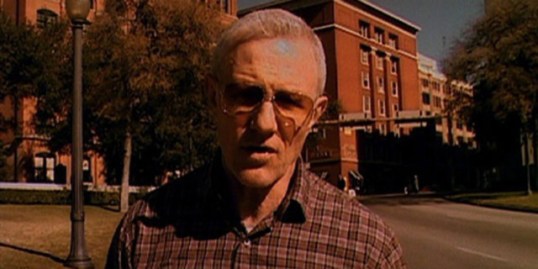
Interview With The Assassin tells the story of Ron (Dylan Haggerty), a cameraman who, at the beginning of the film, has recently lost his job.  His gruff neighbor, an ex-Marine named Walter (a brilliantly menacing Raymond K. Barry), approaches Ron and tells him that he’s dying of cancer and he wants Ron to film him confessing to a crime.  After Ron sets his camera up, Walter proceeds to state that he was the second gunman and that he — and not Lee Harvey Oswald — was the sniper who killed President Kennedy.  When Ron asks Walter who hired him to kill Kennedy, Walter says that he was approached by a man named John Seymour but that he’s not sure who Seymour was working for.

Ron, not surprisingly, is initially skeptical of Walter’s claims.  However, Walter gives Ron a spent shell casing that he claims he grabbed off the ground after he shot Kennedy.  Walter explains that the only reason he’s been allowed to live is because he has that shell casing and, therefore, can prove that there was a second gunman.  Ron gets the shell casing analyzed and is informed that it was probably fired in 1963.

Still skeptical but now intrigued, Ron agrees to make a documentary about Walter and his claims.  Walter and Ron drive across the country to find John Seymour and confront him.  Along the way, they stop in Dallas and Walter shares more of his memories of killing Kennedy.

As Ron becomes more and more convinced that Walter is telling the truth, he also finds himself becoming more and more immersed in Walter’s secretive and fatalistic worldview.  However, as their paranoid road trip continues, Ron also starts to find reasons to doubt whether or not Walter is telling the truth about anything.  It all leads to a genuinely surprising finale that forces us to reconsider everything that we had previously assumed about both Ron and Walter.

I usually hate found footage films but Interview With The Assassin is a wonderful exception.  In his directorial debut, Neil Burger (who would later direct the brilliant Limitless) makes good use of the faux documentary format.  As opposed to many other found footage films, Interview With The Assassin actually provides a believable reason for why the characters are filming everything and, even more importantly, it’s willing to both explore and question the motives of the man holding the camera.  As a result, even though he spends much of the film off-screen, Ron becomes as interesting a character as Walter.

The genius of Interview With The Assassin is to be found in the film’s ambiguity.  While the film creates a believable atmosphere of conspiracy and paranoia, it also forces the viewer to interpret what she’s seen and heard for herself.  Is Walter crazy or is he telling the truth?  Is Ron a hero trying to uncover the truth or is he a frustrated journalist who is exploiting a dying and mentally disturbed man?  Convincing arguments can be made for any of those interpretations as well as a dozen more.  I’ve seen the film a handful of times and I’m still conflicted on just how I feel about both Walter’s claims and the initial assumption that Ron is meant to be the film’s hero.

Interview With The Assassin is a film that invites its audience to think.  As a result, it’s a film that deserves to be seen.

Raymond Barry in Interview With The Assassin

Raymond Barry in Interview With The Assassin

44 Days of Paranoia #3: Winter Kills (dir by William Richert)


MPW-39279Yesterday, I took a look at Executive Action, a 1973 docudrama about the assassination of John F. Kennedy.  Today, I want to take a look at another film inspired by the Kennedys, the 1979 satire Winter Kills.

As the film opens, it’s been 16 years since a popular and dynamic President named Tim Kegan was assassinated in Philadelphia.  Despite constant rumors of conspiracy, the official story is that Kegan was killed by a lone gunman and that gunman was subsequently killed by another lone assassin.  The President’s half-brother, Nick (played by Jeff Bridges, who looks so impossibly young and handsome in this film), has disappointed his father (John Huston) by declining to follow his brother into politics.  Instead, he spends most of his time sailing on corporate oil tankers and dating fashion editor Yvette (Belinda Bauer).  This all changes when a dying man named Fletcher (and played, underneath a lot of bandages, by Joe Spinell) asks for a chance to speak to Nick.  Fletcher reveals that he was the 2nd gunman and that he was hired by to kill President Kegan.  Before dying, Fletcher tells Nick where he can find the rifle that was used to kill the President.

Following Fletcher’s directions, Nick finds both the rifle and proof that his brother’s death was the result of a conspiracy.  Determined to find out who was truly behind the conspiracy, Nick goes to see his father, the flamboyant tycoon Pa Kegan (John Huston) who, we discover, is only alive because he frequently gets blood transfusions from young women.  With Pa’s encouragement, Nick is sent on an increasingly bizarre odyssey into the darkest shadows of America, a world that is populated by militaristic businessmen, sinister gangsters, and an unemotional man named John Cerutti (Anthony Perkins) who very well may be the most powerful man in the world.

The martyred President might be named Tim Kegan, his accused assassin might be named Willie Abbott, and the man who shot Abbott might be named Joe Diamond (and might be played by Eli Wallach) but make no mistake about it — Winter Kills is a thinly disguised look at both the Kennedy assassination and the Kennedy family.  Based on a novel by Richard Condon (who also wrote the conspiracy classic, The Manchurian Candidate), Winter Kills takes all of the various Kennedy conspiracy theories and intentionally pushes them to their most ludicrous extremes.  The end result is a film that tries (and occasionally manages) to be both absurd and sincere, a portrait of a world where paranoia is the only logical reaction.

As I discovered from listening to director William Richert’s commentary on the Anchor Bay DVD, Winter Kills had a long and complicated production history.  The film was produced by two marijuana dealers, one of whom was murdered by the Mafia shortly after the film premiered while the other would later be sentenced to 40 years in prison on federal drug charges.  The production actually went bankrupt more than a few times, which led to Richert, Bridges, and Bauer making and releasing another film specifically so they could raise the money to finish Winter Kills.

When Winter Kills was finally released, it got a good deal of attention because of its spectacular cast.  Along with Bridges, Huston, Perkins, and Wallach, the film also features cameo appearances by Tomas Milian, Elizabeth Taylor, Ralph Meeker, Richard Boone, Sterling Hayden, Dorothy Malone, Toshiro Mifune, and a host of other actors who will be familiar to those of us who enjoy watching old movies on TCM.  And yet, according to Richert, the film itself was barely released in to theaters, the implication being that Winter Kills was a film about conspiracies that fell victim to a conspiracy itself.

Given the film’s history and the subject matter, I was really hoping that Winter Kills would turn out to be a great movie.  Unfortunately, it really doesn’t work.  The film struggles to maintain a balance between suspense and satire and, as a result, the suspense is never convincing and the satire is ultimately so obvious that it ends up being more annoying than thought-provoking.  The cast may be impressive but they’re used in such a way that film ultimately feels like it’s just a collection of showy celebrity cameos as opposed to being an actual story.

That said, Winter Kills remains an interesting misfire.  Jeff Bridges is a likable and compelling lead (and he gives the film much-needed focus) and, playing a role that has a lot in common with his better known work in Chinatown, John Huston is a always watchable if not necessaily likable.  Best of all is Anthony Perkins, who plays a role that, in light of what we now know about the NSA, seems oddly prophetic.

Finally, best of all, Winter Kills remains an interesting time capsule.  If nothing else, it reminds us that mistrust and paranoia are not unique to this century.

3260389_l1

44 Days of Paranoia #2: Executive Action (dir by David Miller)


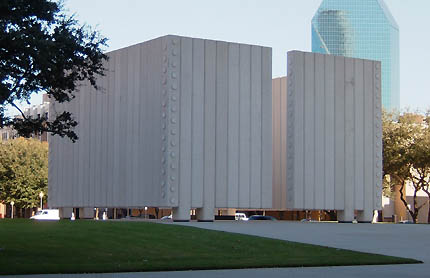
The Kennedy Memorial in Downtown Dallas

The Kennedy Memorial in Downtown Dallas

Even though it happened 22 years before I was born, I sometimes feel as if it was only yesterday that President John F. Kennedy was assassinated.

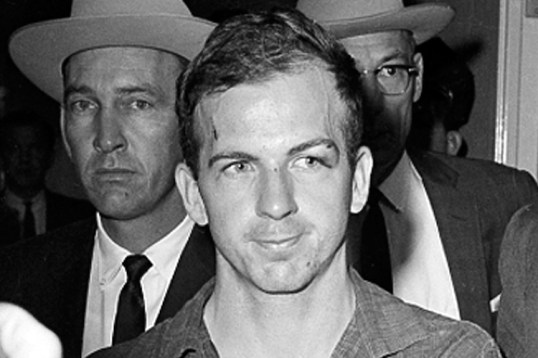
A lot of that is because I’m from Dallas.  When I was born, my family lived in Oak Cliff, a few blocks away from where the accused assassin Lee Harvey Oswald once lived.  I drive by the Kennedy Memorial several times a week.  I’ve gone to the Sixth Floor Museum.  I’ve made out on the Grassy Knoll.  On a daily basis, I see tourists who have come down here from up north with their preconceived prejudices, their unwieldy copies of Stephen King’s 11/22/63, and their overactive sweat glands.  (“How do you handle the heat!?” they ask when the temperature is barely above 90.)  With the 50th anniversary of the assassination approaching, the Dallas Morning News has been running daily stories examining every detail of that terrible event.

The rest of the nation, of course, will never let us forget that JFK was assassinated in Dallas.  Just last week, there was an idiotic and bitter opinion piece in The New York Times, written by James McAuley, in which he claimed that Dallas was a “city of hate” that should feel more guilt over the JFK assassination.  As McAuley (who is studying history at Oxford and is not a resident of that city that he apparently feels qualified to judge) put it, “For 50 years, Dallas has done its best to avoid coming to terms with the one event that made it famous: the assassination of John F. Kennedy on Nov. 22, 1963.”

This, of course, is bullshit.

There are two competing schools of thought about the assassination of John F. Kennedy.  One says that Lee Harvey Oswald was solely responsible.  The other is that Kennedy was killed as the result of a complex conspiracy.

JFK Assassination Bullets

Let’s say, for the sake of argument, that Lee Harvey Oswald acted alone.  Well, Oswald was born in New Orleans but he was raised up north in New York City.  He was also a communist with a history of mental instability.  Hence, if you accept that Oswald was the lone assassin than you also have to be willing to accept that Oswald would have tried to kill Kennedy regardless of what city he was living in.

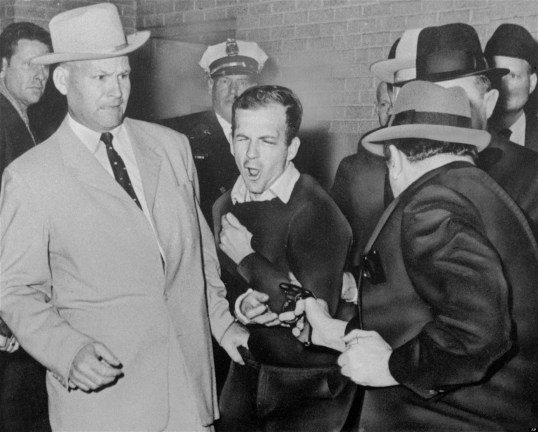
IMF Head-Perp Walk

Things get a bit more complicated if you believe that Kennedy was killed as the result of a conspiracy.  But let’s consider the usual suspects that come up whenever people start talking about the possibility of conspiracy.  The Mafia was based in the north.  The CIA was based in Washington, D.C.  The anti-Castroites were based in Miami.  Again, all of these conspirators would have killed Kennedy regardless of what city he went to in November.

It’s easy for the rest of the country, in a fit of jealousy, anger, and delusion, to blame Dallas and Texas for the assassination of John F. Kennedy but, regardless of whether you believe in the lone assassin or a larger conspiracy, the truth is far more complex.

Over the next few days, as part of the 44 Days of Paranoia, I’ll be taking a look at some of the many films that were inspired by this assassination.  Let’s start things off with one of the lesser known entries in the JFK genre, 1973’s Executive Action.

Executive Action opens with a series of grainy, black-and-white photographs of both America in the 1960s and the men who, over the course of the film, will be portrayed as having plotted and carried out the assassination of President Kennedy while a mournful piano plays in the background.  It’s a low-key but eerily effective opening and it also lets the viewers know exactly what type of film they are about to see.  As opposed to Oliver Stone’s far better known JFK, Executive Action is a low-key, almost deliberately undramatic film.   Despite the fact that there are some familiar faces in the cast (or, at the very least, familiar faces to those of us who watch TCM), Executive Action almost feels as if it could have been a documentary.

blogger-image--1805315534

As the film opens in 1963, we see a group of very rich men talking about the future of America.  Ferguson (Will Geer) and Foster (Robert Ryan) are concerned that President Kennedy’s policies are going to destroy America.  Foster is worried that Kennedy is planning on cutting back on military spending.  Ferguson is upset by Kennedy’s support of the Civil Rights movement.  (In one memorable scene, we see Martin Luther King delivering his Dream speech on TV before the camera pulls back to reveal Ferguson watching in disgust.)  Their associate, the shadowy Farrington (Burt Lancaster), argues that the only way to stop Kennedy is to assassinate him and put the blame on a lone gunman.

With the support of Ferguson and Foster, Farrington recruits a group of gunmen (led by Ed Lauter and including Roger Corman regular Dick Miller) and works to set up the perfect patsy.  A man (James MacColl) goes around Dallas, acting obnoxious and telling anyone who will listen that his name is Lee Oswald.  At Ferguson’s insistence, a picture is doctored to make it appear as if Lee Harvey Oswald is posing in his backyard with a rifle.  As all of this goes on, the date of November 22nd steadily approaches…

ex3

As I stated before, Executive Action is an almost obsessively low-key film.  That, however, works to the film’s advantage.  Ferguson, Foster, Farrington, and the other conspirators are chillingly believable because they are presented almost as being anonymous.  Instead of being portrayed as being super villains, they are instead men who approach assassination as just another part of doing business.  The impression one gets is that Kennedy isn’t the first leader they’ve had killed and he probably wasn’t the last.  Director David Miller seamlessly mixes historical footage with film reenactments and the end result is a disturbingly plausible film.

Unfortunately, Executive Action is less well-known than some of the other films that have argued that a conspiracy was responsible for the assassination for John F. Kennedy.  However, it may very well be the best.

executive-action-movie-poster-1020681901

44 Days of Paranioa #1: Clonus (dir by Robert S. Fiveson)


clone

We live in paranoid times.

When I first started at the University of North Texas, I lived in the Bruce Hall Dormitory and every day, I could count on the fact that there would be at least one fat and bearded resident in the lobby talking about how 9-11 was an inside job and how the only reason we were in Iraq was so Dick Cheney’s buddies could get rich.

By the time I graduated, everyone was convinced that the Republicans were going to steal the election from Barack Obama.  Some people, of course, were hoping that was exactly what would happen because they were convinced that Obama was actually a Muslim from Kenya.

With each passing year of the Obama administration, there’s been a new conspiracy theory.  Some people claimed that Obamacare was actually a Socialist plot.  Others said that the Koch Brothers were behind the Tea Party.  Meanwhile, Occupy Wall Street spoke ominously of how 1% of the population exploited the other 99%.  As I sit here typing this, there is undoubtedly a desperate Obama partisan somewhere who is writing up his 100th blog post claiming that the Republicans somehow sabotaged the Obamacare website.

And, of course, living and working in Dallas, I am constantly reminded of the biggest conspiracy theory of all time.  In just a few days, it will be the 50th anniversary of the assassination of John F. Kennedy and you better believe that my hometown is currently being invaded by wild-eyed men who are incapable of uttering a sentence without including terms like “grassy knoll,” “military-industrial complex,” and “coup d’etat.”

Yes, these are paranoid times.  Nobody trusts anyone.  All motives are suspect.  With each passing day, it seems that more and more people are convinced that their daily failures and fortunes can all be blamed on shadowy forces.  The world is a random place where a billion stories play out at once and not a single one of them is going to have a happy ending.  People cling to their paranoia for much the same reason that some people cling to their concept of God.  It gives them a false sense of security and reason in an otherwise chaotic universe.

As for me, I may not be a believer in conspiracies but, at the same time, I do find myself fascinated by both the theories and the films that they occasionally inspire.  If movies ultimately serve as a reflection of society’s secret fears, insecurities, and desires, can it be any surprise that so many movies seem to be just as a paranoid as the audiences that go to see them?

For that reason, I am proud to announce that today is Day One of the 44 Days of Paranoia!  For the next 44 days, we will be taking a look at some of the best and worst conspiracy-themed and paranoia-inducing films ever made.

Let’s start things off by taking a look at the 1979 sci-fi conspiracy film, Clonus (a.k.a. Parts, the Clonus Horror).

Clonus opens on a compound the looks a lot like a community college.   Living on the compound is a group of people who all appear to be extremely friendly and trusting.  Every single one of them has a permanent smile plastered across his or her fresh faces.  They spend their spare time jogging, working out, and — well, that’s about it.  At the same time, none of them smoke, drink, or do anything else that could possibly cause any damage to their bodies.

So, at this point, you can probably guess that they’re either Mormons or they’re clones.  (If you’re not sure, take another look at the film’s title…)

When the clones aren’t busy jogging, they’re talking about how much they hope that, one day, they will be allowed to go to “America.”  There’s actually something rather touching about how excited they all get whenever they hear that one of them is getting sent to America.  They’re a bit like the rubber aliens in Toy Story, putting all of their faith in “The Claw” and its ability to lift them up to a better life.  Of course, what the clones don’t realize is that “going to America” is just a euphemism for being put under sedation and having their organs forcibly removed.

Eventually, one clone (played to awkward blank-faced perfection by Tim Donnelly) starts to question just why exactly he and his friends are being kept on the compound.  He eventually escapes and discovers that not only has he been in America all along but that he only exists so that the rich and powerful can harvest his organs.  Donnelly meets an idealistic journalist (Keenan Wynn) who happens to be acquainted with the family of a sinister presidential candidate (played by Peter Graves).  When Wynn and Donnelly threaten to expose the truth, they find themselves targeted by the U.S. government which, in typical conspiracy-film style, is more than willing to kill to protect its secrets.

If the plot of Clonus sounds familiar, that’s because Michael Bay pretty much remade the film in 2005.  In fact, Clonus director Robert Fiveson felt Bay’s The Island was so similar to his film, that he filed a lawsuit for copyright infringement.  But whereas The Island was the epitome of a film that was more expensive than memorable, Clonus is an effectively creepy little film that, though dated, is still occasionally even thought-provoking.  Though it may have been the result of the film’s budgetary limitations, Clonus eschews flashy effects for atmosphere and even the blandness of some of the locations adds to the film’s sense of low-key but palpable menace.  If ever one needed proof that a low budget can occasionally be the best thing to ever happen to a film, Clonus is that proof.  The film is generally well-acted and, best of all, it all builds up to one of those wonderfully downbeat endings that appear to have been so popular in the 70s.

Much like another recent and similar film — the excellent Never Let Me Go — Clonus works because it’s disturbingly plausible.  It’s a bit of a cliché to say that a film makes science fiction feel like science fact but Clonus is one of those films that accomplishes just that.

title

Trailer: Noah


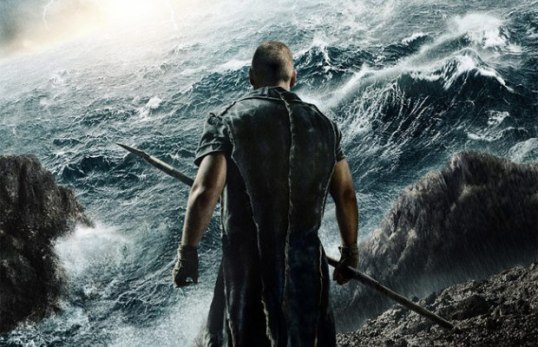
Poster-Noah-AronofskyI have mixed feelings about the upcoming film Noah.

On the one hand, it’s directed by one of my favorite directors, Darren Aronofsky.  I don’t think I need to remind anyone just how much I love Black Swan.

However, it also stars Russell Crowe.  Crowe is a good actor but he’s also  rather impressed with himself and Noah seems like the type of film that will bring out all of his worst tendencies.

But the film is directed by Darren Aronofsky.

Then again, Noah also appears to feature Anthony Hopkins playing yet another vaguely threatening mentor figure.  Hopkins is also a good actor.  I like Anthony Hopkins.  But, seriously, as soon as I heard that they were making a film about Noah, I knew Anthony Hopkins would be somehow involved.  It’s just so …. expected.

However, the film is being directed by Darren Aronofsky.

Unfortunately, the trailer that was released yesterday has a painfully generic feel to it.  Let’s put it like this — every time I saw the trailer for Black Swan, I knew that this was a movie that I had to see.  Every time I see the trailer for Noah, I find myself wondering if Michael Bay was somehow involved in producing the film.  That’s how generic it feels.

However, Noah was directed by Darren Aronofsky.

So, I’ll see it.

Trailer: Divergent


PCAS

When I first saw this trailer for the upcoming film Divergent, my immediate response was to go, “Uhmm … Hunger Games much?”  That said, it should be fun to watch Kate Winslet play a villain and Shailene Woodley is a talented and underrated actress.  It will be interesting to see if Divergent will make her a star in the same way that Hunger Games did for Jennifer Lawrence.

Defending the Counselor


The_Counselor_Poster

(Spoilers Below)

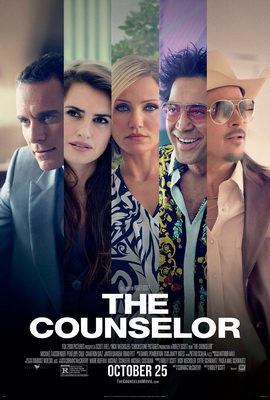
The Counselor was one of the most anticipated films of 2013.  After all, it was based on a screenplay by the Pulitzer-prize winning novelist Cormac McCarthy and it was directed by Ridley Scott.  Its cast included such stars as Michael Fassbender, Javier Bardem, and Brad Pitt.  The film’s two trailers promised a return to the thematic territory that the Coen Brothers explored in their Oscar-winning adaptation of McCarthy’s No Country For Old Men.

And yet, when The Counselor was released in October, the reviews were scathing and audience response was reportedly terrible.  Writing for Salon, film “critic” Andrew O’Hehir suggested that The Counselor was not only the worst film of 2013 but the worst film of all time.

And you know what?

For not the first time, Andrew O’Hehir was wrong.  The Counselor is not the worst film of 2013.  Instead, it’s one of the best.  It’s a film that will be studied long after more acclaimed films have been forgotten.

Why is The Counselor so hated?

It’s not an easy film to love.  In fact, the film is rather brave about alienating its audience and refusing to allow for the crowd-pleasing moments that viewers have come to expect from even the most prestigious of films.

In order to truly defend the Counselor, it’s necessary to know the plot of The Counselor.  Needless to say, everything that follows constitutes a huge spoiler so, if you’re one of those types, feel free to stop reading now.
Brad-Pitt-Michael-Fassbender-Counselor

Okay, still here?  Here’s a condensed version of what happens in The Counselor:

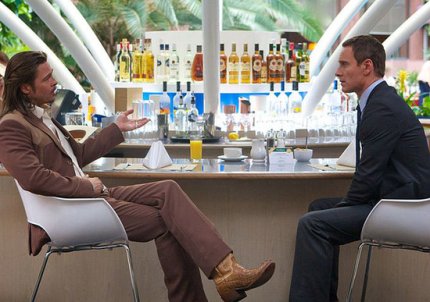
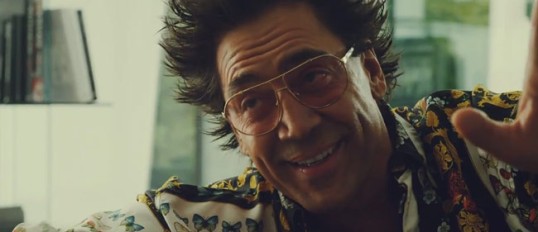
The Counselor (Michael Fassbender) is an honest lawyer in El Paso who has never broken the law and is engaged to marry the beautiful and saintly Laura (Penelope Cruz).  For reasons that are never explicitly stated (but, as I’ll explain below, are obvious to anyone who is willing to look for the clues), The Counselor agrees to help his clients Westray (Brad Pitt) and Reiner (Javier Bardem) smuggle a huge shipment of cocaine into the U.S. from Mexico.  However, Reiner’s girlfriend Malkina (Cameron Diaz) steals the drugs and frames the Counselor for the theft.  As a result, Reiner ends up getting executed by the Mexican cartel, Westray is beheaded on the streets of London, and the Counselor ends up hiding out in Juarez, Mexico, sobbing as he looks at a DVD copy of a cartel-produced snuff film that features Laura being murdered.  The end.

Yeah, it’s not exactly a happy film.  And yet, it’s a film that sticks with you, a portrait of a shadowy underworld that is fueled solely by greed, paranoia, and masculine posturing.  Ridley Scott makes good use of the South Texas landscape and the talented cast creates a memorable gallery of rouges.

And yet, The Counselor is getting some of the worst reviews of the year.  What’s especially interesting is that the things that so many critic cite as flaws are actually the film’s greatest strengths.
The Counselor

Consider the following common criticisms:

1) The film features some of the most overly articulate drug deals of all time.

This is the most frequent complaint that I’ve come across concerning The Counselor and there is some validity to it.  The Counselor is a very talky film.  The film’s first hour is pretty much made up of The Counselor having three conversations, all about the same thing and all reaching the same conclusion.  Cormac McCarthy’s dialogue is, perhaps not surprisingly, rather portentous and florid.  The Counselor does ask the audience to accept a world where even the head of Mexico’s most powerful cartel is given to going off on long philosophical digressions.  The Counselor is one of those films where nearly every line seems to have a double meaning.

That said, I think that those who attacking the film’s dialogue are missing the point.  This is not meant to be a naturalistic film.  Instead, it’s a heavily stylized B-film that uses its sordid story as a metaphor for dealing with deeper issues of greed, masculinity, and the changing mores of American culture.  Much as every line of dialogue has a deeper meaning, so does every pulpy plot twist.  It takes a while to adjust to McCarthy’s dialogue but, ultimately, that dialogue serves to remind us that the film has a lot more on its mind than just telling the story about a drug deal gone bad.  The combination of overly articulate dialogue with primitive violence and desires encourages us to look under the film’s surface.

2) The film’s plot is predictable.

This may be true but I think that’s actually McCarthy’s point.  From the start of the film, the Counselor is continually warned that things could potentially go very wrong.  Despite these warnings, the Counselor still gets involved in Reiner’s drug and, through a combination of hubris and fate, he loses everything that he loved.

The Counselor’s downfall is not meant to be a surprise.  Instead, McCarthy’s point is that the consequences of our actions are usually obvious but we, as human beings, chose to live in denial about just how little control we actually have over our own fate.

TheCounselor-Diaz-Cheetah-Tat

3) Ridley Scott’s direction is stylish but ultimately empty.

This argument goes that, while Scott manages to capture some gorgeous images of the Texas/Mexico border, those images ultimately don’t add up to much.  The idea goes back to a charge that is frequently leveled against Ridley Scott as a director, that he’s all style and technique with little substance.  (Interestingly enough, this is the same charge that is often made against the Coen Brothers.)

In the past, I’ve been critical of Ridley Scott.  (For proof, check out my reviews of Robin Hood and Gladiator.)  However, that being said, I think that, with The Counselor, Scott does a good job of visually interpreting the concepts at the heart of McCarthy’s script.  My mom was from South Texas and I’ve spent enough time down there to understand just how perfectly Ridley Scott manages to capture the combination of beauty and harshness that one finds along the border between Texas and Mexico.  In Scott’s hands, the emptiness of the Texas landscape serves as a perfect parallel for the emptiness of the lives of the majority of the film’s characters.

Speaking of which…

4) The motivations of the Counselor remain a mystery.

Why does the Counselor get involved in the drug deal in the first place?  Many of the film’s critics have complained that the Counselor’s motivations remains a mystery and therefore make it impossible for audiences to sympathize with the character.

Nothing could be further from the truth.

What these critics are failing to realize is that the Counselor’s motives are obvious every time that he appears on-screen.  The audience has to be willing to look for them.  The audience has to be willing to think and that, of course, is asking quite a bit of some viewers.
The-Counselor

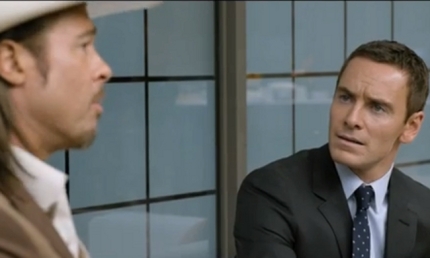
While the Counselor hints that his reason for getting involved with the drug deal is so that he can make enough money to provide a good life for Laura, his actual motivations are far more selfish.  One need only see the Counselor in his perfectly pressed suits or in his sleek but sterile home to understand exactly who the Counselor is.  He is a character who has made his living by defending those who break the law but who has never had the courage to actually flaunt the rules himself.   He is a man who lives in a self-constructed prison of ennui and associating with Reiner and Westray gives him a chance to escape from his conventional existence.   He is a character who spends his day profiting from the crimes of others but, because he can go home to his beautiful home and his beautiful fiancee, assumes that he’s somehow detached from the consequences of the actions of his associates.

The Counselor starts the film as an unemotional, blank-faced cipher, a man whose entire identity is based on his job title.  (Indeed, we never learn once learn or hear the character’s actual name.)  The only time that he shows even a hint of human depth or emotion is when he’s with Laura.  He’s a man who, in many ways, is dead on the inside.  It’s only after he gets involved with Reiner and Westray that the Counselor starts to show any signs of life until, by the end of the film, he literally cannot control his emotions.   The Counselor frees himself from his stifling and conventional existence at the cost of everything and everybody that he loves.  In his pursuit of freedom, he simply moves from one self-imposed prison to another.

5) Particularly in its portrayal of Malkina, there is a strong streak of misogyny running through the film.

This is a point that I’ve seen made by several critics and it’s one that bothers me as both a feminist and as a female who happens to love genre films.  Just because a film features a misogynistic character does that therefore make the film itself misogynistic?

The majority of those who claim that The Counselor is anti-female often point to the character of Malkina.  As played by Cameron Diaz, Malkina is a hyper sexual sociopath who manipulates and destroys everyone else in the film.  Even though he’s obsessed with her, Reiner also claims to fear her and he has several conversations with the Counselor in which he cites her as proof that women cannot be trusted.

However, just because Reiner says this, that doesn’t necessarily mean that the film agrees.  In fact, as should be obvious to anyone who is actually willing to pay attention to the film, Reiner is portrayed as being a fool who, ultimately, is just as delusional as the Counselor.  Reiner, Wainstray, and the Counselor all exist in a hyper masculine environment.  For all of their posturing and macho talk, it’s also obvious that none of them are capable of truly dealing with women.  Wainstray can only bring himself to acknowledge them as potential sexual partners while the Counselor both idealizes Laura and uses her happiness as an excuse to pursue his own criminal enterprises.  Reiner, meanwhile, is both attracted to and terrified of Malkina.
the-counselor-ferrari-diaz

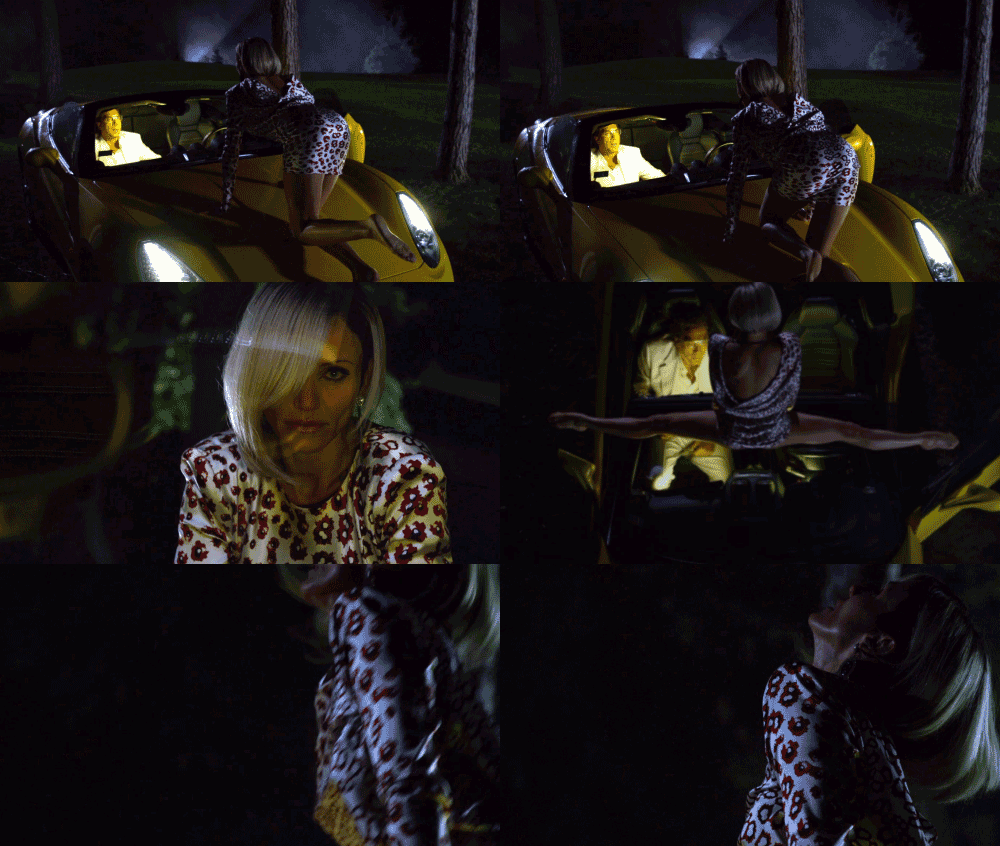
In perhaps the film’s most infamous scene, Malkina removes her panties and then grinds against the windshield of a Ferrari while Reiner watches from inside the car.  Some have argued that, with this scene, the filmmakers are equating Malkina’s sexuality with evil.  I, however, would argue that this scene shows that Malkina — alone of all the film’s major characters — understands the fact that all of the men in her life are essentially boys who are either incapable of or unwilling to grow up.  Malkina uses her sexuality not because she’s evil but because she’s intelligent enough to use every weapon at her disposal to make sure that she will be one of the few characters to survive to the movie’s conclusion.  By the end of the film, it’s obvious that Malkina is both the strongest and the most intelligent character in the film.

There’s an interesting scene towards the end of the film in which the Counselor, who is hiding out in Juarez, stumbles across a group of protesters who are holding pictures of young women who have either been killed on or vanished from the streets of Juarez.  Since 1993, over 4000 women have been murdered in Juarez.  The majority of those murders are still unsolved, with many blaming the Spanish tradition of machismo.  The feeling of many is that “good” girls stay home while “bad” girls get jobs in the city and are often  murdered as a result.  And, since the victims shouldn’t have been pursuing a life outside of domestic servitude in the first place, why waste the time trying to win them any sort of justice?  For the past decade, brave activists have put themselves in danger by daring to demand justice for the dead of Juarez.  When the Counselor stumbles across their rally, it’s a brief moment in which the real world and the cinematic landscape come together.

It’s also a scene that serves to remind us that the film’s characters are living in a hyper masculine world, one that embraces the concept of machismo without understanding or caring about the consequences of that destructive  culture.  The Counselor’s horrified reaction to the rally is the reaction of a man who has finally been forced to confront the evil of which he is now a permanent part.

6) The film’s ending is depressing.

Complaining about Cormac McCarthy writing a depressing ending is a bit like getting upset at a cat for purring.  It’s what McCarthy does and anyone with any knowledge of his work has no right to be shocked that the film ends on a note of hopelessness.  Much as with No Country For Old Men, The Counselor ends the only way that it can.  It may not be a happy ending but it is, at least, an honest ending.

The Counselor may not be an easy film to like but it’s definitely a film that deserves better than to be dismissed as the worst of 2013.
Counselor-Bardem2