The TSL Horror Grindhouse: The Beast Must Die (dir by Paul Annett)


You have 30 seconds to decide who is the werewolf.  Is it the professor?  Is it the wife of the big game hunter?  Is it the long-haired hippie who has a history of cannibalism?  Is it the concert pianist?  Is it the diplomat?  Make your guess and then….

This is the challenge that is presented to the viewers of the 1974 film, The Beast Must DieThe Beast Must Die is a werewolf film.  Calvin Lockhart stars as millionaire big game hunter Tom Newcliffe.  Tom has invited a group of people to his English mansion because, according to him, one of them is a werewolf and he plans to hunt down whoever it is.  It’s not a terrible premise and I imagine that, in 1974, it was probably quite revolutionary to cast a black actor as a millionaire with a large British estate.  (In America, the film was marketed as being a blaxploitation film under the title Black Werewolf.)

That said, The Beast Must Die is still best-known for its “Werewolf Breaks.”  At certain points in the film, a stopwatch appears on the screen and a narrator asks us if we’ve figured out who the werewolf is yet.  The viewer is given 30 seconds to make a guess before the film continues.  The “Werewolf Breaks” were apparently added to the film after production was completed and director Paul Annett was not happy about them.  The Beast Must Die is, in many ways, a pretty grim film or, at least, it would be if not for the campy narrator telling us that it’s up to us to solve the mystery.

But you know what?  I like the Werewolf Breaks.  They’re fun and, without them, The Beast Must Die would come across as being a film that takes itself way too seriously.  Calvin Lockhart, who was so good in Melinda, overacts to a tremendous degree as Tom Newcliffe and, as the film progresses, he goes from being merely eccentric to actually coming across as being rather unhinged in his attempts to discover who is the werewolf.  It’s never really clear how he settled on his suspects.  (All of them are described as being in the area of several unexplained deaths but it seems like the same could be said of probably hundreds of other people as well.)  But once he has them at the mansion, he’s determined to keep them there until he figures out which is infected with lycanthropy.  (In this film, the werewolf curse is described as basically being a virus.)

Fortunately, the suspects are played by an interesting gallery of British and American character actors.  Charles Gray plays the shady diplomat.  Malene Clark is Tom’s wife.  Michael Gambon is the pianist while Ciaran Madden plays his wife.  Tom Chadbon plays the hippie cannibal while Anton Diffring shows up as the head of security for the mansion.  Best of all, Peter Cushing plays the professor who is an expert on werewolves.  It’s always a joy to see Peter Cushing in any film.  He’s particularly good here, handling his often overwritten dialogue like the pro that he was.

The Beast Must Die is an uneven film.  The opening sequence, which features Tom testing the mansion’s security systems, seems to go on forever and the plot is full of twists that fall apart if you give them too much thought,  But the Werewolf Breaks made me smile and the supporting cast is a delight.  It’s a fun film to watch during the Halloween season.

Film Review: A Dry White Season (dir by Euzhan Palcy)


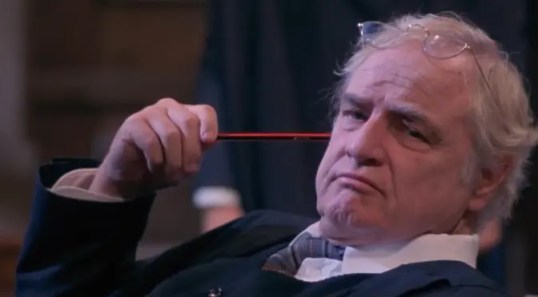
In 1990, Marlon Brando received his final Academy Award nomination when he was nominated for his supporting performance in 1989’s A Dry White Season.

Brando played Ian McKenzie, a human rights lawyer who lives and work in South Africa at the height of the Apartheid regime.  When we first see McKenzie, he’s sitting in his office and complaining about how all the flowers surrounding him have given him a permanent allergy.  When Ben Du Toit (Donald Sutherland) explains that he’s trying to learn the truth about why his gardener and his gardener’s son both died in the custody of South Africa’s “special branch,” McKenzie replies that bringing the case would be a waste of time.  McKenzie makes several dismissive comments about the case and tells Du Toit that pursing the matter would lead to Du Toit becoming a pariah himself.  Only when Du Toit says that he’ll just find another lawyer to pursue the manner does McKenzie agree to take the case.  His comments may have seemed callous but they were McKenzie’s way of testing Du Toit’s commitment to actually getting to the truth.

Up until the death of his gardener, Ben Du Toit was someone who blindly believed in the system.  A former rugby star and a teacher, Ben grew up in South Africa and is proud to call himself a “true African.”  (In one of the film’s best scenes, Ben’s driver, Stanley — played by Zakes Mokae, — informs Ben that being an African in South Africa means not being allowed to vote and having to carry identification papers everywhere with him.)  When the gardener’s son is first arrested, Ben repeatedly says, “He must have done something.”  When Ben’s gardener is arrested, Ben believes that it’s all just a terrible mistake and that he’ll be released soon.  Even after the gardener is killed, Ben initially believes the official story that the death was a suicide.  It’s only after Stanley takes Ben to the funeral home and shows him the gardener’s tortured body that Ben finally comes to realize that he was tortured to death by Captain Stolz (Jurgen Prochow).

Still, Ben is naive enough to assume that McKenzie will be able to get some sort of justice.  In court, McKenzie easily exposes the flaws in Stolz’s story.  When Stolz claims that the dead man’s injuries were the result of the man throwing himself against the bars of his cell, McKenzie mentions that the man’s back was injured and then asks if he was throwing himself backwards.  Stolz smirks and says that the man was “an animal.”  McKenzie may be a brilliant lawyer but it’s a foregone conclusion that he’s going to lose the case.  Stolz is exonerated and the expression on McKenzie’s face is one that indicate that he is not surprised at all.

It’s a small role.  Brando gets less than ten minutes of screentime but he makes perfect use of them and shows that, even in the latter half of his career, Brando could still give a good performance when he cared about the material.  Both Brando and Susan Sarandon took small roles in this anti-Apartheid drama because they believed in the message.  Sarandon’s casting is a bit distracting.  She never becomes the journalist she’s playing, instead she just seems like a movie star lending her name to a cause that she believes in.  But Brando becomes Ian McKenzie and he expertly reveals the absurd lengths to which the Apartheid government will go to excuse its actions.

The majority of the film deals with Ben Du Toit and his slow-awakening about the truth of the country that he calls home.  Upon realizing the truth about the country’s government and its actions, Du Toit declares that he can no longer go back to being who he once was and it costs him his family, his home, and ultimately his life.  Donald Sutherland does a wonderful job, portraying Du Toit’s growing understanding of what’s actually happening in South Africa.  Wisely, the film doesn’t portray Du Toit as being a saint.  It fully understands that Du Toit only started to care about Apartheid when it effected somebody that he knew and fortunately, Stanley is always there to call Du Toit out whenever he starts to forget about his own role in supporting the system that he now opposes.  It’s a powerful and heartfelt film, one that is well-known for Brando’s performance but works just as well when Brando is off-screen as well.

Lisa Marie Reviews An Oscar Nominee: The Insider (dir by Michael Mann)


In the 1999 Best Picture Nominee, The Insider, the American media takes a beating.

Al Pacino plays Lowell Bergman.  Bergman is a veteran newsman who, for several years, has been employed as a producer at 60 Minutes.  He is a strong believer in the importance of the free press and he’s proud to be associated with both 60 Minutes and CBS News.  He’s one of the few people who can manage the famously prickly correspondent, Mike Wallace (Christopher Plummer).  When we first see Bergman, he and Wallace are in the Middle East and arranging a tense interview with the head of Hezbollah.  It’s easy to see that Bergman is someone who will go anywhere and take any risk to get a story.  It’s also apparent that Bergman thinks that the people that he works with feel the same way.

That all changes when Bergman meets Jeffery Wigand (Russell Crowe), a recently fired tobacco company executive who initially agrees to serve as a consultant for one of Bergman’s story but who leaves Bergman intrigued when he reveals that, due to a strict confidentiality agreement, he’s not allowed to discuss anything about his time as an executive.  As the tobacco companies are currently being sued by ambitious state attorney generals like Mississippi’s Mike Moore (who plays himself in the film), Bergman suspects that Wigand knows something that the companies don’t want revealed.

And, of course, Bergman is right.  Wigand was fired for specifically objecting to his company’s effort to make cigarettes more addictive, something that the tobacco industry had long claimed it wasn’t doing.  Wigand’s pride was hurt when he was fired but he knows that breaking the confidentiality agreement will mean losing his severance package and also possibly losing his marriage to Liane (Diane Venora) as well.  However, Wigand is angered by the heavy-handed techniques that his former employer uses to try to intimidate him.  He suspects that he’s being followed and he can’t even work out his frustrations by hitting a few golf balls without someone watching him.  When Wigand starts to get threats and even receives a bullet in the mail, he decides to both testify in court and give an interview to Wallace and 60 Minutes.

The only problem is that CBS, after being pressured by their lawyers and facing the risk of taking a financial loss in an upcoming sell, decides not to run the interview.  Bergman is outraged and assumes that both Mike Wallace and veteran 60 Minutes producer Don Hewitt (Philip Baker Hall) will support him.  Instead, both Wallace and Hewitt side with CBS.  Left out in the cold is Jeffrey Wigand, who has sacrificed almost everything and now finds himself being attacked as merely a disgruntled employee.

Directed by Michael Mann and based on a true story, The Insider is what is usually described as being “a movie for adults.”  Instead of dealing with car chases and super villains and huge action set pieces, The Insider is a film about ethics and what happens when a major media outlet like CBS News fails to live up to those ethics.  (No one is surprised when the tobacco company tries to intimidate and silence Wigand but the film makes clear that people — or at least people in the 90s — expected and hoped for more from the American press.)  Wigand puts his trust in Bergman and 60 Minutes largely because he believed Bergman’s promise that he would be allowed to tell his story.  It’s a promise that Bergman made in good faith but, in the end, everyone from the CBS executives to the tobacco companies is more interested in protecting their own financial future than actually telling the truth.  Wigand loses his family and his comfortable lifestyle and Bergman loses his faith in the network of Edward R. Murrow.  It’s not a particularly happy film but it is a well-made and thought-provoking one.

Pacino and Crowe both give excellent performances in the two lead roles.  Pacino, because he spends most of the film outraged, has the flashier role while Crowe plays Wigand as a rather mild-mannered man who suddenly finds himself in the middle of a national news story.  (Crowe’s performance here is one of his best, precisely because it really is the opposite of what most people expect from him.)  Crowe does not play Wigand as being a crusader but instead, as an ordinary guy who at times resents being put in the position of a whistleblower.  (Director Mann does not shy away from showing how Bergman manipulates, the reluctant Wigand into finally testifying, even if Bergman’s motives were ultimately not malicious.)  That said, the strongest performance comes from Christopher Plummer, who at first seems to be playing Mike Wallace as being the epitome of the pompous television newsman but who eventually reveals the truth underneath Wallace’s sometimes fearsome exterior.

The Insider was nominated for Best Picture.  Somehow, it lost to American Beauty.

Weekly Trailer Round-Up: Beautiful Boy, Mile 22, Juliet Naked, The Equalizer 2, The House With A Clock In Its Walls, King of Thieves, Assassination Nation, Mandy


Lisa already wrote about the new trailers for The Predator and Zoe.  Here are some of the other trailers that were released last week.

First up, there’s Beautiful Boy.  Based on the memoirs of both David Sheff and his son, Nic, this movie is based on the true story of David’s struggle to understand and deal with his son’s drug addiction.  It stars Oscar nominees Steve Carell, Timothee Chalamet, and Amy Ryan.  It will be released on October 12th by Amazon Studios, who are hoping that they’ll have the same success with this film that they had with Manchester By The Sea.

And now, to quote the poet Python, for something completely different.  Mile 22 is the latest action film from star Mark Wahlberg and director Peter Berg.  Mile 22 is due to be released on August 17th.

Also due to be released on August 17th is Juliet, Naked.  This Nick Hornby adaptation is about a rock star (Ethan Hawke) and the couple (Rose Byrne and Chris O’Dowd) who are obsessed with his music.  We can expect this one to inspire many comparisons to High Fidelity.

On July 20th, Denzel Washington returns as retired CIA assassin Robert McCall in The Equalizer 2.  In the sequel, he’s investigating the death of a friend from the first film.

The House With A Clock In Its Walls is the latest fantasy film to be based on a children’s book.  It looks like a change of pace for director Eli Roth, if not star Jack Black, and is set to be released on September 21st.

Also based on a young adult novel is The Hate U Give.  Amanda Stenberg plays Starr, a young African-American woman who finds herself at the center of protest and controversy after she witnesses the fatal police shooting of her best friend.  The Hate U Give will be released on October 19th.

King of Thieves is the latest film from The Theory of Everything‘s director, James Marsh.  Michael Caine, Tom Courtenay, Jim Broadbent, Michael Gambon, and Ray Winstone are over-the-hill thieves.  (Didn’t Caine already do this in Going In Style?)  This British film does not yet have an American release date.

In Assassination Nation, the citizens of suburbia become outraged and violent when a data hack leads to all of their darkest secrets being exposed.  (This would never have happened if they had just taken part in the Annual Purge like they were supposed to.)  Assassination Nation will be released on September 21st.

Finally, in Mandy, Nicolas Cage plays a man who seeks revenge on the cultists and demons that killed the woman he loved.  Mandy will be released on September 14th.

Playing Catch-Up With Four Biopics From 2017: All Eyez On Me, Maudie, A Quiet Passion, and Victoria and Abdul


Continuing with my efforts to get caught up on the major films that I saw in 2017, here are my reviews of four biopics!  Two of them are very good.  One of them is so-so.  And the other one … well, let’s just get to it…

http://www.youtube.com/watch?v=uFttQtY_AVM

All Eyez on Me (dir by Benny Boon)

All Eyez On Me is a movie that I think a lot of people had high hopes for.  It was a biopic about Tupac Shakur, who died over 20 years ago but remains one of the most influential artists of all time.  Starring Demetrius Shipp, Jr. (who, if nothing else, bore a strong physical resemblance to Tupac), All Eyez on Me followed Shakur from his youth as the son of activist Afeni Shakur (Danai Gurira), through his early stardom, his political awakening, his time in prison, his eventual association with Suge Knight (Dominic L. Santana), and his still unsolved murder in Las Vegas.  Along the way all of the expected people pop up.  Kat Graham plays Jada Pinkett and tells Tupac that he’s wasting his talent.  Someone who looks nothing like Dr. Dre is introduced as being Dr. Dre.  Another actor wanders through a scene and says his name is Snoop Dogg.  The film last 2 hours and 20 minutes, with some scenes feeling oddly rushed while other drag on interminably.

The main reason why All Eyez On Me fails is that, unlike Straight Outta Compton, All Eyez on Me never figures out how translate Tupac’s legacy into cinematic form.  For instance, when I watched Straight Outta Compton, I probably knew less about NWA than I knew about Tupac Shakur when I watched All Eyez On Me.  But then there was that scene where NWA performed “Fuck That Police” while surrounded by the police and, at that moment, I understood why NWA deserved their own movie.  There’s no comparable scene in All Eyez On Me, which gets so bogged down in going through the usual biopic motions that it never really comes to grips with why Tupac is such an iconic figure.  Combine that with some less than stellar performances and some amazingly awkward dialogue and the end result is a film that is massively disappointing.

Maudie (dir by Aisling Walsh)

Maudie tells the story of Maud Lewis, a Canadian woman who found fame as a painter despite suffering from crippling arthritis.  Working and living in a one-room house with her husband, a fisherman named Everett (Ethan Hawke), Maud Lewis’s paintings of flowers and birds eventually became so popular that one was even purchased by then-Vice President Richard Nixon.

Maudie is a very special movie, largely because of the incredibly moving performance of Sally Hawkins in the role of Maud.  As played by Hawkins, Maud may occasionally be meek but she never surrenders her dream to create something beautiful out the often harsh circumstances of her life.  Hawkins not only captures Maud’s physical struggles but she also captures (and makes compelling) the inner strength of this remarkable artist.  Ethan Hawke also gives a remarkable performance as the gruff Everett.  When you Everett first appears, you hate him.  But, as the film progresses, Hawke starts to show hints of a sensitive soul that’d hiding underneath all of his gruffnes.  In the end, Everett is as saved by Maud’s art as is Maud.

Directed by Aisling Walsh, this is a low-key but all together remarkable and touching film.  If Sally Hawkins wasn’t already certain to get an Oscar nomination for Shape of the Water, she would definitely deserve one for Maudie.

http://www.youtube.com/watch?v=gh-XATkaRl0

A Quiet Passion (dir by Terrence Davies)

You would be totally justified in assuming that this film, a biopic of poet Emily Dickinson, would have absolutely nothing in common with The Last Jedi.  However, believe it or not, they actually do have something very much in common.  They are both films that, on Rotten Tomatoes, scored high with critics and not so high with audiences.  When last I checked, it had a 93% critical score and a 51% audience score.

Well, you know what?  Who cares?  The idea that you can judge a film’s worth based on an arbitrary number is pure evil, anyway.

Personally, I’m not surprised to hear that audiences struggled with A Quiet Passion.  It’s a very challenging film, one that is more concerned with mood than with traditional narrative.  The film is much like Dickinson herself: dark, uncompromising, sharply funny, and, on the surface, unconcerned with what people might think.  Much as how Dickinson retreated into her Amherst home, the film retreats into Dickinson’s head.  It’s not always the most pleasant place to hide out but, at the same time, it’s so alive with creativity and filled with such a sharp wit that it’s tempting never to leave.

In the role of Emily, Cynthia Nixon gave one of the best performance of the year, bringing Emily to uncompromising life.  Neither the film not Nixon ever make the mistake of sentimentalizing Dickinson.  Her pain is just as real as her genius.  Ultimately, though, both Nixon’s performance and A Quiet Passion stands as a tribute to Emily’s own quiet passion.

Much like Emily Dickinson’s poetry, A Quiet Passion will be appreciated with time.

Victoria & Abdul (dir by Stephen Frears)

If there’s ever been a film that deserves to be known as “generic Oscar bait,” it’s Victoria & Abdul.

Don’t get me wrong.  It’s not a bad movie or anything like that.  Instead, it’s a very respectable film about Queen Victoria (Judi Dench) and her servant, Abdul Karim (Ali Fazal), an Indian Muslim.  While the rest of the royal court is scandalized by Victoria’s close relationship with the foreigner, Karim teaches the Queen about the Koran and encourages her to enjoy life.  The royal court is played by the usual collection of distinguished actors who always appear in movies like this: Simon Callow, Tom Pigott-Smith, and Michael Gambon.  Victoria’s heir is played by Eddie Izzard, which should tell you all you need to know about how the future Edward VII is portrayed.

As I said, it’s not a bad movie as much as it’s just not a very interesting one.  You know that Abdul and Victoria are going to become close.  You know that the Royal Court is going to be a bunch of snobs.  You know that Victoria is going to get a chance to express anti-colonial sentiments that she must surely never actually possessed.  Indeed, whenever the film tries to make any sort of larger statement, all of the characters suddenly start talking as if they’re from 2017 as opposed to the late 1800s.

This is the second time that Judi Dench has played Victoria.  Previously, she played the Queen in a film called Mrs. Brown, which was about Victoria’s friendship with a Scottish servant.  Apparently, Victoria got along well with servants.


Celebrate National Trivia Day With The Actors Who Could Have Been James Bond!


Today is National Trivia Day so I thought why not share some trivia?  I love film trivia.  I especially love trivia about who was considered for certain films.  Hell, one of my most popular posts on the Shattered Lens dealt with all of the actors who were considered for the Godfather!

(I even came up with an alternative cast for The Godfather, even though I consider the actual film to be the best cast film in history.)

I also happen to love the James Bond films.  (Well, not so much the recent Bond films.  I’ve made my feelings on SPECTRE clear.)  As a franchise, I absolutely love them.  So, with all that in mind, here is a look at the actors who could have been Bond.  I’ve compiled this article from many sources.  And yes, you could probably just find a lot of the information on Wikipedia but then you’d miss out on my editorial commentary.

Hoagy Carmichael

Ian Fleming himself always said that his pick for Bond would have been the musician, Hoagy Carmichael.  He even made a point, in Casino Royale, of having Vesper Lynd exclaim that Bond looked like Hoagy Carmichael.  Of course, the first actor to actually play Bond was Barry Nelson in a 1954 television adaptation of Casino Royale.  Nelson is probably best remembered for playing Mr. Ullman in Stanley Kubrick’s The Shining.

Barry Nelson, the first James Bond

When Dr. No went into production in 1961, many actors were considered for the role before Sean Connery was eventually cast.  Many of them were very well-known actors and, had they been cast, Dr. No would not have been remembered as a Bond movie.  Instead, it would be remembered as a star vehicle for … well, let’s take a look at some of the better-known possibilities:

Among the famous actors who were mentioned for Bond in 1961: Cary Grant, Richard Burton, James Mason, Trevor Howard, Stanley Baker, George Baker, Jimmy Stewart, Rex Harrison, and David Niven.  (Of that list, I think Burton would have made for an interesting Bond.  If the Bond films had been made in the 1940s, Grant would have been my first choice.  Trying to imagine Jimmy Stewart as a British secret agent is … interesting.)

Once it became obvious that a star was not going to play Bond, the role was offered to Patrick McGoohan and Rod Taylor.  McGoohan had moral objections to the character.  Rod Taylor reportedly felt that the film would flop.  Steve Reeves, the American body builder who became famous for playing Hercules in Italy, was reportedly strongly considered.  At one point, director Terrence Young wanted to offer the role to Richard Johnson, who later played Dr. Menard in Lucio Fulci’s Zombi 2.

Of course, the role went to Sean Connery and made Connery a huge star.  In 1967, after Connery announced that he would no longer play the world’s most famous secret agent, there was a huge and widely publicized search for his replacement.  Some of the names that were considered are intriguing.  Others are just bizarre.

Oliver Reed

To me, perhaps the most intriguing name mentioned was that of Oliver Reed.  Reed definitely would have brought a rougher edge of the role than some of the other actors considered.  However, that’s one reason why Reed wasn’t picked.  Apparently, it was felt that he did not have the right public image to play the suave Mr. Bond.

Somewhat inevitably, Michael Caine was sought out for the role.  Caine, however, refused to consider it because he had already starred in three back-to-back spy thrillers and didn’t want to get typecast.  Caine’s former roommate, Terrence Stamp, was another possibility but wanted too much control over the future direction of the Bond films.  Future Bond Timothy Dalton was considered to be too young.  Another future Bond, Roger Moore, didn’t want to give up his television career.  Eric Braeden has the right look for Bond but was German.  Rumor has it that producer Cubby Broccoli even considered Dick Van Dyke for the role, though I find that hard to believe.  An even more surprising possibility was the nobleman Lord Lucan, who was offered a screen test in 1967 and who, ten years later, would vanish after being accused of murdering his children’s nanny.

Lord Lucan

Among the actors who auditioned before George Lazenby was cast in On Her Majesty’s Secret Service: Michael Billington, Jeremy Brett, Peter Purves, Robert Campbell, Patrick Mower, Daniel Pilon, John Richardson, Anthony Rogers, Hans De Vries, and Peter Snow.

After the mixed reception of both Lazenby’s performance and On Her Majesty’s Secret Service, Lazenby was soon out as James Bond.  Even today, there’s a lot of controversy about what led to Lazenby being dismissed from the role.  Some say Lazenby demanded too much money.  Some say that Lazenby was merely used a pawn to try to get Sean Connery to return to the role.  Regardless, Lazenby only made one film as Bond.  (Of course, On Her Majesty’s Secret Service has retroactively been recognized as being one of the best of the series.)

With Connery still claiming that he would never return to the role, the film’s producers went through the motions of looking for a new Bond.  Once again, Roger Moore and Timothy Dalton were considered.  Connery suggested that a talk show host named Simon Dee should play the role.  An actor named Roger Green auditioned.  So did Michael Gambon, though he later said he was turned down because, in his own words, he “had tits like a woman.”  Interestingly, several Americans were mentioned.  Clint Eastwood as James Bond?  Burt Reynolds?  Adam “Batman” West? The mind boggles but their names were mentioned.

John Gavin

And interestingly enough, an American was cast.  John Gavin is best known for playing Sam Loomis in Psycho but he was also, briefly, James Bond.  After Gavin accepted he role and signed a contract, Sean Connery announced that he would be willing to return to the role.  Gavin was paid off and Connery went on to star in Diamonds are Forever.

After Diamonds, Connery left the role for a second time and, once again, Bond was recast.  This time, Roger Moore would finally accept the role.  However, before Moore was cast, several other actors were considered.  Some of the regular possibilities were mentioned again: John Gavin, Simon Oates, Timothy Dalton, and Michael Billington.  Others considered included Jon Finch, Ranulph Fiennes, Peter Laughton, and Guy Peters.  Some of those names are probably as unknown to you as they are to me but it’s intriguing to think that Guy Peters may not be a well-known name but, at one time, there was a possibility that he could suddenly become one of the biggest stars in the world.

Looking over the history of the Bond franchise, it’s interesting to see the number of times that Moore tried to leave the role, just to be talked into returning.  Every time that Moore considered quitting, a new group of actors would be considered for the role of Bond.  In 1979, when Moore said he might not return after Moonraker, Timothy Dalton, Michael Jayston, Patrick Mower (who was also considered for On Her Majesty’s Secret Service), and Michael Billington were all considered as replacements.  So was Julian Glover.  Ironically, when Moore did agree to return to the role, Glover was cast as the villain in For Your Eyes Only.

David Warbeck

To me, the most intriguing actor mentioned as a replacement for Roger Moore was David Warbeck.  Warbeck was a television actor and model who subsequently had a nearly legendary film career in Italy.  Not only did he play a key role in Sergio Leone’s Duck You Sucker!, but he also starred in Lucio Fulci’s The Black Cat and The Beyond.  He also appeared in the best of Italian Apocalypse Now rip-offs, The Last Hunter.  In interviews, Warbeck claimed that he was under contract to Cubby Broccoli to step into the role in case Roger Moore ever walked off the set.  The likable and rugged Warbeck would have been an interesting Bond.

In 1983, when Moore again said he might not return to the role, Michael Billington (who actually did appear in a Bond film when he played a KGB agent killed at the start of The Spy Who Loved Me) would be once more considered as a replacement.  British TV actors Lewis Collins and Ian Ogilvy were also considered for the role.  In a repeat of what happened with John Gavin in Diamonds are Forever, American actor James Brolin was actually put under contract until Moore agreed to play the role in Octopussy.

James Brolin, in a screen test for Octopussy

After A View To A Kill, Moore left the role for the final time.  Famously, future Bond Pierce Brosnan was actually cast as his replacement until the surge of interest created by his casting led to the renewal of Remington Steele, the American television show in which Brosnan was starring.  Once the show was renewed, Brosnan could no longer work the Bond films into his schedule.

Among the other names mentioned: Sean Bean, Simon MacCorkindale, Andrew Clarke, Finlay Light, Mark Greenstreet, Neil Dickson, Christopher Lambert, Mel Gibson, and Antony Hamilton.  Sam Neill was another possibility and reportedly came very close to getting the role.  Watch any of the films that Neill made when he was younger and you can definitely see hints of Bond.

Sam Neill

In the end, Timothy Dalton finally accepted the role.  Ironically, for an actor who spent 20 years being courted for the role, Dalton turned out to be a bit of a flop as Bond.  He made two movies (both of which were considered to be disappointing when compared to the previous Bond films) and then left the role.

Looking over the contemporary reviews of Dalton as Bond, one thing that comes through clearly is that a lot of people resented him for taking a role that they felt should have gone to Pierce Brosnan.  When the Bond films resumed production with Goldeneye in 1994, Brosnan finally stepped into the role.  Reportedly, if Brosnan had turned down the role, the second choice was Sean Bean.  Much like Julian Glover, Bean may have lost out on 007 but he did end up playing the villain.

Sean Bean

Among the other actors who were reportedly considered before Brosnan accepted the role: Mark Frankel, Paul McGann, Liam Neeson, Russell Crowe, and Lambert Wilson.  Ralph Fiennes, who has been M since Skyfall, was also considered.

As opposed to his predecessors, Brosnan seemed to be very comfortable with the idea of playing Bond and never threatened to leave the role.  Looking over the Bond-related articles that were published from 1995 to 2004, I found the occasional speculation about whether Rupert Everett would be the first gay James Bond or if Sharon Stone would be the first female James Bond but I found very little speculation about Brosnan actually leaving the role.  Indeed, when Brosnan officially retired as Bond in 2004, it was less his decision and more at the prodding of the franchise’s producers, who felt that the series needed to be rejuvenated with a new (and younger) actor.  After Brosnan left, the series was rebooted and Daniel Craig played the role in Casino Royale.

In the past, I’ve made it clear that Daniel Craig is hardly my favorite Bond.  I loved Skyfall (and I consider it to the 2nd best Bond film, after From Russia With Love) but, even in that case, I felt that the film succeeded despite Craig instead of because of him.  With Casino Royale, we were supposed to be seeing a young and inexperienced Bond.  That’s never come through to me, probably because Craig looked like he was nearly 50 years old when he made Casino Royale.

Among the actors who were mentioned for the role before Craig received the role: Ralph Fiennes (again), Colin Salmon, Ewan McGregor, Henry Cavill, Rupert Friend, Julian McMahon, Alex O’Laughlin, Clive Owen, Dougray Scott, and Goran Visjnic.  Dominic West, who I think would have been great in the role, reportedly ruled himself out because he heard a rumor that Brosnan would be returning to the role.

Dominic West

Daniel Craig, of course, has been talking about leaving the role ever since he was first cast.  I think Skyfall would have been a perfect movie for him to leave on.  (It would have saved the world from SPECTRE.)  However, Craig has apparently agreed to do at least one more Bond film.  Maybe two.

When Craig does leave, who will replace him?  Idris Elba, of course, is probably the most widely discussed possibility.  James Norton has also been named as a possibility.  Others that I’ve seen mentioned: Tom Hardy, Jack Huston, Aidan Turner, Tom Hiddleston, Michael Fassbender, Jamie Bell, and Henry Cavill (again).

My personal choice?  Dominic Cooper.  He’d be an off-center Bond but I think it would still be an intriguing pick.

Dominic Cooper

Who knows what the future may hold for 007?  All I know is that I look forward to the speculation.

Happy National Trivia Day, everyone!

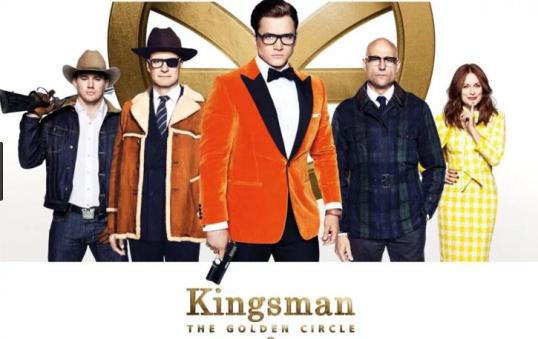
Film Review: Kingsman: The Golden Circle (dir by Matthew Vaughn)


Before I say too much about Kingsman: The Golden Circle, I do want to acknowledge a few good things about the movie.

First off, it doesn’t take long for the film to reveal that Harry (Colin Firth) didn’t actually die when Samuel L. Jackson shot him in the head in the first movie.  Undoubtedly, that diminishes the power of that scene but, at the same time, it also means that Colin Firth gets to come back.

Secondly, Taron Egerton returns as Eggsy.  The script really doesn’t give him too many opportunities to show what he’s capable of as an actor, largely because the character of Eggsy was fully developed by the end of the first movie.  Now that Eggsy is a fully trained and competent Kingsman, there’s not really much for him to do other than trade a few quips and take a few lives.  That said, Egerton is a likable actor and he’s fun to watch.

Third, Julianne Moore has a few fun scenes as the film’s main villain, Poppy Adams.  Poppy is the head of an international drug cartel.  She’s also obsessed with the 1950s and always amazingly cheerful.

Fourth, all of the Kingsmen still wear suits and Michael Caine-style glasses.  Colin Firth gets to use his umbrella as a shield.

Finally, Mark Strong is back as Merlin.

So, that’s five good things about Kingsman: The Golden Circle.  Unfortunately, all five of those things are somewhat obscured by the fact that the movie really, really sucks.

Admittedly, I had really high hopes for the movie.  I loved the first Kingsman film, which was a stylish satire that featured one of the greatest action set pieces of all time.  And I was excited to see that not only was Firth returning but Matthew Vaughn would also be directing the sequel.

But no.  This movie just doesn’t work.

Kingsman: The Golden Circle attempts to do everything on a larger scale than the first Kingsman.  That means more violence, more betrayals, and a longer running time.  This time, the movie not only features the Kingsmen but also the Statesmen, which is the American equivalent of the Kingsmen.  (The Statesmen all dress like cowboys and speak in exaggerated Southern drawls, which I got kind of sick of listening to after about three minutes.)  Along with the returning stars of the first film, Jeff Bridges, Emily Watson, Bruce Greenwood, Halle Berry, and Channing Tatum all have small roles.  Pedro Pascal (best known for playing Oberyn Martell on Game of Thrones) has a much larger role as a Statesman codenamed Whiskey.

Unfortunately, bigger is not always better.  The Golden Circle never comes close to matching the lunatic heights of the first movie.  There are a lot of action scenes but none of them match the church fight from the first film.  There’s a surprise death but it’s nowhere near as shocking or effective as Firth’s “death” in the first film.  Even the required barroom brawl falls flat.  Nowhere does The Golden Circle match the audacity of the first film.  The first film ended with exploding heads.  This film ends with the promise of more sequels.

But really, I think what really doomed The Golden Circle was that extended running time.  There’s really no good reason for The Golden Circle to last for 2 hours and 21 minutes.  Quite a bit of the film, especially during the first hour, felt padded out and, as a result, it seemed like took forever for the film’s story to actually get started.  Probably 40 minutes to an hour could have been cut from The Golden Circle without anyone missing it.

Ultimately, I think the main problem is that the first Kingsman felt like it was made by people who truly did love the material.  This film feels contractually obligated.  The Golden Circle has a lot of action but it’s just not very fun.

A Movie A Day #103: Mobsters (1991, directed by Michael Karbelnikoff)


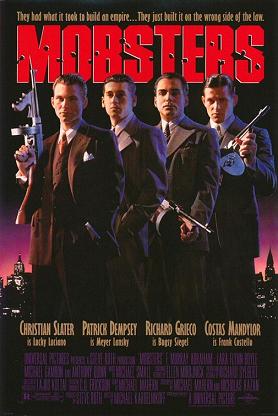
The place is New York City.  The time is the prohibition era.  The rackets are controlled by powerful but out of touch gangsters like Arnold Rothstein (F. Murray Abraham), Joe Masseria (Anthony Quinn), and Salvatore Faranzano (Michael Gambon).  However, four young gangsters — Lucky Luciano (Christian Slater), Meyer Lansky (Patrick Dempsey), Frank Costello (Costas Mandylor), and Bugsy Siegel (Richard Greico) — have an ambitious plan.  They want to form a commission that will bring together all of the Mafia families as a national force.  To do it, they will have to push aside and eliminate the old-fashioned mob bosses and take over the rackets themselves.  When Masseria and Faranzano go to war over who will be the new Boss of all Bosses, Luciano and Lansky seen their opportunity to strike.
I love a good gangster movie, which is one reason that I have never cared much for Mobsters. Mobsters was made in the wake of the success of Young Guns and, like that film, it attempted to breathe new life into an old genre by casting teen heartthrobs in the lead roles.  There was nothing inherently wrong with that because Luciano, Lansky, and Seigel were all still young men, in their 20s and early 30s, when they took over the Mafia.  (Costello was 39 but Mobsters presents him as being the same age as they other three.)  The problem was that none of the four main actors were in the least bit convincing as 1920s mobsters.  Christian Slater was the least convincing Sicilian since Alex Cord in The Brotherhood.  As for the supporting cast, actors like Chris Penn and F. Murray Abraham did the best that they could with the material but Anthony Quinn’s performance in Mobsters was the worst of his long and distinguished career.

Fans of Twin Peaks will note that Lara Flynn Boyle had a small role in Mobsters.  She played Luciano’s girlfriend.  Unfortunately, other than looking pretty and dying tragically, she was not given much to do in this disappointing gangster film.

Guilty Pleasure No. 31: Hail, Caesar! (dir by the Coen Brothers)


Sometimes, I wonder if I was the only filmgoer who actually enjoyed Hail, Caesar! when it was released in February.

Oh, don’t met wrong.  I know that I’m being a bit overdramatic when I say that.  It got some good reviews from the critics, though the praise was rather muted when compared to the reviews that traditionally greet the latest film from the Coen Brothers.  I know more than a few people who have agreed with me that Hail, Caesar! was an entertaining lark of a film.

But I know a lot more people who absolutely hated Hail, Caesar!  Of course, no film is going to please everyone and the Coen Brothers have always had a tendency to attempt to deliberately alienate their audience.  But what has always struck me is the fact that the people who disliked Hail, Caesar seem to really, really dislike it.  Talk to them and you get the feeling that they view Hail, Caesar as almost being some sort of a crime against both humanity and cinema.

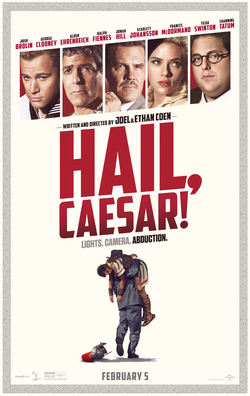
Taking place in a stylized Hollywood in 1951, Hail, Caesar! tells the story of Eddie Mannix (Josh Brolin).  Eddie is a shadowy figure.  As head of production at Capitol Pictures, Eddie’s job is to keep the “bad” behavior of the stars from getting out into the press.  (The press is represented by Tilda Swinton who, in a typical Coen Brothers twist, plays twin sisters who are rival gossip columnists.  If the thought of that makes you smile, you are potentially a part of the right audience for Hail Caesar.  If it makes you roll your eyes, you should probably avoid the film.)  Eddie is the most powerful man in Hollywood and he will do anything to protect the image of the American film industry.  He will lie.  He will cheat.  He will threaten.  He is so ruthless and so good at his job that even Lockheed Martin is trying to hire him away from Capitol.  And yet, at the same time, Eddie is also a family man and a Catholic who is so devout that he goes to confession on a nearly hourly basis.

(For all you non-Catholics out there, Pope Francis only goes to confession twice a month.)

Hail, Caesar! follows Eddie as he deals with a series of potential problems.  Temperamental director Laurence Laurentz (Ralph Fiennes) is upset because he’s been forced to cast Hobie Doyle (Alden Ehrenreich, giving the film’s best performance), a good-natured but inarticulate cowboy star, in his sophisticated comedy.  Synchronized swimmer DeeAnna Moran (Scarlett Johansoon) is not only pregnant but unmarried as well!  (It’s the 50s, remember.)

However, the biggest crisis is that Baird Whitlock (George Clooney) has vanished from the set of his latest film. A mysterious group known as The Future has taken credit for kidnapping him.  It’s not really much of a spoiler to reveal that The Future is a cell of communist scriptwriters and they are determined to convert the rather dumb Baird to the struggle.  As opposed to most films about Hollywood in the 50s, the communist screenwriters are portrayed as being a bunch of self-righteous and rather cowardly nags, the majority of whom spend more time debating minutiae than actually trying to the overthrow capitalism.  In many ways, Hail, Caesar is the anti-Trumbo.

As you might guess from the plot description, there’s a lot going on in Hail, Caesar but none of it really adds up too much.  Nor is it supposed to.  We’re encouraged to laugh at these frantic characters, as opposed to sympathize with them.  Eddie Mannix and Hobie Doyle both emerge as heroes because they’re the only characters who remain calm and confident, regardless of what strangeness is happening onscreen.  Eddie may be ruthless, the film tells us, but at least he gets results.  Hobie may not be the smartest or most talented guy in Hollywood, we are told, but at least he doesn’t pretend to be anything other than who he is.

Hail, Caesar! is a bit of a lark, a celebration of style over substance.  As far as Coen Brother films go, Hail, Caesar has more in common with Burn After Reading than No Country For Old Men.  The film is largely an inside joke aimed at people who know the history of Hollywood, which is perhaps why some viewers reacted so negatively.  Inside jokes are fun when you’re in on the joke.  When you’re not in on it, though, they’re just annoying.

As for me, I thoroughly enjoyed Hail, Caesar!  It may not be the Coens at their best but it’s a lot of fun and it appealed me as both a history nerd and a lover of old movies.  The best parts of Hail, Caesar! are the scenes that parody the largely forgotten, big-budget studio productions of the 1950s.  This is the rare film that acknowledges that not every film made before the 1960s was a masterpiece.  The Coens love movies but that doesn’t keep them from getting a little bit snarky.  For example, check out this production number featuring Channing Tatum:

Is Hail, Caesar self-indulgent?

Yes.

Is it largely an inside joke?

Yes.

Did I absolutely adore it?

You better believe I did.

Hail,_Caesar!_Teaser_poster

Previous Guilty Pleasures

  1. Half-Baked
  2. Save The Last Dance
  3. Every Rose Has Its Thorns
  4. The Jeremy Kyle Show
  5. Invasion USA
  6. The Golden Child
  7. Final Destination 2
  8. Paparazzi
  9. The Principal
  10. The Substitute
  11. Terror In The Family
  12. Pandorum
  13. Lambada
  14. Fear
  15. Cocktail
  16. Keep Off The Grass
  17. Girls, Girls, Girls
  18. Class
  19. Tart
  20. King Kong vs. Godzilla
  21. Hawk the Slayer
  22. Battle Beyond the Stars
  23. Meridian
  24. Walk of Shame
  25. From Justin To Kelly
  26. Project Greenlight
  27. Sex Decoy: Love Stings
  28. Swimfan
  29. On the Line
  30. Wolfen

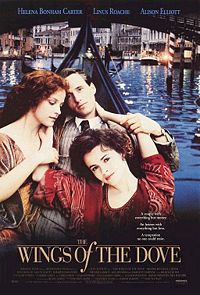
Embracing the Melodrama Part II #94: The Wings of the Dove (dir by Ian Softley)


Wings_of_the_dove_ver1For nearly two months now, I’ve been in the process of reviewing 126 cinematic melodramas.  (I know that I originally said that I would be reviewing 126 films in 3 weeks but, even at the time I said that, I think a part of me knew that it would probably be more like 8 or 9 weeks.)  And, while it seems like forever since I started this series by reviewing the 1927 silent classic Sunrise, I’ve still been having fun discovering and rewatching some wonderful films.  It’s been a lot of work but if I’ve inspired anyone to see any of the 93 films that I’ve reviewed so far, then it’s all been worth it.

For our 94th entry, let’s take a quick look at the 1997 film The Wings of the Dove.

Based on a novel by Henry James, The Wings of the Dove open in London.  The year is 1910 and Kate Croy (Helena Bonham Carter) has problems.  Her mother has recently died and her father (Michael Gamon) is a penniless opium addict.  Kate is taken in and supported by her wealthy Aunt Maude (Charlotte Rampling).  Maude has plans for Kate to marry the vapid Lord Mark (Alex Jennings) and demands that Kate have no contact with either her father or any of her old friends.

Among those that Kate is supposed to abandon is a journalist named Merton Densher (Linus Roache).  Kate and Merton are in love but there’s no way that Maude would ever allow them to get married.  Merton is not only poor but he’s a bit of a radical as well.

While visiting with Lord Mark, Kate meets an American heiress named Milly (Alison Elliott).  As open and kind as Kate is cynical and manipulate, Milly is touring Europe.  Milly and Kate quickly become friends and Milly goes as far as to invite Kate to go to Venice with her.  It’s also through her friendship with Kate that Milly first meets Merton.  Attracted to him and unaware of her relationship with Kate, Milly invites him to come to Venice as well.

Kate, meanwhile, has discovered that Milly is terminally ill.  She comes up with a scheme, in which Merton will romance Milly.  Kate is convinced that Milly will then change her will to include Merton.  Once Milly dies, Merton will be rich and then Maude will have no reason to object to him marrying Kate.

At first, Merton is repulsed by the scheme but he finally agrees, specifically so that he can go to Venice with Kate.  However, once they’re all actually in Venice, things start to get complicated.  Merton starts to fall in love with Milly and Kate discovers that she loves Merton more than she originally realized…

The Wing of the Dove is an effective literary adaptation, one that brings a contemporary spin to the material while still remaining truthful to the spirit of the source material.  The costumes and the sets are beautiful to look at and Venice is as wonderfully romantic and cinematic as always.  Linus Roache is a bit of a stiff as Merton (but then again, the same could be said for the character himself) but it doesn’t matter because the film is dominated by Helena Bonham Carter’s ferocious performance in the role of Kate.  She plays Kate as a bundle of nervous energy and barely repressed carnality, an Edwardian femme fatale.  She was rightfully nominated for best actress for her performance in this film.  The award, however, went to Helen Hunt for As Good As It Gets.

(This, along with the complete snubbing of Boogie Nights, would seem to suggest that 1997 was not a banner year as far as the Academy Awards were concerned…)

The Wings of the Dove is currently available to be viewed on Netflix.  Don’t miss it.