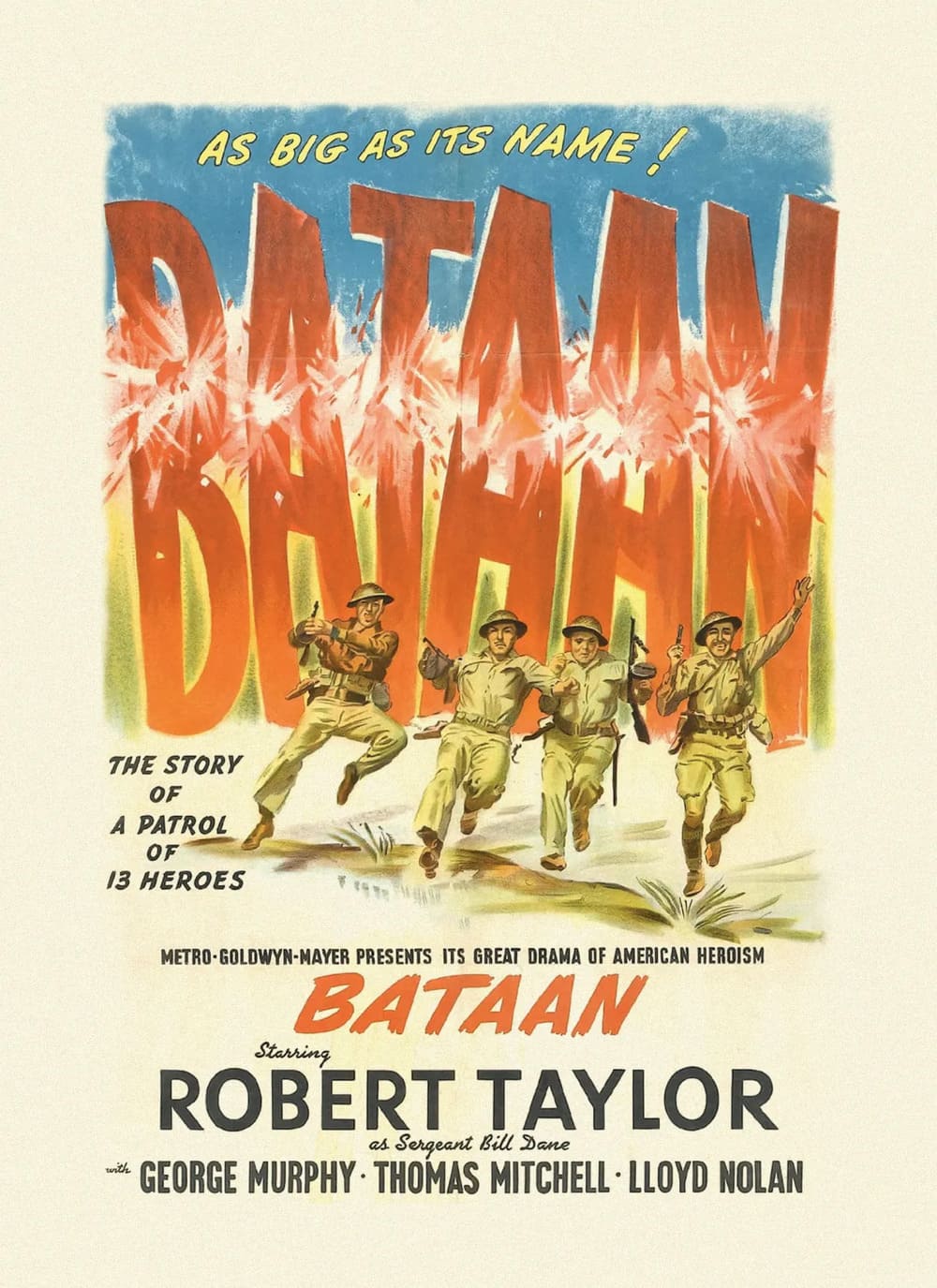
“We’re still here! We’ll always be here!” — Sergeant Bill Dane
The most effective thing about Tay Garnett’s Bataan (1943) is that it makes a small patch of ground feel like the entire world. There’s a bridge to keep destroyed, an enemy moving closer, and a group of men running out of ways to stay alive. That’s pretty much the movie, but Garnett gets plenty out of those ingredients. Rather than building excitement around where the soldiers will go next, he makes their inability to go anywhere the central problem. It’s a war film driven by waiting, and its best moments make that waiting feel almost unbearable.
Set during the American retreat in the Philippines, the story follows thirteen men assigned to demolish a bridge and stop Japanese forces from rebuilding it. Their mission is a delaying action, which immediately gives the usual military objective a troubling wrinkle. Completing the job doesn’t mean they’ll be rescued or even improve their own chances. It simply means somebody else might gain a little time. The film keeps bringing that uncomfortable bargain into focus. Every hour the men hold their position has value, but they’re the ones who have to pay for it.
Robert Taylor anchors the film as Sergeant Bill Dane, and his performance fits that emphasis on carrying on without much encouragement. Dane isn’t an especially complicated character on paper, but Taylor gives his toughness an increasingly strained quality. He looks like a man who understands that letting his exhaustion show could become everybody else’s problem. What works isn’t just his ability to bark orders or look determined. It’s the impression that maintaining authority takes effort. As the situation deteriorates, his leadership becomes less about having answers than about keeping the absence of answers from breaking the group.
Around him, the supporting players supply the personality that the narrow setting needs. Lloyd Nolan’s abrasive presence keeps the group from becoming too comfortably united, while Thomas Mitchell, Robert Walker, and Desi Arnaz help give the unit some variety. Not everybody gets enough material to become a fully rounded person, though. There are stretches when the characters feel assembled according to a familiar wartime formula, with individual traits standing in for deeper characterization. Still, those quick sketches have a practical purpose. Once the fighting starts reducing the group, we recognize who’s missing, and the position feels emptier in more than a numerical sense.
Garnett makes particularly good use of the jungle, even when it’s obviously a studio creation. The artificiality can be distracting if you’re looking for convincing outdoor realism, but it also gives the film a strangely enclosed atmosphere. Trees, shadows, and fog seem to mark the edges of a world the soldiers can’t escape. There’s no reassuring sense of geography, no broad view that lets us organize the danger. Instead, the surrounding space stays uncertain. The enemy might be approaching, watching, or already closer than anyone realizes. The setting keeps turning the simple act of looking into the distance into a source of tension.
That uncertainty matters because Bataan isn’t consistently fast-paced. At roughly 114 minutes, it gives plenty of room to stretches between attacks, and some of the dialogue feels more functional than revealing. A little tightening wouldn’t hurt. Even so, the slower passages aren’t merely obstacles between the exciting bits. They establish a rhythm of temporary relief followed by renewed dread. Exhaustion and malaria further undermine the idea that survival depends only on fighting well. These men can do what they’re supposed to do and still find their bodies failing them. The longer they remain in place, the less control they seem to have.
When violence does break out, its closeness makes it unpleasant rather than exhilarating. Bayonet fighting and sudden encounters strip away the comfortable distance that can make screen combat resemble a tactical exercise. The men aren’t moving neatly toward victory; they’re trying to get through the next confrontation with whatever strength remains. That’s also where the ensemble becomes important. The film’s racially mixed group, including a Black serviceman presented as a capable participant, gives its vision of collective effort some substance. Cooperation isn’t just a sentiment expressed in speeches. It’s something the assignment requires, regardless of the differences between the men carrying it out.
The limits of that vision are hard to miss, however. The Japanese largely exist as an anonymous threat, denied the individuality the film grants its American characters. That reflects its function as wartime propaganda, but it also narrows the drama. We’re encouraged to understand one group’s fear while treating the other primarily as its cause. The patriotic emphasis can become similarly blunt, especially when the movie pushes its message instead of trusting the situation to speak for itself. Still, its most persuasive passages don’t need much explanation. A depleted group, an exposed position, and another attack already tell us what endurance costs.
What stays with me about Bataan isn’t the promise that sacrifice will make everything worthwhile. It’s the uncomfortable distance between doing a necessary job and ever knowing what that job accomplished. The men can defend their position, follow orders, and support one another, but they can’t see the larger outcome their suffering is supposed to serve. That uncertainty gives the film weight beyond its rallying message. For all its familiar types and forceful patriotism, it understands something bleak about military duty: sometimes the task is clear, the price is enormous, and the people paying it never get to see the result.

