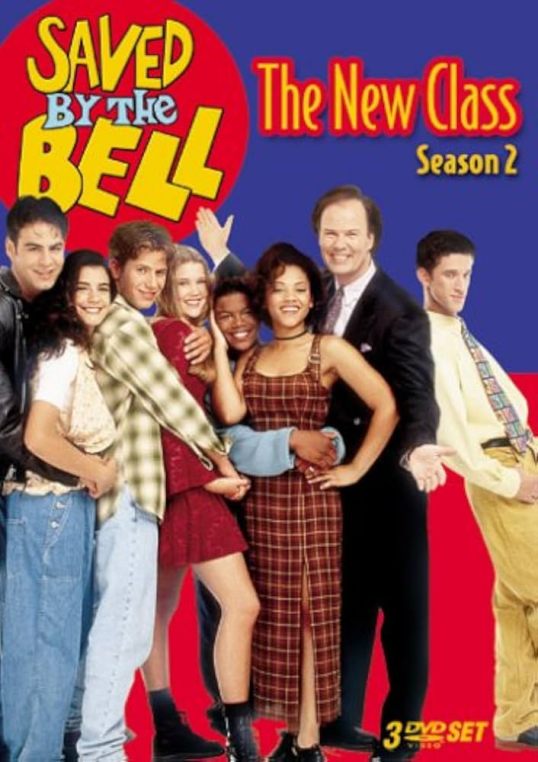
Welcome to Retro Television Reviews, a feature where we review some of our favorite and least favorite shows of the past! On Tuesdays, I will be reviewing Saved By The Bell: The New Class, which ran on NBC from 1993 to 2o00. The show is currently on Prime.
This week, it’s a 4th of July episode that aired in September.
Episode 2.6 “Brian’s Girlfriend”
(Dir by Don Barnhart, originally aired on September 24th, 1994)
Oh Hell, it’s another country club episode.
The country club is having a tip competition for the 4th of July. Whoever gets the most tips will have their earnings matched by the club. Megan wants to win so she can send her parents on a cruise. (How did Bayside go from being a school full of wealthy trust fund brats to one full of poor people?) Bobby decides to give her all of his tips so she can win. That sounds like cheating to me.
Meanwhile, due to Screech’s stupidity, Mr. Belding ends up with a terrible sunburn. (Screech was supposed to bring the sunscreen but he brought salad dressing instead.) This leads to countless scenes of Screech slapping Belding on the back and causing him agonizing pain. Ha ha, I guess.
Meanwhile, Brian makes Rachel jealous by pretending to like the new tennis instructor (Brittney Powell). She likes him too, even though he’s like 16. When a guilt-stricken Brian finally admits that he was only pretending to like her, the tennis instructor says, “You’re a jerk!” and she’s right. But I guess it doesn’t matter because Brian’s plan works and he and Rachel end up sharing a kiss while watching the 4th of July fireworks.
What type of show airs their 4th of July episode in September?
The country club episodes are so annoying. If I wanted to watch people work, I could just go hang out at Target for 30 minutes.
4 Shots From 4 Films is just what it says it is, 4 shots from 4 of our favorite films. As opposed to the reviews and recaps that we usually post, 4 Shots From 4 Films lets the visuals do the talking!
Today, we pay tribute to the legendary cinematographer, Vilmos Zsigmond. Born 91 years ago today in Hungary, Zsigmond got his start in the 60s with low-budget films like The Sadist but he went on to become one of the most in-demand cinematographers around. In fact, of all the people who started their career working on a film that starred Arch Hall, Jr., it’s hard to think of any who went on to have the type of success that Zsigmond did.
Zsigmond won one Oscar, for his work on Close Encounters of Third Kind. He was nominated for three more. He also received a BAFTA award for his work on The Deer Hunter and was nominated for an Emmy for his work on Stalin. He’s considered to be one of the most influential cinematographers of all time.
In honor of the legacy of Vilmos Zsigmond, here are….
4 Shots From 4 Films
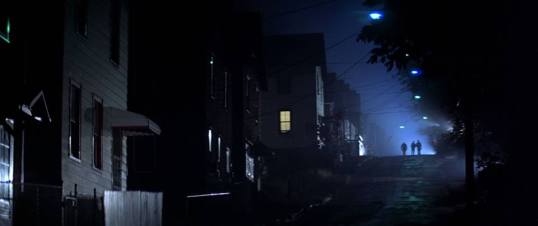
Deliverance (1972, dir by John Boorman, DP: Vilmos Zsigmond)
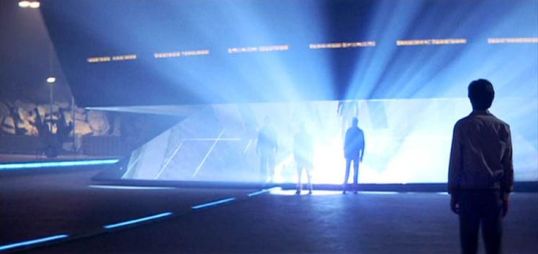
Close Encounters of the Third Kind (1977, dir by Steven Spielberg, DP: Vilmos Zsigmond)
The Deer Hunter (1978, dir by Michael Cimino, DP: Vilmos Zsigmond)
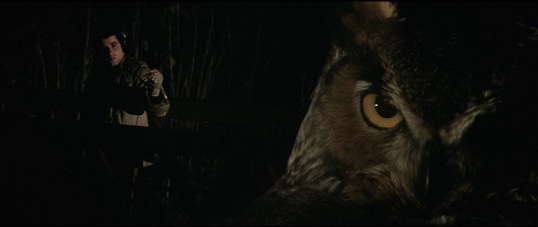
Blow Out (1981, dir by Brian De Palma, DP: Vilmos Zsigmond)
Welcome to Late Night Retro Television Reviews, a feature where we review some of our favorite and least favorite shows of the past! On Mondays, I will be reviewing CHiPs, which ran on NBC from 1977 to 1983. The entire show is currently streaming on Prime!
This week, there’s an interesting crime spree but nothing is more important than Ponch’s feelings.
Episode 5.23 “Trained For Trouble”
(Dir by Barry Crane, originally aired on April 4th, 1982)
Animals have been trained to steal money! A hawk swoops down and steals a bag of cash from an armored car. Chimpanzees rob a bank! It’s madness and the Highway Patrol has its work cut out for them as they attempt to catch whoever has trained these criminal animals. (The minute that one sees Don Stroud’s name in the guest star list, it’s pretty easy to guess who is responsible.)
That may sound like a cute idea for a show and, to be honest, it is. However, this episode is somehow less concerned with the animals robbing banks than it is with every woman in Los Angeles mistaking Ponch for a Chippendale’s dancer. It turns out that one of the male strippers — “Officer Richard” — looks like just like Ponch. Richard is credited as being played by “Angelo Bernardi.” Seeing as how Bernardi has no other credits on the imdb other than this episode, I’m not convinced that wasn’t Erik Estrada stripping off his uniform.
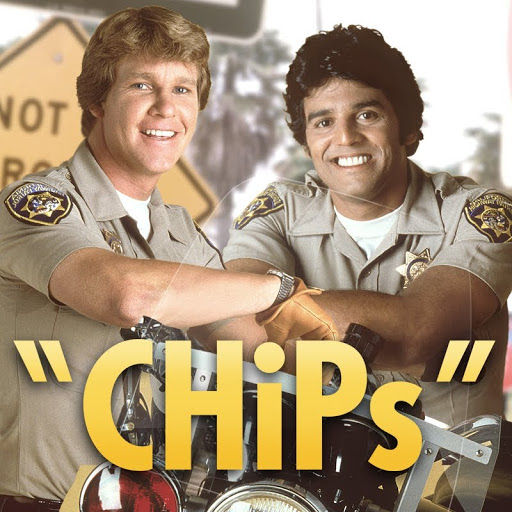
Consider this to be your weekly reminder that, during the fifth seasos, CHiPs was….
From what I’ve read, Larry Wilcox left this show after the fifth season specifically because he felt Erik Estrada was getting all of the good storylines and had basically become the producer’s pet. Watching this episode, you can see why he would be upset. While Estrada spends the episode being chased by every woman in Los Angeles, Wilcox gets a handful of forgettable lines.
On a positive note, this episode did feature the character actor Dan Hedaya, playing someone who chronically confesses to unsolved crimes. His character was, at least, a little interesting. He also got more lines than Larry Wilcox in this episode which, again, perhaps explains why Jon Baker returned to Wyoming after the fifth season.
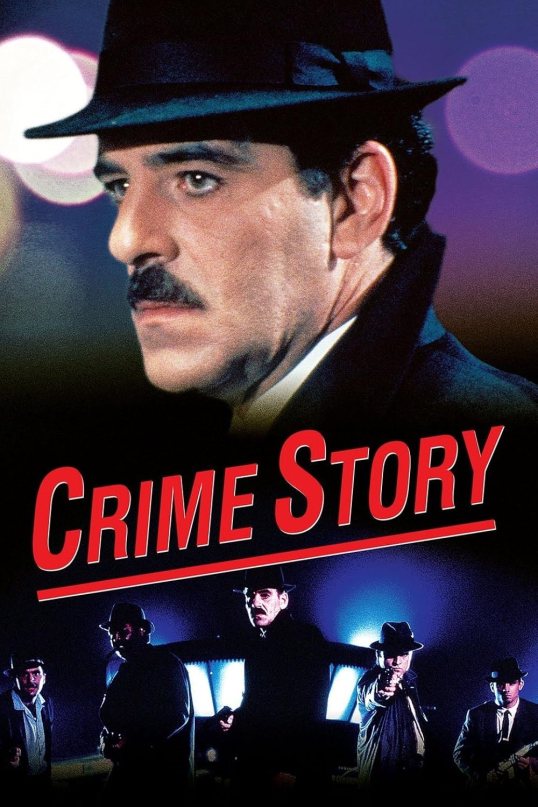
Welcome to Retro Television Reviews, a feature where we review some of our favorite and least favorite shows of the past! On Mondays, I will be reviewing Crime Story, which ran on NBC from 1986 to 1988. The entire show can be found on Tubi!
This week, the Torello marriage falls apart.
Episode 1.7 “Pursuit of a Wanted Felon”
(Dir by Aaron Lipstadt, originally aired on October 28th, 1986)
Last week, a recently acquitted man named Hector (Ving Rhames) was arrested after murdering his landlord. Torello, Danny, and David Abrams were all upset.
This week, they’ve all moved on. Sorry, Ving Rhames, you were only a one-episode guest star.
David is pursuing his relationship with Suzanne Terry (Pam Grier). At a cocktail party, Detective Walter Clemmons (Paul Butler), the black member of the Crime Squad, approaches Suzanne and warns her that she shouldn’t be pursuing a relationship with “that white boy.” Seriously, this is the first time that Walter’s gotten any real dialogue since the show began and it’s basically to tell Suzanne not to pursue an interracial relationship. “We’re only seven years out from integration,” Clemmons says, an awkward piece of dialogue that is meant to remind viewers that this show takes place in 1963. The show actually deserves some credit for being realistic about how many people would have viewed David and Suzanne’s budding romance in 1963. I just find it interesting that the show’s only regular black character is the one who is shown objecting while all of the white Chicago cops don’t have a problem with it. Who knew the Chicago police force was so progressive in the early 60s?
(I really want to like Stephen Lang’s performance as David but something feels off about it. It’s not a bad performance. I stand by my earlier praise. It’s just that David is such a caricature of an early 60s liberal that it is sometimes hard for me to tell if his character is supposed to be satirical or not. In episodes like this, where David is portrayed as being a cool hipster, Lang can seem a bit stiff and miscast. He’s much better when he’s giving an emotional speech in court.)
Luca continues to prove himself indispensable to Manny Weisbrod. In this episode, he blows up a union leader who doesn’t want to take orders from the mob.
Finally, Mike and Julia Torello split up in this episode. It’s not really a shock. Mike Torello is extremely intense and obsessed with his job. He’s tightly wound, to the point where he seems like he might just randomly shoot someone at any given moment. An attempt to take a relaxing vacation with Julie is a disaster. (The motel is tacky. The service is mediocre. Mike spends the entire time threatening the staff and complaining.) As soon as Torello returns to Chicago, he hops on a plane for Cleveland in an unsuccessful attempt to capture Frank Holman. When Torello returns home, he finds that Julie is preparing to go out with another man.
“You are not going to watch my TV,” Torello says, before grabbing the TV and leaving the apartment with it.
Does that scene sounds familiar? That’s probably because Michael Mann later reused the scene, almost word-for-word, in Heat. It’s a good scene. It’s certainly the most memorable moment in this episode.
Otherwise, this episode felt a bit bland. Torello’s doomed marriage isn’t really that interesting and I actually kind of got annoyed with David and Suzanne going to a cocktail party when they really should have been trying to get Hector out of prison. I laughed at Torello’s irritation at the hotel and his line about the TV. Those were the highlights. The rest of this installment was forgettable.
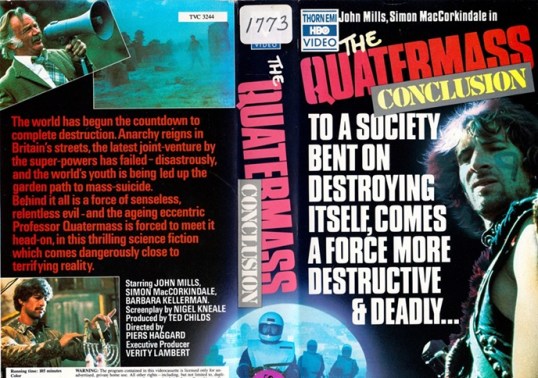
1979’s The Quatermass Conclusion opens with a narrator telling us that civilization is collapsing and no one knows why.
Though the film takes place in London and the English countryside, we are told that societal collapse a worldwide phenomenon. What we see in London is a city that has been taken over by criminal gangs, where the police stand-by helplessly and watch as battles play out. The elderly, abandoned by their government, hide out in decrepit homes and try to avoid being noticed. The future is a world that is pretty much ruled by the young and the young appear to be insane.
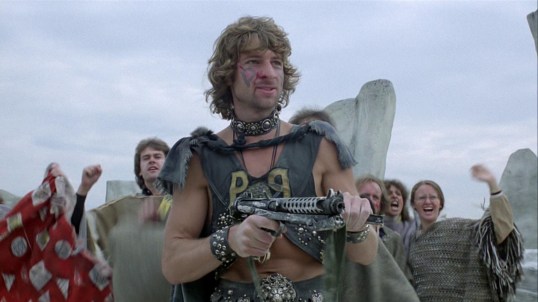
Even if one escapes the gangs, there’s still the Planet People to deal with. The Planet People are a group of hippies, who walk across the countryside and who claim that they are going to be transported to another planet. At first glance, they make seem innocent and even a bit ludicrous. But they are actually aggressive and angry, convinced that the adults have destroyed the Earth and that the young are the chosen ones who will be transported to a better world. They are led by a man who calls himself Kick Along (Ralph Arliss), an anti-Semite who smiles when he manages to find a gun and who clearly relishes getting to decide who deserves to be saved and who doesn’t.
Into all of this comes a retired scientist named Bernard Quatermass (John Mills). Elderly and suffering from heart disease, Quatermass has come to London to search for his missing granddaughter. Because Quatermass has spent the last few years living in the Scottish highlands and because the British government has covered-up the extent of the unrest, he is shocked to discover just how bad things have become. Rescued from a gang by another scientist, an astronomer named Joe Kapp (Simon MacCorkindale), Quatermass finds himself watching as humanity slowly sacrifices itself to an alien presence who is not interested in saving anyone but who instead just wants to feast.
The Quatermass Conclusion started life as a 4-episode British television simply called Quatermass, which was the last to feature the character of Prof. Bernard Quatermass. The four-hour miniseries was edited down to a 100-minute feature film that was subsequently released outside of the UK. As a result of the editing, The Quatermass Conclusion is a occasionally intriguing, frequently messy, and almost relentlessly downbeat. Having seen both the original miniseries and the subsequent film, I can tell you that tragedies that were evenly spaced out over the course of four hours come at you nonstop in the feature version. It seems like every other scene features someone either dying or giving up hope. Themes that were fully developed in the miniseries are only hinted at in the feature film. Events that were fully explained and built-up in the miniseries seem to spring out of nowhere in the movie, giving the whole thing a disjointed but nightmarish feel.
Taken on its own, the film has its flaws. I’m not really sure that the plot can truly be followed if you haven’t already watched the original miniseries. As the unfortunately-named Kick Along, Ralph Arliss gives a disturbingly plausible portrayal of a fascist who has adapted to the latest trend and John Mills is instantly sympathetic as the mentally strong but physically weak Prof. Quatermass but some of the other performances are definitely more appropriate for television than a film. And yet the film has moments that work incredibly well. A scene where the alien presence feasts on the thousands who have gathered at Wembley Stadium is undeniably well-done and brings to mind the real-life reports of political dissidents being held and executed in South American soccer stadiums. By the end of the film, the atmosphere has become so polluted with the particles of human remains that it takes on a sickly yellow hue. Even the film relentlessly bleak tone works. If you’re going to make a movie about the collapse of civilization, you should definitely go all out. There’s not much deliberate humor in The Quatermass Conclusion but, then again, there’s not much to smile about when the world’s collapsing.
Watching The Quatermass Conclusion, what struck me is just how much writer Nigel Kneale and Piers Haggard got right about the future. On the one hand, the film is anti-youth to the point of almost feeling like a parody. This is a movie that often seems to be shouting, “Get off my lawn!” Watching this, one can easily guess how Nigel Kneale felt about everyone from the hippies to the punks. However, the film’s portrayal of cities where people are scared to go out at night and of bureaucrats who would rather cover-up a problem than solve it feels rather prophetic today. (In the miniseries, there’s a youthful government official who is overjoyed at the idea of creating an entirely new civilization after destroying the current one and it’s hard to watch him without being reminded of some of the rhetoric of the COVID lockdowns.) It’s easy to laugh at the Planet People, with their face paint and their chanting, but they really don’t feel that far off from a lot of today’s wannabe activists. There’s really not that much difference between the smugly ignorant Kick Along and the people who used to throw paint on works of art.
The Quatermass Conclusion is a flawed, messy, intriguing, and prophetic. It may not be subtle but it’s a film that feel very relevant today.
Hi, everyone! Tonight, on twitter, I will be hosting one of my favorite films for #MondayMania! Join us for 2019’s Seduced By A Killer (a.k.a. Dating To Kill)!
You can find the movie on Prime and then you can join us on twitter at 9 pm central time! (That’s 10 pm for you folks on the East Coast.) See you then!
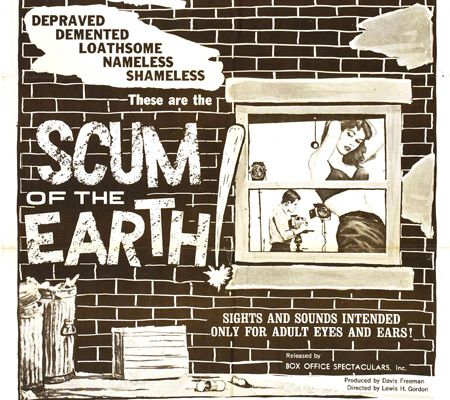
Here is a scene that should be familiar to anyone who has ever watched anything from Something Weird, the infamous “you’re damaged goods and this is a fire sale!” monologue from Herschell Gordon Lewis’s 1963 expose of the Hollywood smut trade, Scum of the Earth.
4 Shots From 4 Films is just what it says it is, 4 shots from 4 of our favorite films. As opposed to the reviews and recaps that we usually post, 4 Shots From 4 Films is all about letting the visuals do the talking.
Today, on what would have been his birthday, the Shattered Lens remembers director Herschell Gordon Lewis. It’s time for…..
4 Shots From 4 Herschell Gordon Lewis Films
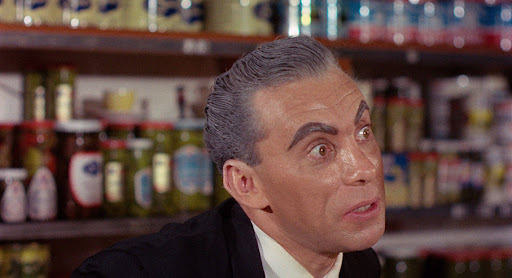
Blood Feast (1963, dir by Herschell Gordon Lewis, DP: Herschell Gordon Lewis)
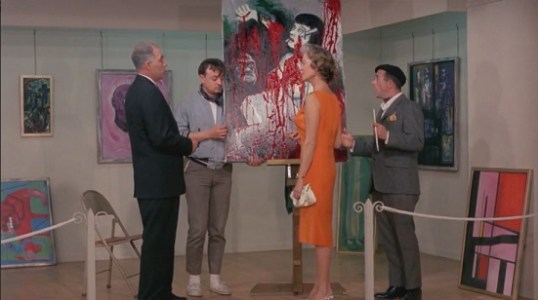
Color Me Blood Red (1965, dir by Herschell Gordon Lewis, DP: Herschell Gordon Lewis)
Something Weird (1967, dir by Herschell Gordon Lewis, DP: Andy Romanoff)
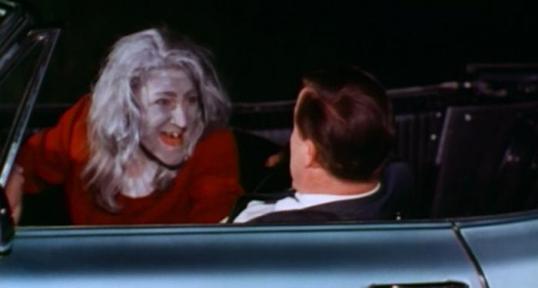
The Wizard of Gore (1970, dir by Herschell Gordon Lewis, DP: Alex Ameri and Daniel Krogh)



 Through the Shattered Lens