Horror Film Review: The Bells (dir by James Young)


A silent film from 1926, The Bells stars Lionel Barrymore as Mathias, a businessman who lives in a small Austrian village during the 19th Century.

Mathias is the owner of the inn, the bar, and the local mill.  He’s a popular man around town, specifically because he gives away drinks and meals on credit but he rarely bothers to collect.  He’s hoping that his generosity will lead to him being elected burgomaster.  Instead, it’s left him in debt to Frantz (Gustav von Seyffertitz), who threatens to take away everything that Mathias owns unless Mathias agrees to allow Frantz to marry his daughter, Annette (Lola Todd).  Annette, however, is in love with Christian (Eddie Phillips).

On one snowy Christmas night, a traveler from Poland (E. Alyn Warren) enters the bar.  Mathias befriends the man but, when he sees that the man is carrying a lot of gold, Mathias’s desperation takes over.  He follows the man outside and stabs him.  As the man dies, he shakes a set of horse bells at the man.

Mathias is soon out-of-debt and he is also elected burgomaster.  His daughter is free to marry Christian.  However, Mathias finds himself consumed with guilt.  The ghost of the dead man continually appears to him and stares at him without saying a word.  Mathias is haunted by the sound of the ringing bells.  Soon, the man’s identical twin brother arrives in town, looking for the murderer.  Accompanying him is a mesmerist (Boris Karloff) who claims that he can always get the guilty to confess.

The Bells is a surprisingly effective film.  It’s a silent film so we don’t actually hear the sound of the bells.  But we do see Mathias reacting to what he hears and we see him seeing the bells ringing and what we imagine is undoubtedly scarier than anything that a sound film could recreate.  Meanwhile, the silence of the dead man’s ghost is far more ominous than if the ghost had spoken accusingly.  Because the ghost does not speak, Mathias doesn’t know what it wants and neither do we.  The Ghost itself never reacts to Mathias’s words.  Instead, it just stares at him.  We’re left to wonder if the ghost is real or if Mathias’s guilt-stricken mind is playing tricks on him.  It’s also impossible not to notice that, though Frantz was the one who was causing Mathias so much worry, Mathias take his anger out on a stranger, on someone who he probably presumed wouldn’t be missed.  In the film, it’s made clear that the traveler was also Jewish.  He was an outsider, a Jew who came to an inn on Christmas and was murdered because someone else wanted to take his possessions.  The film is not just about the guilt of one man but it’s also a portrait of the institutional anti-Semitism that has historically defined so much of Europe.

Lionel Barrymore gives a strong performance as Mathias.  Since the film was made at a time when actors could not be heard, Barrymore uses his eyes and the tilt of his head to show us what Mathias is thinking and he does a great job showing us Mathias growing increasingly more and more desperate.  Mathias is never portrayed as being a simple villain.  Instead, he’s a man who lost control for one terrible moment and now has to live with the consequences of his actions.  The film also makes good use of Boris Karloff’s imposing physical presence.  Just as with the ghost, the film leaves it up to the viewer to decide whether the mesmerist has any powers or not.  Karloff plays him as being a intimidating enigma.

Considering the limits of the era in which it wad made, The Bells holds up well.  Director James Young emphasizes the story’s ominous atmosphere.  His direction of the snowstorm and the murder is especially impressive.  The sight of the victim’s blood falling onto the snow remains a haunting one.  One hundred years after it was released, The Bells remains a memorable look at the haunting power of guilt.
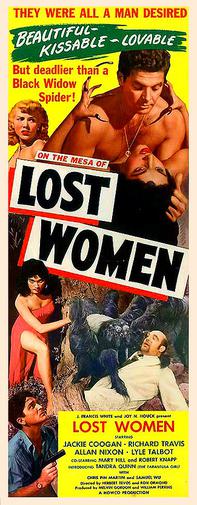
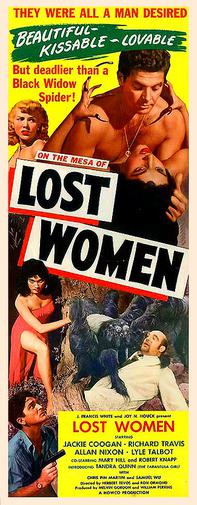
Horror Film Review: Mesa of Lost Women (dir by Herbert Tevos and Ron Ormond)


“Have you ever been kissed by a girl like this?” a disembodied voice asks at the start of 1953’s Mesa For Lost Women as a pair hands with claw-like fingernails caresses the face of someone who is later identified as being “Doc” Tucker (Allan Nixon).

Things get stranger from there.  A couple is found lost and dehydrated in the Mexican desert.  Grant Phillips (Robert Knapp) rambles about “super bugs” out in the desert and how they have to be destroyed.  American land surveyor Frank (John Martin) assumes that Grant must be delirious but Frank’s assistant, Pepe (Chris Pin Martin), knows differently.  We know that Pepe knows differently because the narrator tells us that Pepe had heard all about the monsters in the desert but Pepe keeps that information to himself….

Who is this narrator and why is he so condescending?  (For the record, he’s actor Lyle Talbot, who split his career between major, Oscar-winning productions and stuff like this.)  Have you ever noticed that a narrator usually just leaves you feeling even more confused by what you just watched?  There’s a trailer playing right now for a film called Ella McCay that opens with Julie Kavner saying, “Hi, I’m the narrator!” and whenever I hear that line, I’m just like, “Oh, this film is going to be so bad!”

I think it’s because most narrators are added after the fact, in an attempt to give some sort of uniformity to a badly constructed movie.  The narrator is there to tell us stuff that a good movie would be able to show us.  For instance, in the trailer for Ella McCay, Julie Kavner tells us that “I’m nuts about her,” as a way to assure us that Ella McCay is someone worth making a movie about.  Now, ideally, you wouldn’t have to have someone tell you that.  You would just watch the movie and say, “Hey, Ella McCay!  She deserves all the happiness in the world!”  But when your trailer is a bunch of scenes of Ella McCay acting a bit immature for someone who is destined to become “governor of the state you were born and raised in,” you need that narrator to say, “No, she’s likable, I promise!”

By that same logic, Mesa of Lost Women was apparently a mash-up of several different films, none of which had a complete script.  Narrator Lyle Talbot is here to tell us that, despite what we’re seeing, Mesa of Lost Women is an actual movie with an actual story as opposed to just a bunch of random scenes that were haphazardly crammed together.  We get a flashback of a scientist named Masterson (Harmon Stevens) traveling to the laboratory of Dr. Aranya (Jackie Coogan) and discovering that Aranya is creating giant tarantulas and transforming human women into mind-controlled slaves with the instincts of a spider.  Masterson doesn’t think that’s ethical so Aranya’s assistant, Tarantella (Tandra Quinn), gives him an injection that turns him into a simpleton.  Masterson ends up in a mental hospital, though he later escapes.  Meanwhile, an American businessman and his girlfriend (Mary Hill) come to Mexico and witness Tarantella dancing in a bar.  Masterson shows up and shoots Tarantella and then takes everyone hostage so that he can force Grant, who we now discover is a pilot, to fly him to the mesa of lost women …. or something.

Despite the best efforts of the narrator, the film is impossible to follow.  A big problem is that Dr. Aarnya’s plan never makes much sense.  How is creating a giant spider and a bunch of women who think that they’re spiders going to help him conquer the world?  The other problem is that the film had two directors, one of whom was an enigmatic German named Herbert Tevos who got the job by claiming to have directed Josef von Sternberg’s The Blue Angel.  Tevos’s footage of Dr. Aranya, the giant tarantula, and the “lost women” was not enough to secure the film distribution so a second director, Ron Ormond, was brought in to shoot a bunch of new footage to make the film more commercial.  Tevos’s film became an extended flashback in the middle of Ormond’s film and the whole thing is a big mess.

In fact, the film is such a mess that some people insist Ed Wood must have been involved.  It is true that narrator Lyle Talbot also appeared in Plan 9 From Outer Space and Glen or Glenda.  Plan 9‘s Mona McKinnon appears as a spider woman.  So does Dolores Fuller, who was Wood’s girlfriend at the time.  Wood later “borrowed” Mesa of Lost Women‘s score for Jail Bait.  Mesa of Lost Women was definitely Wood-adjacent but, by all accounts, Wood didn’t actually do any work on the film.  This mess of a film belongs to Tevos and Ormond.

And it is a mess.  It’s a watchable mess, in much the same way that a nuclear meltdown would probably be watchable.  But, nonetheless, it’s still a mess and the incoherence of the plot really does get on one’s nerves, despite the best efforts of Lyle Talbot.  Talbot can’t sell the viewer on Mesa of Lost Women.  Maybe he would have had better luck with Ella McCay.

Horror on the Lens: Mesa of Lost Women (dir by Herbert Tevos and Ron Ormond)


Today’s Horror on the Lens is the infamous 1953 film, Mesa of Lost Women.  Off in the middle of the desert, Dr. Aranya (Jackie Coogan) is conducting dangerous experiments that are resulting not only in giant spiders but also a master race of superwomen who Aranya is planning to use to conquer the world or something.

Mesa of Lost Women is a bit of a disjointed film.  It was originally filmed by a German director named Herbert Tevos, who claimed to be an associate of Erich Von Stroheim’s and a former collaborator of Marlene Dietrich’s.  However, despite his claims of being well-connected, no one was particularly impressed with Tevos’s first cut of the film so Ron Ormond was brought in to film additional scenes, the majority of them featuring Jackie Coogan as the insane Dr. Aranya.  Jackie Coogan was, at the time, still best-known for playing The Kid in the Charlie Chaplin film of the same name.  After Mesa, he would go on to play Uncle Fester on the original Addams Family.

Anyway, Mesa of Lost Women is one of those B-movies that simply has to be seen and heard to be believed.  (Lyle Talbot provides the narration, which is judgmental even by the standards of the 1950s.)  Enjoy Mesa of Lost Women!