Horror Film Review: The Bells (dir by James Young)


A silent film from 1926, The Bells stars Lionel Barrymore as Mathias, a businessman who lives in a small Austrian village during the 19th Century.

Mathias is the owner of the inn, the bar, and the local mill.  He’s a popular man around town, specifically because he gives away drinks and meals on credit but he rarely bothers to collect.  He’s hoping that his generosity will lead to him being elected burgomaster.  Instead, it’s left him in debt to Frantz (Gustav von Seyffertitz), who threatens to take away everything that Mathias owns unless Mathias agrees to allow Frantz to marry his daughter, Annette (Lola Todd).  Annette, however, is in love with Christian (Eddie Phillips).

On one snowy Christmas night, a traveler from Poland (E. Alyn Warren) enters the bar.  Mathias befriends the man but, when he sees that the man is carrying a lot of gold, Mathias’s desperation takes over.  He follows the man outside and stabs him.  As the man dies, he shakes a set of horse bells at the man.

Mathias is soon out-of-debt and he is also elected burgomaster.  His daughter is free to marry Christian.  However, Mathias finds himself consumed with guilt.  The ghost of the dead man continually appears to him and stares at him without saying a word.  Mathias is haunted by the sound of the ringing bells.  Soon, the man’s identical twin brother arrives in town, looking for the murderer.  Accompanying him is a mesmerist (Boris Karloff) who claims that he can always get the guilty to confess.

The Bells is a surprisingly effective film.  It’s a silent film so we don’t actually hear the sound of the bells.  But we do see Mathias reacting to what he hears and we see him seeing the bells ringing and what we imagine is undoubtedly scarier than anything that a sound film could recreate.  Meanwhile, the silence of the dead man’s ghost is far more ominous than if the ghost had spoken accusingly.  Because the ghost does not speak, Mathias doesn’t know what it wants and neither do we.  The Ghost itself never reacts to Mathias’s words.  Instead, it just stares at him.  We’re left to wonder if the ghost is real or if Mathias’s guilt-stricken mind is playing tricks on him.  It’s also impossible not to notice that, though Frantz was the one who was causing Mathias so much worry, Mathias take his anger out on a stranger, on someone who he probably presumed wouldn’t be missed.  In the film, it’s made clear that the traveler was also Jewish.  He was an outsider, a Jew who came to an inn on Christmas and was murdered because someone else wanted to take his possessions.  The film is not just about the guilt of one man but it’s also a portrait of the institutional anti-Semitism that has historically defined so much of Europe.

Lionel Barrymore gives a strong performance as Mathias.  Since the film was made at a time when actors could not be heard, Barrymore uses his eyes and the tilt of his head to show us what Mathias is thinking and he does a great job showing us Mathias growing increasingly more and more desperate.  Mathias is never portrayed as being a simple villain.  Instead, he’s a man who lost control for one terrible moment and now has to live with the consequences of his actions.  The film also makes good use of Boris Karloff’s imposing physical presence.  Just as with the ghost, the film leaves it up to the viewer to decide whether the mesmerist has any powers or not.  Karloff plays him as being a intimidating enigma.

Considering the limits of the era in which it wad made, The Bells holds up well.  Director James Young emphasizes the story’s ominous atmosphere.  His direction of the snowstorm and the murder is especially impressive.  The sight of the victim’s blood falling onto the snow remains a haunting one.  One hundred years after it was released, The Bells remains a memorable look at the haunting power of guilt.
A Loyalty Day Film Review: My Son John (dir by Leo McCarey)


Oh my God, did you know that it’s Loyalty Day!?

Well, actually, it’s not Loyalty Day for everyone.  In fact, a lot of the world’s citizens are celebrating Communist May Day today.  However, here in the United States, it’s Loyalty Day.  Even if you are an American, it’s possible that you’ve never heard of Loyalty Day.  It was first celebrated in 1921 and it was intended to provide a non-Communist alternative to International Workers Day.  It wasn’t until 1955 that Loyalty Day was officially recognized by Congress.

From Wikipedia:

Loyalty Day is defined as follows in 36 U.S.C. § 115:

  • (a) Designation.— May 1 is Loyalty Day.
  • (b) Purpose.— Loyalty Day is a special day for the reaffirmation of loyalty to the United States and for the recognition of the heritage of American freedom.
  • (c) Proclamation.— The President is requested to issue a proclamation—
    • (1) calling on United States Government officials to display the flag of the United States on all Government buildings on Loyalty Day; and
    • (2) inviting the people of the United States to observe Loyalty Day with appropriate ceremonies in schools and other suitable places.

Though released before it officially became a holiday, the 1952 film, My Son John, is perfect for Loyalty Day.

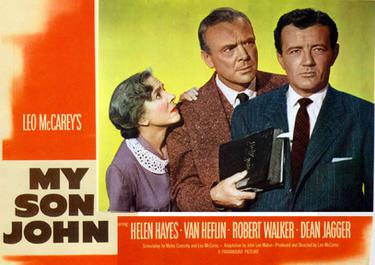
The John of the title is John Jefferson (Robert Walker, in his final role), an employee of the State Department.  While his younger brothers (played by Richard Jaeckel and James Young) are two high school football stars who are looking forward to serving their country in Korea, John is an intellectual who considers concepts like patriotism to be simplistic and naive.  While his father (Dean Jagger) sings patriotic songs at the American Legion hall, John rolls his eyes at such middle class activities.  (“If you don’t like your Uncle Sammy,” move to another country, John’s father sings.)  The only person to whom John is especially close is his nervous mother, Lucille (Helen Hayes).

However, John is keeping a secret from even Lucille.  He’s a double agent, working for the communists!  With FBI agent Stedman (Van Heflin) hot on his trail, will John ever be able to see the light about the communists?  And, how will the communists respond to John having doubts about the cause?

My Son John was a dream project for Hollywood director Leo McCarey.  (It’s not a coincidence that the devoutly Catholic McCarey made a film about a devoutly Catholic family who discovers that one of their own has become a communist.)  McCarey carefully supervised every detail of the film and he was even able to talk stage legend Helen Hayes into starring in the film, her first in 14 years.  My Son John is full of scenes of shadowy communists, smug intellectuals, and all-American FBI agents marveling at the strength of Lucille Jefferson’s faith.  Everything that is today often cited as a negative aspect to living in the suburbs is presented as being a positive in My Son John.  The film’s communists come into a world of happy families, big houses, and well-manicured lawns and they set out to make everyone else as miserable as they are.  There’s nothing subtle about either McCarey’s approach or Helen Hayes’s performance but, as is often the case with propaganda, the film is crudely effective.

My Son John was Robert Walker’s final film.  In fact, he died before completing work on the film, leading the ending being rewritten.  (No longer would John personally deliver a commencement address.  Instead, his words come out of a tape player that has been rolled out on stage.  A holy light shines down on the player while The Battle Hymn of the Republic plays in the background.  It’s bizarre but it’s also probably the most memorable part of the movie.)  Scenes from Strangers On A Train were rather awkwardly spliced into final moments of My Son John, never mind the fact that Robert Walker’s gleefully evil performance as Bruno Antony had little in common with his self-tortured performance as John Jefferson.

Surprisingly, considering that My Son John was released at the height of the anti-Communist era, the film was not a success at the box office.  (Audiences seemed to better appreciate low-budget and pulpier anti-communist films, like I Was A Communist For The FBI.)  Still, thanks to the Internet, My Son John is still available to be viewed on this Loyalty Day.

So, remember — if you don’t like your Uncle Sammy …. well, actually, the cool thing about this country is that you don’t have to like your Uncle Sammy.  You have the right to decide for yourself how you feel about old Uncle Sammy.  That’s an idea that is worth being loyal to.

The Fifth Annual Academy Awards: 1918


Over on Through the Shattered Lens Presents the Oscars, we are continuing to reimagine Oscar history, one year at a time! Today, we take a look at the year 1918. World War I ended, the Spanish Flu wiped out 5% of the world’s population, and the Academy embraced Tarzan of the Apes!

Lisa Marie Bowman's avatarThrough the Shattered Lens Presents The Oscars

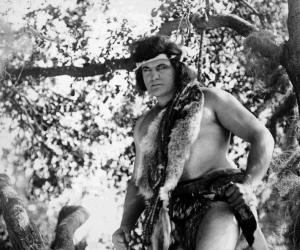
A scene from Tarzan of The Apes A scene from Tarzan of The Apes

1918 was a year of dominated by war and pestilence.  As the world seemed to be intent on destroying itself, both the Academy and American filmgoers embraced escapism.

Overseas, the Great War continued to drag on.  With no end to the fighting in sight, there were fears that the American public would turn against the war and their elected leaders would withdraw American soldiers from the fighting.  The British government, realizing the potential of film as a propaganda tool, contacted director D.W. Griffith and offered to help him make a film.  The end result was Hearts of the World, an epic war film that starred Lillian Gish as a French girl who struggles to survive and find true love as the Germans raid her village.

Though Gish would later say that Griffith was displeased with the pro-war tone of Hearts Of The World

View original post 1,357 more words

The Third Annual Academy Awards: 1916


Over on Through the Shattered Lens Presidents the Oscars, Jedadiah Leland and I have been reimagining Oscar history, one year at a time! Today, we take a look at 1916, the year of Thomas H. Ince, Civilization, and Intolerance!

Lisa Marie Bowman's avatarThrough the Shattered Lens Presents The Oscars

Thomas H. Ince, the 2nd President of AMPAS Thomas H. Ince, the 2nd President of AMPAS

In the long history of the Academy of Motion Picture Arts and Sciences, 1916 was dominated by one man: Thomas H. Ince.

Today, Ince is a largely forgotten figure and his many accomplishments have been overshadowed by the mysterious and potentially sordid circumstances of his death in 1924.  However, in 1916, Ince was one of the most popular figures working in the film industry.  He was the first producer to build his own studio in California and, with D.W. Griffith and Academy President Mack Sennett, founded the Triangle Motion Picture Company.  When, following the 2nd Academy Awards ceremony, Sennett announced the he would not be running for a second term as president of the AMPAS, Ince was the obvious choice to replace him.

As President, Ince immediately launched a recruiting drive to bring more industry professionals into the organization…

View original post 1,487 more words